The relationship between the expression levels of
miR-135a and
HOXA10
gene in the eutopic and ectopic
endometrium
Seyed Hamidreza Mirabutalebi1, 2 M.Sc., Noorodin Karami1 M.Sc., Fatemeh Montazeri2 Ph.D., Farzaneh Fesahat3 Ph.D., Mohammad Hasan Sheikhha2, 4 M.D., Ph.D., Elnaz Hajimaqsoodi1 M.Sc.,
Mojgan Karimi Zarchi2,5 M.D., Seyed Mehdi Kalantar2,4 Ph.D.
1. Genetics Department, Faculty of Medicine, Shahid Sadoughi University of Medical Sciences, Yazd, Iran.
2. Abortion Research Center, Yazd Reproductive Sciences Institute, Shahid Sadoughi University of Medical Sciences, Yazd, Iran.
3. Reproductive Immunology Research Center, Shahid Sadoughi University of Medical Science, Yazd, Iran.
4. Research and Clinical Center for Infertility, Yazd Reproductive Sciences Institute, Shahid Sadoughi University of Medical Sciences, Yazd, Iran.
5. Department of Obstetrics and Gynecology, Shahid Sadoughi Hospital, Shahid Sadoughi University of Medical Sciences, Yazd, Iran.
Seyed Mehdi Kalantar and Mojgan Karimi Zarchi are both corresponding authors.
Corresponding Author:
Mojgan Karimi Zarchi, Department of Obstetrics and Gynecology, Shahid Sadoughi Hospital, Shahid Ghandi blvd., Yazd, Iran. Postal code: 5529475231
Email:[email protected]
Tel: (+98) 9100650916
Seyed Mehdi Kalantar, Abortion Research Center, Yazd Reproductive Sciences Institute, Bouali Ave., Safaeyeh, Yazd, Iran. Postal code: 8916877391
Email: [email protected]
Tel: (+98) 9131518918
Received: 17 February 2018
Revised: 3 June 2018
Accepted: 27 June 2018
Abstract
Background: The study of microRNA expression can be effective in the diagnosing and treating different diseases. miR-135a is one of the most important micro-ribonucleic acids involved in endometriosis. Among the genes that become the target of the miR-135a and are subjected to changes in the endometrium of patients with endometriosis is HOXA10 gene which is expressed in the endometrium in response to steroid hormones.
Objective: The aim of this study was to evaluate the expression of miR-135a and its relationship with the level of HOXA10 gene expression in both endometrial ectopic and eutopic tissues in patients with endometriosis compared to the control samples. Materials and Methods: In this prospective case-control study, both case-eutopic and case-ectopic tissue samples were obtained from 17 women with endometriosis and the eutopic endometrial tissue was sampled from 17 women with normal endometrium as the control group. The gene's expression of miR-135a and HOXA10 were investigated using quantitative reverse transcription PCR (q-RT PCR).
Results: A significant decrease in the expression of HOXA10 gene was detected in case-eutopic during the luteal phase compared to the control samples (p=0.001), while in the case-ectopic, the expression of this gene was increased (p=0.681) compared to the control samples. In addition, the expression miR-135a in the luteal phase showed a remarkable increase in the case-eutopic endometrial tissue (p=0.026) as well as a significant decrease in the case-ectopic endometrial tissue compared to the control samples (p=0.008).
Conclusion: Considering the inverse relations between the over-expression of miR-135a and the reduction of HOXA10, it seems that miR-135a may be applied as an endometrial diagnostic and therapeutic biomarker.
Key words: Endometriosis, Gene expression, Micro-ribonucleic acid, HOXA10, miR-135a. This article extracted from M.Sc. thesis. (Seyed Hamidreza Mirabutalebi)
Introduction
ndometriosis is considered as an
estrogen-dependent, autoimmune
and genetic disease, which is characterized by the presence of endometrial cells outside the uterus and abdominal cavity. Endometrial tissue growth outside the uterus (ectopic) in this disease is commonly seen in the abdominal cavity, pelvis (mostly on the
ovaries and peritoneum) (1, 2). Approximate incidence of endometriosis in women is estimated to be about 11% in women during reproductive cycle and about 30-50% in infertile women. Also, the infertile women are 6-8 times more likely to suffer from endometriosis than healthy females (3). Despite these statistics, the exact incidence of the disease is not precisely clear, because there are no precise non-invasive tools for
E
diagnosis of endometriosis, and in some cases it is symptomless (4).
Ectopic transcriptome studies showed that
processes such as cell adhesion,
inflammation, immune system regulation, cell migration, regeneration of the extracellular matrix, and angiogenesis were associated with endometriosis (5-7). The expression of
HOXA10 gene in the normal endometrium of healthy women during the reproductive cycle has been observed in the proliferative phase and has a significantly increased expression in the luteal phase (8). In women with
endometriosis, the expression of the HOXA10
gene decreases dramatically, indicating a defect in uterine acceptance that may be responsible for reduced fertility in women with endometriosis (9). Micro-RNAs, small internal molecules with a length of about 22-24 nucleotides and non-coding 3 UTR region of the mRNA
posttranscriptional and reducing the
translation levels, regulate the expression of the genes (10).
Micro-RNAs, as a responsible factor for
endometriosis pathogenesis, can be
considered one of the most effective technologies for the treatment of this disease (11). The micro-RNA profile of ectopic tissues is different from that of the utopic tissues obtained from women with endometriosis (12). Micro-ribonucleic acid 135 (miR-135) was considered one of the most important micro-ribonucleic acids involved in endometriosis and also in many cancers, especially in ovarian cancer (13-15). It has been evidenced
that the HOXA10 gene is targeted by
miR-135a that was increased significantly in endometriosis. So, it may a possible explanation for the reduction in the expression of this gene in women with endometriosis (16).
So far, few studies have been conducted to evaluate the expression of miR-135a and its
association with the level of HOXA10
expression in patients with endometriosis, which indicated the relationship between the significant increase in the expression of
miR-135a and the reduction of HOXA10
expression in the endometrial eutopic tissue of patients with endometriosis. But, there is no study on the association of miR-135a with its target gene in endometrial ectopic tissue.
The aim of this study was to evaluate the expression profile of miR-135a and its
relationship with the level of HOXA10 gene
expression in both endometrial ectopic and eutopic tissues in patients with endometriosis compared to controls.
Materials and methods
A total of 34 women with history of
endometriosis who referred to Shahid
Sadoughi hospital between November 2016 to MAY 2017 were enrolled in this Case-Control study. For patients were receiving Tissue from endometriotic ectopic lesions (case-ectopic, n=17) was collected during the laparoscopic session and the eutopic endometrium was obtained by endometrial biopsy in 17 women (aged 20-45 yr) (Table I). Also, endometrial tissue samples (control, n=17) from women who did not have endometriosis but referred to the hospital for some reasons such as pelvic pain or fallopian tube blockage were taken as the control samples.
The tissues were stored in RNase free
RNA ™
Stabilization Solution (Thermo Fisher
Scientific) at -80oC to maintain their RNA stability. The inclusion criteria were women aged 20-45 yr with regular menstrual cycles (28-32 days) and the lack of receiving a hormonal drug in the last three months. Exclusion criteria were the observation of cellular changes in the endometrium, such as hyperplasia and carcinoma, the existence of benign tumors like fibroma and polyps, and not being contaminated with common DNA viruses and the human papillomavirus as well.
RNA Isolation and quantitative real time-PCR
In order to examine the expression rate of the HOXA10 gene and miR-135a in the tissues of patients and healthy subjects, the total RNA was first extracted from the tissues using Trizol Kit (Invitrogen, USA). For eliminating the external DNA contaminations, RNA w w DN Ι (Fermentas). The purity and concentration of
RNA were determined using
spectrophotometer (NanoDrop, Thermo
Fisher) and OD 260/280. Complementary
DNA (cDNA) of HOXA10 was synthesized
using Revert Aid First Strand cDNA Synthesis Kit, Fermentase. Then quantitative real
PCR (Q-PCR) w 2.0 μ DNA 10 μ commercial (T k J ) 0.5μ forwarding and r 7.0 μ DNase/RNase-free water for the genes
expression profile. Glyceraldehyde
3-phosphate dehydrogenase (GAPDH) was used as the reference gene as well as
HOXA10 as the target gene (Table II). cDNA of miR-135a was synthesized using Bon-Mir RT kit (Bonyakhteh, Tehran, Iran) based on ’ . M RNA gene expression was carried out using thermal cycler (Applied Biosystem, ABI, Step One Plus, USA) and expression levels were evaluated using 2(-∆ ). SNORD w the reference gene as well as miR-135a as the target gene (Bonyakhteh, Tehran, Iran) (Table II).
Ethical consideration
This study was approved by the ethics committee of Yazd Reproductive Sciences Institute, Shahid Sadoughi University of
Medical Science, Yazd, Iran
)IR.SSU.MEDICIN.REC.1396.16) and written informed consents were obtained from all patients.
Statistical analysis
To compare the mean of the relative expression of miR-135a and its target gene
HOXA10 in three groups, SPSS software (Statistical Package for the Social Sciences, version 24.0, SPSS Inc, Chicago, Illinois, USA) and ONE WAY ANOVA with post-hoc Tukey's HSD test were used. A significant difference was considered as p<0.05. The diagrams were plotted using GraphPad Prism 7.3 software.
Results
The HOXA10 gene expression in the endometrium during the menstrual cycle
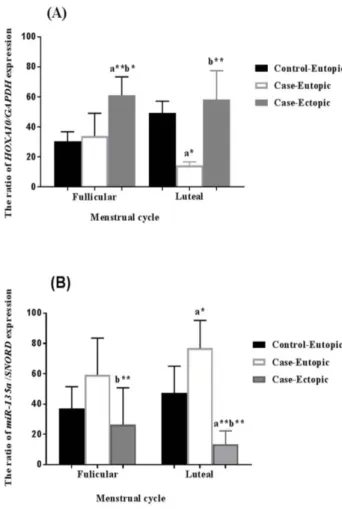
Findings showed the significant increase in
the expression level of the HOXA10 gene in
the endometrium of women as controls in the luteal phase of the menstrual cycle (p=0.042) compared to the follicular phase. It was
observed that the expression of HOXA10
gene has been significantly increased in endometrial lesions in the follicular phase compared with controls. In addition, a
significant and remarkable reduced
expression was observed in the luteal phase (p=0.001) in the eutopic tissue, and in the ectopic lesions, the expression of this gene did not have a significant difference with that of the control group in the luteal phase (p=0.681).
According to the results, the expression of
HOXA10 gene has been altered depending on the phases of the menstrual cycle. The gene expression in the luteal phase of the menstrual cycle of the control group increased considerably compared to the follicular phase, which was statistically significant. While the gene expression in the case-eutopic group did not have a significant difference with that of the control group in the follicular phase of the menstrual cycle (p=0.991). In contrast, in the case-ectopic group, the expression of this gene was significantly increased compared to the control (p=0.001) and case-eutopic (p=0.02) groups. In the luteal phase of the menstrual cycle, the gene expression in case-eutopic reduced dramatically with respect to the control group, and in contrast, in the case-ectopic group, this gene showed a higher rate despite insignificancy compared to the control group (Figure 1A).
The miR-135a gene expression in the endometrium during the menstrual cycle
The findings demonstrated the expression of the miR-135a gene was unlikely to be related to the phases of the menstrual cycle. The miR-135a expression in the luteal phase and follicular phase of the menstrual cycle were not significantly different in the control group. Also, with the respect of the comparing the expression of this gene in the case-eutopic and case-ectopic endometrium of the patients with the controls, the gene expression in the case-ectopic showed a no significant difference in the follicular phase (p=0.007), while a significant increase in gene expression was observed in the case-eutopic tissue in the luteal phase (p=0.026).
It was found that miR-135a expression in both case-eutopic and ectopic groups was not significantly different from the control group in the follicular phase. In contrast, in the luteal phase, ovarian ectopic specimens of this gene showed a significant reduction in expression compared to the case-eutopic (p=0.001) and control (p=0.008) groups (Figure 1B).
Table I. The demographic data of patients based on categorization in three groups.
Groups Patients** Menstrual cycle** Age (yr)*
Case-Ectopic 17 Follicular: 8 32 ± 2 Luteal: 9
Case-Eutopic 17 Follicular: 8 32 ± 2 Luteal: 9
Control-Eutopic 17 Follicular: 8 36 ± 2 Luteal: 9
* Data are presented as mean±SD.
** Data are presented as total numbers of each variable.
Table II. Oligonucleotide primers
Gene Primer sequence
miR-135a - - Reverse*
SNORD Reverse*
HOXA10 - - - -
GAPDH - - -TCTTCCTCTTGTGCTC - * Universal Reverse Primers were obtained from Bonyakhteh Company (Bonyakhteh, Tehran, Iran)
Figure 1. Comparing the expression of HOXA10 and miR-135 to GAPDH and SNORD in endometrial tissues obtained from the women with endometrium as ectopic and case-eutopic groups as well as women without endometrium as a control group. The ratio of gene expression of HOXA10 to GAPDH (A) and the ratio of miR-135 to SNORD (B). *: p<0.05, **: p<0.001, a: compared with the control group, b: compared with the eutopic group.
Discussion
In the current study, we aimed to scrutinize
the expression levels of miR135a in eutopic
and ectopic tissues in the patients with endometriosis compared to control samples throughout the menstrual cycle and its role in
the regulation of HOXA10. The results
showed a remarkable increase in the
miR-135a expression in the luteal phase in the
case-eutopic endometrial tissue as well as a significant decrease in the case-ectopic endometrial tissue. In addition, a significant
decrease in the expression of HOXA10 gene
was detected in case-eutopic samples during the luteal phase compared to the control samples, nevertheless, in the case-ectopic, the expression of this gene was increased compared to the control samples.
Studying the relationship between the
expression levels of miR-135a and HOXA10
genes expression in the eutopic endometrial tissue samples in patients with endometriosis, stated that there was a significant relationship
between the higher expression of miR-135a
and decreased expression of HOXA10 in the
eutopic endometrium of the patients with endometriosis that was in agreement with our findings (16). Previous studies have proven
that the expression of HOXA10 gene in the
eutopic endometrium is altered in women with
endometriosis. Additionally, HOXA10 gene
was regulated directly by miR135a and
miR-135b (13, 16).
In other study conducted to examine the
role of miR-135a tumor suppressor in
epithelial tissue of the patients with ovarian
cancer, it was found that HOXA10 gene was
targeted by miR-135a. Further, they
concluded that the expression of miR-135a
significantly decreased in epithelial tissue of ovarian cancer, with a higher expression of
HOXA10 in contrast (13). In the same study
on breast cancer findings showed that
miR-135a represented an increased expression in
the metastasis of the breast tumor (17). On
the other hand, HOXA10 gene was
considered as a metastatic suppressor in
breast cancer. They showed that miR-135a
targeted HOXA10 gene and suppressed its
expression both at the mRNA and protein levels, which our results also explained such
this relationships between miR-135a and
HOXA10 . Sz z ń k w
levels of HOXA10 gene expression in the
eutopic tissue of infertile women with endometriosis have significantly decreased compared with control subjects in line with ours (18).
This study showed significant differential
patterns in the miR-135a expression profile
during menstrual cycles of women either with normal endometrium or with endometriosis. Analysis of the miRNA profile in the endometriosis has improved our knowledge about the process of endometrial disease. Comparison of the ectopic and eutopic endometrium revealed the posttranscriptional patterns that have led to the formation of new perspectives in the unique cellular processes
for the ectopic endometrium (12). miRNA
regulated many different processes during the menstrual cycle, but their hormonal regulation in the endometrial functions and differentiation has still remained unknown (19). Few studies
have evaluated the miRNA expression profile
during the menstrual cycle. For instance, wang and associates reported the differential
expression of miR-142-5p and miRa-146-5p in
eutopic endometrium tissue during
implantation window of patients with
endometriosis that may cause affecting endometrial receptivity (20).
The main challenge for the development of advanced diagnostic and therapeutic tools for endometriosis is our slight knowledge of the pathology of this disease. The genetic factors and the higher rates of estrogenic hormones increased the risk of developing endometriosis (3). The novelty point of our study is that no
previous study has investigated the
expression profile of the miR-135a in ectopic
endometriotic tissue and whether the
endometriotic lesions present a different
miRNA pattern during menstrual cycles in women with endometriosis.
Several pieces of evidence showed that epigenetic mechanisms such as microRNAs play an important role in the pathogenesis of this disease (21). The study by Andersson
showed the hypermethylation rates of
HOXA10 gene promoter in the eutopic endometrium of the patients than the control
samples. In contrast, in the ectopic
endometrium of patients affected by
endometriosis, few methylation rates of
HOXA10 gene promoter was detected than their eutopic endometrium of those patients, stated of the ectopic tissues contribute to a
better etiopathologic understanding of
endometriosis (22). Although, the role of epigenetic changes in the etiology of endometriosis has not yet been determined, the present study together with mentioned studies (18, 23) supported the hypothesis that
HOXA10 homeodomain transcription factor
plays an important role in human
endometrium, which is related to the success in the implantation, and also explains that
HOXA10 is necessary for denovo endometrial development.
Conclusion
Considering the inverse relations between the over-expression of miR-135a and the
reduction of HOXA10 expression, it is
concluded that miR-135a may be applied as an endometrial diagnostic and therapeutic
biomarker in the early diagnosis of
endometriosis, and identification of this relation would also help to understand the etiology of endometriosis.
Acknowledgments
The authors thank the staff who assisted with this study at the Yazd Reproductive Sciences Institute.
This article was financially supported by Research and Clinical Center for Infertility, Yazd Reproductive Sciences Institute, Shahid Sadoughi University of Medical Sciences, Yazd, Iran.
Conflict of interest
The authors declare that they have no competing interests.
References
1. Nisolle M, Donnez J. Peritoneal endometriosis, ovarian endometriosis, and adenomyotic nodules of the rectovaginal septum are three different entities.
Fertil Steril 1997; 68: 585-596.
2. Shao R, Cao S, Wang X, Feng Y, Billig H. The elusive and controversial roles of estrogen and
progesterone receptors in human endometriosis. Am
J Transl Res 2014; 6: 104-113.
3. Verkauf BS. Incidence, symptoms, and signs of endometriosis in fertile and infertile women. J Fla Med Assoc 1987; 74: 671-675.
4. Rogers PA, D'Hooghe TM, Fazleabas A, Gargett CE, Giudice LC, Montgomery GW, et al. Priorities for endometriosis research: recommendations from an
international consensus workshop. Reprod Sci 2009; 16: 335-346.
5. Borghese B, Mondon N JC M TM Vaiman D, et al. gene expression profile for ectopic versus eutopic endometrium provides new insights
into endometriosis oncogenic potential. Mol
Endocrinol 2008; 22: 2557-2562.
6. Eyster KM, Klinkova O, Kennedy V, Hansen KA. Whole genome deoxyribonucleic acid microarray analysis of gene expression in ectopic versus eutopic endometrium. Fertil Steril 2007; 88: 1505-1533.
7. Matsuzaki S, Canis M, Pouly JL, Botchorishvili R, Déchelotte PJ, Mage G. Differential expression of genes in eutopic and ectopic endometrium from patients with ovarian endometriosis. Fertil Steril
2006; 86: 548-553.
8. Samadieh Y, Favaedi R, Ramezanali F, Afsharian P, Aflatoonian R, Shahhoseini M. Epigenetic dynamics
of HOXA10 gene in infertile women with
endometriosis. Reprod Sci 2018:
1933719118766255.
9. Zanatta A, Rocha AM, Carvalho FM, Pereira RM, Taylor HS, Motta EL, et al. The role of the
Hoxa10/HOXA10 gene in the etiology of
endometriosis and its related infertility: a review. J Assist Reprod Genet 2010; 27: 701-710.
10. Sengupta S, den Boon JA, Chen IH, Newton MA, Stanhope SA, Cheng YJ, et al. MicroRNA 29c is down-regulated in nasopharyngeal carcinomas, up-regulating mRNAs encoding extracellular matrix proteins. Proc Nati Acad Sci USA 2008; 105: 5874-5878.
11. Fasciani A, D'ambrogio G, Bocci G, Monti M, Genazzani AR, Artini PG. High concentrations of the vascular endothelial growth factor and interleukin-8 in ovarian endometriomata. Mol Hum Reprod 2000; 6: 50-54.
12. Filigheddu N, Gregnanin I, Porporato PE, Surico D, Perego B, Galli L, et al. Differential expression of
microRNAs between eutopic and ectopic
endometrium in ovarian endometriosis. J Biomed Biotechnol 2010; 2010: 369549.
13. Tang W, Jiang Y, Mu X, Xu L, Cheng W, Wang X. MiR-135a functions as a tumor suppressor in
epithelial ovarian cancer and regulates HOXA10 expression. Cell Signal 2014; 26: 1420-1426. 14. Guo Lm, Ding GF, Xu W, Ge H, Jiang Y, Chen XJ, et
al. MiR-135a-5p represses proliferation of HNSCC by targeting HOXA10. Cancer Biol Ther 2018; 26: 1-28.
15. Kalantar SM, Karami N, Zarei S, Miraboutalebi SH, Montazeri F, Abdian Asl A, et al. miR-135b as a Diagnostic Biomarker in Patients with Endometriosis.
J Isfahan Med School 2018; 36: 241-245. (in Persian)
16. Petracco R, Grechukhina O, Popkhadze S, Massasa E, Zhou Y, Taylor HS. MicroRNA 135 regulates
HOXA10 expression in endometriosis. J Clin
Endocrinol Metab 2011; 96: E1925-E1933.
17. Chen Y, Zhang J, Wang H, Zhao J, Xu C, Du Y, et al. miRNA-135a promotes breast cancer cell migration
and invasion by targeting HOXA10. BMC Cancer
2012; 12: 111-121.
18. Sz z ń k M W P L z k M J z ń k
PP, Skrzypczak J. Reduced expression of HOXA10 in the midluteal endometrium from infertile women
with minimal endometriosis. Biomed Pharmacother
2010; 64: 697-705.
19. Bartel DP. MicroRNAs: genomics, biogenesis, mechanism, and function. Cell 2004; 116: 281-297. 20. Wang Y, Ma CH, Qiao J. Differential expression of
microRNA in eutopic endometrium tissue during implantation window for patients with endometriosis related infertility. Zhonghua Fu Chan Ke Za Zhi 2016; 51: 436-441.
21. Schenken RS, Asch RH, Williams RF, Hodgen GD. Etiology of infertility in monkeys with endometriosis: luteinized unruptured follicles, luteal phase defects, pelvic adhesions, and spontaneous abortions. Fertil Steril 1984; 41: 122-130.
22. Andersson KL, Bussani C, Fambrini M, Polverino V, Taddei GL, Gemzell-Danielsson K, et al. DNA methylation of HOXA10 in eutopic and ectopic
endometrium. Hum Reprod 2014; 29: 1906-1911.
23. Fambrini M, Sorbi F, Bussani C, Cioni R, Sisti G, Andersson KL. Hypermethylation of HOXA10 gene in mid-luteal endometrium from women with ovarian endometriomas. Acta Obstet Gynecol Scand 2013; 92: 1331-1334.