Watch your Constants: Malicious Streebog
Riham AlTawy and Amr M. Youssef
Concordia Institute for Information Systems Engineering, Concordia University, Montr´eal, Qu´ebec, Canada
Abstract. In August 2012, the Streebog hash function was selected as the new Russian cryptographic hash standard (GOST R 34.11-2012). In this paper, we investigate the new standard in the context of malicious hashing and present a practical collision for a malicious version of the full hash function. In particular, we apply the rebound attack to find three solutions for three different differential paths for four rounds, and using the freedom of the round constants we connect them to obtain a collision for the twelve rounds of the compression function. Additionally, and due to the simple processing of the counter, we bypass the barrier of the checksum finalization step and transfer the compression function collision to the hash function output with no additional cost. The presented attack has a practical complexity and is verified by an example. While the results of this paper may not have a direct impact on the security of the current Streebog hash function, it presents an urge for the designers to publish the origin of the used parameters and the rational behind their choices in order for this function to gain enough confidence and wide spread adoption by the security community.
Keywords: Cryptanalysis, Hash functions, Malicious hashing, Rebound attacks, GOST R 34.11-2012, Streebog.
1
Introduction
Only few papers have been peer reviewed in public venues in the area of ma-licious cryptography. Young and Young were among the firsts to address the topic of malicious cryptography through their cryptovirology project [34]. Later Rijmen and Preneel proposed malicious versions of CAST and LOKI by hiding linear relations in the used Sboxes [27]. Work related to malicious ciphers, imple-mentations and pseudorandom generators includes [7, 25, 8, 26]. Although most of the previous work focused on ciphers, just recently the concept of malicious hashing have been introduced in [6, 2]. Specifically, Albertini et al. proposed a malicious version of SHA-1 by which collisions can be produced in an efficient way. They have used the freedom of the round constants to satisfy a given dif-ferential path and generate one block message collisions.
Streebog was proposed in 2010 [18]. It has an output length of 512/256-bit. The compression function employs a 12-round AES-like cipher with 8×8-byte internal state. The compression function operates in Miyaguchi-Preneel (MP) mode and is plugged in a modified Merkle-Damg˚ard domain extender with a modular checksum finalization step [1]. Streebog officially replaces the previous standard GOST R 34.11-94 which has been theoretically broken in [21, 20]. The new GOST is standardized by IETF as RFC 6896 [11] as well. Unlike the specifi-cations of other hash functions, the reference of the new GOST standard [1] gives no information about how or why the parameters of the function (e.g., round constants, matrix constants, and the number of rounds) have been chosen. This fact opens the door to our analysis, which makes use of exactly two parameters: the heavily random looking independent constants and the number of rounds, to present practical collisions for a malicious version of Streebog. Early works related to the cryptanalysis of Streebog have been introduced in [3–5, 16] and in [13, 10, 30], where practical semi free-start collision and near collision examples for reduced round versions have been presented in only [3, 30].
block message collision along with its corresponding digest is provided in Table 3.
The rest of the paper is organized as follows. In the next section, the description of the Streebog hash function along with the notation used throughout the paper are provided. A brief overview of the rebound attack is given in Section 3. Af-terwards, in Sections 4, we provide a detailed description of the used approach, the malicious compression function attack and its corresponding complexity. In Section 5, we show how collisions of the malicious hash function are generated using the attack presented in Sections 4. Finally, the paper is concluded and a short discussion is provided in Section 6.
2
Description of Steebog
Streebog outputs a 512 or 256-bit hash value, where half the last state is trun-cated when adopting the 256-bit output. The standard specifies two different IVsto be used with the two output lengths. The function can process messages of length up to 2512−1. The compression function iterates over 12 rounds of an AES-like cipher with an 8×8 byte internal state and a final round of key mixing. The compression function operates in Miyaguchi-Preneel mode and is plugged in Merkle-Damg˚ard domain extender with a finalization step. The input message M is padded into a multiple of 512 bits by appending one followed by zeros. The message length for MD-strengthening is further included as an extra separate block, followed by a block of a checksum evaluated by the modulo 2512
addi-tion of all message blocks as a finalizaaddi-tion step. More precisely, let n=⌊|M| 512⌋ and the input message M = x∥mn∥..∥m1∥m0, where |M| is length of M, and
x is an un-complete or an empty block. The message is padded as follows: let
mn+1= 0511−|x|∥1∥x, then the padded messageM =mn+1∥mn∥..∥m1∥m0. Let
∑
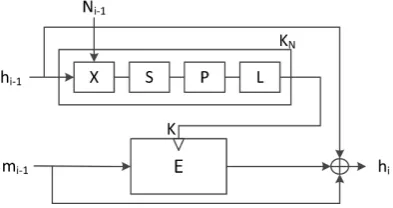
=mn+1+..+m1+m0. The compression functiongN is fed with three inputs:
Fig. 1.Streebog’s compression functiongN
so farNi−1= 512×i. (see Figure 1). Lethi be a 512-bit chaining variable. The first state is loaded with the initial valueIV and assigned toh0. The hash value ofM is computed as follows:
hi←gN(hi−1, mi−1, Ni−1) fori= 1,2, .., n+ 2
hn+3←g0(hn+2,|M|,0)
h(M)←g0(hn+3,
∑
,0),
where h(M) is the hash value of M, andg0 isgN withN = 0. As depicted in Figure 1, the compression functiongN consists of:
– KN: a nonlinear whitening round of the chaining value. It takes a 512-bit chaining variable hi−1 and a counter of the bits hashed so far Ni−1 and outputs a 512-bit keyK.
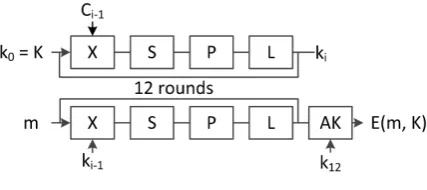
– E: an AES-based cipher that iterates over the message for 12 rounds in addition to a finalization key mixing round. The cipher E takes a 512-bit key K and a 512-bit message block m as a plaintext. As shown in Figure 2, it consists of two similar parallel flows for the state update and the key scheduling.
Fig. 2.The internal block cipher (E)
BothKN andE operate on an 8×8 byte key stateK.E updates an additional 8×8 byte message state M. In one round, a given state is updated by the following sequence of transformations:
– AddKey(X): XOR with either a round key, a constant, or the counter of bits hashed so far (N).
– SubBytes (S): A nonlinear byte bijective mapping. – Transposition (P): Byte permutation.
– Linear Transformation (L): Row multiplication by an MDS matrix in GF(2).
Initially, stateK is loaded with the chaining valuehi−1and updated by KN as follows:
NowKcontains the keyk0 to be used by the cipherE. The message stateM is initially loaded with the message blockmandE(k0, m) runs the key scheduling function on stateK to generate 12 round keys,k1, k2, .., k12, as follows:
ki=L◦P◦S◦X[Ci−1](ki−1), fori= 1,2, ..,12,
whereCi−1is theithround constant. The stateM is updated as follows:
Mi=L◦P◦S◦X[ki−1](Mi−1), fori= 1,2, ...,12.
The final round output is given by E(k0, m) = M12⊕k12. The output of gN in the Miyaguchi-Preneel mode is E(KN(hi−1, Ni−1), mi−1)⊕mi−1⊕hi−1 as shown in Figure 1. For further details, the reader is referred to [1].
2.1 Notation
LetM andK be (8×8)-byte states denoting the message and key state, respec-tively. The following notation is used throughout the paper:
– Mi: The message state at the beginning of roundi. – MU
i : The message state after theU transformation at roundi, where U ∈
X, S, P, L.
– Mi[r,c]: A byte at rowrand columnc of stateMi. – Mi[rowr]: Eight bytes located at rowrofMi state. – Mi[colc]: Eight bytes located at columnc ofMi state.
Same notation applies toK.
3
The rebound attack
The rebound attack [22] was proposed by Mendelet al. for the cryptanalysis of AES-based hash functions. It is a differential attack that follows the inside-out or start from the middle approach which is used in the boomerang attack [31]. The attack is composed of three phases, one inbound and two outbounds. The compression function, internal block cipher or permutation of the hash function is divided into three parts. IfCis a block cipher, thenCis expressed asC=Cf w◦
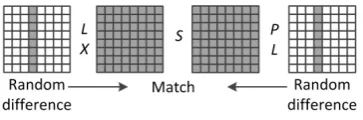
Cin◦Cbw. The middle part is the inbound phase and the forward and backward parts are the two outbound phases. In the inbound phase, a low probability XOR differential path is used and all possible degrees of freedom are used to satisfy the inbound path. In the two outbound phases, high probability truncated paths [14] are used. In other words, one starts from the middle satisfying Cin, then hash forward and backward to satisfy Cf w and Cbw probabilistically. For an 8×8 byte state, the basic rebound attack finds two states satisfying an inbound phase over two rounds 8−→ri
Using the Sbox differential distribution table (DDT), we find values that satisfy input and output differentials. This process is further illustrated in Figure 3. The last step of the attack is called the Sbox matching phase and its complexity depends on the Sbox DDT. If the probability of differentials that have solutions isp, then the matching probability is given byp8.
Fig. 3.The rebound attack.
Literature related to the rebound attack includes Mendel et al.first proposal on the ISO standard Whirlpool and the SHA-3 finalist Grøstl [22, 23]. In par-ticular, Mendel et al.presented a 4.5-round collision, 5.5-round semi free-start collision and 7.5-round near collision attacks on the Whirlpool compression func-tion. As for Grøstl-256, a 6-round semi free-start collision is given. Subsequently, rebound attacks have been applied to other AES-based hash functions such as LANE [17], JH [28], Echo [12], Streebog [3], and Grøstl [24]. Various tweaks have been applied to the basic rebound attack in order to construct differential paths that cover more rounds such as merging multiple in-bounds [15], super Sbox cryptanalysis [9], extended 5-round inbound [15], and linearized match-in-the-middle and start-from-the-match-in-the-middle techniques [19]. Lastly, K¨olbl and Rechberger presented a practical method to find semi free-start collision for a 4-round AES-based compression function [30]. More precisely, they have proposed a way to
first find a specific differential path for 1 −→ri
8 r−→i+1
64−→ri+2 8−→ri+3 1 transition, then use the freedom in the key to find two messages that follow the given path. They have implemented their approach on Streebog and presented a semi free-start collision for the 4-round reduced compression function. In what follows, we show how we used this approach to generate collisions for a malicious version of Streebog compression function.
4
Malicious compression function collision
Fig. 4.The first truncated differential path.
Our attack starts by finding the first solution which is a pair of messages and a key that follow the given differential path shown in Figure 4. In doing so, we employ the approach proposed in [30] which is composed of two procedures and is briefly described as follows:
4.1 Building the differential characteristic
In this procedure, one determines the exact differential transitions of the trun-cated differential trail given above.
1. Choose a random difference atML
4[3,3] and propagate it backward until the full active stateMS
3.
2. For each byte difference in M3S, save a set of all possible input differences 3. Create a table TL of all possible 255 byte difference values d3 (candidates
forMP
2[∗, 3]) and their corresponding 8 byte difference values L(d3) (can-didates for MX
3 [row 3]). These values are the result of applying the linear transformationL to a difference at column 3.
4. For each row of MX
3 , check if there is a possible match with the rows inTL. 5. To achieve the transition from 1 active byte inM1P[∗, 3] to 8 active bytes in
MX
2 [row 3], steps 2 and 4 must be repeated for only one row between states
MS
2 andM1P.
According to the Streebog Sbox differential distribution properties, [30] states that finding the differential characteristic has a complexity of≈220 and conse-quently, the above procedure is repeated 220times.
4.2 Finding a solution for the differential path
1. Set the message state at MX
3 with a solution that satisfies the full active state differentials from the above procedure.
2. UseK3[col 3] to satisfy the solutions of the Sbox differentials atM2P[col 3]. Also useK3[row 3] to satisfy the solutions of the Sbox differentials atM4X[col 3]
Since there is one byte, K3[3, 3], shared between the two solutions, one needs to repeat the above procedure 28 times. For more details on the specifics of the used technique, the reader is referred to [30].
To this end, we have found a solution to the first differential path with a key input different from that is produced by the standard IV. This solution gives us a specific input and output differences∆1
inand∆1out atM1[3, 3] andM4L[3, 3], respectively. In the sequel, we restart the above two procedures to search for the second differential characteristic and its solution such that this second search covers rounds five to eight and have an input difference∆2inatM5[3, 3] equals to the output difference∆1outof the first path. Since we restrict the input difference of the second path to a specific value, the complexity of the second procedure of our search is increased by a factor of 28. However, the overall search complexity is still dominated by the first procedure which is about 220. Finally, we search for the third and last differential path and its solution which covers rounds nine to twelve. For this path, we have to restrict its input difference∆3
inatM9[3, 3] to be equal ∆2
out atM8L[3, 3] and its output difference∆3out at M12[3, 3] to be equal ∆1
inat M1[3, 3], so that the latter cancels out after the feedforward.
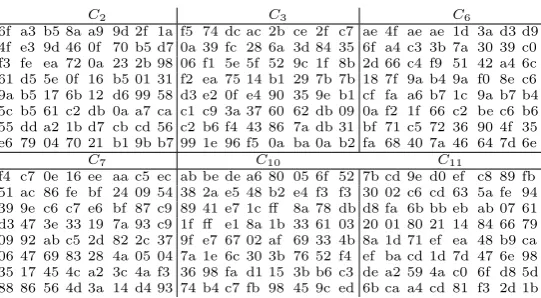
Connecting the three solutions: Now that we have the three solutions, we can start tuning specific round constants to connect them. We first work on the first solution’s key outputK1, which is different than that generated by the standard IV. To solve this problem, we fix the newC1=LP S(IV)⊕(K1X). By doing this, we guarantee that the resulting new key satisfies the first differential path. Thus, the new colliding messages are m1 = (M1X ⊕LP S(IV) and m2 =
m1⊕∆1in.
To connect the first and second solutions, we have to change K5. However, altering K5 affects both K4 and K6, which are restricted by the solutions of the first and second paths, respectively. In order to cancel the propagation of alteration to the latter two round keys, we compute the new two constants C5 andC4 as follows:
K5=M4L⊕M X 5
C5=K5⊕K5X
C4=S−1P L−1(K5)⊕K4,
whereML
5
Collision attack on the full malicious Streebog
While previous work [6] speculated that collisions of the compression function cannot be reflected at the output of the hash function when employing a check-sum finalization step, in this section, we show how to turn the previous com-pression function collision to a hash function collision. On top of the modular checksum finalization step, Streebog incorporates a counter N with each com-pression function call. However,Nis mixed with the chaining value with a simple XOR operation. It should be noted that once the constants of the compression function are fixed to some values, they remain the same for all successive execu-tions of the compression function. Accordingly, one cannot search for a different collision with the same constants.
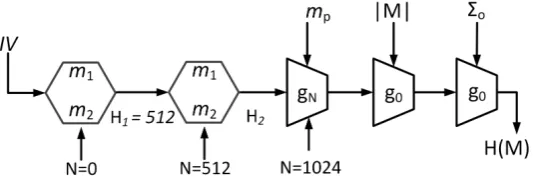
Fig. 5.Malicious Streebog collision.
Our approach is to replicate the first collision two times, thus creating a 2-block multicollision structure with the sameH2 input to the padding callgN(H2, mp) as depicted in Figure 5. By doing this, it is guaranteed that four messages collide atH2, and only two of them collide at the output of the hash function. Namely, those two that have the same modular checksum which are M = m1||m2 and
M′ =m2||m1. However, using the same collision twice implies that the second collision should have a chaining inputH1equal to that of the first collision which is IV = 0. For this, we compute a new C12 to enforce the output of the first collision H1 to be 512, which is equal to the value of N used in the following compression function call. To this end, at the input of the second compression function call H1 cancels the effect ofN and the second colliding message pair has a chaining input equal to the IV which is used at the first call.
6
Conclusion and Discussion
digest. Our approach first searches for three solutions for three different 4-round differential paths and use the freedom of five constants to connect them to pro-duce a compression function collision. Finally, we employed the freedom in the last constant used in the round key generation to cancel the effect of the counter used in the second compression function call. Hence, we were able to append a second similar message pair, thus creating a 22 multicollision structure where only two of them have the same modular checksum and accordingly the same digest.
It should be noted that these results has no impact on the security of the original standard. Additionally, this new set of constants does not provide collision for GOST-256 as it uses a different IV. However, they are interesting in the light of the absence of the source of the used parameters of the standard. Our results also show one of the first examples of compression function collisions being sufficient to generate hash function collisions. It is interesting to mention that, due to the versatility of the used differential path where the one byte difference can virtually be anywhere in the state, we get the freedom to satisfy the magic number as well as other constraints that are needed to produce meaningful collisions for some specific file formats (cf. section 4 in [2]). As a future direction, one may investigate the applicability of the attack if the number of rounds is not a multiple of four. Also, one might try searching for a malicious adaptation that holds for the two versions of the hash function simultaneously. Finally, we see that this paper provides an incentive for the designers of Streebog to publish the origin of the used parameters and the rational behind their choices.
C1 C4 C5
3b 7b 5d ca f1 e4 23 2f 7b 51 2e eb f5 f6 ab f4 9b b1 e8 b9 00 2f 6d 75 de dd 27 78 d6 9b fe 93 42 52 38 55 1b 14 c2 9d 96 d7 e3 12 a2 5c 66 9c f7 9f 94 dd 27 02 f3 a2 6e 5b 20 23 c9 b9 8f 3d 7e aa 0e bf dd 0e 04 88 4b 8e ad 06 8d 6f 3a fd a5 cc 0b e3 78 9b 9d 52 f7 30 67 e2 8c b5 37 1e fa da e2 5c b1 2a 0f 3a bc 30 cc de 99 39 07 69 6b 1c 1b 28 09 6d 0d 78 0f 7d 0d 18 ba f6 0c e9 cb 69 60 cf 89 c9 20 cd 4c fa 57 06 9e da f6 4f 27 b7 42 a3 7d 68 cd 64 e7 e6 7c 81 ef d7 97 6e 1d 20 22 e9 ce 7e 54 3f 5b 41 e8 61 e2 cb 9d a6 71 ac 16 c5 bf cc b9 c1 35 0c 56 b4 d8 a5 01 b7
C8 C9 C12
02 e5 04 18 6c 11 2d 01 f9 53 2e c1 78 84 d2 6e a3 23 32 b5 81 5e 1b 85 02 f1 f2 49 5d d0 aa 7b 17 ae c9 5a a4 44 4c 8d f4 67 4d bc c3 77 fd 7f 98 4c e1 b8 08 fd 0f 60 21 8b 63 a4 c1 2a 32 b8 f8 a1 db b5 e3 69 99 41 46 79 75 f7 37 5d a1 8c 41 2c 9a d0 71 20 55 30 eb 15 09 84 de 8d 22 ea 3c b5 83 ac 90 27 38 30 fb 71 99 26 59 a8 6f 4f 9d e6 44 d5 fd 40 7b 5d 25 af e8 05 d1 bd e3 34 8e 37 7a c5 06 ad 7f 93 d1 32 45 08 e9 3d 3f 51 ea eb 50 bf be 39 32 9a 50 0b be 70 04 4b 9d 5c 2a 36 ae cc 53 97 0f fc 61 1a 1a 22 e1 0d ff 58 d7 aa 2c 27 6e cd 41 01 41 a7 84 f3 44 91 24 3e
C2 C3 C6
6f a3 b5 8a a9 9d 2f 1a f5 74 dc ac 2b ce 2f c7 ae 4f ae ae 1d 3a d3 d9 4f e3 9d 46 0f 70 b5 d7 0a 39 fc 28 6a 3d 84 35 6f a4 c3 3b 7a 30 39 c0 f3 fe ea 72 0a 23 2b 98 06 f1 5e 5f 52 9c 1f 8b 2d 66 c4 f9 51 42 a4 6c 61 d5 5e 0f 16 b5 01 31 f2 ea 75 14 b1 29 7b 7b 18 7f 9a b4 9a f0 8e c6 9a b5 17 6b 12 d6 99 58 d3 e2 0f e4 90 35 9e b1 cf fa a6 b7 1c 9a b7 b4 5c b5 61 c2 db 0a a7 ca c1 c9 3a 37 60 62 db 09 0a f2 1f 66 c2 be c6 b6 55 dd a2 1b d7 cb cd 56 c2 b6 f4 43 86 7a db 31 bf 71 c5 72 36 90 4f 35 e6 79 04 70 21 b1 9b b7 99 1e 96 f5 0a ba 0a b2 fa 68 40 7a 46 64 7d 6e
C7 C10 C11
f4 c7 0e 16 ee aa c5 ec ab be de a6 80 05 6f 52 7b cd 9e d0 ef c8 89 fb 51 ac 86 fe bf 24 09 54 38 2a e5 48 b2 e4 f3 f3 30 02 c6 cd 63 5a fe 94 39 9e c6 c7 e6 bf 87 c9 89 41 e7 1c ff 8a 78 db d8 fa 6b bb eb ab 07 61 d3 47 3e 33 19 7a 93 c9 1f ff e1 8a 1b 33 61 03 20 01 80 21 14 84 66 79 09 92 ab c5 2d 82 2c 37 9f e7 67 02 af 69 33 4b 8a 1d 71 ef ea 48 b9 ca 06 47 69 83 28 4a 05 04 7a 1e 6c 30 3b 76 52 f4 ef ba cd 1d 7d 47 6e 98 35 17 45 4c a2 3c 4a f3 36 98 fa d1 15 3b b6 c3 de a2 59 4a c0 6f d8 5d 88 86 56 4d 3a 14 d4 93 74 b4 c7 fb 98 45 9c ed 6b ca a4 cd 81 f3 2d 1b
Table 2.The six unchanged (original) constants.
m1 m2 ∆m
d2 d7 5d 81 b1 63 d8 cc d2 d7 5d 81 b1 63 d8 cc 00 00 00 00 00 00 00 00 63 16 bb de 0e 61 85 d6 63 16 bb de 0e 61 85 d6 00 00 00 00 00 00 00 00 97 89 a3 e6 55 cf 46 e7 97 89 a3 e6 55 cf 46 e7 00 00 00 00 00 00 00 00 37 de 22 19 54 d6 01 95 37 de 22 bb 54 d6 01 95 00 00 00 a2 00 00 00 00 13 44 b8 4d a3 4d 36 4c 13 44 b8 4d a3 4d 36 4c 00 00 00 00 00 00 00 00 a3 50 36 27 f3 51 7f ee a3 50 36 27 f3 51 7f ee 00 00 00 00 00 00 00 00 58 23 1d 88 80 1b 09 62 58 23 1d 88 80 1b 09 62 00 00 00 00 00 00 00 00 08 9d bc 4d aa a1 73 2a 08 9d bc 4d aa a1 73 2a 00 00 00 00 00 00 00 00
H(m1||m2) =H(m2||m1)
94e19a2ad9252ca78d14600c20488ad66de12c72ab3aac19f7bb9e277abe973a ea22f1c3fa3be180c6dd212f4b19eefed80fb114c44dfb39ffdb2cfad24c6275
Table 3.Example of a 2-block message collision for the malicious Streebog hash func-tion.
References
1. The National Hash Standard of the Russian Federation GOST R 34.11-2012. Russian Federal Agency on Technical Regulation and Metrology report, 2012. https://www.tc26.ru/en/GOSTR34112012/GOST R 34 112012 eng.pdf.
2. Albertini, A., Aumasson, J.-P., Eichlseder, M., Mendel, F., and Schl¨affer, M. Malicious hashing: Eve’s variant of SHA-1. In SAC (2014), A. Joux and A. Youssef, Eds., vol. 8781 of Lecture Notes in Computer Science, Springer. (to appear).
4. AlTawy, R., and Youssef, A. M. Integral distinguishers for reduced-round Stribog. Information Processing Letters 114, 8 (2014), 426 – 431.
5. AlTawy, R., and Youssef, A. M. Preimage attacks on reduced-round Stribog. In AFRICACRYPT (2014), D. Pointcheval and D. Vergnaud, Eds., vol. 8469 of Lecture Notes in Computer Science, Springer, pp. 109–125.
6. Aumasson, J.-P. Eve’s SHA3 candidate: malicious hashing. Online article, 2011. https://131002.net/data/papers/Aum11a.pdf.
7. Biham, E., Carmeli, Y., and Shamir, A.Bug attacks. InAdvances in Cryptology CRYPTO 2008 (2008), D. Wagner, Ed., vol. 5157 of Lecture Notes in Computer Science, Springer, pp. 221–240.
8. Filiol, E. Malicious cryptography techniques for unreversable (malicious or not) binaries. CoRR abs/1009.4000 (2010).
9. Gilbert, H., and Peyrin, T. Super-Sbox Cryptanalysis: Improved attacks for AES-like permutations. In FSE (2010), S. Hong and T. Iwata, Eds., vol. 6147 of Lecture Notes in Computer Science, Springer, pp. 365–383.
10. Guo, J., Jean, J., Leurent, G., Peyrin, T., and Wang, L. The usage of counter revisited: Second-preimage attack on new russian standardized hash func-tion. InSAC (2014), A. Joux and A. Youssef, Eds., vol. 8781 ofLecture Notes in Computer Science, Springer. (to appear).
11. IETF. GOST R 34.11-2012: Hash Function, 2013. (RFC6896).
12. Jean, J., and Fouque, P.-A. Practical near-collisions and collisions on round-reduced ECHO-256 compression function. InFSE (2011), A. Joux, Ed., vol. 6733 ofLecture Notes in Computer Science, Springer, pp. 107–127.
13. Kazymyrov, O., and Kazymyrova, V. Algebraic aspects of the russian hash standard GOST R 34.11-2012. In CTCrypt (2013), pp. 160–176. Available at: http://eprint.iacr.org/2013/556.
14. Knudsen, L. R. Truncated and higher order differentials. InFSE (1995), B. Pre-neel, Ed., vol. 1008 ofLecture Notes in Computer Science, Springer, pp. 196–211. 15. Lamberger, M., Mendel, F., Rechberger, C., Rijmen, V., and Schl¨affer, M. Rebound distinguishers: Results on the full Whirlpool compression function.
InASIACRYPT (2009), M. Matsui, Ed., vol. 5912 ofLecture Notes in Computer Science, Springer, pp. 126–143.
16. Ma, B., Li, B., Hao, R., and Li, X. Improved cryptanalysis on reduced-round GOST and Whirlpool hash function. InApplied Cryptography and Network Secu-rity (2014), I. Boureanu, P. Owesarski, and S. Vaudenay, Eds., vol. 8479 ofLecture Notes in Computer Science, Springer, pp. 289–307.
17. Matusiewicz, K., Naya-Plasencia, M., Nikoli´c, I., Sasaki, Y., and
Schl¨affer, M. Rebound attack on the full lane compression function. In ASI-ACRYPT (2009), M. Matsui, Ed., vol. 5912 ofLecture Notes in Computer Science, Springer, pp. 106–125.
18. Matyukhin, D., Rudskoy, V., and Shishkin, V. A perspective hashing algo-rithm. InRusCrypto (2010). (In Russian).
19. Mendel, F., Peyrin, T., Rechberger, C., and Schl¨affer, M. Improved cryptanalysis of the reduced Grøstl compression function, ECHO permutation and AES block cipher. In Selected Areas in Cryptography (2009), M. J. Jacobson Jr, V. Rijmen, and R. Safavi-Naini, Eds., vol. 5867 of Lecture Notes in Computer Science, Springer, pp. 16–35.
21. Mendel, F., Pramstaller, N., Rechberger, C., Kontak, M., and Szmidt,
J. Cryptanalysis of the GOST hash function. In CRYPTO (2008), D. Wagner, Ed., vol. 5157 ofLecture Notes in Computer Science, Springer, pp. 162–178. 22. Mendel, F., Rechberger, C., Schl¨affer, M., and Thomsen, S. S. The
re-bound attack: Cryptanalysis of reduced Whirlpool and Grøstl. In FSE (2009), O. Dunkelman, Ed., vol. 5665 of Lecture Notes in Computer Science, Springer, pp. 260–276.
23. Mendel, F., Rechberger, C., Schl¨affer, M., and Thomsen, S. S. Rebound attacks on the reduced Grøstl hash function. InCT-RSA(2010), J. Pieprzyk, Ed., vol. 5985 ofLecture Notes in Computer Science, Springer, pp. 350–365.
24. Mendel, F., Rijmen, V., and Schlffer, M. Collision attack on 5 rounds of Grøstl. InFSE (2014), Lecture Notes in Computer Science, Springer. (to appear). 25. Patarin, J., and Goubin, L. Trapdoor one-way permutations and multivariate polynomials. Y. Han, T. Okamoto, and S. Qing, Eds., vol. 1334 ofLecture Notes in Computer Science, Springer, pp. 356–368.
26. Paterson, K. G.Imprimitive permutation groups and trapdoors in iterated block ciphers. InFSE (1999), L. Knudsen, Ed., vol. 1636 ofLecture Notes in Computer Science, Springer, pp. 201–214.
27. Rijmen, V., and Preneel, B. A family of trapdoor ciphers. In FSE (1997), E. Biham, Ed., vol. 1267 ofLecture Notes in Computer Science, Springer, pp. 139– 148.
28. Rijmen, V., Toz, D., and Varici, K.Rebound attack on reduced-round versions of JH. InFSE (2010), S. Hong and T. Iwata, Eds., vol. 6147 ofLecture Notes in Computer Science, Springer, pp. 286–303.
29. Schneier, B. The NSA is breaking most encryption on the inter-net. https://www.schneier.com/blog/archives/2013/09/the nsa is brea.html, [On-line; published September-2013].
30. Stefan K¨olbl, C. R.Practical attacks on AES-like cryptographic hash functions. InLatincrypt (2014), Lecture Notes in Computer Science, Springer. (to appear). 31. Wagner, D. The boomerang attack. InFast Software Encryption (1999), L. R.
Knudsen, Ed., vol. 1636 ofLecture Notes in Computer Science, Springer, pp. 156– 170.
32. Wikipedia. Bullrun (decryption program) — wikipedia, the free encyclopedia, 2014. [Online; accessed 22-October-2014].
33. Wikipedia. Dual ec drbg — wikipedia, the free encyclopedia, 2014. [Online; accessed 22-October-2014].