PHENOTYPIC RESPONSE OF WILLOW CUTTINGS TO HEAVY METALS.
A PRELIMINARY LABORATORY TEST
Hernea Cornelia1, Corneanu Mihaela1
Keywords: Salix sp., cadmium, nickel, lead
ABSTRACT
The present paper analyses some biometric characteristics of willow cuttings in a comparative laboratory test with heavy metals. Six Swedish hybrids (Tora, Tordis, Klara, Olof, Stina and Sven) and one Romanian hybrid (1077) have been tested. As plant material were used one-year-old cuttings (5-10 cm long), with 2-5 buds each. There were ten experimental variants for each genotype: three concentrations of cadmium (1.0; 3.0, 6.0 ppm), nickel (50.0, 150.0, 450.0 ppm), lead (50.0, 150.0, 450.0 ppm) and Control (tap water). Biometrical observations on: the roots number and length, the shoots number and length, the leaves number/shoot in the days 7 and 15, were performed. All hybrids are quite resistant to heavy metals except hybrid 1077, for this one the shoots percent is much lower for all heavy metals concentration compared with the control one.
INTRODUCTION
There are more than 300 species of Salix, tree and shrubs. One of this species, with
a high capacity of vegetative regeneration and biomass productivity is Salix viminalis. This
is the reason why willow is used for energetic crops. Willow is important also for their capacity in phytoaccumulation and/or phytodegradation of contaminants from soils, sediments and water due to the high tolerance to metals. Because there is a permanent increase of energy and a large area with degraded soil, finding solutions for both, biomass
production and soil phytoremediation is very important (Drzewiecka, 2012).
In order to evaluate the behavior of willow cuttings at different concentrations of heavy metals, has been installed an experiment whose results give us some basic information about the phenotypic response of plants to heavy metals. Three heavy metals were selected: cadmium, nickel and lead due to the fact that it causes a number of toxic symptoms in plants, e.g. growth retardation and severe chlorosis and necrosis (Mishra, 1974, Prasad, 1995).
MATERIAL AND METHOD
Biological material is made by one-year-old cuttings with 5-10 cm long and 2-5 buds per cutting. The experiment took place in the research laboratory of Department of Forestry. Six Swedish hybrids produced under license in Romania by REBINA Agrar and one Romanian hybrid produced by the Forest Research and Management Institute
Bucharest has been tested. The Swedish hybrids are: Klara ((Salix burjatica x S. viminalis)
x S. burjatica) x (S. viminalis x (S. schwerinii x S. viminalis)), Olof (Salix viminalis x (S. schwerinii x S. viminalis)), Sven (Salix viminalis x (S. schwerinii x S. viminalis)), Tora (Salix schwerinii x S. viminalis) Tordis ((Salix schwerinii x S. viminalis) x S. viminalis).
The behavior of willow cuttings have been tested by three heavy metals (cadmium
-Cd, nickel – Ni and lead -Pb) and three concentrations: 1.0 3.0, 6.0 ppm for cadmium,
1
50.0, 150.0, 450.0 ppm for nickel, 50.0, 150.0, 450.0 ppm for lead and one Control (tap water).
There were 28 experimental variants and measurements and observations have been made on 140 cuttings. The cuttings were maintained in solutions for 15 days. In the
days 7th and 15th, biometrical observations on: the roots number and length, the shoots
number and length, the leaves number/shoot, viability of the shoots were performed One-way analysis of variance (Anova) and Duncan test were determined by STATISTICA 10 software. The differences were considered significant at a probability level of 95% (p<0.05)
RESULTS AND DISCUSSIONS
Phenotypic response of Salix genotypes to different concentrations of analyzed
heavy metals is highlight in below graphs (Figures 1-4)
Genotype: Klara
C
o
n
tr
o
l
C
d
A
C
d
B
C
d
C
N
i
A
N
i
B
N
i
C
P
b
A
P
b
B
P
b
C
-4 -2 0 2 4 6 8 10 12 14 16 18 20 22
Genotype: Olof
C
o
n
tr
o
l
C
d
A
C
d
B
C
d
C
N
i
A
N
i
B
N
i
C
P
b
A
P
b
B
P
b
C
Genotype: Stina
C
o
n
tr
o
l
C
d
A
C
d
B
C
d
C
N
i
A
N
i
B
N
i
C
P
b
A
P
b
B
P
b
C
Genotype: Sven
C
o
n
tr
o
l
C
d
A
C
d
B
C
d
C
N
i
A
N
i
B
N
i
C
P
b
A
P
b
B
P
b
C
-4 -2 0 2 4 6 8 10 12 14 16 18 20 22
Genotype: Tora
C
o
n
tr
o
l
C
d
A
C
d
B
C
d
C
N
i
A
N
i
B
N
i
C
P
b
A
P
b
B
P
b
C
Genotype: Tordis
C
o
n
tr
o
l
C
d
A
C
d
B
C
d
C
N
i
A
N
i
B
N
i
C
P
b
A
P
b
B
P
b
C
Genotype: 1077
C
o
n
tr
o
l
C
d
A
C
d
B
C
d
C
N
i
A
N
i
B
N
i
C
P
b
A
P
b
B
P
b
C
-4 -2 0 2 4 6 8 10 12 14 16 18 20 22
roots no./cutting 7 days roots no./cutting 15 days
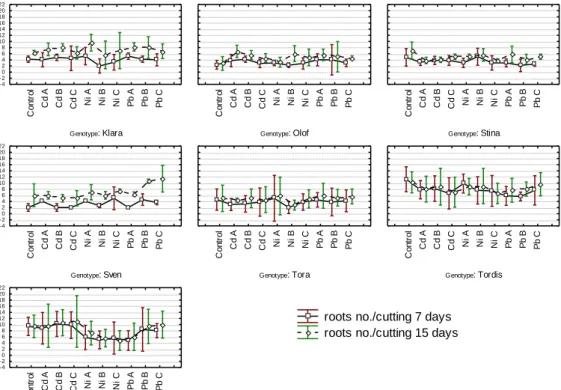
Figure 1 Phenotypic response of cuttings to heavy metals. Root number
Observations made about character “number of root” put in evidence an increase of these values for the both periods of observations. The highest variation but also the highest values of this character have been observed for Romanian hybrid 1077.
For all experimental variants it can be saw an increase of root length for Salix cutting.
The highest variation but also the highest values of the character “root length” were also
been observed for Romanian hybrid 1077. It also can be observed that as higher the metal concentration is as lower the roots length is.
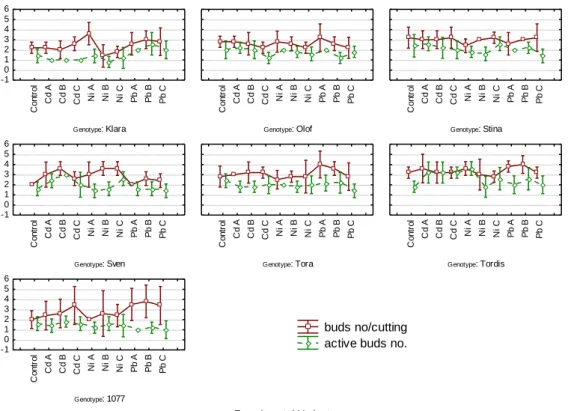
For all experimental variant, the number of active buds per cutting is lower that the number of buds per cutting; this character seems not to be influenced by the nature and concentration of the metal.
In terms of “shoot number per bud”, the values are very close for all genotypes and
for genotypes Klara, Tora and 1077. The highest fluctuation it has been observed for genotype Tordis.
Experimental Variant
Genotype: Klara
C o n tr o l C d A C d B C d C N i A N i B N i C P b A P b B P b C -50 0 50 100 150 200 250 300
Genotype: Olof
C o n tr o l C d A C d B C d C N i A N i B N i C P b A P b B P b C
Genotype: Stina
C o n tr o l C d A C d B C d C N i A N i B N i C P b A P b B P b C
Genotype: Sven
C o n tr o l C d A C d B C d C N i A N i B N i C P b A P b B P b C -50 0 50 100 150 200 250 300
Genotype: Tora
C o n tr o l C d A C d B C d C N i A N i B N i C P b A P b B P b C
Genotype: Tordis
C o n tr o l C d A C d B C d C N i A N i B N i C P b A P b B P b C
Genotype: 1077
C o n tr o l C d A C d B C d C N i A N i B N i C P b A P b B P b C -50 0 50 100 150 200 250 300
roots length (mm) 7 days roots length (mm) 15 days
Figure 2 Phenotypic response of cuttings to heavy metals. Root length
Experimental Variant
Genotype: Klara
C o n tr o l C d A C d B C d C N i A N i B N i C P b A P b B P b C -1 0 1 2 3 4 5 6
Genotype: Olof
C o n tr o l C d A C d B C d C N i A N i B N i C P b A P b B P b C
Genotype: Stina
C o n tr o l C d A C d B C d C N i A N i B N i C P b A P b B P b C
Genotype: Sven
C o n tr o l C d A C d B C d C N i A N i B N i C P b A P b B P b C -1 0 1 2 3 4 5 6
Genotype: Tora
C o n tr o l C d A C d B C d C N i A N i B N i C P b A P b B P b C
Genotype: Tordis
C o n tr o l C d A C d B C d C N i A N i B N i C P b A P b B P b C
Genotype: 1077
C o n tr o l C d A C d B C d C N i A N i B N i C P b A P b B P b C -1 0 1 2 3 4 5 6 buds no/cutting active buds no.
Experimental Variant
Genotype: Klara
C o n tr o l C d A C d B C d C N i A N i B N i C P b A P b B P b C -2 0 2 4 6 8 10 12 14 16 18 20 22 24 26
Genotype: Olof
C o n tr o l C d A C d B C d C N i A N i B N i C P b A P b B P b C
Genotype: Stina
C o n tr o l C d A C d B C d C N i A N i B N i C P b A P b B P b C
Genotype: Sven
C o n tr o l C d A C d B C d C N i A N i B N i C P b A P b B P b C -20 2 4 6 8 10 12 14 16 18 20 22 24 26
Genotype: Tora
C o n tr o l C d A C d B C d C N i A N i B N i C P b A P b B P b C
Genotype: Tordis
C o n tr o l C d A C d B C d C N i A N i B N i C P b A P b B P b C
Genotype: 1077
C o n tr o l C d A C d B C d C N i A N i B N i C P b A P b B P b C -20 2 4 6 8 10 12 14 16 18 20 22 24 26 no. shoots/bud leaves no./shoot
Figure 4 Phenotypic response of cuttings to heavy metals. Shoots no. /bud and leaves no. /shoot
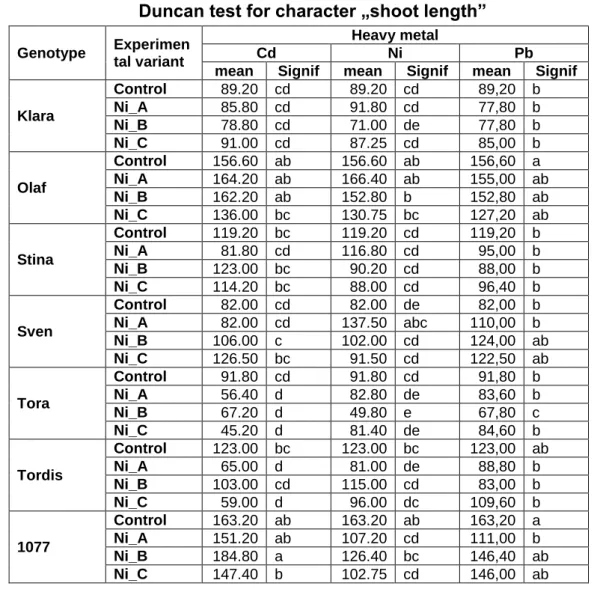
One-way analysis of variance highlight significant differences for all analyzed characters (Table 1). In order to determine which experimental variant are particulary different from each other, Duncan test was applied for character „shoot lenght” (table 2.) For this character has been observed differences to genotype Sven. In this particular case experimental variant “Control” is very different for all other experimental variants with a much lower value.
Table 1
Analysis of Variance. Marked effects are significant at p<0,05000
Character SS df MS SS df MS
F p
effect error
roots no./ cutting 7 days
Cd 929,5 27 34,42 575,3 108 5,32 6,46233 0,00000
Ni 804,3 27 29,79 643,5 109 5,904 5,045734 0,00000
Pb 695,5 27 25,75 561,60 109 5,152 4,999325 0,00000
roots no./ cutting 15 days
Cd 698,1 27 25,85 881,5 110 8,01 3,22655 0,00001
Ni 528,8 27 19,58 716,4 111 6,45 3,034522 0,00002
Pb 633,8 27 23,47 695,95 109 6,384 3,676446 0,00001
roots length (mm) 7 days
Cd 227636,8 27 8430,99 126807,7 107 1185,11 7,11405 0,00000 Ni 170963,2 27 6331,96 147553,1 106 1392,01 4,548794 0,00000 Pb 210004,2 27 7777,93 93860,52 109 861,105 9,032494 0,00000 roots length
(mm) 15 days
Cd 249762,7 27 9250,47 128466,0 108 1189,50 7,77677 0,00000 Ni 179605,2 27 6652,04 129987,3 109 1192,54 5,578029 0,00000 Pb 181710,7 27 6730,02 84862,24 109 778,552 8,644279 0,00000 %
active buds
Cd 23794,9 27 881,29 49613,6 112 442,97 1,98947 0,00671 Ni 27950,3 27 1035,19 69913,6 112 624,22 1,658360 0,03544 Pb 37341,3 27 1383,01 48729,15 111 439,004 3,150357 0,00001 no. shoots/
bud
Cd 73,2 27 2,71 94,8 112 0,84 3,20175 0,00001
Ni 71,3 27 2,64 62,4 112 0,55 4,738841 0,00000
Pb 40,2 27 1,48 90,00 112 0,803 1,851523 0,01363
shoots length (cm)
Cd 196493,9 27 7277,55 72249,8 111 650,89 11,18077 0,00000 Ni 112760,8 27 4176,32 52473,8 108 485,86 8,595577 0,00000 Pb 107660,9 27 3987,44 90058,20 110 818,710 4,870390 0,00000 leaves no./
shoot
Cd 1343,3 27 49,75 1042,8 112 9,31 5,34365 0,00000
Ni 1300,3 27 48,16 751,4 108 6,95 6,921591 0,00000
Differences have been observed for genotype Tordis also. In this case the value for experimental variant “Control” was much higher than others. It can be say that this genotype is not so tolerant to heavy metal compare with other genotypes. Differences have been also observed for hybrid 1077; the highest values have been registered for experimental variant “Control”.
Table 2
Duncan test for character „shoot length”
Genotype Experimen
tal variant
Heavy metal
Cd Ni Pb
mean Signif mean Signif mean Signif
Klara
Control 89.20 cd 89.20 cd 89,20 b
Ni_A 85.80 cd 91.80 cd 77,80 b
Ni_B 78.80 cd 71.00 de 77,80 b
Ni_C 91.00 cd 87.25 cd 85,00 b
Olaf
Control 156.60 ab 156.60 ab 156,60 a
Ni_A 164.20 ab 166.40 ab 155,00 ab
Ni_B 162.20 ab 152.80 b 152,80 ab
Ni_C 136.00 bc 130.75 bc 127,20 ab
Stina
Control 119.20 bc 119.20 cd 119,20 b
Ni_A 81.80 cd 116.80 cd 95,00 b
Ni_B 123.00 bc 90.20 cd 88,00 b
Ni_C 114.20 bc 88.00 cd 96,40 b
Sven
Control 82.00 cd 82.00 de 82,00 b
Ni_A 82.00 cd 137.50 abc 110,00 b
Ni_B 106.00 c 102.00 cd 124,00 ab
Ni_C 126.50 bc 91.50 cd 122,50 ab
Tora
Control 91.80 cd 91.80 cd 91,80 b
Ni_A 56.40 d 82.80 de 83,60 b
Ni_B 67.20 d 49.80 e 67,80 c
Ni_C 45.20 d 81.40 de 84,60 b
Tordis
Control 123.00 bc 123.00 bc 123,00 ab
Ni_A 65.00 d 81.00 de 88,80 b
Ni_B 103.00 cd 115.00 cd 83,00 b
Ni_C 59.00 d 96.00 dc 109,60 b
1077
Control 163.20 ab 163.20 ab 163,20 a
Ni_A 151.20 ab 107.20 cd 111,00 b
Ni_B 184.80 a 126.40 bc 146,40 ab
Ni_C 147.40 b 102.75 cd 146,00 ab
CONCLUSIONS
The behavior of Salix hybrids to different concentration of heavy metal was analyzed in a laboratory research as a screening for future experimental crop culture.
In terms of phenotypic response of the hybrids (one Romanian and six Swedish) we can say that although there were lower values of analyzed characters at higher concentrations of heavy metals, especially Ni and Pb, the phenotypic response of the plants are good.
Acknowledgements
This paper was financially supported by MEN UEFISCDI, Programme PN II 2014-2016, project no. 111 SAROSWE.
BIBLIOGRAPHY
1. Kocik, A., Truchan, M., Rozen, A., 2007 - Application of willows (Salix viminalis)
andearthworms (Eisenia fetida) in sewage sludge treatment, Eur. J. Soil Biol. 43.
2. Heged, R., Kosáros, T., Gál, D., Pekár, F., Bíróné, M., Lakatos, G.,2009 - Potential
phytoremediation function of energy plants (Tamarix tetranda Pall. and Salix viminalis L.) in effluent treatment of an intensive fish farming system using geothermalwater, Acta Universitatis Sapientiae, Agric. Environ. 1.
3. Drzewiecka K., Mleczek M., Gasecka, M., Magdziak, Z., Golinski, P., 2012 – Changes
in Salix viminalis L.cv „Cannabina” morpology and pysiology in response to nickel ions – Hypodronic investigations, Journal of Hazardous Materials, 217-218.
4. Mishra, D., Kar, M., 1974 - Nickel in plant growth and metabolism. The Botanical
Review, vol 40
5. Prasad, M.N.V., 1995 - Cadmiuim toxicity and tolerance in vascular plants. nvironmental