Scenario
TECNOSCIENZA
Italian Journal of Science & Technology Studies 6 (2) pp. 135-172 - ISSN 2038-3460
www.tecnoscienza.net 2015
The Future as Practice
A Framework to Understand Anticipation in Science
and Technology
Carla Alvial-Palavicino
Universidad Diego Portales and University of Twente
Abstract The future has become a common theme in governance of con-temporary societies, particularly in the context of technological develop-ment. It is presented as open and uncertain, which, either as an opportunity or as a threat, demands a sense of urgency. Concretely, the future is em-bodied and made present through expectations, which have a performative effect in the constitution of socio-technical fields. These expectations are embedded in socio-material practices, through which they are produced, shared, shaped and contested. In this essay, I propose a framework to un-derstand anticipation as a set of interrelated techno-scientific practices, which I call an anticipatory assemblage. This perspective has two contribu-tions: first, it allows an in-depth understanding of phenomena such as tech-nological hype cycles. Secondly, it frames the performative aspect of expec-tations in relation to governance, by considering how a series of anticipa-tory practices co-produce techno-scientific fields. I specify this framework using the case of two emerging technologies: graphene and 3D printing, for which I stress some of the differences in anticipatory practices and govern-ance.
Keywords: anticipation; sociology of expectations; governance; anticipa-tory practices; futures.
Corresponding author: Carla Alvial-Palavicino, Núcleo Milenio de Investigación en Energía y Sociedad, Escuela de Sociología Universidad Diego Portales, Av. Ejército 333, Santiago, Chile. E-mail: [email protected].
1.
Living in the Future: Emergent Technologies and
Contemporary Life
these promises and expectations seem to be forceful enough to create as-sociations, promote investments and market products. In fact, this com-pulsion to look and act in relation to the future is at the core of capitalist dynamics and liberal democracies (Anderson 2010; Beckert 2014).
It is for this reason that the future has become a category of social in-quiry in and of itself. A large and heterogeneous set of literature in the social sciences has been devoted to the study of “the future.” While tradi-tionally the social sciences have been a past- or present-oriented disci-pline (Brown and Michael 2003; Emirbayer and Mische 1998; Poli 2014), in recent years scholars from diverse areas of the humanities and social sciences have engaged actively in the study of the social, cultural and po-litical aspects of the future (Adam and Groves 2007; Andersson and Rin-dzeviciute 2015; Appadurai 2013; Beckert 2013).
For contemporary societies, the future is highly uncertain. While this might seem self-evident, it is a profoundly contemporary phenomenon to perceive the future as empty, open-ended and unpredictable (Adam and
Groves 2007)1. Despite this unpredictability, there is an increasing need
to act in relation to the future, particularly to prevent potential risk or to profit from big promises. This implies that an uncertain future is made “actionable” by a set of societal arrangements, attitudes and interventions that can be legitimized in the name of what is yet to come (Anderson 2010; Beckert 2014; Massumi 2007).
What can or should be done in relation to the future varies across cul-tures and historical times (Koselleck 2004). Despite their uncertain and indeterminate nature, futures are known through a range of methods. Modern forms of prediction are characterized by a techno-scientific ra-tionale in which calculative and modelling practices play an important
role (Schubert 2015).2 Adam and Groves (2007) argue that there are three
forms of knowledge about the future: (1) the future as an extension of the present, as the consequence of ongoing developments, in terms of its in-dividual, socio-cultural or natural components; (2) the future as a contin-uation of the past, which can be rationally grasped by scientific methods of correlation and calculation; and (3) mapping possible, probable or preferable futures in a non-deterministic way, as a basis for choices, deci-sions and actions. The last two forms can be observed in modern ways of relating to the future.
1 In contrast to an unpredictable future, Adam and Groves (2007) refer for
example to a “divine future” determined by the Gods, which is a future that can be known, seen and anticipated because it is a pre-given future. This form of fu-ture thinking was important for pre-industrial western societies.
2 One recent development is to move from exploratory forms of prediction
Starting from the post-World War II period, a number of specialized methods and institutions have been created with the purpose of knowing and controlling the future. With the establishment of the RAND
Corpo-ration and other related institutes across the western world3, the future
was established as an object of knowledge, expertise and governance (Andersson and Keizer 2014). These organizations developed methods
such as forecast, Delphi4 and scenarios to understand future threats or
predict the success of future technologies. The future emerged “as a field of study, constituted by actors through a wide repertoire of instruments, technologies and narratives, held together by their ambition to shape and reshape the modern world” (Andersson and Rindzeviciute 2015, 5).
This range of methods and actors contribute to building up futures as an element of current societies. The future has become an object of gov-ernance, a category of both scientific and political intervention (Anders-son and Keizer 2014). However, it is not a neutral construct; instead, how it is framed, such as what and who is included or excluded, is central to accounting for the choices made, particularly in relation to technology policy decisions (Skjølsvold 2014). In fact, actions in the present need to be understood not solely as the ultimate outcome of past events, but ra-ther as an outcome of ideas and perceptions of the future (Beckert 2014).
The concept of anticipation captures the modes and effects of acting in the name of the future. It refers to ways of action that are future-oriented, in which futures are grasped, known and articulated so that par-ticular interventions may take place (Anderson 2007, 2010). Anticipation pays attention to the ways in which the future is constructed in the pre-sent; it is not about prediction, but about the mutual adjustment between future expectations and contingent dynamics.
1.1 Anticipation in Science and Technology
Anticipation is a process through which the present is transformed, in-tervened in and ultimately governed in the name of the future (Adams et al. 2009; Anderson 2010; Rip 2012). It is both a cognitive mechanism and a social process (Kinsley 2012). Schutz (1976) argues that despite the im-possibility for social actors to predict the future, since it does not have a pre-existing ontology, actors nonetheless anticipate what is to come and are interested in controlling it. While anticipation itself can be considered almost an “anthropological category” proper to all human beings
3 The development of techniques and technologies to know and control the
future is not just a feature of western democracies. Similar developments can be found in the East, particularly in the ex-USSR in relation to the notion of cyber-netics (Andersson and Rindzeviciute 2015; Barbrook 2007).
4 Delphi methodology is a forecasting method that is based on the opinions of
ert 2013; Poli 2014), “anticipation” as a form of governance is the result of understanding the future as highly dynamic, uncertain and indetermi-nate (Massumi 2007).
Anticipation is an important part of innovation processes, particularly for emerging technologies. It has been argued that promises and expecta-tions play a particularly important role in shaping technological develop-ments (Rip and Van Amerom 2010; Rip 2012). Innovation actors coordi-nate in relation to future expectations through the creation of a shared “agenda” (van Lente and Rip 1998). Anticipation is enabled by expecta-tions, visions and imaginaries. For example, socio-technical imaginaries shape the structuration of large-technical systems such as energy, in a process in which an imaginary of a technology as well as an imaginary of society are co-produced (Jasanoff and Kim 2009; Levidow and Papaioan-nou 2013). Visions and more specific expectations also play an important role in shaping technological developments; in fact, in early stages of de-velopment, promises about a technology are often overenthusiastic, in a process known as hype, which promotes collective action but which also leads to over-exaggeration and disappointment (Dignum 2013; Gisler et al. 2011; Pedersen and Hendricks 2013).
It has been suggested that there are two contrasting forms of relating to the future for new and emerging technologies, in the process of co-construction of technologies and society. These two regimes have been
characterized as techno-scientific or collective experimentation (Felt and
Wynne 2007). These notions aim to capture ideal forms in which future
orientation shapes technological development. The regime of economics of
techno-scientific promises (ETP) is characterized by a linear, top-down and centralized model of innovation. In this regime, fictions are used to attract resources, drawing from an uncertain future that stresses competi-tion, but these fictions do not account for the broader societal aspects of
a technology. In contrast, the regime of collective experimentation (CE)
represents a distributed, collective, and open process of innovation. In this case the emphasis is on the democratization of technological devel-opment and on the expectations produced through the engagement of users and experimentation around new socio-technical configurations (Felt and Wynne 2007).
fu-tures, as this is often the result of a nonlinear process in which claims and counterclaims are contested (Brown et al. 2000, 5).
This normative characteristic of socio-technical innovation has been used to develop approaches to the steering of these processes into desired directions. One of them is known as “anticipatory governance,” which can be defined as the capacity to rehearse future possibilities prior to “diving into the future” (Guston 2014). Similarly, calls for “steering” the development of emerging technologies, recently under the label of “Re-sponsible Innovation,” are based on the capacity of actors to anticipate how technologies will become embedded in society (Nordmann 2014). In particular this last approach has been strongly taken up in policy cycles as an implicitly future-oriented governance approach to emergent technolo-gies, which steers its development towards socially desirable situations (Simakova and Coenen 2013).
In sum, anticipation as a way of knowing and acting in relation to the future is a central aspect of technological development. Yet this is a com-plex process that requires a specific arrangement of knowledge, expertise, actors, practices, and institutions. In this process, expectations – as prom-ises or concerns – play an important role. It is through expectations that discourses about the future are produced, shaped and circulated. It is necessary to make explicit the relation between anticipation and expecta-tions: anticipation refers to a process in which ideas of the future are made present through knowledge, affects, practices, etc.; this is broader than just expectations, but expectations are central to the process. An tensive area of research has been developed to understand the role of ex-pectations in technological development, known as the Sociology of Ex-pectations (Brown and Michael 2003). In the next section I introduce the main aspects of the study of expectations.
2. The Sociology of Expectations
Anticipation today can hardly be separated from techno-science: on the one hand, for every new technology, futures are imagined and mobi-lized. On the other hand, these technologies are used to portray (and know, and even predict) specific societal futures: they are used as political tools (Beckert 2013; Brown 2003; Kinsley 2011). With new technologies, expectations about the future are circulated in order to obtain resources, and to guide and legitimize innovation processes. Within Science and Technology Studies, an area of research named Sociology of
Expecta-tions5 has extensively discussed the role of expectations in innovation
processes.
5 Brown and Michael actually introduce this area of research as the Sociology
This analytical approach can be characterized “as a detailed examina-tion of forms of acexamina-tion and agency through which the future is both per-formed (as a temporal representation) and colonized (as a spatial and temporal locus)” (Brown and Michael 2003, 5). Its focus is on the exami-nation of the role of promises, visions and concerns, which are largely discursive but also embedded in material practices. Expectations, in the form of promises, visions and concerns, play a central role in shaping the socio-technical arrangements of emerging technologies. In cases when in-novation actors are confronted with high uncertainties and indetermina-cies (Joly et al. 2010; van Lente 1993), these expectations shape the “con-ditions of possibility” for emerging techno-science (Horst 2007). Expec-tations can be defined as “real time represenExpec-tations of future technologi-cal situations and capabilities” (Borup et al. 2006, 286). They correspond to collective ideas about the future, in contrast to those belonging to an individual or particular actor group. These collective expectations gradu-ally become taken for granted, as if they were a self-evident statement that does not need to be justified (Konrad 2006b). Expectations are both dis-cursive (as narratives about desires and future states), and simultaneously embedded in technologies, emerging actor-networks and socio material practices (Konrad 2006a, 2). As “wishful enactments” of desirable fu-tures, expectations are highly normative, since they embody particular ways of considering how society should be (Eames et al. 2006; Hedgecoe 2003). These promises or concerns embody specific values, hopes and fears (Milne 2012), which are always interrelated: just as there are big promises, there are also concerns and fears (te Kulve et al. 2013). Fur-thermore, their specific content tends to be a reflection of current con-cerns, promising to solve societal challenges that are relevant to the pre-sent. In this sense, collective expectations tell us more about how society is understood today than about the future itself (Konrad 2006b).
This area of research treats expectations as discursive elements that have an effect in innovation processes. This means that expectations do not merely narrate the future, but actually have an effect on the technolo-gies they refer to: they are performative. More than just providing a refer-ence point, expectations contribute to steering the innovation processes (Borup et al. 2006; te Kulve 2011). They fulfil specific functions and con-tribute to the configuration of the field they refer to: mobilizing actors and resources, providing guidance and coordination, enabling sense-making processes, and legitimizing socio-technical arrangements (Brown and Michael 2003; Swanson and Ramiller 1997).
2.1. Performativity of Expectations
1948; van Lente and Rip 1998). This so-called law refers to the increasing power of computing while reducing its cost. This expectation is largely maintained by the ITRS, an association of semiconductor industries and researchers that yearly forecasts and organizes the future of Moore’s law. The success of this prophecy is the result of a highly coordinated network of actors and the strong interdependencies between the semiconductor’s industries and other industrial sectors (Le Masson et al. 2012; Schubert et al. 2013; Sydow et al. 2012).
In contrast to Moore’s law, not all expectations present such strong and highly coordinated forms of performativity. Instead, their effect is more diffuse: performativity can only be addressed in hindsight by tracing back the ways in which statements about the future changed and the world they constituted changed in relation to each other. This does not imply in any sense a full or complete alignment between expectations and the way technologies develop (Waterton 2010). In fact, in most cases ex-pectations do not materialize (Bátiz-Lazo et al. 2014; Geels and Smit 2000); nevertheless, they have a strong effect in structuring and shaping
actual developments in a field (van Lente et al. 2013). Stressing the
per-formative aspect of expectations is an analytical approach which high-lights “the ways in which techniques deployed in marshaling anticipated futures are engaged in reflexive processes of world making” (Kearnes 2013, 459).
Some scholars have suggested explanatory mechanisms for the formativity of expectations. One of these propositions attributes the per-formativity of expectations to the effect they have in the mutual position-ing of actors and the creation of agendas. Van Lente and Rip (1998) have called expectations “prospective structures to be filled by agency,” as they show some of the effects of structures but do not have their endur-ance and stability. They become forceful through what is called a “prom-ise-requirement cycle” in which a promise is turned into a requirement for innovation actors, which then leads to other promises. These cycles are reinforced by “umbrella promises” (Rip and Voß 2013), open ended and broad promises that are broadly shared by innovation actors. The re-lation between umbrella and specific promises happens in a cycle of “dual dynamics of expectations” in which the specific promise-requirements cycles support the validity of an umbrella promise (Parandian et al. 2012).6
6 These umbrella promises are overarching ideas about the future, which in
Such an account pays attention to the relation between expectations as discursive elements, and the effects that the articulation of this dis-course has in the activities of innovation actors. However, expectations are not only rhetoric: they become embodied in artefacts, institutions and practices. The performative effect of these expectations depends on these material embodiments that mediate their operation, negotiation and cir-culation, be it in the form of prototypes, standards or procedures (Borup et al. 2006; Hyysalo 2006; Milne 2012; Wilkie and Michael 2009). As ex-plained by Michael (2000) in his introductory work to the Sociology of Expectations,
The performativity of these representations does not take place in some abstracted, a-material domain. It is conducted in material settings, where bodies and texts, for example, come into contact or close proximity at least (ibid, 292).
More specifically, expectations are embedded in socio-material prac-tices. This is particularly evident in design processes, where expectations of developers, designers, and sometimes users become embodied in pro-totypes (Hyysalo 2006). Wilkie (2014) describes propro-totypes as “expecta-tional devices” with the capacity to “reify the future in the present” as experiments that translate the interests of implicated actors, encoding fu-ture practices. While this performativity approach to expectations has shown that they do have an effect in the constitution of technological fields, and that this means that they fulfil specific functions, it has provid-ed only scatterprovid-ed accounts specifically referring to the forms, practices and materiality that constitute this process. For this reason, I propose to look closely to the broader notion of performativity and to re-assess its use in the Sociology of Expectations.
2.2. Some General Notions of Performativity
within a network in which it is embedded (Callon 1998).7 That is to say,
the social is not an external category, a specific type of “substance,” but rather it accounts for the formation of linkages – the assembling - within a network of heterogeneous elements, and it is present only as long as it is performed (Latour 2005). In this context, agency is performed in certain
socio-technical agencements, roughly translated from French as
“ar-rangements” or “assemblages.” Agencement, with its root in the word
“agency” is not just a network; instead, it stresses the capacity of these as-semblages to act or operate differently in different configurations. In oth-er words, the way in which these hetoth-erogeneous elements are arranged explains its capacity to act in the world and its effects – in other words, its agency (MacGregor Wise 2014). An assemblage includes elements as di-verse as meanings, discourse, material elements, actors, institutions, net-works and practices, and involves the process of arranging, organizing and fitting these elements together – it is a “becoming” that brings things
together (ibid).
These assemblages explain the relation between statements and their worlds; they have the capacity of acting differently depending on their configurations or positions in the actor-network. The effectiveness of statements cannot be dissociated from the position they come to occupy in the socio-technical assemblage (Callon 2009). This approximation re-frames the concept that ideas can be true or not true by considering in-stead that the world described by an idea or a theory is actualized. It con-siders the social not as given, but instead as performative, meaning that the definition is valid as long as it is performed, and for the same reason it has potential to disappear or change (Latour 2007). The actualization de-pends not only on the constant adjustment of the theory, but also on the adjustment of the world to this theory (Callon 2009).
One can think for example that ideas such as patterns of technological change are persistent because actors think they are persistent. From this perspective they resemble self-fulfilling prophecies: a firm would believe that other firms will take a certain trajectory, and for this reason they will follow the same path (MacKenzie 1998). However, not all performativity is like a self-fulfilling prophecy. MacKenzie (2007) proposes four types of performativity. General performativity refers to the cases in which an as-pect of economics, such as a theory, model or concept, is used by partici-pants in the economic process. Effective performativity occurs when the practical use of an aspect of economics has an effect on economic
pro-cesses (irrespective of what the exact effect is). Barnesian performativity8
7 Callon (1998) gives the example of the notion of social capital, which
intro-duces this dualism by thinking in terms of action and resources. While, instead, he argues that the “social capital” of an actor is given by its relations within a network and the ability to mobilize them.
8 Barnesian performativity is in reference to Barnes’ notion of performativity,
sub-is the most extreme case, and it occurs when the practical use of an aspect of economics makes economic processes become more like their depic-tion by economics. Last, counter-performativity, which also refers to self-negating prophecies, corresponds to the cases in which a practical use of
an aspect of economics makes economic processes less like the description.9
These definitions of performativity are useful when assessing process-es that took place in the past, but they do not refer explicitly to emergent processes, to the constitution of what is not yet, and might never be there – such as the future (Massumi 2007). The question arises of how to then assess the performativity of expectations, which can only be assessed in retrospective. This is particularly troublesome for the study of emerging technologies in which no stabilization has yet been achieved.
A second aspect of this notion gives more clues in relation to how to trace it empirically. The notion of performativity brings attention to the materialities that comprise a certain assemblage, which explains the oc-currence of unexpected and independent events that are beyond what is formulated in theories or models, and yet are the performative effect of these assemblages. The effectiveness of a theory – or a statement, or an expectation – lies in what it does; and this does not happen by acting alone, but it operates through its embedding in a system of institutions, sets of information, agencies, resources, etc. (Mitchell 2007). Performa-tivity points to the fact that for statements to be true it is not just a matter of implementing an idea in reality, but rather, it is a question of assem-bling and aligning diverse components and practices so that they might operate as a more or less stable and coherent working ensemble, even if the stability was always only ever transient. Central to that process of forming a working ensemble, are the instruments that link or mediate be-tween the various elements (Miller and O’Leary 2007). As such, per-formativity is a social process, not an effect. As explained by Didier (2007):
Rome cannot be changed in a day. That is why the process is
stantially confirmed by the practice it sustains” (Barnes 1988; as quoted by Mac-Kenzie 2007).
9 The ‘ends’ of Moore’s law, that is, the expectations that at some point it will
luted over time, and the theory is said to act only gradually. So the world does not arise, like Athena, fully armed and shouting cries of victory; rather, it came, little by little, to conform to economic theories (ibid, 300, emphasis in the original).
This means that to trace performativity, we need to pay attention to the small adjustments that happen in the world, in which a statement or an idea aligns to the reality it describes. Particularly, to the material prac-tices and institutional conditions that enable this performativity to take place, and that change through the process as well. This understanding draws attention to the way in which the material and the discursive world constitute each other.
The materiality in which the future and the anticipation of this future is embodied is fairly evident. In recent years, methods and actors have emerged that are specialized in the production of expectations and the coordination of anticipatory processes. Among these, there are consultan-cies (Pollock and Williams 2010), specialized media providers (Morrison and Cornips 2012), and think-tanks (Wilkie and Michael 2009). Particu-larly interesting is the emergence of specialized expectations actors, or-ganizations whose role is to act as intermediaries in the production, circu-lation and performance of expectations. Pollock and Williams (2010) have introduced the term “promissory organizations” to refer to these consultancies, whose role is to produce expectations or knowledge about the future, to be used by other innovation actors in emergent technolo-gies. This type of future knowledge is of a very particular nature, since it is associated to a type of expertise that is highly interactional and requires the embodiment of the object studied (Evans 2007; Pollock and Williams
2015; Reichmann 2013)10.
Such developments stress how the institutionalization of the future has become a matter of inquiry, intervention and consequently, of gov-ernance. This trend has been developing since the 1960s and has become stronger in association to notions of risk (Beck 1992). This is particularly striking for new technologies; their development is often a process of weighting and negotiation between promises and concerns (te Kulve et al. 2013), which means that expectations are a core element of governance processes in emergent technologies (Rip 2012). I suggest that governance aspects can be grasped by thinking in relation to the performativity of ex-pectations.
10 Producing knowledge about economic futures is a process in which the
2.3. De Facto Governance of Expectations
Governance can be understood as an analytical perspective that makes comprehensible complicated processes of collective action at the level of the state, the economy and society (Benz 2007; Borrás and Edler 2014). It corresponds to forms of coordination among heterogeneous but inter-linked actors, which involves political guidance e as well as forms of self-control and self-regulation (Mayntz 2003). Such forms of coordination can be characterized as hierarchies, networks, markets or negotiations (Benz 2007; Treib et al. 2007).
Taking a governance perspective to the study of expectations and an-ticipation means to focus on the way expectations and associated antici-patory practices contribute to collective action in a technology field. This perspective has been developed under the notion of anticipatory govern-ance, either as an analytical concept (Anderson 2010) or as a normative framework (Barben et al. 2008). Both refer, from different angles, to the role of “the future” in coordinating action in the present. A more specific
perspective is introduced by the notion of governance of and by
expecta-tions, which has been introduced to capture the different modes in which expectations contribute to the coordination of innovation processes.
Governance of refers to the way in which expectations themselves are
co-ordinated by the activities of innovation actors; governance by
expecta-tions refers to the fact that expectaexpecta-tions influence innovation (Konrad and Alvial-Palavicino 2015). It is important to note that this is an analyti-cal distinction, and that in reality governance of and governance by are part of the same processes.
Rip (2006; 2012) has argued that anticipation is proper to any govern-ance process, and that it has in particular an especially relevant role in shaping emergent technological fields. Expectations about particular fu-tures can solidify into a societal agenda to govern strategic choices – what he calls “delegation to the future.” From this angle, expectations contrib-ute to de facto governance of innovation through this structuring effect, by enabling and constraining, coordinating, and orienting innovation ac-tivities, which is often an unintended and collective effect of their circula-tion, contributing to lock-in and path-dependency (Konrad 2006a, 2006b). De facto governance refers to the patterns and structures of co-ordination that emerge largely non-intentionally from the interaction of many actors, through mutual dependencies of perspectives and action (Rip and Van Amerom 2010, Rip et al. 2006). De facto governance can be understood as a patchwork of governance arrangements. Nevertheless, they are interrelated; in fact, intentional governance can be considered one element of de facto governance.
pro-cesses of collective action by which innovation actors intentionally or im-plicitly align their activities to future expectations. In addition to a per-formativity perspective, a governance perspective stresses the relation be-tween local developments and global effects, seen as coordination at the level of society or the economy. It can either be the result of the aggregat-ed effect of multiple local practices, as well as the result of specific prac-tices that have the particularity of connecting local developments with the global. For example, publishing a research paper in a high-impact journal can potentially increase immensely the visibility of a research area and its promises, and serve as a starting point for its expansion (Alvial-Palavicino and Konrad submitted).
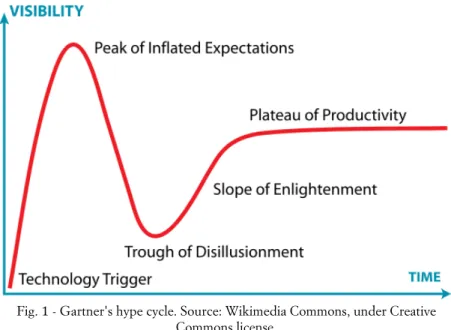
Fig. 1 - Gartner's hype cycle. Source: Wikimedia Commons, under Creative Commons license.
It is important to note that governance, as performativity, is a two-way process, in which both expectations and the world they represent align to each other through the activities of innovation actors. Additionally, ex-pectations have dynamics of their own which are influenced by changes in the innovation field. In fact, there are explicit attempts to “govern” ex-pectations, as reflected by the development of future-oriented methodol-ogies, and the emergence of specialized expectations actors (Pollock and Williams 2010). These developments reflect the active and reflexive ac-tion of innovaac-tion actors, who are aware of expectaac-tions, their dynamics and their role in innovation, and strategically and actively influence ex-pectations to suit their objectives (Konrad et al. 2012).
The dynamics of expectations show temporal and spatial variations, as well as a variation in the effects they have in different actor groups (Bo-rup et al. 2006; Brown and Michael 2003). The variation in the type (from positive to negative) and attention of expectations is known as the “hype-cycle” (Figure 1). This cycle, introduced in the ICT world by the Gartner group consultancy, describes cycles of media attention and content of ex-pectations that go from over-promising to disappointment, and stabiliza-tion (Fenn and Raskino 2008). Besides its particular use by the Gartner group as a tool for management of emerging technologies, hype-cycles have been identified as a recurrent pattern in expectations dynamics often referred to in expectation studies. I will detail the main aspects of this cy-cle in the next section.
2.4. The Dynamics of Expectations: Hypes
For many emerging technologies it is often the case that early expecta-tions are overly optimistic. This optimism might lead to exaggeration, fol-lowed by disappointment when these promises are not fulfilled. From high temperature superconductivity (Felt and Nowotny 1992) to fuel cells (Bakker and Budde 2012; Konrad et al. 2012), and the hydrogen econo-my (Dignum 2013), and from genomics (Fortun 2008) to biotechnology (Gisler et al. 2011) multiple technologies and technological concepts have gone through one or many cycles of high attention followed by disap-pointment – also known as “hype cycles.” While hypes might have a neg-ative connotation, they are at the core of innovation processes in emer-gent technologies (Brown and Michael 2003).
In general, hypes and hype-cycles are understood as the circulation of over exaggerated promises, often through media, which might lead to un-founded excitement and disappointment. But before going into extensive discussions about the dynamics of hypes, it is first necessary to introduce two clarifications about the use and definition of the notions of hype and hype-cycle.
Hype is commonly understood as the act of exaggeration of the prom-ises and expectations of a technology. Often accusations of hype emerge in scientific discourses, being attributed to the system of incentives and competition of science, closely entangled with the system of press releases and media relations (Caulfield and Condit 2012; Master and Resnik 2013; Nerlich 2013; Rinaldi 2012). Similarly, hype as act of exaggeration is a common feature of the discourse of technology actors – it often fulfils a strategic function for the diffusion and long term development of the technology (Gisler et al. 2011; Ramiller 2006). The hype-cycle has been strongly established in the imagination of innovation actors, to become a shared belief or “folk-theory” among innovation actors (Rip 2006), who might look for signals of hype and anticipate its occurrence.
focus-es on the collective effect thfocus-ese exaggerated claims have in the field, and on what this tells us about the technology (hype-cycles). I would argue, however, that to understand hypes it is necessary to use a hybrid defini-tion that situates between two distinct ontological levels: the basic acdefini-tion of hyping and the meta-level phenomenon of hype. In this definition, hype-cycles are more than the sum of individual actions and more than the additive effect of exaggerated claims: hypes have intentional as well as unintended effects to which innovation actors need to respond (Konrad et al. 2012).
It is this last understanding of hypes that I want to develop further. In doing so, I propose to understand the performativity of expectations in the context of hypes as the active assembling, or bringing together, of multiple elements which constitute emergent technology fields. Such as-sembling can take different forms, which often do not fit the description of the Gartner group. In fact, their shape and extension varies considera-bly: there are technologies that can go through several hype cycles, and the depth of the disappointment and the extension of the peak will vary among different technologies (van Lente et al. 2013). For example, the case of high temperature superconductivity during the 80s is a case of very sharp and short hypes (Felt and Nowotny 1992). In contrast, we can look to fuel cells (Ruef and Markard 2010), artificial intelligence (Gomes 2014) and peer to peer networking technologies (Oram 2001) as exam-ples of technologies that have been through multiple cycles of hype and
disappointment without losing out all their credibility.11
Nevertheless, hype is a useful concept to understand the relation be-tween technology development and expectations, since it refers to their specific and dynamic interrelations. Innovation actors are aware of these cycles of expectations and might strategically respond to them by getting involved in raising high expectations (Ramiller 2006) or develop specific innovation activities in moments of strong attention, such as investments, products or press releases, etc. (Konrad et al. 2012). The responses to hype vary among innovation actors. While core innovators or developers of a technology commit for long-term to certain expectations, even during disappointment, other actors might enter or exit the field during different stages of the hype (Dignum 2013). Even those who do not agree with the promises often react and develop strategies in relation to hypes (Gisler and Sornette 2013; Konrad 2006b). A particularly interesting case is that of venture capital markets, which behave like and are closely coupled to
11 The case of artificial intelligence is particularly interesting, because although
hypes (Gisler et al. 2011). Investors would react not only in relation to expectations about the technology, but also in relation to expectations about the behavior of other financial actors; thus, they need to under-stand the hype to develop their own strategies (Wüstenhagen et al. 2009). Hypes, therefore, do not merely rearrange expectations, but also have an effect on the relations between innovation actors. An example is the way in which venture capitalists change their attitudes toward opportunistic investors, who seem to be responding to hype: they anticipate disap-pointment and consider forming exit strategies.
These accounts show that hypes are constructed not only by the for-mulation of a certain type of discourse, but also by the actions of actors, enabled and embedded in specific material settings. In this respect, the analogy of hypes with “social bubbles” highlights the notion that such hypes emerge and produce strong social interactions, reinforcing feed-back cycles which in turn lead to extraordinary commitments for a tech-nological project; secondly, this creates entanglements of financial re-sources, technical capabilities, hopes and expectations, and investments (Gisler and Sornette 2010). This understanding of hypes stresses two im-portant aspects: the first is that hypes are the result of a process of assem-bling heterogeneous elements, and therefore they can be understood as an assemblage. Second, because this particular assemblage fulfils certain social functions, there is a performativity aspect to the hype itself. For this reason, it is possible to speak about the performativity of hypes as a par-ticular way of framing, modeling and thinking about expectation-technology dynamics, in addition to the performativity of expectations. I propose to think of hypes as an anticipatory assemblage that is composed of a set of interrelated practices. I will develop this idea in the following section.
3.
Anticipatory Assemblages: Understanding
Anticipation through Practices
In order to develop the notion of anticipatory assemblage, I focus here on the practices that mobilize expectations and constitute hypes. This perspective stresses the material embedding of expectations (Brown and Michael 2003), and the way in which the active arrangement of tions leads to overall patterns and patchworks of performative expecta-tions. In doing so, I examine how specific ways of doing expectation work in specific local contexts contribute to the construction,
stabiliza-tion and governance of an emergent technological field.12
12 It is important to note that by introducing local/global relations I do not
To this end, I focus on the study of practices that compose processes
of anticipation in emergent technologies. I will use the term anticipatory
practices to refer to the socio-material practices in which expectations are embedded, following and further developing the approach introduced by Anderson (2007; 2010). By doing so, I want to understand how expecta-tions are produced, and what are the condiexpecta-tions that enable their produc-tion and performative character.
The study of anticipatory practices is not completely new to STS. Pre-vious studies have focused on either implicit, situated design practices (Hyysalo 2006; Kinsley 2012; Wilkie 2011), or on the study of explicit forms of expectation work, such as foresight. These latter are explicit techniques and tools used for knowing and anticipating futures (van Len-te 2012). However, these accounts are limiLen-ted to the analysis of local and specific practices, and say little about the relations that emerge between them. Against this background, I am interested in how local and specific practices produce macro scale phenomena, such as hype-cycles. To ex-plore this aspect, I will discuss and compare two examples of emerging technologies that have recently gone through a hype cycle: graphene and 3D printing. There are interesting differences between these two technol-ogies: graphene stands for a science-push discovery that is turned into a commodity. In contrast, 3D printing is the result of the activities of user communities; it represents a bottom-up development that is now being taken up by market actors. These two technologies, while both hyped, embody (in principle) different forms of doing “techno-science” (Nord-mann 2010), which can be roughly related, respectively, to the regime of economics of techno-scientific promises and to the regime of collective experimentation (Felt and Wynne 2007; Joly 2010). While graphene fol-lows the path of a scientific discovery that is transformed into a
marketa-ble technology, 3D printing is a “grassroots”13 technology that is in the
process of becoming a mainstream technology. The type of actors, institu-tions, networks and even expectations of these two cases are different, however, strong similarities can nonetheless be identified.
In what follows, I introduce the analytical categories required to ex-plore the relations between local anticipatory practices and global dynam-ics for emerging technologies. I will start by revisiting the very notion of practice, and later build up conceptually, in order to address the com-plexity of the emergence of technological fields.
assembling expectations, actors, practices which lead to the temporal stabilization of a specific field.
13 Some of the aspects of consumer 3D printers, such as their inception in
hacker and makerspaces, and development of initiatives such as FabLabs, can be considered “grassroots.” By this, I refer to a bottom-up development which lacks a hierarchical governance structure and that resembles a social movement to some extent. For a critical review on the topic see Smith et al. (2013).
3.1. Practice Theories
Science and technology studies have introduced a practice perspective to study science not only as knowledge, but as “practice” (Latour 1987). This approach stresses the material culture of science, which is neither knowledge nor social relations; rather, science is understood as a hybrid between the material and the social (Pickering 2008). Practice approaches have been used to understand the development of infrastructure (Bowker and Star 1999), organizations (Orlikowski 2007), and marketing (Araujo et al. 2008), etc. Along these lines, Anderson (2007; 2010) has introduced the notion of anticipatory practices, to refer to those practices which ac-tively contribute to shaping “futures.”
Clear examples of anticipatory practices are the methodologies for fu-ture technology assessment, including forecast, scenarios, and foresight, among others. These methodologies have evolved from probabilistic forms of prediction, into more open and exploratory approaches that study alternative futures and their underlying frameworks (Martin 2010). This demonstrates that practices which actively engage with the future have a history and trajectory of their own. As Anderson (2010) argues, these practices are central to understanding future-oriented governance in liberal democracies: they guide and legitimize action. I propose to go one step further, and argue that this future orientation is not only reflect-ed in explicit practices aimreflect-ed at shaping the future (as methodologies, methods, tools, etc.) but also embedded in other common techno-scientific practices, from grant applications to venture investment. Taking this perspective brings to existing studies of techno-scientific practices the analytical tools to understand how these practices contribute to ex-pectation dynamics, and consequently, to shaping the future. For exam-ple, what is the role of a practice such as “filling a patent” in promoting and/or shaping certain expectations? How does it relate to other practic-es, and, particularly, to more explicit forms of anticipation?
Despite the relevance and novelty of this analytical perspective, An-derson does not provide a detailed “theory of (anticipatory) practices” that could guide an in-depth analysis. Therefore, it should be clarified what a practice means for this anticipatory perspective: practices are es-sentially forms of collective action (Barnes, 2001), which generate order in the social world as a relational and performative effect (Law and Lien, 2012). They are a form of routinized behaviour, but the routines in ques-tion can be filled in multiple ways (Glynos and Howarth 2007; Reckwitz 2002), involving both humans as well as technical artefacts (Pickering 2002).
am not only interested in the detailed accounts of a practice, but also in how practices evolve in relation to a field and its expectations. In order to explore this aspect, I follow the practice approach introduced by
Eliza-beth Shove et al. (2012), which focuses on the way practices evolve and
change. Using this approach, she describes, for example, how the practice of driving a car has evolved from the end of the XIX century to the pre-sent, which includes not only changes in terms of technologies, but also in the competences required to ride a car (more evident now with self-driving cars) and the meaning attributed to the practice. In this context, my intention is to understand the role of specific anticipatory practices in technology fields, and how they relate to other practices and to changes in the field itself. As Shove states, paraphrasing Latour, the approach allows to “follow the practices” and in this way understanding the social.
Shove et al.’s (2012) notion is composed of a double conceptualization
of practices, both as entities and as performances. This double definition highlights the interdependencies between multiple elements. A practice exists as
a recognizable conjunction of elements, consequently figuring as an entity which can be spoken about and more importantly drawn upon as a set of resources. At the same time practices exist as per-formances. It is through performance, through the immediacy of doing, that the ‘pattern’ provided by the practice-as-an-entity is filled and reproduced (ibid, 7, emphasis in the original).
This definition refers to two aspects of practices: firstly, that practices as performances take place in a certain spatio-temporal context and so they are unique every time this happens. It is important to note that “per-formance” here is different from the Callonian notion of performativity that I have introduced earlier. The performance of a practice means “do-ing” a practice, the act of making a practice happen or when a practice takes place. Secondly, that practices as entities are referred to and talked about, i.e. there is a recognizable meaning of a practice that is more or less unchanged between performances (Feldman and Pentland 2003;
Shove et al. 2012). This aspect highlights that practices, despite their
re-peatability and recognizability, are inherently improvisational, and so the way they are carried out is always somehow novel. It pays attention to the material dimension of these practices that is mobilized when they are per-formed, while underlining that practices have a meaning beyond individ-ual instances of enactment.
3.2. Anticipatory Practices
speak of and analyse the practices involved in processes of anticipation.14
Anticipatory practices are practices that give content to futures, and make them present through specific materialities (Anderson 2010). These prac-tices range from calculation techniques, forms of imagining futures such as scenarios, to forms of performing futures such as gaming, role-playing, etc.; these are collective practices that involve the circulation of collective expectations (Konrad 2006). This notion accounts not only for those practices that are explicitly performed in order to give shape to specific futures (as it is the case for forecasts, models, trends and so on), but also practices which implicitly shape future expectations and contribute to the process of anticipation, such as setting up standards, prototyping, filing patent applications, etc.
Drawing on Anderson’s work, I further develop the notion of “antici-patory practice,” drawing on the conceptualization of practice by Shove et al. (2012) introduced above. In general, practices can be considered an-ticipatory if some form of future orientation is at the core of the practice itself. Everything that people do has a history and a setting, and is in principle future-oriented (Schatzki 2010). Nevertheless, not all practices are anticipatory. Here I shall introduce a more strict definition of antici-patory practices, in which a practice can be considered anticiantici-patory if it fulfils two conditions: firstly, the meaning attributed to it must relate to a non-immediate and collective future. This means that anticipatory prac-tices refer to futures that are far enough to be uncertain, and on which a variety of actors have to agree and ultimately act, despite their uncertain nature. An example is practices which are expected to have a long-term effect such as investments (Wüstenhagen et al. 2009). Secondly, a practice is anticipatory when expectations about the future are mobilized in doing the practice, and as a result, other future-oriented activities are triggered. For example, a practice that enables the circulation of expectations such as the writing of policy reports about a technology (Wilkie and Michael 2009).
I will illustrate this definition with two techno-scientific practices, drawing examples from the cases of graphene and 3D printing. The first case is the graphene roadmap developed in the context of the application
14 Anderson (2007; 2010) introduces the broader concept of “anticipatory
process to the Flagship funding scheme.15 This collective practice is
pre-sented as a way to understand what is the most plausible future of gra-phene, in terms of both science and applications. In this way, graphene’s full potential to create social and economic growth can be developed. Creating such a roadmap requires compiling and coordinating the expec-tations of a large and diverse community, from researchers to industry to investors, and it is composed of many micro practices such as gathering opinions through a website, expert meetings, etc. The effect of such a practice is to enable this future coordination by distributing certain struc-ture and roles to specific actors within the field; it also serves as a legiti-mating device for innovation activities.
A second example of an anticipatory practice is the creation of stand-ards, a process often caught between being too early to have concrete def-initions, or too late to regulate, as in the line of Collingridge’s dilemma (1980). Standards are necessary for the diffusion of a technology, and so while there is no certainty that a particular product will succeed in the market, its diffusion can only take place when there are appropriate standards to support it. For this reason, actors involved in standardization processes have to anticipate the possible socio-technical configurations of the technology in order to develop useful standards. This process is not devoid of contestation, as many of the actors involved in the process have their own ideas and agendas about the best configuration possible, for which they mobilize and attempt to position certain expectations. Thus, the meaning of the practice is related to the future embedding of a tech-nology in society. To perform it, actors strategically mobilize expectations to push for their particular interests in the process. The outcome of the practice has a strong impact on path dependency: it will enable certain developments while excluding others.
With these two examples, I wish to highlight that for a practice to be considered anticipatory, it is not necessary to aim explicitly at shaping expectations. However, it is necessary that “the future” contributes to the meaning of the practice, that expectations take part in the practice itself, and that its performance contributes to anticipation. A caveat is that alt-hough this definition helps to identify those practices that are anticipa-tory, it does not explain why some practices are preferred while others are not, in a given context. Therefore, to characterize the conditions that structure sets of anticipatory practices (e.g. enable and constrain them, as understood in Rip and Kemp 1998), I use the notion of anticipatory logic.
15 The FET Flagship funding scheme was initiated by DG Connect of the
3.3. Anticipatory Logics
It is possible to argue that the hype related to graphene is based on a different set of practices than the hype around 3D printing. While it seems intuitive that different actor groups, such as scientists versus ven-ture capitalists or industries, would engage in different forms of anticipa-tion, it is nevertheless important to analyse the conditions that enable dif-ferent practices to take place in each case. These practices produce and sustain a specific social order. However, this order is not static: in fact, when different actor groups come together, as in the case of the produc-tion of the consumer 3D printer, where the interests of hackers, makers and industrialists met, practices change and new ones emerge. In this re-spect, a concept such as “logic” captures the relation between a diverse set of practices and their context, and the evolution thereof.
Logic refers to the “grammar” or rules of a set of practices, and the conditions that make the practice both “possible and vulnerable;” i.e., the conditions of possibility or impossibility of a practice (Glynos and
Howarth 2007).16 Anticipatory logics refer to “a coherent way in which
intervention in the here and now on the basis of the future is legitimized,
guided and enacted” (Anderson 2010, 788).17 We can think of this
con-cept in terms of two forms of acting in relation to future threats:
precau-tion and preempprecau-tion. The logic of precauprecau-tion18 operates under the
as-sumption that through a precautionary act, a catastrophic event will not take place, stopping something before it reaches the point of irreversibil-ity (Stirling, 2008). In contrast, a preemptive logic puts emphasis on ac-tion under complete uncertainty about a future event, but in a world of strong interdependencies. It does not follow the logic of risk as a
16 Glynos and Howard (2007) introduce three types of logics: social logics are
related to the maintenance of certain practices, political logics are related to chal-lenge and transformation, which leads transformations in institutions, and
fantas-matic logics account for why a specific practice and regime grips subjects, or the
resistance to change of social practices.
17In particular Anderson refers to logics that are mobilized under potential
threats, and that involve actions that “aim to prevent, mitigate, adapt to, prepare for or preempt specific futures” (Anderson 2010, 779). Nevertheless, these logics need to be constantly reassembled for each of the cases in which they are enacted, which explains their transformative capacity. These logics function as a repeatable means of instantiating the conditions for anticipation – which are based historical-ly on the presumption that certain forms of knowing the future are possible (Kins-ley 2012). In fact, forms of prediction and anticipation are often a highly contest-ed, yet contingent and culturally inflected activity (Andersson and Keizer 2014).
18 A well-known example of the logic of precaution is the “precautionary
ble entity, and instead it acts in the face of indeterminacy of the nature of
a threat (Massumi 2007).19 There is a fundamental difference between
precaution and preemption: the former acts upon processes that are known, on empirically apprehended threats. The latter calls for action on threats that have not yet emerged or even been fully identified. These two logics embody two different ways of knowing the future – and the as-sumption of what can be known and by which means – which enable dif-ferent forms of intervention, and, ultimately, difdif-ferent forms of
anticipa-tory governance.20
These forms of acting upon the future can be related to or originated from idealist or ideological discourses (Kinsley 2011). In fact, different logics can co-exist in a certain field such as in the case of 3D printing, in which at least two logics characterize anticipation: techno-economic and
open source.21 While the former characterizes practices in which the
fu-ture is associated with a sense of urgency and competition, the latter re-fers to practices in which the future is reflexive and is a space for experi-mentation. A techno-economic logic will include practices such as the economic assessment of promises and risks, or the spread of high expec-tations through media. An open source logic, in contrast, emphasizes practices such as the development of open source hardware and open standards, in which the specificities, aims and ethos of the machine are negotiated among members of a community.
A logic provides a certain way of seeing and knowing the future, codi-fying for specific practices and setting a specific context for a present sense of “futurity” (Kinsley 2011). In this sense, logics “enable and con-strain” forms of knowing and acting in relation to the future, and for the same reason they can be subject to dissent and contestation (Brown et al. 2000). Thus, there is a political dimension to anticipation. While I will not develop extensively this aspect, it must not be ignored, especially when framing expectations in relation to governance. Beckert (2014) has emphasized the distributive and political dimension of expectations and anticipation. He argues that the contingent nature of expectations makes them open to interest-based politics.
If decisions have distributive consequences, and if decisions
19 Massumi (2007) uses as an example of the logic of preemption the
Ameri-can invasion to Irak in 2003, an event that was justified on the basis of a threat that was not concrete neither could be identified by any methods.
20 I use the term “anticipatory governance” in the way Anderson (2010) does.
Thus, it is important to distinguish it from the more normative understanding of “anticipatory governance” (Barben et al. 2008) which has been developed in the context of steering innovation processes.
21 These two logics are related to the two regimes as introduced by Felt and
Wynne (2007) and Joly (2010): economics of techno-scientific promises (techno-economic) and collective experimentation (open source).
are based on expectations, then actors have an interest in the ex-pectations of other actors. Influencing exex-pectations has become a central task of both political regulation and business and is a major part of discourses on business and the economy (ibid., 11).
The “politics of expectations” are played out, for example, in the way open source 3D printers are developed and promoted, against proprietary technology. Similarly, it is embedded in the way the “future of graphene” becomes a European project, through the flagship, by rearranging a scien-tific, technological and industrial community with the purpose of exploit-ing the economic promises of the material. This political aspect is related to the normative considerations that inform certain practices, their ideo-logical commitments and the way in which anticipation creates inclusions and exclusions.
4. Anticipatory Assemblages
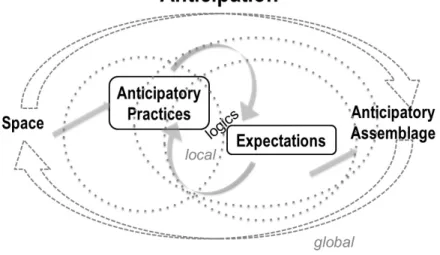
In order to fully characterize processes of anticipation, it is necessary to pay attention to the relations between different practices and their ef-fects. For this reason, I introduce in this last section the notion of assem-blage, to account for how different practices come together among a mul-tiplicity of elements, i.e. how they influence each other and their joint ef-fects. I use this notion as a heuristic to account for the multiplicities of practices involved in anticipation, their different contexts and the rela-tions that emerge from them. Future expectarela-tions, as a dynamic phenom-enon (e.g. hypes) can be understood as an anticipatory assemblage, a pro-cess that develops over time, in which local activities lead to global ef-fects. Such is the case of both graphene and 3D printing, technologies that are currently going through a hype phase; yet the types of actors, practices and logics that characterize these hypes differ. However, despite these two technology fields being in principle substantially different, it is possible to recognize some common dynamics.
To understand this apparent conundrum, I focus on two aspects of as-semblages: the first one is its reference to a set of heterogeneous elements that are brought together, which is constantly re-enacted and has per-formative effects. The second aspect is that although this specific ar-rangement can be found in various contexts, local and global, it is more than a pattern, because its structure is not given but is constantly rear-ranged. Along these lines, one can think about hypes as the result of a set of expectations, practices, technologies, and others that are brought to-gether, partly because of the strategic activities of actors, but largely as a result of an arrangement of stabilized anticipatory practices that shape the future in specific and recurrent ways. A hype is both a local and a global phenomenon; it is the result of strategic and specific actions with local implications but also global aggregated effects.