Sathidevi. C
Page 412
THE REASONS FOR DROPOUTS OF ADULT LEARNERS FROM ADULT EDUCATION CENTRES IN KERALA – A CASE STUDYSathidevi. C
Department of Mathematics, Amrita Vishwavidyapeetham, Amritapuri (India)
Abstract
This paper analyses the reasons for the dropouts of adult learners from the equivalency classes under non-formal education conducted by Kerala Saksharata Mission. Kerala State Literacy Mission (KSLMA) is a registered society- sponsored by the government of Kerala, which coordinates and implements the adult and continuing education programs of the state. Statistical survey method like preparation of questionnaire is used in this paper and the data is collected from two types of respondents like the adult learners and their teachers. Based on this study, I find that above 50% of the adults learners are drop outs from the class due to many reasons. The suggestion to improve and overcome this problem is to create a suitable atmosphere in the class by giving maximum facilities in the class rooms and financial support. The Socio –economic status of the adult learners is the main reason of dropouts from the adult education centres.
Keywords: Adult education, Drop-outs, Questionnaire, Respondents, Statistical survey.
Introduction
Kerala is the first state in India, which has successfully completed total literacy and post literacy campaign in all the fourteen districts. The outcome of their campaign can be
sustained only when they are effectively followed up with
continuing education program. Experience in Kerala indicated that in spite of successful completion of total literacy campaign and post literacy campaign there where a good number of illiterate and semi-literates who dropped out at literacy centers. Such a situation, it was felt not conducive for promoting and sustaining literacy. Hence continuing education program was introduced in Kerala.
The continuing education scheme of National Literacy Mission (NLM) envisages different types of programs which would provide neo literate an opportunity to acquire different skills and their move towards self-sustenance and self-reliance.
Following are the types of programs expected to be offered by the adult education centers:
Basic Literacy program
Equivalency program
Skill development and income generating program
Quality of life improvement program
Individual interest promotion program
Adult education is one of the areas of continuing education program, which has become a popular movement in Kerala. The equivalency program for class IV was started in Kerala in 2000 and 12 batches have successfully completed this program. In
2016, Kerala was declared as the first statewhich has acquired
the total primary education in India. The equivalency course for class VII was started in 2005 and completed 10 batches now. Equivalency program for Class X started in the state in 2006 and completed eleven batches. The first batch of equivalency course for class XII has started in 2015 has completed their course in 2017. In these adult education programs, adult learners face so many problems. So the study about the problems faced by adult learners is very important to find out the reasons for dropouts. Kollam district is one of the districts in Kerala where equivalency classes for adults are conducted in a very good manner. The main reason for choosing Kollam district for the study is that Kollam is a mixture of various cultures and livelihood; i.e. in the east, Adivasis and Tamilians, at the western area fishermen and coir workers and also the huge number of cashew workers are residing at different parts of the district. Kollam is the district which implemented the continuing education projects with the great support of the local self-governments. If a project like this can be completed successfully in Kollam district, we can achieve success in making Kerala a complete literate state with the wholehearted support and leadership of respected persons from all areas.
Objectives of the study:
To study the reasons for drop-outs from the classes.
To identify the socio-economic profile of adult learners.
To study the reasons for joining the equivalency program.
To study the problems faced by adult learners.
To study the teaching\ learning activities of the program.
Research Design and Metodology
Statistics is branch of mathematics which deals with the collection, analysis, interpretation, presentation and organization of data. A field of applied statistics of human research surveys,
survey methodology studies the sampling of the individual units from a population and the associated survey data collection techniques, such as questionnaire construction and methods for improving the number and accuracy of responses to survey.
Sathidevi. C
Page 413
Questionnaires are the most commonly used tool in survey research. It is a research instrument consisting of a series of questions for the purpose of collecting information from respondents. Usually, a questionnaire consists of a number of questions that the respondent has to answer in a set format given to the respondents. There are two types of questionnaires, closed ended an open ended, in which the closed ended questionnaire consists of multiple choice questions and the respondents can give explanations in the open ended questionnaire.
Methods of Data collection
Two sets of questionnaires were prepared separately for the adult learners and their teachers with 30 closed ended questions.
Population and sample
Kerala state has been selected as the population of the study and from among fourteen districts, Kollam district has been taken as the sample.
Sample and sample size
The samples of adult learners and their teachers were chosen from some selected centers of equivalency classes for adults from rural and urban areas in Kollam district. A sample of 110 adult learners including seventh, tenth and twelfth equivalency classes was taken and samples of 20 teachers were selected as respondents.
This paper is mainly intended to find out the reason for dropouts from the equivalency classes and I expect that this study will have significant implication for improving the attendance of the
learners in the class and also improving the teaching learning activities.
Basic Literacy Programme
The literacy rate of Kerala State is 94.6%, and around 5% of the population is illiterate. Kerala State Literacy Mission Authority (KSLMA) conducts basic literacy classes to the illiterates. This program is known as „Aksharalaksham‟. Kerala Government supports this programme through the CEC and the NCECs.
Equivalency Course for Class IV
Kerala State Literacy Mission started equivalency program for Class IV in 2000 and completed it in 2015 with the Athulyam project. The classes were conducted by the Preraks and resource persons of the literacy movement. The curriculum, learning materials, training for resource persons, examinations were conducted and certificates were issued by KSLMA with the support of local self -governments. In 2015, Kerala was declared as the “State of total literacy up to Primary education” in India.
TABLE: 1
Details of Adult Learners for Fourth Equivalency in Kerala State
Batch Year Registered Exam.
Appeared Drop
Out
Passed Percentage
I 2000 2600 1712 888 1600 93.46
II 2003 13200 12105 1095 11865 98.02
III 2004 12505 11447 1058 11350 99.15
IV 2007 18045 11230 6815 11000 97.95
V 2008 10245 5496 4749 5313 96.67
VI 2009 7622 6564 1058 3817 58.15
VII 2010 23108 12324 10784 10592 85.95
VIII 2012 16809 9178 7631 6345 69.13
IX 2013 6073 3916 2157 2911 74.34
Sathidevi. C
Page 414
Equivalency Course for Class VIIThe second stage of equivalency course is seventh standard in Kerala State. This course started in 2003 and now nine batches are completed. School dropouts and those who have passed the
IV th equivalency course are the beneficiaries of this program.
KSLMA aimed at to achieve cent percent equivalency in VII standard by the year 2019.
TABLE: 2
Details of Adult Learners for Seventh Equivalency in Kerala State
Equivalency Course for Class X
The third stage of equivalency course in Kerala State is 10th
equivalency course which is equivalent to formal SSLC. The
qualification for joining the 10th equivalency course is the pass of
VII standard of the formal system or pass of the VII equivalency course. School dropouts from eighth standard to tenth standard also register for this course. The age for joining this course is seventeen years. It started in 2006 and completed its eleventh batch in 2017. KSLMA supplied the study materials and conduct the course, examination and certification by Kerala State Pareeksha Bhavan.
Thousands of adults join the equivalency course for their better
future. There are many benefits for the adults by passing the Xth
equivalency program, who is already working under the government. The last grade Government or public servants get
promotion and salary hike by passing this course. The Kerala State Public Service Commission approved this course as a qualification for applying various job vacancies and promotion in Kerala Government Services.
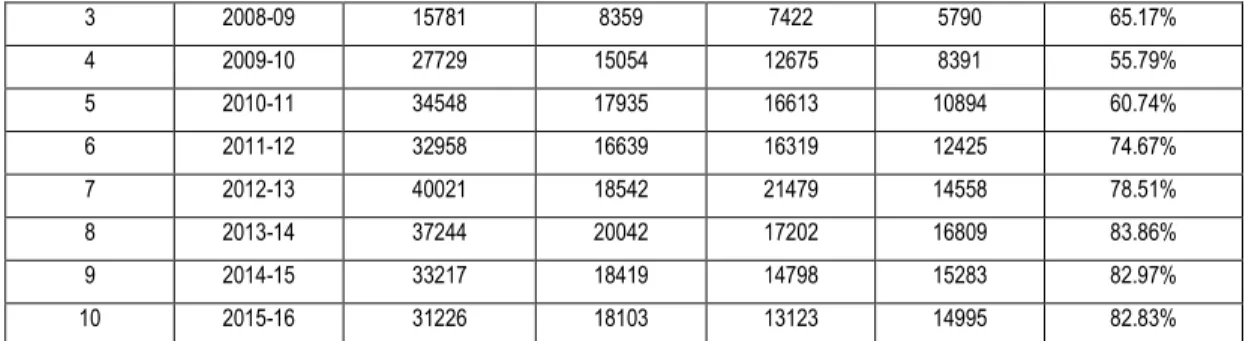
Even if these adults have many benefits by passing the equivalency course and thousands of adults join the courses every year, above 50% of them drops out from the courses. So I would like to find the main reason behind the dropouts. The news about the dropouts from the equivalency classes came in the newspapers says that around 52% of them drops out from the courses, which gave me an inspiration to search for the reasons of the dropouts. The news came in Indian Express on
7th January 2018 about Class X equivalency course is displayed
below.
TABLE: 3
Details of Adult Learners for Registered for Tenth Equivalency in Kerala State Sl. No. Year of Batch No. Registered Attended
Exam
Drop out Passed Percentage of Pass
1 2006-07 2819 1693 1126 1088 64.26%
2 2007-08 12710 6315 6395 3235 51.37%
Batch Year Registered Exam Appeared Drop out Passed Percentage
I 2005 13834 11631 2203 11082 86.68
II 2007 10928 5952 4976 4343 82.46
III 2008 9482 4929 4553 3985 80.85
IV 2009 7429 5062 2367 4020 79.40
V 2011 13788 8414 5374 7098 84
VI 2012 11145 7023 4122 6004 85.50
Sathidevi. C
Page 415
3 2008-09 15781 8359 7422 5790 65.17%
4 2009-10 27729 15054 12675 8391 55.79%
5 2010-11 34548 17935 16613 10894 60.74%
6 2011-12 32958 16639 16319 12425 74.67%
7 2012-13 40021 18542 21479 14558 78.51%
8 2013-14 37244 20042 17202 16809 83.86%
9 2014-15 33217 18419 14798 15283 82.97%
10 2015-16 31226 18103 13123 14995 82.83%
The table given above shows that almost 50% of the adults registered in every year is dropping the courses due to many reasons in their life. This study and analysis helped me to find many reasons in their life to quit the course. This is explained under the heading „the problems faced by the equivalency learners‟. The details of the adult learners registered for tenth equivalency course for the last 10 years is listed in the following table.
Plus Two Equivalency Course
Plus two equivalency courses are started in 2015 firstly in India at Kerala. The first batch has completed successfully. The tenure of the course is two years. The examination is conducted in each year. The registration and classes are conducted by the KSLMA and the examination and certification conducted by Kerala Higher Secondary Board. The eligibility to register the course is for those who pass the regular SSLC or Tenth equivalency and the dropouts from Plus two or Pre-degree. At the time of submission of application, the candidate must complete 22 years
of age. The dropouts of Plus two or Pre-Degree can also join
this course. The department of higher secondary education conducts examinations and issues certificates. This course is a model for the country. The success of this course will give a new face for the continuing education process of the country and the world.
The problems faced by the learners
The equivalency classes for the adults in different centers are conducted mainly on Sundays and public holidays. The equivalency centers are some selected schools, where regular classes and some other selected training courses are conducted. In this study, I observe that the main reason for dropouts of the adult learners from the equivalency classes are „the engagement in other labours by the learners, financial problems, lack of interest, lack of refreshment, complication of learning modules, the atmosphere of the class room, and the schedule of classes is not suitable for the learners‟. I also noticed that the caring of the their children, lack of interest of family members, certain bars in their family, lack of time for studying the lessons, people
laughing on studying in the old age, physical condition is not good for attending the class from morning to evening, the negative approach of the colleagues, fear of questions from the teachers, lack of concentration, and their eye sight etc. are preventing them to actively participate in the classes. The teaching is not understandable, the teachers not care all of the learners equally, fear of examinations, continuing evaluation, lack of sanitary facilities, darkness in the classroom, and they think that the learning at this time is a waste.
Data Analysis and Interpretation of The Questionnaire Based on the Questionnaire prepared for the Learners
A questionnaire consisting of 30 closed ended and some open ended questions were prepared and was circulated among the adult learners of different classes in different centers of Kollam district. Based on their responses, the data was classified into four groups such as Personal problems, Academic problems, Organizational problems and financial problems. Graphical method is used to interpret the data obtained from the respondents considering each groups and it is shown in the following graphs. Based on this data, I could observe that 68% of the adults were females and the rest males. They belong to different age groups ranging from 26 to 60 years. They include single, married and widow or widower. These adult learners had to choose the equivalency courses due to many reasons like failure from the regular courses, long absenteeism, dropouts from schools etc. They had to choose the equivalency courses for the sake of their promotion or for the fulfillment of their desire to pass the examination and to get some social status in the society.
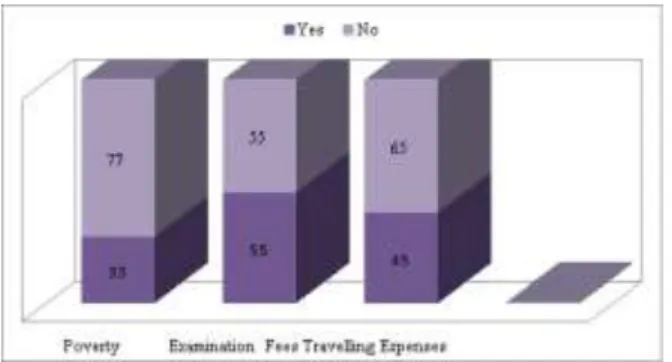
Figure 1: Response of the learners regarding Personal Problems
Sathidevi. C
Page 416
during the old age, they are finding it very difficult to study the topics and is not easy to remember whatever they learn. Most of the women leaners, find it difficult to attend the class since there are no one to take care of their children. Personal problem
becomes one of the main reasons for dropping the course in between, even though they have many benefits in doing the course.
Fig. 1: response of the learners regarding personal problems
Fig. 2 response of the learners regarding academic problems
The above graph shows that academic problems matters a lot to drop out from the equivalency courses, so it is better to revise the curriculum and make it easily understandable by the adult learners.
Fig 3. response of the learners regarding organizational problems
In order to make interest in the learners,the organisation of the classes should be well ordered, and the atmosphere of the class rooms must be improved for the attention and attraction of the learners.
Fig.4 response of the learners regarding financial problems
As most of the learners are coming from the poor family or they are being the main source of money, they cannot afford the cost of study materials and all other expenses related to this. This shows that financial problems also become one of the reasons for dropouts at some extent.
Based on the Questionnaire prepared for the Teachers
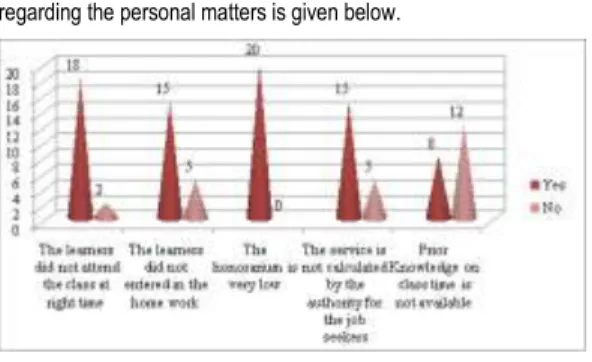
The teachers engaging classes for these adult learners are chosen from different Higher Secondary schools and literacy workers. A separate questionnaire was prepared for the teachers with some closed and open ended questions. Their responses were classified into two groups such as Academic and Personal problems. The details of the teacher‟s responses are shown in the following graphs.
Fig. 5 response of the teachers regarding academic problems
Sathidevi. C
Page 417
decision to quit from the course. The graph showing the details regarding the personal matters is given below.
Fig. 6 response of the teachers regarding personal problems
Suggestions
1. Create a suitable atmosphere in the class by giving
maximum facilities in the class rooms. Start mid-day meal for the learners. Change the class time at the evening or two hours per day.
2. Supply the learning materials at proper time. Simplify the
learning materials of the standard of equivalency learners especially on General Science. Adopt participatory approach in the teaching and learning system. To include environmental and participatory self-reliant ideas in the study module. Supply computers and other instrument to the classes for the betterment of the course and to conduct study tours to knowledge centers for acquiring new knowledge. Give proper training for the teachers on andragogy.
3. Give counseling for the learners with their problems and to
conduct program to improve personality development of the learners. Start vocational training programs along with the equivalency program for adults. Give grace marks or concession of marks to the learners of the equivalency courses for the selection of jobs in the government and private sector. Give importance to continuous evaluation.
4. Set up a labor supply unit under the DLM or Block Literacy
Mission with the involvement of equivalency learners and co-coordinators to overcome the unemployment problem of the learners.
5. Create social atmosphere to attain the slogan of
„education for all and education for ever‟. Empower the school students on lifelong learning.
Conclusions
Kerala is the first state in India to declare total literacy up to Primary level. Kerala State Literacy Mission and Local bodies play an important role in this field. Through this adult education
programs, we can attain the goal of total literacy up to 10th and
12th standards within years. The study of the problems faced by
the adult learners will help to acquire total literacy up to 12th
standard through the equivalency programs in Kerala state in India. Our state has been recognized as a world training institute for the equivalency projects in non-formal education. The equivalency projects can attain even greater achievements only through democratic development. Proper and continuous innovative programs would go a long way in stabilizing the equivalency programs of the state of Kerala.
The equivalency courses and classes are one of the important nonformal education systems in Kerala. The model of non -formal education in Kerala State gives light to the Indian non-formal education system. India is a large country having a wide chance in the field of non-formal education. This will give the researcher a very high and vast area on research. Major issues for the sustainability of the equivalency classes for the adults can be studied in detail. The Socio –economic status of the adult learners is the main reason of dropouts from the adult education centres.
References
Jayachandran K, Problems faced by the equivalency Learners in
Kollam District, MAAE diss., IGNOU, Thiruvananthapuram, 2017.
Sundersan Nair. T, A Study of the Performance of Continuing
Education Program in Kerala, 2005.
JP Dhalamaini, P JH Heeralal, Factors and Circumstances
Leading to Adults Dropping Out from Community Colleges, 2014
Haseena V A, Ajims P Mohammed, Scope of Education and