Volume 4, Issue 2 www.stmjournals.com
Influences of Prefresh and Early Fresh Body Condition
Score Changes on Some Holstein Dairy
Performance Traits
Dawod A.
1*, Abdel-Hamid T.M.
2, Ramadan S.
31
Department of Husbandry and Animal Wealth Development, Faculty of Veterinary Medicine, University of Sadat City, Menofia, Egypt
2
Animal Wealth Development Department, Faculty of Veterinary Medicine, Zagazig University, Sharkia, Egypt
3
Animal Wealth Development Department, Faculty of Veterinary Medicine, Banha University, Kalubia, Egypt
Abstract
This study was performed to investigate the effect of body condition change from the prefresh to early fresh periods on the subsequent milk production performance in Holstein dairy cows. For this purpose, 89 Holstein cows in a private high yielding dairy enterprise (average milk yield 8000 kg/season) were included in this study. Body condition score (BCS) was evaluated at the prefresh period (260–270 day) post last insemination, as well as one month postpartum. Evaluations of BCS were performed via, two evaluators on a scale of 1–5 points and the average BCS value for each cow was detected. BCS loss was estimated via, subtract of postpartum BCS value from the prefresh one. Data of the daily, initial, 305-day, and actual milk yield were collected and recorded. The results of this study revealed that, fatty cows during their prefresh phase (BCS 4.5–5.0 points) had high dairy performance, as these cows depicted the highest values of daily milk yield (37.58 kg), initial milk yield (43.38 kg), 305– day milk yield (11461.00 kg) and actual milk yield (12229.38 kg). Moreover, the cows with a postpartum BCS of 3.5–4.0 points recorded the highest significant daily milk yield (37.93 kg), 305-day milk yield (11566.67 kg), initial milk yield (49.00 kg) and actual milk yield (14945.00 kg). The cow losing from (–0.5)–(–1.0) point BCS has the highest significant daily and 305-day milk yield. In conclusion, BCS significantly influenced the milk performance traits of Holstein cows both at prefresh and postpartum period. For higher performance, the cows should be with somewhat heavy BCS at prefresh and with medium BCS postpartum. The dairy Holstein cows could loss about 0.5–0.75 BCS unit during their early fresh phase with efficient milk production. Further research is needed to prove this presumption.
Keywords: body condition score, Holstein, prefresh, postpartum, milk yield
*Author for Correspondence E-mail: [email protected]
INTRODUCTION
Body condition score (BCS) is an easy, inexpensive, and subjective method to evaluate the body tissue reserves of lactating cows, independent of frame size and body weight (BW). During early fresh period, mobilization of body reserve for milk production becomes greater which induces the negative energy balance. It was proved that the negative energy balance has great impacts on dairy cattle performance [1].
The insufficient and unbalanced nutrition have the ability to bring the cow in severe negative
energy balance which has a negative impact on reproduction [2–4] and health [5, 6]. Depending on feed records, determining such energy in the field conditions is difficult. BCS is an evaluation tool of the amount of fat reserve on the body mobilized during the early period of lactation and replenished in the middle or at the end of lactation.
cattle enterprises due to its robust and quicker result and easy applicability [8]. Some previous publications have studied the effects of BCS during the calving, dry period and different periods of lactation on milk yield [9– 11], and milk components [12]; however, others reported that BCS had no effect on the yield and health performances [3, 13, 14].
Certain complications such as decreased milk yield, high incidence of metabolic diseases, delayed postpartum estrus of emaciated cows, may take place due to lack of usable reserves in the early period of lactation. Furthermore, difficult birth, high incidence of metabolic diseases and reduction in milk yield of over-conditioned cows could occur due to a reluctance to consume dry food [15–17]. To avoid such complications of emaciation or obesity, the cows should have a BCS of at least 3.5 out of 5 at calving period [2]. Our concurrent work investigated the impact of BCS changes during prefresh and fresh stages on Holstein cows performance to detect how many BCS unites could be lost during early fresh period without any effect upon their dairy performance?
MATERIALS & METHOD
This study was conducted in a private high yielding Holstein dairy enterprise (average milk yield 8000 kg /season). The dairy farm was located 80 Km away from Cairo in Giza province, Egypt. The trial was conducted from December 2013 to June 2014 with 89 Holstein cows. The dairy Holstein females were well managed according to the standards of Holstein breed. The Holstein cows were artificially inseminated using the same bull semen. Dairy cow BCS were evaluated during 260–270 day post last insemination, as well as 30 days postpartum. BCS evaluations were performed via, two evaluators on a scale of 1– 5 points, where the cows were award a condition score on the scale 1 (very poor) to 5
(grossly fat) according to Ferguson et al. [16].
Average condition score scale was calculated as mean value between the two different evaluators. Cattle were managed not to increase nor decrease their BCS till parturition. BCS was evaluated twice, as the first time was done at prefresh stage (260–270 day of last insemination), while the second time at one
month postpartum (early fresh stage). BCS loss was estimated via, subtraction of postpartum BCS value from the prefresh one. As complete scoring of dairy cows was done, the cows were grouped into six main BCS groups according to their BCS value. The prefresh BCS groups were 1st, 2nd, 3rd, 4th, 5th,
and 6th for BCS values of >2.5, 2.5–3.0, 3.0–
3.5, 3.5–4.0, 4.0–4.5, 4.5–5.0, respectively. Dairy cows with BCS value below 2.5 were culled as a part of farm culling policy. BCS was recorded again at 30-day postpartum in order to detect its effect on milk production. Also, dairy cows were grouped into five groups according to their postpartum BCS value, as 1st, 2nd, 3rd, 4th, and 5th for the BCS value of >2.5, 2.5–3.0, 3.0–3.5, 3.5–4.0, 4.0– 4.5, respectively.
Cows were again regrouped at postpartum into five groups according to the rate of BCS point
loss on the same scale defined before, as 1st,
2nd, 3rd, 4th, and 5th for the rate of decrease of BCS points of <(–0.25), (–0.25)–(–0.50), (– 0.50)–(–0.75), (–0.75)–(–1.0), and gained (+0.25) points, respectively to determine its effect on milk production performance. The daily, 305-day, actual, and initial milk yield were recorded for the dairy Holstein females, so as to determine the effect of prepartum, postpartum and postpartum BCS loss on the dairy performance of high yielding Holstein cows.
Statistical Analysis
Data were analyzed using SAS statistical analysis system package SAS (2008). One way ANOVA was performed using the following model:
Yij = μ + Bi + eij
Where, Yij = any observed value; μ = overall
mean; Bi = the fixed effect of BCS; eij =
random deviation due to unexplained source. Differences among means were compared statistically using Duncan’s multiple range tests [18].
RESULTS
Effect of Prepartum BCS on Holstein Cows Dairy Performance
ISSN: 2319-3409(online), ISSN: 2349-3704(print)
among different prepartum BCS groups, as cows with BCS of (4.5–5.0 points) sustained the highest values of daily milk yield (37.58 kg), initial milk yield (43.38 kg), 305-day milk yield (11461.00 kg), and actual milk yield (12229.38 kg). However, the lowest values of daily and 305-day milk yield were recorded for cows with BCS of (2.5–<3.0 points), and those with BCS of (<2.5 points), for initial milk yield and actual milk yield. Indeed, cows with BCS ranging from 3.0 to <4.5 points
showed a somewhat similar performance for daily and 305-day milk yield. Cows with BCS of (3.0–<3.5 points) have higher significant daily and 305-day milk yield as compared to those with BCS of (<2.5 points) and (2.5–<3.0 points); however, higher significant actual milk yield and initial milk yield were recorded when compared with those of BCS ranging from (<2.5–<3.0) and those with BCS of (3.5– <4.0).
Table 1: Effect of Prepartum BCS on Holstein Cows Dairy Performance.
Prepartum BCS groups BCS
points N %
Milk production traits
Daily milk yield
Initial milk yield
305-day milk
yield Actual milk yield
Mean ± Se Mean ± Se Mean ± Se Mean ± Se
1 <2.5 5 5.61 26.15±3.78cd 20.80±4.41e 7976.00±153.71cd 6344.00±344.77e
2 2.5–< 3.0 13 14.60 25.33±0.73d 22.31±1.31de 7721.54±221.54d 6803.85±398.85de
3 3.0–< 3.5 42 47.19 31.25±0.53bc 37.74±0.89ab 9531.28±161.94bc 11511.79±270.01ab
4 3.5– < 4.0 18 20.22 30.70±1.41bc 27.94±2.25cde 9364.44±330.11bcd 8523.06±386.21cde
5 4.0–< 4.5 6 6.74 33.07±2.97ab 35.00±2.65abc 10086.67±306.83ab 10675.00±306.95abc
6 4.5–5.0 5 5.61 37.58±1.44a 43.38±4.26a 11461.00±438.14a 12229.38±299.05a
P-value
Means within the same column shearing different letters are significant at P<0.05. BCS = body condition score
Effect of Postpartum BCS on Holstein Cows Dairy Performance
Holstein dairy performance possessed
significant difference among different
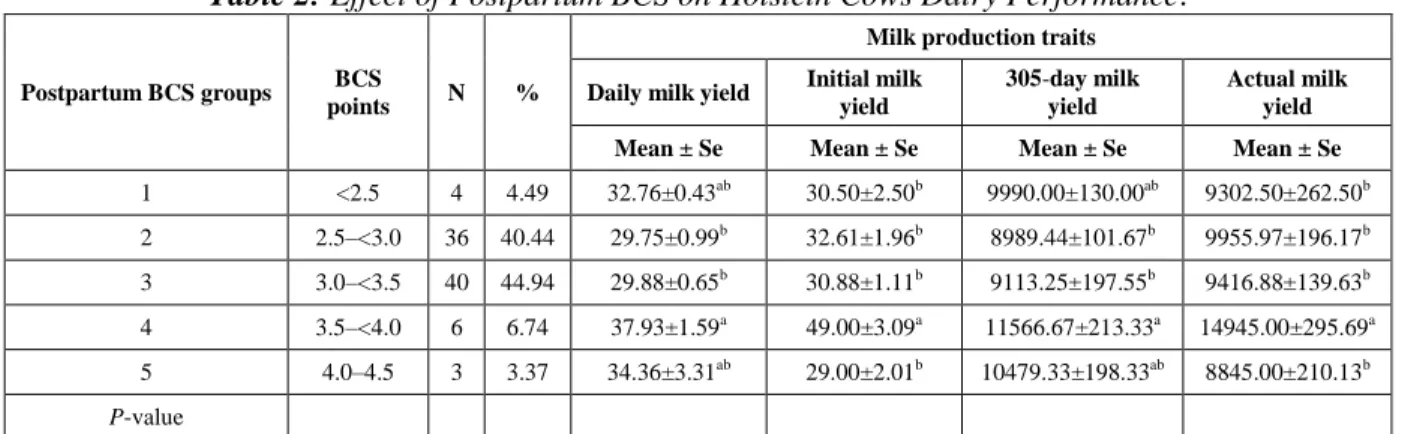
postpartum BCS groups (Table 2). Cows with BCS of (3.5–<4.0 points) recorded the highest significant daily milk yield (37.93 kg), initial milk yield (49.00 kg), 305-day milk yield (11566.67 kg), and actual milk yield (14945.00 kg) as compared to other ones. The
lowest value of daily and 305-day milk yield was recorded as 29.75 kg and 8989.44 kg, respectively in the cows with BCS of (2.5– <3.0 points); while the lowest actual milk yield (8845.00 kg) was obtained from cows with BCS of (4.0–4.5 points). The lowest initial milk yield (30.50 kg) has been observed in cows of <2.5 BCS.
Table 2: Effect of Postpartum BCS on Holstein Cows Dairy Performance.
Postpartum BCS groups BCS
points N %
Milk production traits
Daily milk yield Initial milk yield
305-day milk yield
Actual milk yield
Mean ± Se Mean ± Se Mean ± Se Mean ± Se
1 <2.5 4 4.49 32.76±0.43ab 30.50±2.50b 9990.00±130.00ab 9302.50±262.50b
2 2.5–<3.0 36 40.44 29.75±0.99b 32.61±1.96b 8989.44±101.67b 9955.97±196.17b
3 3.0–<3.5 40 44.94 29.88±0.65b 30.88±1.11b 9113.25±197.55b 9416.88±139.63b
4 3.5–<4.0 6 6.74 37.93±1.59a 49.00±3.09a 11566.67±213.33a 14945.00±295.69a
5 4.0–4.5 3 3.37 34.36±3.31ab 29.00±2.01b 10479.33±198.33ab 8845.00±210.13b
P-value
Effects of Condition Score Loss and/or Gain on Holstein Cows Dairy Performance
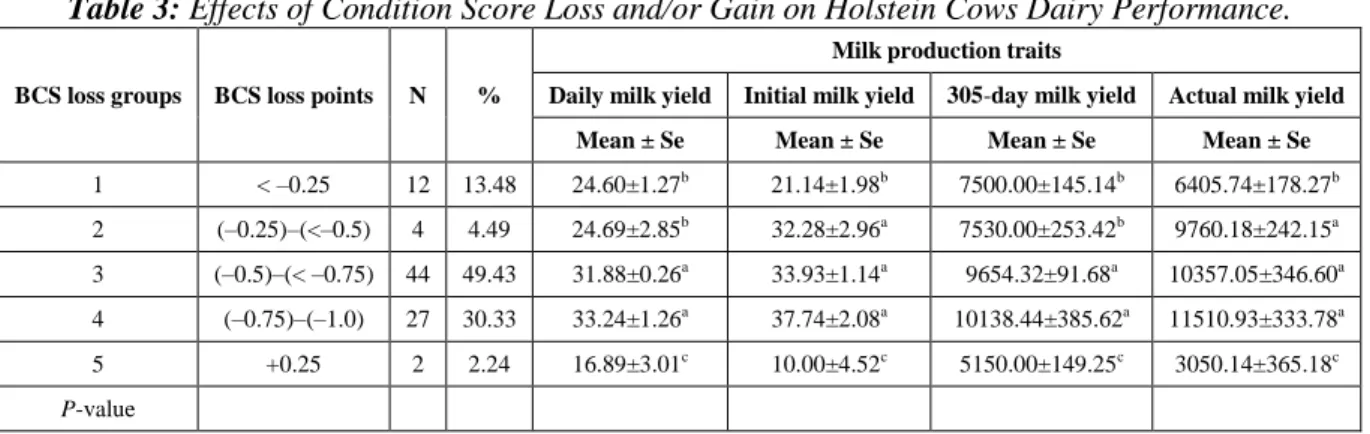
The effect of loss and/or gain in BCS of Holstein cows on some milk production traits are presented in Table 3. Cows with BCS loss from (-0.5) to (-1.0) points has the highest significant daily and 305-day milk yield, while
those with BCS loss of (-0.25)–(-1.0) points has the highest significant actual milk yield and initial milk yield. Cows with BCS gain (+0.25 points) and BCS loss (<-0.25 points) showed inferior performance for all milk production traits studied.
Table 3: Effects of Condition Score Loss and/or Gain on Holstein Cows Dairy Performance.
BCS loss groups BCS loss points N %
Milk production traits
Daily milk yield Initial milk yield 305-day milk yield Actual milk yield
Mean ± Se Mean ± Se Mean ± Se Mean ± Se
1 < –0.25 12 13.48 24.60±1.27b 21.14±1.98b 7500.00±145.14b 6405.74±178.27b
2 (–0.25)–(<–0.5) 4 4.49 24.69±2.85b 32.28±2.96a 7530.00±253.42b 9760.18±242.15a
3 (–0.5)–(< –0.75) 44 49.43 31.88±0.26a 33.93±1.14a 9654.32±91.68a 10357.05±346.60a
4 (–0.75)–(–1.0) 27 30.33 33.24±1.26a 37.74±2.08a 10138.44±385.62a 11510.93±333.78a
5 +0.25 2 2.24 16.89±3.01c 10.00±4.52c 5150.00±149.25c 3050.14±365.18c
P-value
Means within the same column shearing different letters are significant at P<0.05. BCS = body condition score
DISCUSSION
Effect of Prepartum BCS on Holstein Cows Dairy Performance
In fact, cows with moderate BCS produced significantly higher actual milk yield and initial milk yield as compared to those with lower BCS and those with BCS of 3.5–<4.0 points. These results were reinforced by the
finding of Samarütel et al. [14] who reported
that, thin cows at calving could not reach their genetic milk yield potentials due to absence of body reserves that would support elevation of milk production at the beginning of lactation.
Two presumptions were suggested regarding this positive relation between sufficient body reserves at calving and higher milk yield— first is the positive impact of high BCS on the number of mammary cells during the calving period; the second is the reduction in the stress on the digestive system to decompose the foods [2]. In contrast, the results recorded by
Bayram et al. [19] found that cows with low
condition score at calving have higher significant (P<0.01) actual milk yield and 305-day daily milk yield than those with moderate condition score, as well as BCS at calving did not have an effect on peak daily milk yield.
Bouska et al. [20] reported that cows with low
body reserves achieved the highest milk yield among all body condition classes (≤ 3.5, 4.0, ≥
4.5) during the drying off period. In addition, cows with high condition score during the calving period consumed less feed, so they suffered from a higher negative energy balance, and subsequently produced less milk than other cows. Increasing BCS resulted in reduced dry food intake, as review by Broster and Broster [21]. Some previous researchers reported that BCS at calving did not have an effect on milk yield [3, 9, 10, 22]. These disparate results about the effect of BCS on milk yield may attribute to the use of different scoring systems and classifications, different mathematical models and different factors such as the breed, milk yield and raising
techniques, as published by Bayram et al. [19].
Some previous studies observed no effect of BCS at calving on peak daily milk yield and days to attain peak milk yield [9, 19, 23, 24]. However, others found a positive effect on the peak daily milk yield [2, 15]. Harmonious
results were reported by Gergovska et al. [25]
who found that cows from both the breeds (Holstein and Brown Swiss) with higher BCS (≥ 3.5 points) at calving have the highest milk
yield for 305-day lactation. Banuvalli et al.
ISSN: 2319-3409(online), ISSN: 2349-3704(print)
Effect of Postpartum BCS on Holstein Cows Dairy Performance
Indeed, cows with BCS of 3.5–4.0 points showed superiority for milk production traits which need greater proof because of small number of animal in this group which is reflected by higher standard error. These
results agreed with those obtained by Jilek et
al. [3] who reported that cows with low body
reserve within the month after calving had a great impact on daily milk yield (P<0.01) during the first five months of lactation. This could be explained as cows with genetically high milk yield potential are more inclined to mobilize their bodies' fat reserves to milk and these cows had lower BCS at the first month of lactation but had higher milk yield.
Concurrently, Samarütel et al. [14] recorded
that cows with low BCS produced more daily milk yields in the first two months of lactation.
Contradictory results were obtained by
Bayram et al. [19] who reported that condition
score obtained in the first month of lactation has no effect on milk production traits with the exception of peak daily milk yield (P<0.05), but they found that cows with BCS in the first month of lactation had a significant more milk yield (2.4 kg) at the peak point than those with moderate BCS (P<0.01) which agreed with the present results as daily and 305-day milk yield of moderate cows was lower than those of thin body condition (<2.5 points).
The insufficient reserves in emaciated cows and/or the insufficient dry food intake in obese cows may be expected to decrease peak daily
milk yield or extend milk period. Yamazaki et
al. [27] reported weak and negative
phenotypic associations between peak and 305-day milk yield and BCS in early stage of lactation (0–30 days in milk).
The present results agreed with those of
Gergovska et al. [28] who found that BCS at
calving had a significant effect on the 305-day milk yield, test-day milk yield and peak lactation production. Cows with a BCS of 3.5– 4.0 points at calving had sufficient body reserves in the early lactation, which allowed them to reach higher peak milk yield, and higher 305-days milk yield as compared to cows with BCS of 3.0 points or lower at
calving. At BCS of 2.0–2.5 points at calving, Holstein-Friesian cows had lower milk yield than those of cows with high BCS (3.5– 4.0
points). Also, Samarütel et al. [14] recorded
that during the first two months of lactation, the heavy cows had the highest milk yield.
Effects of Condition Score Loss and/or Gain on Holstein Cows Dairy Performance
From the outgoing results it was clearly found that, the higher the loss in the BCS the higher
the milk production performance. The
outgoing result was going barrel with previous publications [2, 17, 24] who reported higher milk yields in cows with high BCS losses.
Positive genetic correlations have been indicated between BCS loss and milk yield characteristics [17]. However, some studies reported a nonsignificant effect of the change in the condition score on reproduction and
milk yield traits. Bayram et al. [19] found that
17.7% of the cows showed condition gain, while 25.1% showed no change and 57.1% showed condition loss ranging between 0.01 and 0.90 units.
Normally, dairy cows during their postpartum suffer from negative energy balance, so they mobilized their body reserves for milk production at the beginning of lactation. The degree of loss of body reserves depends on a number of factors, such as degree of body condition at calving, nutrition after calving, level of milk production, etc. Cows selected for high milk yield were found to suffer more from negative energy balance, thereby greater loss of body condition after calving as compared to the ones with average milk yield [29].
Koenen et al. [30] found that the average loss
with good body condition have lost 0.60 points. The foregoing results proved that, the highest percent of cows 49.43% (44) showed condition loss ranged between 0.5 and 0.75
units. Gergovska et al. [25] recorded that cows
from both the breeds (Holstein and Brown Swiss) with higher BCS (≥ 3.5 points) at calving, with greater loss of BCS after calving (≥ 2.5 points) have the highest milk yield for 305-day lactation which go barrel with the
present results. Banuvalli et al. [26] found that
cows having high BCS at calving had lost more condition and produced more daily milk yield, when compared to cows with low body condition.
CONCLUSION
BCS significantly influenced the dairy performance of Holstein cows both at prefresh and postpartum period. The higher dairy performance of Holstein dairy cows was usually accompanied with somewhat heavy BCS at a prefresh and with medium BCS postpartum, but this needs further research to prove this presumption because of small number of animals including in this paper. Furthermore, the higher the loss in the body condition unites during fresh period the higher was the dairy performance.
REFERENCES
1. Beam SW, Butler WR. Effects of energy
balance on follicular development and first
ovulation in postpartum dairy cows. J
Reprod Fertil. 1999; 54: 411–24p.
2. Roche JR, Lee JM, Macdonald KA, et al.
Relationships among body condition score, body weight, and milk production
variables in pasture-based dairy cows. J
Dairy Sci. 2007b; 90: 3802–15p.
3. Jilek F, Pytloun P, Kubesova M, et al.
Relationships among body condition score, milk yield and reproduction in
Czech Fleckvieh cows. Czech J Anim Sci.
2008; 53(9): 357–67p.
4. Marsalek M, Zednikova J, Pesta V, et al.
Holstein cattle reproduction in relation on
milk yield and body condition score. J
Central Euro Agri. 2008; 9 (4): 621–8p.
5. Lassen J, Hansen M, Sorensen MK, et al.
Genetic analysis of body condition score
in first-parity Danish Holstein cows. J
Dairy Sci. 2003; 86: 4123–8p.
6. Berry DP, Lee JM, Macdonald KA, et al.
Body condition score and body weight effects on dystocia and stillbirths and
consequent effects on postcalving
performance. J Dairy Sci. 2007b; 90:
4201–11p.
7. Edmonson AJ, Lean IJ, Weaver LD, et al.
A body condition scoring chart for
Holstein dairy cows. J Dairy Sci. 1989;
72: 68–78p.
8. Anonymous. Condition Scoring of Dairy
Cows. UK: Department for Environment, Food & Rural Affairs; 2010. Available from: http://www.defra.gov.uk/foodfarm.
9. Pedron O, Cheli F, Senatore E, et al.
Effect of body condition score at calving on performance, some blood parameters, and milk fatty acid composition in dairy
cows. J Dairy Sci. 1993; 76: 2528–35p.
10. Ruegg PL, Milton RL. Body condition
scores of Holstein cows on Prince Edward
Island; relationships with yield,
reproductive performance, and disease. J
Dairy Sci. 1995; 78: 552–64p.
11. Tapkı İ, Önal AG, Ünalan A. Effects of
body condition score on calf birth weight,
reproductive traits, milk yield and
composition of Holstein Friesain cows during the dry period 2. Milk yield and
composition (In Turkish). MKU Ziraat
Fakültesi Derg. 2005b, 10(1–2): 55–62p.
12. Treacher RJ, Reid IM, Roberts CJ. Effect
of body condition at calving on the health
and performence of dairy cows. Animal
Production. 1986; 43: 1–6p.
13. Yaylak E. Effects of body condition score
on reproductive traits of Holstein cows (In
Turkish). Hayvansal Üretim. 2003; 44(1):
44–51p.
14. Samarütel J, Ling K, Jaakson H, et al.
Effect of body condition score at parturition on the production performance, fertility and culling in primiparous
Estonian Holstein cows. Veterinarija Ir
Zootechnika. 2006; 36(58): 69–74p.
15. Waltner SS, McNamara JP, Hillers JK.
Relationships of boy condition score to production variables in high producing
Holstein dairy cattle. J Dairy Sci. 1993;
76: 3410–9p.
16. Ferguson JD, Galligan DT, Thomsen N.
Principal descriptors of body score in
Holstein cows. J Dairy Sci. 1994; 77:
ISSN: 2319-3409(online), ISSN: 2349-3704(print)
17. Dechow CD, Rogers GW, Clayt JS.
Heratibility and correlations among body condition score loss, body condition score,
production and reproductive
performance. J Dairy Sci. 2002; 85: 3062–
70p.
18. Duncan DB. The Multiple Range and F.
Tests. Biometrics. 1955; 11: 1–45p.
19. Bayram B, Aksakal V, Akbulut Ö. Effect
of the body condition score on some reproduction and milk yield traits of
Swedish red and white cows. The Journal
of Animal & Plant Sciences. 2012; 22(3): 545–51p.
20. Bouska J, Stipkova M, Pytloun P.
Relationships among body condition score, milk yield and sires’ breeding value for beef production efficiency in Czech
Fleckvieh cattle. Czech J Anim Sci. 2008;
53(11): 453–61p.
21. Broster WH, Broster VJ. Body score of
dairy cows. J Dairy Res. 1998; 5: 155–
73p.
22. Domecq JJ, Skimore AL, Lloyd JW, et al.
Relationships between body condition scores and milk yield in a large dairy herd
of high yielding Holstein dairy cows. J
Dairy Sci. 1997; 80: 101–12p.
23. Markusfeld O, Gallon N, Ezra E. Body
condition score, health, yield and fertility
in dairy cows. Vet Rec. 1997; 141: 67–
72p.
24. Berry DP, Buckley F, Dillon P. Body
condition score and live-weight effects on milk production in Irish Holstein-Friesian
dairy cows. Animal J. 2007a; 1(9): 1351–
9p.
25. Gergovska Z, Mitev Y, Angelova T, et al.
Effect of changes in body condition score on the milk yield of Holstein-Friesian and
Brown Swiss cows. Bulg J Agric Sci.
2011; 17: 837–45p.
26. Banuvalli N, Bhaskaran R, Krishnamurthy
U, et al. Effect of Body Condition Score at Parturition on Postpartum Productive and Reproductive Performance in Crossbred
Dairy Cows. Int J Livestock Res. 2014; 4:
5–13p.
27. Yamazaki T, Takeda H, Nishiura A, et al.
Phenotypic Relationship between
Lactation Persistency and Change in Body Condition Score in First-lactation Holstein
Cows. Asian-Aust J Anim Sci. 2011; 24(5):
610–15p.
28. Gergovska Z, Mitev J, Angelova T, et al.
Effect of body condition score at calving on 305-day and test-day milk yield in
Holstein-Friesian and Brown Swiss.
İstanbul Üniv Vet Fak Derg. 2012; 38(2): 141–9p.
29. Harrison R, Ford S, Young J, et al.
Increased milk production versus
reproductive and energy status of high
producing cows. J Dairy Sci. 1990; 73:
2749–58p.
30. Koenen E, Veerkamp R, Dobbelaa P, et al.
Genetic analysis of body condition score of lactating Dutch Holstein and
red-and-White heifers. J Dairy Sci. 2001; 84:
1265–70p.
31. Gallo L, Carnier P, Cassandro M, et al.
Change in body condition score of Holstein cows as affected by parity and
mature equivalent milk yield. J Dairy Sci.
1996; 79: 1009–15p.
Cite this Article
Dawod A, Abdel-Hamid TM, Ramadan
S. Influences of Prefresh and Early
Fresh Body Condition Score Changes on Some Holstein Dairy Performance
Traits. Research & Reviews: Journal of