Res Chem Intermed (2015) 41:9207–9215
DOI 10.1007/s11164-015-1957-x
Ni/silica based bimetallic catalysts by solid state co-reduction of admixed metal oxides
for acetic acid hydroconversion to ethanol
György Onyestyák*
Institute of Materials and Environmental Chemistry, Research Centre for Natural Sciences, Hungarian Academy of
Sciences, Magyar tudósok körútja 2, Budapest, H-1117, Hungary
*Corresponding author: [email protected]
Abstract Consecutive reduction of acetic acic (AA) to ethanol was investigated looking for advantageous bimetallic catalysts for the processing of VFAs (volatile fatty acids) that can be produced by thermochemical or
biological biomass degradation. The reactant acid was hydrotreated in a flow-through reactor at 21 bar total
pressure and 200-380 °C over fumed silica loaded with Ni main metal and Cu, Zn, Cd, Ga, In, Sn modifying
metals. Varied these bimetallic compositesprepared by solid state co-reduction of admixed metal oxide precursors
the characteristic hydrodecarbonylation activity of nickel can be completely eliminated and high etanol yield can
be attained selectively with exception of Zn and Cd. Low boiling point, high volatility of these two elements in
Group IIb exclude formation of stable bimetallic composition. Indium and tin doping were found to be the most
efficient. The lower reduction temperature of the In2O3 was found to be the advantage of novel In doping
compared to well-known Sn-admission using oxide precursors for introduction of the second metal .
Introduction
Nowadays the research efforts of biomass conversion to chemicals and fuels have significantly increased, as the
necessity for the utilization of renewable carbon sources has become more evident [1-6]. Degradation of biomass gives
various platform molecules of high oxygen content. Upgrading to valuable products seems to be a challenge, where
bimetallic catalysts can play important role. Abundant platform intermediates are the carboxylic acids (e.g. acetic acid)
or various carboxylic group containing compounds [7]. Instead of the simple thermochemical routes (as pyrolysis), a
novel way, a favorable biochemical destruction (on basis of the biogas process stopped after the rapid anaerobic
acidogenic digestion stage) is suggested utilizing volatile fatty acids (VFAs) for production of biofuels and
biochemicals [8-10]. Species of anaerobic bacteria, including members of the genus Clostridium, can convert directly
sugar building units to AA from less expensive feeds, various wastes of food industry and agriculture:
C6H12O6 3 CH3COOH
The value of carboxylic acid reduction products depends on the catalytic selectivity. Short chain carboxylic
acids can give either gaseous hydrocarbons or liquid phase alcohols, where latter is representing higher value.
Complex bi- or tri-metallic heterogeneous catalysts seem to gain more and more significance in biomass
upgrading technologies [7, 12].
From the 1960s, the unexpected properties of bimetallic catalysts inspired extensive investigations. Numerous
studies were dealing with the effect of tin addition. Recently, advantageous influence of Sn-doping of alumina
supported platinum catalyst was shown in acetic acid hydroconversion, too [12, 13]. However, use of non-precious
metal catalysts seems to be a challenge initiated effortful research. Nowadays the adjacent indium (in the periodic table
near the expansively studied tin) doping supported Ni-catalysts was found outstandingly efficient to suppress the total
hydrogenation or hydrodecarbonylation of carboxylic acids resulting in selective consecutive reaction only to alcohols
[14, 15]. The aim of present work was to apply non noble metal hydrogenating catalysts for selective reduction of
carboxylic acids based on nickel main metal comparing impact of various modifying metals (Cu, Zn, Cd, Ga) formed
from various oxides located around well-known tin and uncommon indium in the periodic table. Tin is a least rare
element than the quite expensive indium. If tin could modify so favorably the non-precious main metals as indium in
hydrodeoxygenation of platform molecules of biomass origin this study can show a significant practical impact, too.
Experimental
NiO/silica was obtained by incipient wetness impregnation on CAB-O-SIL M-5 (Cabot Corp.) fumed silica (BET:
200 m2/g) using Ni(II)acetate, dried at 120 oC and calcined at 400 oC in air. Pt-catalyst was prepared on similar way
and 1 wt. % for Pt. Composite catalysts were prepared by adding various metal-oxides (10 wt. % CuO, ZnO, CdO,
Ga2O3, In2O3, SnO) to the silica containing the main metal precursors and grinding the mixture in an agate mortar
.
Thecatalyst powders were compressed to tablets. The tablets were crushed and sieved to get the 0.63-1.00 mm size fraction
used as catalyst in the catalytic experiments.
The reduction of the samples was studied using temperature-programmed H2-reduction (H2-TPR) using a
flow-through quartz microreactor. Around 30 mg catalyst was pretreated in a flow of 30 ml min-1 nitrogen at 350 °C for 1 h.
The pretreated sample was then cooled to room temperature in the same N2 flow thereafter contacted with a
30 cm3 min−1 flow of 9.7 % H2/N2 mixture. The reactor temperature was ramped up at a rate of 10 °C min−1 to 800 °C
and maintained for 1 h at this temperature. The effluent gas was passed through a liquid nitrogen trap and a thermal
conductivity detector (TCD). Data were recorded and processed by computer.
The XRD patterns of the catalysts were recorded by Philips PW 1810 diffractometer at elevated temperatures in
hydrogen flow using a high temperature XRD cell (HT-XRD). The crystalline phases were identified using the ICDD
database.
Nitrogen adsorption measurements were carried out at -196 °C using Quantochrome Autosorb 1C instrument. The
specific surface area did not changed significantly after loading the metals.
All the catalysts were activated (reduced to form metallic active surface) in hydrogen flow in situ in the reactor for 1 h
in order to generate active supported metal prior to the catalytic test. Routine reduction temperature was 450 °C except
catalysts shown in Fig. 4 and 5. The catalytic hydrogenation of acetic acid was carried out in a high-pressure fixed bed
flow-through reactor at 21 bar total pressure in the reaction temperature range of 200-380 °C. The inner diameter of the
flow reactor was 16 mm, the maximum height of catalyst bed can be 120 mm. Dilution of the bed by inert material was
not applied. Position of the thermocouple can be changed inside the catalyst bed in an inner sleeve. The WHSV of
acetic acid was 1 h-1 and its partial pressure was 2.1 bar. Hydrogen feeding was half as big again as needed to full
reduction of AA to ethane. The reaction was allowed to run for 1 h at each temperature to attain steady state and for
second hour to collect reactor effluent for analysis. Ageing of the catalysts was not detected, consequently whole
temperature profile was measured using the same load of catalyst The reactor effluent was cooled down and the liquid
and gas phase products were separated. The liquid was analyzed using a gas chromatograph (GC, Shimadzu 2010)
equipped with flame ionization detector and a Restek Rt-U-Bond capillary column. The gas was analyzed by an on-line
GC (HP 5890) equipped with thermal conductivity detector and Carboxen 1006 PLOT capillary column. The activity
and the selectivity of the catalysts were characterized by product distributions represented by stacked area graphs. In
Results and Discussion
Over monometallic hydrogenating catalysts (e.g. nickel or noble metal platinum as shown in Fig. 1A and 1C)
hydrogenolysis can be a characteristic reaction attacking C-C bonds. In such cases, hydrodecarbonylation may be the
main reaction route hardly producing alcohols in the carboxylic acid hydroconversion. However, appearance of indium
atoms on the active metal surface (Ni [14] or Pt [15] supported on alumina, and on silica shown in Fig. 1B and 1D)
results in a drastic mechanism change produced alcohols at high yield selectively as demonstrated in Fig. 1. Nickel and
indium containing bimetallic catalysts can be easily formed with admixed In2O3 by the solid state co-reduction at
450 °C. The appearance of Ni2In phases seemed to be responsible for the significant enhancement of the desired, high
hydrogenation activity and alcohol selectivity in comparison with the corresponding properties of the monometallic
forms. Indium co-catalyst applied with a noble metal, platinum has been found also extremely efficient for the selective
reduction of acetic acid to ethanol (see Fig. 1D and [14]). Question of this study is what about the efficiency of adjacent
tin compared to indium when this modifying metal can be also admitted to nickel by co-reduction of SnO precursor
similarly to the simple In-doping technique.
Formation of bimetallic active phases in the studied catalysts is demonstrated in Fig. 2 using H2-TPR technique
and shown by HT-XRD method in Fig. 3. NiO loaded on fumed silica can be completely reduced in hydrogen flow at
quite low temperature (see Fig. 2a) contrary to In2O3 where three reduction steps can be distinguished in a higher and
wider temperature range (Fig. 2b). Low temperature formation of nickel can activate interaction of molecular hydrogen
with indium(III)oxide resulting in complex TPR peaks between signals of monometallic forms (Fig. 2c). The situation
is qualitatively quite similar admixing SnO or Ga2O3 however these oxides needed higher reduction temperatures
resulting in the multiple TPR peaks of bimetallic samples at significantly higher temperature (Fig. 2d).
HT-XRD technique was proven really powerful in earlier studies to show interactions of indium modifier with
hydrogenating main metals (e.g. nickel or copper [14, 16-17]) parallel to dynamic methods as H2-TPR. NiO (●) formed
during calcination of impregnated Ni-acetate can be fully reduced to nickel bellow 450 oC (the routine pretreatment
temperature prior to catalytic investigations) (see in Fig. 3, a and a1 diffractograms). HT-XRD measurements were
carried out in H2 flow by increasing linearly the temperature to selected values then keeping constant for 30 minutes.
Half hour was found to be sufficient for total reduction of investigated samples on a characteristic temperature. Using
CAB-O-SIL M-5 fumed silica support on the average nickel particles diameters of 17 nm were determined from the
XRD patterns using the Scherrer equation. Shape of these particles was spheric and a quite wide particle size
distribution was observed in some TEM images /not shown/.
In presence of indium one of the Ni-In alloys, specified as Ni2In intermetallic compound can be formed [14] (using
picture can be observed (see in Fig. 3). Contrary to indium tin oxide can be reduced only between 450 and 550 °C,
where SnO and NiO equally cannot be see in the diffractogram (see in Fig. 3 b2).. However there are no any new lines
which can be assigned to one of the six existing intermetallic compounds of tin and nickel. Only nickel diffraction lines
can be detected but with much lower intensity than prior to SnO reduction reflecting decreased transmittance. Tin has
similarly low melting point as indium mostly below the 450 °C routinely applied pretreatment temperature. Cooling
done the reduced NiSn/SiO2 sample from 550 °C to room temperature tin diffraction lines can be well observed
reflecting only the presence of pure tin phase (see in Fig. 3 b3). Interestingly nickel with indium and tin can form
numerous intermetallic compounds with the same composition only with one exception: tin cannot form Ni2Sn with
atomic ratio two. Contrary appearance Ni2In was characteristic for the most efficient In-doped catalysts. However, from
catalytic point of view it can be satisfactory, if only the outer surface or layer of the main metal contains Sn atoms
forming the desired phase composition. Most of the tin atoms can be dispersed standing apart Ni particles causing only
lower transmittance for X-ray.
Further discrepancies were also found with other investigated oxides during the solid state co-reduction: Ga2O3 can
be only reduced at high temperature, above 600 °C, however some kind of NiGa intermetallic compounds can be
detected by HT-XRD /not shown/. Zinc and mainly cadmium oxides can be reduced easily at low temperature however
the low boiling point and high volatility of these elements exclude formation of stable bimetallic composition. Ultimate
problem is the impoverishment of the support consequential from the high volatility of these metals. Thus introduction
of Cd and Zn precursors cannot result in any influence for Ni/silica reactivity at routine reaction temperatures.
Although tin doping can reach only the upper layers of nickel particles the catalytic influence is perfectly
accordant with indium admission (compare Fig. 4A and 1A, B). More active catalyst seems to be produced with tin
than indium (compare the conversion curves in Fig. 4A /dashed line is obtained on Ni2In/silica catalyst/). To eliminate
the undesired hydrodecarbonylation reaction route enough tin atom can be produced from the oxide phase above 400
o
C co-reduction temperature. Applying only one tenth of routine modifying metal oxide content, the side reaction can
be completely eliminated however the activity for the selective consecutive reduction of acetic acid to ethanol is quite
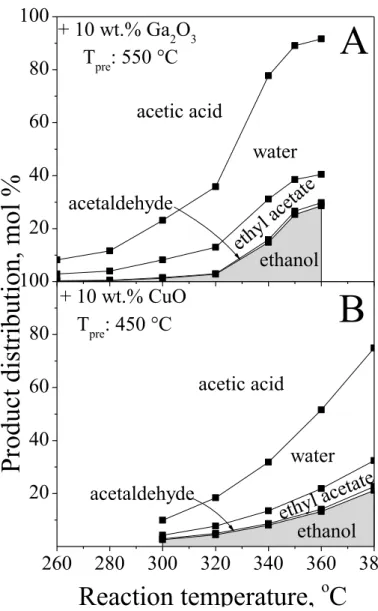
low similarly to copper or gallium admission (Fig. 5). Cu and Ga can eliminate the hydrodecarbonylation side reaction,
but give low activity level in ethanol production. Using SnO as the precursor of second metal for efficient bimetallic
catalyst co-reduction should take place at much higher pretreatment temperature than applied in routine procedure
earlier. However the choice of the suitable catalysts is expanded and a further improvement can be attained by
Conclusions
Modification of supported Ni particles with In, Sn, Cu or Ga by a novel co-reduction process of the oxide
forms effectively directs hydrodeoxygenation of carboxylic acids to alcohol production in consecutive reduction
steps and the presence of these metals hinders the hydrodecarbonylation, the chain shortening of bioacids. This
study reveals that In and Sn doped Ni/silica catalysts are highly efficient bimetallic composites. The needed lower
reduction temperature of the In2O3 containing precursor mixture and the potential of well-defined Ni2In active
phase formation are main advantages of use indium doped bimetallic catalysts for selective alcohol production
from carboxylic acids. Contrary tin promotes formation of more active bimetallic catalyst using cheaper precursor
(SnO).
Acknowledgement The authors wish to express their appreciation to Mrs. Ágnes Farkas Wellisch for her
technical assistance. Thanks is due to the Hungary-Slovakia Cross-border Co-operation Programme (Project registration
number: HUSK/1101/1.2.1/0318) for supporting this research. Thanks to the European Union and the State of Hungary
co-financed by the European Social Fund in the framework of TÁMOP 4.2.4. A/2-11-1-2012-0001 ‘National
Excellence Program’ for the further support.
References
1 G.W. Huber, S. Iborra, A. Corma, Chem. Rev. 106, 4044 (2006)
2 J.N. Cheda, G.W. Huber, J.A. Dumesic, Angew. Chem. Int. Ed. 46, 7164 (2007) 3 M. Stöcker, Angew. Chem. Int. Ed. 47, 9200 (2008)
4 D. Kubicka, Collect. Czech. Chem. Commun. 73, 1015 (2008) 5 M. F. Demirbas, Appl. Energy 86, S151 (2009)
6 S.N. Naik, V.V. Goud, P.K.Rout, A.K. Dalai, Renew. Sustain. Energy Rew. 14, 578 (2010) 7 J. C. Serrano-Ruiz, R. Luque, A. Sepúlveda-Escribano, Chem. Soc. Rev. 40, 5266 (2011) 8 M.T. Holtzapple, C.B. Granda, Appl. Biochem. Biotech. 156, 525 (2009)
9 H.N. Chang, N.J. Kim, J. Kang, C. M. Jeong, Biotechn. Bioproc. Eng. 15, 1 (2010) 10 V. Pham, M.T. Holtzapple, M.El-Halwagi, J. Ind. Microbiol. Biotech. 37, 1157 (2010) 11 D.M. Alonso, S.G. Wettstein, J. Dumesic, Chem. Soc. Rev. 41 (2012) 8075.
12. R. Alcala, J.W. Shabaker, G:W. Huber, M.A. Sanchez-Castillo, J. Dumesic, J. Phys. Chem. 109 (2005) 2074. 13. K. Zhang, H. Zhang, H. Ma, W. Ying, D. Fang, Catal. Lett. 144 (2014) 691.
15. Gy. Onyestyák, Cat. Com., 38, 50(2013)
16. Gy. Onyestyák, Sz. Harnos, Sz. Klebert, M. Stolcova, A. Kaszonyi, D. Kalló, Appl. Catal. A 464-465, 313 (2013) 17. Gy. Onyestyák, Sz. Harnos, D. Kalló, Catal. Comm. 26, 19 (2012)
Figure captions
Figure 1. Stacked area graphs of product distribution of AA hydroconversion as a function of the reaction temperature
at 21 bar and 1 gAA·/gcat.·h WHSV over Ni/silica (A), Pt/silica (C) catalysts and their In-doped forms (B, D).
Figure 2. H2-TPR fingerprints demonstrating the reduction of NiO (a), In2O3 (b), NiO + In2O3 (c), and NiO + SnO (d)
silica loaded catalyst precursors.
Figure 3. HT-XRD patterns of the indium free NiO/silica (a, a1) and NiO/silica + 10 wt% In2O3 mixture (b, b1, b2, b3)
catalyst precursors, treated in H2 flow for 30 min at different temperatures.
Figure 4. Stacked area graphs of product distributions obtained in the hydroconversion of AA over NiO/silica + 10 wt%
SnO mixture catalysts after co-reduction at 550 oC (A), 500 oC (B), 400 oC (C), and NiO/silica + 1 wt% SnO mixture
reduced at 550 oC (D) depending on the reaction temperature characteristic for SnNi/silica catalyst. The total pressure
was 21 bar and the WHSV of AA was 1 h-1. (The dashed line in Fig. 4A is the conversion curve from Fig.1B
characteristic for InNi/silica catalyst.)
Figure 5. Stacked area graphs of product distributions obtained in the hydroconversion of AA over NiO/silica + 10 wt%
Ga2O3 mixture catalysts after co-reduction at 550 oC (A) and NiO/silica + 10 wt% CuO mixture reduced at 450 oC (B)