Example-based Speech Intention Understanding and
Its Application to In-Car Spoken Dialogue System
Shigeki Matsubara† Shinichi Kimura‡ Nobuo Kawaguchi† Yukiko Yamaguchi†and Yasuyoshi Inagaki‡
†Information Technology Center, Nagoya University
‡Graduate School of Engineering, Nagoya University
CIAIR, Nagoya University
Furo-cho, Chikusa-ku, Nagoya, 464-8601, Japan [email protected]
Abstract
This paper proposes a method of speech inten-tion understanding based on dialogue examples. The method uses a spoken dialogue corpus with intention tags to regard the intention of each in-put utterance as that of the sentence to which it is the most similar in the corpus. The degree of similarity is calculated according to the degree of correspondence in morphemes and dependen-cies between sentences, and it is weighted by the dialogue context information. An exper-iment on inference of utterance intentions us-ing a large-scale in-car spoken dialogue corpus of CIAIR has shown 68.9% accuracy. Further-more, we have developed a prototype system of in-car spoken dialogue processing for a restau-rant retrieval task based on our method, and confirmed the feasiblity of the system.
1 Introduction
In order to interact with a user naturally and smoothly, it is necessary for a spoken dialogue system to understand the intentions of utter-ances of the user exactly. As a method of speech intention understanding, Kimura et al. has pro-posed a rule-based approach (Kimura et al., 1998). They have defined 52 kinds of utterance intentions, and constructed rules for inferring the intention from each utterance by taking ac-count of the intentions of the last utterances, a verb, an aspect of the input utterance, and so on. The huge work for constructing the rules, however, cannot help depending on a lot of hands, and it is also difficult to modify the rules. On the other hand, a technique for tagging di-alogue acts has been proposed so far (Araki et al., 2001). For the purpose of concretely deter-mining the operations to be done by the system,
the intention to be inferred should be more de-tailed than the level of dialogue act tags such as “yes-no question” and “wh question”.
This paper proposes a method of understand-ing speeches intentions based on a lot of dia-logue examples. The method uses the corpus in which the utterance intention has given to each sentence in advance. We have defined the ut-terance intention tags by extending an annota-tion scheme of dialogue act tags, called JDTAG (JDRI, 2000), and arrived at 78 kinds of tags presently. To detail an intention even on the level peculiar to the task enables us to describe the intention linking directly to operations of the system.
In the technique for the intention inference, the degree of similarity of each input utter-ance with every sentence in a corpus is calcu-lated. The calculation is based on the degree of morphologic correspondence and that of depen-dency correspondence. Furthermore, the degree of similarity is weighted by using dialogue con-text information. The intention of the utterance to which the maximum score is given in the cor-pus, will be accepted as that of the input utter-ance. Our method using dialogue examples has the advantage that it is not necessary to con-struct rules for inferring the intention of every utterance and that the system can also robustly cope with the diversity of utterances.
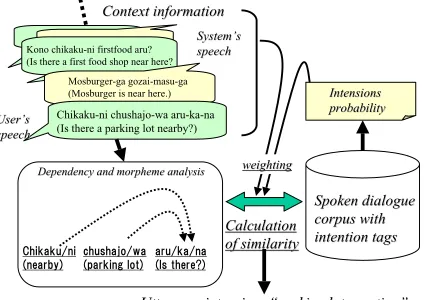
Chikaku-ni chushajo-wa aru-ka-na (Is there a parking lot nearby?)
Kono chikaku-ni firstfood aru? (Is there a first food shop near here?
Mosburger-ga gozai-masu-ga (Mosburger is near here.)
Spoken dialogue
Dependency and morpheme analysis
Dependency and morpheme analysis
System
Utterance intension: ““parking lot questionparking lot question”” Context information
Figure 1: Flow of the intention inference pro-cessing
2 Outline of Example-based Approach
Intentions of a speaker would appear in the vari-ous types of phenomenon relevant to utterances, such as phonemes, morphemes, keywords, sen-tential structures, and contexts. An example-based approach is expected to be effective for developing the system which can respond to the human’s complicated and diverse speeches. A dialogue corpus, in which a tag showing an ut-terance intention is given to each sentence, is used for our approach. In the below, the outline of our method is explained by using an inference example.
Figure 1 shows the flow of our intention inference processing for an input utterance “Chikaku-ni chushajo-wa aru-ka-na ? (Is there a parking lot nearby?)”. First, morphological analysis and dependency analysis to the utter-ance are carried out.
Then, the degree of similarity of each input utterance with sentences in the corpus can be calculated by using the degree of correspon-dence since the information on both morphol-ogy and dependency are given to all sentences in the corpus in advance. In order to raise the accuracy of the intention inference, moreover, the context information is taken into consid-eration. That is, according to the occurrence probability of a sequence of intentions learned from a dialogue corpus with the intention tags, the degree of similarity with each utterance is
weighted based on the intentions of the last ut-terances. Consequently, if the utterance whose degree of similarity with the input utterance is the maximum is “sono chikaku-ni chushajo ari-masu-ka? (Is there a parking lot near there?)”, the intention of the input utterance is regarded as “parking lot question”.
3 Similarity and its Calculation
This section describes a technique for calculat-ing the degree of similarity between sentences using the information on both dependency and morphology.
3.1 Degree of Similarity between Sentences
In order to calculate the degree of similarity be-tween two sentences, it can be considered to make use of morphology and dependency infor-mation. The calculation based on only mor-phemes means that the similarity of only sur-face words is taken into consideration, and thus the result of similarity calculation may become large even if they are not so similar from a struc-tural point of view. On the other hand, the cal-culation based on only dependency relations has the problem that it is difficult to express the lex-ical meanings for the whole sentence, in partic-ular, in the case of spoken language. By using both the information on morphology and de-pendency, it can be expected to carry out more reliable calculation.
Formula (1) defines the degree of similarity between utterances as the convex combination
βof the degree of similarity on dependency, αd, and that on morpheme,αm.
β =λαd+ (1−λ)αm (1)
αd: the degree of similarity in dependency
αm: the degree of similarity in morphology
λ : the weight coefficient (0≤λ≤1)
Section 3.2 and 3.3 explain αd and αm, re-spectively.
3.2 Dependency Similarity
Generally speaking, a Japanese dependency re-lation means the modification rere-lation between
a bunsetsu and a bunsetsu. For example,
“kono (here)”, “chikaku-ni (near)”, “washoku-no (Japanese-style food)”, “mise (a restau-rant)”, “aru (being)”, and there exist some de-pendencies such that “mise” modifies “aru”. In the case of this instance, the modifying
bun-setsu “mise” and the modified bunsetsu “aru”
are called dependent and head, respectively. It is said that these twobunsetsus are in a depen-dency relation. Likewise, “kono”, “chikaku-ni” and “washoku-no” modify “chikaku-ni”, “aru” and “mise”, respectively. In the following of this paper, a dependency relation is expressed as the order pair of bunsetsus like (mise, aru), (kono, chikaku-ni).
A dependency relation expresses a part of syntactic and semantic characteristics of the sentence, and can be strongly in relation to the intentional content. That is, it can be expected that two utterances whose dependency relations are similar each other have a high possibility that the intentions are also so.
A formula (2) defines the degree of similar-ity in Japanese dependency, αD, between two utterances SA and SB as the degree of
corre-spondence between them.
αd=
2CD
DA+DB
(2)
DA: the number of dependencies in SA
DB: the number of dependencies inSB
CD: the number of dependencies in
corre-spondence
Here, when the basic forms of independent words in a head bunsetsu and in a dependent
bunsetsucorrespond with each other, these
de-pendency relations are considered to be in cor-respondence. For example, two dependencies (chikaku-ni, aru) and (chikaku-ni ari-masu-ka) correspond with each other because the inde-pendent words of the headbunsetsuand the de-pendent bunsetsu are “chikaku” and “aru”, re-spectively. Moreover, each word class is given to nouns and proper nouns characteristic of a dialogue task. If a word which constitutes each dependency belongs to the same class, these de-pendencies are also considered to be in corre-spondence.
3.3 Morpheme Similarity
A formula (3) defines the degree of similarity in morpheme αm between two sentences SA and
⁓
‵⁚⁛⁝⁓⁝‡⁛ ⁓⁚⁝‡
‽
(Is there a Japanese restaurant near here?) ⁛⁗
Japanese dependency Japanese dependency
4 dependencies
common dependencies: 3
㱍d= 0.86
Japanese morpheme Japanese morpheme common morphemes: 6
㱍m= 0.80
㱍
= 0.82 Degree of Similarity Degree of Similarity
If㱗= 0.4,
= 0.4*0.86+0.6*0.80
7 morphemes User
User’’s utterance unit: s utterance unit: SSii
⁓⁛‡ ⁓‡⁝⁓
‵⁚⁛⁝⁓⁝‡⁛ ⁚⁝‡ ⁛⁗
(Is there a European restaurant nearby?) Example of utterance: S
Example of utterance: See
3 dependencies 8 morphemes
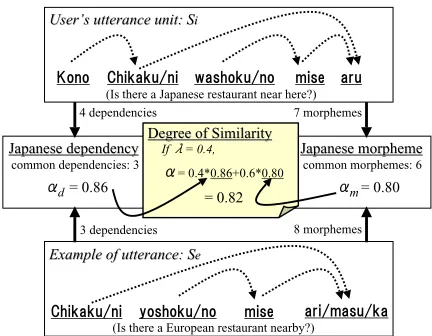
Figure 2: Example of similarity calculation
SB.
αm =
2CM
MA+MB
(3)
MA: the number of morphemes in SA
MB: the number of morphemes inSB
CM: the number of morphemes in
correspon-dence
In our research, if a word class is given to nouns and proper nouns characteristic of a di-alogue task and two morphemes belong to the same class, these morphemes are also consid-ered to be in correspondence. In order to ex-tract the intention of the sentence more simi-lar as the whole sentence, not only independent words and keywords but also all the morphemes such as noun and particle are used for the cal-culation on correspondence.
3.4 Calculation Example
Figure 2 shows an example of the calculation of the degree of similarity between an input ut-terance Si “kono chikaku-ni washoku-no mise
aru? (Is there a Japanese restaurant near here?)” and an example sentence in a corpus,
Se, “chikaku-ni yoshoku-no mise ari-masu-ka (Is
there a European restaurant located nearby?)”, when a weight coefficient λ = 0.4. The num-ber of the dependencies of Si and Se is 4 and
(washoku, aru) and (yoshoku, aru) also corre-spond with each other. Therefore, the degree of similarity in dependency αd comes to 0.86
by the formula (2). Since the number of mor-phemes of Si and Se are 7 and 8, respectively,
and that of morphemes in correspondence is 6, i.e., “chikaku”, “ni”, “no”, “mise”, “aru(i)” and “wa(yo)shoku”. Therefore, αm comes to 0.80 by a formula (3). As mentioned above, β us-ing both morphemes and dependencies comes to 0.82 by a formula (1).
4 Utilizing Context Information
In many cases, the intention of a user’s utter-ance occurs in dependence on the intentions of the previous utterances of the user or those of the person to which the user is speaking. There-fore, an input utterance might also receive the influence in the contents of the speeches before it. For example, the user usually returns the answer to it after the system makes a question, and furthermore, may ask the system a ques-tion after its response. Then, in our technique, the degree of similarity β, which has been ex-plained in Section 3, is weighted based on the intentions of the utterances until it results in a user’s utterance. That is, we consider the oc-currence of a utterance intentionInat a certain timento be dependent on the intentions of the last N − 1 utterances. Then, the conditional occurrence probabilityP(In|Inn−−N1+1) is defined
as a formula (4).
P(In|Inn−−N1+1) = C
(Inn−N+1)
C(Inn−−N1+1) (4)
Here, we write a sequence of utterance in-tentions In−N+1· · ·In as Inn−N+1, call it in-tentions N-gram, and write the number of appearances of them in a dialogue corpus as
C(In
n−N+1). Moreover, we call the conditional
occurrence probability of the formula (4), in-tentions N-gram probability.
The weight assignment based on the inten-tions sequences is accomplished by reducing the value of the degree of similarity when the in-tentions N-gram probability is smaller than a threshold. That is, a formula (5) defines the de-gree of similarityγ using the weight assignment by intentions N-gram probability.
Search
Condition search
Parking search
Nearness question
Shop question Business hours question
Distance question
Time question
Rank questionMenu price question Number of car question Parking price question Parking question
䊶䊶䊶intention tag 䊶䊶䊶dialogue act tag
䊶䊶䊶conditional tag leaf
Yes-no question Wh question 䊶䊶䊶
Unknown information
Unknown information
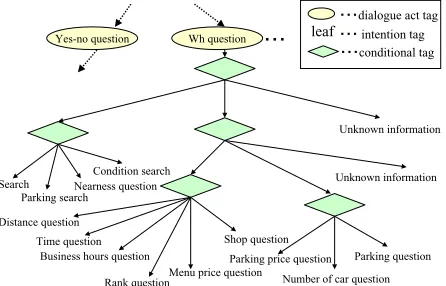
Figure 3: Decision tree of intention tag (a part)
γ =
ωβ (P(In|Inn−−N1+1)≤θ)
β (otherwise) (5)
ω: weight coefficient (0≤ω≤1)
β: the degree of similarity
θ: threshold
A typical example of the effect of using inten-tions N-gram is shown below. For an input ut-terance “chikaku-ni chushajo-wa ari-masu-ka? (Is there a parking lot located nearby?)”, the degree of similarity with a utterance with a tag “parking lot question” which intends to ask whether a parking lot is located around the searched store, and a utterance with a tag “parking lot search” which intends to search a parking lot located nearby, becomes the maxi-mum. However, if the input utterance has oc-curred after the response intending that there is no parking lot around the store, the system can recognize its intention not to be “parking lot question” from the intentions N-gram prob-abilities learned from the corpus, As a result, the system can arrive at a correct utterance in-tention “parking lot search”.
5 Evaluation
In order to evaluate the effectiveness of our method, we have made an experiment on ut-terance intention inference.
5.1 Experimental Data
0.4 0.45 0.5 0.55 0.6 0.65 0.7
0 0.1 0.2 0.3 0.4 0.5 0.6 0.7 0.8 0.9 1
weight coefficient 㱗
ac
cura
cy
recall precision
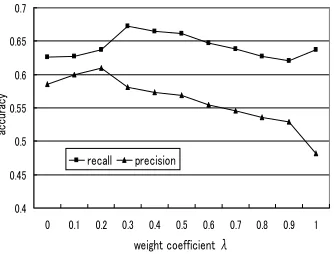
Figure 4: Relation between the weight coeffi-cient λand the accuracy (λ= 0.3)
2001), was used as a corpus with intention tags, and analyzed based on Japanese dependency grammar (Matsubara et al., 2002). That is, the intention tags were assigned manually into all sentences in 412 dialogues about restaurant search recorded on the corpus. The intentions 2-gram probability was learned from the sen-tences of 174 dialogues in them. The standard for assigning the intention tags was established by extending the decision tree proposed as a di-alogue tag scheme (JDRI, 2000). Consequently, 78 kinds of intention tags were prepared in all (38 kinds are for driver utterances). The inten-tion tag which should be given to each utter-ance can be defined by following the extended decision tree. A part of intention tags and the sentence examples is shown in Table 1, and a part of the decision tree for driver’s utterances is done in Figure 3 1.
A word class database (Murao et al., 2001), which has been constructed based on the pus, was used for calculating the rates of cor-respondence in morphemes and dependencies. Moreover, Chasen (Matsumoto et al., 99) was used for the morphological analysis.
5.2 Experiment
5.2.1 Outline of Experiment
We have divided 1,609 driver’s utterances of 238 dialogues, which is not used for learning the intentions 2-gram probability, into 10 pieces equally, and evaluated by cross validation. That is, the inference of the intentions of all 1,609
sen-1In Figure 3, the description in condition branches is
omitted.
㪇㪅㪌㪍 㪇㪅㪌㪏 㪇㪅㪍 㪇㪅㪍㪉 㪇㪅㪍㪋 㪇㪅㪍㪍 㪇㪅㪍㪏 㪇㪅㪎
㪇 㪇㪅㪈 㪇㪅㪉 㪇㪅㪊 㪇㪅㪋 㪇㪅㪌 㪇㪅㪍 㪇㪅㪎 㪇㪅㪏 㪇㪅㪐 㪈 㫎㪼㫀㪾㪿㫋㩷㪺㫆㪼㪽㪽㫀㪺㫀㪼㫅㫋㩷㱥
㪸㪺㪺㫌㫉
㪸㪺
㫐
㫉㪼㪺㪸㫃㫃㩷㩷㩷㩷㩷㩷㩿㱗㪔㪇㪅㪊㪀
㫇㫉㪼㪺㫀㫊㫀㫆㫅㩷㩿㱗㪔㪇㪅㪊㪀
Figure 5: Relation between the weight coeffi-cientω and the accuracy
tences was performed, and the recall and preci-sion were calculated. The experiments based on the following four methods of calculating the de-gree of similarity were made, and their results were compared.
1. Calculation using only morphemes
2. Calculation using only denpendencies
3. Calculation using both morphemes and denpendencies (With changing the value of the weight coefficientλ)
4. Calculation using intentions 2-gram prob-abilities in addition to the condition of 3. (With changing the value of the weight co-efficient ω and asθ= 0)
5.2.2 Experimental Result
The experimental result is shown in Figure 4. 63.7% as the recall and 48.2% as the precision were obtained by the inference based on the above method 1 (i.e. λ = 0), and 62.6% and 58.6% were done in the method 2 (i.e. λ= 1.0). On the other hand , in the experiment on the method 3, the precision became the maximum by λ= 0.2, providing 61.0%, and the recall by
λ= 0.3 was 67.2%. The result shows our tech-nique of using both information on morphology and dependency to be effective.
When λ ≤ 0.3, the precision of the method 3 became lower than that of 1. This is because the user speaks with driving a car (Kawaguchi
et al., 2000) and therefore there are much
Table 1: Intention tags and their utterance examples
intention tag utterance example
search Is there a Japanese restaurant near here?
request Guide me to McDonald’s.
parking lot question Is there a parking lot?
distance question How far is it from here?
nearness question Which is near here?
restaurant menu question Are Chinese noodles on the menu?
Morphological &
Intension
Intension
Action
Dependency analysis
Shop information database Search
Search
Response inference
generation
In-car spoken dialogue corpus with
intension tags CalculationCalculation
Intensions 2 Intensions 2--gramgram probability probability Weighting
Weighting
Dictionary & parsing rules
Intension Intension--actionaction transfer rules transfer rules
Context stack
Decision Decision Analysis
Results User
User’’s Utterances Utterance
System
System’’s utterances utterance
Figure 6: Configuration of the prototype system
one utterance, a lot of sentences in the corpus tend to have the maximum value in inference using dependency information.
Next, the experimental result of the inference using weight assignment by intentions 2-gram probabilities, when considering as λ = 0.3, is shown in Figure 5. At ω = 0.8, the maximum values in both precision and recall were provided (i.e., the precision is 68.9%). This shows our technique of learning the context information from the spoken dialogue corpus to be effective.
6 In-car Spoken Dialogue System
In order to confirm our technique for automat-ically inferring the intentions of the user’s ut-terances to be feasible and effective for task-oriented spoken dialogue processing, a proto-type system for restaurant retrieval has been developed. This section describes the outline of the system and its evaluation.
6.1 Implementation of the System
The configuration of the system is shown in Fig-ure 6.
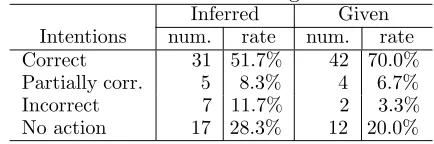
Table 2: Comparison between the results on in-ferred intentions and those on given intentions
Inferred Given
Intentions num. rate num. rate
Correct 31 51.7% 42 70.0%
Partially corr. 5 8.3% 4 6.7%
Incorrect 7 11.7% 2 3.3%
No action 17 28.3% 12 20.0%
1. Morphological and dependency
anal-ysis: For the purpose of example-based speech understanding, the morphological and dependency analyses are given to each user’s utterance by referring the dictionary and parsing rules. Morphological analy-sis is executed by Chasen (Matsumoto et al., 99). Dependency parsing is done based on a statistical approach (Matsubaraet al., 2002).
2. Intentions inference: As section 3 and 4 explain, the intention of the user’s ut-terance is inferred according to the degree of similarity of it with each sentence in a corpus, and the intentions 2-gram proba-bilities.
key-words such as “washoku (Japanese restau-rant)” and “chikaku (near)”.
4. Response generation: The system re-sponds based on templates which include the name of shop, the number of shops, and so on, as the slots.
6.2 Evaluation of the System
In order to confirm that by understanding the user’s intention correctly the system can behave appropriately, we have made an experiment on the system. We used 1609 of driver’s utterances in Section 5.2.1 as the learning data, and the intentions 2-gram probabilities learned by 174 of dialogues in Section 5.1. Furthermore, 60 of driver’s utterances which are not included in the learning data were used for the test. We have compared the results of the actions based on the inferred intentions with those based on the given correct intentions. The results have been classi-fied into four groups: correct, partially correct, incorrect, and no action.
The experimental result is shown in Table 2. The correct rate including partial correct-ness provides 76.7% for the giving intentions and 60.0% for the inferred intentions. We have confirmed that the system could work appropri-ately if correct intentions are inferred.
The causes that the system based on given intentions did not behave appropriately for 14 utterances, have been investigated. 6 utterances are due to the failure of keywords processing, and 8 utterances are due to that they are out of the system’s expectation. It is expected for the improvement of the transfer rules to be effective for the former. For the latter, it is considered to turn the responses such as “I cannot answer the question. If the questions are about · · ·, I can do that.”
7 Concluding Remarks
This paper has proposed the example-based method for inferring speaker’s intention. The intention of each input utterance is regarded as that of the most similar utterance in the cor-pus. The degree of similarity is calculated based on the degrees of correspondence in both mor-phemes and dependencies, taking account of the effects of a sequence of the previous utterance’s intentions. The experimental result using 1,609 driver’s utterances of CIAIR in-car speech
cor-pus has shown the feasibility of example-based speech intention understanding. Furthermore, we have developed a prototype system of in-car spoken dialogue processing for a restaurant re-trieval task based on our method.
Acknowledgement: The authors would like to thank Dr. Hiroya Murao, Sanyo Electric Co. LTD. for his helpful advice. This work is par-tially supported by the Grand-in-Aid for COE Research of the Ministry of Education, Sci-ence, Sports and Culture, Japan. and Kayamori Foundation of Information Science Advance-ment.
References
Araki, M., Kimura, Y., Nishimoto, T. and Ni-imi, Y.: Development of a Machine Learnable Discourse Tagging Tool,Proc. of 2nd SIGdial
Workshop on Discourse and Dialogue, pp. 20–
25 (2001).
The Japanese Discouse Research Initiative JDRI: Japanese Dialogue Corpus of Multi-level Annotation,Proc. of 1st SIGdial
Work-shop on Discourse and Dialogue(2000).
Kawaguchi, N., Matsubara, S., Iwa, H., Ka-jita, S, Takeda, K., Itakura, F. and Inagaki, Y.: Construction of Speech Corpus in Mov-ing Car Environment, Proc. of ICSLP-2000, Vol. III, pp. 362–365 (2000).
Kawaguchi, N., Matsubara, S., Takeda, K. and Itakura, F.: Multimedia Data Collec-tion of In-car Speech CommunicaCollec-tion, Proc.
of Eurospeech-2001, pp. 2027–2030 (2001).
Kimura, H., Tokuhisa, M., Mera, K., Kai, K. and Okada, N.: Comprehension of Intentions and Planning for Response in Dialogue,
Tech-nical Report of IEICE, TL98-15, pp:25–32
(1998). (In Japanese)
Matsubara, S., Murase, T., Kawaguchi, N. and Inagaki, Y.: Stochastic Dependency Parsing of Spontaneous Japanese Spoken Language,
Proc. of COLING-2002 (2002).
Matsumoto, Y., Kitauchi, A., Yamashita, T. and Hirano, Y.: Japanese Morphological Analysis System Chasen version 2.0
Man-ual, NAIST Techinical Report,
NAIST-IS-TR99009 (1999).