An Investigation into Teachers’ Attitudes towards Performance
Management in Zimbabwe
N. Wadesango*, D. Nduna** and M. Kurebwa**
*Walter Sisulu University, East London, RSA **Zimbabwe Open University, Midlands Region, Zimbabwe KEYWORDS Principals. Efficiency. Standards. Performance. Supervision
ABSTRACT This study sought to examine the attitude of teachers in Rusununguko Cluster of Shurugwi in the Midla nds Pr ovince in or der to establish the extent to which performa nce ma nagement helped to improve performance of teachers in schools. The descriptive survey research design was used and the sampling technique used was the random sampling. Thirty (30) teachers and seven (7) heads were used as research subjects. Questionnaires and interviewers were used as instruments. The data that was collected through questionnaires and interviews was calculated in percentages and presented in tables. The study showed that performance management is a policy which is there in the Ministry of Education, Sport, Arts and Culture that is also being implemented in schools. The study recommended that work for teachers be reduced so that more time should be devoted to the implementation of performance management. Secondly, the study also recommends that there be a comprehensive traini ng for teachers and heads on performance management programme so that they continue to implement performanc e management positively.
Address for correspondence:
Dr. N. Wadesango,
Walter Sisulu University, RSA
E-mail: [email protected]
INTRODUCTION
The History of Performance Management
Performance management began a long time ago in both private and public sectors. It was done in higher offices and industry. This is sup-ported by Rollison et al. (1998: 722) when they say, “Performance Appraisal in the past was con-ducted in the high reaches of the organisation.” Bell (1989: 323) says: “...appraisal of teacher is not new since all promotions depend on some form of appraisal. What is new is the govern-ment’s intention to ensure that the performance of teachers is regularly appraised and to enshrine this determination in legislation.” Robins (2007: 131) also says: “..performance management ...was done by means of the very unpopular inspec-torate system. The system was secretive in the sense that educators had no say in the way in-spection was done or the criteria used in the eval-uation of their performance”
Before independence in Zimbabwe, inspec-tors would ‘raid’ the school to do their apprais-als. The system was strongly associated with a summative and judgmental approach to perfor-mance management rather than a formative and
developmental approach. Summative and judge-mental is comparative, adjudicative and final. It is meant to and designed to make a decision about the worthiness of a teacher. Contrarily for-mative and developmental approach is ongoing, cooperative, collaborative, non-judgemental and is directed at improving teacher performance (Bo-wora and Mpofu 1995). In the 1980s performance management of teachers in Zimbabwe took some more positive approach.
Both formative and summative evaluation of teachers is undertaken by heads through fre-quent visits to teachers in their classrooms. The frequency of visits as reported by Nyagura and Reece (1989) vary depending on whether the teacher is new, inexperienced, experienced, weak, untrained or in training.
In a school the head and teachers identity performance standards which would be the ba-sis for the work plans. In the second stage, the head and the teacher agree on the strategies of determining individual performance within a giv-en period. At the third stage, individual perfor-mance is measured against set standards within a given time frame. At the fourth step which is the final stage, performance is being evaluated reinforced or remediated (Certo 1997).
The Purpose of Performance Management
Performance management can help the indi-vidual teacher to identify his or her strengths
and weaknesses. It also enables the supervisors or heads to identify the skills and competencies that are inadequate in teachers for which staff development programmes can be planned so as to remedy the deficiency. Jubenkanda (2004: 86) cites that, “the performance management sys-tem enables managers, to identify employees who are effective in their jobs and those who are not performing to expectations.” This means that performance management can help in the achievement of organisation goals because the deficiencies may be remedial and this may lead to organisation effectiveness.
Writing on the same issue, Cole (1993: 325-326) provides a summarised list of reasons for performance appraisal as:
To identify an individual’s current level of job performance
To identify employee strengths and weak-nesses
To enable employees to improve their per-formance
To provide a basis for rewarding employ-ee in relation to their contribution to or-ganisation goals
To motivate individuals
To identify training and development needs
To provide information for succession planning
To draw attention to present performance in the job in order to reward people fairly
To identify those with potential for pro-motion or transfer.
As stated above by Cole (1993), performance management is an aid to creating a satisfactory level of performance by employees in their jobs. It may contribute towards effective and improved performance by individuals as they know that their performance is monitored. The above idea is supported by Fletcher and Williams (1992: 1) when they say that the purpose of performance appraisal is;
...providing a basis for making comparison between staff in deciding on promotion, pay increase or their incentives acting as a moti-vating mechanism and as a vehicle for perfor-mance improvement or collecting information for personal planning and management
devel-opment.
From the above quotation, it can be deduced that performance management requires quality managerial judgement. The most likely reason
for the adoption of performance management is to draw attention to present performance in the job in order to reward fairly and to identify those with potential for promotion or transfer.
Performance management helps teachers to achieve organisational goals. Performance ap-praisal helps heads, deputy heads and teachers in charge to select specific goals and objectives and make some agreements towards the attain-ment of the set objectives. Sergiovanni and Star-rat (1983: 100) say, “...actual classroom perfor-mance is the basis for improvement...” This means performance management can help the teacher to improve performance and achieve or-ganisational goals, children, receiving quality education as demanded by parents and society at large. Chakanyuka (1999) also confirmed that performance management has crept in the edu-cation system as a result of demands for quality education from parents and society at large. Teachers want to know how they perform and to be rewarded through recognition, money and opportunity for growth. Sallis (2002: 317) states that, “an effective performance appraisal system must only accurately measure current perfor-mance levels but also mechanisms for reinforc-ing strengths.”
According to Betts (1989), there is need to appraise employees in order to give a clear indi-cation of progress. Performance management encourages employees to obtain useful feedback. The information obtained can be used by super-visors to transfer/promote employees or to give them performance related pay. When teachers get high pay increase or bonuses through per-formance management, they may be motivated to work harder. Performance management also promotes colleagueship as stated by Mnkandla (2004: 15) when he says performance manage-ment promotes. “...collegial dialogue and infor-mation sharing” This means that performance management builds friendship and helps teach-ers to share ideas which are very important in implementing the curriculum, teachers staff de-veloping each other so as to achieve organisa-tional effectiveness.
Problems of Performance Management in Zimbabwean Schools
Below is a brief discussion of some of the problems of performance management Zimbabwe identified:
Basing Assessment on a Single Criterion Kapfunde (2000: 86) argues that, “if perfor-mance were to be assessed on a single criterion, teachers would be forced to ignore tasks that are not assessed.” Thus, ignoring other tasks which the teacher is good at might frustrate the teach-er.
Leniency Error
Kapfunde (2000) identifies two types of Le-niency Errors. The first is positive leLe-niency error characterised by high rating. The teacher’s per-formance is overstated. The second one is neg-ative leniency error characterised by low rating. The teacher’s performance is understated. Halo Error
Is the tendency of the appraiser to let the assessment of the individual appraise on one trait influence his/ her appraisal of that individual on other traits (Kapfunde 2000). For example, if a teacher tends to be trustworthy and dependable, a ratter might become biased towards the teach-er and rate the teachteach-er highly on many othteach-er de-sirable attributes.
Similarity Error
This occurs when the school head rates teachers by giving special consideration to those qualities that he or she perceives to be good. For example, the head might become biased towards the teacher who has the same handwriting as his and the rate the teacher high.
Low or High Differentiation
According to Kapfunde (2000), the school head’s ability to appraise objectively and accu-rately may be adversely affected by social differ-entiation.
METHODOLOGY
Theresearch design that was used to inves-tigate the attitudes of teachers towards perfor-mance management was the descriptive survey. The descriptive survey research design is effec-tive in gathering information that describes the nature and extent of specific data. This method was found suitable because the researchers’
interest was to collect original data for purposes of describing a population large enough to ob-serve directly. Comprehensive descriptions and statistical figures were obtained from questions as well as interviews to describe the phenome-non under study. Babbie (1992: 278) states that “in one sense, surveys are flexible, many ques-tions may be answered on a given topic giving you considerable flexibility in your analysis”. Random sampling was used and the sample cov-ered thirty teachers and seven school heads. Data were collected through questionnaires and indi-vidual interviews.
Data Presentation and Analysis
An analytical technique was employed to analyse data gathered during the field study. Quantitative data from open ended questions followed thematic approach in its description and interpretation. Themes were derived from re-search objectives and rere-search questions. Fre-quency tables were constructed. Information was recorded on data sheets, open ended questions were analysed and linked to the tabulated data. The percentages were calculated and numbers from these calculations were rounded off to one decimal place using a scientific calculator.
RESULTS AND DISCUSSION
A total of thirty-seven questionnaires were distributed to teachers and heads in Rusunguko Cluster of Shurugwi. The percentage return of questionnaires was hundred percent. The high rate of return was due to the fact that the re-searchers visited the schools and personally handed and collected the questionnaires soon after completion.
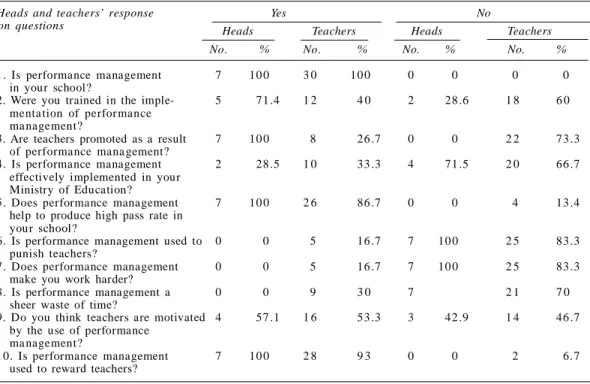
As reflected in Table 1, all teachers 30 (100%) and all heads 7 (100%) agreed that the policy was being implemented. It showed that the poli-cy was being carried out in schools. Twelve (40%) teachers and five (17%) heads received some training while 29 (60%) of teachers and 2 (28%) were not trained. The data revealed that they were some heads and teachers who were not trained. What was worrying was that if 28.6% of heads and 60% of teachers did not receive any form of training and yet they were the ap-praisers and appraises how they rating each oth-er? Mnkandla (2004: 45) states that:
Insufficient training has been blamed for performance management fragile state. It is pos-sible that performance management as an in-strument for the average teacher effectiveness may be too sophisticated. Furthermore, school heads charged with its promotion may not be well versed in its intricacies. This means that for any programme to take off smoothly the par-ticipants of that programme must receive suffi-cient training.
Seven (100%) heads and twenty- eight (93%) teachers agreed that the policy was used to re-ward teachers. Cole (1993: 326) says, “The most likely reason for the adoption is to draw atten-tion to present performance in the job in order to reward people fairly.” Seven (100%) heads and fifteen (83.3%) denied that performance manage-ment was used to punish teachers, but teachers were rated according to their performance. From the interviews conducted most of the teachers revealed that performance management was not there to punish teachers but to help teachers identify their strengths and weaknesses only that the policy was not clear. On the contrary, 5 (16.7%) agreed that performance management was used by heads to punish teachers for previous offenc-es. Mnkandla (2004: 6) states that performance
management is, “...a source of inspiration for some and a source of frustration and disdain for oth-ers, sometimes appreciated and at other times rejected as an untenable ideal, depending on the circumstances.”
This means that some teachers knew the ben-efits of performance management and view it as punishment as indicated by 5 (16.7%) teachers. Nine (30%) teachers agreed that performance management was a sheer waste of time as allud-ed by Lathan (2004: 6) when he statallud-ed that, “It is a waste of time and resources.” While 21 (70%) teachers and all heads indicated that performance management was not sheer waste of time one of the interviewees was quoted saying that.
Performance management is not a sheer waste of time but it enables teachers to improve their performance. Only that is has a lot of cheat-ing, teachers recording wrong information. For example, in the individual progress record book, the teacher manufacturing marks with-out giving the children an exercise or tests but
only to update records.
Seven (100%) heads and twenty- six (86.7%) teachers indicated that high pass rates in schools were recorded. Through interviews the heads revealed that performance management encour-Table 1: Head and teachers’ respo nse on perf ormance management questions
Heads and teachers’ response Yes No
Heads Teachers Heads Teachers
No. % No. % No. % No. %
1. Is performance management 7 10 0 3 0 10 0 0 0 0 0 in your school?
2. Were you trained in the imple- 5 71 .4 1 2 4 0 2 28 .6 1 8 6 0 menta tion of perfor mance
ma nagement?
3. Are teachers promoted as a result 7 10 0 8 26 .7 0 0 2 2 73 .3 of performance mana gement?
4. Is performance management 2 28 .5 1 0 33 .3 4 71 .5 2 0 66 .7 effectively implemented in your
Ministry of Education?
5. Does performance management 7 10 0 2 6 86 .7 0 0 4 13 .4 help to produce high pass rate in
your school?
6. Is performance management used to 0 0 5 16 .7 7 10 0 2 5 83 .3 punish teachers?
7. Does performance management 0 0 5 16 .7 7 10 0 2 5 83 .3 make you work harder?
8. Is performance management a 0 0 9 3 0 7 2 1 7 0 sheer waste of time?
9. Do you think teachers are motivated 4 57 .1 1 6 53 .3 3 42 .9 1 4 46 .7 by the use of performance
ma nagement?
10. Is performance management 7 10 0 2 8 9 3 0 0 2 6.7 used to reward teachers?
aged teachers to be duty conscious. Sallis (2002) states that, “performance management encour-ages, ‘better support for the person with the ball.” This means that performance management helps the teacher to air out his or her problems so that they can be quickly solved, for example, shortage of textbooks. Robins (2007) also noted that performance appraisal provides formal op-portunity to exchange views if the atmosphere is conducive. This means that teachers are allowed to share insights in performance appraisal. This can help to solve problems and good results may be produced. Zero (0%) heads and five (16.7%) teachers agreed that performance management made them work harder. What it meant is that 7 (100%) and 25 (83.3%) teachers disagreed that performance management made them work hard-er. Most of the teachers and all heads in inter-views argue that they were adults, they knew what they were doing and they always worked hard so as to achieve organisational goals. What they wanted was a pressure- free environment where they could work without being pushed. Seven (100%) heads and eight (26.7%) agreed that performance management was used to pro-mote teachers. Bell (1989) contends that appraisal of teachers is now new since all promotions de-pend on some form of appraisal. However, the majority of teachers disagreed that performance management was used for promotion. This means that most of the teachers did not see people be-ing promoted because of performance manage-ment.
On the other hand, all heads agreed that per-formance management was used to promote teachers. Through interviews, about three- quar-ters of the heads indicated that they were pro-moted because of performance management. Some were saying that they used to produce good results at Grade Seven (7). As reflected in Table 1, 4 (57.1%) heads and 16 (53.3%) teachers agreed that performance management was used to motivate teachers. Timperly (1989) states that, “when teachers get high pay increases or bo-nuses through performance management, they may be motivated to work hard”. This means that if teachers are rewarded they work hard. This means that if teachers are rewarded they become motivated and work very hard. On the other hand, 3 (42.9%) heads and 14 (46.7%) teachers disagreed that performance management was used to motivate teachers. Some argued that if heads show some signs of favouritism then
teachers become demotivated and my resent its implementation.
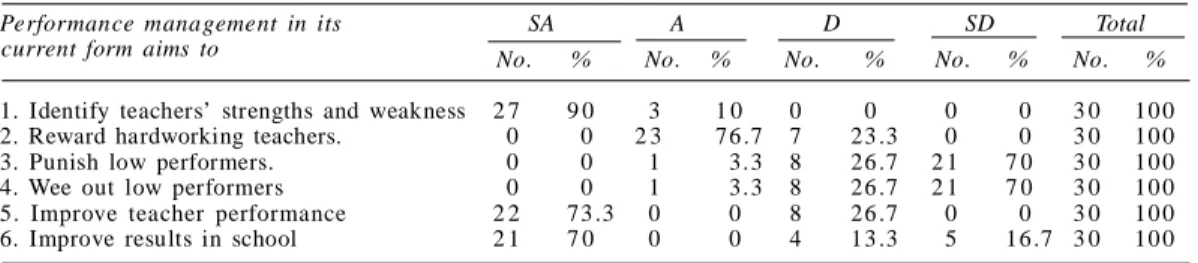
As reflected in Table 2, 27 (90%) teachers strongly agreed that 3 (10%) agreed that perfor-mance management was meant to identify teach-ers’ strength and weaknesses. They held the perception that performance management helped teachers identify their strengths and weakness-es. Jubenkanda (2004) notes that performance management provides guidance and assistance to teachers so that they can develop their strengths and overcome their weaknesses. For example, teachers detected problems and diffi-culties concerning teaching and learning in or-der to find solutions.
On rewarding hardworking teachers, the re-sponses revealed that 23 (76.7%) agreed and 7 (23.3%) disagreed. If teachers are highly moti-vated, they may be in a position to work hard and a high pass rate is likely to be recorded. Those who disagreed felt that results of perfor-mance management were not really used to re-ward teachers who excelled because some heads were biased. Mnkandla (2004: 5) concedes this as he says, “There are problems of bias and the halo effect leading to problems of leniency, gen-erosity and central tendency.”
From Table 2 (3.3%) agreed that performance management was there to punish teachers. Through an interview the responded was quot-ed saying that, “Some heads use performance management to punish teachers for personal grudges or for some previous misbehaviour.” This seems to contradict with Mullins (2005) that appraisal should not be used by administrators to punish or humiliate teachers whom they do not like. This implies that some heads misuse the system on teachers.
On the contrary, 8 (26.7%) disagreed that performance management was used by heads to punish teachers. The data showed that perfor-mance management improves results in school. Twenty- one (70%) of the teachers agreed. Re-sponding to open ended questions some respon-dents commented that it encouraged cheating rather than teaching. Some teachers entered false marks in the Individual Progress Record book so as to update it. Indeed this is not professional development. One of the interviewees said that, “Performance management gave the teacher un-necessary work to write especially updating which did not help the pupils.” However, most of the teachers perceived performance manage-ment as a beneficial exercise.
As indicated in Table 3, the data collected showed that 1 (14.2%) heads strongly agreed, 3 (42.9%) of the heads disagreed that performance management was about rewarding performance. Jubenkanda (2004) argues that an appraisal is not only a statement of a subordinate’s perfor-mance, but a mirror of the supervisor’s personal-ity and concept of adequate performance. Also one of the respondents through heads to evalu-ate themselves... “This means that performance management is there to help the heads grow pro-fessionally. Seven (100%) of the schools heads confirmed that performance management en-hanced teachers’ professional efficiency and ef-fectiveness. All asserted that performance man-agement resulted in production of both qualita-tive and quantitaqualita-tive work and improvement of results. Other heads felt that linking performance management to pay undermined attempts to pro-vide honest feedback and emotion free review of strengths and weaknesses of teachers’ perfor-mance. Timperly (1989) also suggests that di-rectly linking appraisal with rewarding excellence or identifying incompetence tended to undermine the way in which a teacher typically conceives his or her commitment and professionalism. Since the programme was put in place, it is painful that some teachers have not been rewarded.
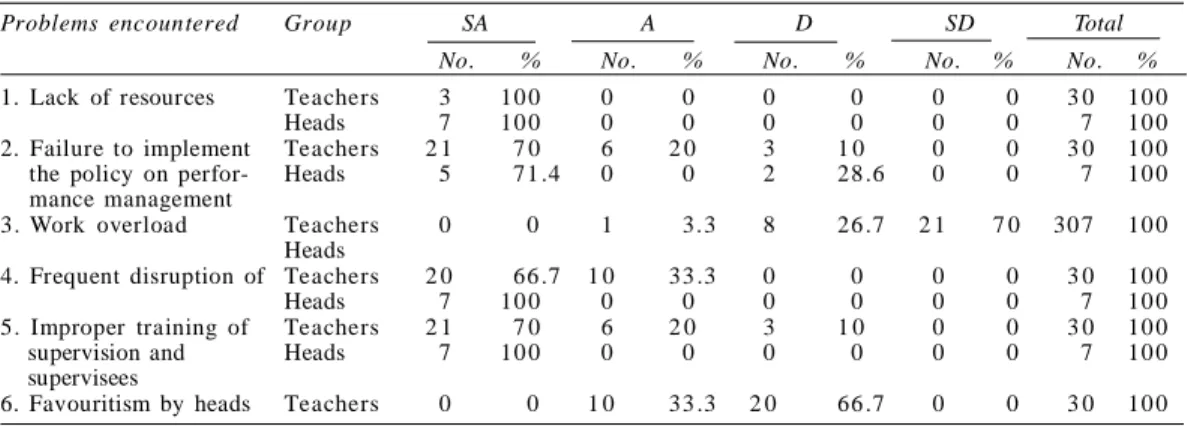
As shown in Table 4, all teachers and heads agreed that lack of resources was a great
draw-back on the implementation of performance man-agement. From the data collected from the table, 27 (90) teachers and 7 (100%) heads agreed that there was improper training of supervisors and supervisee. Mnkandla (2004: 45) states that, “In-sufficient training has been blamed for perfor-mance management fragile state.” This means that most of the heads did not know how to im-plement the programme effectively as revealed in the data that the majority of teachers and all heads agreed that they were failing to implement the policy effectively. Three (21%) teachers dis-agreed. They indicated that they underwent the training and were of the opinion that supervi-sors understood the concept of performance management.
Twenty (66.7%) and ten (33.3%) teachers which is 100% of them and all heads agreed that there was work overload when implementing performance management. This implies that all teachers and heads agreed that performance management increased the workload, on the open ended questionnaire one respondent noted that:
There is a lot to be done so as to implement the curriculum effectively. Time tables are load-ed with lessons to be taught daily or weekly. If there are few or less written exercises recorded in the Individual Progress Record Book auto-matically the teacher is going to be underrated and is considered a low performer yet more time current form aims to
Table 2: Teachers’ responses on the objectives of performance management (N=30)
Performance management in its SA A D SD Total
No. % No. % No. % No. % No. %
1. Identify teachers’ strengths and weakness 2 7 9 0 3 1 0 0 0 0 0 3 0 10 0 2. Reward hardworking teachers. 0 0 2 3 76 .7 7 23 .3 0 0 3 0 10 0 3. Punish low performers. 0 0 1 3.3 8 26 .7 2 1 7 0 3 0 10 0 4. Wee out low performers 0 0 1 3.3 8 26 .7 2 1 7 0 3 0 10 0 5. Improve teacher performance 2 2 73 .3 0 0 8 26 .7 0 0 3 0 10 0 6. Improve results in school 2 1 7 0 0 0 4 13 .3 5 16 .7 3 0 10 0 SA = Strongly agreed, A = Agreed D = Disagree, DS = Strongly disagreed
Table 3: Heads’ responses on the objectives of performance management (N=7)
Performance management in its SA A D SD Total
No. % No. % No. % No. % No. %
1 . Supervising the subordinate 1 14 .2 3 42 .9 3 42 .9 0 0 7 10 0 2 . Assessing the efficiency and effectiveness 5 71 .4 2 28 .6 0 0 0 0 7 10 0
of teachers
3 . Enhancing teachers’ performance. 4 57 .1 3 42 .9 0 0 0 0 7 10 0 4 . Enhancing teachers’ professionalism in
was given to the records and other curricular activities.
Mullins (2005: 6) also states that performance management is considered as “...a useless exer-cise meant to provide records only.” Twenty- six (86.7%) strongly agreed and four (13.3%) dis-agreed that there was frequent disruptions of time-tables. Seven (100%) heads also strongly agreed that there were frequent disruptions of time-tables. All respondents agreed that there was a lot of disruption of time-tables. All respon-dents agreed that there was a lot of disruption of lessons due co-curricular duties and other activ-ities that disturbed lessons such as sports, prize giving days just to mention a few.
It was difficult for the teachers to cover up the wasted time in the preparations for co-curric-ular duties in order to meet the intended goals of performance management programmes. Time al-located to performance management was inade-quate. Heads had to meet each teacher to agree on Key Result Areas and to carry out reviews with each other. Heads have got administrative tasks, curricular tasks and also instructional tasks to carry out, so time allocated to each teacher for appraisal may not be sufficient. Ten (33.3%) teachers indicated that some heads showed favouritism. Through interviews some teachers indicated that some heads did not have some form of training on the implementation of perfor-mance management. In this research 29% were not knowledgeable. Kapfunde (2000: 89) states that, “Where good appraisers are not available, the alternative is to train personnel as apprais-ers. Common errors such as the halo effect and leniency error can be eliminated with systematic training programmes for evaluators...” this means
that if one is not well vested with knowledge to carry out appraisal interviews he/she maybe caught up in problems like halo effect, strictness and biases.
Twenty (66.7%) teachers indicated that heads did not show some favouritism. Through inter-views the majority of teachers said that if heads had undergone training on performance manage-ment, they would be well vested with knowledge to carry out the implementation process and rate teachers accordingly. If teachers were rated un-fairly they reacted in a defensive or hostile fash-ion as was said by one of the respondents. The main findings of the study were that although performance management is something old, teachers and heads viewed it with mixed feel-ings. Teachers perceived performance manage-ment differently. The study revealed that the majority of teachers and heads had not under-gone some training in the implementation of per-formance management. Goldstein (1995) and Lathan (2004) have emphasized the need to have both appraisers and appraises trained in the skills of appraisals. They went on to say for any pro-gramme to take off smoothly participants of that programme must receive some form of training. If both heads and teachers are trained, they are likely to appreciate the process. The study showed that the main purpose of performance management was not to punish or weed out low performers but the best solution was to help them. Bowora and Mpofu (1995) have said that one should assess how well the teachers are perform-ing and whether there is somethperform-ing that can be done to improve their performance. Bell (1989) revealed that because of the hidden agenda be-Table 4: Heads and teachers’ responses to the factors that influence the implementation of performance m a n a g e m e n t
Problems encountered Group SA A D SD Total
No. % No. % No. % No. % No. %
1. Lack of resources Teachers 3 10 0 0 0 0 0 0 0 3 0 10 0
Heads 7 10 0 0 0 0 0 0 0 7 10 0
2. Failure to implement Teachers 2 1 7 0 6 2 0 3 1 0 0 0 3 0 10 0 the policy on perfor- Heads 5 71 .4 0 0 2 28 .6 0 0 7 10 0 mance management
3. Work overload Teachers 0 0 1 3.3 8 26 .7 2 1 7 0 30 7 10 0 Heads
4. Frequent disruption of Teachers 2 0 66 .7 1 0 33 .3 0 0 0 0 3 0 10 0
Heads 7 10 0 0 0 0 0 0 0 7 10 0
5. Improper training of Teachers 2 1 7 0 6 2 0 3 1 0 0 0 3 0 10 0 supervision and Heads 7 10 0 0 0 0 0 0 0 7 10 0 supervisees
hind the implementation of performance manage-ment, teachers may resent it especially if it is intended to identify incompetent teachers and weed them out.
Despite its benefits, performance manage-ment presents implemanage-mentation problems such as lack of time and resources. As said earlier, heads and insufficient time to implement the programme as they had administrative, curricular and insti-tutional tasks to perform in their schools. On the other hand, teachers were overloaded with records and congested time-tables. These prob-lems affected effective implementation of perfor-mance management programme. Again, linking performance management to pay can undermine attempts to provide honest feedback. Timperly (1989) stated that linking performance to pay can also undermine participative setting of targets since teachers and heads may attempt to set what is easily achievable. If the main aim of mance management is to improve current perfor-mance, then the attachment of performance man-agement to bonus makes one to question wheth-er the intention is to reward high pwheth-erformwheth-ers or to dissertation staff development needs. How-ever, some heads and teachers interviewed ar-gued that linking of performance management to bonus increases motivation and establishes the credibility of pay decisions. The above state-ments holds some element of truth but the wor-thiness of performance should not solely mea-sured in terms of bonus but in producing quality results. The researcher realised that performance management can improve performance. Howev-er, it requires careful diagnosis, training, imple-mentation and reinforcement, performance man-agement appears to be quite simple on paper.
CONCLUSION
It was found out that performance manage-ment is a policy which is there in the Ministry of Education, Sport, Arts and Culture and that it is being implemented in schools. At the time of the study it was found that some teachers and heads were not rewarded, that is, no salary increments were given to both teachers and heads as a re-sult of performance management. This shows that the Ministry of Education, Sports, Arts and Culture did not reward teachers accordingly through salary increments or bonus due to per-formance management. These findings
indicat-ed that although performance management was implemented not all teachers were not motivated by performance management so as to work hard to improve quality of education. The research revealed that some teachers and heads were aware of the performance management. Perfor-mance management policy was intended to pro-mote teachers, used as way of motivating and rewarding teachers. This was done to improve school personnel so as to improve quality of education.
RECOMMENDATIONS
On the basis of the research findings, the research findings, the researchers made the fol-lowing recommendations in anticipation that they would help in the implementation of perfor-mance management in Rusununguko Cluster of Shurugwi District. The following recommenda-tion was made:
1) The work load of teachers should be re-duced so that more time can be devoted to the implementation of performance man-agement. This can be done by reducing record books. For example, child study Record Book, number of written exercises per week should be reduced.
REFERENCES
Babbie E 1992. The Practice of Social. 6th edition.
Cal-ifornia: Wadsworth.
Bartlett S 2000. The development of teacher apprais-al: A recent history. British Journal of Education
Studies, 48 (3): 24-37.
Bell L 1989. Management Shill in Primary Schools. London: Routledge.
Bowor a LC, Mpofu DA 19 95. Ma nag ing Sch ools. Harare: Zimbabwe.
Certo SC 1997. Supervisions: Quality: Diversity and
Technology. 2nd Edition. Chicago: Irwin.
Chakanyuka S 1999. Leadership and Organisational
Effectiveness (Module EA3AD 301). Harare:
Zim-babwe Open University.
Cole GAM 1993. Management Theory and Practice.
4th Edition. London: Shepherds Bush Green.
Fletcher C, Williams R 1994. Performance Appraisal
and Career Development. 2nd Edition.
Chaltern-ham: Stanley Thomas Publishers Ltd.
Goldstein H 1995. Interpreting International
Compar-isons of Achievement. Paris, UNESCO.
Jubenkanda RR 2004. Human Resources Management
Policy. Harare: Zimbabwe Open University.
Lathan GP 2004. The motivation benefits of goal set-ting. Academy of Management Executive, 18(4): 126 -129.
Mnkandla VA 2004. The A....B....C... of Performance
Management for Schools and College. Bulawayo:
Typocra fter s.
Mullins LJ 2005. Manag ement and Organisational
Behaviour. London: Pearson Education Limited.
Nyangura LM, Reece JL1989. The school head as an instructional leader in Zimbabwe. Zimbabwe
Jour-nal of EducatioJour-nal Research, 22(3): 23-38.
Robbins SP 1998. Organisational Behaviour and
Anal-ysis: An Integrated Approach. London: Prentice
Hall.
Robins SP 2007. Organisational Behaviour. Global and
Southern African Perspectives. Cape Town:
Pear-son Education South Africa.
Sallis E 2002. Total Quality Management in Educa-tion. London: Kegan Paul.
Sergiovanni TJ, Starrat RJ 1979. Supervision: Human
Perspectives. New York: Mac Graw Hill.
Timperly HS 198 9. Per formance appraisal: Princi-pal’s perspectives and source implications.