prepared by:
G. Jasniewicz, F. Crifo, D. Hestroffer, A.
Jean-Antoine-Piccolo, A. Siebert, C. Soubiran
approved by:
CU6 Steering Committee
reference:
GAIA-C6-SP-UM2-GJ-001-4
issue:
4
revision:
1
date:
28-03-2008
Abstract
This document presents the Software Requirement Specifications (SRS) of the DU640 ”Radial Velocity Zero-Point”. It is identical with the preceding issue and applicable for cycle 4.
Document History
Issue Revision Date Author Comment
4 1 28-03-2008 G. Jasniewicz Document (cycle 4) approved by CU6 Steering Committee
4 0 11-01-2008 G. Jasniewicz Document (cycle 4) submitted to the CU6 Steering Committee
3 1 03-10-2007 G. Jasniewicz Revised document (cycle 3), after last correc-tions
3 0 24-09-2007 G. Jasniewicz Revised document (cycle 3), rewritten with la-tex
2 2 19-07-2007 G. Jasniewicz Document (cycle 3) submitted to the CU6 Steering Committee
2 1 05-06-2007 G. Jasniewicz Revised document due to revision of the SDD (cycle 2)
1 1 14-02-2007 G. Jasniewicz Revised document (cycle 2)
1 0 15-12-2006 G. Jasniewicz Document (cycle 2) submitted to the CU6 Steering Committee
Contents
1 Introduction 6 1.1 Objectives . . . 6 1.2 Scope . . . 7 1.3 Assumptions . . . 7 1.4 Applicable Documents . . . 7 1.5 Reference Documents . . . 71.6 Definitions, acronyms, and abbreviations . . . 7
2 General description and requirements 10 2.1 Context . . . 10
2.2 Decomposition . . . 12
2.3 Requirements . . . 12
3 List of radial velocity reference sources : stars 13 3.1 Description and Objectives . . . 13
3.2 Requirements . . . 14
3.3 Input / Output . . . 15
4 List of radial velocity reference sources : asteroids 16 4.1 Description and Objectives . . . 16
4.2 Requirements . . . 16
5 The external CU6/CU8 external database of stars and asteroids 18
5.1 Description and Objectives . . . 18 5.2 Requirements . . . 19 5.3 Input / Output . . . 20
6 Software Module ”Astrophysical Zero-Point” 21
6.1 Description and Objectives . . . 21 6.2 Requirements . . . 21 6.3 Input / Output . . . 22
1
Introduction
This document presents the Software Requirement Specifications of the DU ”Radial Velocity Zero-Point”.
The main goal of this DU is to establish a grid of ground-based reference sources (stars and asteroids) for the radial velocity zero-point of the RVS. This task is clearly not a software prod-uct, but is included in this SRS document (§3, §4 &§5). This issue of the SRS contains also requirements concerning asteroids.
Another goal of this DU is to determine the best kinematic radial velocities from the RV mea-surements obtained with the RVS (software module ”Astrophysical zero-point”).
The list of ground-based reference stars will evolve with time and its content will be ultimately confirmed only at the end of the mission. In particular the optimal number of these stars will be defined from studies in other WPs of CU6. The ground-based reference stars will have to be numerous enough in order to correct any sudden instrumental changes in the satellite (warming of the on-board instruments, necessity of regular resets of detectors, etc...).
The list of asteroids will depend on the date of the launch and ephemeris. Simulation of spectro-scopic data on the one hand and spectrospectro-scopic observations of ground-based reference sources on the other hand are in progress.
1.1
Objectives
As the RVS has no wavelength calibration device on board, the RVS calibration system (see GAIA-C6-SP-MSSL-HEH-003-2) will use GAIA-selected reference stars, e.g. qualified as ref-erence based on GAIA observations. These well behaved-stars (bright, RV-stable and of a well-suited spectral type) will allow to iteratively derive the wavelength scale of the RVS in-strument and hence the RV of all observed stars in a relative reference frame. Ground-based reference stars, also called RV-STD standard stars hereafter (stars with an accurate RV already known from ground observations) and asteroids (for which celestial mechanics gives a very precise RV) will be used to derive the transformations from SGIS relative reference frame to an absolute reference frame. These transformations are hereafter referred to as ”zero point correc-tions”.
Due to a lack of bright asteroids to be observed by RVS, and their peculiar distribution over the sky, the main ground-based reference sources for the RV zero-point will be stars. The asteroids will be however the ultimate references, as only for them the kinematic radial velocity (KRV) can be known with high accuracy and in an absolute way.
Thus our main objective is to build a list of RV-STD stars from existing catalogues of radial ve-locities complemented with new dedicated ground-based observations. An ad-hoc database will also be built for an easy use and verification of the data obtained with different ground-based instruments, as well as for permitting the exchange of data and information through the GAIA community.
astro-physical corrections (see software module ”Astroastro-physical zero point”,§6).
1.2
Scope
This document is applicable to the development unit DU640 within CU6.
1.3
Assumptions
1.4
Applicable Documents
[1] DPAC Product Assurance Plan
[2] CU6 Structure & Software Development Plan [3] CU6 Software Requirements Specification
1.5
Reference Documents
[1] T. Levoir & contributors. Product Assurance and Engineering Dispositions for Software Development Plan. Technical report, CNES, 2006. GAIA-C1-SP-CNES-TL-001-1. [2] D. Katz, M. Cropper and N. Gerbier, G. Jasniewicz, A. Jean-Antoine, T. Levoir, and
Y. Viala. Software Development Plan of CU6. Technical report, Observatoire de Paris Meudon, 2006. GAIA-C6-SP-OPM-DK-003-2.
[3] F. Th´evenin et al. A. Jean-Antoine, D. Katz. CU6 Spectroscopic Processing Software Re-quirements Specification. Technical report, CNES, 10 2007. GAIA-C6-SP-CNES-AJA-001-01.
1.6
Definitions, acronyms, and abbreviations
The requirements set out in this SRS follow the labeling scheme:
CU6-DU640-X-SCOPE-xxx
where DU640 is the WP number or Software Product Label (e.g. AGIS) X is either S (for
Scientific), T (for Technical), Q (for Quality Assurance), or M (for Management). SCOPE is a three or four letter scope specification of the requirement following the identified list of possible values (see [1]) whenever feasible. xxx is a monotonically increasing counter. In the
following, the constant prefix CU6-DU640 will be omitted from the requirement labels for brevity. However, the full form shall be used when referring to specific requirements outside the scope of this SRS.
Each requirement is presented with its unique label and a number of attributes in accordance with [1] in the following form:
X-SCOPE-010 C.v Priority Verific. Status
Description
Parent Parent
with (see [1] for lists of allowed values, meanings and valid ranges):
X-SCOPE-xxx The unique identifier of the requirement (see above)
C.v Version number of the requirement composed of major (C) and minor (v) part
Priority Priority of the requirement Verification
Envisaged validation method of requirement - this will be either AUT for auto-mated or MAN for Manual. The Software Test Plan defines precisely how the requirement is verified.
Status Status identifier
The following is a complete list of acronyms used in this document.
Acronym Description
AIP Astrophysikalisches Institut Postdam
ASU Astronomical Server URL (see http//cdsweb.u-strasbg.fr/doc/asu.html) AZP Astrophysical Zero Point
BP Blue Photometer
BVC Barycentric Velocity Correction HR Hertzsprung-Russell
KRV Kinematic Radial Velocity RP Red Photometer
RV Spectroscopic Radial velocity (see also SRV) RVS Radial Velocity Spectrometer
RVZP Radial Velocity Zero Point
SGIS Spectroscopic Global Iterative Solution SRV Spectroscopic Radial velocity
2
General description and requirements
This document will include four kinds of requirements :
- requirements concerning the list of stars as radial velocity reference sources - requirements concerning the asteroids as radial velocity reference sources - requirements concerning the CU6 external database
- requirements concerning the Astrophysical Zero Point software module
2.1
Context
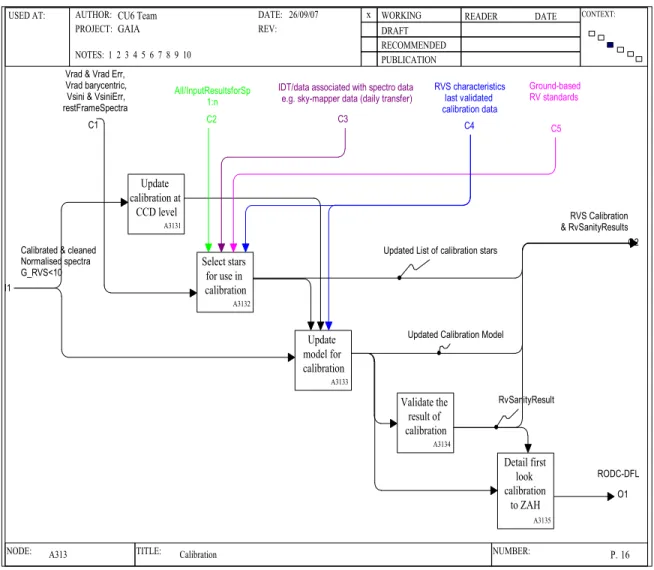
!" # $ I1Calibrated & cleaned Normalised spectra G_RVS<10 C2 All/InputResultsforSp 1:n C3
IDT/data associated with spectro data e.g. sky-mapper data (daily transfer)
C4 RVS characteristics last validated calibration data C5 Ground-based RV standards C1 Vrad & Vrad Err, Vrad barycentric, Vsini & VsiniErr, restFrameSpectra O2 RVS Calibration & RvSanityResults O1 RODC-DFL %&'() *'+,-.'(,/0'( +)1)+ )+)*(2('.2 3/.42),0 *'+,-.'(,/0 %&'() 5/&)+3/. *'+,-.'(,/0 '+,&'()(6) .)24+(/3 *'+,-.'(,/0 )(',+3,.2( +//7 *'+,-.'(,/0 (/8 RvSanityResult Updated Calibration Model
Updated List of calibration stars
9 " )'5 :: '+,-.'(,/0
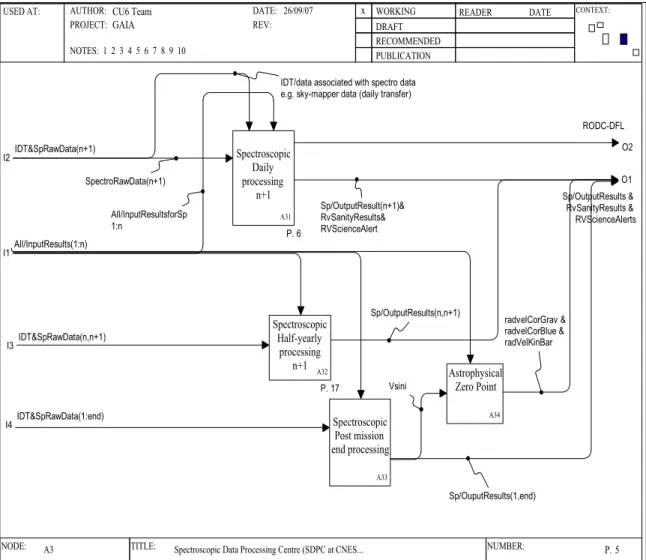
!" # $ O2 RODC-DFL O1 Sp/OutputResults & RvSanityResults & RVScienceAlerts I3IDT&SpRawData(n,n+1) I2IDT&SpRawData(n+1) I1All/InputResults(1:n) I4IDT&SpRawData(1:end) %&'()*+'*%,' -,./ %)*'&++,01 02 P. 6 %&'()*+'*%,' -.34/&-)./ %)*'&++,01 02 P. 17 %&'()*+'*%,' *+(5,++,*0 &06%)*'&++,01 All/InputResultsforSp 1:n SpectroRawData(n+1) Sp/OutputResults(n,n+1) Sp/OutputResult(n+1)& RvSanityResults& RVScienceAlert IDT/data associated with spectro data e.g. sky-mapper data (daily transfer)
Sp/OuputResults(1,end) +()*%7/+,'-. 8&)**,0( Vsini radvelCorGrav & radvelCorBlue & radVelKinBar 9 " &-5 :: %&'()*+'*%,'-(-)*'&++,01 &0()&; -( $$$
2.2
Decomposition
The Work Packages WP-640-3000 and WP-640-4000 will give lists of reference sources (re-spectively RV-STD stars and asteroids) for the RV Zero-Point.
A database has been built in order to store basic data and to collect ground-based observations of all reference sources.
This document is concerned with requirements about i) the list of RV-STD stars, ii) the list of asteroids, iii) the external CU6 (shared with CU8) database and iv) the software module Astro-physical Zero Point (AZP). The software module AZP (WP-640-5000) is totally independent on WP-640-3000 and WP-640-4000.
3
List of radial velocity reference sources : stars
3.1
Description and Objectives
The RV-STD stars (see§1.1) are expected to have no variation of their radial velocities greater than 300ms−1 during the 5 years of the Gaia observations. Our objective is thus to select
can-didates having the highest probability to have this property. They will be included in a priority 1 list which is expected to have a limited number of reference stars (<∼ 3000). It is also
planned to have a list of verification stars (priority 2) including many more stars, with lower accuracy, but wider range of parameters (from e.g. the RAVE survey which has typical errors of∼1−3km s−1).
The RV-STD stars should be F5-G-K stars (dwarfs & giants) and M dwarfs which are very well suited for high precision RV measurements because of many sharp absorption lines in their op-tical and near IR spectrum. Giant stars have the sharpest lines but only clump stars in the HR diagram are known to be RV stable (otherwise micro-variability may affect their RV measure-ments). Besides we have to check that the RV zero-point established with the list of RV-STD stars, is correct for ALL spectral-type stars observed with the RVS. A basic priority 1 list has been built since cycle 1 and before, according to the following concerns :
• the selection criteria should apply on a very homogeneous way; therefore it seems very desirable that the RV-STD candidates all belong to the HIPPARCOS catalogue (even if not a real must);
• only a small number of original lists and corresponding instruments should be con-sidered, again for homogeneity reasons;
• the stars have to be sufficiently bright for a high spectral S/N ratio and good accu-racy of RV measurements. On the other hand, the stars must not be too bright in order to avoid saturation of CCDs.
• several RV measurements of the candidates should be already available from the literature;
• known variable stars and double stars should be avoided, unless temporal periodic variations are well below the threshold of0.3km s−1;
• most of the RV-STD stars will have late spectral type, but some of them will have earlier spectral types in order to check independency of the RV zero-point with spectral type.
• RV-STD stars have to be constant (no slow drift) until end of mission (2017). The already published RV lists cover measurements made before 2002, and their time
span is smaller than the time remaining until end of mission. Therefore ground-based measurements are an absolute must, from now until end of mission, in order to ensure a good long-term stability of these reference objects.
• in this follow-up process of the selected stars, some will prove to be not usable, because not stable enough; therefore one has to start with an oversized list.
Several selection criteria have already been adopted, some others are currently investigated. An improved list of RV-STD stars is being built according to the following requirements (§3.2).
3.2
Requirements
S-FUNC-010 3.1 FUNC HIGH MAN Issued
Establish a list of RV-STD F-G-K stars and associated SRV, available for the CU6 Calibration DU.
Parent CU6-RVZP-S-FUN-030
S-FUNC-020 3.1 FUNC HIGH MAN Issued
A few RV-STD stars shall also be selected for each spectral type in order to derive the radial velocity zero-point as function of spectral type.
Parent CU6-RVZP-S-FUN-030
S-FUNC-030 1.1 FUNC HIGH MAN Issued
Sky coverage of the RV-STD stars shall be as uniform as possible, and with no holes.
Parent CU6-RVZP-S-FUN-030
S-FUNC-040 1.1 FUNC HIGH MAN Issued
Density of the RV-STD stars in the sky coverage (thus total number of RV-STD stars) shall be in compliance with DU Calibration.
Parent CU6-RVZP-S-FUN-030
S-FUNC-050 1.1 FUNC HIGH MAN Issued
The RV-STD F-G-K stars shall belong to the HIPPARCOS catalogue ; they shall not be known as photometric variables nor as binaries.
S-FUNC-060 1.1 FUNC HIGH MAN Issued Brightness of RV-STD candidates shall be :6≤V;GRVS≤10.
Parent CU6-RVZP-S-FUN-030
S-FUNC-070 1.1 FUNC HIGH MAN Issued
Observational history of the ground-based measurements shall be ”good” (spectra with a high S/N, high number of RV measurements, time span of observations of several years).
Parent CU6-RVZP-S-FUN-030
S-FUNC-080 1.1 FUNC HIGH MAN Issued
RV-stability of RV-STD stars shall be : σ(RV)≤300m.s−1
(no RV-variations due to binarity, pulsation, etc...) ;σbeing the standard deviation
of measurements.
Parent CU6-RVZP-S-FUN-030
S-FUNC-090 1.1 FUNC HIGH MAN Issued
For each RV-STD, there will be no bright neighbours (∆mag≤5) within a 70” radius in the sky (their spectra could contaminate the reference source spectrum).
Parent CU6-RVZP-S-FUN-030
S-FUNC-100 1.1 FUNC HIGH MAN Issued
Ground-based observations shall be made before the launch and during the mission in order to guarantee good observational history (see FUNC-70) and RV-stability (see FUNC-80) of the RV-STD stars.
Parent CU6-RVZP-S-FUN-030
S-FUNC-110 3.1 FUNC HIGH MAN Issued
An external database, collecting ground-based observations of RV-STD candidates and storing results, shall trace requirement FUNC-100.
Parent CU6-RVZP-S-FUN-030
4
List of radial velocity reference sources : asteroids
4.1
Description and Objectives
Asteroids are ultimate reference sources for the RVS because their theoretical orbital RV are predicted at the accuracy level of 1m.s−1. Asteroids belong to the ecliptic zone (with
eclip-tic latitude circa ±30 deg) and are photometrically variable due to variations of distance and phase (over period of months), and also due to their spin and shape (over periods of hours). The number of asteroids withVmin ≤ 10(maximum of brightness) over say one year is rather
small, about 25; it reaches roughly 250 objects withVmin≤12. One can also note that the solar
system objects will not be observed near opposition, where they are brighter. The number of bright asteroids (V <10) which go across the Field of View (FoV) of the RVS has already been
estimated thanks to simulations (by F. Mignard and D.Hestroffer), taking into account different scanning laws, initial conditions, epochs of launch, etc... The average number (rate) of obser-vations per day could be0.2±0.7; the period without observable objects could be as long as 5
months.
Besides, SRV of asteroids obtained with the RVS can be altered by numerous effects: high proper motion, angular size, and possibly phase and reflectance. Moreover the brightest objects are also the largest, and are not always detected by the Gaia onboard detection pipeline. These effects have to be studied thanks to the GIBIS simulator and to observational studies (especially in the GAIA wavelength range).
The number and list of asteroids to be retained for the KRV zero-point will be set depending on the required signal-to-noise ratio ; this might yield to a limiting magnitude slightly different to the valueGRVS
,min = 10given here. We will also have to test the coherence of the RV zero-point
provided by the RV-STD stars with that provided by asteroids.
4.2
Requirements
S-FUNC-210 1.1 FUNC HIGH MAN Issued
Establish a list of asteroid candidates for the RV zero-point, and a way to deliver their SRV to the CU6 ”Calibration” DU.
Parent CU6-RVZP-S-FUN-030
S-FUNC-220 3.1 FUNC HIGH MAN Issued
Asteroid candidates for the RV zero-point shall have to be bright enough. The limiting magnitude should be clarified with the ground-based tests.
S-FUNC-230 3.1 FUNC HIGH MAN Issued
Asteroid candidates for the RV zero-point shall have a limited angular size on the sky.
Parent CU6-RVZP-S-FUN-030
S-FUNC-240 3.1 FUNC HIGH MAN Issued
Asteroid candidates for the RV zero-point shall have a limited apparent motion.
Parent CU6-RVZP-S-FUN-030
S-FUNC-250 3.1 FUNC HIGH MAN Issued
Effects due to rotational velocity and phase, that are not well modeled, shall not alter significantly the SRV of asteroids.
Parent CU6-RVZP-S-FUN-030
S-FUNC-260 3.1 FUNC HIGH MAN Issued
Ground-based observations of asteroids shall be made before the launch in order to check i) the consistency between their SRV and KRV, ii) the consistency between the RV zero point of asteroids and that of RV-STD stars.
Parent CU6-RVZP-S-FUN-030
S-FUNC-270 3.1 FUNC HIGH MAN Issued
Ground-based observations of asteroids and measurements shall be stored in the external CU6/CU8 database, in order to trace requirement FUNC-260.
Parent CU6-RVZP-S-FUN-030
5
The external CU6/CU8 external database of stars and
as-teroids
5.1
Description and Objectives
Data associated to the ground-based reference stars, both from the literature and from our ded-icated ground-based observations, will be integrated in a dynamical database according to cri-teria of RV-stability. Calibration data being required for both CU6 and CU8, the database is aimed at storing both the astrophysical parameters (CU8) and the radial velocities (CU6) from ground-based observations for a large number of reference stars that will be observed before and during the mission. Stars with the requested properties (stability over several years for RV reference stars) will thus be easily selected from the database and used for calibration purposes. The database will consist of a set of four tables which can be accessed and updated via a web interface. The four tables are the following :
• Basic Data : will store external information (not linked to CU6 or CU8 observa-tions) on the objects.
• Radial velocity measurements : will store radial velocities (derived from dedicated ground-based measurements or collected from the literature) and associated quanti-ties/description to assess the radial velocity stability.
• Stellar parameters measurements : will store measured stellar parameters for a given observation.
• Observation : will contain a full description of the observation and associated spec-tra.
The common key between the tables has been chosen to be the object’s primary identifiers (Hipparcos, HD, 2MASS or UCAC2) instead of the position to avoid misidentification of the sources.
Web interface :
The database will be accessed using a web-application hosted by the AIP. The access will be password protected for security as database update features are available in the web-application.
5.2
Requirements
S-FUNC-310 1.1 FUNC HIGH MAN Issued
The database will store basic data for stars (identifiers, photometry, astrom-etry, spectral classification) extracted from literature and other databases (SIMBAD,etc...) and for asteroids.
Parent CU6-RVZP-S-FUN-030
S-FUNC-320 1.1 FUNC HIGH MAN Issued
The database shall store spectra (and raw data) of stars and asteroids from dedicated ground-based observations for CU6 and CU8, before and during the GAIA mission.
Parent CU6-RVZP-S-FUN-030
S-FUNC-330 1.1 FUNC HIGH MAN Issued
The database shall store description of observations and associated spectra of stars & asteroids.
Parent CU6-RVZP-S-FUN-030
S-FUNC-340 1.1 FUNC HIGH MAN Issued
The database shall store stellar RV measurements (from literature and ded-icated ground-based observations) and associated quantities for CU6. The database shall also store the observed SRV and computed KRV of asteroids observed from ground.
Parent CU6-RVZP-S-FUN-030
S-FUNC-350 1.1 FUNC HIGH MAN Issued
The database shall store stellar parameters measurements for CU8.
Parent CU6-RVZP-S-FUN-030
S-FUNC-360 1.1 FUNC HIGH MAN Issued
The database shall be reachable/queryable through a Web interface. The spectra shall also be retrievable through this interface.
6
Software Module ”Astrophysical Zero-Point”
6.1
Description and Objectives
For all stars observed by the RVS, the objective is to derive RV corrections in order to get KRV from SRV. The KRV must reflect only the motion of the center of gravity of the star. In order to compute these corrections, the software will have to locate in the HR diagram any star observed by the RVS (such as white dwarf, giant, supergiant, etc..). There are two kinds of corrections :
• gravitational correction (redshift) ; for white dwarfs, this correction can be as high as30km s−1. This gravitational correction will be delivered by CU8.
• atmospheric correction : the SRV reflects properties of the atmosphere of the star, which may be moving up or down, or perturbed by rotational velocity. For a typical star of the main sequence with a spectral type F, the correction due to a convective blueshift of the absorption lines could be about1km s−1 (Cf Lindegren & Dravins,
2003, A&A 401, 1185-1201).
6.2
Requirements
S-FUNC-510 1.1 FUNC HIGH MAN Issued
The ’Astrophysical Zero Point’ shall carry out radial velocity corrections (redshifts and blueshifts of spectral lines) on SRV (Spectroscopic Radial Velocity, as given by the RVS) and shall derive KRV (Kinematic Radial Velocity).
Parent CU6-RVZP-S-FUN-010
S-FUNC-520 1.1 FUNC HIGH MAN Issued
The ’Astrophysical Zero Point’ shall apply only to stars.
Parent CU6-RVZP-S-FUN-010
S-FUNC-530 1.1 FUNC HIGH MAN Obsolete
The ’Astrophysical Zero Point’ shall derive radius from Parallax, BP & RP (photometry), extinction and atmospheric parameters, and then shall compute gravitational redshift.
S-FUNC-540 1.1 FUNC HIGH MAN Issued
The ’Astrophysical Zero Point’ shall compute blueshifts (especially con-vective blueshift) from atmospheric parameters and specific stellar atmo-spheric models.
Parent CU6-RVZP-S-FUN-020
6.3
Input / Output
Name Description Access
type
Object Type of the object (star, galaxy, asteroid, etc...)
C teff Effective temperature of the source C
teffErr Error on teff C
logg Surface gravity of the source C
loggErr Error on logg C
feh Metallicity of the source C
fehErr Error on feh C
Vsini Projected rotational velocity C
VsiniErr Error on Vsini C
radVelSpeBar Barycentric spectroscopic radial velocity of the star
I radVelSpeBarErr Error on radVelSpeBar I radVelCorGrav RV correction = gravitational redshift I radVelCorGravErr Error on radVelCorGrav I radVelCorBlue RV correction = blueshift (convective, etc...) O radVelCorBlueErr Error on radVelCorBlue O radVelKinBar Barycentric kinematic radial velocity of the
star
O radVelKinBarErr Error on radVelKinBar O
Atmospheric parameters teff, logg, feh and Vsini will be given by CU8 (GAIA photometry and/or GAIA RVS).
The spectroscopic radial velocity radVelSpeBar is assumed TO BE CORRECTED from the Barycentric Velocity Correction (BVC) given by CU3. Thus radVelKinBar is also corrected from the BVC.
A
Traceability to upper level requirements
Parent Requirement Requirements in this document
CU6-RVZP-S-FUN-010 S-FUNC-510, S-FUNC-520, S-FUNC-530
CU6-RVZP-S-FUN-020 S-FUNC-540
CU6-RVZP-S-FUN-030 S-FUNC-010, S-FUNC-020, S-FUNC-030, S-FUNC-040, S-FUNC-050, S-FUNC-060, S-FUNC-070, S-FUNC-080, S-FUNC-090, S-FUNC-100, S-FUNC-110, S-FUNC-210, S-FUNC-220, S-FUNC-230, S-FUNC-240, S-FUNC-250, S-FUNC-260, S-FUNC-270, S-FUNC-310, S-FUNC-320, S-FUNC-330, S-FUNC-340, S-FUNC-350, S-FUNC-360