FORWARD
This paper introduces Enterprise Database to you and your organization. Enterprise Database reflects your organization’s effective planning, management, and control. Enterprise Database employs database, technology, and above all else, clear thinking and common sense. Whitemarsh Products (methodologies, courses, and software) provides the first two; you provide the last two. All four empower you to achieve Enterprise Database with minimum effort and maximum effectiveness.
Whether your organization is small, medium, or large, its survival depends on learning from the past, controlling the present, and planing the future. Small organizations have a local area network, intra- or inter-net, servers, and work stations for operations, administration, and management. Working together is essential to make the sweet music of business: profits.
If your business is bigger, there are multiple LANS, multiple locations, some amount of centralized management, and growing tension for decentralized controls. While high profits of some products will cover the losses of other products, maximizing the effective use of timely information is essential to optimize the present and to leverage the future.
And finally, if your business is an international conglomerate, all that has been said above has been understated! You must simultaneously have greater centralized dominion along with
decentralized, multiple-country, multi-lingual, multi-monetary implementation. And, mistake not the warm winds of today's success, they are really the closing-in, hot breath of escalating, predatory competition.
Enterprise Database is achieved by following a formalized approach to maximize the use of your business' information. Whitemarsh’s product line contains methodology, courses, tools,
techniques and consulting geared to help your business--small, medium, or large--to assess, plan, and achieve information system mastery. Ultimately, you alone achieve Enterprise Database. We can only help. For us to say, or for you to believe otherwise would be our lie and an indication of your naivety.
Data is executed policy. If your policy is in disarray, then, so too, must your business. In today's environment, you cannot have a quality business and disheveled information systems. This paper reflects the importance of the topic. Read on. We hope to hear from you soon! Even a clean bill of health can be a shot in the arm.
1.0 WHAT IS ENTERPRISE DATABASE
Enterprise Database is not something you buy. Rather, it is something you achieve. Achieved, your enterprise's state of organization, and your functions of planning, financing, and controlling will enable you to research the past, operate effectively in the present and plan for the future with maximum efficiency and minimum cost.
Enterprise Database is data centered: data that is firmly rooted in essential policy analysis and procedures formulation so as to ensure constancy and longevity. The heart of Enterprise Database is database: the treaty that governs its users. Given today's technology, Enterprise Database is implemented in a distributed manner, exhibiting consistent semantics (rules of meaning and usage) with maximum local control and ownership.
Figure 1 depicts a typical schematic of distributed hardware, software and data networks. At the core of each distribution ring is one or more server controlled databases. Each database,
These databases show an integrated set of five database architecture classes: original data capture, transaction data staging area, subject area, wholesale data warehouses, and data marts. These databases all address one or more functional areas. As appropriate, all the databases make use of a common set of reference data to regularize the semantics of selection, control breaks, and reporting. Altogether, this network of databases form the enterprise's database1.
Original data capture databases store information about ongoing database applications. This data may arise from commercial off the shelf (COTS) applications, those that have been custom created, or that may have resulted from software generation. This latter approach is seen to provide all the benefit of custom, but at the speed and cost of COTS. There may be as many different ODC databases are there significant nodes within the various Resource Life Cycles2. The data from the
Subject area databases pull data from one or more TDSA databases and construct databases about broad subject areas. The maximum quantity of subject area databases should be the quantity of distinct enterprise resources. Subject area databases can contain completely new information that results from analyses and forecasting based on subject area data.
A warehouse database is one that stores information pulled from the many different subject area databases. The data contained in data warehouses is pulled from subject area databases and is synchronized as to time and granularity. For example, monthly, and in whole dollars. Wholesale databases are commonly multi-subject area but may be restricted to divisions of the enterprise and/or countries within which a company does business.
A data mart database is ad hoc and is created for a special need. Its design, software to load and report from it are all custom developed. Data mart database volumes may also be restricted to just the broad swath of data required for an individual office or even person and may be downloaded to that office or person on a weekly or even nightly basis.
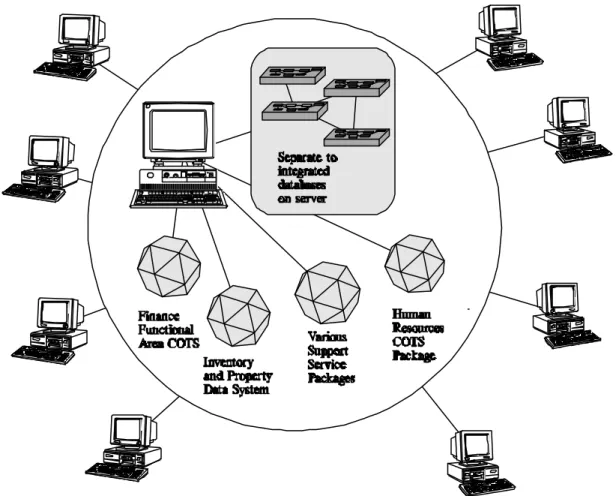
Figure 3 shows how Enterprise Database supports critical business functions such as finance, human resources and other support services. Each functional area supports its own operational, warehouse, and special study databases and also supplies data to the overall enterprise-wide warehouse databases. The functional areas themselves can be centralized within the enterprise or distributed.
Achieving Enterprise Database is not a great intellectual feat; rather, it is the product of clear thinking and careful formulation of essential business policies and procedures along with the effective use of appropriate technology.
Figure 4 identifies the critical models that must be built and interrelated to achieve each and every database in the enterprise. While these models must be centrally built, they must reflect the consensus and compromise that make them the basis of the database treaty rather than the war.
Organizations striving to succeed in today's world must build their own Enterprise Database environment. While built from common components, the sum total of Enterprise Database is unique to each organization. Enterprise Database requires both internal organizational commitment and the continuous participation of the organization's best and most committed. Because of modern tools, contractor involvement can be kept to a minimum. Enterprise Database contractors are catalysts (providing courses, workshops and consulting) through which organizations achieve their own Enterprise Database
There are ten distinct models. Six (Mission model ... Organization model) are accomplished as part of the effort’s specification. They are generally accomplished left-to-right. Mission, Data are accomplished at a high level for as large an area within the Enterprise as possible. Then when specific application within the overall mission are targeted for completion, detailed versions of the data model and complete versions of Business Information Systems through Organization model are accomplished. This enables a broad brush view by one small team, and then parallel development by multiple teams..
The boxes on the diagonal starting with Database objects required... and ending with
Organization unit that accomplishes... represent the interrelationship--in words--between the two boxes that point to it. For example, Business Information system’s package of ... is the relationship between Database object required... and Business Information Systems Model.
The three models, Implemented Data Model, through Implemented Information Systems Model represent the implementation transformation details that occur when some aspect of the specification (Mission through Organization) is actually implemented. These models exist in addition to their specification counterparts so that maintenance is both efficient and effective.
The security model is both a specification and an implementation model because its specifications are established in terms of SQL VIEWS and that are defined in terms of persons, roles, and organizations and are mapped to data view specifications that are accessed by implemented information systems that operate on deployed hardware.