Durham E-Theses
A Study of the Fluorine Eect in C-H Borylation
DING, MINGYAN
How to cite:
DING, MINGYAN (2019) A Study of the Fluorine Eect in C-H Borylation, Durham theses, Durham
University. Available at Durham E-Theses Online: http://etheses.dur.ac.uk/13017/
Use policy
The full-text may be used and/or reproduced, and given to third parties in any format or medium, without prior permission or charge, for personal research or study, educational, or not-for-prot purposes provided that:
• a full bibliographic reference is made to the original source • alinkis made to the metadata record in Durham E-Theses • the full-text is not changed in any way
The full-text must not be sold in any format or medium without the formal permission of the copyright holders. Please consult thefull Durham E-Theses policyfor further details.
Academic Support Oce, Durham University, University Oce, Old Elvet, Durham DH1 3HP e-mail: [email protected] Tel: +44 0191 334 6107
A Study of the Fluorine Effect in C-H
Borylation
MSc Thesis
Mingyan Ding
Supervisor: Professor Patrick G. Steel
Durham University
Department of Chemistry
Abstract
Iridium-catalysed C-H borylation of fluoroarenes represents a very powerful method for the synthesis of fluorinated aryl boronic esters, which are a range of versatile synthetic building blocks. Following a brief review of the developments of Ir-catalysed C-H borylation reactions and synthesis of fluoroaromatics, this thesis describes the investigation of the influence of fluorine substituents on selectivity and effectiveness of iridium-catalysed C-H borylation of polyfluorinated arenes. As observed through the reactions of 1-fluoro-4-methylbenzene, 1-bromo-4-fluorobenzene, and other related substrates, simple fluoroarenes react considerably faster than their non-fluorinated counterparts. Polyfluoroarenes and fluorinated pyridines are even more reactive substrates. The fluorine atom is of low steric bulk and this coupled with a strong inductive electron-withdrawing effect leads to the activation of the C-H bonds ortho to a fluorine atom. However, with 1,3-difluoro-2-substituted arenes, as the electron-withdrawing nature of the 2-substituent increases there is a corresponding increase in the formation of the difluoro-5-Bpin product. The parent arene, 1,3-difluorobenzene, shows variable selectivity depending on the nature of the boron source (B2pin2 and HBpin) and this observation challenges the accepted catalytic cycle for
these reagents for which the key C-H activation step is supposed to be common. The resulting fluorinated aryl boronic esters can be used in the synthesis of fluorinated biaryls through Suzuki-Miyaura cross-coupling reactions using CsF as an anhydrous base to circumvent protodeboronation observed with more classical aqueous base
Contents Abbreviations………... v Statement of copyright………... ix Declaration……….. ix Acknowledgements………..…… x 1.0 Introduction……… 1
1.1 Introduction to this thesis………. 1
1.2 C-H borylation………. 1
1.2.1 Organoboron compounds………... 1
1.2.2 Discovery of iridium-catalysed C-H borylation……… 4
1.2.2.1 Early developments of iridium-catalysed C-H borylation…………... 4
1.2.2.2 [Ir(COD)X]2-bipyridines-catalysed borylation……….... 6
1.2.3 Mechanism of aromatic C-H borylation catalysed by Ir-dtbpy-system…… 11
1.2.4 Regiocontrol in C-H borylation……… 13
1.2.4.1 Steric effects in C-H borylation………. 13
1.2.4.2 Electronic effects in C-H borylation………... 15
1.2.4.3 Directed ortho-borylation……….. 21
1.2.4.4 Directed meta-borylation………... 25
1.2.4.5 Directed para-borylation………... 26
1.2.5 Conclusions………... 27
1.3.1 Fluoroarenes………... 27
1.3.2 Synthesis of fluoroarenes………... 29
1.3.3 C-H activation of fluoroarenes………... 30
1.3.4 ArF-M cross-coupling chemistry……... 31
1.3.5 Synthesis of fluorinated aryl boronic esters……... 33
1.3.5.1 Electrophilic borate trapping of arylmetal intermediates... 33
1.3.5.2 C-X borylation of aryl halides……... 34
1.3.5.3 Direct C-H borylation of fluoroarenes... 35
1.3.6 Conclusions……... 37
1.4 Aims of this project……... 38
2.0 Results and discussion... 39
2.1 Borylation of simple fluoroarenes... 39
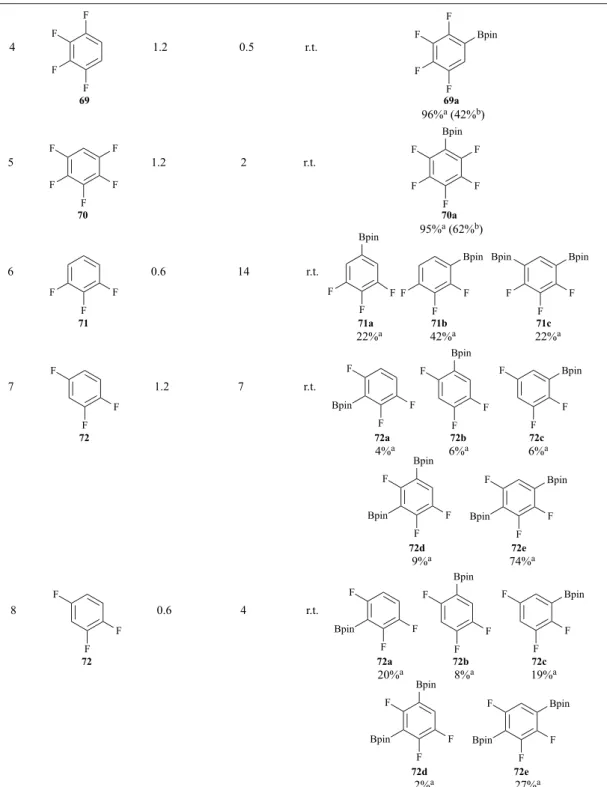
2.2 Borylation of polyfluorinated arenes... 45
2.3 Borylation of 1,3-difluoroarenes... 49
2.4 Borylation of fluorinated pyridines……… 56
2.5 Iridium-catalysed C-H borylation/Suzuki-Miyaura cross-coupling strategies…... 60
3.0 Conclusions and future work……….. 67
4.0 Experimental detail……….. 72
4.1 General experimental considerations……… 72
4.2 General procedures……… 74
Abbreviations
aq. aqueous
ASAP atmospheric pressure solid analysis probe
Bn benzyl
Boc tert-butoxycarbonyl
B2pin2 bis(pinacolato)diboron bpy 2,2’-bipyridine ca. circa Cb carbamate cod 1,5-cyclooctadiene coe cyclooctene conv. conversion
COSY correlation spectroscopy
Cp cyclopentadienyl Cp* pentamethylcyclopentadienyl Cy cyclohexyl dba dibenzylideneacetone DCM dichloromethane DMA dimethylacetamide DME 1,2-dimethoxyethane DMF N,N-dimethylformamide
DMSO dimethyl sulfoxide
DoM directed ortho metalation
dppe 1,2-bis(diphenylphosphino)ethane
dppf 1,1’-bis(diphenyl-phosphino)ferrocene
dr diastereomeric ratio
dtbpy 4,4’-di-tert-butyl-2,2’-bipyridine
ee enantiomeric excess
eq. equivalents
ESI-MS electrospray ionisation-mass spectrometry
Et ethyl
Et2O diethyl ether
EtOAc ethyl acetate
EtOH ethanol
GC-MS gas chromatography-mass spectrometry
h hour
HBpin pinacolborane
HMBC heteronuclear multiple bonds correlation
HSQC heteronuclear single quantum coherence
Hz Hertz
Ind indenyl
iPr iso-propyl
LC-MS liquid chromatography-mass spectrometry Me methyl MeCN acetonitrile MeOH methanol mg milligram min minute mL milliliter mmol millimole m.p. melting point
MTBE methyl tert-butyl ether
m/z mass/charge ratio
NOESY nuclear Overhauser effect spectroscopy
NMR nuclear magnetic resonance
Ph phenyl
ppm parts per million
ref. reference
r.t. room temperature
Silica-SMAP silica-supported silicon-constrained monodentate trialkylphosphine
TBAB tetra-n-butylammonium bromide
tBu tert-butyl
TLC thin-layer chromatography
Statement of copyright
The copyright of this thesis rests with the author. No quotation from it should be published without prior written consent and information derived from it should be acknowledged.
Declaration
The work described in this thesis was carried out in the Department of Chemistry at Durham University between October 2017 and September 2018 under the supervision of Professor Patrick G. Steel. All the work is my own work, unless otherwise stated, and has not been submitted previously for a degree at this or any other university.
Mingyan Ding December 2018
Acknowledgements
First and foremost, I would like to express my sincere gratitude to my supervisor Professor Patrick G. Steel for his guidance, encouragement and support in all the time of my MSc study.
I am grateful to all the members of CG1 for the fun we have had in the last year. Special mention goes to Jay for his assistance and advice in solving difficulties in my project, and to Courtney and Vanessa for proofreading sections.
My thanks and appreciations should go to the departmental service staff, especially Dr. Alan Kenwright for support in NMR analysis and Dr. Jackie A. Mosely for help with mass spectrometry.
I would also like to thank my parents who have provided me financial and emotional support throughout my life.
Last but by no means least, special thanks must go to my girlfriend Xirui, for all her love and support that helped me along the way.
1.0 Introduction
1.1 Introduction to this thesis
To date, aromatic organofluorine compounds have found diverse applications ranging from pharmaceuticals to agrochemicals due to their unique chemical, physical, or physiological properties afforded by fluorine substituents. For these molecules, cross-coupling reactions of suitable fluorinated aryl boronic precursors have been some of the most useful synthetic methods that can avoid the difficulties of late stage incorporation of fluorine atoms. Reflecting this, efficient methods for the synthesis of these fluorinated precursors would be valuable. In this thesis, the work directed towards this objective is described. This involves the preparation of fluorinated aryl boronic esters through Ir-catalysed C-H borylation of fluoroarenes, with the selectivity and effectiveness of this process being investigated. This thesis is divided into four main chapters. The remaining part of this chapter will provide a review focusing on areas most relevant to this project: C-H borylation and fluoroaromatics. Chapter 2 gives the results obtained in this study and the associated discussion and in the following two chapters, conclusions and future work, and detailed experimental procedures will be described respectively.
1.2 C-H borylation
1.2.1 Organoboron compounds
and applied in organic synthesis and catalysis because of their versatility and pivotal roles as synthons. The C-B bond can be easily converted to a C-C, C-N, C-O or C-X (X = Br, Cl) bond, as observed in numerous chemical transformations including the Suzuki-Miyaura cross-coupling reaction, Matteson homologation and allylboration of
carbonyl compounds (Scheme 1).1–3 Additionally, organoboron reagents have had an
essential role in the pharmaceutical industry, as 10B carriers for neutron capture therapy,
in molecular imaging, and in material science and engineering.4
Scheme 1 Common reactions of organoboron compounds.1–3
MeO Br (HO)2B 94% yield B O O OH Ph PhCHO (1 equiv.) THF, 50 ℃, 30 min 95% yield 94 : 4 dr OCb Li Me Bpin Li Me
(ii) EtBpin (1.5 equiv.), -78-20 ℃, 2 h
95% yield 99% ee Cb = carbamate
MeO
(i) s-BuLi, Et2O, -78 ℃, 20 min
(a) Suzuki-Miyaura cross-coupling reaction
(c) Allylboration of carbonyl compounds (b) Matteson homologation
Pd(OAc)2 (2 mol%)
Cy2NH (4 mol%)
Cs2CO3, dioxane
Figure 1 Classification for organoboron compounds.
Classification for organoboron compounds in the reported literature varies greatly. However, they can be best categorised as boranes, boron hydrides, borinic and boronic acids, borinic and boronic esters, boronamides and other related compounds (Figure 1). Among these boron reagents, boronic (boronate) esters, which have fair stability to air, excellent functional-group tolerance, high compatibility with many reagents, and ease of purification and characterisation, are an extremely attractive class of chemical building block used in organic synthesis.5 Moreover, due to their ultimate degradation
into boric acid, boronic esters can be considered as environmentally friendly compounds of low toxicity.5 Consequently, developing practical and efficient synthetic
routes for boronic esters is of considerable current and future interest.
For the purpose of this thesis, only the synthesis of aryl boronic esters will be discussed. Traditionally, these compounds have been synthesised via the reaction of an
organometallic species (Grignard or lithium reagent) with a borate ester (Scheme 2a).6
Alternatively, routes containing palladium- or copper-catalysed borylation of aryl halides have been developed and widely employed (Scheme 2b and 2c).7,8 These
BR3 boranes
BR2(OH)
borinic acids boronic acids
borinic esters BR2(OR)
boronic (boronate) esters
RB(NR2)2 boronamides BRnH3-n boron hydrides BR(OR)2 BR(OH)2
methods, however, have the drawbacks of limited functional group tolerance or the requirement of multistep synthesis. Recently, a direct iridium-catalysed C-H borylation strategy has emerged.9–11 This provides access to aryl boronic esters under milder
conditions in fewer steps and shows a high level of functional group tolerance. As such, this is the method of choice for the work described in this thesis. In this chapter, the developments of Ir-catalysed aromatic C-H borylation strategy will be described, along with the studies of mechanism and regioselectivity of these reactions.
Scheme 2 Traditional synthetic routes for aryl boronic esters.6–8
1.2.2 Discovery of iridium-catalysed C-H borylation
1.2.2.1 Early developments of iridium-catalysed C-H borylation
Scheme 3 First Ir-catalysed C-H borylation reaction for benzene.12
(c) (a) (b) O MgBr PinB OiPr (i) (ii) 50 ℃ Bpin O 94% yield Br
KOAc (3 equiv.), DMSO 80 ℃, 2 h 98% yield Bpin PdCl2(dppf) (3 mol%) B2pin2 I B2pin2 CuI (10 mol%) nBu3P (13 mol%) KOtBu (1.5 equiv.) THF, r.t., 24 h Bpin 92% yield Bpin
Cp*Ir(PMe3)(H)(Bpin) 2 (17 mol%)
150 ℃, 120 h
HBpin 3 (5.0 equiv.)
53% yield
In 1999, Smith and Iverson reported the first catalytic C-H borylation reaction for benzene 1 using Cp*Ir(PMe3)(H)(Bpin) 2 as catalyst and HBpin 3 (Bpin =
pinacolborane) as boron source (Scheme 3).12 After 120 hours at 150 °C, 3 catalytic
turnovers were obtained affording C6H5Bpin 4 in 53% yield. Whilst the exact
mechanism and intermediates are unknown, a comparative experiment of Cp*IrH4 5
and Cp*Ir(PMe3)(H)2 6 suggested that the active catalyst contained a PMe3 ligand.9 The
low turnover numbers afforded by Cp*Ir complex 2 limited the ability of this system
and, to date, no reactions of arenes involving esters, amines, amides or of heteroarenes borylated with Cp*Ir(PMe3)(H)(Bpin) 2 have been reported.
Scheme 4 Arene borylation catalysed by iridium-phosphine-systems.9
Br Br N Cl Cl Cl MeOOC MeO Ir(Ind)(COD) (2 mol%) dppe (2 mol%), HBpin (1.5 equiv.)
cyclohexane, 100 ℃, 17 h 92% yield Br Br Bpin MeO MeO MeO Bpin N Cl Cl Cl MeOOC Bpin Bpin Ir(Ind)(COD) (2 mol%)
dppe (2 mol%), HBpin (2.0 equiv.) cyclohexane, 100 ℃, 4 h
69% yield
Ir(Ind)(COD) (2 mol%) dppe (2 mol%), HBpin (2.0 equiv.)
cyclohexane, 100 ℃, 25 h
95% yield
Ir(Ind)(COD) (2 mol%) dmpe (2 mol%), HBpin (3.0 equiv.)
cyclohexane, 150 ℃, 95 h 62% yield (a) (b) (c) (d) 7
In 2002, a more efficient iridium-based catalytic system involving bisphosphine ligand was reported by Smith et al.9 For example, whilst the borylation of benzene with HBpin
at 150 ℃ using PMe3 produced PhBpin in 88% yield after 18 hours, using systems
with dmpe and dppe ligands produced 84% and 95% yields, respectively, after only 2 hours. Moreover, it proved possible to reduce the catalyst loading from 2 mol% to 0.02 mol% for the same substrate. This high efficiency of bidentate phosphine ligands was further demonstrated by reactions of a group of electron-deficient and electron-neutral arenes. Ester-, alkoxide- and halogen-substituted arenes and heteroaromatics were
tolerated giving moderate to excellent yields (62% to 95%) (Scheme 4).9
These iridium-phosphine-catalysed borylation systems represented a significant step forward from the earlier works due to their faster reaction rates and reduced catalyst loadings. However, the temperatures required for these reactions remained high (100-150 ℃) and short reaction times were not available for all arenes. For example, 95
hours were required to afford 62% borylated product from 1,2-dimethoxybenzene 7, a
more electron-rich substrate (Scheme 4d).
1.2.2.2 [Ir(COD)X]2-bipyridines-catalysed borylation
Concurrently with the work on arene borylation catalysed by phosphine ligands-containing iridium complexes,9 Ishiyama, Miyaura, Hartwig and colleagues10 reported
a catalyst system using iridium precursors and bipyridine ligands. These novel catalyst combinations were demonstrated to be more active than that with phosphine ligands,
not only lowering reaction temperatures to room temperature-80 ℃ (Scheme 5a), but also increasing turnover numbers to 500-1000 in many cases and even achieving 8000 in favourable cases (Scheme 5b).10,13
Scheme 5 (a) First catalytic C-H borylation at room temperature,10 (b) Borylation
with 8000 turnovers.13
1 : 1 mixture of arenes GLC yields ratio (%)
PhCF38 PhMe 9 PhCF3-Bpin 11 : PhMe-Bpin 12 = 90 : 10
PhCF38 PhOMe 10 PhCF3-Bpin 11 : PhOMe-Bpin 13 = 85 : 15
PhMe 9 PhOMe 10 PhMe-Bpin 12 : PhOMe-Bpin 13 = 40 : 60
Table 1 Comparative studies for electron-poor and electron-rich arene substrates.10
In their initial work, a variance in the reactivity of electron-poor and electron-rich arenes given by this catalyst system was observed.10 Electron-poor arene substrates
were shown to have higher reactivity than the electron-rich ones in a series of [Ir(COE)2Cl]2 (2.5 mol%) dtbpy (5.0 mol%) B2pin2 (1.0 equiv.) room temperature, 4.5 h Bpin 83% yield (60 equiv.) [Ir(COE)2Cl]2 (0.01 mol%) dtbpy (5.0 mol%) B2pin2 (1.0 equiv.) 100 ℃, 16 h Bpin 80% yield (60 equiv.) (a) (b)
comparative experiments where PhCF38 and PhMe 9, PhCF38 and PhOMe 10, PhMe
9 and PhOMe 10 were mixed in an equimolar amount to yield the corresponding borylated products (Table 1).
In order to optimize the iridium-bipyridine catalytic system, a systematic study of various anionic ligands (X) in the Ir(I)-COD precursor and bpy ligand was conducted
in the presence of an excess amount of arene substrates by the same group.11 Higher
catalytic efficiencies were observed with more basic hydroxide- or alkoxide-containing iridium(I) complexes (14c, 14d,and 14e) (Table 2, entries 3-5) when compared to the corresponding halide 14a (Table 2, entry 1), cationic 14b (Table 2, entry 2) or acetate complexes 14f (Table 2, entry 6). This was attributed to the easier formation of (boryl)iridium complexes, the key reactive intermediates in the catalytic process.
Table 2 [Ir(COD)(X)]2 precursors with various anionic ligands.11
[Ir(COD)(X)]2 (1.5 mol%) bpy (3.0 mol%) B2pin2 (1.0 equiv.) room temperature Bpin (60 equiv.)
Entry Ir(I)-COD precursor Time/h Conversion of B2pin2/% GC yield/%
1 [IrCl(COD)]2 14a 24 0 0 2 [Ir(COD)2]BF4 14b 24 3 0 3 [Ir(OH)(COD)]2 14c 4 100 88 4 [Ir(OPh)(COD)]2 14d 4 100 84 5 [Ir(OMe)(COD)]214e 4 100 90 6 [Ir(OAc)(COD)]2 14f 24 19 1
The influence of steric effects on the bpy ligand was probed through the introduction
of methyl groups at various positions.11 The lower activity of complexes containing
3,3’-dimethyl-2,2’-bipyridines 15c (Table 3, entry 3) was proposed to result from increasing inhibition to the forming of a coplanar arrangement of the two pyridine rings. Moreover, the use of 6,6’-dimethyl-2,2’-bipyridine 15d led to an inactive complex (Table 3, entry 4). This was attributed to the steric congestion around nitrogen atoms inhibiting coordination between ligands and iridium centres.
Table 3 Iridium catalytic systems containing dimethyl-2,2′-bipyridine ligands.11
N N N N N N N N Me Me Me Me Me Me Me Me Bpin [Ir(COD)(OMe)]2 (1.5 mol%) Ligand (3.0 mol%) B2pin2 (1.0 equiv.) room temperature (60 equiv.)
Entry bpy ligand Time/h Conversion of B2pin2/% GC yield/%
1 4 100 89 2 2 100 82 3 8 100 60 4 24 27 0 15a 15b 15c 15d
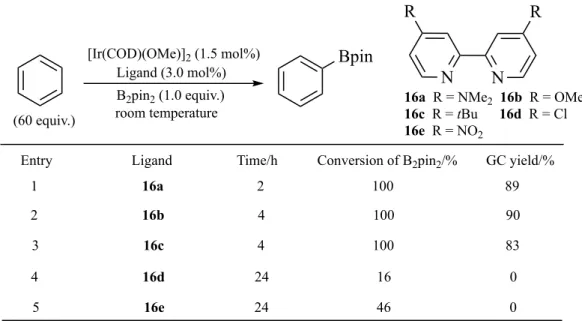
Electronic influences on bpy ligands in arene borylation were also investigated by Ishiyama, Miyaura, Hartwig and co-workers, who disclosed that for arene borylation at room temperature, the reactivity with electron-donating functionalities (e.g. NMe2,
OMe and tBu) (Table 4, entries 1-3) was superior to that when electron-withdrawing
groups (e.g.Cl and NO2) were present, which did not catalyse the reaction at all (Table
4, entries 4 and 5).11
Table 4 Variation of 4,4’-disubstituted-2,2′-bipyridine ligand.11
Further advances in the utility of this protocol have included expanding the reaction scope from that conducted in neat arenes to ones that use more common organic solvents.11 Experimental results showed that nonpolar solvents such as hexane
conducted the reaction at a faster rate than more polar solvents such as DME and DMF. As the last part of this work, arenes with a variety of functionalities were tested and afforded moderate to high yields, indicating the versatility of this system.11
Entry Ligand Time/h Conversion of B2pin2/% GC yield/%
N N 1 16a 2 100 89 2 16b 4 100 90 3 16c 4 100 83 4 16d 24 16 0 5 16e 24 46 0 R R Bpin [Ir(COD)(OMe)]2 (1.5 mol%) Ligand (3.0 mol%) B2pin2 (1.0 equiv.) room temperature (60 equiv.)
16a R = NMe2 16b R = OMe 16c R = tBu 16d R = Cl 16e R = NO2
Since these papers, an iridium catalyst comprised of [Ir(COD)(OMe)]214e and
4,4′-di-tert-butyl-2,2′-bipyridine 16c has been widely applied in aromatic C-H borylation due to its high reactivity and compatibility at room temperature.
1.2.3 Mechanism of aromatic C-H borylation catalysed by Ir-dtbpy-system
The mechanistic pathway of arene borylation catalysed with iridium precursors and dtbpy ligand have now been extensively studied.10,13–16 Key intermediates were initially
speculated to be [Ir(dtbpy)(Bpin)3] 17 and its related Ir(III)-boryl complexes by
Ishiyama, Miyaura and Hartwig et al.10,13 In initial experiments,
[Ir(dtbpy)(COE)(Bpin)3] 18 was successfully isolated, with its structure determined by
X-ray diffraction.10 The rapid formation of C
6D5Bpin when 18 was dissolved in C6D6 suggested that this Ir(III)-boryl complex was competent to be a reactive intermediate in the catalytic system. Subsequently, more detailed studies showed that 18 gave similar yields and regioselectivities as [Ir(COD)(OMe)]2 14e did in the borylation of arenes,
indicating that iridium(III)-boryl complexes were the catalytically active species.13
Following this a general mechanism for arene borylation (Scheme 6) was proposed. The catalytic process starts after the reaction of Ir(I) complex [Ir(dtbpy)(X)] 19 and B2pin220, in which a trisboryl Ir(III) complex 17 is generated. The resulting trisboryl
Ir(III) intermediate 17 then reacts with the arene 23 to afford the corresponding aryl boronic ester 25. This latter process could occur either via an oxidative addition of 23
Ir(III)(Bpin)2(H) complex 26, or via a concerted 𝜎-bond metathesis pathway which will afford the same functionalized product and Ir(III) hydride complex. The cycle is completed by the oxidative addition of 20 to afford [Ir(dtbpy)(H)(Bpin)4] 27, which
later undergoes reductive elimination of HBpin 3 to regenerate the active trisboryl Ir(III) species 17. Alternatively, another pathway from 26 to 17 involves the oxidative addition of 3 and H229 reductive elimination from an 18-electron Ir(V) species 28. In this
two-cycle model, fast consumption of B2pin2 occurs first followed by the slower borylation
with HBpin.
Scheme 6 Proposed general mechanism for Ir-catalysed aromatic C-H borylation.10,13,14
[Ir] X -XBpin 21B2pin2 20 [Ir] Bpin B2pin2 Ir Bpin Bpin Bpin N N Ar-H Ir Bpin Bpin Bpin N N H Ar Ar-Bpin Ir Bpin H Bpin N N B2pin2 Ir Bpin Bpin Bpin N N H Bpin HBpin H2 Ir Bpin Bpin Bpin N N H H 19 22 24 17 26 27 28 29 3 25 20 23 20
Sakaki and collaborators14 then published further theoretical elucidation of this
catalytic cycle, which was consistent with the results of experimental investigations.13,15,16 In Sakaki’s studies, the electron-donating effect to the metal centre
from dtbpy ligand and diboron reagent as well as the small steric hindrance in the planar structures of dtbpy and B2pin2 facilitates the oxidative addition process and stabilizes
the Ir(V) complex 24. Besides, less bulky arene substrates such as benzene will be more favourable in this catalytic reaction.
1.2.4 Regiocontrol in C-H borylation 1.2.4.1 Steric effects in C-H borylation
The regioselectivity in the borylation of arenes catalysed by an iridium system is predominantly controlled by steric effects. With the exception of special cases, borylation occurring at the ortho-position to substituents or ring junctions is sterically disfavoured. This rule in monosubstituted aromatics (Scheme 7a10) leads to an
approximate statistical distribution of 2 : 1 for meta- and para-borylated products, with rare, or even no ortho-functionalized product being observed. In the borylation of symmetrically 1,2-substituted arenes (Scheme 7b10), steric effects lead to the formation
of 4-substituted aryl boronic ester exclusively, but for 1,2-disubstituted arenes bearing two different substituents (Scheme 7c17), a mixture of products is obtained in most cases.
Both 1,3-disubstituted (Scheme 7d11) or 1,2,3-trisubstituted arenes (Scheme 7e18) give
aromatics has received the greatest attention due to the ability to generate a broad range of desired 1,3,5-trisubstituted products, that are difficult to produce selectively in traditional aromatic substitution reactions.
Scheme 7 Steric effect-conducting regioselectivity for aromatic C-H borylation.10,11,17
MeO MeO MeO MeO MeO Cl Bpin MeO Cl Bpin MeO Cl Bpin Cl Cl Cl Cl Cl Cl Bpin R1 R2 R1 R2 Bpin B2pin2 (1.0 equiv.) [Ir(COD)Cl]2 (1.5 mol%) bpy (3.0 mol%) (60 equiv.) neat, 80 ℃, 16 h B2pin2 (1.0 equiv.) [Ir(COD)Cl]2 (1.5 mol%) bpy (3.0 mol%) neat, 80 ℃, 16 h 86% yield 82% yield (69 : 31) B2pin2 (1.0 equiv.) [Ir(COD)(OMe)]2 (1.5 mol%) dtbpy (3.0 mol%) hexane, 25 ℃, 2-8 h (2.0 equiv.) Cl Cl Bpin 84% yield F3C Br Bpin 91% yield F3C MeO Bpin 81% yield NC Br Bpin 83% yield B2pin2 (1.2 equiv.) [Ir(COD)(OMe)]2 (1.5 mol%) dtbpy (3.0 mol%) (1.0 equiv.) MTBE, r.t., 16 h 94% conversion (60 : 40) HBpin (1.8 equiv.) [Ir(COD)(OMe)]2 (1.0 mol%) dtbpy (2.0 mol%) neat, 80 ℃, 2 h (1.0 equiv.) 91% yield Bpin Bpin (60 equiv.) (a) (b) (c) (d) (e)
Compared with 1,2 or 1,3-disubstituted arene substrates, relatively low reactivity is exhibited by 1,4-disubstituted compounds because all of the C-H bonds are sterically hindered. Borylation of unsymmetrically 1,4-substituted arenes will typically afford a mixture. However, distinct steric properties from two functionalities will make one of the possible 1,2,4-substituted arenes preferentially obtained. For instance, Smith and colleagues reported that the reactions of 4-substituted benzonitriles tended to occur
ortho to the smaller substituents (Scheme 8).19
Scheme 8 Borylation of 4-substituted benzonitriles in an iridium-catalysed system.19
1.2.4.2 Electronic effects in C-H borylation
Electronic effects have also shown an impact upon the regioselectivity of C-H borylation. For instance, unlike reactions of many other monosubstituted benzenes which afford a statistical ratio for meta- and para-products (ca. 2 : 1), borylation of anisole 10 catalysed by [Ir(COD)Cl]214a and bpyresults in a ratio of 3 : 1 (Scheme 9),
CN R [Ir(COD)(OMe)]2 (1.5 mol%) dtbpy (3 mol%) HBpin or B2pin2 THF, 80 ℃, 16 h CN R Bpin CN R Bpin
R = F, Cl, Br, I, Me, OMe, SMe, NMe2, CO2Me, NHAc, CF3
55-70% yield R = I, Br, CF3, NHAc, CO2Me, NMe2 (99 : 1) R = Cl, SMe, Me (90 : 10) R = OMe (67 : 33) R = F (8 : 92)
reflecting a preference for meta-substitution derived from the electronic influences associated with a methoxy group.10
Scheme 9 Borylation of anisole catalysed by [Ir(COD)Cl]2-bpy system.10
Scheme 10 Borylation of substrates containing five-membered heteroarenes.20
When there are no significant steric effects, electronic effects on C-H borylation of heteroarenes can be observed more obviously and can control the site selectivity. Early studies by Hartwig, Ishiyama, Miyaura et al. described the borylation of a range of heteroarenes with B2pin2 catalysed by [Ir(COD)Cl]2-dtbpy-system.20 Five-membered
heteroarenes including thiophene 30, furan 31, pyrrole 32, and their benzofused
B2pin2 (1.0 equiv.) [Ir(COD)Cl]2 (1.5 mol%) bpy (3.0 mol%) (60 equiv.) neat, 80 ℃, 16 h 95% yield (o : m : p = 1 : 74 : 25) OMe OMe Bpin OMe Bpin OMe Bpin 10 X [Ir(COD)Cl]2 (1.5 mol%) dtbpy (3.0 mol%) B2pin2 (0.1 equiv.) octane, 80 ℃, 16 h X Bpin X = S 30a Yield = 83% O 31a 83% NH 32a 67% (a) X Bpin [Ir(COD)Cl]2 (1.5 mol%) dtbpy (3.0 mol%) B2pin2 (0.1 equiv.) octane, 80 ℃, 16 h X = S 33a Yield = 89% O 34a 91% NH 35a 92% (b) X X = S 33 O 34 NH 35 X = S 30 O 31 NH 32
derivatives (33, 34, 35) were borylated exclusively at the 2-position in high yields (Scheme 10). This observation was consistent with computational studies which suggested that acidity was a significant factor influencing the regioselectivity of C-H activation.21
Scheme 11 Changes of selectivity in the borylation of pyrroles and indoles.20,22
However, even in these systems steric factors can dominate. For example, regioselectivities in borylation of 5-membered heterocyclic compounds can be altered
by introducing steric blocking groups on the nitrogen atom or at the alpha-position.
Reactions of pyrroles and indoles containing a large protecting group, tri(isopropyl)silyl group, at nitrogen of the heterocycles give 3-borylated products 36a
[Ir(COD)Cl]2 (1.5 mol%) dtbpy (3.0 mol%) B2pin2 (0.25 equiv.) octane, 80 ℃, 16 h 79% yield N Si(iPr)3 N Si(iPr)3 Bpin [Ir(COD)Cl]2 (1.5 mol%) dtbpy (3.0 mol%) B2pin2 (0.25 equiv.) octane, 80 ℃, 16 h 83% yield N Si(iPr)3 Bpin (a) (b) N Si(iPr)3 N H R N H R Bpin [Ir(COD)(OMe)]2 (1.5 mol%) dtbpy (3.0 mol%) HBpin (1.5-2.0 equiv.) or B2pin2 (1.0 equiv.) hexane, 60 ℃, 1-4 h (c) R= Me, CO2Et, TMS, CONEt2, Ph 69-90% yield 36 36a 37 37a 38 38a
and 37a (Scheme 11a and 11b).20 Reactions of 2-substituted indoles 38 exclusively
afford 7-functionalized products 38a (Scheme 11c).22 The strategy for using a
bulky-N-protecting group to change selectivity has been applied in versatile methodologies to prepare natural products and pharmaceutical drugs. For example, Guant et al. reported a total synthesis of rhazinicine 39, which involved the borylation of N-Boc protected pyrrole derivatives selectively at the 3-position as a key step (Scheme 12).23
Scheme 12 A total synthesis of rhazinicine 39 by Guant et al.23
Borylation of substrates containing 6-membered rings is controlled by electronic factors in a different way. Unsubstituted pyridine 40 gives an approximate statistical distribution of 2 : 1 for meta- and para-borylated products (Scheme 13a24), whereas
quinoline 41 selectively affords 3-borylated products (Scheme 13b20). The poor
reactivity of pyridine in borylation can be attributed to the coordination between the basic nitrogen atom and the iridium catalyst that inhibits a significant quantity of the active catalyst.24 The higher efficiency of quinoline is proposed to be due to the steric
effect from the benzofused ring preventing the coordination between iridium complex and substrate.
N Boc TMS
(i) [Ir(COD)Cl]2 (2 mol%) dtbpy (4 mol%)
B2pin2 (1.0 equiv.)
n-C6H14, µw, 100 ℃, 1 h (ii) Pd(OAc)2 (2 mol%) K3PO4 (aq.) iodo-2-nitrobenzene (1.0 equiv.) nBuOH, 100 ℃, 2 h N Boc TMS NO2 N HN Et O O Rhazinicine 39
Scheme 13 Borylation of pyridine 40 and quinoline 41.20,24
Difficulties arising from the pyridyl coordination can be reduced by the incorporation
of ortho-substituents. Borylation of 2,6-disubstituted pyridines gives much higher
efficiency compared with that of unsubstituted pyridine. Steric hindrance of the 3-position allows the functionality to be exclusively installed at the 4-3-position (Scheme 14a9), analogous to the reaction of 1,3-disubstituted arenes. Pyridines bearing one
substituent at the 2-position react to form 4- and 5-borylpyridines, with the sterically accessible 6-position remaining unreactive (Scheme 14b25).
N [Ir(COD)Cl]2 (1.5 mol%) dtbpy (3.0 mol%) B2pin2 (0.5 equiv.) octane, 100 ℃, 16 h N Bpin N Bpin 42% yield (67 : 33) N N Bpin [Ir(COD)Cl]2 (1.5 mol%) dtbpy (3.0 mol%) B2pin2 (0.1 equiv.) octane, 100 ℃, 16 h 84% yield (a) (b) 40 41 N Ir(COD)(Ind) (2.0 mol%) dppe (2.0 mol%) HBpin (2.0 equiv.) neat, 100 ℃, 4 h N Bpin Cl Cl Cl Cl 69% yield N [Ir(COD)(OMe)]2 (2.5 mol%) dtbpy (5.0 mol%) B2pin2 (0.5 equiv.) hexane, 80 ℃, 16 h N Bpin N Bpin (a) Ph Ph Ph (b) 61% yield (1 : 1)
Scheme 15 Borylation of dtbpy 16c.25
The challenge of borylation adjacent to the pyridyl nitrogen has been attributed to the electronic repulsion between the nitrogen lone pair and the partial negative charge on
the C-2 during the C-H activation process.26 This electronic effect can be overcome
when reactions at other positions are sterically inhibited, as is shown in the borylation of dtbpy 16c which is forced to afford 2-borylated product (Scheme 15).25
Scheme 16 Proposed mechanism for protodeboronation of 2-borylated pyridines.27
However, even in this case, the 𝛼-pyridyl boronic esters are prone to undergo rapid
protodeboronation, making access to these reagents challenging.26,28–30 The mechanism
of protodeboronation has not been well-established. Kuivila and colleagues31,32 have
suggested that this decomposition may be catalysed by acids, bases, or metal salts. One scenario suggested by Stevens27 is that after the protonation of the nitrogen atom, the
N N tBu tBu N N tBu tBu Bpin Bpin [Ir(COD)(OMe)]2 (5 mol% dtbpy (10 mol%) B2pin2 (2.0 equiv.) hexane, 80 ℃, 16 h 100% conversion N B(OR)2 M-X N B(OR)2 M X N M N +H+, -M+ -BX(OR)2 42 43 44 40
resulting zwitterion 43 undergoes nucleophilic substitution of the boryl group to form the ylide intermediate 44, which then reproduces the parent pyridine 40 via rapid electron rearrangement (Scheme 16). As such, in a similar version to that described above, this protodeboronation process can be minimized by lowering the basicity of the pyridyl nitrogen with a sufficiently electronegative o-substituent. This has been exemplified by the borylation of methyl 2-chloroisonicotinate 45, which gives a stable 𝛼-pyridyl boronic ester 46 that readily undergoes subsequent functionalization (Scheme 17).26
Scheme 17 Reaction sequences containing stable 𝛼-pyridyl boronic ester.26
1.2.4.3 Directed ortho-borylation
The regioselectivity controlled by steric effects in arene borylation often complements
N Cl COOMe N Cl COOMe N Cl COOMe [Ir(COD)(OMe)]2 (1.5 mol%) dtbpy (3 mol%) B2pin2 (1.0 equiv.) MTBE, r.t., 24 h Bpin OMe 4-MeOC6H4I (2.0 equiv.) Pd(dppf)Cl2 (5 mol%) CsCO3, DMF, 100 ℃, MW, 1h N H COOMe OMe HCO2NH4 Pd/C EtOH, r.t., 2 h 73% conversion 47% yield from 45 45 46 47 48
that of electrophilic aromatic substitution or directed ortho metalation (DoM).33
However, a mild alternative to conduct directed borylation would be valuable. Hartwig and Boebel reported a silyl-directed arene borylation catalysed with [Ir(COD)Cl]2
-dtbpy-system.34 In this method, the introduction of a hydrosilyl group as a directing
group leads to benzyls and phenols facilitating exclusively ortho-borylation (Scheme
18). Reversible addition of an Si-H bond of the hydrosilyl group to the metal centre was proposed to account for the mechanism of this reaction (Scheme 19). This docking of the arene substrate at the catalyst through the silicon atom makes borylation occur preferentially at the position ortho to the substituent.
Scheme 18ortho-Directed arene borylation developed by Hartwig and Boebel.34
[Ir(COD)Cl]2 (0.25 mol%) dtbpy (0.5 mol%), HBpin (5 mol%)
B2pin2 (1.0 equiv.), THF, 80 ℃ SiMe2H R’ Bpin R SiMe2H R’ R F SiMe2H Bpin 82% yield SiMe2H Bpin 74% yield MeO SiMe2H Bpin 75% yield OH R
(i) Et2SiH2, [Ir(COD)Cl]2 (0.5 mol%), C6H6
(ii) B2pin2, HBpin (5 mol%), [Ir(COD)Cl]2 (1 mol%)
dtbpy (2 mol%), THF, 80 ℃ (iii) KHF2(aq), THF OH R BF3K OH BF3K Me 96% yield OH BF3K OMe 89% yield OH BF3K 79% yield O O OH BF3K 94% yield (a) (b)
Scheme 19 Mechanism for hydrosilyl-directed ortho-borylation of arenes.34
Scheme 20ortho-Directed borylation of benzoates.35
Ishiyama, Miyaura et al. demonstrated the ortho-directing effect of a catalyst system
consisting of [Ir(COD)(OMe)]2 and an electron-deficient monodentate phosphine
ligand 49, which can borylate benzoates to generate selective products in moderate to
excellent yields (Scheme 20).35 This methodology is dependent on chelation control,
COE Ir Bpin Bpin Bpin N N tBu tBu COE COE Ir Bpin Bpin Bpin N N BnSiMe2H Ir Bpin SiMe2 Bpin N N Ir Bpin SiMe2 Bpin N N Ir H SiMe2 Bpin N N Bpin SiMe2H Bpin HBpin B2pin2 O OR’ R O OR’ R Bpin R = Me2N, Me, Br, F3C,
R’ = Me, Et, iPr, tBu 57-99% yield
[Ir(COD)(OMe)]2 (1.5 mol%) Ligand 49 (6 mol%) B2pin2 (1.0 equiv.) octane, 80 ℃, 16 h P CF3 CF3 3 Ligand 49
by which coordination of the ester functionality to the metal centre allows the
subsequent cleavage of an ortho C-H bond. Ishiyama and Miyaura then extended the
substrate scope of this protocol to aryl ketones.36
Scheme 21 Selected examples of developments of ortho-directed C-H borylation.37–39
R R Bpin Silica-SMAP-Ir 50 (0.5 mol%) B2pin2 (0.5 equiv.) hexane or octane 25-100 ℃, 1-24 h CO2Me Bpin 89% yield Cl Bpin 75% yield F3C S Bpin CO2Me 74% yield O Bpin CO2Me 92% yield N Bpin CO2iPr 79% yield Si P Ir O OMe Si O O O O Si O O O SiO2 SiMe3 Silica-SMAP-Ir 50 N H N Bpin N NMe2 H N NMe2 Bpin N N NBn2 B2pin2 (1.0 equiv.) Ligand 51 (1 mol%) [Ir(COD)(OMe)]2 (0.5 mol%) HBpin (5 mol%), THF, 50 ℃, 7 h B2pin2 (1.0 equiv.) Ligand 51 (1 mol%) [Ir(COD)(OMe)]2 (0.5 mol%) HBpin (5 mol%), THF, 80 ℃, 24 h MeO MeO 88% yield 51 Me Me NMe2 NMe2 Bpin B2pin2 (1.0 equiv.) [Ir(COD)(OMe)]2 (1.5 mol%) 2-picolylamine 52 (3 mol%) Me-cyclohexane, 70 ℃, 16 h 88% yield Me Me 73% yield (a) (b) (c) (d)
Sawamura and colleagues described the first examples of the solid-supported catalyst, Silica-SMAP-Ir 50, in arene borylation (Scheme 21a).37 This methodology has also
been applied to the ortho-borylation of heteroarenes40 and phenol derivatives.41
Fernandez and Lassaletta performed the Ir-catalysed nitrogen-directed ortho-borylation
on 2-aryl pyridine and aromatic N,N-dimethylhyarazone substrates under mild
conditions using a hemilabile N,N-ligand 51 (Scheme 21b and 21c).38 Recently, in
related work, Clark and colleagues reported the ortho-borylation of benzylic amines
using 2-picolylamine 52 as a ligand (Scheme 21d).39
1.2.4.4 Directed meta-borylation
In 2015, Kuninobu, Kanai and co-workers developed the first Ir-catalysed meta
-selective C-H borylation of 𝛼-aryl carbonyl compounds using well-designed catalytic
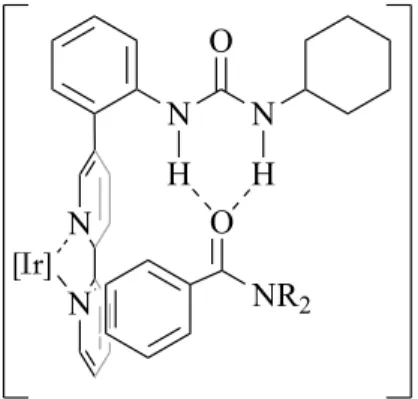
system.42 In this method, the bipyridine ligand that binds to the metal centre contains a
pendant urea moiety (Figure 2). The secondary interaction between this urea moiety and the carbonyl group controls the regioselectivity by placing the iridium centre in the vicinity of the meta-C–H bond.
Figure 2 Secondary interaction between the ligand and substrate.42
O NR2 H H N N O N N
Figure 3 Noncovalent interaction between cationic substrate and anionic ligand.43
In 2016, Phipps et al. reported an alternative strategy for meta-borylation, in which an ion pair interaction was introduced between quaternary ammonium salts in the arene substrates and the anionic ligand to achieve the desired regioselectivity (Figure 3).43
1.2.4.5 Directed para-borylation
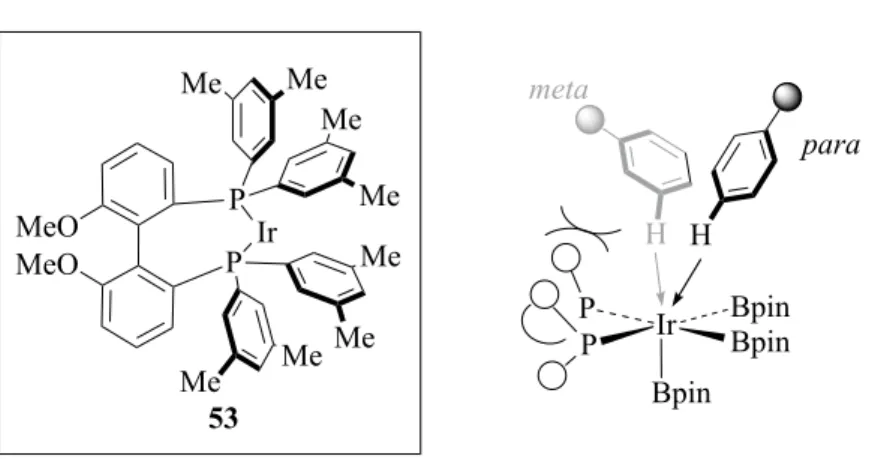
Figure 4Para-selective borylation directed by bulky ligand.44
Recently, Itami and co-workers developed a method for highly para-selective aromatic
N Ir N Bpin Bpin Bpin H R N S O O O Ir P P MeO MeO Me Me Me Me Me Me Me Me 53 Ir BpinBpin P Bpin P H H meta para
C-H borylation.44 By using a novel catalyst with bulky phosphine ligand 53, the
monosubstituted benzenes can be directed to para-borylation with up to 91% yield (Figure 4). Higher yields can be achieved by increasing the bulkiness of the substituent, demonstrating the crucial role that steric repulsion between substrate and catalyst plays in regiocontrol of C-H borylation.
1.2.5 Conclusions
In summary, as is shown in the above examples, since the first observation of iridium-catalysed aromatic C-H borylation in 1999, numerous improvements in this field have been made. Ligand screening provided the reaction system with high efficiency and practical protocol, successfully conducting the reaction at room temperature to give large turnovers and excellent yields. Substrate scope has been expanded from benzene to a wide range of functionalized arenes and heteroarenes. Mechanistic studies of the most active Ir-dtbpy-system suggests that the pathway involves the reductive elimination of the borylated arene, the ensuing oxidative addition of B2pin2, and the
reductive elimination of HBpin to regenerate the active Ir(III) complex. Whilst the regioselectivity of C-H borylation is governed by steric factors, the inherent electronic effects that direct the C-H activation to the most acidic position should not be neglected.
1.3 Fluoroaromatics 1.3.1 Fluoroarenes
to significant changes in their chemical reactivity, physical properties, and physiological activity. Fluoroarenes have been broadly employed in many fields,
ranging from solvents and catalysts to pharmaceutical drugs and agrochemicals.45 At
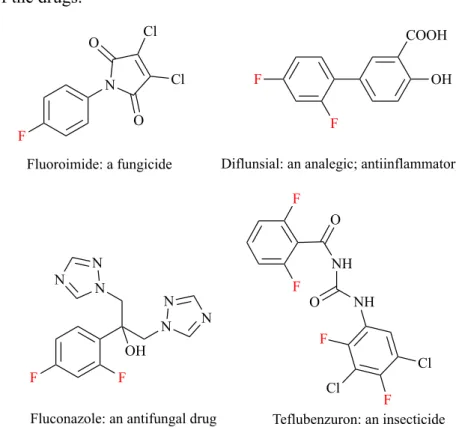
present, an estimated 30% of agrochemicals and 20-25% of pharmaceuticals contain fluorine atoms (Figure 5).45–47 These fluoroaromatic moieties were introduced to
modify the lipophilicity, bioavailability, acidity and more importantly, the metabolic stability of the drugs.46
Figure 5 Examples of pharmaceutically and agriculturally important fluoroarenes45–47
Although organofluorine compounds are in great demand by mankind, fluorine mainly occurs in inorganic materials in nature whereas naturally occurring organofluorine compounds have rarely been identified. Therefore, all of the fluorinated aromatic compounds used in these applications must be artificially synthesised and it is
OH N N N N N N F F
Fluconazole: an antifungal drug
F
F
OH COOH
Diflunsial: an analegic; antiinflammatory N Cl Cl O O F Fluoroimide: a fungicide O NH O NH Cl F Cl F F F Teflubenzuron: an insecticide
worthwhile to develop practicable and efficient synthetic routes to them.
1.3.2 Synthesis of fluoroarenes
To date, numerous conventional synthetic methods for fluorinated aromatics have been well-established, either using direct fluorination with fluorinating reagents (Scheme 22a48 and 22b49) or by synthesising them from fluorinated building blocks (Scheme
22c50).
Scheme 22 Methods for preparation of fluoroarenes.48–50
These established fluorination procedures can be used on industrial scales; however, applications are limited in the synthetic chemistry due to the harsh conditions and
NH2 HC () HBF4 (1.2 equiv.) NaNO2 (1.05 equiv.)
N2BF4
(a) Nucleophilic fluorinating agent
BAlz-Schiemann reaction widest used fluorination process
(b) Electrophilic fluorinating agent
NO2 NO2 10% F2 in N2 CH3CN, 0-10 ℃ Microreactor NO2 NO2 F 98% yield
(c) Fluorinated building block
F AlCl3 (1.91 equiv.) O O Cl O () (1.5 equiv.) DCM, 4.25 h F O O O 74% yield 0 ℃ heat F 92% yield
introduction of fluorine atoms have been developed, which can reduce the loss of fluorine-containing intermediates in side reactions or purification. However, it is still challenging to control regio-, chemo- and stereoselectivity in the construction of C-F bonds. As a result, the use of fluorinated building blocks to generate target molecules is more practicable and wide spread in modern fluorine chemistry.
1.3.3 C-H activation of fluoroarenes
In terms of atom utilization and reaction efficiency, C-H activation/functionalization is the most straightforward way to prepare target fluorinated aromatic molecules. Over recent decades, methodologies for direct C-H arylation of fluorinated arenes mediated by Cu (Scheme 23a),51,52 Au (Scheme 23b),53,54 Ru (Scheme 23c),55 and Pd-based
catalysts (Scheme 23d),56–58 have been developed. Studies of challenging
regioselectivity issues have been reported. For example, Fagnou et al.56 disclosed that
the preference of direct arylation ortho to the fluorine substituents using palladium catalysts resulted from the acidities of C-H bonds in these positions. Larrosa’s group57
reported another breakthrough in selective C-H arylation, performing the first examples of Pd-catalysed meta-C-H functionalization of fluoroarenes using CO2 as a transient
directing group.
However, for these reactions, inherent challenges arising from the requirement of harsh reaction conditions, often associated with poor functional group tolerance and limited substrate scope, remain unsolved.
Scheme 23 Preparation of fluoroarenes using transition metal-catalysed C-H arylation.51,54–56
1.3.4 ArF-M cross-coupling chemistry
Compared to the direct C-H arylation strategy discussed above, transition metal catalysed cross-coupling reactions of fluoroaryl organometallics can be used to synthesise fluorinated aromatics under milder conditions. For example, transformations of suitable fluorinated aromatic precursors under Suzuki-Miyaura (Scheme 24a),59
Stille (Scheme 24b),60 Hiyama (Scheme 24c),61 and Negishi coupling conditions
F F F F F F Me CuI (10 mol%) phenanthroline 4-iodotoluene K3PO4, DMF 130-140 ℃ F F F F F F F F N Piv N Piv PPh3AuCl (5 mol%), PBX AgOPiv (35 equiv.) DMSO (50 equiv.) 1,4-dioxane, 110 ℃ 68% yield 67% yield Piv = (CH3)3CCO2 -PBX = 1-pivaloyloxy-1,2-benziodoxol-3(1H)-one F OtBu F F F F OtBu F F F MeO 13% yield
[Ru(OPiv)2(p-cymene)] (2 mol%)
(NMe4)OC(CF3)3 (44 mol%)
4-FC6H4CO2H (4 mol%) 1-bromo-4-methoxybenzene (0.2 equiv.) t-BuCN, 120 ℃, 16 h F Me F F F F Me F F F Me Pd(OAc)2 (5 mol%)
PtBu2Me-HBF4 (9 mol%)
4-iodotoluene (0.9 equiv.) K2CO3 (1.0 equiv.) DMA, 120 ℃ 78% yield (a) (b) (c) (d)
(Scheme 24d)62 have been reported. Of these various cross-coupling approaches the use
of fluorinated aryl boronic esters represents a powerful synthetic method to avoid difficulties in the late stage incorporation of fluorine atoms. This method has the advantages of wide substrate scope, reduced toxicity when compared to using organostannane and organozinc compounds, and low cost of reagents. Therefore, access to readily accessible fluorinated boronic ester derivatives is currently of high interest for synthetic chemists.
Scheme 24 Cross-coupling reactions of fluorinated arene precursors.59–62
TMS F SnBu3 iodobenzene (1.0 equiv.) Pd(dba)2 (10 mol%) PPh3 (40 mol%) CuI (75 mol%) DMF, 50 ℃, 21 h F TMS 95% yield F ZnCl PhBr precatalyst 55 (1 mol%) F 72% yield Pd H2N L MsO PCy2 iPr iPr iPr L: 55 (b) Stille cross-coupling: (d) Negishi cross-coupling: (a) Suzuki-Miyaura cross-coupling:
F Bpin F F F F 1-bromo-4-fluorobenzene (1.0 equiv.) catalyst 54 (1 mol%) Et3N (1.1 equiv.) toluene/H2O (25 : 1) r.t., 1 h F F F F F F 87% yield P Pd Br F 54 (c) Hiyama cross-coupling: F Si(OMe)3 F PhSO2NHNH2 (1.0 equiv.) Pd(TFA)2 (5 mol%) TBAT (2.0 equiv.) DMI, 60 ℃, 12 h (1.2 equiv.) 94% yield Pd(TFA)2: Palladium(II) trifluoroacetate
1.3.5 Synthesis of fluorinated aryl boronic esters
1.3.5.1 Electrophilic borate trapping of arylmetal intermediates
Strategies for fluorinating aryl boronic esters remain unknown. In contrast, there are several methods in which boronate substituents can be installed onto fluorinated aromatic rings. A traditional process for the preparation of fluorinated boronic esters begins with the generation of an organometallic compound by either metalation of an
arene (Scheme 25a63) or metal-halogen exchange with an aryl halide (Scheme 25b64),
followed by trapping the arylmetal intermediate with a borate, before an acid hydrolysis to release the product. Despite moderate to good yields of borylated products, such routes are limited by the low functional group compatibility of these hard-organometallic compounds and the requirement for low temperature conditions.
Scheme 25 Preparation of fluorinated boronic esters from Grignard or ArLi
reagents.63,64 F F F Li B O O 98% yield LTMP (1.5 equiv.) HO HO Toluene, r.t. (i) B(OiPr)3 (2.0 equiv.) THF, -78 ℃ THF, -78 ℃ (ii) (1.2 equiv.) LTMP: lithium 2,2,6,6-tetramethylpiperidide (a) F Br F MgBr Mg (1.0 equiv.) THF, 45 ℃, 5 h F Bpin N Bpin (1.2 equiv.) THF, 20 ℃, 2 h (b) 76% yield
1.3.5.2 C-X borylation of aryl halides
Direct catalytic borylation of an aryl C-X (X = Cl, Br, I) bond using a transition metal can represent a milder technique to synthesise the required boronic esters (Scheme 26a65). However, access to suitable halogenated substrates with regioselective
installation of halogen atoms are prohibitively challenging owing to the strong electron-withdrawing nature of the fluorine substituents, which decreases the nucleophilic character of the aromatic ring and interferes with the electrophilic functionalization process. Recently, a protocol involving nickel-catalysed C-F borylation of
fluoroaromatic compounds has emerged (Scheme 26b).66 However, non-symmetrical
substrates can lead to a mixture of isomeric products and the issue of regioselectivity remains an unsolved challenge.
Scheme 26 Preparation of fluorinated boronic esters via C-X borylation.65,66
F F F F F Bpin F Bpin F Bpin F 77% yield based on B2pin2
(10 : 1 : 1) B2pin2 (1.0 equiv.) [Ni(IMes)2] (10 mol%) NMe4F (0.5 equiv.) (1.1 equiv.) methylcyclohexane 100 ℃, 15 h IMes =1,3-dimesitylimidazolin-2-ylidene F F Br F Bpin tBuOK in THF (1.5 equiv.) MTBE, r.t., 4 h B2pin2 (1.5 equiv.)
DHASIiPr-CuCl 56 (5 mol%)
63% yield N N CuCl 56 (a) (b)
1.3.5.3 Direct C-H borylation of fluoroarenes
Scheme 27 C-H borylation of 1,3-difluorobenzene using different metal catalysts.
More recently, a more attractive and versatile approach to access aryl boronic esters is the transition metal mediated C-H activation of fluoroarenes. This obviates the need for cryogenic conditions, strong bases, and the prior preparation of haloaromatic precursors. A variety of metal complexes have been reported for this transformation, including POP-supported rhodium catalysts (Scheme 27a),67 PSiN-pincer platinum catalysts
nBuLi (1.5 mol%) mesitylene, 150 ℃, 4 h Pt Si Cl N Cy2P Me Me Me 58 (10 equiv.) HBpin (1.0 equiv.) Rh catalyst 57 (4.0 mol%) cyclohexene (1.0 equiv.) 110 ℃, 24 h (27 equiv.) (a) (b) (c) (d) Bpin F F
99% yield based on HBpin 1* : 2* : 3* = 16 : 44 : 40 F F F F 1* 2* 3* Bpin F 1* F 2* 3* B2pin2 (1.0 equiv.) Pt catalyst 58 (1.5 mol%)
86% yield based on B2pin2 1* : 2* : 3* = 74 : 22 : 4 (1.0 equiv.) F F Bpin F 1* F 2* 3* 91% yield 1* : 2* : 3* = 1 : 2 : 97 cyclohexene (1.0 equiv.) THF, 100 ℃, 24 h N N N Et Si Et Si Co Br Br N N Ph tBu tBu N N tBu Ph tBu 59 (1.0 equiv.) F F Bpin F 1* F 2* 3* 100% conversion 1* : 2* : 3* = 17 : 33 : 55 THF, 25 ℃, 1 h HBpin (0.25 equiv.) [Ir(COD)(OMe)]2 (0.375 mol%) dtbpy (0.75 mol%) B2pin2 (1.0 equiv.) Co precatalyst 59 (4 mol%) NaBHEt3 (8 mol%) RhH-{xant(PiPr2)2} 57 (xant(PiPr2)2} = 9,9-dimethyl-4,5-bis-(diisopropylphosphino)xanthene)
(Scheme 27b),68 cobalt(II) bis(silylene)-based precatalysts (Scheme 27c)69 and the
iridium bipyridine-based catalysts that were discussed previously (Scheme 27d).19
Scheme 28 Selected examples of Ir-catalysed borylation of fluorinated arenes.19,70,71
Several research groups have explored the scope of iridium catalyst-mediated fluoroarene borylation. Smith and co-workers performed the borylation of 4-fluorobenzonitrile 60, for which the regioselectivity outcome arises from both the small steric hindrance and the ortho-directing effect of the fluorine atom (Scheme 28a).19
Hartwig and Robbins demonstrated the sterically controlled regioselectivity of the
F Br
F H Bpin (i) [Ir(COD)(OMe)]2 (1mol%)
B2pin2 (0.55 equiv.) dtbpy (2 mol%), THF, r.t., 24 h 63% yield (a) (b) (c) F COOMe F Bpin COOMe F HBpin (1.1 equiv.) [Ir(COD)(OMe)]2 (0.25 mol%) dtbpy (0.5 mol%) THF, 80 ℃ 61% yield PMHS: polymethylhydrosiloxane F MeO MeO
(ii) Pd(OAc)2 (5 mol%)
KF (2 equiv.), PMHS (4 equiv.) H2O, THF, r.t., 24 h THF, 25 ℃, 1 h F CN F CN F CN Bpin Bpin HBpin (0.25 equiv.) [Ir(COD)(OMe)]2 (1.5 mol%) dtbpy (3 mol%) 71% yield (11 : 89) 60
borylation of trisubstituted fluoroarenes, in which functionalization occurs ortho to
fluorine to minimize repulsion with other functional groups (Scheme 28b).70
Oppenheimer, Smith and Maleczka et al. developed a two-step
borylation/dehalogenation reaction sequence where bromine or chlorine atoms serve as blocking groups to increase the selectivity for ortho-fluorinated borylated products
(Scheme 28c).71 While these are important progresses, to date, no general study that
extensively explores the Ir-catalysed borylation of different polyfluorinated substrates has been reported. Additionally, the subtle balance between steric and electronic influences of fluorine substituents are incompletely known.
1.3.6 Conclusions
As discussed in the previous sections, fluorinated boronic esters are a range of versatile precursors for the preparation of substituted fluoroaromatics. Several synthetic routes have been developed for the preparation of these fluorinated reagents, including electrophilic borate trapping of arylmetal intermediates, C-X borylation of aryl halides, and direct C-H borylation of fluoroarenes. Among these methods, Ir-catalysed C-H borylation of suitable fluoroarenes is currently the most attractive one because it obviates the requirements for strong bases, low temperature conditions, and the pre-generation of haloaromatic precursors. However, the substrate scope, particularly for polyfluorinated arenes substrates, has not been fully studied.
1.4 Aims of this project
The high efficiency and predictable regioselectivity of iridium-catalysed C-H borylation reactions have made them very useful transformations in the synthesis of fluorinated building blocks. While the regioselectivity in Ir-catalysed aryl C-H borylation is recognised to be driven by steric effects which make meta- or para -functionalization more favourable, it is possible to install the Bpin group ortho to the small fluorine atom when compared with other aryl functionalities. Moreover, it is well-established through both thermodynamic72 and kinetic studies73 that the more acidic
C-H bonds ortho to fluorine atoms can be preferentially activated by transition metal catalysts. As such, C-H borylation reactions of fluorinated arene substrates with more than one sterically available C-H bond represent an unexplored area for the synthesis of fluorinated aryl boronic esters. The selectivity and effectiveness of this process remain to be determined and the aim of this project was to address this issue through Ir-catalysed C-H borylation of a series of polyfluorinated arenes.
2.0 Results and discussion
2.1 Borylation of simple fluoroarenes
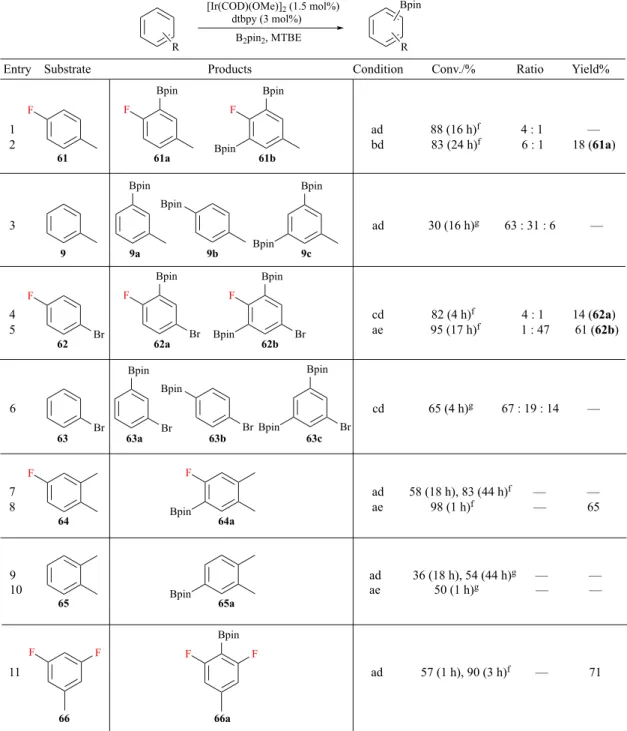
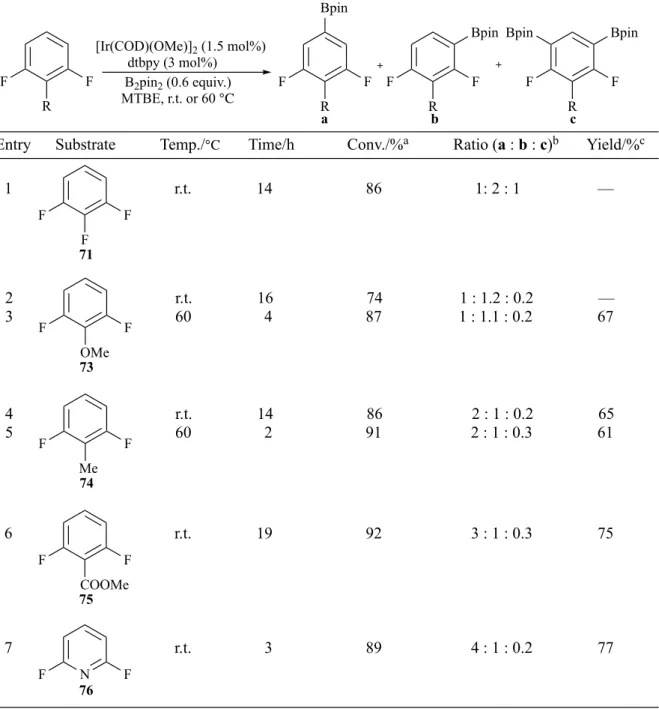
As discussed in Chapter 1, the reported examples of borylation ortho to a C-F bond in early studies have demonstrated that the steric hindrance of a fluorine atom can be overridden when there are no other sterically available positions. However, these reactions were generally conducted at elevated temperatures and were not conducive to high selectivity. As a means of verifying this sterically controlled o-borylation at room temperature, gaining preliminary assessment of the applicability of this Ir-catalysed C-H borylation methodology to fluoroarenes, and gaining experience in carrying out the procedure, it was decided to carry out the comparative experiments shown in Scheme 29.
Scheme 29 Ir-catalysed C-H borylation of fluoroarenes and parent arenes at room
temperature/60 ℃. MTBE, r.t./60 ℃ R R Bpin R R Bpin [Ir(COD)(OMe)]2 dtbpy, B2pin2 (a) (b) [Ir(COD)(OMe)]2 dtbpy, B2pin2 MTBE, r.t./60 ℃ F F
Table 5 Fluorine-assisted ortho-borylation to a C-F bond.
Previous work in the group has demonstrated the effectiveness of methyl tert-butyl ether (MTBE) as a C-H borylation solvent.74 Based on this and a literature procedure,10
borylation of a group of fluorinated arenes and their corresponding parent arenes were
F F
B2pin2, MTBE
R R
(a) 1.2 equiv. of B2pin2 was used; (b) 1.0 equiv. of B2pin2 was used; (c) 0.6 equiv. of B2pin2 was used; (d) performed at room temperature;
(e) performed at 60 ℃; (f) Conversion was based on arene substrate and detected by 19F NMR spectroscopy; (g) Conversion was based on
arene substrate and detected by GC-MS.
[Ir(COD)(OMe)]2 (1.5 mol%)
dtbpy (3 mol%)
Entry Substrate Products Condition Conv./% Ratio Yield%
1 ad 88 (16 h)f 4 : 1 — 2 bd 83 (24 h)f 6 : 1 18 (61a) Bpin F Bpin Bpin Bpin Bpin Bpin Bpin F Br F Br Bpin F Br Bpin Bpin Br Br Bpin Bpin Bpin Br Bpin 3 ad 30 (16 h)g 63 : 31 : 6 — 4 cd 82 (4 h)f 4 : 1 14 (62a) 5 ae 95 (17 h)f 1 : 47 61 (62b) 6 cd 65 (4 h)g 67 : 19 : 14 — F F Bpin 7 ad 58 (18 h), 83 (44 h)f — — 8 ae 98 (1 h)f — 65 Bpin 9 ad 36 (18 h), 54 (44 h)g — — 10 ae 50 (1 h)g — — 61 61a 61b 9 9a 9b 9c 62 62a 62b 63 63a 63b 63c 64 64a 65 65a Bpin F F 66 66a F F Bpin 11 ad 57 (1 h), 90 (3 h)f — 71 Br
conducted with an excess of boron source to drive the reaction to completion. For
example, charging a Schlenk tube with a combination of [Ir(COD)(OMe)]2 (1.5 mol%),
dtbpy (3.0 mol%), and B2pin2 (1.2 equiv.), followed by flushing the mixture with
nitrogen and the addition of anhydrous MTBE, gave the black active catalyst species. The substrate, 61 or 9, was then added. The mixture was stirred at room temperature
before being monitored by 19F NMR or GC-MS. The resulting fluorinated aryl boronic
esters were isolated by flash column chromatography and characterised by NMR analysis.
For fluoroarene 61 (Table 5, entry 2), mono- and bis-borylated products were firstly
identified based on the degree of downfield shift of the fluorine signal (approximately 10 ppm) that is typical for an o-borylated C-F bond and GC-MS trace (M+ peaks of 236
and 362 m/z), and were further confirmed by an NMR analysis of the isolated products
(vide infra). Due to the possible decomposition of products during GC analysis, the
ratio between two products and the conversion of 61 were calculated by integrations of the fluorine peaks in the 19F NMR spectrum of the crude mixture (Figure 6). The ratio
of the two signals at -108.4 and -97.5 ppm indicated an approximate 6 : 1 ratio of mono- and bis-borylated products and comparison of the integrated areas of the substrate peak (-118.7 ppm) to the total integration showed an 83% conversion of 61. The crude mixture was then subjected to flash column chromatography to afford 18% of 61a, which was fully characterised by 1H, 13C, 19F, and 11B NMR techniques.
Figure 6 19F NMR spectrum of the crude mixture of borylation of 61.
Figure 7 1H NMR spectrum (700 MHz, CDCl
Assignments of 1H and 13C spectra using a combination of HSQC, HMBC, COSY and
NOESY spectroscopic techniques unambiguously confirmed the identity of 61a. In 1H
NMR analysis (Figure 7), the highly deshielded signal at 7.53 ppm was associated with 6’-H, which had an approximate 0.3 ppm downfield shift compared to 4’-H at 7.21 ppm arising from the introduction of the withdrawing Bpin group at C-1’. The triplet at 6.91 ppm with a larger coupling constant was assigned to the proton adjacent to the C-F
bond (3’-H). The remaining resonances at 2.31 and 1.36 ppm, respectively, indicated
three protons at the 5’-CH3 and 4-CH3 positions. In its 13C NMR spectrum, the
strong-coupling characteristic of a fluorine atom was shown more obviously, with JC2’-F of 250
Hz and JC3’-F of 25 Hz. The signal of the carbon attached to boron (C-1’) was not found.
This could be attributed to its broadened line caused by the quadrupolar boron nucleus.
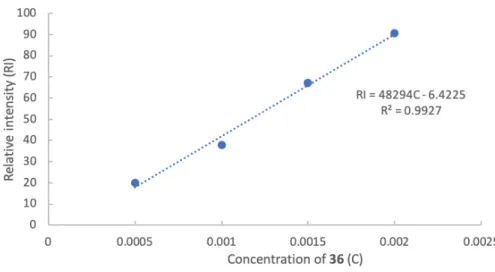
Figure 8 The calibration curve established for substrate 63.
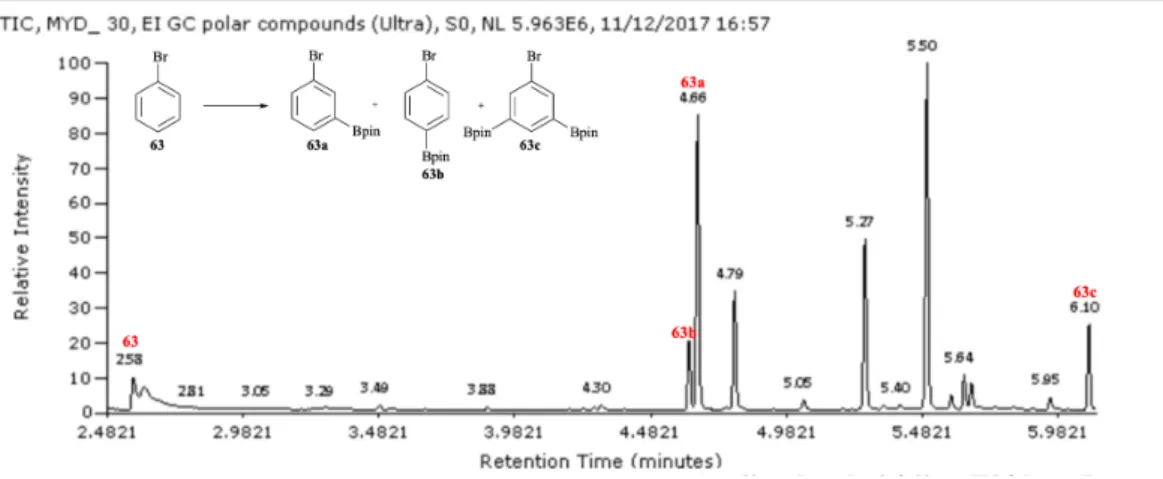
concentration and integrated areas of the substrate peaks in the GC-MS. The ratio of products was calculated based on GC-MS analysis (e.g. Figure 9).
Figure 9 GC-MS analysis of borylation of 63.
Having established a method, the comparative reactions were undertaken with a set of arenes using small variations in boron stoichiometry and reaction temperature (Table 5). Isolation of the resulting fluorinated boronic esters was performed by flash chromatography to give pure boronic esters in low to good yields. The lower yields of 61a and 62a reflected the challenges in the separation of the mono- and bis-borylated products. Fluorinated substrates afforded borylated products exclusively ortho to a C-F bond, whilst for the corresponding non-fluorinated arenes, ortho-positions were sterically disfavoured. This suggests that it is possible to overcome the hindrance of a small fluorine atom when compared with other functionalities in sterically controlled C-H borylation, which is consistent with established observations. Moreover, reaction of 66 (entry 11) showed that even two ortho-fluorine substituents could be tolerated.