Chapter 3 Buckling of Restrained Pipe under External Pressure
The buckling of uniformly supported steel liner used in separated tunnel structure had been studied as a free pipe buckling and the corresponding theory solution were given. However, when the steel liner is installed with locally support in tunnel, the contact between tunnel lining and steel liner should be taken into account, as well as the restraining effects due to RC linings, because the critical pressure increases significantly for an elastic liner encased in rigid cavity when consider the restraining effect. In this chapter, the steel liner as restrained pipe, its buckling is investigated using experimental, numerical and analytical method, in terms of plain steel liner and stiffened liner. Meanwhile the corresponding theoretical solutions will be discussed, based on the existing single-lobe buckling theories.
3.1 Literature Review
The buckling of encased cylindrical shells under external pressure has been studied since the mid-twentieth century. Two typical restrained hydrostatic buckling theories, the rotary symmetric buckling and the single-lobe buckling were presented by Borot, Vaughan, Cheney1), 2) and Amstutz3), Jacobsen 4), respectively. Because the single-lobe buckling theory had been
verified by many practical buckling accidents, it is widely applied in the buckling analysis of encased cylindrical shells at present. The recent research works have been carried out by El-Sawy et al 5),6),
using numerical analysis
, where Jacobsen theory was used to estimate thetheoretical critical pressure. The other related studies were conducted by
Croll
7),Omara
et al8),Yamamoto
et al9), and etc. In addition, the Jacobsen buckling equations has beenrecommended by Berti, D. et al. 10) in the technical forum on buckling of tunnel liner under
external pressure in 1998, because Jacobsen’s theory always gives conservative critical pressure. On the other hand,
ρ R Δ β α R ' Initial gap Tunnel lining (RC Segments) Steel liner
Amstutz buckling equations are still adopted in Japanese Standards11),12). In the current study,
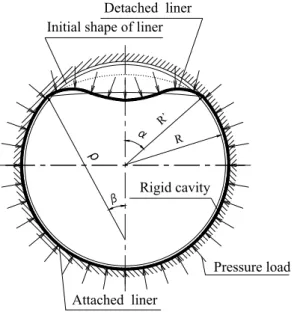
the buckling of restrained liner is considered the single-lobe buckling and its buckling deformation and corresponding notations are shown in Fig. 3.1. In the following paragraphs the single-lobe buckling theories are described in terms of the plain liner and stiffened liner. 3.1.1 Single-Lobe Buckling Theory of Plain Liner
In general, buckling of a plain pipe begins at a circumferential/axial stress (σN) substantially lower than the yield stress of the material except for liners with very small gap ratios and for very thick liners, in such cases σN approaches the yield stress. The modulus of elasticity (E) is assumed constant in Amstulz’s analysis. To simplify the analysis and to reduce the number of unknown variables, Amstutz introduced a number of coefficients that remain constant and do not affect the results of calculations. These coefficients are dependent on the value of ε, an expression shown in Eq. (3.1). Amstutz indicated that the acceptable range for magnitude of ε is 5<ε<20. Others researchers contend that the ε dependent coefficients are more acceptable in the range 10<ε<20, as depicted by the flatter portions of the curves. According to Amstutz, axial stress (σN) must be determined in conjunction with the corresponding value of ε. As the result, the Amstutz equations are given as Eqs. (3.2),
⎟
⎠
⎞
⎜
⎝
⎛
⎟
⎠
⎞
⎜
⎝
⎛
+
=
E
i
R
σ
Nε
21
(3.1) ⎥ ⎦ ⎤ ⎢ ⎣ ⎡ − ⎟ ⎠ ⎞ ⎜ ⎝ ⎛ − ⎟ ⎠ ⎞ ⎜ ⎝ ⎛ = ⎥ ⎥ ⎦ ⎤ ⎢ ⎢ ⎣ ⎡ ⎟ ⎠ ⎞ ⎜ ⎝ ⎛ − − * * 3 * * 1.73 1 0.225 e E R e R E i R N F N N F V Nσ
σ
σ
σ
σ
σ
σ
(3.2a) ⎥ ⎦ ⎤ ⎢ ⎣ ⎡ − ⎟ ⎠ ⎞ ⎜ ⎝ ⎛ − ⎟ ⎠ ⎞ ⎜ ⎝ ⎛ = 1 0.175 * * E e R R F P F N N crσ
σ
σ
(3.2b)Where, Δ/R: gap ratio between steel liner and concrete lining, R: liner mean radius, t: liner plate thickness, E: modulus of elasticity, fy: yield strength , v: Poisson’s Ratio, σN : circumferential / axial stress in plain liner, E* = E/(l – v2) , i = t/(12)0.5, e = t/2, F = t, σ
v= -(Δ/R)E*, μ =1.5-0.5[1/(1+0.002 E/fy)]2, and, σ*F =μfy (1-v+v2)0.5.
On the other hand, Jacobsen presented another theoretical solution based on the failure shape as shown in Fig. 3.2, his buckling equations of single-lobe buckling are shown in Eqs. (3.3). The Jacobsen buckling equations were derived in terms of the following three equations based
α
β
Attached liner Initial shape of liner
Detached liner Rigid cavity Pressure load R' R ρ
Fig. 3.2 Analytical model of single-lobe buckling
on geometrical and kinetic conditions of deformed liner: 1) the circumference of the deformed liner consisted of detached and attached portions equals to that of the original liner, disregarding the membrane deformation, 2) the differential equation of elastic deflection liner considering the slopes of both detached and attached portions is compatible at the connecting point, and 3) the failure criterion that the maximum normal stress in the extreme outer fiber of the liner reach the yield stress of liner material.
[
] [
]
[
]
[
/
(
sin
sin
)
1
tan
(
)
4
]
)
sin
sin
(
12
)
sin
sin
(
1
)
4
9
(
2 ' 3 2 2 2 'β
α
β
α
β
π
α
β
α
β
α
β
α
π
β
π
−
+
−
Δ
−
+
−
−
=
R
t
R
(3.3a) 3 3 ' 2 2)
sin
sin
(
)
(
12
1
4
9
β
α
β
π
t
R
E
P
cr=
−
(3.3b)⎥
⎦
⎤
⎢
⎣
⎡
+
−
+
⎟
⎠
⎞
⎜
⎝
⎛ −
=
β
π
β
α
α
β
β
α
α
β
sin
)
tan(
sin
4
1
sin
sin
sin
sin
1
2
' * ' 't
R
t
E
R
P
R
h
E
f
y cr (3.3c)Where,R’: tunnel lining internal radius, Δ/R: gap ratio, for gap between steel liner and concrete lining, α: one-half the angle subtended to the center of the cylindrical shell by the buckled lobe, fy : yield stress of liner, β: one-half the angle subtended by the new mean radius through the half
3.1.2 Single-Lobe Buckling Theory of Stiffened Liners
For ring-stiffened pipe, Amstutz presented an analytical solution in terms of buckling of overall stiffened pipe and buckling of inter-stiffeners pipe. The theoretical analysis for general buckling was presented using the same equations of plain pipe mentioned above. However, the cross-sectional properties J, i, and e is defined as the cross-section of stiffener with a co-operating strip of the pipe shell with effective width of thirty times the thickness. For F, the overall cross-section including the pipe shell between stiffeners is taken. As the inter-stiffeners shell buckling, the buckling theory of free pipe was adopted using Flügge’s equations, because the inter-stiffeners shell was considered to be left off the rigid wall in the reach of the buckling wave.
In many literatures, that Amstutz analysis is not applicable to steel liners with stiffeners has been mentioned because it is limited to buckling with ε greater than 5, α less than 90°. Because of this reason, only Jacobsen’s analysis of single-lobe failure of a stiffened liner is adopted in many manual, and the Amstutz analysis is not recommended. Jacobsen’s analysis of steel liners with external stiffeners is similar to that without stiffeners, except that the stiffeners are computed for the total moment of inertia as the moment of inertia of the stiffener with contributing width of the shell equal to 1.57( Rt)0.5 + t
r. As same with the case of un-stiffened liner, the analysis of stiffened liner is based on the assumption of a single-lobe failure. The three simultaneous equations with three unknown α, β, and Pcr are:
[
] [
]
[
]
[
/ (sin sin )1 tan ( ) 4]
) sin sin ( 12 ) sin sin ( 1 ) 4 9 ( 12 3 ' 2 2 2 2 '
β
α
β
α
β
π
α
β
α
β
α
β
α
π
β
π
− + − Δ − + − − = R F J R (3.4a) 3 3 ' 2 2)
sin
sin
(
)
12
(
12
1
4
9
12
β
α
β
π
F
J
R
EF
F
J
S
P
cr=
−
(3.4b)⎥
⎦
⎤
⎢
⎣
⎡
+
−
+
⎟
⎠
⎞
⎜
⎝
⎛ −
=
β
π
β
α
α
β
β
α
α
β
sin
3
)
tan(
sin
2
1
sin
sin
sin
sin
1
' ' 'J
F
hR
EF
SR
P
R
h
E
f
y cr (3.4c)Where, F: cross-sectional area of the stiffener and the pipe shell between the stiffeners, h: distance from neutral axis of stiffener to the outer edge of the stiffener, Pcr: critical external buckling pressure, and, J: moment of inertia of the stiffener and contributing width of the shell.
3.1.3 Other Buckling Theories of Restrained Liner
As well known, the critical pressure increases significantly for an elastic liner encased in rigid cavity. Glock in 1977 analyzed the elastic stability problem of the constrained liner under external pressure, using a non-linear deformation theory and the principle of minimum potential energy to develop his solution based on a pre-assumption of the deformed shape of the detached part of the liner13). His solution can be written as
2 . 2 2
1
⎟
⎠
⎞
⎜
⎝
⎛
−
=
D
t
E
P
crν
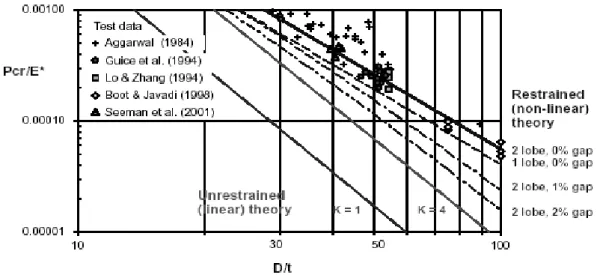
(3.5) The Glock solution was later extended by Boot14), 15) in 1998 to consider the effect of a gapbetween the liner and its host on the liner’s buckling pressure. Boot extended Glock.s closed-analysis theory to take account of initial gap imperfections and also to reflect the observed two-lobe buckling mode. Since then, the theories of Glock and Boot are usually called Boot-Glock theory. The generalized buckling equation derived by Boot can be expressed in convenient dimensionless form simply as Eq. (3.6) when converted to plane strain conditions for long pipe.
m cr cr
D
t
C
E
P
E
P
−⎟
⎠
⎞
⎜
⎝
⎛
=
−
=
)
1
(
2 *ν
(3.6)Where, both the coefficient C and the power m of t/D are functions of imperfections in the focused system. For zero imperfection m = -2.2, and the coefficient C has value of 1.003 for single-lobe buckling corresponding to Glock’s published solution and 1.323 for two-lobe buckling. As the mean gap to radius ratio w/R increases, both m and C increase, and at very large gaps approach 2-lobe values of -3 and 2 respectively, corresponding to the unrestrained buckling formula.
The concept of comparing the buckling pressure between free and encased liner has been employed by both researchers and developers of design codes. The idea has been used to determine an enhancement factor K, which is used to define the critical pressure for the encased liner. The enhancement factor K was defined by Aggarwall and Cooper 16)as,
cr r cr
KP
P
=
(3.7) Where, 3 21
2
⎟
⎠
⎞
⎜
⎝
⎛
−
=
D
t
E
P
crν
Aggarwall and Cooper indicated that the values of the enhancement factor varied from 6.5 to 25.8 with a range of diameter to thickness ratio of pipe approximately from 30 to 90, and 46 of 49 tests gave a value of K greater than 7. While another tests done by Lo and zhang17) gave the
enhancement factors ranged from 9.66 to 15.1.
These basic predictions of the Boot-Glock theory are plotted in Fig. 3.3 and compared with experimental data from various sources covering a wide range of D/t values from 30 to 100. The top two theoretical lines correspond to the two and one-lobe solutions respectively. The next two lines show how introduction of symmetrical gap imperfections w/R = 1%, and then 2%, not only reduces the 2-lobe buckling pressure but also progressively changes the mean slope of the curve closer to that of the unrestrained theory.
Fig. 3.3 Various gap-corrected hydrostatic buckling data compared with Boot-Glock theory for perfectly close fitting, perfectly circular liners
3.2 Contact Analysis Technology
18)Since a restrained liner will forms a detached part and attached another part during fitting the void between liner and its host, and the failure only occurs at a detached part of liner, the numerical analysis of buckling of restrained liner is required to simulate the contact phenomena. The contact analysis therefore, becomes the key issue to the analysis work. In the following paragraphs, the existing high-technology on numerical contact analysis is introduced with respect to the FEM software of MSC.Marc.
3.2.1 General Introduction
With the numerical analysis technology development, the simulation of many physical problems requires the ability to model the contact phenomena. This includes analyses of interference fits, rubber seals, tires, crash, and manufacturing processes among others. The analysis of contact behavior is complex due to the requirement to accurately track the motion of multiple geometric bodies, and the motion due to the interaction of these bodies after contact occurs. This includes representing the friction between surfaces and heat transfer between the bodies if required. The numerical objective is to detect the motion of the bodies, apply a constraint to avoid penetration, and apply appropriate boundary conditions to simulate the frictional behavior and heat transfer. Several procedures have been developed to treat these problems including the use of Perturbed or Augmented Lagrangian methods, penalty methods, and direct constraints. Furthermore, contact simulation has often required the use of special contact or gap elements. In many developed FEM software the contact analysis is allowed to be performed automatically without the use of special contact elements.
3.2.2 Contact Bodies Definition
In contact analysis, there are two types of contact bodies deformable and rigid body required to be defined.
As the deformable body, there are three key aspects to be considered: 1) the elements which make up the body, 2) the nodes on the external surfaces which might contact another body or itself, are treated as potential contact nodes, and, 3) the edges (2-D) or faces (3-D) which describe the outer surface in which a node on another body (or the same body) might contact, are treated as potential contact segments. Note that a body can be multiply connected (have holes in itself). It is also possible for a body to be composed of both triangular elements and quadrilateral elements in 2-D models or tetrahedral elements and brick elements in 3-D models. Beam elements and shells are also available for contact. However, it should not mix continuum elements, shells, and/or beams in a same contact body. Each node and element should be in, usually, one body. The elements in a body are defined using the CONTACT option. It is not
necessary to identify the nodes on the exterior surfaces as this is done automatically. The algorithm used is based on the fact that nodes on the boundary are on element edges or faces that belong to only one element. Each node on the exterior surface is treated as a potential contact node. The potential deformable segments composed of edges or faces are treated in potentially two ways. The default is that they are considered as piece-wise linear (PWL). As an alternative, a cubic spline (2-D) or a Coons surface (3-D) can be placed through them. The SPLINE option is used to activate this procedure. This improves the accuracy of regular calculation.
Rigid bodies are composed of curves (2-D) or surfaces (3-D) or meshes with only thermal elements in coupled problems. The most significant aspect of rigid bodies is that they do not deform. Deformable bodies can contact rigid bodies, but contact between rigid bodies is not considered. In 3-D, a too large number is automatically reduced so that the analysis cost is not influenced too much. The treatment of the rigid bodies as NURBS surfaces is advantageous because it leads to a greater accuracy in the representation of the geometry and a more accurate calculation of the surface normal. Additionally, the variation of the surface normal is continuous over the body which leads to a better calculation of the friction behavior and a better convergence. To create a rigid body, one can either read in the curve and surface geometry created from a CAD system or create the geometry using MSC.Marc Mentat or directly enter it in MSC.Marc. The CONTACT option then can be used to select which geometric entities is to be a part of the rigid body. However, an important consideration for a rigid body is the definition of the interior side and the exterior side. It is not necessary for rigid bodies to define the complete body because only the bounding surface needs to be specified.
A CONTACT TABLE option or history definition option can be used to modify the order in which contact is established. This order can be directly user-defined or decided by the program. In the latter case, the order is based on the rule that if two deformable bodies might come into contact, searching is done such that the contacting nodes are on the body having the smallest element edge length and the contacted segments are on the body having the coarser mesh. It should be noted that this implies single-sided contact for this body combination, as opposed to the default double-sided contact.
3.2.3 Analysis Procedure and Parameters
Analysis Procedure
In contact analysis a potential numerical procedure to simulate these complex contact problems has been implemented. At the beginning of the analysis, bodies should either be separated from one another or in contact. Bodies should not penetrate one another unless the objective is to perform an interference fit calculation. In practice, rigid body profiles are often complex, making it difficult to determine exactly where the first contact is located. Before the analysis
begins (increment zero), if a rigid body has a nonzero motion associated with it, the initialization procedure brings it into first contact with a deformable body. No motion or distortion occurs in the deformable bodies during this process. The CONTACT TABLE option may be used to specify that the initial contact should be stress free. In such cases, the coordinates of the nodes are relocated on the surface so that initial stresses do not occur. During the incremental procedure, each potential contact node is first checked to see whether it is near a contact segment. The contact segments are either edges of other 2-D deformable bodies, faces of 3-D deformable bodies, or segments from rigid bodies. By default, each node could contact any other segment including segments on the body that it belongs to. This allows a body to contact itself. To simplify the computation, it is possible to use the CONTACT TABLE option to indicate that a particular body will or will not contact another body. This is often used to indicate that a body will not contact itself. During the iteration process, the motion of the node is checked to see whether it has penetrated a surface by determining whether it has crossed a segment. Because there can be a large number of nodes and segments, efficient algorithms have been developed to accelerate this process. A bounding box algorithm is used so that it is quickly determined whether a node is near a segment. If the node falls within the bounding box, more sophisticated techniques are used to determine the exact status of the node.
Contact Tolerance
The contact tolerance is a vital quantity in contact analysis, which is used to judge whether the contact happen. When a node is within the contact tolerance, it is considered to be in contact with the segment. The value of the contact tolerance has a significant impact on the computational time and the accuracy of the solution. In default, the contact tolerance is calculated by the program as the smaller value of 5% of the smallest element length or 25% of the smallest (beam or shell) element thickness. It is also possible to define the contact tolerance by inputting its value directly. If the contact tolerance is too small, detection of contact and penetration is difficult which leads to long computation time. Penetration of a node happens in a shorter time period leading to more repetition due to iterative penetration checking or to more increment splitting and increases the computational costs. If the contact tolerance is too large, nodes are considered in contact prematurely, resulting in a loss of accuracy or more repetition due to separation. Furthermore, the accepted solution might have nodes that “penetrate” the surface less than the error tolerance, but more desirable to the user. The default error tolerance is recommended. Usually, there are areas exist in the model where nodes are almost touching a surface. In such cases, the use of a biased tolerance area with a smaller distance on the outside and a larger distance on the inside is recommended. This avoids the close nodes from coming into contact and separating again and is accomplished by entering a bias factor. The bias factor should be given a value between 0.0 and 0.99. The default is 0.0 or no bias. Also, in analyses
involving frictional contact, a bias factor for the contact tolerance is inside contact area (1 + bias) times the contact tolerance. The recommended value of bias factor is 0.95.
As for shell contact, it is considered shell contact occurred when the position of a node pulsing or minusing half the thickness projected with the normal comes into contact with another segment. As the shell has finite thickness, the node (depending on the direction of motion) can physically contact either the top surface, bottom surface, or mathematically contact can be based upon the mid-surface. One can control whether detection occurs with either / both surfaces, the top surface, the bottom surface, or the middle surface. In such cases, either two or one segment will be created at the appropriate physical location. Note that these segments will be dependent, not only on the motion of the shell, but also the current shell thickness.
Friction and Separation
Friction is a complex physical phenomenon that involves the characteristics of the surface such as surface roughness, temperature, normal stress, and relative velocity. An example of this complexity is that quite often in contact problems neutral lines develop. This means that along a contact surface, the material flows in one direction in part of the surface and in the opposite direction in another part of the surface. Such neutral lines are, in general, not known a priori. The actual physics of friction and its numerical representation are continuously to be topics of research. Currently, in MSC.Marc the modeling of friction has basically been simplified to two idealistic models. The most popular friction model is the Coulomb friction model. This model is used for most applications with the exception of bulk forming as encountered in e.g. forging processes. For such applications the shear friction model is more appropriate.
In contact analysis, another physical phenomenon is separation. After a node comes into contact with a surface, it is possible to separate in a subsequent iteration or increment. Mathematically, a node should separate when the reaction force between the node and surface becomes tensile or positive. Physically, one could consider that a node should separate when the tensile force or normal stress exceeds the surface tension. Rather than use an exact mathematical definition, one can enter the force or stress required to cause separation. Separation can be based upon either the nodal forces or the nodal stresses. The use of the nodal stress method is recommended as the influence of element size is eliminated. When using higher-order elements and true quadratic contact, the separation criteria must be based upon the stresses as the equivalent nodal forces oscillate between the corner and mid-side nodes.
However, in many cases contact occurs but the contact forces are small; for example, laying a piece of paper on a desk. Because of the finite element procedure, this could result in numerical chattering. MSC.Marc has some additional contact control parameters that can be used to minimize this problem. As separation results in additional iterations (which leads to higher costs), the appropriate choice of parameters can be very beneficial. When contact occurs, a
reaction force associated with the node in contact balances the internal stress of the elements adjacent to this node. When separation occurs, this reaction force behaves as a residual force (as the force on a free node should be zero). This requires that the internal stresses in the deformable body are redistributed. Depending on the magnitude of the force, this might require several iterations. You should note that in static analysis, if a deformable body is constrained only by other bodies (no explicit boundary conditions) and the body subsequently separates from all other bodies, it would then have rigid body motion. For static analysis, this would result in a singular or non-positive definite system. This problem can be avoided by setting appropriate boundary conditions. A special case of separation is the intentional release of all nodes from a rigid body.
3.3 Pre-Discussions on
Buckling of Restrained LinerThe analysis of restrained hydrostatic buckling is more complex than the free hydrostatic buckling of liner, because the buckling location in the former analysis has to be predicted except the critical pressure. On the other hand, as the application of existing buckling equations, Jacobsen equations can be physically applied directly, however, the application of Amstutz equations should satisfy the variation ε required in the range of 5 to 20. In the following paragraphes, the buckling location prediction and the application of theory equations will be given. Meanwhile, the methodology and the objective of the study on buckling of restrained liner will be discussed.
3.3.1 Prediction on Buckling Location
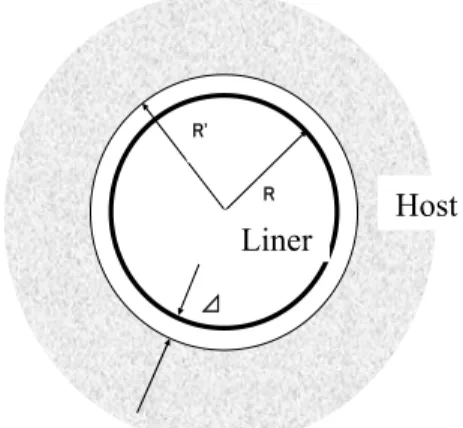
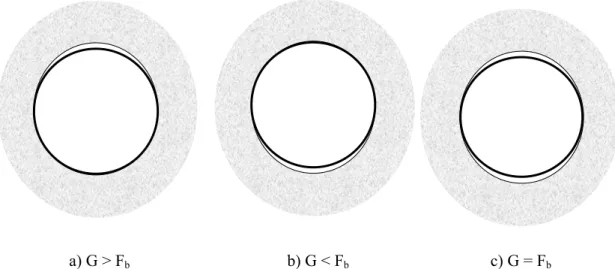
In practical engineering, for an encased pipe there are three buckling modes for hydrostatic bucking according to the relations of self weight and the lift force (buoyant) can be considered. Initially, the pipe is supported at invert of host cavity due to the self-weight. However, when the groundwater leaks/seepages into the void of liner back the buoyancy will lift liner until attach to the host lining. Consequently, if the self weight (G) of liner and operational internal water is larger than imposing buoyancy (Fb), the pipe maintains the initially state of attaching the host lining at invert and the gap existing at crown, on the contrary, the pipe reverses the initially state with attaching the host lining at crown. With the hydrostatic pressure increase, the attached portion of liner extents in the hoop direction and the gap increases until a new equilibrium state of the deformed liner reaches. Finally, the single-lobe buckling will occur in detached portion of the liner. As a result, the buckling occurs at the crown in the case of G>Fb, at the invert in the case of G<Fb. The buckling modes are generally called one lobe mode. While in case of G=Fb, the two single-lobe buckling may occur simultaneously at the invert and crown, commonly is called two lobe mode. The prediction procedure on buckling of encased pipe can be demonstrated as shown in Fig. 3.4, Fig. 3.5 and Fig. 3.6.
Fig. 3.4 Initial state of encased pipe R'
R
⊿
Host Liner
a) G > Fb b) G < Fb c) G = Fb
Fig. 3.5 Potential equilibrium state of encased pipe before buckling
R'
Buckling deformed liner Initial shape of liner
R R R' R R'
Buckling deformed liner Initial shape of liner
Buckling deformed liner Initial shape of liner
a) G > Fb (one lobe mode) b) G < Fb (one lobe mode) c) G = Fb (two lobe
mode)
3.3.2 Application of Existing Buckling Equations
Amstutz buckling equations has a simpler form due to using some constant values for several variables in developing the equations. The variation ε is the vital one to Amstutz buckling equations, which is a function of the ration of the thrust times the square of the ratio of radius to flexural rigidity of the liner and is assumed in a range of between 5 and 20. In addition, that the buckling failure occurs when the maximum normal stress in the most outer fiber reaches the yield point of liner material was assumed. For stiffened liner, the radius of gyration used in the Amstutz equations is computed by taking the cross sections of stiffener plus the co-operating strip of cylindrical shells with a width of thirty times the thickness. On the other hand, the Jacobsen buckling equations were derived based on simple geometrical and kinetic properties with the assumption of zero membrane extension. For stiffened liner, the moment of inertia is considered as that of stiffener and the cylindrical shells with the effective length, while the cross-sectional area is that of stiffener and cylindrical shells between stiffeners. However, the effective width of co-operating shells varies between the two theories for stiffened liner, the 30t and 1.57(Rt)0.5+tr for Amstutz’s and Jacobsen’s respectively, while the radius of gyration is all
computed according to the assumed effective cross-section. Moreover, that the most outer fiber reaching yield strength is the failure criterion for both mentioned buckling equations. Accordingly, the application of Amstutz buckling equation must satisfy the variation ε is in the assumed range; while Jacobsen equation can be simply applied because there is no extra limit requirement. In practices, the Jacobsen’s buckling equations are adopted widely.
Since in the derivation of Amstutz equations, the maximum stress in the external fiber, as the hoop compressive stresses including both stresses due to axial force and bending fy=σN +
σM should reach the yield strength, and the maximum σN is about 80 % of the yield strength. And the variation ε as expressed in Eq. (3.8) should be in the range of 5 to 20.
⎟
⎠
⎞
⎜
⎝
⎛
⎟
⎠
⎞
⎜
⎝
⎛
+
=
E
i
R
σ
Nε
21
(3.8) Where 12 ti= for plain liner;
F J
i= for stiffened liner.
The range of radius to thickness ratio (R/t) is can be calculated using the yield strength in terms of ε in range of 5 to 20. Where, when the steel pipe is considered, the general yield strength fy =315 N/mm2, and Young’s modulus E=2.1+e5 N/mm2, the minimum ratio(R/t) can
y N
f
E
E
t
R
6
.
9
)
1
(
12
)
1
(
2 2−
≥
−
=
ε
σ
ε
(
5
≤
ε
≤
20
)
(3.9a) Substituting the minimum value of ε=5, the application of Amstutz equations should satisfy the R/t>40 for steel pipe with the material properties mentioned above. Similarly, for the stiffened pipe, the limit of geometries of stiffened liner can given as follows,y y N
f
E
f
E
E
F
J
R
30
8
.
0
)
1
(
)
1
(
/
2 2=
−
≥
−
=
ε
σ
ε
(3.9b)Weather the application of Amstutz buckling equation is valid can also be judged from the obtained critical pressure. Since the normal stress σN was given by in Amstutz theory,
t
PR
N '=
σ
(3.10) Then the variation ε can be written in,⎟
⎠
⎞
⎜
⎝
⎛
⎟⎟
⎠
⎞
⎜⎜
⎝
⎛
⎟
⎠
⎞
⎜
⎝
⎛
+
=
E
P
t
R
t
R
2 '12
1
ε
(3.11)12
)
1
(
2 ' 2−
⎟
⎠
⎞
⎜
⎝
⎛
⎟
⎠
⎞
⎜
⎝
⎛
=
ε
R
t
R
t
E
P
(
5
≤
ε
≤
20
)
(3.12)If R=R’ is assumed, the maximum and minimum values of critical pressure can be estimated as below, 3 min
2
⎟
⎠
⎞
⎜
⎝
⎛
=
R
t
E
P
forε
=5 (3.13) 3 max33
.
3
⎟
⎠
⎞
⎜
⎝
⎛
=
R
t
E
P
forε
=20 (3.14)However, practically R’≠R, the mean to judge application of Amstutz buckling equation should be cautious. As for the stiffened pipe, for application of Amstutz equations, the ration of radius to thickness may be greater than 40, because the normal force component of
compressive stresses is smaller than the satisfactory providing σN <0.8 fy.
On the other hand, although Jacobsen equations are widely recommended by many researchers there is still a major criticism for the solution. The solution did not explicitly consider the elastic or inelastic stability of the liner but instead Jacobsen assumed that the ultimate pressure capacity of the liner corresponds to the first yielding at outer point in the liner. For a liner that buckles elastically before any material yielding (i.e. thin liner), this assumption is expected to overestimate the critical pressure since the pressure is controlled by the first yield of the liner. For the liners that yield before buckling (i.e. thick liners), the critical pressure values are expected to be underestimated since there is a considerable amount of pressure that can be carried by the liner after its first yield. This suggests that the Jacobsen solution should be critically evaluated. Moreover, although there is no limit requirement, the solution is difficult to solve out because it is consisted of three equations with too many unknown variants.
3.3.3 Methodology and Objective
The investigation of buckling of restrained pipe should consider three cases in terms of G<Fb G>Fb and G=Fb. As the approaching methods, the self weight loading is taken into account in the numerical analysis, as well as the buoyancy produced non-uniform hydrostatic water pressure. For the experimental investigation, since the single-lobe buckling occur in the portion of detached shells after equilibrium state reaches, and its behavior is almost identical to the bending behavior of a simple supported arch, the simplified model experiments are carried out using one half of un-stiffened and stiffened pipes. Where, the two liner loads are applied at the crown of test models to simulate the un-conservational hydrostatic pressure acting on the single-lobe deformed liner. As for the theoretical critical pressure calculation, the computing programs for Amstutz and Jacobsen equations are made using computer program language VB, respectively.
Considering the complexity of restrained hydrostatic buckling of liner installed in separated-type water tunnel, the investigations are mainly carried out in following aspects: 1) investigate the buckling behavior of restrained pipe and examine the existing two buckling theories, using numerical analysis method; 2) investigate the failure mechanism of single-lobe buckling and examine the existing two single-lobe buckling theories, using experimental analysis method; and, 3) discuss and present rational single-lobe buckling theories.
3.4 Numerical Analysis of Buckling of Restrained Liner
3.4.1 Numerical Analysis Modeling
Finite Element Analysis Modeling
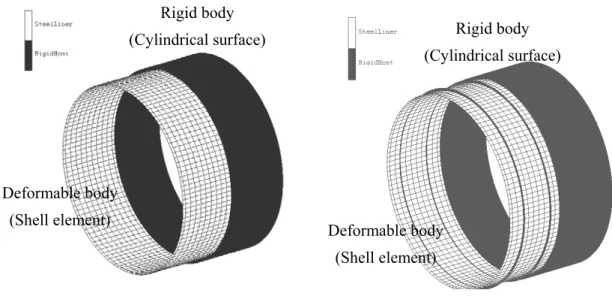
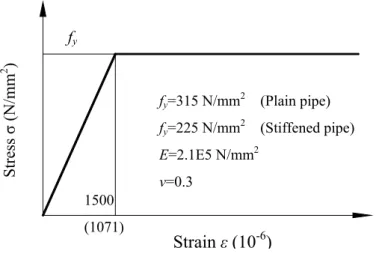
3D finite element models are used in contact analysis as shown in Fig. 3.7 (a) and (b) for plain pipe and stiffened pipe respectively. 3D shell element is applied to simulate steel liner as the deformable body in contact analysis, and surface of cylinder for RC linings as the rigid body. For the deformable body, a complete cross-sectional liner with a unit length is adopted for plain liner, and two spacing length for stiffened liner. The 4 nodes shell element is applied to model liner with thin shell element for plain liner and thick shell element for stiffened liner, respectively, considering the shear effects on the interaction between stiffeners and pipe. As the RC tunnel lining, the cylindrical rigid body is used to restrict the inner steel liner in terms of radial deformation. The liner’s material is supposed as an elastic-perfectly- plastic material following Von Mises yield criterion with Young ’s modulus E=2.1e5 N/mm2 and, yield stress f
y =315 N/mm2 for plain pipe and f
y=225 N/mm2 for stiffened pipe. The stress-strain behavior and material properties are shown in Fig. 3.8.
a) Plain pipe b) Stiffened pipe Fig. 3.7 Schematic profile of contact analysis modeling
(Liner is extracted for seeing easily) Rigid body (Cylindrical surface) Deformable body (Shell element) Rigid body (Cylindrical surface) Deformable body (Shell element)
Steel pipe Δ Initial gap Self-weight R Host tunnel
Uniform pressure Hydrostatic pressure Steel pipe Host tunnel R Self-weight Initial gap Δ
Fig. 3.8 Elastic-perfectly- plastic stress-strain behavior
As for the support boundaries, the fewest supports required for structural analysis are employed in order to reduce the effects of boundaries and consider the practical supporting conditions. The two nodes at crown and invert of the middle of model are fixed in circumferential direction on account of the symmetry of single-lobe buckling with respective to the vertical center line. Meanwhile, since the unit long model represents the infinite long liner, the nodes at two ends are also fixed in longitudinal direction. On the other hand, as the loading boundaries, two loading cases are considered: 1) the self-weight and uniform external pressure namely loading (case1), and, 2) the self-weight and hydrostatic pressure as loading (case2), in terms of the theoretical and practical loading conditions, briefly named as LC1 and LC2, respectively. However, the self-weight is not taken into account generally in theoretical solution, where it is used to provide an initial contact in analysis, as well as the initial imperfection
a) LC1 (self-weight and uniform external pressure) b) LC2 (self-weight and hydrostatic pressure)
Fig. 3.9 Loading conditions (Loading cases) fy=315 N/mm2 (Plain pipe) fy=225 N/mm2 (Stiffened pipe) E=2.1E5 N/mm2 v=0.3 1500 (1071) fy
Strain
ε
(10
-6)
Stress σ (N/mm 2 )inevitably required for buckling analysis using arc-length increment method. Whereas the loading case2 (LC2), the practical loading conditions is completely simulated when the underground water leaks /seepages into water tunnel. In addition, the initial imperfections due to self-weight and uniform external pressure can also be taken into account. The two loading conditions are shown in Fig. 3.9, respectively.
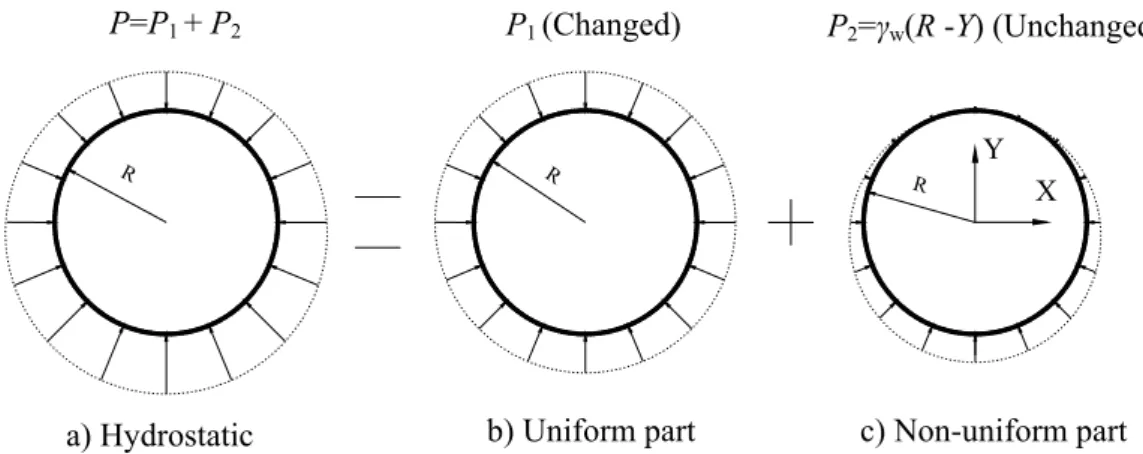
However, the loading procedure in numerical analysis is required to discuss previously, particularly for the loading of non-uniform water pressure. The self weight of liner as a gravity load can be taken into account by just inputting gravitational acceleration in the initial load case and zero in incremental load case, considering the self-weight maintains constant during bucking analysis. As the hydrostatic pressure (P), the part of uniform pressure and another part of non-uniform pressure should be considered respectively, as shown in Fig. 3.10. The uniform pressure (P1) as the pressure of crown is set zero for initial load case and a quantity of
twice predicted theoretical failure pressure in the incremental load case, because it is a variable changed in loading increment. Whereas the non-uniform pressure (P2) as a constant
value decided by its location with respect to the diameter of liner should be set the same as the self-gravity. However, the loading non-uniform force is required to use a special force subroutine of a FORTRAN computer program for initial and increment load cases, the pressure level of the respective location is calculated by P2=γw(R -Y). Where, Y is the ordinate
of rectangular coordinate with center of liner as its origin, because the non-uniform part of hydrostatic pressure is only decided by the diameter of liner.
Additionally, since the liner’s pressure-displacement relationship exhibits a peak-type behavior, the incremental arc-length control method is adopted, considering the conventional Newton- Raphson incremental approach would fail when approaching the point of peak pressure. In the incremental arc-length control method, no load or displacement increments are prescribed, but instead a constraint equation is applied and both the displacement and load increments are obtained through the solution. The contact analysis is employed between deform body and rigid body in numerical analysis, corresponding to the liner and RC segmental lining.
Fig. 3.10 Loading procedure of water pressure in numerical analysis
R R R
a) Hydrostatic b) Uniform part c) Non-uniform part
P2=γw(R -Y) (Unchanged)
P1 (Changed)
P=P1 + P2
Y X
Contact Analysis Setting
RC tunnel lining and liner are modeled as a rigid body and a deformable body, respectively. And the deformable body should be defined before rigid body. A contact table is also set by which the relationship between contact bodies in a contact analysis can be specified for the purposes:
・indicate which set of bodies may or may not touch each other, so that the computational time can be saved;
・define contact analysis inertias , like contact tolerance, bias factor;
・define different properties per set of contact bodies, like friction coefficient, error tolerance, and separation force. Where, the single side touching of deformable body touching rigid body is set, and an option is used to specify that the initial contact is stress free.
As discussed in section 3.2, the contact tolerance has a significant impact on the computational costs and the accuracy of the solution. If the contact tolerance is too small, detection of contact and penetration is difficult which leads to long computational time. Penetration of a node happens in a earlier time can lead to more repetitions due to iterative penetration checking or to more increment splitting and increases the computational time. In the contrast, if the contact tolerance is too large, nodes are considered in contact prematurely, resulting in a loss of accuracy or more repetition due to separation. Furthermore, the accepted solution might have nodes that “penetrate” the surface less than the error tolerance, but more than that desired by the user. Since the contact tolerance is dependent upon the value of error tolerance and bias factor, the error tolerance is carefully considered, as well the bias factor. In the current study, the error tolerance are set zero for plain pipe and 0.001 times height of stiffeners for stiffened pipe, considering the difference of practical contact phenomenon between plain pipe and stiffened pipe corresponding to the face and edge contacting. The contact happens when the node of pipe touch the surface of RC tunnel lining for plain liner, while when the node of stiffeners is below the tolerance distance for stiffened liner. It is therefore rational to adopt a larger size of error tolerance for stiffened liner considering the stiffened liner has small area of stiffener edge to detect the touching surface. Otherwise, at the default error tolerance of 25%, the smallest shell thickness varying with thickness is easy to induce the different contact criterion. Moreover, the large areas exist in the model where nodes are almost touching a surface during increment of loading. In such cases, the use of a biased tolerance area with a smaller distance on the outside and a larger distance on the inside is recommended. This avoids the close nodes from coming into contact and separating again and is accomplished by entering a bias factor. Also, in analyses involving frictional contact, a bias factor for the contact tolerance is inside contact area (1 + bias) times the error tolerance. Accordingly, by increasing the bias factor, the outside contact tolerance zone is decreased and the inside contact tolerance zone is increased. This generally reduces the number of iterations to get a converged solution. Where, the bias factor is
set by using the recommended value 0.95.
Additionally, the top surface check is set for plain liner by which nodes only come into contact with top layer and ignore the thickness of shells. Whereas for stiffened liner, both the top and bottom surface check are set considering the nodes distributed on both bottom and top surface of stiffener is potential to contact. As the separation, it is considered that separation occurs when the contact normal stress on the node in contact becomes larger than the separation stress set as 0. In other words, when tensile is produced in contact normal stress, the separation occurs. In the current study, the friction during contact is disregarded, considering the friction factor between steel liner and the RC lining is rather smaller in water surrounding.
3.4.2
Buckling of Plain Liner
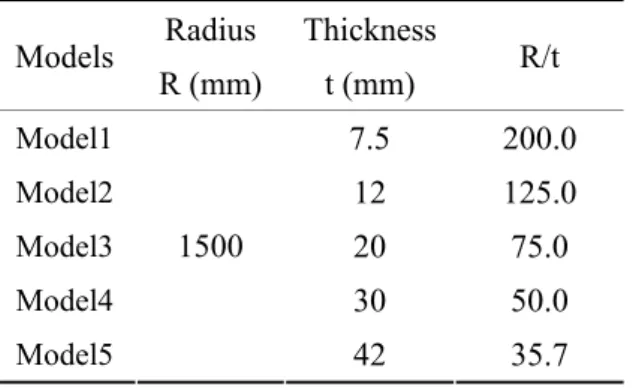
Analysis Models and CasesThe numerical analysis is carried out using 5 models with different ratio of radius to thickness, as shown in Table 3.1. In addition, for each model the 11 gap cases are considered in terms of the ranges of gap ratio from 0 to 20%, as shown in Table 3.2. Meanwhile, the Application range of Amstutz’s equations for computing critical pressure by means of Eq. (3.13) and Eq. (3.14) are summarized in Table 3.3. The vilification of Amstutz equation’s application is conducted
Table 3.1 Analysis models Models Radius R (mm) Thickness t (mm) R/t Model1 7.5 200.0 Model2 12 125.0 Model3 20 75.0 Model4 30 50.0 Model5 1500 42 35.7 Table 3.2 Gap cases
Cases Gap ⊿(mm) R' (m) Gap ratio ⊿/R (%) 1 1.5E-3 1.5 1.0E-04 2 0.6 1.5006 0.04 3 1.2 1.5012 0.08 4 3.0 1.503 0.1 5 7.5 1.5075 0.5 6 15.0 1.515 1.0 7 22.5 1.5225 1.5 8 30.0 1.53 2.0 9 37.5 1.5375 2.5 10 75.0 1.575 5.0 11 300 1.8 20.0
Table 3.3 Application range of Amstutz’s equation for computing critical pressure
Pcr (kN/m2) Model1 Model2 Model3 Model4 Model5
Max. 874 3580 16576 55944 153510
through checking the obtained critical pressure: if the calculated critical pressure belongs to the range, the Amstutz’s equation can be judged to be applicable..
Moreover, in the current study the material density, ρs =7.8 t/m3 for the steel liner, and ρw =1.0 t/m3 for the water are taken, respectively. For the loading case2 (LC2), taking into
account the non-uniform water pressure, the buoyancy of unit length pipe (Fb) and the self-weight is (W) are calculated as follows,
Fb=πR2ρwg (3.15) W=2πRtρsg (3.16) By substituting ρw=1.0 t/m3 and ρs =7.8 t/m3 to above equations, the ratio of buoyancy to self weight can be obtained as,
Fb/W=Rρw/2tρs=R/15.6t (3.17) According to the above discussion, the single-lobe bucking occurs at invert only when the buoyancy is larger than the self-weight, therefore in terms of the radius to thickness ratio, the single-lobe bucking occurs at invert for the model with the geometrics of R/t>15.6. From Table 3.1, the buckling failure should occur at invert for loading case2, because the radius to thickness ratios of all models are R/t>15.6. Whereas for the buckling under loading case1, the single-lobe buckling should occur at crown, since the acting loads are self-weight and uniform pressure without the buoyancy.
Numerical Analysis Results and Discussions
1) Single-lobe buckling mechanism
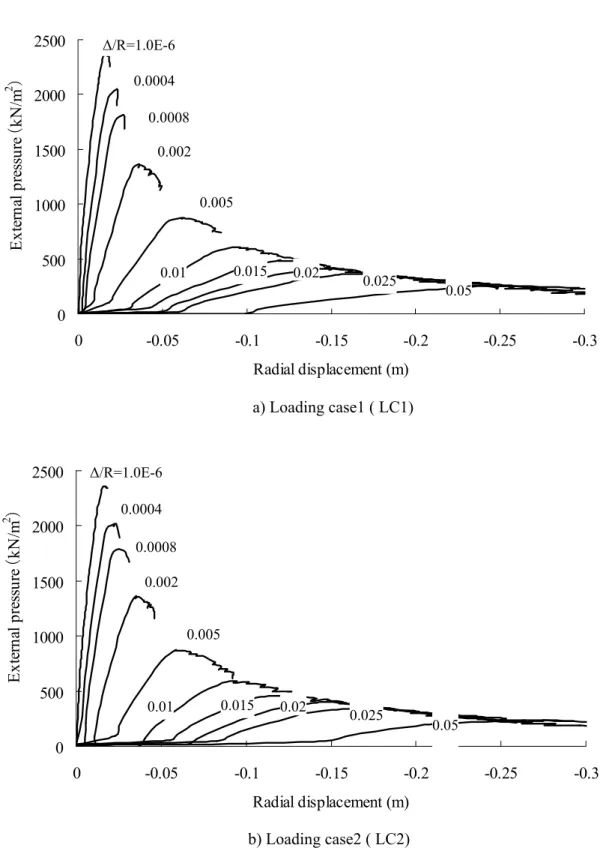
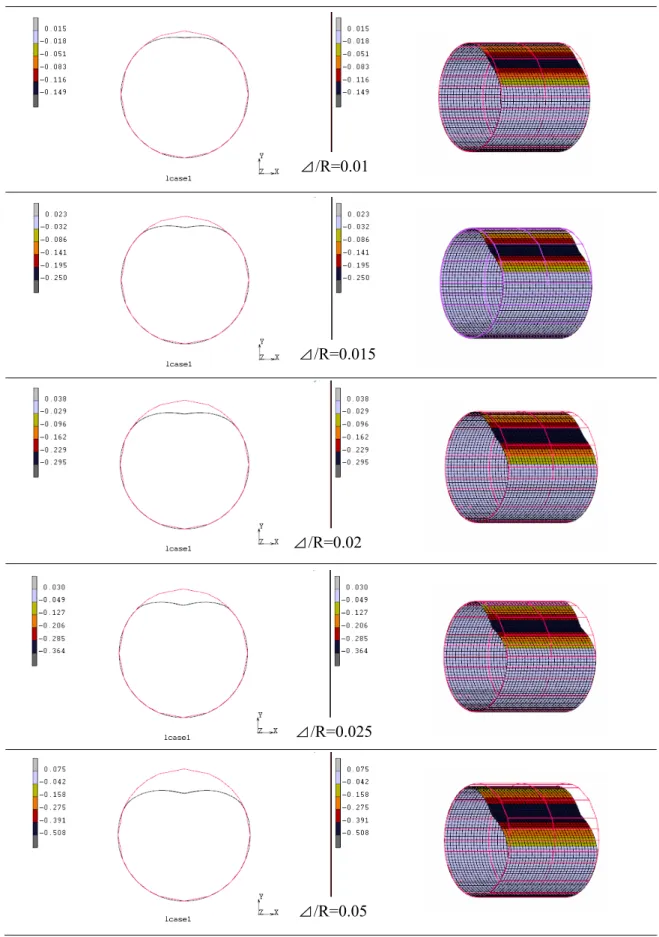
The numerical analysis of all models is carried out for all the gap cases, and all the results are summarized. As the numerical analysis results, the behavior of external pressure and radial displacement of all models is focused as well as the failure mode in terms of radial displacement and VonMise stress. As for the displacement, the nodes located in single-lobe buckling area are used to provide the radial displacement relation. Where, all the numerical results of the model3 are presented as an example. The pressure-displacement curves with respect to the gap ratio of model3 are given for the two loading cases as shown in Fig. 3.11 a) and b), and the corresponding failure modes are summarized in Fig. 3.12 a) and b), respectively, in terms of radial deformation.
0 500 1000 1500 2000 2500 -0.3 -0.25 -0.2 -0.15 -0.1 -0.05 0 Radial displacement (m) Ext er na l pr es su re ( kN /m 2 ) a) Loading case1 ( LC1) 0 500 1000 1500 2000 2500 -0.3 -0.25 -0.2 -0.15 -0.1 -0.05 0 Radial displacement (m) Ex te rn al pr es su re (kN/ m 2 ) b) Loading case2 ( LC2)
Fig. 3.11 Pressure-displacement behavior with different gap ratio ( Model3 )
0.0004 Δ/R=1.0E-6 0.0008 0.002 0.005 0.01 0.015 0.02 0.025 0.05 0.0004 Δ/R=1.0E-6 0.0008 0.002 0.005 0.01 0.015 0.02 0.025 0.05
⊿/R=0.0004
⊿/R=1.0E-6
⊿/R=0.0008
⊿/R=0.002
1
Fig. 3.12 a) Radial deformation of failure mode under LC1 (Model3)
⊿/R=0.01
⊿/R=0.015
⊿/R=0.02
⊿/R=0.025
1 ⊿/R=1.0E-6 ⊿/R=0.0004 ⊿/R=0.0008 ⊿/R=0.002 ⊿/R=0.005
1
Fig. 3.12 b) Radial deformation of failure mode under LC2 (Model3)
⊿/R=0.01
⊿/R=0.015
⊿/R=0.02
⊿/R=0.025
From the Fig. 3.11 a) and b), the encased plain pipe failed in single-lobe buckling and the critical pressure increases with the initial gap declining. In addition, it can be easily recognized that the single-lobe buckling occurred at crown and the corresponding failure inward deformation becomes large with the initial gap increasing for LC1 from Fig. 3.11 a) and b). On the contrary, the single-lobe buckling occurred at invert and its inward failure deformation increases with the increase of initial gap for LC2 of self-weigh and hydrostatic pressure. The similar results can be recognized from the Fig. 3.12 a) and b). As the deformation development, the crown of pipe detaches from host wall with the inward deformation increasing, while the other part deformed outward and attaches the host wall as the external pressure increase, and the inward deformed area enlarges with the initial gap increase at critical pressure.
Moreover, the consideration on predicting the buckling location is also verified, in which the single-lobe buckling of encased liner can be predicted according to the initial loading conditions, and always occur at the location with the larger gap under initial loads. Accordingly, it is valid to predict the buckling location through comparing the buoyancy and self weight based on the initial acting loads. Particularly, the buckle location of practical encased liner can be predicted validly by geometrical ratio of radius to thickness for plain liner, with respective to the practical loading conditions of self-weight and non-uniform hydrostatic pressure, considering the fact that single-lobe buckling of all models with R/t larger 15.6 occurred at invert. As the failure mechanism of encased liner, the Jacobsen’s consideration may be more reasonable and practical. When an encased pipe with initial annular gap is subjected to the external pressure loads, the deformations will vary from location around liner considering the external loads is not only a uniform pressure and the liner has initial shape imperfection. With external pressure increase, the outward deformation will be enlarged in one part of liner until outward deformation is restrained by host lining, while a single-lobe is formed in another part of liner with the inward deformation. The liner then fails when the inward deformed part liner comes to failure. The failure criterion is defined by Jacobsen as that the most outer fiber reaching the yield point. However, the failure criterion should be further discussed, although the formation of single-lobe and the failure mechanism is well explained.
2) Discussion of critical pressure and existing buckling theories
The critical pressure is obtained from the pressure-displacement behavior by only using the peak value for LC1, while for LC2 the critical pressure should be adopted the total of peak value and the additional part of non-uniform pressure. However, the critical pressure in LC2 is difficult to estimate because the part of non-uniform pressure varies with the focused location. Where, the water pressures at bottom and center, representing the average pressure and maximum pressure, respectively are considered as the critical pressures of LC2. The relation of the critical pressure and gap ratio under two loading conditions obtained from numerical analysis are given for all the models as shown in Figs. 3.13-17, and the theoretical results calculated using equations of Amustutz and Jacobsen are also plotted on these figures. To explicitly show the relation of buckling pressure and gap ratio, the logarithmic type graphs are used.
Since the Glock’s equation is usually recommended for calculation of close-fitted pipe, the investigation of the critical pressure is carried out with respect to the gap case1, and the comparison results are listed in Table 3.4. Where, Pcr_G., Pcr_A. and Pcr_J. denote the theoretical critical pressure of Glock, Amustutz and Jacobsen, Pcr_num.1 are Pcr_num.2 represent the numerical values of LC1 and LC2, respectively. In addition, since the concept of comparing the buckling pressure for unsupported and encased liner has been employed by both researcher and developers of design codes, using an enhancement factor K, which is used to define the critical pressure for the encased liner, the enhancement factor K is computed and described in Figs. 3.18, with respect to the ratio of radius to thickness and gap to radius. Where, the enhancement factor is calculated by Eq. (3.7) using the numerical critical pressure of LC1 and LC2, respectively. 0 50 100 150 200 250 300 350 400 450 500 0.0001 0.001 0.01 0.1 Δ/R C ritic al p re ssu re ( kN /m 2 )
Numerical (Self-weight & uniform pressure) Numerical (Self-weight & water pressure) Theoretical (Amstuzu)
Theoretical (Jacobsen)
Average water pressure Maximum water pressure Fig. 3.13 Comparison of theoretical and numerical results (Model1, R/t=200) 0 50 100 150 200 250 300 350 400 450 500 0.0001 0.001 0.01 0.1 Δ/R C ritic al p re ss ure ( kN /m 2 )
Numerical (Self-weight & uniform pressure) Numerical (Self-weight & water pressure) Theoretical (Amstuzu)
0 200 400 600 800 1000 1200 0.0001 0.001 0.01 0.1 Δ/R C ri tical p ressu re ( kN/ m 2 )
Numerical (Self-weight & uniform pressure) Numerical (Self-weight & water pressure) Theoretical (Amstuzu)
Theoretical (Jacobsen)
Average water pressure Maximum water pressure Fig. 3.14 Comparison of theoretical and numerical results (Model2, R/t=125)
0 500 1000 1500 2000 2500 3000 0.0001 0.001 0.01 0.1 Δ/R C ri tical p ressu re ( kN /m 2 )
Numerical (Self-weight & uniform pressure) Numerical (Self-weight & water pressure) Theoretical (Amstuzu)
Theoretical (Jacobsen)
Average water pressure Maximum water pressure Fig. 3.15 Comparison of theoretical and numerical results (Model3, R/t=75)
0 1000 2000 3000 4000 5000 0.0001 0.001 0.01 0.1 Δ/R C ri tical p ressu re ( kN /m 2 )
Numerical (Self-weight & uniform pressure) Numerical (Self-weight & water pressure) Theoretical (Amstuzu)
Theoretical (Jacobsen)
Average water pressure Maximum water pressure Fig. 3.16 Comparison of theoretical and numerical results (Model4, R/t=50)
0 200 400 600 800 1000 1200 0.0001 0.001 0.01 0.1 Δ/R C ri tical p ressu re ( kN /m 2)
Numerical (Self-weight & uniform pressure) Numerical (Self-weight & water pressure) Theoretical (Amstuzu) Theoretical (Jacobsen) 0 500 1000 1500 2000 2500 3000 0.0001 0.001 0.01 0.1 Δ/R C ri tical p ressu re ( kN /m 2 )
Numerical (Self-weight & uniform pressure) Numerical (Self-weight & water pressure) Theoretical (Amstuzu) Theoretical (Jacobsen) 0 1000 2000 3000 4000 5000 0.0001 0.001 0.01 0.1 Δ/R C ri tical p ressu re ( kN /m 2 )
Numerical (Self-weight & uniform pressure) Numerical (Self-weight & water pressure) Theoretical (Amstuzu)
0 1000 2000 3000 4000 5000 6000 7000 8000 9000 10000 0.0001 0.001 0.01 0.1 Δ/R C riti cal p ressu re (kN /m 2)
Numerical (Self-weight & uniform pressure) Numerical (Self-weight & water pressure) Theoretical (Amstuzu)
Theoretical (Jacobsen)
Average water pressure Maximum water pressure Fig. 3.17 Comparison of theoretical and numerical results (Model5, R/t=35.7) Table 3.4 Critical pressure comparison of close-fitted pipe
Critical pressure (kN/m2) Model1 Model2 Model3 Model4 Model5
Pcr_G. 435.2 1223.8 3765.1 9187.1 19260.1 Pcr_Num.1 404.2 985.8 2369.6 4531.0 7410.0 Pcr_Num.1/ Pcr_G. 92.9 % 80.6 % 62.9 % 49.3 % 38.5 % Pcr_ Num.2 392.8 973.4 2359.3 4524.7 7409.4 Pcr_ Num.2/ Pcr_G. 90.3 % 79.5 % 62.7 % 49.3 % 38.5 % Pcr_A. 396.2 962.9 2375.3 4656.2 7883.0 Pcr_A./ Pcr_G. 91.0 % 78.7 % 63.1 % 50.7 % 40.9 % Pcr_J 376.4 879.7 2058.3 3893.6 6463.6 Pcr_J/ Pcr_G. 86.5 % 71.9 % 54.7 % 42.4 % 33.6 % 0 10 20 30 40 50 60 0.0001 0.001 0.01 0.1 Δ/R E nh an cem en t fact or K R/t=200 R/t=125 R/t=75 R/t=50 R/t=35.7
a) Loading case1 (LC1) b) Loading case2 (LC2) Fig. 3.18 Enhancement factor change with respective to the R/t and Δ/R
0 1000 2000 3000 4000 5000 6000 7000 8000 9000 10000 0.0001 0.001 0.01 0.1 Δ/R C rit ic al p re ssu re ( kN /m 2 )
Numerical (Self-weight & uniform pressure) Numerical (Self-weight & water pressure) Theoretical (Amstuzu) Theoretical (Jacobsen) 0 10 20 30 40 50 60 0.0001 0.001 0.01 0.1 Δ/R E nh an cem en t fact or K R/t=200 R/t=125 R/t=75 R/t=50 R/t=35.7
From the above Figs. 3.13-17, it can be found that the critical pressure increases with the decreasing of gap ratio and the increasing of thickness. For all models with different thickness, the numerical results of buckling pressure under LC1 of self-weight and uniform external pressure agree well with that under LC2 of self-weight and hydrostatic pressure in general for any gap. Particularly, the critical pressures of two loading cases are almost identical to each other when the critical pressure of LC2 employs the maximum water pressure. Considering the bucking under LC2 of all the models occurred at invert, this may also indicate the critical pressure should apply the hydrostatic pressure of buckled location. Moreover, as single lobe buckling, the material failure of inward deformed part of liner cause the failure of general encased liner can be found, which has been discussed above.
As for the theoretical equations, generally the Amstutz’s equations give reasonable results which are agreement with the numerical results except model4 and model5 with radius to thickness ratio less than 50; while Jacobsen’s equations provide conservational results, especially for cases with smaller gap ratio. Moreover, for Amstutz’s buckling equations, the trend that the less the radius to thickness ratio is, the more the analytical critical pressure is agreeable with the numerical results can also be found. Whereas for Jacobsen’s buckling equations, the trend that the greater the gap to radius ratio is, the more the agreement between theoretical and numerical results can be obtained.
However, since Amstutz’s buckling equations can only be applied when the variation ε satisfies the requirement of in ranges 5 to20, and the corresponding judgment method in buckling pressure has been discussed, the method can be used to judge the results, as well as their verifications. From the Table 3.3 and the Figs. 3.13-17, that the judgment method using critical pressure is rather valid can be understood. The difference between theoretical and numerical pressure becomes greater when the critical pressure is less than the lower limits: 53 kN/m2 for model1, 215 kN/m2 for model2, 996 kN/m2 for model3, 3360 kN/m2 for model4 and
9220 kN/m2 for model5, respectively. Furthermore, that the thicker the pipe is, the more
difficult the Amstutz’s equations can be applied is also confirmed, especially the model5 are completely out of the application range.
On the other hand, that the thicker the liner is the more conservational the Jacobsen’s theoretical critical pressure can also be concluded. The failure criterion of the most outer fiber yielding can be considered as the cause. For a thin wall liner the yielding of the most outer fiber at the point with maximum inward deformation can cause pipe failure; while for a thick wall pipe the liner is difficult to fail when the most outer fiber reaches the yield point because the cross section of inward deformed liner is rather high and is mainly subjected to bending force during failure process of single-lobe buckling. The consistent agreement between theoretical and numerical critical pressure of model1 with ratio of radius to thickness 200 as shown in Fig. 3.13 could be the good evidence. In addition, Jacobsen’s equations can provide
a safe design for all cases of gap ratio less than 0.01, while for case with larger gap the application of Jacobsen’s equations should be carefully cautious, especially the critical pressure is possible to be over-estimated for a thinner liner.
Since the critical pressures are almost identical even the liners have different initial states of shape and stresses produced by different initial loading conditions, the initial imperfections of shape and stress distribution have little effects on single-lobe buckling of encased liner may be considered. This can be explained from the mechanism of single-lobe buckling, the imperfections will be adjusted during the single-lobe formation. In addition, the liner failure is just determined by material failure of inward deformed liner wall and the critical pressure is almost decided by the bending capacity of the inward deformed part. Moreover, that the effects of self weight and non-uniform pressure on single-lobe buckling are very limited can also be considered. The self-weight and non-uniform water pressure only affect the buckling location from crown to invert when the buoyancy is larger than the self-weight of liner.
Otherwise, as the Glock’s equation usually applied for the tightly fitted liner, the dangerous critical pressure is always given can be found from the critical pressure comparing with the analytical and numerical results as shown in Table 3.4. And, the more dangerous critical pressure is given by Glock’s equation with the increasing of ratio of radius to thickness. Since the critical pressure is related with not only the ratio of radius to thickness but also the yielding stress, elastic modulus, and the gap ratio in numerical analysis and Amstutz’s or Jacobsen’s buckling equations, while only the ratio of radius to thickness in Glock’s bucking equation, the Glock’s equation is not able to recommend, especially for the tunnel liner installed in separated water tunnel structure. As the enhancement factor widely adopted in design codes, the enhancement factor decreases with the inclining of the radius to thickness ratio and gap ratio in general is indicated explicitly in Fig. 3.18, no matter for LC1 or LC2. Additionally, Aggarwall and Cooper indicated that the values of the enhancement factor varied from 6.5 to 25.8 with a range of pipe of radius to thickness ratio approximately from 30 to 90, and 46 of 49 tests gave a value of K greater than 7. While another tests done by Lo and Zhang gave the enhancement factors ranged from 9.66 to 15.1. In the current study, the enhancement factor of tightly fitted case is 17, 10 and 6 for mode3, model4 and model5 with radius to thickness ratio 75, 50 and 35.7, respectively. This may also identify the numerical analysis rather sound. However, for the steel liner in the current study, the concept of enhancement may be meaningless since it is considered as loosely fitted liner and the enhance factor varies with not only the radius to thickness ratio but also the gap ratio.
Summary
In general, the mechanism of the single-lobe buckling can be explained that the encased liner experiences the formulation of detached part and attached part of liner, and the single-lobe formulation in attached liner in two stages under the external pressure, then the finally material failure causes the liner failure. As the buckling location, the presented prediction method can be used to estimate the buckling site accurately. The critical pressure increases with the decreasing of gap ratio and the increasing of thickness was indicted. The initial imperfections of shape and stress distribution have little effects on single-lobe buckling of encased liner was found. As the theoretical solution, the Amstutz’s equations can be used to accurately estimate critical pressure if the 5<ε <20 was satisfied, and the presented judgment method was tested the useful solution to judge variation ε using the critical pressure. On the other hand, Jacobsen’s equations always give a conservational critical pressure, then is recommended to design considering the complex conditions unpredicted in engineering. However, the Glock’s equation and concept of enhancement applied for the tightly fitted liner should not be used because the variable gaps must be taken into account in the current study.
3.4.3 Buckling of Stiffened Liner
Numerical Analysis and Results
1) Models and gap cases
The numerical analysis of buckling of stiffened pipes is carried out using the FE contact analysis method. To investigate the effects of geometries of pipe on buckling, three kinds of steel pipe with different thicknesses were used as the numerical analysis models. Meanwhile, as the effects of the stiffening conditions, three ring stiffeners with different cross sections, and three different stiffening spacing are employed in analysis. All the numerical analysis models are summarized in Table 3.5. However, since the initial gap is vital to restrained hydrostatic buckling, seven gap cases are considered in the current study, including the tightly fitted case and free case, as shown in Table 3.6. Otherwise, the modeling and material properties of stiffened liners can refer 3.4.1, where the modeling of encased liner and water tunnel lining was described as well as contact analysis. However, it should be noted the radius of the host lining is equal to the total of the mean radius of pipe, stiffener height and the gap.
Table 3.5 Analysis models (stiffened pipe)
Pipe geometrics Stiffener
Radius R (m) Wall thickness t (mm) High hr (mm) Thickness tr(mm) Spacing S (m) 1.5 5 10 20 35 10 20 30 0.5 1.0 1.5 Table 3.6 Gap cases (stiffened pipe)
Gap Gap ratio Host radius Cases Δ (mm) Δ/R R' (m) Case1 0 0.0 1.5350 Case2 0.6 0.0004 1.5356 Case3 0.9 0.0006 1.5359 Case4 1.5 0.001 1.5365 Case5 7.5 0.005 1.5425 Case6 45 0.03 1.5800 Case7 1500 1.0 3.0350