Army Regulation 608–10
Personal AffairsChild
Development
Services
HeadquartersDepartment of the Army Washington, DC
15 July 1997
SUMMARY of CHANGE
AR 608–10Child Development Services This change
1--o This (write-in) change implements the reissue 1--of Department 1--of Defense Instruction 6060.2, Child Development Programs.
o The change expands policy on administering medication to children with special needs, and revises policy on placement of children with disabilities in Child Development Services programs pursuant to the Rehabilitation Act of 1973, as amended.
o The change complies with the decision by the United States Court of Appeals for the Sixth Circuit in Hartmann et al. v. Stone et al. concerning religious activities in family child care provider homes.
o The change removes restrictions which prohibit religious activities in family child care and Supplemental Programs and Services provider homes and adds provisions ensuring parents receive prior notification of religious
activities in family child care and Supplemental Programs and Services homes. o Further, the change provides additional guidance and clarification for
commanders and other leaders to enforce Army Child Development Services policies.
This
revision--o Increvision--orprevision--orates existing HQDA prevision--olicy directives and field requests frevision--or specific guidance on Child Development Services (CDS) construction design criteria, the United States Department of Agriculture Child Care Food Program, staff training, management practices to minimize the risk of child abuse occurring in a CDS setting, health policies, staffing requirements, priorities for service, developmental programming, and quality assurance procedures. o Expands Family Child Care (FCC) to include certification requirements,
special endorsements, and claims (chap 6).
o Expands Supplemental Programs and Services (previously Supplemental/ Outreach Care Options) to include the School-Age/Latch Key Program;
delineates common support delivery systems; and lists optional care available to meet new mission requirements (chap 7).
o Adds consolidated criteria to include child abuse prevention standards necessary to meet CDS Standards (app C).
Headquarters
Department of the Army Washington, DC
15 July 1997
Personal Affairs
Child Development Services
*Army Regulation 608–10
Effective 15 August 1997
H i s t o r y . T h i s p u b l i c a t i o n w a s o r i g i n a l l y p r i n t e d o n 1 2 F e b r u a r y 1 9 9 0 . I t w a s authenticated by Carl E. Vuono, General, U n i t e d S t a t e s A r m y C h i e f o f S t a f f , a n d M i l t o n H . H a m i l t o n , A d m i n i s t r a t i v e A s s i s t a n t t o t h e S e c r e t a r y o f t h e A r m y . This electronic edition publishes the basic 1997 edition and incorporates Changes 1. Change 1 to this regulation was printed on 15 July 1997. Change 1 was authenticated b y T o g o D . W e s t , J r . , S e c r e t a r y o f t h e Army.
Summary. This (write–in) change imple-ments the reissue of Department of De-f e n s e I n s t r u c t i o n 6 0 6 0 . 2 , C h i l d Development Programs. The change ex-pands policy on administering medication to children with special needs, and revises policy on placement of children with disa-b i l i t i e s i n C h i l d D e v e l o p m e n t S e r v i c e s p r o g r a m s p u r s u a n t t o t h e R e h a b i l i t a t i o n A c t o f 1 9 7 3 , a s a m e n d e d . T h e c h a n g e complies with the decision by the United States Court of Appeals for the Sixth Cir-cuit in Hartmann et al. v. Stone et al. concerning religious activities in family child care provider homes. The change rem o v e s r e s t r i c t i o n s w h i c h p r o h i b i t r e l i -gious activities in family child care and
Supplemental Programs and Services pro-vider homes and adds provisions ensuring parents receive prior notification of reli-gious activities in family child care and S u p p l e m e n t a l P r o g r a m s a n d S e r v i c e s homes. Further, the change provides addi-tional guidance and clarification for com-m a n d e r s a n d o t h e r l e a d e r s t o e n f o r c e A r m y C h i l d D e v e l o p m e n t S e r v i c e s policies.
Applicability.
a. This regulation applies to—
(1) The Regular Army.
(2) The U.S Army Reserve (USAR) on active duty, active duty for training, or special active duty for training (30 days or more duration).
(3) The Army National Guard of the United States (ARNGUS) on active duty, active duty for training, or special active duty for training under title 10, United States Code (30 days or more duration). (4) Members of other uniformed serv-ices (and their families) assigned to Army installations.
(5) Others entitled to care in medical treatment facilities (MTFs).
b. This regulation does not apply to
members of the USAR performing inac-tive duty training or to members of the ARNGUS performing duty in a State sta-tus under title 32, United States Code.
Proponent and exception authority.
The proponent of this regulation is the Assistant Chief of Staff for Installation Management. The proponent has the au-thority to approve exceptions to this regu-lation that are consistent with controlling law and regulation. Proponents may dele-gate this approval authority, in writing, to a d i v i s i o n c h i e f w i t h i n t h e p r o p o n e n t agency in the grade of colonel or the ci-vilian equivalent.
Army management control process.
This regulation contains management con-t r o l p r o v i s i o n s i n a c c o r d a n c e w i con-t h A R 11–2, but does not contain checklists for conducting management control reviews. Alternative management control reviews a r e u s e d t o a c c o m p l i s h a s s e s s m e n t o f management controls.
S u p p l e m e n t a t i o n . S u p p l e m e n t a t i o n o f this regulation and establishment of com-mand and local forms are prohibited with-out prior approval from the United States A r m y C o m m u n i t y a n d F a m i l y S u p p o r t C e n t e r ( U S A C F S C ) ( C F S C – S F – C Y ) , 2 4 6 1 E i s e n h o w e r A v e n u e , A l e x a n d r i a , VA 22331–0521.
Interim changes. Rescinded.
Suggested Improvements. Users are invited to send comments and suggested improvements on DA Form 2028 (Recom-m e n d e d C h a n g e s t o P u b l i c a t i o n s a n d Blank Forms) directly to the Commander, U.S. Army Community and Family Sup-p o r t C e n t e r , A T T N : C F S C – S F – C Y , Alexandria, VA 22331–0521.
Distribution. Distribution of this publi-cation is made in accordance with the ini-t i a l d i s ini-t r i b u ini-t i o n n u m b e r ( I D N ) 0 9 3 6 3 6 , intended for command levels C, D, and E for Active Army, Army National Guard, and U.S. Army Reserve.
*This regulation supersedes AR 608–10, 15 October 1983.
AR 608–10 • 15 July 1997 i
Contents (Listed by paragraph and page number) Chapter 1
Structure and Policy, page 1 Section I
General, page 1 Purpose • 1–1, page 1 References • 1–2, page 1
Explanation of abbreviations and terms • 1–3, page 1
Child Development Services (CDS) program objectives • 1–4, page 1 Criteria for establishing CDS delivery systems • 1–5, page 1
Child eligibility criteria • 1–6, page 2 Section II Overview, page 3 CDS concept • 1–7, page 3 CDS policy • 1–8, page 3 CDS organization • 1–9, page 4 Chapter 2
Program Oversight, page 5 Section I
Responsibilities, page 5
Headquarters, Department of the Army (HQDA) • 2–1, page 5 Major Army commands (MACOMs) • 2–2, page 6
Installation commanders • 2–3, page 7 Section II
Assessment and Compliance, page 9 General • 2–4, page 9
CDS Installation Child Care Evaluation Team Review • 2–5, page 9 CDS program compliance and oversight • 2–6, page 10
Crimes prevention surveys • 2–7, page 10 State licensing • 2–8, page 10
Patron satisfaction • 2–9, page 10
CDS Program Review Board (PRB) • 2–10, page 10 Exceptions to policy • 2–11, page 10
Section III
Recordkeeping Requirements, page 11 General • 2–12, page 11
Child records • 2–13, page 11 Employee records • 2–14, page 13 Program records • 2–15, page 13 Operational records • 2–16, page 13
CDS needs assessment and construction project validation • 2–17, page 13 Section IV
Reporting Requirements, page 14 General • 2–18, page 14
Patron reporting requirements • 2–19, page 14
CDS operational reporting requirements • 2–20, page 14 CDS reporting requirements to parents • 2–21, page 18
Contents—Continued Section V
Child Abuse Prevention and Response, page 18 General • 2–22, page 18
Response to allegations of child abuse in CDS settings • 2–23, page 19 CDS background clearance requirements • 2–24, page 20
Youth applicants • 2–25, page 21
Management procedures for minimizing the potential risk of abusive situations in center settings • 2–26, page 21 Management procedures for minimizing the potential risk of abusive situations in FCC homes • 2–27, page 22 CDS touch policy • 2–28, page 23
Child abuse prevention education • 2–29, page 23 Child abuse risk avoidance • 2–30, page 24
DOD Child Abuse and Safety Violation Hotline • 2–31, page 24 Inspections and Certification • 2–32, page 24
Installation Child Care Availability Plan (ICCAP) • 2–33, page 25 Chapter 3
Program Management, page 26 Section I
Funding, page 26 General • 3–1, page 26 APF support • 3–2, page 26
Common table of allowances (CTA) authorizations • 3–3, page 27 NAF support • 3–4, page 27
Patron fees and charges • 3–5, page 27 Supplemental funding sources • 3–6, page 29 USDA CACFP funding • 3–7, page 29
Contracting CDS activities and services • 3–8, page 29 Section II
Personnel, page 30 General • 3–9, page 30
Position descriptions • 3–10, page 30 Staffing criteria • 3–11, page 30
CDS management personnel • 3–12, page 31
CDS caregiving employees and FCC providers • 3–13, page 35 CDS support personnel • 3–14, page 35
CDS volunteers • 3–15, page 36 Program guidance • 3–16, page 37 Section III
Training, page 37 General • 3–17, page 37
Individual Education Plan (IDP) • 3–18, page 38 CDS management personnel • 3–19, page 39 Specialized management training • 3–20, page 40 Section IV
Community Relations, page 40 Program publicity • 3–21, page 40 Public relations • 3–22, page 40
CDS parent advisory/support groups • 3–23, page 41
Government agencies, professional organizations, and civic groups • 3–24, page 41 Section V
Contents—Continued
Parent involvement • 3–25, page 41
Parent information/education • 3–26, page 41 Chapter 4
Program Core Requirements, page 45 Section I
Overview, page 45 General • 4–1, page 45
Structure and policy • 4–2, page 45 Section II
Program Management Compliance Requirements, page 46 Management oversight • 4–3, page 46
USDA CACFP • 4–4, page 47
CDS central enrollment registry • 4–5, page 47 Section III
Program Operations Compliance Requirements, page 48 Admission criteria • 4–6, page 48
Program enrollment • 4–7, page 48
Daily admission and release procedures • 4–8, page 49 Limitations of service • 4–9, page 49
Discipline • 4–10, page 49 Transportation • 4–11, page 50 Television/radio • 4–12, page 50 Rest and quiet • 4–13, page 50
Diapering and toileting • 4–14, page 51 Night care • 4–15, page 51
Section IV
Developmental Programming Compliance Requirements, page 52 General • 4–16, page 52
Child/family orientation • 4–17, page 52 Management • 4–18, page 52
Space • 4–19, page 52 Time • 4–20, page 52
Equipment and materials • 4–21, page 53 Caregiving competencies • 4–22, page 53
Age group program requirements • 4–23, page 53 Section V
Health Compliance Requirements, page 54 General • 4–24, page 54
Adult health requirements • 4–25, page 54 Child health requirements • 4–26, page 55
Care of children infected with HIV • 4–27, page 55 Illness criteria for denial of service • 4–28, page 55 Readmission following illness • 4–29, page 56 Administrative health procedures • 4–30, page 56 Medical care after admission • 4–31, page 56
Administering medication and Performing Caregiving Health Practices • 4–32, page 57 Program health and sanitation practices • 4–33, page 58
Contents—Continued Section VI
Food and Nutrition Compliance Requirements, page 58 Nutrition • 4–35, page 58
Meals and snack service • 4–36, page 59 Food service operations • 4–37, page 59 Section VII
Facility Compliance Requirements, page 60
CDC facility compliance requirements • 4–38, page 60 FCC facility compliance requirements • 4–39, page 60 Section VIII
Fire Prevention Compliance Requirements, page 60
CDC fire prevention compliance requirements • 4–40, page 60 FCC fire prevention compliance requirements • 4–41, page 60 Section IX
Safety Compliance Requirements, page 60
CDC safety compliance requirements • 4–42, page 60 FCC safety compliance requirements • 4–43, page 60 Chapter 5
CDC System Component Requirements, page 60 Section I
Overview, page 60 General • 5–1, page 60
Structure and policy • 5–2, page 60 Section II
Program Management Compliance Requirements, page 62 Management oversight • 5–3, page 62
Parent involvement • 5–4, page 62 Business operations • 5–5, page 63
CDC food service program • 5–6, page 63 Section III
Personnel Management Compliance Requirements, page 64 CDS personnel criteria • 5–7, page 64
CDC staff training • 5–8, page 64 Staff meetings • 5–9, page 66
Child abuse prevention and response • 5–10, page 66 Section IV
Program Operations Compliance Requirements, page 66 Operating hours • 5–11, page 66
Standing operating procedures (SOPs) • 5–12, page 67 Age composition, ratios, and group sizes • 5–13, page 68 Staffing patterns • 5–14, page 69
Supervision of CDS personnel • 5–15, page 69
Program oversight for new caregiving employees • 5–16, page 70 Supervision of children • 5–17, page 70
Section V
Developmental Programming Compliance Requirement, page 71 General • 5–18, page 71
Contents—Continued
Schedule of developmental activities • 5–19, page 71 Organization of Indoor child activity spaces • 5–20, page 71 Indoor program equipment and materials. • 5–21, page 72 Child activity space furnishings. • 5–22, page 72
Organization and design of outdoor child activity spaces • 5–23, page 73 Outdoor program equipment and materials • 5–24, page 73
Section VI
Facility Compliance Requirements, page 74 Facility designation • 5–25, page 74
Facility funding and programming guidance • 5–26, page 74 Facility design and alterations • 5–27, page 74
Facility location • 5–28, page 75 Facility size • 5–29, page 75 Facility capacity • 5–30, page 75
Child activity space requirements • 5–31, page 75
Administrative and program support space requirements • 5–32, page 76 Administrative and program support space furnishings • 5–33, page 76 Facility security requirements • 5–34, page 76
Interior design • 5–35, page 77
Maintenance and repair • 5–36, page 77
Custodial and housekeeping services • 5–37, page 77 Insect and rodent control • 5–38, page 78
Circulation and ventilation • 5–39, page 78 Power • 5–40, page 78
Lighting • 5–41, page 78 Climate control • 5–42, page 78 Noise levels • 5–43, page 78 Section VII
Fire Prevention Compliance Requirements, page 79 Fire prevention structural requirements • 5–44, page 79 Fire protection systems • 5–45, page 79
Exit criteria • 5–46, page 79
Fire prevention operational requirements • 5–47, page 79 Section VIII
Safety Compliance Requirements, page 80 Safety structural requirements • 5–48, page 80 Safety operational requirements • 5–49, page 80 Section IX
Health and Nutrition Compliance Requirements, page 81 Health inspection requirements • 5–50, page 81
Appliances and equipment • 5–51, page 81 Sick child care • 5–52, page 81
Section X
Program Oversight and Quality Assurance, page 81
Facility upgrade/program compliance status • 5–53, page 81 Program evaluation • 5–54, page 81
Chapter 6
Contents—Continued Section I
Overview, page 82 General • 6–1, page 82
Structure and policy • 6–2, page 82 Section II
Program Management Compliance Requirements, page 83 Management oversight • 6–3, page 83
Parent involvement • 6–4, page 83 Business operations • 6–5, page 83
Resource/toy lending library • 6–6, page 83 USDA CACFP • 6–7, page 84
Child abuse prevention and response • 6–8, page 84 Section III
FCC Provider and Home Certification, page 84 Home categories • 6–9, page 84
Recruitment and screening of potential providers • 6–10, page 85 Background clearances • 6–11, page 85
Provider applicant criteria • 6–12, page 86 Substitute provider criteria • 6–13, page 86 Provider and home certification • 6–14, page 86 Provider records • 6–15, page 87
Provider reporting requirements • 6–16, page 88 Certification status • 6–17, page 88
Provider transfer • 6–18, page 89
Claims Arising from the Activities of FCC Providers • 6–19, page 89 Training • 6–20, page 90
Specialized training • 6–21, page 90 Section IV
Program Operations Compliance Requirements, page 91 Operating hours • 6–22, page 91
Attendance records • 6–23, page 91
Standing operating procedures (SOPs) • 6–24, page 91 Discipline • 6–25, page 92
Age composition, ratios, and group size • 6–26, page 92 Staffing patterns • 6–27, page 93
Supervision of children • 6–28, page 93 Section V
Developmental Programming Compliance Requirements, page 93 General • 6–29, page 93
Developmental programming requirements • 6–30, page 93 Program materials, toys and equipment • 6–31, page 94 Indoor child activity spaces • 6–32, page 94
Outdoor child activity spaces • 6–33, page 95
Program oversight for FCC providers • 6–34, page 95 Provider and home compliance • 6–35, page 95
Noncompliance/suspension/revocation of certificates • 6–36, page 95 Investigation of complaints • 6–37, page 95
Unauthorized child care • 6–38, page 96
Contents—Continued Section VI
Health and Nutrition Compliance Requirements, page 97 Health inspection requirements • 6–40, page 97
Sanitation operational requirements • 6–41, page 97 Section VII
Facility Compliance Requirements, page 97 Facilities requirements • 6–42, page 97 Maintenance and repair • 6–43, page 98 Lighting • 6–44, page 98
Circulation and ventilation • 6–45, page 98 Climate control • 6–46, page 98
Standards for privately or commercially owned housing on a military installation • 6–47, page 98 Section VIII
Fire Prevention Compliance Requirements, page 99 Fire prevention structural requirements • 6–48, page 99 Fire prevention operational requirements • 6–49, page 99 Section IX
Safety Compliance Requirements, page 99 Safety structural requirements • 6–50, page 99 Safety operational requirements • 6–51, page 100 Program evaluation • 6–52, page 101
Chapter 7
SPS System Component Requirements, page 106 Section I
Overview, page 106 General • 7–1, page 106
Structure and policy • 7–2, page 107 Section II
Program Management Compliance Requirements, page 108 Management oversight • 7–3, page 108
Parent involvement • 7–4, page 108 Business operations • 7–5, page 108
SPS resource/lending library • 7–6, page 109 USDA CACFP • 7–7, page 109
SPS personnel criteria • 7–8, page 109 Training • 7–9, page 109
Child abuse prevention and response • 7–10, page 109 Section III
Program Operations Compliance Requirements, page 109 Operating hours • 7–11, page 109
Standing operating procedures (SOPs) • 7–12, page 109 Age composition, ratios, and group sizes • 7–13, page 110 Section IV
Compliance References, page 110
Program management references • 7–14, page 110 Program operations references • 7–15, page 110
Contents—Continued Section V
Common Support SPS Compliance Requirements, page 110 General • 7–17, page 110
Parent education services • 7–18, page 110
Volunteer services in CDS programs • 7–19, page 111 CDS resource and referral services • 7–20, page 111 CDS central enrollment registry • 7–21, page 113 Section VI
SAS Program Compliance Requirements, page 113 General • 7–22, page 113
School–age Services models • 7–23, page 113 Operational guidance • 7–24, page 113 Section VII
Optional SPS Programs Compliance Requirements, page 114 General • 7–25, page 114
Short term alternative child care (STACC) • 7–26, page 114 Volunteer child care in unit settings (VCCUS) • 7–27, page 115 Parent co–ops • 7–28, page 116
Special interest programs • 7–29, page 116
CDS baby-sitting training and referral service • 7–30, page 117 SPS homes • 7–31, page 118
Foster Grandparent Program • 7–32, page 119
General Services Administration (GSA) space • 7–33, page 119 Contract operations • 7–34, page 119
Alternative sick child care program • 7–35, page 120 Private organizations • 7–36, page 120
Section VIII
Compliance Requirements, page 120 Facility references • 7–37, page 120 Fire prevention references • 7–38, page 120 Safety references • 7–39, page 120
Health and nutrition references • 7–40, page 120 Section IX
Program Oversight and Quality Assurance, page 121 Facility upgrade compliance status • 7–41, page 121 Program evaluation • 7–42, page 121
Appendixes
A. References, page 129
B. Appropriated and Nonappropriated Fund Support, page 134 C. Single Source Criteria, page 136
D. Instructions for Completing DA Form 5246–R (Child Development Services (CDS) Program Report), page 265 Table List
Table 2–1: Records screening requirements, page 20 Table 5–1: CDC ratios and group sizes, page 68
Table 5–2: CDC ratios and group sizes (as of 1 Oct 90), page 69 Table 6–1: FCC home ratios and group size, page 92
Contents—Continued
Table C–1: USDA meal requirements 12 months–12 years, page 187 Table C–2: USDA meal requirements 4 weeks–12 months, page 187
Table C–3: USDA meal requirements for ages 12 months–12 years., page 227 Table C–4: USDA meal requirements for ages 4 weeks–12 months., page 228 Table C–5: FCC home ratio and group size, page 233
Figure List
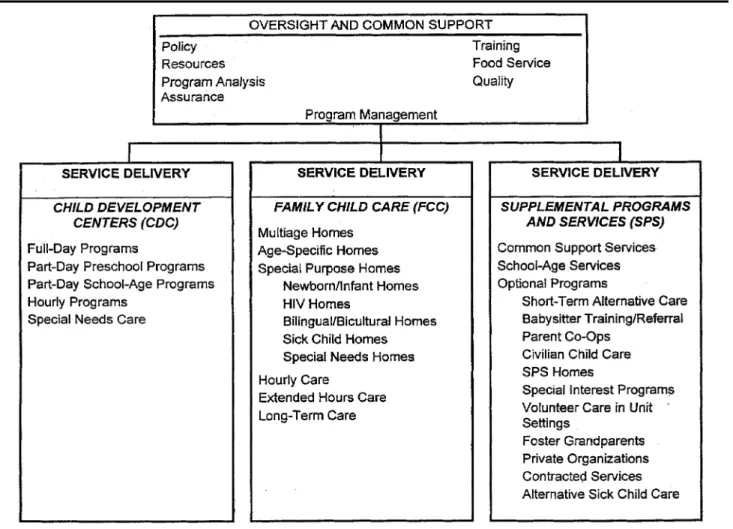
Figure 1–1: Army Child Development Services, page 4
Figure 2–1: Sample Outline for Child Development Services (CDS) Information Paper, page 17 Figure 3–1: Installation staffing pattern, page 42
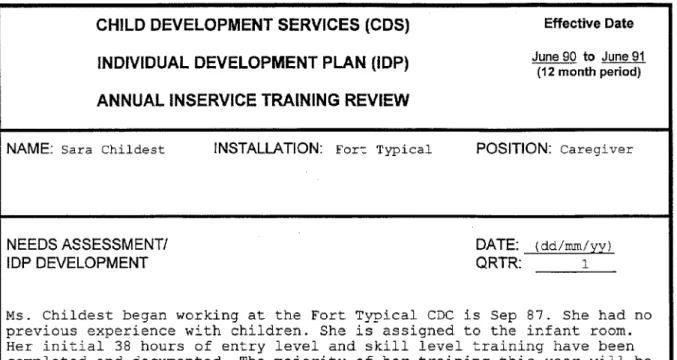
Figure 3–2: Child Development Services (CDS) Individual Education Plan (IDP) annual inservice training review, page 43
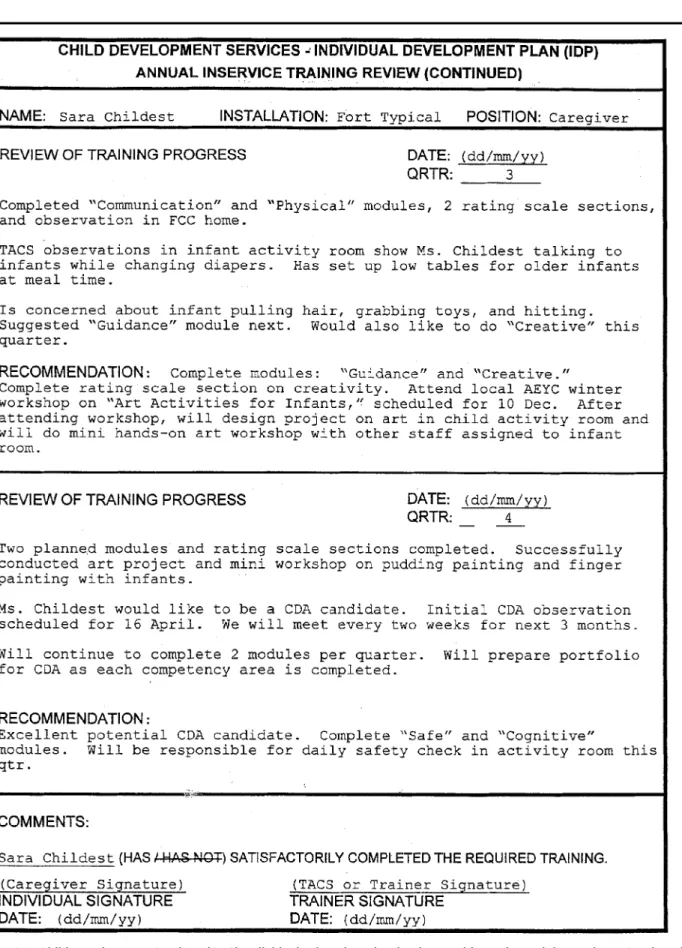
Figure 3–2: Child Development Services (CDS) Individual Education Plan (IDP) annual inservice training review— Continued, page 44
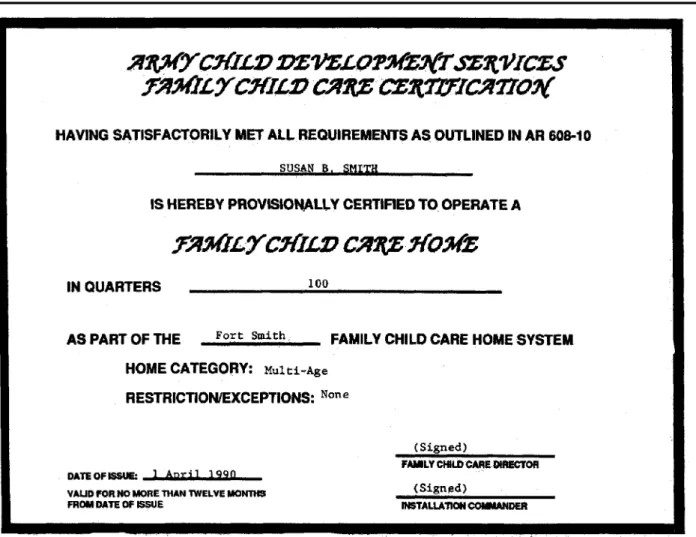
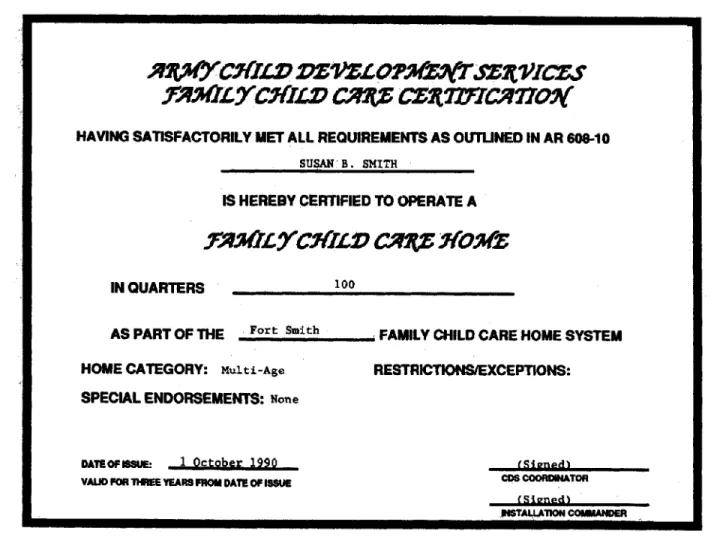
Figure 6–1: Sample FCC provisional certification document, page 102 Figure 6–2: Sample certification document, page 103
Figure 6–3: Provider Statement of Understanding Regarding Family Child Care, page 104 Figure 6–4: Parental Statement of Understanding Regarding Family Child Care, page 105
Figure 7–1: Sample format for patron statement of understanding regarding child care resource and referral service, page 126
Figure 7–2: Sample format for consent for inclusion on the Child Development Services (CDS) baby-sitter referral list, page 127
Figure 7–3: Sample format for parental consent for inclusion on the Child Development Services (CDS) baby-sitter referral list, page 128
Figure C–1: Army Child Development Services background checks, page 250 Figure C–2: Army child development center inspections, page 251
Figure C–2: Army child development center inspections—Continued, page 252 Figure C–2: Army child development center inspections—Continued, page 253 Figure C–3: Army family child care inspections, page 254
Figure C–3: Army family child care inspections—Continued, page 255 Figure C–3: Army family child care inspections—Continued, page 256 Figure C–3: Army family child care inspections—Continued, page 257 Figure C–4: Anthropometric chart for a child–scaled environment, page 258 Figure C–5: Food chart, page 259
Figure C–6: Child care food program infant meal pattern, page 260 Figure C–7: Method of hand washing, page 261
Figure C–8: Method of changing diapers, page 262 Figure C–9: Toxic Plant Listing, page 263
Figure C–10: Non–Toxic Plant Listing, page 263 Glossary
Chapter 1
Structure and Policy Section I
General 1–1. Purpose
This regulation prescribes policy and procedures for establishing and operating Army Child Development Services (CDS). The format of this regulation is as follows:
a. Chapters 1 through 4 apply to the following three CDS delivery systems: Child Development Centers (CDC), Family Child Care (FCC), and Supplemental Programs and Services (SPS).
b. Chapter 5 applies specifically to CDC and selected SPS programs in center–based settings. c. Chapter 6 applies specifically to FCC and selected SPS programs.
d. Chapter 7 applies to the SPS delivery system.
e. Appendix C contains additional guidance specific to program areas. 1–2. References
Required and related publications are listed in appendix A. Prescribed and referenced forms are also listed in appendix A.
1–3. Explanation of abbreviations and terms
Abbreviations and special terms used in this regulation are explained in the glossary. 1–4. Child Development Services (CDS) program objectives
The objectives of Army CDS are to— a. Promote the quality of the force by—
(1) Supporting readiness by reducing lost duty time due to conflict between parental responsibilities and unit mission requirements. Child development programs will, in priority order—
(a) Assist DOD military and civilian personnel working parent or full–time students parents of children under the age of 6 to locate at least one affordable option for quality child care.
(b) Assist DOD military and civilian personnel who are working parents or full–time student parents of school–age children in locating at least one affordable option for quality child care.
(c) Expand the availability of care through use of resource and referral (R&R) programs to quality affordable options both on and off the installation.
(d) Whenever possible, support the needs of personnel for hourly care and part–day preschool programs in facilities and programs other than the Child Development Centers.
(2) Promoting military retention by providing services that increase soldier satisfaction with the Army as a way of life.
(3) Contributing to the quality of life and well–being of families in the command with young children. b. Support parental child–rearing responsibilities by providing developmentally appropriate quality care options for children.
c. Operate using measurable standards and compliance assurance procedures to ensure that continuity and consis-tency of CDS operations exist Army–wide.
d. Contribute favorably to the growth and development of children while they are in the Army’s care. e. Support Service families in their effort to attain economic self–sufficiency by providing accessible and affordable child care for working parents.
f. Provide employment and career advancement opportunities within CDS programs for military and Department of Defense (DOD) civilian family members.
g. Support community activities in their effort to improve the quality of life by providing accessible and affordable child care for community volunteers.
1–5. Criteria for establishing CDS delivery systems
a. The need for CDS for military members and DOD civilian employees shall be determined by local needs and such factors as—
(1) The number of military and civilian personnel needing child care services.
(2) The need to support readiness and to address military child care during deployments, mobilization, and other missions of the military installation.
(3) Problems in recruitment or retention of military and civilian personnel resulting from a lack of child care services.
(4) Absenteeism or productivity problems that could be alleviated by reliable child care services. (5) Availability of comparable services at comparable rates in the private sector.
b. Army CDS delivery systems should be established at installations that— (1) Are not tenants or satellites of a host installation.
(2) Authorized families to join their sponsors.
(3) Have a total installation population of 1,000 or more (DA Pam 570–551).
c. The establishment of a CDS delivery system(s) is strongly recommended and is authorized at installations that may not meet one or more of the conditions in a above if—
(1) Off–post child care resources are limited.
(2) The complexity of social problems require special programming. (3) Off–post child care is too costly.
d. This regulation does not apply to the care given to children— (1) In the home of, or by the parent, guardian, or relatives.
(2) By individuals providing short–term intermittent care in their homes when care does not exceed a total of 10 child hours per week on a regular basis.
(3) By an individual in the child’s home. (4) By DOD schools.
(5) In public school programs.
e. With exception of required CDS adult/child ratios and background check requirements, this regulation does not apply to the care given to children—
(1) In chapel settings where care is limited to short periods while parents are in attendance at religious services or related functions on the premises or immediately accessible to child activity spaces where care is being given.
(2) In religious educating programs of limited duration such as vacation Bible school. 1–6. Child eligibility criteria
a. Active duty military personnel, APF and NAF DOD civilian personnel, reservists on active duty or during inactive duty personnel training, and DOD contractors are eligible to use all Army operated or sponsored child development programs (CDC, FCC, and SPS).
(1) Each installation commander shall establish a written priority system which clearly states military and civilian access to CDS programs. This written policy will be available to all eligible patrons who want to enroll their children in installation operated or sponsored child development programs. The written policy should consider the installation mission and demographics when determining military and civilian access.
(2) The installation policy will give first priority for child care to active duty military and DOD civilian personnel who are either single parents; or parents whose spouse is employed on a full–time basis outside the home or is a military member on active duty. Spouses may be military members on active duty, employed full–time outside the home by a government agency or a private sector employer, or full–time students. Installation commanders shall determine on a case–by–case basis whether spouses employed on a full–time basis but working within the home shall be included in the full–time working parent patrons category.
(3) First priority patrons (paragraph 1–6 a (2) above) shall be referred to as full–time working parent patrons in policy documents.
(4) Policies for full–time working parent patrons must be based on one of the following categories. The installation will—
(a) Serve all full–time working parent patrons on a first come first served basis; or
(b) Serve all full–time working parent patrons who are single parents first, then all active duty military and DOD civilians with a working spouse second, or vice versa; or
(c) Serve all full–time working parent patrons who are single parents on active duty and all active duty military with a working spouse first, then all full–time working parent patrons who are DOD civilians and DOD civilians with a working spouse second or vice versa;
(d) Serve all full–time working parent patrons on a military/civilian percentage basis, allotting child care spaces to military and civilian patrons which reflect the percentage of the total military and civilian workforce on the installation; or
(e) Serve all full–time working parent patrons assigned/attached to the installation before serving full–time working parent patrons who are not assigned/attached to the installation; or
(f) Other combinations of first priority full–time working parent patrons.
b. At least 80 percent of the existing operational capacity of CDC facilities shall be used for full day and part day care if there is an excess demand waiting list for either type of care. Use of this space for part–day preschool, school–age before and after school or hourly care programs is restricted to 20 percent of the existing operational capacity. Part day preschool, before and after school and hourly care programs may be offered in other suitable facilities.
c. When the number of full–time working parent patrons on the excess demand waiting list exceeds 15 percent of the existing CDS operational capacity, the installation commander shall expand full–day child care spaces both on and off the installation by:
(1) Actively recruiting for more FCC and or SPS providers; or
(2) Increasing the installation CDS R & R services to locate viable off–post child care options; or (3) Contracting for spaces in off–post programs.
d. A child already attending a program generally should not be displaced to allow room for a child with higher priority.
e. Written installation policies are available which address priorities for service and procedures for filling child care spaces. The most current procedural guidance on waiting list management from HQDA, to include sibling priority and placement of special needs children, will be followed.
Section II Overview
1–7. CDS concept
a. CDS is a network of child care delivery systems through which the Army provides quality child development options that reduce the conflict between parental responsibilities and unit mission requirements. Increasing numbers of sole and dual military parents, coupled with an increase in working spouses and the frequent relocation of Service families, have combined to increase demand for child care.
b. Soldiers look to the military establishment to provide services that assist parents in their child–rearing responsibil-ities. The military family does not have the stability of an established neighborhood or the proximity of relatives to allow for a constant and reliable child care plan. Off–post civilian programs are often inaccessible, unaffordable, and have limited operating hours. Most private child care operations do not provide care for infants or toddlers, have no hourly services, and have waiting lists for vacancies. Off–post family day care homes are often not licensed or certified and may be unmonitored for health, safety, and quality of service factors.
c. CDS is designed to assist commanders in fulfilling their morale and welfare responsibilities to soldiers and their families. CDS should identify child care needs and coordinate installation resources to meet service demand. To effectively accomplish this task, command commitment to and involvement in CDS operations is essential.
d. Child care is not considered an entitlement, CDS is offered as a supplement to, not a substitute for the family as the primary agent for the care and development of the child. Quality CDS options can strengthen and sustain child and parent relationships. However, the Army and parents should work together to ensure that these options for care will exist.
e. CDS offers care options with various types of service, locations, hours of operation, and fee schedules that are responsive to the needs of military families living both on and off–post.
(1) CDC services within centralized installation facilities offer closely monitored, structured group experiences relevant to the age and development of the child.
(2) FCC homes within government owned or leased quarters, or privately owned housing on an installation offer a family atmosphere with a limited number of children, flexible hours, and the capability of addressing special requirements.
(3) SPS increase child care capabilities by providing on and off–post alternative child care programs and support services.
1–8. CDS policy
a. CDS is a basic family program.
b. Services offered will support mission requirements and Army quality of life standards.
c. Installation commanders are authorized to provide full–day, part–day, and hourly services in CDCs, FCC homes, and in SPS delivery systems as needed. Services provided should reflect assessed needs for infant, toddler, pres-chool–age, and school–age care.
d. Services will be responsive to needs of patrons living on and off–post.
e. All FCC within Government owned or leased quarters or privately owned housing located on an installation must occur in CDS certified FCC homes.
f. Facilities used by center–based programs, designated SPS settings, and family housing units certified for quar-ters–based care must meet DOD and Army CDS standards.
g. All CDS program operations will be developmental in nature with appropriate staff, facilities, equipment and materials, and program experience. Care provided to children will foster and develop a child’s physical, intellectual, social, and emotional capabilities regardless of the setting or length of time in care.
h. All programs offered within CDS will be staffed with professionally qualified child development management personnel, trained caregiving employees, FCC providers, and other caregiving adults.
i. The dissemination of religious information (e. g. grace) or materials is prohibited as well as providing program activities that teach or promote religious doctrine. Programs operated by chaplains, and programs conducted in FCC and SPS provider homes are exempt from this restriction.
j. Services within the CDS delivery systems will be available and affordable to all eligible patrons.
k. All program operations within CDS delivery systems will be evaluated annually by an internal review and evaluation process.
l. Delivery of services will be provided directly through Army operated or regulated programs and/or through public agencies and independent contractors. Regardless of the nature of service delivery provided, the CDS coordinator position will be maintained at the installation to monitor all services for compliance with pertinent regulations. 1–9. CDS organization
a. CDS will be established as a separate, but equivalent, program to Army Community Service (ACS) and Youth Services (YS) located within the Family Support Division within the standard installation organization.
b. Installation programs and services should be organized within the service delivery systems shown in figure 1–1.
Chapter 2
Program Oversight Section I
Responsibilities
2–1. Headquarters, Department of the Army (HQDA)
a. The Assistant Chief of Staff for Installation Management (ACSIM) has overall responsibility for policy guidance in implementing CDS. The Commander, USACFSC will perform the following functions for the ACSIM:
(1) To the extent permitted by law, formulate DA policy on CDS using the criteria shown below:
(a) Does the action strengthen or erode the stability of the family and, in particular, the marital commitment? (b) Does the action strengthen or erode the authority and rights of parents in the education, nurture, and supervision of their children?
(c) Does the action help the family perform its functions or substitute governmental activity for the function? (d) Does the action increase or decrease family earnings? Do the proposed benefits of the action justify the impact on the family budget?
(e) Can the activity be carried out by a lower level of Government, or by the family itself?
(f) What message, intended or otherwise, does the program send to the public concerning the status of the family? (g) What message does the program send to young people concerning the relationship between their behavior, their personal responsibility, and the norms of our society?
(2) Ensure HQDA CDS personnel are professionally qualified.
(3) Identify CDS needs and resource requirements to Army leadership.
b. The Chief, Soldier and Family Support Directorate, Child and Youth Services Division within the USACFSC will—
(1) Establish and maintain plans, policy, administrative procedures, program materials, and operational guidance for CDS delivery systems.
(2) Define professional standards for CDS program development and operation.
(3) Develop and publish minimum standards as defined by appropriate Department of Army (DA) staff proponents for fire, health, facilities, safety, and prevention of child abuse.
(4) Develop and approve functional design requirements for CDS facilities in coordination with the Office of the Chief of Engineers (CEEC–EA) and the DA Facility Standardization Subcommittee for CDS Facilities.
(5) Exercise program oversight of CDS Military Construction, Army (MCA) Program and upgrade or waiver status of existing facilities.
(6) Develop and approve program materials to address special needs programs, nutrition, health, and child abuse in child development settings from a CDS operational perspective.
(7) Develop an Army–wide comprehensive CDS standard training plan for all levels of CDS employees and FCC providers.
(8) Support training workshops sponsored by major Army commands (MACOMs) for installation CDS personnel. (9) Visit, monitor, and provide technical assistance to MACOMs and installations.
(10) Approve and monitor CDS programs and facilities for participation in the United States Department of Agriculture (USDA) Child and Adult Care Food Program (CACFP).
(11) Coordinate and submit CDS resource requirements through program and budget channels to include oversight of CDS Management Decision Package (MDEP) execution.
(12) Distribute CDS resources as required to MACOMs.
(13) Consult and coordinate with related activities within DOD as well as other agencies and organizations to broaden input on CDS policy issues.
(14) Develop guidance for statements of work for contracting the management and operation of CDS Programs. (15) Function as the proponent for CDS issues and initiatives in support of the Army Family Action Plan (AFAP), General Accounting Office (GAO) studies, Congressional inquiries and special actions.
(16) Coordinate and monitor research efforts and initiatives impacting on CDS programs.
(17) Develop and implement a quality assurance system in coordination with MACOMs to assess program effective-ness, quality of service, and the efficiency of overall CDS operations.
(18) Collect and analyze MACOM and installation CDS data for compliance with DOD and Army program and facility standards, and determine resource requirements, program trends, and initiatives that have an impact on CDS policy.
(19) Conduct periodic announced and unannounced onsite inspections with ARSTAF regulatory proponents to determine installation compliance with policy fire, health, nutrition, safety, program, child abuse, and facility structural standards; and report findings as directed to ACSIM, the Assistant Secretary of the Army for Manpower and Reserve Affairs ASA(M&RA), and the Deputy Assistant Secretary of Defense (Family Support, Education and Safety).
(20) Write and distribute an Army CDS Resource List annually. c. The Surgeon General (TSG) (DASG–PSP) will—
(1) Develop CDS health standards and related health aspects of CDS and oversee implementation of nutrition standards.
(2) Provide professional services and technical assistance required to support CDS programs to include preventive medicine and community health nursing personnel, pediatricians, and child psychiatrists.
(3) Staff policy related to health, nutritional, environmental, and sanitation aspects of CDS facilities and program operations.
d. The Director of Army Safety (DACS–SF) will— (1) Develop CDS safety standards.
(2) Provide technical assistance relative to the safety aspects of CDS facilities and operations.
e. The Judge Advocate General (TJAG) (DAJA-ALG) will provide legal advice as necessary. The Command Judge Advocate U.S. Army Community and Family Support Center will provide primary legal advice and assistance to CDS.
f. The Chief of Engineers (HQ, USACE) (CEEC) will— (1) Develop CDS facility and fire standards.
(2) Provide technical guidance on all design and construction matters concerning CDS facilities including site, building, and utilities.
(3) Issue design guides, standard designs, and supplementary criteria as issued in the Architectural and Engineering Instruction (AEI) design criteria and requirements for constructing and renovating CDCs.
(4) Review and approve projects submitted on DD Form 1391 (Fiscal Year Military Construction Project data) for technical accuracy and conformance with prescribed criteria, cost engineering requirements and DA policy and guidance.
g. The Commander, U.S. Army Command Criminal Investigation (USACIDC) will— (1) Support requirements for background investigations for CDS personnel.
(2) Monitor the process for thoroughness, effectiveness, and prompt response.
h. The Commander, United States Army Force Integration Support Agency (USAFISA) will—
(1) Provide manpower management and TDA documentation assistance for CDS programs throughout the Army (CFSC, MACOM, installations) including update or publication of staffing criteria for CDS programs (DA Pam 570–551).
(2) Provide guidelines on APF and NAF staffing patterns. 2–2. Major Army commands (MACOMs)
a. MACOM commanders are responsible for the management and operational supervision of MACOM, major subordinate command, and installation CDS programs. They will—
(1) Establish CDS staff positions or designees at MACOM and major subordinate command levels to interpret program policy and oversee CDS programs within the command.
(2) Ensure MACOM CDS management personnel, or designees are professionally qualified and that grade level ratings show levels of responsibility and complexity of duty assigned.
(3) Coordinate with resource management concerning allocation of MACOM CDS resources to installations. (4) Ensure MACOM CDS management personnel and the regulatory proponents for health, facilities, fire, safety, child abuse, and legal matters coordinate regularly with HQDA counterparts. (Note: This will ensure that MACOMs remain apprised of current policies and have access to guidelines and resource materials issued for use in interpreting program policy.)
b. MACOM CDS management personnel or designees will— (1) Establish and review MACOM CDS program policy.
(2) Oversee installation implementation of HQDA guidance and requirements; and provide technical assistance to ensure compliance with CDS standards.
(3) Conduct periodic onsite technical assistance visits. Conduct periodic unannounced inspections with regulatory proponents as part of the MACOM Child Care Evaluation Team (MCCET) for installation compliance with policy, fire, health, nutrition, safety, program, child abuse, and facility structural standards; and report findings to the installation and MACOM commanders and USACFSC (CFSC–SF–CY) as directed.
(4) Sponsor training opportunities and resources for installation CDS personnel. (5) Collect and analyze installation CDS reports and resource requirements.
(6) Coordinate and submit installation and MACOM CDS resource requirements through program and budget channels to HQDA.
(7) Review requirements for installation CDS services through needs assessment and demographic surveys and realign or expand services as reflective of installation needs.
(8) Coordinate installation CDS pilot projects and research studies with USACFSC (CFSC–SF–CY) (9) Inform USACFSC (CFSC–SF–CY) of innovative MACOM and installation program efforts.
(10) Distribute to the field and ensure compliance with most current procedural guidance from HQDA. c. MACOM Chief of Engineers will—
(1) Review and approve functional requirements, project formulation control data, initial project design data, and concept and project design control data.
(2) Ensure that economic analysis of all feasible alternatives is prepared to justify and identify construction projects before the projects are presented to HQDA in the MACOM submission. Ensure that the required economic analysis is included in the special requirements paragraph 1 (SRPI) of the DD Form 1391 with projects submitted to HQDA. (3) Review installation DD Form 1391 to ensure that proposed sitings are consistent with the approved MACOM master plan.
2–3. Installation commanders
a. Installation commanders are responsible for the management and operational supervision of all programs and services within CDS delivery systems. They will—
(1) Ensure authorization and assignment of qualified installation personnel to provide effective CDS delivery systems to accomplish the mission.
(2) Ensure that CDS management personnel at the installation level are professionally qualified, that management personnel have child development related administrative program experience, and that personnel grade level ratings reflect level of responsibility and complexity of duty assignment.
(3) Identify installation CDS needs and resource requirements to MACOM.
( 4 ) P r o v i d e i n s t a l l a t i o n C D S r e p o r t d a t a a n d r e s o u r c e r e q u i r e m e n t s t o M A C O M a n d U S A C F S C A T T N : CFSC–SF–CY, 2461 Eisenhower Avenue, Alexandria, VA 22331–0521.
(5) Allocate resources and approve priorities for the allocation of resources within CDS to meet installation needs. (6) Ensure that CDS personnel receive training as required.
(7) Ensure that all programs and activities falling under CDS are monitored by the CDS coordinator and assessed for regulatory compliance.
(8) Approve installation nominees for participation on the Installation Child Care Evaluation Team (ICCET) and support ICCET recommendations to improve CDS programs.
(9) Ensure that installation agencies support CDS oversight and technical assistance requirements including actions needed for CDS personnel background clearances.
b. The CDS coordinator will—
(1) Supervise, monitor or function as a contracting officer representative for all activities, contractors, and individu-als, providing child care on property controlled by the U.S. Army unless exempted by this regulation.
(2) Verify compliance with CDS program and facility standards on DA Form 4841–R (Child Development Services (CDS) Program/Facility Report) annually to MACOM and USACFSC (CFSC–SF–CY).
(3) Report noncompliance with standards to the installation and MACOM commanders. (4) Act as the point of contact (POC) for all issues and actions concerning CDS.
(5) Develop and execute budget documents to address short and long term CDS program needs.
(6) Review community demands for child care services through periodic needs assessments, surveys, and operational data studies; and establish a full range of systems to address requirements.
(7) Act as the final CDS authority for CDC, FCC, SPS, Training and Curriculum Specialist (TACS), administrative, and resourcing actions.
(8) Act as POC and assist Director of Engineering and Housing (DEH) in preparation of the DD Form 1391, a p r o j e c t d e v e l o p m e n t b r o c h u r e ( P D B ) , a n d e c o n o m i c a n a l y s i s t o a d e q u a t e l y s u p p o r t a n d v a l i d a t e c o n s t r u c t i o n requirements.
(9) Coordinate the annual internal assessment conducted by the installation ICCET. (10) Implement most current procedural guidance from HQDA.
c. The health consultant(s) as designated by Medical Department Activity (MEDDAC) or Medical Center (MED-CEN) (usually the health nurse for nutrition and health, and the environmental science officer for environmental and food sanitation) will—
(1) Consult on standing operating procedures (SOPs) developed by the CDS coordinator to meet program health requirements.
coordination with the appropriate Medical Treatment Facility (MTF) staff on a monthly basis in centers; and conduct FCC home inspections as specified in paragraph 6–40.
(3) Act as POCs for all issues and actions regarding the overall health program within CDS. (4) Verify compliance with CDS health standards on DA Form 4841–R annually.
(5) Coordinate meal planning and nutrition education aspects of CDS programs in collaboration with the MTF dietitian.
(6) Provide and/or approve education and instructional content for training of CDS personnel in health related matters.
(7) Serve on the CDS ICCET.
(8) Coordinate veterinary services as required for pets involved with CDS.
(9) Ensure all foods are procured from approved sources as prescribed by AR 40–657. (Coordination with the installation veterinarian is required.)
(10) Confirm outbreaks of disease of public health significance occurring in CDS programs and assist CDS coordinator in reporting such cases (para 2–20).
(11) Identify individuals (on or off–post) responsible for providing training and instruction on the administration of medications and caregiving health practices for children with special needs.
d. The MTF dietitian or designated professional will—
(1) Review all menus used in center–based settings and representative menus in FCC and SPS homes to ensure compliance with USDA nutritional and meal component guidance.
(2) Serve on the CDS ICCET.
(3) Verify compliance with CDS nutrition standards on DA Form 4841–R annually. e. The safety officer will—
(1) Consult on SOPs developed by the CDS coordinator.
(2) Monitor the safety of CDS facilities as a special hazard area and conduct required annual and other inspections. (3) Conduct initial and annual inspections of FCC homes.
(4) Verify compliance with CDS safety standards on DA Form 4841–R annually. (5) Provide training to CDS personnel on safety related matters.
(6) Serve on the CDS ICCET.
(7) Ensure CDCs and FCC homes are entered into installation hazard abatement programs as necessary. f. The Director of Engineering and Housing (DEH) will—
(1) Develop and submit a CDS construction request (DD Form 1391) as needed. (2) Coordinate all CDS construction and repair work with the CDS coordinator.
(3) Maintain and repair CDS facilities, installed equipment, and premises according to AEI criteria with appendix G. (4) Serve on the CDS ICCET.
(5) Participate as an advisor on actions involving FCC in Government quarters.
(6) Work cooperatively with the CDS coordinator to identify and eliminate unauthorized child care occurring in Government housing.
(7) Act as an advisor on standards prescribing cleanliness and orderliness in housing units used for FCC homes. (8) Adhere to the AEI criteria with appendix C for renovation or addition projects.
(9) Conduct annual on–site structural inspection of each CDS facility.
(10) Verify compliance with CDS standards for facility structural/systems, administrative support, and child activity and related areas.
g. The fire marshal will—
(1) Conduct monthly inspections of CDS facilities and annual inspections of FCC homes.
(2) Consult on SOPs developed by the CDS coordinator to meet program fire prevention requirements. (3) Verify compliance with CDS fire prevention standards on DA Form 4841–R annually.
(4) Serve on the CDS ICCET.
h. The staff judge advocate will provide guidance on CDS legal matters including liability issues and the application of State, local, and host nation laws to program operations.
i. The provost marshal will—
(1) Monitor the security of CDS facilities. (2) Process local civilian law records check.
(3) File DD Form 1731 (Serious Incident Report) and consult with CDS coordinator as needed.
(4) Address situations involving children left in CDCs, FCC homes, or SPS programs after closing time; and release of children under circumstances where children’s safety or well being is in question.
j. The installation Criminal Investigation Division (CID) commander will—
(2) Process Crime Records Center checks.
(3) Advise the CDS coordinator of any child abuse or other criminal allegations against any CDS employee or FCC provider to allow appropriate management decisions to protect the safety and well being of children in care.
k. The Civilian Personnel Officer will—
(1) Obtain a signed release of information for background clearances checks on all applicants for CDS employment. (2) Initiate and follow-up on the following:
(a) National Agency Checks (NAC or NACI) for all CDS nonappropriated fund and appropriated fund employees. (b) Criminal Investigation Division (CID) background information/clearance checks including the Defense Central Investigation Index (DCII).
(c) Military Police background information records checks. (d) Local civilian law enforcement agency checks.
(3) Advise the CDS coordinator on management actions involving employees involved in suspected child maltreat-ment cases.
(4) Provide results of checks and references to the Center’s program director.
(5) Ensure CDS employees are hired under appropriate grades using standard position descriptions. (6) Ensure CDS employees can receive CPO sponsored training.
(7) Ensure a qualified pool of applicants for CDS positions.
(8) Provide timely response to recruitment actions necessary to meet child/staff ratios and management oversight responsibilities.
(9) Serve on the CDS ICCET.
l. The Alcohol and Drug Prevention Control (ADCO) Program manager will screen records involving CDS employ-ees, CDS volunteers, FCC applicants, and FCC family members for drug and substance abuse, as permitted pursuant to AR 600–85, chapter 6.
m. The Family Advocacy Program Manager (FAPM) will—
(1) Work with the chairperson, Family Advocacy Case Management Team (FACMT) and FACMT members to develop an installation SOP that designates a reporting point of contact (RPOC) and procedures for addressing all child abuse allegations in CDS settings; or identification of any familial child abuse situation involving a child receiving child care services.
(2) Provide inservice training on the recognition and reporting of child abuse and neglect in both familial and institutional settings.
(3) Coordinate with CDS to provide child abuse prevention training for parents with children enrolled in CDS programs.
(4) Coordinate on all CDS SOPs involving child abuse or neglect. (5) Serve on the CDS ICCET.
(6) Review and make recommendations on any statement about child abuse and neglect in parent and employee handbooks.
n. The Public Affairs Officer (PAO) will—
(1) Handle press releases and publicize special events involving CDS operations (e.g., Month of the Military Child, opening of a new facility).
(2) Inform USACFSC (CFSC–SF–CY) through the MACOM of all anticipated or actual media coverage concerning CDS operations for press or television, that has the potential for national release.
(3) Provide copies of newspaper clippings of adverse publicity concerning child abuse allegations in CDS settings through the MACOM to the Commander, USACFSC, ATTN: CFSC–SF–CY, 2461 Eisenhower Avenue, Alexandria, VA 22331–0521.
o. The chairperson, FACMT will process requests for Central Registry Background Checks for CDS employees, FCC provider applicants, FCC family members, and CDS volunteers.
Section II
Assessment and Compliance 2–4. General
A copy of this regulation and any local supplements concerning programs within CDS, will be maintained at all CDS delivery system offices, CDCs, and SPS settings; and will be readily accessible to employees, FCC providers, CDS volunteers, patrons, and command representatives. A summary of FCC regulatory requirements will be distributed to each FCC provider.
2–5. CDS Installation Child Care Evaluation Team Review
substantiate CDS compliance with DOD and Army standards, and to ensure application of regulatory and policy guidance within all CDS delivery systems.
b. The review will be organized and coordinated by the CDS coordinator and conducted by an installation ICCET composed of the following: a local command representative, (e.g., DPCA, ADCFA), the CDS coordinator, installation regulatory proponency representatives, (fire marshal, housing officer, health consultant, CPO officer, FAPM, safety officer, facility engineer, dietitian) a parent and a child development professional from the private sector or from another installation. Additional team members may be designated by the command according to local requirements. The installation (inspector general) IG may participate as an observer if requested by the installation commander. The most current procedural guidance from HQDA on the ICCET process will be followed.
c. The CDS Single Source Criteria (appendix C) and materials provided by USACFSC (CFSC–SF–CY) will be used for the ICCET.
d. The ICCET will identify the following in writing:
(1) The level and quality of services being provided to fulfill the requirements for meeting CDS standards. (2) The extent to which installation CDS programs are meeting DOD and Army standards.
(3) The areas of strength and those needing improvement. e. The ICCET will brief findings to the installation commander.
f. The ICCET will develop an action plan to be approved by the commander to correct deficiencies and improve or expand program services.
g. Information derived from the ICCET will support reporting requirements specified in section IV, paragraphs 2–18 through 2–20.
h. The ICCET may occur in conjunction with a MACOM or DA staff assistance visit.
i. ICCET findings, recommendations, and corrective action initiatives will be maintained on file at the installation and provided to higher headquarters upon request (paras 5–54 and 6–52).
2–6. CDS program compliance and oversight
a. All programs applicable under this regulation will be monitored through unannounced, on–site inspections by higher headquarters to ensure compliance with DOD standards for child care programs and Army CDS program and facility standards. DOD certification will be accomplished with USACFSC and MACOM guidelines.
b. The quality of service, efficiency, and effectiveness of all operations monitored by CDS will be assessed by higher headquarters for compliance with regulatory guidance.
c. All health, fire, facility, and safety requirements will be monitored by installation proponents according to the frequency specified by this regulation.
d. Installations and MACOMs will determine the frequency and type of monitoring needed by regulatory proponents in addition to those specified within this regulation.
2–7. Crimes prevention surveys
The Criminal Investigation Division Command (CIDC) will conduct a Crimes Prevention Survey at any installation, whenever circumstances indicate that CDS program conditions could be conducive to criminal activity or impact negatively on the health, security, and well being of children in care.
2–8. State licensing
State licensing of Army CDCs, FCC homes, and SPS programs is permitted in addition to, but not in lieu of, compliance with this regulation.
2–9. Patron satisfaction
a. Written guidelines will be established addressing procedures for parents who wish to submit a complaint or concern.
b. Program directors in all CDS delivery systems will conduct patron satisfaction surveys, at a minimum on an annual basis; and establish a follow–up plan for addressing areas of dissatisfaction as appropriate.
c. Patron satisfaction survey formats have been developed for installation use and are available from USACFSC (CFSC–SF–CY).
2–10. CDS Program Review Board (PRB)
A CDS PRB may be established to address or make recommendations on situations and issues which include multiple proponents, or on CDS operational issues which can be broadly interpreted.
2–11. Exceptions to policy
a. Exceptions to existing criteria may be requested only when alternative methods of compliance do not endanger the safety or well–being of the children in care. Exceptions will only be granted when the intent of the standard can be