CLUB GOODS PROVISION:
THE EFFECT OF WEAK PARTIES ON CLIENTELISM STRATEGIES
Katherine M. McKiernan
A dissertation submitted to the faculty of the University of North Carolina at Chapel Hill in partial fulfillment of the requirements for the degree of Doctor of Philosophy in the Department of Political Science.
Chapel Hill 2020
Approved by:
Cecilia Martinez-Gallardo
Anna Bassi
Jonathan Hartlyn Lucy Martin
©2020
ABSTRACT
Katherine M. McKiernan: Club Goods Provision: The Effect of Weak Parties on Clientelism Strategies (Under the direction of Cecilia Martinez-Gallardo)
This dissertation explores when legislators in weak party systems will use mayors as brokers in order
to provide club goods to citizens. I argue that mayors have the potential to be effective brokers because of
their knowledge of local citizens and conditions, as well as their ability to create networks. In three articles, I
explore when legislators will select mayors as brokers, how to estimate the extent to which mayors invest
in their own clientelist networks, and whether mayors with larger clientelist networks are more likely to be
selected as brokers who deliver club goods benefits.
The first chapter explores when legislators are likely to use mayors as brokers. I use a signaling model
in order to generate predictions about when mayors are most likely to attribute credit to legislators for club
goods. Attributing credit is an essential feature of a reliable broker. I argue that ambitious mayors are more
likely to attribute credit to legislators and find the conditions where a legislators are able to identify ambitious
mayors and when a legislator will provide club goods despite the uncertainty over the type of mayor. I explore
the equilibria from the signaling model using interview data collected in Colombia from 2016-2018.
The second chapter addresses a major methodological limitation for testing the equilibrium solution
from chapter one- that there is no clear measurement of the cost mayors will pay to signal their potential as a
broker. In chapter one, I argue that mayors will pay a cost of building their own network in order to signal
that they are ambitious and can better serve as brokers. In the second chapter, I explore one way to measure
this cost by generating an estimate of patronage at the local level. Patronage is a costly clientelist strategy
that mayors can use to build and maintain their networks. I use a Bayesian Mixed-Membership Model to
estimate the use of patronage, and I validate this model using both qualitative data and survey data from the
Latin American Public Opinion Project.
Finally, the third chapter explores whether municipalities where mayors have build larger clientelist
networks are more likely to receive additional transfers from the central government. Using the intuition
to signal their potential as brokers, I argue that mayors who use more patronage in the public service are
likely to receive more discretionary transfers from the central government. I use my estimates of patronage
from chapter two to test my theory on three types of discretionary transfers: discretionary royalties transfers,
number of contracted projects, and the value of contracted projects. I find that mayors with larger patronage
ACKNOWLEDGEMENTS
The process of writing this dissertation is almost impossible to summarize clearly. In some ways, it
was a uniquely lonely process filled with countless hours alone thinking, sketching, analyzing, tinkering,
writing, and editing. Some days dragged on indefinitely while others escaped me. Some days writing feels
like a Herculean task with an ever-looming to-do list of what’s left, other days the words come easily and
the progress was measurable. Despite this, most of the time spent producing this dissertation wasn’t lonely
at all. On the contrary, it was a product of the love, support, mentorship, and friendships I held close. This
document would not be possible without my community of friends, family, and colleagues who stood by my
side throughout the graduate school experience.
The list of people to whom I owe my deepest gratitude is by no means exhaustive. I have been blessed
with several communities of support who have been instrumental in helping me find my research niche, in
my growth as a scholar, and in supporting me as a scholar and as a person. To my academic communities at
F&M, UNC, and EITM, thank you.
This document would not have been possible without my amazing committee members at UNC. To my
advisor and chair, Cecilia Martinez-Gallardo, I can honestly say that I owe this document to you. As a mentor,
you encouraged me to follow the questions that most interested me and believed in my ability to find the
methods best suited to the questions. Thanks to your encouragement and unwavering belief in my work, I was
motivated to challenge myself while collecting data, find solutions to methodological challenges, and follow
my passions. Even when the work was difficult, I never tired of my dissertation topic because I had a mentor
who encouraged me to always do the work I loved. You have always challenged me to clarify my thoughts,
pushed me to think further, and helped me to simplify my presentation of ideas; all of these have made me a
better scholar and a better writer. Outside of my research, you always encouraged me to do what I needed to
as a person and to remember my needs beyond my work. You have always emphasized the importance of a
work-life balance and taking breaks. These lessons will stay with me as I enter the next stage of my career.
My committee has truly been a team that have helped me with different aspects of the research. To
of my favorite memories of graduate school. Thank you for encouraging me to pursue the world of formal
theory and experiments, for helping me find a community through EITM, and for always being available as I
thought through my modeling decisions. To Jonathan Hartlyn, thank you for your pointed critiques. Your
comments on my many drafts were instrumental in helping me find the balance between the general and
the context-specific elements of my work. I will always appreciate your insights and emphasis on being as
specific as possible. Your theory-driven approach has helped me always put my argument first. To Lucy
Martin, thank you for your extensive feedback on both my survey experiments (that will be saved for future
articles) and my formal model. During Game Theory I, you encouraged me to continue learning game theory,
even though I wasn’t sure how it would fit into my future research. This encouragement forever changed my
approach to political science and helped me learn who I was as a researcher. Finally, to Santiago Olivella,
thank you for your guidance as I learned to write a Bayesian measurement model and your help in designing,
coding, and explaining my own measurement strategy. As I continue to work on these skills, I am lucky to
have you to turn to for advice.
I owe a special debt of gratitude to my colleagues and friends from every stage of my life. The list of
people who have encouraged me and guided me on the path to producing this dissertation is too long to count,
but I would like to highlight a few people. To Stephanie McNulty, my advisor at F&M turned coauthor, thank
you for helping to encourage my early interest in research, for preparing me to apply for graduate school,
and for supporting me throughout the process. To my college roommate, Cheryl Tourigny, thank you for
always supporting me and listening to me from the first day of college and beyond. To the graduate student
community at UNC, thank you for being incredible colleagues. In particular, to Bilyana Petrova. From my
first day at UNC, you have been available, not only for professional advice, but also for coffee breaks and
adventures. You taught me how to be a good mentor to younger graduate students. To Kelsey Shoub, Chelsea
Estancona, Bailee Donahue, and Claire Dunn, words cannot express how much your friendship means to me
and how much I respect and admire each of you. To Emily Carty and Maura McDonald for their support. I
often think about how lucky I am to have such a strong community of female scholars to call friends.
Finally, I would like to thank my family. To Brian Lindley, meeting you was one of the greatest moments
of my time in graduate school. You have always believed in me, even when I doubted myself and my work.
Your excitement when you get a new result in lab is a constant reminder of why I love research. While no one
would confuse the processes of chemistry and political science research, going through the journey of life
I love you. To my parents, Mary Ann and David McKiernan, you have been the most supportive people
throughout the dissertation writing process. To my Mom, thank you for standing by me. You are always
available to listen and support me as I’ve navigated the dissertation process. To my Dad, I thank you for
taking an interest in Latin American politics because of my interest in studying it. I feel lucky to have a Dad
who assumes my interests for the sake of discussing them with me. As parents, you have both afforded me
every opportunity, supported all my curiosities, and dreamed all of my dreams. I am who I am because of
you, I believe in myself because you believe in me, and I know what I want because you have given me the
TABLE OF CONTENTS
LIST OF TABLES . . . xi
LIST OF FIGURES . . . xii
1 Introduction . . . 1
2 When do Club Goods Buy Votes? Mayoral Cooperation in Clientelist Exchanges . . . 4
2.1 Introduction. . . 4
2.2 Exchanging Club Goods: The Case of Colombia . . . 7
2.3 A Signaling Model of Brokerage . . . 11
2.3.1 Best Responses . . . 14
2.3.1.1 Stage 3: Credit Attribution . . . 14
2.3.1.2 Stage 2: Deciding Whether to Provide the Benefit . . . 15
2.4 Equilibria . . . 16
2.4.1 Comparative Statics . . . 21
2.4.2 Testing the Equilibria: Mayor Behavior Across Types . . . 25
2.5 Conclusion . . . 27
3 Measuring Local-Level Clientelism: A Bayesian Mixed-Membership Approach . . . 30
3.1 Motivation . . . 30
3.2 A Model for Local-Level Clientelism . . . 32
3.2.1 Bayesian Mixed Membership Models . . . 32
3.2.2 Applying Mixed Membership Models to Clientelism . . . 32
3.3 Data . . . 35
3.4.1 Validation Tests: Clientelism and Corruption . . . 38
3.5 Applying the Measure . . . 40
3.6 Discussion . . . 41
4 Club Goods Provision: The Effect of Weak Parties on Clientelism Strategies . . . 42
4.1 Introduction. . . 42
4.2 Clientelism in Modern Democracies . . . 44
4.3 Theory . . . 46
4.3.1 Club Good Clientelism . . . 46
4.3.2 Using Mayors as Brokers . . . 48
4.3.3 When and Where are Club Goods Used . . . 48
4.4 Data and Methods . . . 50
4.4.1 Club Goods in Colombia . . . 51
4.4.2 Dependent Variables . . . 52
4.4.3 Estimating Municipal-Level Clientelism . . . 53
4.4.4 Independent Variables . . . 58
4.4.5 Methods . . . 60
4.5 Results and Analysis . . . 61
4.5.1 High Transparency Transfers: Guaranteed SGP Transfers . . . 61
4.5.2 Medium Transparency Transfers: Royalties through SGR . . . 61
4.5.3 Discretionary Royalty Transfers . . . 62
4.5.4 Approved Contracts . . . 65
4.6 Conclusion . . . 70
A Appendices: When do Club Goods Buy Votes? Mayoral Cooperation in Clientelist Exchanges . . . . 72
A.1 Full Model Solution . . . 72
A.1.1 Stage 3: Mayor Attributes Credit . . . 72
A.1.2 Stage 2: The Legislator Determines Whether to Provide the Benefit, k . . . 73
A.1.4 Best Responses and Equilibrium . . . 74
A.1.4.1 Case 1:σN ≤1 . . . 74
A.1.4.2 Case 2:µs=µ < σN1 . . . 74
A.1.4.3 Case 3:µs=µ≥ σN1 . . . 75
A.1.4.4 Case 4:µs< σN1 andµ≥ σN1 . . . 76
A.1.5 Case 5:µs≥ σN1 andµ < σN1 . . . 76
B Appendices: Measuring Local-Level Clientelism: A Bayesian Mixed-Membership Approach . . . 80
B.1 Regression Results for Validity Checks . . . 80
B.2 Results for Model Application . . . 81
B.3 Imputation Results for Municipalities Without Hires . . . 82
C Appendices:Club Goods Provision: The Effect of Weak Parties on Clientelism Strategies . . . 83
C.1 Validity Check Regressions and Graphs . . . 83
C.2 Alternative Modeling Specifications: Number of Contracts . . . 85
C.2.1 Count Models . . . 85
C.2.2 Zero-Inflated Negative Binomial . . . 86
C.2.3 Zero-Inflated Models with Municipal Demographics in the Logit Component . . . 87
C.3 Summary Statistics of All Variables . . . 87
LIST OF TABLES
2.1 Model Parameters . . . 13
2.2 Payoffs . . . 14
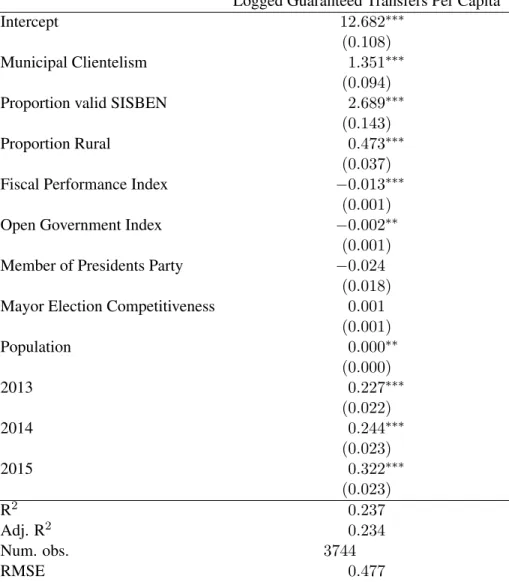
4.1 Guaranteed Transfers . . . 62
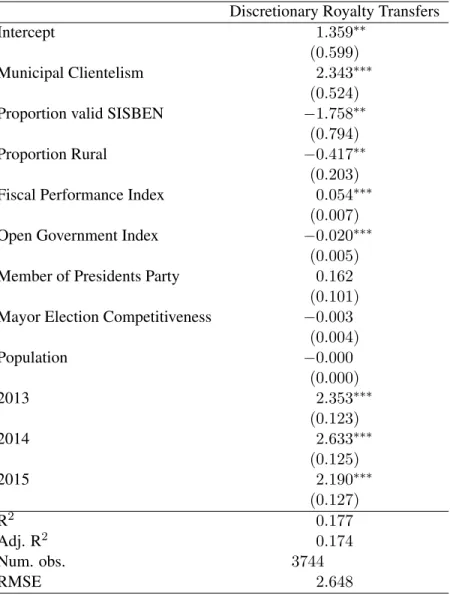
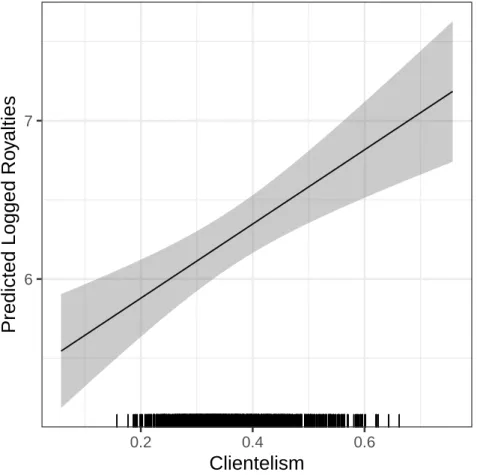
4.2 Royalty Transfers . . . 63
4.3 Number of Projects . . . 67
4.4 Value of Contracts . . . 68
A.1 Model Parameters . . . 72
A.2 Payoffs . . . 72
B.1 To what extent does the government combat corruption? . . . 80
B.2 How widespread is corruption in public officials? . . . 80
B.3 To what extent do you trust your mayor? . . . 81
C.1 To what extent does the government combat corruption? . . . 83
C.2 How widespread is corruption in public officials? . . . 84
C.3 Non Zero-Inflated Models . . . 85
C.4 Negative Binomial Specifications . . . 86
C.5 Zero-Inflated Models with Municipal Indicators . . . 87
C.6 Summary Statistics for all Dependent Variables . . . 88
LIST OF FIGURES
2.1 Signaling Game . . . 12
2.2 Equilibrium Space . . . 22
3.1 Estimates of Clientelism in Colombia, 2013 . . . 37
3.2 Predicted Probability of Survey Responses Given Clientelism in the Respondent’s Municipality 39 3.3 Predicted Probability of Responses for Trust in Mayor . . . 40
4.1 Estimate of Clientelism in Each Colombian Municipality . . . 59
4.2 Discretionary Royalty Transfers . . . 64
4.3 Expected Number of Contracts . . . 66
4.4 Value of Awarded Contracts . . . 69
B.1 Patronage Map with Imputations . . . 82
C.1 Predicted Probability of Response to Question “To what extent does the government combat corruption?” . . . 83
CHAPTER 1: INTRODUCTION
My research is motivated by a central question: how do governments determine where to allocate
resources? One of the central functions of government is allocating resources to different projects that can
benefit citizens. How these decisions get made, however, is a complicated process that requires coordination
between various political actors, negotiation between competing voices, and sensitivity towards budget
constraints. These decisions are further complicated by electoral incentives: in order to be part of the
conversation about resource allocation, politicians need to be able to win elections.
In this dissertation, I ask how politicians allocate resources in order to win reelections. In particular,
I focus on how national politicians use club goods, or excludable public goods, in order to target specific
voters. Club goods are an important type of resource allocations for several reasons. First, club goods are
meaningful benefits that can help improve infrastructure or access to other social services. Second, club
goods are excludable and politicians can use them in order to reach specific subsets of the population. For
example, a club good can be a water treatment facility that provides a tangible benefit to citizens in that
geographic area, but does not contribute to water improvements outside of that area. Finally, club goods are
part of a profile of strategies politicians can use to reach voters. They are not just politics between elections,
but rather can be used as part of broader campaigning techniques that occupy the space between public and
private goods. As a result, they allow politicians to use more targeted techniques when they do not have the
capacity for more micro-level clientelist targeting.
In the following three papers, I explore how club goods can be used as a clientelist electoral strategy in
weak party contexts. Unlike more micro-level clientelist benefits, like direct cash benefits or jobs through
patronage that are directed towards individuals, club goods target groups of voters who occupy the same
geographic space. However, these strategies still can depend on brokers who help determine how to distribute
benefits. Where political parties are strong, clientelist strategies, including club goods, often rely on a partisan
broker selected by political parties that can be trusted to be loyal to the political party. However, in weak
party systems, political parties lack the capacity to coordinate clientelist networks. Moreover, low levels of
loyal. While each of these papers stands alone, they all explore how national-level politicians in weak party
contexts select potential clientelist brokers to help the national politician translate club goods benefits into
votes.
In the first paper, I ask when mayors will be reliable brokers for national level politicians. In this paper, I
introduce the idea that mayors have different incentives for attributing credit to legislators, and thus serving
as reliable brokers, or claiming credit for themselves based on their long-term career ambitions. I argue
that ambitious mayors who one day hope to run for higher office are more likely to serve as reliable brokers
because they receive a higher benefit from a new club good in their municipality than non-ambitious mayors
who hope to stay in office. I use a signaling game in order to model the interactions between mayors and
legislators and derive implications about when mayors will signal that they are ambitious, by investing in
costly network-building strategies, in order to be chosen as potential brokers. I find that there exists a pooling
equilibrium where both types of mayors will invest in building networks in order to receive benefits and a
separating equilibrium that suggests conditions where a legislator can use network building as an informative
signal for which type of mayor exists in a municipality. I analyze how these equilibria results appear in
practice using interview data from the Antioquia and Valle de Cauca departments of Colombia
In the second paper, I focus on one of the strategies that mayors can use to build local networks- patronage.
One of the central challenges to empirically testing the model from the first article is that we do not have
a measure that can capture how much a politician invests in building a network. This is because building
political networks is a costly endeavor including strategies both during campaigns and activities while a
politician is in office. I argue that one meaningful signal of local network capacity is a politicians ability to
sustain a loyal clientelist network where citizens will vote for the politician who provides benefits. However,
due to the nature of clientelist exchanges, there is no empirical data on the use of clientelism in any area. In
this paper, I propose using a Bayesian Mixed-Membership Model in order to estimate the use of patronage,
one particular type of clientelism, at the municipal level. Using data about public service hiring practices
in municipalities across Colombia in 2013, I estimate to what extent political considerations factor into
hiring decisions. I validate this measurement strategy using qualitative data and survey data from the Latin
American Public Opinion Project in 2012, 2013, and 2014.
In the final paper, I ask where legislators are most likely to use club goods. I use my own estimate of
patronage at the local level as a proxy for a costly investment in network building in order to test the pooling
in order to receive club goods benefits. I argue that when a mayor invests in their own patronage network,
they are more likely to be used as brokers and receive benefits from the national government. I use data
on various types of transfers from the national government and find that mayors who have larger networks
receive more goods, all else equal.
Taken together, these papers provide important insight into the link between politicians building their
own patronage networks and modalities of club goods benefits. I find that mayors’ investment in building
strong voter networks is often rewarded with club goods. This suggests a potential explanation for how
local-level clientelism persists even when institutional reforms, such as non-consecutive terms, could curb its
electoral benefits. If local-level clientelism can help signal broker competency, mayors may have alternative
incentives to use clientelism in order to help their municipality receive goods. Moreover, this suggests a
path forward for research on why citizens continue to elect clientelist politicians, even when these citizens
complain about the politician’s clientelist practices. If a clientelist politician can form better relationships
CHAPTER 2: WHEN DO CLUB GOODS BUY VOTES? MAYORAL COOPERATION IN CLIEN-TELIST EXCHANGES
In weak party systems, politicians using clientelist strategies are tasked with the challenge of finding their
own brokers in order to help them reach citizens. How do these politicians, who cannot use party identity
as an information shortcut to help them select brokers, determine who will reliably help deliver votes? In
this paper, I specifically analyze when legislators will use mayors as brokers when distributing club goods
benefits. Mayors can serve as effective brokers because of their relationships with voters and knowledge of
local conditions, but they may also have incentives to claim credit for club goods rather than use these benefits
to help deliver votes for the legislator. In this paper, I use a signaling model in order to determine when it is
rational for legislators to use mayors as brokers, despite the inherent risk in selecting politicians with their
own incentives.Mayors use their own preexisting voter networks to signal whether they have ambition to
run for higher office in the future. The national legislator will then decide whether or not to use the mayor
as a broker by providing a benefit. I find that when the cost of network-building is low, there is a pooling
equilibrium where all mayors will send a signal that they are ambitious, but at slightly higher costs, there is a
separating equilibrium where the legislator can identify ambitious mayors.
2.1 Introduction
In democracies where politicians regularly use clientelist strategies to target citizens, politicians rely on
brokers, or intermediaries, to help build stable clientelist networks. This is particularly true for national
politicians who need to reach voters across a large geographic area that often extends beyond their own
personal network. In traditional theories of clientelism, politicians decide to target voters using particular
goods such as money, material goods, or jobs. However, it is the brokers who are responsible for the details
of clientelist exchanges. Brokers decide which voters receive benefits, the best strategy for distributing those
benefits to voters, and how to monitor the voters to make sure they uphold their end of the clientelist exchange.
In democracies around the world, this central relationship between a politician and their broker is tantamount
Generally, studies of clientelism consider the party machine as the main driver of clientelism (Kitschelt &
Wilkinson 2007, Stokes, Dunning, Nazareno & Brusco 2013). When brokers and politicians are copartisans,
the broker is expected to deliver votes because of their loyalty to the party and its platform, and because the
party can easily penalize a defector’s reputation within the political party (Holland & Palmer-Rubin 2015,
Mazzalay, Nazareno & Cingolani 2017). However, in much of the developing world, there has been a decline
in the strength of political parties. In these contexts, many politicians need to rely on independent brokers
since political parties lack the capacity to select and monitor partisan brokers. Independent brokers may be
more difficult to incentivize and to punish since they can sell their services to the politician who offers them
the most benefits (Camp 2017, Novaes 2018). Furthermore, in weak party contexts, citizens tend to have lower
levels of partisanship which forces legislators and brokers alike to work in a low-information environment.
This simultaneously reduces the reliance on parties and increases the necessity of identifying brokers who
can, and will, deliver votes (Dargent & Mu˜noz 2011, Novaes 2014, Holland & Palmer-Rubin 2015).
How, then, do national-level politicians select local-level brokers who are likely to deliver voters?1
While little is known about why brokers cooperate in clientelist exchanges, we know that voters deliver
votes to politicians who provide particularistic benefits for two main reasons: structural conditions, or the
belief that they are being monitored and that there will be repercussions if they do not fulfill their end of
the clientelist bargain, and psychological norms of reciprocity, where citizens feel compelled to “repay”
the politician who helps them (Lawson & Greene 2014). In this paper, I extend this logic to brokers and
argue that independent brokers have similar motivations as non-partisan citizens. On the one hand, structural
conditions will disincentivize brokers from defecting from their agreements with the politician. On the other
hand, norms of reciprocity will encourage independent brokers to stay loyal to the politicians that help them.
I argue that independent brokers will need to anticipate future interactions with the politician in order to
believe that they can be punished for defecting. Similarly, I argue that brokers will only be concerned about
norms of reciprocity when the ongoing rewards from repeated interactions with the politician outweigh the
short-term benefits of selling their services to the politician willing to provide the largest benefit.
I argue that local-level politicians are particularly attractive brokers for national politicians because they
have unique information and insights about their municipality’s voters. Since local politicians have won
their own political campaigns, they know what types of benefits can be effective for their voters and already
1Henceforth, politicians will refer to national-level politicians who have been elected to the legislature while brokers
have a network of voters to deliver. However, selecting local politicians as brokers creates a new issue. As
elected officials, local politicians have their own incentives to claim credit for the clientelist benefits provided
by national politicians. Consequently, when national politicians select local politicians as brokers, these
brokers are also working to build and maintain their own relationships with voters. In this circumstance,
the broker who fails to deliver votes receives a personal benefit in addition to the goods they have extracted
from a national politician. Thus, the risk of a broker defecting and claiming credit for clientelist benefits is
particularly salient. I argue that when brokers are local-level politicians, they will only cooperate when the
national-level politician is able to promise a greater future benefit than the immediate pay-off they receive
from credit-claiming.
When considering how the structural conditions and the norms of reciprocity encourage non-partisan
brokers to stay loyal to national-level politicians, I introduce the idea of political ambition. I define political
ambition broadly as the desire to run for a higher-level political office. So, if a municipal-level politician
expresses interests in running for a regional-level office, this politician is exhibiting political ambition.
However, if the municipal-level politician hopes to continue serving in municipal-level offices, they are not
exhibiting political ambition. Ambition is an important factor to consider in assessing brokers because it
is likely to affect how potential brokers respond to incentives from national-level politicians. The role of
ambition is two-fold: an ambitious local-level politician can be more incentivized by the mere act of receiving
a benefit that will please their constituents and less incentivized by receiving credit because of their need
to expand their network beyond their municipality and prioritize their relationship with other politicians.
A non-ambitious politician may be more motivated to invest in their local network and value credit from
their constituents since their political ambitions are constrained to their own local government. Therefore,
introducing ambition to any explanation for when a local-level politician is likely to be a reliable politician
provides new insights on why we see such variation in a local politician’s likelihood of delivering votes.
In order to analyze the relationship between national-level politicians and independent brokers in weak
party contexts, I conducted field research in Colombia. In Colombia, clientelism is a widely used strategy
even though political parties have limited capacity to control clientelist machines and most citizens do not
identify with a political party. Building on my field research, I use a formal signaling model to isolate
the relationship between the legislator and local-level politicians acting as independent brokers. I use the
model to generate expectations about how legislators will provide benefits through local brokers in order to
the broker’s benefit for credit-claiming. Based on the solution to the signaling model, I find that mayors
who have aspirations for higher-level political office will attribute credit to legislators for larger clientelist
benefits than non-ambitious mayors. Furthermore, I find that when benefits are relatively small and the cost
of signaling ambition is moderate, the ambitions mayor is more likely to pay the cost of signaling ambition
than the non-ambitious mayor. This is particularly noteworthy because it makes it possible for a national
politician to distinguish ambitious mayors who are likely to provide credit for benefits from non-ambitions
mayors who will claim credit for themselves. These findings suggest that legislators will not maximize their
transfers in order to reach voters, but rather will moderate what transfers they provide to maximize their
likelihood to receiving credit from voters.
My research contributes to our understanding of why independent brokers are loyal to clientelist
politi-cians. Given the high number of clientelist politicians that cannot rely on party brokers, knowing when
independent brokers are most likely to deliver votes helps us understand both why national politicians provide
the benefits they do and when these benefits are likely to improve national politicians’ vote share. Moreover,
understanding which mayors are likely to behave as reliable brokers has effects on whether local politicians
are accountable to voters or to other politicians. Who politicians are accountable to shapes the types of
politicians who may be most attractive to voters and can shape our understanding of how voters select
local-level politicians. By focusing on the case where the independent broker is a mayor, my research is
also able to help explain when national politicians are able to incentivize brokers who have particularly large
incentives to defect from clientelist agreements and claim credit for themselves.
2.2 Exchanging Club Goods: The Case of Colombia
Colombia is an excellent case for understanding legislator’s decision calculus when selecting independent
brokers. In Colombia, the problem of weak party machines is two-fold. First, after the 1991 Constitution,
Colombia experienced party fragmentation leading to multiple parties occupying the same ideological space.
While reforms in 2003 helped tackle the problem of party switching, mayors, bureaucrats, and legislators
agree that political parties have exceptionally limited power. As one legislator explained, in Colombia “the
party is merely a name on a list.”2The parties do not contribute to political campaigns, and thus have very
little control over whether party members chose to use clientelist linkages. Second, in Colombia, citizens
are largely non-partisan. While many identify as supporters of specific candidates, such as former president
´
Alvaro Uribe, very few have clear partisan attachments. Thus, any broker is limited in their ability to use
parties as an informational shortcut when determining how to target citizens.
Despite this, legislators continue to use club goods as clientelist benefits in order to target voters. Club
goods, or excludable public goods, can take a variety of forms– including projects ranging from new roads
connecting isolated communities to the town centers to new medical clinics serving small villages. Club
goods are still used by legislators because they can be targeted towards particular areas for specific voters.
When it is not feasible to use micro-level targeting through direct cash transfers or patronage, club goods
provide a way for national politicians to reach a broader group of voters in order to minimize the consequences
of any singular voter defecting from the clientelist bargain. Moreover, citizens concerned with the normative
implications of more direct targeting are less likely to object to club goods.
In Colombia, the most common means to distribute club goods is through “cupos indicativos”, also
referred to as “jam”. This is a central feature to Colombian clientelism, where many legislators, mayors,
and bureaucrats refer to jam as the “grease in the wheels of Colombian politics”.3 The process of receiving
jam is direct: a legislator has a particular good that they’d like to provide to a municipality and the ability to
secure those funds through the necessary national ministries (La Silla Vac´ıa 2018). For a legislator, providing
goods is a strategy for reaching voters. For ministers, providing goods allows the ministry to show that
it has invested in relevant projects. For example, a legislator can hope to build a soccer field with their
access to funds from the recreation department or a new wing on a hospital with their access to funds from
the health ministry. The legislator contacts a mayor who is central to their network, usually a member of
their department, to act as a broker and offers to invest in the project. The mayor agrees and the money is
transferred. Very rarely will a mayor decline a project funded through jam. According to mayors interviewed,
access to these funds is a crucial form of investment. While many mayors decry the practice as corrupt, they
argue that it’s a necessary corruption that improves local conditions, improves relationships across levels of
government, and helps both actors politically. Newspapers and citizens alike complain that jam needs to be
reformed, but they agree that it is a prominent strategy that Colombian legislators use to cultivate votes.
Mayors, therefore, have access to additional benefits if they are a member of that politicians’ network.
National politicians, who need allies in order to reach voters across a large geographic area, will build
political networks in order to help them reach voters. For a mayor, being a member of a national politician’s
network creates a web of political allies across party lines and improves access to benefits since it increases
the likelihood that mayor will receive jam benefits. Where political parties cannot help connect politicians,
independent networks can form a similar function.
In interviews, no subjects explained exactly how legislators determine which mayors are central to their
network and are likely to receive jam. However, bureaucrats emphasized that the mayors who receive jam
are those who are able to maintain ongoing relationships with the legislators.4In this article, I propose an
explanation for how legislators determine who receives club good benefits. Rather than trying to provide
benefits broadly to maximize the voters reached, I argue that legislators will moderate their use of club goods
so that they receive credit for providing goods and can build more loyal political networks. I expect that
mayors are more likely to receive jam when they have shown that they expect to stay in the political-system
long-term. Mayors will choose to invest in building a network that suggests ambition when the club goods
benefits are particularly desirable. I argue that ambitious mayors who need to maintain voter networks and
expand their reach are more likely to be central to a legislators network.
For legislators, jam is an important tool for reelection since it allows them to reach a large range of voters.
However, in order to translate funds into new projects that can help them win votes, they need the support of
a broker that can help them decide where the project can do they most good and, most importantly, make
sure that voters know the legislator deserves credit for new projects. However, since both ambitious and
non-ambitious mayors alike can personally benefit from jam in local elections, legislators are faced with a
clear principal-agent problem. Legislators need mayors as brokers, but they only benefit from using the jam
system when the mayors are reliable brokers that help legislators translate benefits provided through jam into
votes. Otherwise, jam is a costly investment with minimal returns.
Legislators have access to limited funds through their relationships with ministers. In order to decide how
to allocate these funds to maximize their own potential returns, they need to trust that voters will know who
provides the goods. Selecting the brokers who will do this is especially difficult since mayors are also chosen
through elections, and thus have incentives to receive credit from voters. The pressure to select brokers who
will willingly attribute credit is crucial given that, in federal states, citizens have trouble identifying which
level of government is responsible for different local projects (Roberts & Wibbels 1999). This is true even
when considering unitary states with extensive decentralization reforms, like Colombia.
In Colombia, extensive administration decentralization highlights the challenges faced by legislators who
need to receive credit for the goods they provide. For example, health and education are funded by the national
government, but mayors implement the projects. I ran an original survey of over 2000 citizens in Colombia
randomizing if they were asked about which political actors deserve credit for road maintenance, water and
sewage, schools, hospitals, parks, or electricity. When asked about whether the president, congress, governors,
department legislatures, mayors, or town councils fund specific initiatives, only 14.41% correctly identified
Congress as the level of government that funds hospitals. Meanwhile, 16.23 % of respondents believed the
mayor paid for this initiative. Similarly, of the group asked about education, 9.17% correctly identified the
legislature as responsible for funding schools while 22.49% believed the mayors were responsible. Citizens
have trouble assigning credit when there is a clearly defined division between paying for and implementing
projects. When considering other categories, where the roles are less clearly defined, citizens are consistently
more likely to see the mayor as more responsible for financing local projects than legislators. Receiving
credit for club goods is not only desired, it is essential for legislators who hope these goods will help them
win elections.
Mayors benefit from the assumption that they are responsible for providing local goods. Thus, attributing
credit to national legislators is not immediately appealing because it communicates with citizens that someone
outside the municipality was actually responsible for any development within the municipality. Mayors
who want to maintain a strong reputation with their local constituents benefit from receiving credit for
projects funded using jam. Across interviews, mayors repeatedly exclaimed, “Isuccessfully brought projects to my municipality”5, even when these mayors conceded to using their relationships with legislators to
fund the projects. Moreover, mayors consistently lamented the challenges in receiving additional funds for
their municipality, expressing the importance that citizens understand just how hard they work to bring in
funds. However, other local-level political officials treated credit attribution as part of a long-term strategy,
explaining, “you need to provide votes for the legislators, and then they make sure you have what you need.
And you keep providing votes, and it lets you advance in their network. Everyone has a network, and you
have to advance to win”. I explore the trade offs associated with attributing credit to projects and providing
jam benefits using a signaling model.
2.3 A Signaling Model of Brokerage
In order to analyze when mayors will assign credit to legislators for club goods within a municipality, I focus
on a candidate-centered model of the interactions between elected officials across levels of government. This
model explicitly omits the presence of a political party with its own interests since I am focused on weak party
contexts. When political parties are weak, legislators are responsible for determining their own independent
brokers and cannot rely on a party to help select partisan brokers (Holland & Palmer-Rubin 2015). The
intuition of the model stems from each actors optimal preferences.
National legislators prefer to provide goods efficiently. That is, the national legislator wants to provide
goods to mayors who have stable blocks of voters that they can mobilize in order to support the legislator.
These mayors are likely to act as effective brokers because they can use their information about local
constituents in order to provide club goods that are most likely to increase a voters support of a politician.
However, a legislator will only benefit from using this type of mayor as a broker if the mayor is willing to
attribute credit to national legislators for the new goods in a given municipality.
Not all mayors are likely to act as reliable brokers. For this model, I argue that there are two types of
mayors with different preferences that affect the mayor’s optimal decision. The first is the “ambitious” mayor
who aspires for higher office and benefits from building a personal network with the national politician. This
mayor receives a higher benefit from being within a national politicians network than the not-ambitious mayor
due to their own long-term political goals. The second is the “not ambitious” mayor. This mayor may hope to
stay in local-level politics, and thus receives a higher benefit from showing their local constituents how much
they do for the municipality itself. As a result, they do not have equally strong incentives to prioritize their
relationship with national politicians over their immediate payoff for voters. This mayor will care less about
their future with the legislator because their immediate payoff from local voters is more pressing than the
uncertain future with the national government.
I model the interactions between the national legislator and the mayor using a signaling game. First,
nature decides whether a mayor is the “ambitious” type of the “not ambitious” type. A mayor is an ambitious
whether to send a signal that they6have invested in network building. The network building signal suggests
that a mayor is ambitious because they have paid the cost of long-term political investment. This signal can
include investing in clientelistic exchanges with voters. Conversely, the absence of a signal implies that the
mayor is not engaged in network-building between electoral cycles. In the absence of a signal, a mayor may
maintain their popularity through personal charisma or hope that their performance will establish a reputation.
The national legislator, who prefers to target stable constituencies, observes the network-building signal as a
potential indicator of the mayors desire to continue serving in politics long-term. After observing the signal,
the national legislator decides whether to provide a benefit of size,k. Finally, a mayor determines whether to “attribute credit”, or give credit to the national politician for the benefit, or “claim credit” and assert their
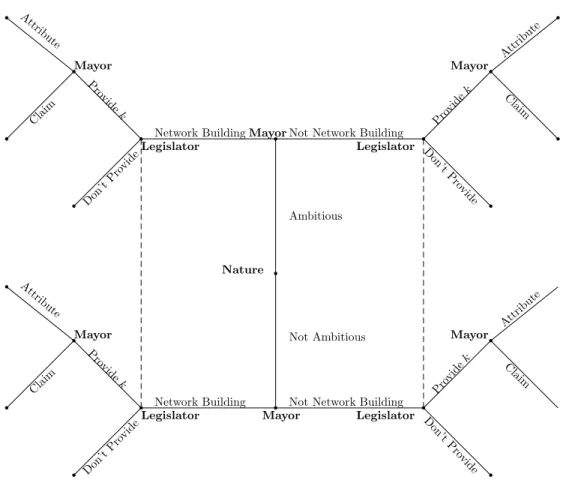
responsibility in providing the benefit to citizens. The extensive form of the game can be seen in Figure 2.1.
bbb b b b b b b b b b b b b b b Nature Ambitious Not Ambitious Mayor Mayor Mayor Mayor Mayor Mayor Legislator Legislator Legislator Legislator Pro vide k Prov ide k Prov id e k Prov id e k D on’t Prov id e D on’t Prov id e Don ’tPr ovid e Don ’tPr ovid e Attrib ute b b Attrib ute
Claim
Claim
b b b b Attr ibut e Attr ibut e Cla im Cla im Network Building Not Network Building
Network Building Not Network Building
Figure 2.1: Signaling Game
The utility functions for legislators and the ambitious and non-ambitious mayors are a function of the
size of a club good benefit, k, a multiplicative benefit,σ, for receiving credit for a club good, and a base
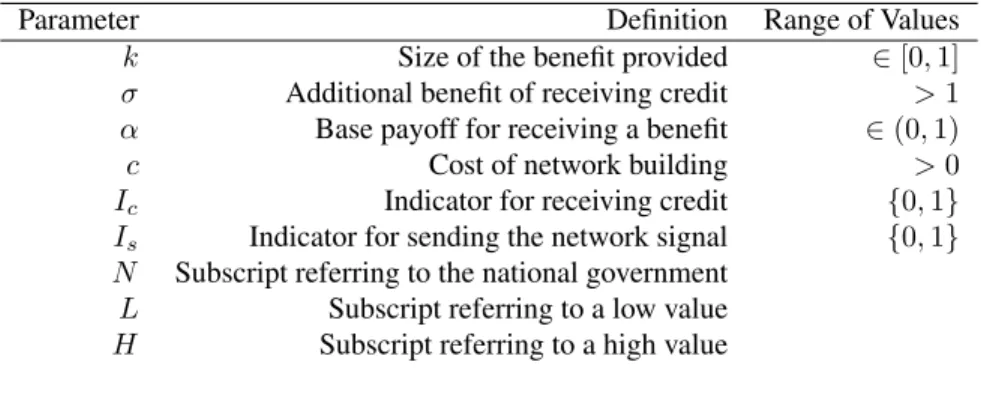
Parameter Definition Range of Values
k Size of the benefit provided ∈[0,1]
σ Additional benefit of receiving credit >1
α Base payoff for receiving a benefit ∈(0,1)
c Cost of network building >0
Ic Indicator for receiving credit {0,1} Is Indicator for sending the network signal {0,1} N Subscript referring to the national government
L Subscript referring to a low value
H Subscript referring to a high value
Table 2.1: Model Parameters
benefit,α, that is a proportion of the size of the benefit and that a mayor receives for being chosen as a broker. There is no parameter for reelection. Instead, a potential reelection benefit is accrued as part of the base
payoff for receiving the benefit,αand the additional payoff for receiving credit,σ. It follows that if a mayor has a highαandσvalue, they are more likely to be reelected. Table 2.1 define each of these parameters and their components.
The national legislator’s utilities are a function of whether or not they receive credit and the size of the
club good they provided. The legislator’s utility isk(IcσN −1)In this utility function,Icis an indicator function that determines whether the legislator has received credit. If they do, then the legislator receives the
multiplicative benefit for receiving credit, less the cost of providing the benefit. If they do not, they simply
pay the cost of providing the benefit.
The mayor’s utility functions are a function of their benefit for receiving credit and their base payoff
for receiving the benefit. If a mayor sends a network building signal, they pay an additional cost, c. The
mayor’s utility isk(Icσ+α)−Ic1−Isc. In this function,Icis the indicator that is one if the legislator received credit, and 0 otherwise whileIsis the indicator for whether the mayor sent the network-building signal. The mayor who claims credit will receive the additional benefit,σ, that is a function of the size of the good. However, this mayor will have to pay a normalized cost, 1, of jeopardizing their reputation with the
national politician. This cost for claiming credit is the loss that a mayor has for no longer being a member of
a politician’s network, and thus losing potential future benefits and political allies within that network.
Since the ambitious mayor is concerned about their reputation beyond their own municipality, they value
receiving a benefit, regardless of credit, more than a mayor who is more focused on their local reputation. As
club goods benefits, but the ambitious mayor benefits more because they place higher value on being part of
the legislators political network. Likewise, the not ambitious mayor, since they are most focused on their
local reputation, receive a higher benefit,σ, when they receive credit. As a result, the credit benefit for the ambitious mayor isσLand for the not ambitious mayor isσH. As with receiving benefits, both mayors have payoffs for receiving credit, but the payoff for the ambitious mayor is lower because they need to build a
broader constituency outside their own municipality. The full utility functions can be seen in Table 2.2
Legislator Strategy Mayor Strategy Legislator Payoff Ambitious Not Ambitious Mayor Payoff Mayor Payoff
Don’t Provide - 0 −Isc −Isc
Providek∈(0,1] Attribute credit k(σN −1) kαH−Isc kαL−Isc
Providek∈(0,1] Claim Credit −k k(σL+αH)−1−Isc k(σH+αL)−1−Isc
Table 2.2: Payoffs
2.3.1 Best Responses
2.3.1.1 Stage 3: Credit Attribution
In the final stage of the game, the mayor decides whether to attribute credit of claim credit. The mayor will
attribute credit only where the utility from attributing credit is greater than the utility from claiming credit for
themselves. For the ambitious mayor, this occurs whenk≤ 1
σL. This means that, as long as the contract is
smaller than the inverse of their credit claiming benefit, the mayor will be willing to attribute credit. The
larger the benefit for receiving credit, the smaller the benefit that the mayor is willing to attribute credit for.
The not ambitious mayor will attribute credit whenk ≤ 1
σH. This means that it is harder for a
non-ambitious mayor to attribute credit since this type of mayor will always receive a larger payoff for receiving
credit than the ambitious mayor. When k > σL1 , neither the ambitious nor the not-ambitious mayors will attribute credit. Whenk < σH1 both types of mayors will attribute credit. The third region, where
1
σH < k≤ 1
σL, is most interesting because in this range of benefits,k, the two types of mayor will behave differently. In this range, the ambitious mayor will attribute credit while the not ambitious mayor will claim
credit for themselves.7.
2.3.1.2 Stage 2: Deciding Whether to Provide the Benefit
The legislator will always provide the benefit if they know that they will receive credit. The legislator will
always provide the benefit ifk≤ 1
σH. The legislator will never provide the benefit if they will not receive
credit. So, they will never provide the benefit ifk > 1 σL.
If the benefitk∈( 1 σH,
1
σL], whether the legislator provides the benefit is a function of their belief,µ, that the mayor is ambitious. The legislator will provide the benefit if:
µ(k(σN −1)) + (1−µ)(−k)≥0
µkσN −k≥0
µσN −1≥0
µ≥ 1 σN
The legislator has beliefs,µfor whether they observe the network building signal or whether they do not observe the network building signal. If the legislator holds a belief,µs, that the mayor who sent the signal was ambitious. They will provide the benefit ifµs≥ 1
σN. If the mayor does not observe the network
building signal, they hold a belief,µ, that the mayor who did not invest in building a network is ambitious. The legislator will provide a club good benefit ifµ≥ 1
σN.
Stage 1: Sending the Ambitious Signal
If the mayor will receive a club good regardless of sending a signal, then the mayor will always prefer not to
send the signal to maximize their own returns and avoid paying the cost, c. However, if sending the signal is
the only way to receive a contract, then the two mayors will only send the signal when the cost of doing so
is sufficiently low. When both mayors attribute credit, ork < 1
σH, then the ambitious mayor will send the
signal whenc < kαH and the not ambitious mayor will send the signal whenc < kαL. In this circumstance, the ambitious mayor is more likely to pay to send the signal.
When the size of the benefit,k, incentivizes the two mayors to behave differently,k∈( 1 σH,
1
σL], then the
mayors have different considerations when deciding whether to pay to send the signal. Since the ambitious
the other hand, will pay to send the signal when the cost of network building is less than their benefit for
claiming credit:c < k(σH +αL)−1.
2.4 Equilibria
As seen in stage 3, whether a mayor is a reliable broker depends solely on the size of the benefit,k. An ambitious mayor will be reliable broker whenever the benefit is less than their additional benefit for receiving
credit, whenk≤ 1
σL. For the not ambitious mayor, they will be a reliable broker whenever the benefit is less
than their additional benefit for receiving credit, ork≤ 1
σH. Thus, the legislators optimal decision can be
determined based on the size of the benefit,k, that the legislator can use as a club good. The legislator has to determine their best response in three separate conditions:
1. k > 1
σL, the best response for the legislator is never to provide k because neither type of mayor will be
a reliable broker. Instead, both types of mayor will claim credit for themselves.
2. k≤ 1
σH, the best response for the legislator is always to provide k because both types of mayor will
always be reliable brokers and attribute credit to the legislator.
3. k∈(σH1 ,σL1 ]the best response for the legislator is a function of their belief that the mayor is ambitious. The legislator will provide k when their belief,µ, that the mayor is ambitious is at least σN1
Since the beliefs are irrelevant for best responses ifk≤ 1
σH ork > 1
σL, the interesting range to study
occurs whenk∈(σH1 ,σL1 ]. This case depends on two sets of beliefs, the belief,µsthat the mayor who invests in building a network is ambitious and the belief,µ, that the mayor who does not invest in building a network is ambitious.
The legislator will only provide a benefit when their belief that the mayor is ambitious is at least σN1 . This means that, in order for providing a club good benefit to be rational, the legislator must believe the mayor is
ambitious with a probability greater than the inverse of their benefit for receiving credit. The legislator has
four possible strategies in pure strategies.
1. The legislator never provides the benefit,k.
3. The legislator does not provide a benefit when they observe the network building signal but does
provide a benefit when they do not observe the network building signal.
4. The legislator provides the benefit when they observe the network building signal and does not provide
the benefit when they do not observe the network building signal.
In the first case, the legislator will never provide the benefit,k, regardless of what signal they observe. Neither type of mayor will invest in building a network because there is no positive utility for sending the
signal. This case occurs when the legislator believes that the mayor is ambitious with a probabilityµ < 1 σN.
The beliefs are consistent as long as the probability that any mayor is ambitious, p, is less than σN1 . This equilibrium can occur when the national legislator receives a relatively small payoff for receiving credit. The
smaller the legislator’s payoff for receiving credit, the more discerning they will be about providing benefits
to mayors that might not be reliable brokers.
In the second case, the legislator will always provide the benefit,k, regardless of what signal they observe. In this case, both types of mayor will not invest in building a network because they can receive the same
payoff from the benefit without paying the cost of sending a signal about their political network. This case
occurs when the legislator believes that the mayor is ambitious with a probabilityµ > 1
sigmaN. The beliefs
are consistent as long as the probability that any mayor is ambitious, p, is greater thanσN1 . This equilibrium can occur when the national legislator receives a relatively high payoff for receiving credit. The larger the
legislator’s payoff for receiving credit, the less discerning they will be about providing benefits to mayors
who may not be reliable brokers.
The strategies for the mayor become more interesting when the legislator bases their actions on observing
a signal about the strength of the mayors network. If the legislator does not provide the benefit when they
observe the network building signal but does provide the benefit when they do not observe the network
building signal, then the mayor will never invest in building a network in order to receive the benefit. This
belief is consistent if the probability, p, that a mayor is ambitious is greater thanσN1 and the legislator believes that ambitious mayors will not invest in building political networks. This equilibrium result, therefore,
depends on how the legislator evaluates mayors incentives. For example, if a legislator thought that a mayor
with national ambitions would not invest in their local network, this equilibrium result could be observed. In
each of these three conditions, there is a pooling equilibrium where neither type of mayor invests in building
Finally, I consider the case where the legislator provides benefits to mayors who send the network
building signal and does not provide benefits to mayors who do not send the network building signal. If an
ambitious mayor sends the signal, they will claim credit and their payoff will be a proportion of the benefit
they receive, less the cost they paid to send the network building signal,kαH−c. However, if the ambitious mayor does not send the signal, they will receive a payoff of 0. As a result, the ambitious mayor will send
the signal as long as the cost of sending the signal,c, is less than their benefit from attributing credit,kαH. On the other hand, the not ambitious mayor will claim credit if they receive the benefit. As a result, the not
ambitious mayor will receive their benefit for receiving credit, less the penalty for being an unreliable broker
and the cost of sending the network building signal,k(σH +αL)−1−c. If the not ambitious mayor does not send the signal that they have build a political network, they will receive 0. The not ambitious mayor will
send the signal as long as the cost,cis less than their benefit for claiming credit,k(σH +αL)−1.
This leads to four cases of interest: one where both mayors will invest in building networks to receive
the benefit, one where only the ambitious mayor is willing to pay the cost of network building, one where
only the not ambitious mayor is willing to pay the cost of network building, and one where neither mayor is
willing to pay the cost of building networks.
If both mayors are willing to pay to send the signal,c≤kαH andc≤k(σH +αL)−1
The legislator will only provide the benefit if they believe that the mayor who sends the signal is ambitious
with a probabilityµs≥ σN1 . I update the mayor’s beliefs given the mayors strategies and find that:
µs= 1p 1p+ 1(1−p) =p
µ= 0p 0p+ 0(1−p) =All Beliefs Consistent
Ifp ≥ 1
σN there exists a pooling equilibrium where both types of mayors send the network building
they do not observe the signal. The ambitious mayor attributes credit and the not ambitious mayor claims
credit.µs=pandµ < 1
σN. This equilibrium result reflects a situations where a legislator treats the network
building signal as informative and the not ambitious mayor will imitate the ambitious mayor so that they can
benefit from being selected as a broker.
If the ambitious mayor pays to send the signal and the not ambitious mayor does not,c ≤kαH andc > k(σH +αL)−1
Here, it is only rational for a legislator to provide benefits after observing the network building signal if
their belief,µsthat the mayor who sends the signal is ambitious is greater than σN1 and their belief,µthat the mayor who does not send the signal is ambitious is less than σN1 . The legislators updated beliefs are:
µs= 1p 1p+ 0(1−p) = 1
µ= 0p
0p+ 1(1−p) = 0
These beliefs are consistent. So, ifc < kαH, andc > k(σH+αL)−1there is a separating equilibrium where the ambitious mayor sends the clientelist signal and the not ambitious mayor does not. The legislator
will provide the good if they observe the signal and will not provide the good if they do not observe the signal.
The ambitious mayor will attribute credit and the not ambitious mayor would claim credit if they sent the
signal.µs = 1andµ= 0. This equilibrium is possible whenk∈(σH1 ,σH−αH1 −αL), the point where both types of mayors will receive the same payoff. This equilibrium result is the ideal for a legislator because it
allows them to select a reliable broker with minimal risk.
Again, it is only rational for a legislator to provide the benefit only after observing the signal ifµs≥ f rac1σN andµ < σN1 . However, in this case, only the not ambitious mayor pays to send the signal. As a result, the legislators updated beliefs are:
µs=
0p
0p+ 1(1−p) = 0
These beliefs are not consistent and there is no equilibrium.
If neither mayor pays the cost of clientelism,c > kαH andc > k(σH+αL)−1
In this condition, neither mayor is willing to send the network building signal. However, the legislator’s
strategy is still rational ifµs ≥ 1
σN andµ < 1
σN. Based on the mayor’s strategies, the legislator’s updated
beliefs are:
µs =
0p
0p+ 0(1−p) =All Beliefs Consistent
µ= 1p
1p+ 1(1−p)
µ=p
Ifp < 1
σN there is a pooling equilibrium where neither mayor sends the signal, the legislator will provide
the benefit if they observe the signal and will not provide the benefit if they do not observe the signal, and the
mayor would attribute credit if they received the benefit while the not ambitious mayor would claim credit if
they received the benefit.µs≥ 1
2.4.1 Comparative Statics
A mayor will only send the network building signal when the national legislator provides a benefit after
observing the signal and does not provide the benefit if they do not observe the signal. In this condition, the
legislator believes that a mayor who sends the signal is ambitious with a probability≥1σN and believes a mayor who does not send the signal is ambitious with a probability< 1
σN. While this is only one condition,
it occurs quite frequently: mayors regularly explain that they invest in patronage strategies because it helps
them gain resources from the national government.
In this common condition, it is possible to observe three types of equilibria: a pooling equilibrium where
both types of mayors send the signal by investing in network building, a separating equilibrium where only
the ambitious mayor invests in network building, and a pooling equilibrium where neither mayor invests in
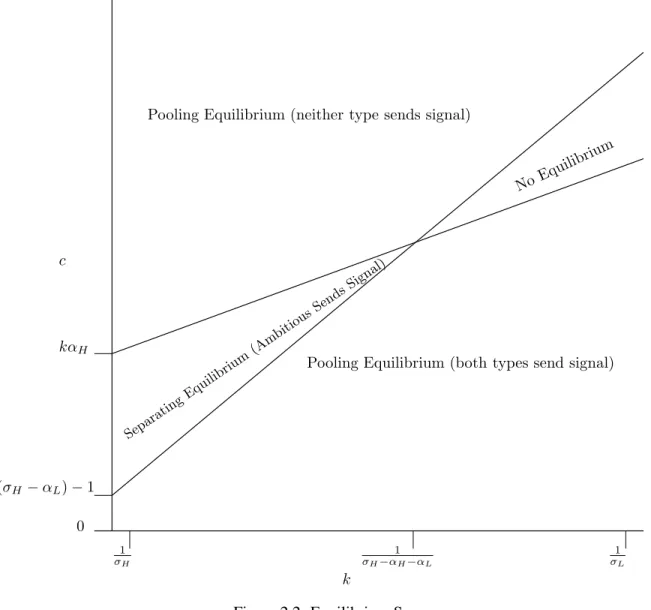
network building. The regions can be seen in Figure 2.2.
The model helps to explain when observing the signal informs a legislators decision to provide the
benefit,k. When a legislator chooses to provide the benefit, they are choosing that mayor as their broker. For any moderately sized benefitk∈( 1
σH, 1
σL], the ambitious mayor will attribute credit while the not ambitious
mayor will claim credit for themselves. The benefit that the legislator has the ability to provide, therefore,
will determine whether the mayors can be reliable brokers: the ambitious mayor is likely to be reliable, while
the not ambitious mayor is not reliable. The challenge, then, remains: how can the legislator determine
whether they are selecting an ambitious mayor as their broker.
The range of values where it may be possible to separate ambitious and not ambitious mayors depends
on the difference between each mayors additional benefit for receiving credit. If the mayor who is ambitious
has almost the same additional benefit of credit as the not ambitious mayor, which could be the case if a
mayor was not locally popular and needed additional support within their municipality, then there are very
few benefits where network building can behave as an informative signal. However, if the benefit for the not
ambitious mayor of receiving local credit is much larger than the ambitious mayors, as would be the case
if this mayor was particularly worried about their visibility for future reelection or anticipating a difficult
challenger, then the space from σ1 H to
1
σL can represent a large range of benefits. In other words, when
the two types of mayor have similar payoffs for claiming credit, then there is a limited range of benefits
where it is possible to observe either type of mayor paying the cost of sending the signal or for a separating
0 1
1 σH
1 σL
kαH
k(σH −αL)−1
1 σH−αH−αL
c
k
Pooling Equilibrium (both types send signal) Pooling Equilibrium (neither type sends signal)
NoEq
uilibriu
m
Sepa ratin
g Equ ilibriu
m(A
mbiti ous S
ends Signa
l)
Legislator provides a benefit, k, only if the mayor sends the network-building signal
However, when there is a benefit,k, that causes the two types of mayors to behave differently, whether a mayor decides to pay to send the signal depends on the cost,c, of building a network. When the cost of sending the network building signal is sufficiently low, for example when there is already a strong network in
place or there are a high number of jobs available that can be filled using patronage, then both types of mayors
will invest in building a network. This creates a pooling equilibrium where the legislator cannot ascertain
which type of mayor they are providing a benefit to. When the cost of building a network is low, therefore,
then observing the network signal is not informative and the legislator still will be unable to separate the two
types of mayors. The legislator may select a mayor as a broker, but they are risking selecting a not ambitious
mayor who will fail to deliver votes.
Further complicating the decision is the fact that both mayors will be willing to pay a higher cost for
a larger benefit. If the benefit that the legislator can extract from the ministry is larger, then the legislator
is more likely to select a mayor without knowledge of that mayors type. Similarly, the largerσH −αL, or the difference between the payoff for receiving credit and the base payoff for receiving a good for the not
ambitious mayor, the larger the area where there will be a pooling equilibrium. So, if the not ambitious mayor
only receives a very small payoff for receiving a benefit, but receives a relatively large payoff for getting
credit for that benefit, then the not ambitious mayor will be willing to invest more in building a network. In
sum, when the benefit is large, the cost of network building is low, and/or the difference between the benefit
for receiving credit and the benefit for receiving a good for the not ambitious mayor is high, then the not
ambitious mayor will mimic the ambitious network by investing in network building. If this is the case, then
the legislator is always taking a risk when they select a mayor as a broker.
When the cost of sending the signal is sufficiently high, neither type of mayor will pay the cost of
building a network. Regardless of how large the benefit,k, is that the mayor can receive, they will prefer to receive nothing. This is counter-intuitive: when politicians value their reputation with voters, they should
always prefer receiving a benefit to not receiving a benefit. However, if it is expensive to build a network,
as could be the case when there is no pre-existing infrastructure to connect with voters and the mayor is
particularly unpopular, then a mayor might choose to forgo strengthening their network, and the potential
benefits from the national government. When the payoff an ambitious mayor gets for receiving a benefit,αH, is low, it’s possible for there to be a quite large area where the cost of sending the signal is simply too large
for a mayor to pay. As when the cost of network building is low, when the cost of network building is high