Dr G.Arul Venkadesh et al JMSCR Volume 06 Issue 10 October 2018 Page 996
Study of Cystatin C as a Risk Factor for Myocardial Infarction in Patients
with Normal Renal Function
Authors
Dr G. Arul Venkadesh
1*, Prof. Dr M.Senthilvelan
2, Dr K. Baburaj
3, Dr A. Elaiyaraja
4,
Dr Jayaram Kosalram
5, Dr G.Sivachandran
61,6
Post Graduate, Department of General Medicine, Rajah Muthiah Medical College, Annamalai University, Chidambaram,Tamilnadu
2
Professor & HOD, Department of General Medicine, Rajah Muthiah Medical College, Annamalai University, Chidambaram,Tamilnadu
3
Reader, Department of General Medicine, Rajah Muthiah Medical College, Annamalai University, Chidambaram,Tamilnadu
4,5
Senior Resident, Department of General Medicine, Rajah Muthiah Medical College, Annamalai University, Chidambaram, Tamilnadu
*Corresponding Author
Prof Dr M. Senthilvelan
Professor & HOD, Department of General Medicine, Rajah Muthiah Medical College, Annamalai University, Chidambaram, Tamilnadu, India
Email: [email protected]
Abstract
Objective and Design: Cystatin C facilitates the progression of atherosclerosis by regulating inflammation and thereby it has a significant impact on pathogenesis of Myocardial Infarction. In this study we assessed the association between cystatin C and Myocardial Infarction in a consecutive series of patients with normal kidney function.
Materials and Methods: 40 Patients of age 30 to 60 years of both sexes, attending casualty within 12hours after the onset of symptoms in Rajah Muthiah Medical college and hospital, Annamalai University during the period of November 2016 till August 2018, diagnosed as Acute Myocardial Infarction with normal renal function, normal thyroid function without any malignancies / recent surgeries were taken for present study.
Results: Cystatin C was elevated among 82.5% of the total patients participated in the study. Cystatin C being less influenced by age, gender, and muscle mass and can be considered as a better indicator of cardiovascular risk especially Myocardial Infarction. CYSTATIN C to be considered as an independent risk factor for Acute Myocardial Infarction in patients with normal renal function.
Keywords: Acute Myocardial infarction, STEMI, NSTEMI, CYSTATIN C.
Introduction
Myocardial Infarction accounts for 20% of all medical emergency admissions and has the highest risk for adverse effects and deaths.[1] Risk of CAD could be prevented by various strategies and most of the developed countries could reduce the incidence and mortality related to CAD
especially Myocardial Infarction by various preventive methods. Some of the risk factors of coronary heart disease are non modifiable like age, male sex and family history of atherosclerosis. Modifiable risk factors includes hypertension, hyperlipidemia, diabetes mellitus and smoking cigarette which are commutable risk
www.jmscr.igmpublication.org Impact Factor (SJIF): 6.379
Dr G.Arul Venkadesh et al JMSCR Volume 06 Issue 10 October 2018 Page 997 factors of myocardial infarction. Clinical
evaluation of suspected acute myocardial infarction depends on patient history, electrocardiographic findings and cardiac enzymes and other biomarkers.
Cystatin C is a cysteine protease inhibitor, secreted by all nucleated cells. This protein is less influenced by age, gender, and muscle mass. Cystatin C regulates inflammation and thereby facilitates the progression of atherosclerosis and hence involves in the pathogenesis of Myocardial Infarction. Cystatin C acts as an independent risk factor for Myocardial Infarction [2] and heart failure [3].
The current study demonstrated that serum levels of cystatin C, were independently associated as a risk factor for the development of Myocardial Infarction in patients with normal renal function. Renal impairment patients were excluded in order to avoid the well known effects of renal insufficiency over atherosclerosis and Cystatin C.
Aims and Objectives
To estimate the Serum level of Cystatin - C in Acute Myocardial Infarction with normal renal function andto compare the levels of Cystatin - C in predicting the severity and prognosis of STEMI and NSTEMI patients.
Materials and Methods
40 Patients belonging to age 30 to 60 years of both sexes, attending casualty within 12 hours after the onset of symptoms in Rajah Muthiah
Medical college and hospital, Annamalai University during the period of November 2016 till August 2018, diagnosed as Acute Myocardial Infarction with normal renal function, normal thyroid function without any malignancies / recent surgeries were taken for present study.
Observation and Results
The present work aims to analyse cystatin ‘C’ in Myocardial Infarction. A total of 40 patients with Myocardial Infarction was selected and analysed. Overall cystatin ‘C’ was studied by descriptive statistics such as mean and standard deviation (sd). Cystatin ‘C’ in relation to types of Myocardial Infarction is analysed by independent sample ‘t’ test. Cystatin C with respect to subtypes of STEMI is analysed by Analysis of variance (ANOVA) as its subtypes consists of more than 2 variables. Cystatin ‘C’ in relation to Left Ventricular function and TIMI score is studied by reason correlation coefficients. The entire statistical procedure is carried out by statistical packages of social sciences (Spss-21).
Table: 1 Age Distribution AGE (in
year)
Number Percentage Mean S.D
38-44 3 7.5
51.10 5.47
45-51 18 45.0
52-59 19 47.5
Total 40 100
The common age was 52 to 59 years (47.5%) and 45 to 51 years (45.0%). The mean age of the study patients was 51.10 5.47 years.
0 10 20 30 40 50
38 - 44 45 - 51 51 - 59
7.5
45 47.5
%
Dr G.Arul Venkadesh et al JMSCR Volume 06 Issue 10 October 2018 Page 998 Table: 2 Gender Distributions
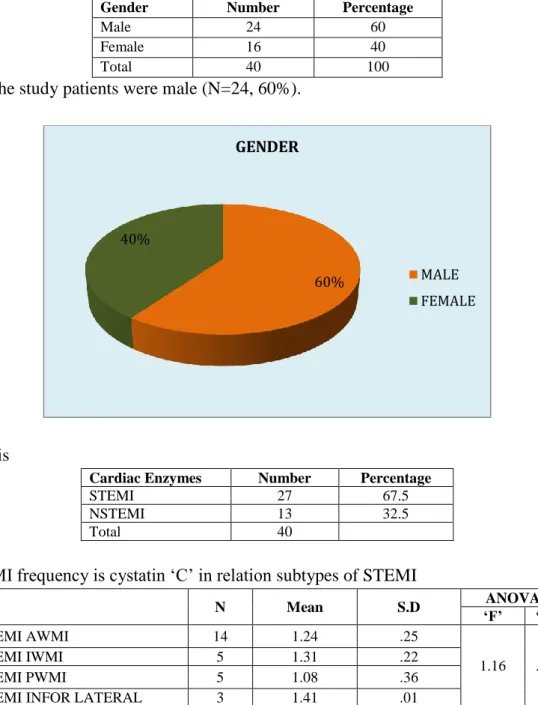
Gender Number Percentage
Male 24 60
Female 16 40
Total 40 100
The majority of the study patients were male (N=24, 60%).
Table 3 Diagnosis
Cardiac Enzymes Number Percentage
STEMI 27 67.5
NSTEMI 13 32.5
Total 40
Table 3(a) STEMI frequency is cystatin ‘C’ in relation subtypes of STEMI
N Mean S.D ANOVA
‘F’ ‘P’
STEMI AWMI 14 1.24 .25
1.16 .35
STEMI IWMI 5 1.31 .22
STEMI PWMI 5 1.08 .36
STEMI INFOR LATERAL 3 1.41 .01
The mean cystatin ‘C’ was comparatively higher for inferlateral –STEMI (M=1.41.01) and IWMI-STEMI (M=1.3122). The differences in cystatin
‘C’ among subtypes of STEMI is statistically insignificant (F=1.16, p = 35).
Table: 4 Cardiac enzymes
Cardiac Enzymes Number Percentage
Normal 6 15
Elevated 34 85
Total 40 100
The cardiac enzyme was elevated in most of the patients (N=34, 85%).
60% 40%
GENDER
Dr G.Arul Venkadesh et al JMSCR Volume 06 Issue 10 October 2018 Page 999 Table: 5 LV Function
LU FUNCTION Number Percentage
Normal 9 22.5
Mild 14 35.0
Moderate 9 22.5
Severe 8 20.00
Total 40 100
LV function was normal for only 22.5%, in MI. Mild LV dysfunction was observed in 35% of the
patients. Moderate and severe dysfunctions were 22.5% and 20% respectively.
Table: 6 Diagnosis Vs cystatin ‘C’ STEMI VS NSTEMI
Diagnosis N Mean S.D Independent Sample Test
STEMI 27 1.24 .26
1.46 .151 NSTEMI 13 1.38 .28
Overall 40 1.29 .27 The mean cystatin ‘C’ for STEMI was 1.24 .26
whereas it was 1.38 28 for NSTEMI. The difference is statistically insignificant (t=1.46,
p=151). The overall cystatin ‘C’ Mean was 1.29.27, which was higher than normal level.
0 20 40 60 80 100
NORMAL ELEVATED
15
85
%
CARDIAC ENZYMES
0 5 10 15 20 25 30 35
NORMAL MILD MODERATE SEVERE
22.5
35
22.5
20
%
Dr G.Arul Venkadesh et al JMSCR Volume 06 Issue 10 October 2018 Page 1000 Table: 7 Relationship of cystatic ‘C’ in relation to gender
Gender N Mean S.D Independent Sample TGT
‘t’ ‘P’
Male 24 1.27 .28
.36 .72
Female 16 1.30 .27 The Mean cystatin ‘C’ was comparatively higher for females (M=1.30.27) than males
(m=1.27.28), but the difference is statistically insignificant.
Table: 8 Cystatin in relation to age
Age
(in yrs) N Mean S.D ANOVA
38-44 3 1.17 .39
.770 .47 45-51 18 1.25 .24
52-59 19 1.34 .29 The difference in cystatin in relation to age is
studied by ANOVA. The mean cystain was higher for 52-59 years (1.34 .29) followed by 45-51
years (M = 1.25 .24). But the difference is insignificant (F=.770, P=.47).
Table: 9 The correlation of cystatin ‘C’ with TIMI
‘r’ ‘p’
Pearson’s correlation .126 .44 The correlation of cystatin ‘c’ with TIMI is
negative ie when cystatin is more, TIMI is less
and vice-versa but the relationship is poor (r=.126, p=.44) and insignificant.
Table: 10 TIMI Score
TIMI SCORE Number Percentage Mean S.D
1 12 30
2.20 .99
2 12 30
3 12 30
4 4 10
Total 40 100
In TIMI scores 1, 2 and 3 each of 30% were observed. Only 10% had TIMI score of 4. The Mean TIMI score was 2.20 .99.
Discussion
Cystatin C is produced by all the nucleated cells, which regulates the activity of cysteine protease, and plays a major role in maintaining the balance
1.24
1.38
1.29
1.15 1.2 1.25 1.3 1.35 1.4
STEMI NSTEMI OVERALL
MEAN
Dr G.Arul Venkadesh et al JMSCR Volume 06 Issue 10 October 2018 Page 1001 of production and degradation of Extracellular
matrix. Cystatin C also affects the phagocytic and chemotactic ability of neutrophil and thereby regulates the inflammatory responses and hence plays a major role in the development of atherosclerosis. Also Extracellular matrix degradation by means of Cystatin C activity and arterial remodeling closely relate to plaque stabilization(8).
The pathophysiology of myocardial infarction is basically the rupture of vulnerable plaque leading to platelet aggregation resulting in coronary thrombosis. Extracellular matrix provides the structural integrity of the plaques, and also participates in several events such as cell migration, proliferation, lipoprotein retention, and thrombosis. An excess of cysteine proteinase over cystatin C results in destruction of Extracellular matrix resulting in plaque more prone to rupture which results in Myocardial Infarction.
The study population consists of 40 Acute Myocardial Infarction patients among which 27 patients were STEMI and 13 patients were NSTEMI. All patients had a normal renal function. All the patients had normal thyroid function and no recent surgeries. The age group of all patients were between 30 to 60 years of age. Patients with renal impairment, prior history of recent surgeries, malignancies, thyroid dysfunction were excluded from the study as they would have elevated levels of cystatin C.
A single sample of blood was collected from all the patients within 12 hours of onset of symptoms. Cystatin C was elevated among 33 patients which constitutes 82.5% of the total patients included in the study. The mean Cystatin C was 1.29±0.27 which was higher than the normal value according to various studies.
In Prospective Epidemiological Study of Myocardial Infarction (PRIME), Cystatin C predicted the occurrence of the first coronary events in men of age 50 to 59 years old, and suggested a strong relation with CAD independent of renal impairment[4].
Reference ranges of Cystatin C quoted by Kyhse – Anderson et al[5] was 0.61-1.21 mg/L, by Norund et al[6] 0.7-1.21 mg/L[7]. This difference in the range of Cystatin C may be probably due to difference in the calibrated material.
The mean values of Cystatin C for STEMI was 1.24±0.26 whereas it was 1.38±0.28 for NSTEMI. The difference is statistically insignificant but it was higher among NSTEMI patients. The overall Cystatin C mean was 1.29±0.27 which was higher than normal level.
Correlation of Cystatin C among age and gender was also statistically insignificant which concludes that CYSTATIN C was less influenced by age and gender.
Cardiac enzyme was elevated and there was Left Ventricular dysfunction in most of the study patients. But the correlation of Cystatin C values with Left Ventricular function, cardiac enzymes and TIMI scoring was statistically insignificant.
Conclusion
CYSTATIN C to be considered as a risk factor for Acute Myocardial Infarction in patients with normal renal function.
Cystatin C influences the pathogenesis of Myocardial Infarction by regulating inflammation thereby promoting atherosclerosis.
Cystatin C being less influenced by age, gender, and muscle mass and thus a better indicator of risk of various cardiovascular events especially Myocardial Infarction.
Bibliography
1. Capewell S, McMurray J. Chest pains-please admit: is there an alternative? A rapid Cardiological assessment service may prevent unnecessary admissions.Br Med.J.2000; 320:951-52.
2. Nagesh CM, Roy A. Role of biomarkers in risk stratification of acute coronary syndrome .Indian J Med Res. 2010; 132(5): 627–633.
Dr G.Arul Venkadesh et al JMSCR Volume 06 Issue 10 October 2018 Page 1002 Cystatin C Concentration as a Risk Factor
for Heart Failure in Older Adults. Ann Intern Med. 2005; 142: 497-505.
4. Luc G, Bard JM, Lesueur C, Arveiler D, Evans A, Amouyel P, Ferrieres J, Juhan-Vague I, Fruchart JC, Ducimetiere P: Plasma cystatin-C and development of coronary heart disease: The PRIME Study. Atherosclerosis. 2006, 185:375– 380.
5. Kyhse–Andersen J, Schmidt C, Nordin G, Anderson B, Nilsson Ehle, et al. Serum Cystatin C, determined by a rapid, automated, particle – enhanced turbidometric method is a better marker than serum creatinine for glomerular filtration rate. Clin. Chem. 1994; 40:1921-1926. [PubMed]
6. Norfund L, Fex G., Lande J, Von Schenck H, Nilsson JE, et al. Reference intervals for the glomerular filtration rate and cell – proliferation markers; Serum /cystatin C and serum b2 microglobulin I cystatin C ratio. Scand. J. Clin.Lab Invest 1997; 57: 463-470. [PubMed]
7. Pergande M, Jung K. Sandwich enzyme immuno assay of cystatin C in serum with commercially available antibodies. Clin chem 1993; 39: 1885-1890.