THE EFFECT OF ANTIRETROVIRAL THERAPY ON PRETERM BIRTH IN A U.S POPULATION OF WOMEN LIVING WITH HIV: A REEXAMINATION OF ANALYSIS
METHODS
Hamsa Lakshmi Subramaniam
A dissertation submitted to the faculty at the University of North Carolina at Chapel Hill in partial fulfillment of the requirements for the degree of Doctor of Philosophy in the Department
of Epidemiology in the Gillings School of Global Public Health.
Chapel Hill 2020
© 2020
ABSTRACT
Hamsa Lakshmi Subramaniam: The Effect of Antiretroviral Therapy on Preterm Birth in a U.S Population of Women Living With HIV: A Reexamination of Analysis Methods
(Under the direction of Audrey Pettifor)
Harmful effects of combination antiretroviral therapy (cART) in pregnancy is a research priority given its widespread use in preventing vertical transmission of HIV. Studies
investigating the relationship between ART and preterm birth (PTB) offer conflicting results as to whether PI cART is harmful in causing PTB, likely due to methodological challenges and not truly harmful effects. Our study reexamines methods used in the literature with the Women and Infants Transmission Study data (WITS). WITS is a US-based observational cohort designed to study the natural course of maternal-infant HIV-1 infection between 1990 and 2005. Exposure categories considered for both aims are no therapy, Zidovudine (ZDV) monotherapy; PI-based cART and non-nucleoside reverse transcriptase inhibitor (NNRTI) cART. For Aim 1, we used the complement of the Kaplan-Meier estimator and inverse probability weights to estimate PTB risk by time-varying exposure. A total of 1,067 HIV-positive pregnancies in 932 women were followed until delivery. The weighted risk differences indicated PI cART was harmful compared to NNRTI cART in preventing PTB, though insignificant. Exposure to either combination
To my children,
ACKNOWLEDGEMENTS
First and foremost, I thank my partner and husband, Arun. I cannot sufficiently express my gratitude in words, other than to say that this dissertation would not have been possible without his love, intelligence, selflessness and humor. It is impossible to count the number of days, nights and weekends he was left to manage caregiving and dishes alone while I was working. This milestone is as much his as it is mine. My doctoral journey was enriched by the arrival of our daughter, Savitri Lalitha, without whom I would have lost the forest for the trees. I pursued advanced study in public health to do my part in improving the world for subsequent generations – for my Lali and the little one to come. I dedicate this dissertation to them.
I thank my advisor Dr. Audrey Pettifor, whose generosity, guidance, and encouragement facilitated my growth as an epidemiologist and a person. I also thank Dr. Daniel Westreich, who gave me a paid research position my first year in the program, and since then has almost single-handedly shaped my understanding of epidemiology methods and the importance of linking epidemiology to action. From the beginning of my time at UNC, both Audrey and Daniel have met me where I was – through pregnancies and family obligations – to facilitate my journey through the program. While I was not the sort of highly productive and energetic student I embodied in my 20s, they supported my journey as the student I am now, in pursuit of the technical skills and knowledge needed for the next chapter of my professional life.
Julie Daniels supported my training in reproductive epidemiology by overseeing my time as a RPPE T32 grantee. Her thoughtfulness and close reading of my work gave me the sort of kind and decisive guidance to help me develop both as a researcher and a writer. Dr. Sabrina
Zadrozny generously extended her time, expertise and empathy by working with me through the foundational aspects of my dissertation work. She always encouraged me to take the essential step of “doing the thing” in my unsure moments and helped me feel confident when I didn’t.
I thank all the participants and collaborators who made the Women and Infants Transmission Study possible. Their dedication to studying the effect HIV has on women and families is astonishing. Advances in our understanding of HIV and pregnancy today stems directly from their work and sacrifice.
Without the kind and always timely help of Valerie Hudock and Jennifer Moore, I would have been lost in this program. I also thank Dr. Jess Edwards for additional methodological support and thought-partnership throughout my coursework and dissertation process.
Gopika Tazarurwa. Without my fellow epidemiology classmates, I would almost certainly still be stuck at my computer, struggling with SAS code. These wonderful humans did everything from providing emergency childcare while I hastily finished homework, to offering a newborn-free escape to sleep before my qualifying exams. I would especially like to thank Yasmin Barrios, Alex Breskin, Victoria Buchanan, Giehae Choi, Molly Deutsch-Feldman, Lindsey Filiatreau, Joyce Rhoden, Arti Virkud, Sanah Vohra, Jeff Yang and Paul Zivich for their guidance, humor and cheerleading.
My parents-in-law, Chitra and Chandar, were steadfast in their support and
encouragement as I progressed through the program. I am so grateful. My sister-in-law, Anita, was an empathetic shoulder to lean on as we both struggled through our respective PhD programs, giggling through our angst.
TABLE OF CONTENTS
LIST OF TABLES ... xii
LIST OF FIGURES ... xiv
LIST OF ABBREVIATIONS ... xv
CHAPTER 1: SPECIFIC AIMS ... 1
CHAPTER 2: BACKGROUND ... 3
2.1 HIV and Pregnancy in the United States ... 3
2.2 HIV Treatment in Pregnancy ... 4
2.3 ART and Preterm Birth ... 6
2.4 Limitations in the Current Research ... 8
2.5 Conclusion ... 10
2.6 Tables and Figures ... 12
CHAPTER 3: RESEARCH DESIGNS AND METHODS ... 14
3.1 Study Overview ... 14
3.2 Parent Study and Study Population... 14
3.3 Analytic Sample Construction ... 15
3.4 Gestational Age Assessment ... 16
3.10 Aim 1 Statistical Analysis ... 21
3.11 Aim 2 Statistical Analysis ... 23
3.12 Tables and Figures ... 25
CHAPTER 4: AIM 1 - PROTEASE INHIBITOR-CONTAINING ART REGIMENS AND PRETERM BIRTH: A REEXAMINATION USING SURVIVAL ANALYSIS METHODS ... 28
4.1 Introduction ... 28
4.2 Methods... 30
4.3 Study Population ... 31
4.4 Outcome Classification ... 32
4.5 Exposure and Confounder Classification... 32
4.6 Statistical Methods ... 34
4.7 Results ... 36
4.8 Discussion ... 38
4.9 Tables and Figures ... 42
CHAPTER 5: AIM 2 - EXPLICITLY EMULATING A TARGET TRIAL USING OBSERVATIONAL DATA: AN APPLICATION TO THE EFFECT OF ART IN PREGNANCY ON PRETERM BIRTH AND LESSONS LEARNED ... 48
5.1 Introduction ... 48
5.2 Methods... 52
5.3 Study Population ... 53
5.4 Outcome Classification ... 54
5.5 Exposure and Confounder Classification... 54
5.6 Statistical Methods ... 56
5.7 Missing Data ... 56
5.8 Results ... 57
5.10 Tables and Figures ... 62
CHAPTER 6: DISCUSSION ... 67
6.1 Overview ... 67
6.2 Contributions... 68
6.3 Limitations ... 68
6.4 Conclusion ... 71
APPENDIX A: DIRECTED ACYCLIC GRAPHS ... 73
APPENDIX B: SUPPLEMENTAL DESCRIPTION OF EXPOSURES ... 75
APPENDIX C: AIM 1 - SUPPLEMENTAL TABLES AND FIGURES ... 76
APPENDIX D: AIM 2 - SENSITIVITY ANALYSIS ... 78
LIST OF TABLES
Table 2.1. HIV medications by drug class and year of FDA approval from 1987 to
2005 (Drugs no longer in use are listed in italics.) ... 12 Table 2.2 HIV treatment guidelines in the United States for adults and pregnant
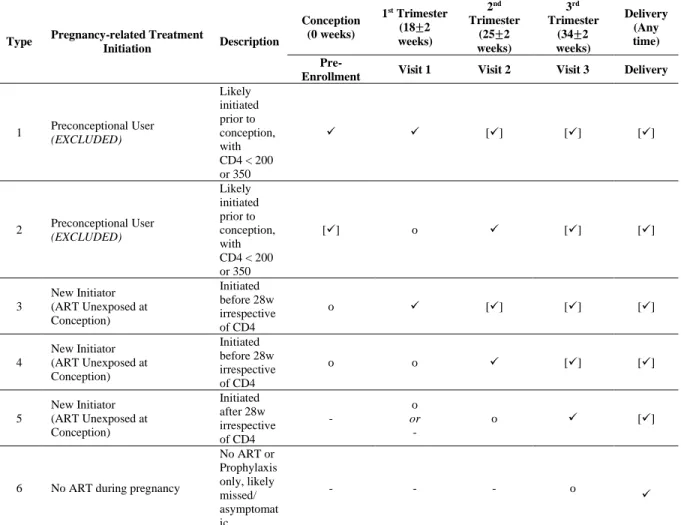
women from 1994 to 2012. ... 13 Table 3.1. Subject Typology based on CD4 thresholds, and timing of treatment
initiation, 1996 to 2005 ... 25 Table 3.2 Measured covariates considered for analysis for Aims 1 and 2 ... 26 Table 4.1. Baseline characteristics of 1067 singleton pregnancies from 932
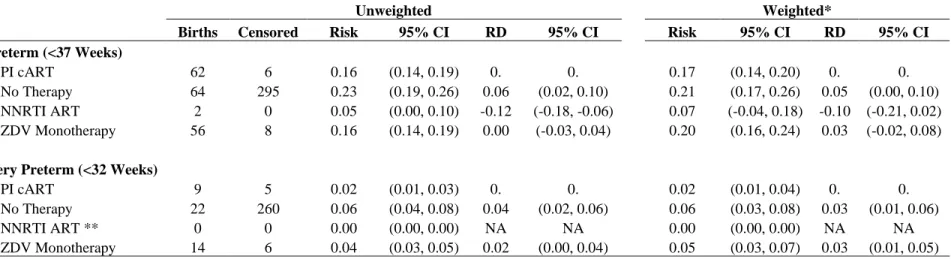
women living with HIV enrolled between 1996 and 2005 in WITS. ... 43 Table 4.2. Unweighted and weighted risks and risk differences for the effect of
ART regimen on preterm delivery among pregnancies enrolled in WITS between 1996 and 2005 from women living with HIV (aged 15 to 45) accounting for
time-varying exposure with bootstrapped 95% confidence intervals (N = 1067). ... 45 Table 5.1. Study protocol summaries for the proposed target trial and the related
emulated target trial to examine the causal effect of ART on preterm birth in the
WITS dataset, 1990 – 2005. ... 62 Table 5.2. Baseline and pregnancy characteristics of singleton pregnancies
surviving past 20 weeks from eligible women enrolled in WITS between 1990
and 2005 (N = 260). ... 64 Table 5.3. Risks and Risk Ratios of preterm birth by baseline exposure among
women eligible for the emulated target trial analysis in the WITS cohort with 95% confidence intervals, assuming that randomization is unconditional (Analysis 1)
and that randomization is conditional on baseline covariates (Analysis 2). ... 66 Table B.1. Description of study exposures clarifying exposure definition and
drugs comprising combination therapies. ... 75 Table C.1. Weighted risks and risk differences for the effect of ART regimen on
preterm delivery among women enrolled in WITS between 1996 and 2005 from women living with HIV (aged 15 to 45) with bootstrapped 95% confidence
intervals (N = 932). ... 77 Table D.1. Selected baseline and pregnancy characteristics of singleton
pregnancies surviving past 20 weeks from eligible women enrolling between 12
Table D.2. Sensitivity analysis identical to the primary analysis but allowing women to enroll throughout the second trimester of pregnancy. Analysis 1 assumes that randomization is unconditional (no model adjustment) and Analysis
LIST OF FIGURES
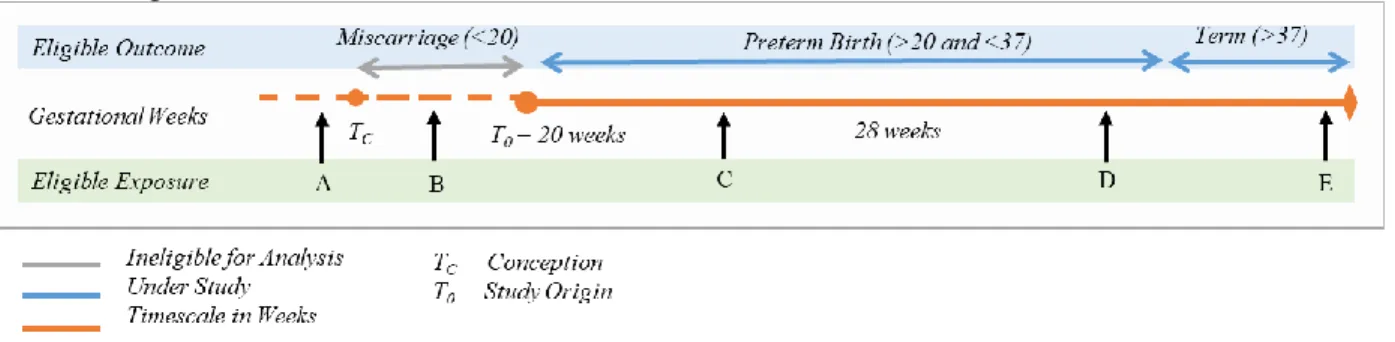
Figure 4.1. Survival analysis framework detailing subject eligibility, exposure and
outcome relative to gestational weeks for Aim 1. ... 42 Figure 4.2. Consort diagram of pregnancies eligible for analysis from the Women
and Infants Transmission Study (WITS). ... 42 Figure 4.3. Unweighted and weighted risks and risk differences for the effect of
ART regimen on (A) preterm delivery and (B) very preterm delivery among pregnancies accounting for time-varying exposure. Unweighted estimates are in lighter shades and weighted estimates are in darker shades, with bootstrapped
95% confidence intervals (N = 1067). ... 46 Figure 4.4. Cumulative incidence curves for delivery among singleton
pregnancies enrolled in WITS between 1996 and 2005 from women living with HIV (aged 15 to 45) by time-varying exposure (N = 1067). Dashed lines appear at
20 and 37 weeks marking the preterm delivery period. ... 47 Figure 4.5. Cumulative incidence curves for delivery among singleton
pregnancies, weighted for baseline viral load and maternal age. ... 47 Figure 5.1. Timing of assessment of study eligibility (enrollment) and exposure
assignment by study type ... 63 Figure 5.2. Consort Diagram for Emulated Target Trial ... 63 Figure A.1. Aim 1 Directed Acyclic Graph for the relationship between PI cART
and preterm birth. ... 73 Figure A.2. Aim 2 Directed Acyclic Graph for the relationship between PI cART
and preterm birth ... 74 Figure C.1. Histogram showing the distribution of gestational age at delivery
among singleton pregnancies enrolled in WITS between 1996 and 2005 from
women living with HIV (aged 15 to 45). ... 76 Figure C.2. Cumulative incidence curve for delivery among singleton pregnancies
enrolled in WITS between 1996 and 2005 from women living with HIV (aged 15 to 45). Dashed lines appear at 20 and 37 weeks marking the preterm delivery
LIST OF ABBREVIATIONS
3TC lamivudine
ART antiretroviral therapy AZT azidothymidine cART combination ART BMI body mass index
CD4 cluster of differentiation 4 CDC Centers for Disease Control
CI confidence interval
DAG directed acyclic graph
ELISA enzyme-linked immunosorbent assay EMM effect measure modification
FDA Federal Drug Administration FDC fixed-dose Combinations GA gestational age
NNRTI non-nucleoside reverse transcriptase inhibitors NRTI nucleoside reverse transcriptase inhibitor NVP nevirapine
PI protease inhibitors PTB preterm birth
RCT randomized control trial RD risk differences
RR risk ratios RNA ribonucleic acid RTV Ritonovir
CHAPTER 1: SPECIFIC AIMS
An increasing number of HIV-infected women of reproductive age are initiating
antiretroviral therapy worldwide. Because of this, the number of women on treatment before and during pregnancy is increasing. Modern HIV treatments, known as highly active antiretroviral therapy (HAART), effectively prevent vertical transmission from mother to child, contributing to a growing population of individuals living without HIV, due to in-utero exposure to antiretroviral drugs. Current research priorities have turned to the effect of treatment initiation timing and length of exposure to certain classes and combinations of antiretroviral drugs that could be associated with preterm birth and other adverse birth outcomes. This study analyzed data from the Women’s Infant Transmission Study (WITS), to further refine our understanding of the possible effect of HIV treatment type on preterm birth (delivery prior to 37 weeks gestation) using revised methodological approaches than those used in the literature.
The WITS cohort is a large, multi-site study of HIV-positive women in pregnancy and their infants collected in the United States from 1988 to 2005, with follow-up ending in 2008. While related questions have been explored using these data in the past, this study proposes a re-analysis of the WITS data for the following reasons:
adjusting for prior preterm birth and inappropriately utilizing binary methods in the context of longitudinally collected observational data. Binary regression methods do not easily
accommodate time-varying exposure, competing risks or censoring, which are common features of pregnancy cohorts. Reanalyzing to estimate preterm birth risk utilizing survival methods or appropriately using binary methods to estimate easily interpretable measures of effect would be more appropriate given the presence of late-entry and time-varying exposure to HIV treatment as well as to facilitate public health action.
To explore the use of alternative epidemiology methods to understand the effect of in-utero exposure to PI-based ART on preterm birth, this dissertation has two aims.
Aim 1: Estimate the effect of ART regimen on risk of preterm birth among HIV-infected pregnant women enrolling after 1996 who initiate treatment after conception and prior to 28 weeks gestation using survival methods. We hypothesize that the effect of PI ART on preterm birth will not be different than that among pregnancies exposed to other combination therapies.
Aim 2: Estimate the causal effect of ART regimen initiated at 20 weeks gestation on risk of preterm birth among HIV-infected pregnant women by emulating a target trial using
observational data. We hypothesize that the effect of PI ART on preterm birth derived from the emulated target trial will not be different than that among pregnancies exposed to other
CHAPTER 2: BACKGROUND
2.1 HIV and Pregnancy in the United States
The public health burden of HIV remains high worldwide, particularly among
reproductive-aged women of color. Of the 34.5 million adults living with HIV globally in 2016, nearly half of the population were women between 16 and 45 years old.4 In that same year, adult and adolescent women comprised approximately 20% of all new HIV diagnoses.5,6 In the United States, HIV incidence among adults has declined overall since treatment and prevention efforts gained momentum starting in the early 1990s. Even so, HIV incidence among Black women of reproductive age is 20 times higher compared to white women - a difference that has not
meaningfully changed from the mid-1980s when HIV was first discovered among women in the United States.6–8 As of 2017, 69% of new HIV cases were Black or Latino, and 19% of new cases were women of reproductive age.9 As a result, women of color are more likely than all other racial groups combined to conceive and give birth while living with HIV.
Pregnant women are a special population within those living with HIV due to the additional risk of transmitting HIV to their infant. The estimated number of women living with HIV who give birth in the United States has increased by 30% between 2000 and 2017.10
acquire HIV in-utero12,13 or in the intrapartum period, and an additional 5-40% will be infected
through breastfeeding. 11,14,15
Health outcomes for pregnant women living with HIV and their children have improved with the introduction of new drugs and interventions since the early 1990s. HIV-testing for pregnant women; HIV treatment provision during pregnancy, delivery and post-partum periods; avoidance of breastfeeding, and elective cesarean section dramatically reduced rates of vertical transmission in the United States from 43.1 per 100,000 births in 1992 to 1.8 per 100,000 births in 2013.16,17 Until 2000, women and clinicians generally decided on an ad hoc basis whether
C-section was appropriate given the overall pregnancy context. If a woman was severely infected with HIV, indicated by a high viral load in her blood, a C-section delivery would avoid the mixing of infected maternal fetal blood during spontaneous vaginal labor, thereby minimizing infant risk of exposure to HIV.18 Similarly, early guidelines advised exclusive formula-feeding to prevent infant exposure to infected breastmilk altogether. Since 2012 however, advances in HIV treatment type, availability and adherence, coupled with improved obstetric care have allowed HIV-positive pregnant women to experience pregnancy, delivery, breastfeeding and post-partum periods normally provided they are able to achieve viral suppression.4,19
2.2 HIV Treatment in Pregnancy
The most significant of these interventions in preventing vertical HIV transmission widespread HIV testing and initiating women on ART during pregnancy.The first Centers for Disease Control (CDC) recommendations on preventing mother-to-child transmission in 1987 recommended that women delay pregnancy and avoid breastfeeding until more is known about the risks of transmission.20 The first HIV antiretroviral therapy discovered was a nucleoside
be effective for 98% of non-pregnant adults through 24 weeks of treatment, however the beneficial effects declined shortly after.21 Even so, the United States Public Health Service recommended antenatal oral administration of ZDV for pregnant women, beginning at 14-34 weeks and continuing throughout pregnancy to prevent vertical transmission.18 It was further recommended that women receive intrapartum intravenous ZDV to suppress viral load during delivery, followed by postnatal oral administration of ZDV to the infant for six weeks after delivery.22 The use of this three-part regimen of ZDV monotherapy rapidly became standard practice. Consequently, vertical transmission risk was reduced by 67.5% in women with CD4 cell counts > 200 cells/mm.22,23
Additional NRTIs were developed and put on the market, however all of them faced similar challenges as ZDV when administered alone.24 When HIV’s highly mutagenic properties were discovered, treatment with one drug caused resistance and eventual inefficacy of treatment. Given the limitations of ZDV monotherapy, the research and clinical communities hypothesized about the possible benefits of treating HIV with more than one drug simultaneously, however more drug development was necessary to test this hypothesis. After the introduction of ZDV in 1987, the next drug to market in 1995 was Saquinavir (SQV), a PI.24 Shortly thereafter,
Nevirapine (NVP), the first of the non-nucleoside reverse transcriptase inhibitors (NNRTI), was approved.24 HIV medications and the year of FDA approval are detailed in Table 2.1.
be the standard of care in 2020.26 After the discovery of HAART in 1996, HIV-positive adults
meeting the recommended CD4 thresholds were advised to initiate or switch to HAART (Table 2.2). Pregnancy treatment guidelines extended from the adult guidelines with modifications, usually based on possible side-effects for the woman or toxicities for the child.27 A considerable amount of evidence demonstrated that early initiation to treatment increased likelihood of
morbidity-free survival and reduction in HIV transmission. In March of 2012, HIV guidelines recommended universal “test and treat”, removing all CD4 eligibility thresholds and encouraging clinicians to initiate treatment upon a HIV diagnosis.4,28 As a result, perinatal transmission rates
in the United States dropped from 42.8 per 100,000 live births in 1991, to 1.3 per 100,000 live births in 2017. 29,30
With the science of mother-to-child HIV prevention now largely established and the worldwide incidence of pediatric HIV on the decline, attention has turned to adverse effects of type and timing ART exposure in pregnancy.31Preterm birth is a primary cause for a host of
short and long-term developmental challenges faced by children.32 If there is indeed a significant association between ART and preterm birth, exploring alternative HIV treatment regimens may prevent adverse birth outcomes for the 270,000 HIV-positive women of reproductive age and their children in the United States alone.9
2.3 ART and Preterm Birth
The etiology of preterm birth is the principle unsolved problem in perinatal medicine. Preterm birth accounts for 75% of perinatal mortality worldwide, and more than half of long-term morbidity of children, including cognitive disability, poor motors skills, behavioral problems, hearing loss, and chronic lung disease.33–36 HIV is known to be associated with
Women living with HIV share other risk factors for preterm birth, like gestational diabetes and gestational hypertension; 3,38 excessive alcohol and drug use;34,36 and smoking cigarettes both prior to and during pregnancy.37 It is clear that the causes of preterm birth are complex, particularly among HIV-positive women.
A growing literature suggests that certain types of ART could cause preterm birth. In 1998, a Swiss group reported an increased risk of preterm birth among women receiving HAART in pregnancy.41 Since then, a multitude of studies examining the relationship between ART and adverse birth outcomes have emerged from all over the world, using surveillance, observational and trial data.35,36,42,43 Risks have been suggested both by regimen type, and timing of HIV initiation as it relates to conception. The protease inhibitor class of drugs has been
commonly implicated in causing preterm birth, both in high- and low- income contexts.44–46 Additionally, preconceptional ART initiation has been suggested to cause preterm birth compared to women initiating ART during pregnancy.47–50
The suggestion that preconceptional exposure to HIV treatment causes preterm birth is “at odds with biology.”51 Findings from the PROMISE trial conducted in several sites
sub-Saharan Africa report that women who initiated any ART combination preconceptionally were more likely to experience preterm birth compared to women who initiate ART during
pregnancy.47,48 Similar results were found in studies conducted in Botswana49 and Ireland.50
conception would therefore reduce, and not increase, the risk of preterm birth.54,55 Even so, it is
possible that certain ART classes – while preventing transmission of HIV - contain inflammatory agents that could cause premature initiation of the labor cascade.38 If treatment for HIV is in fact causing premature delivery in addition to the infection, further study is of urgent importance considering the risks of lifetime disability and death of the child.
Even so, these conclusions could be subject to systematic selection bias making it seem that risk of preterm birth is higher among preconceptional ART users, when in reality, there is no such risk.51,56 While HIV treatment exposure later in pregnancy could be associated with
iatrogenic preterm birth, a study from Spain found that early exposure is not associated with spontaneous preterm birth at all.57 Perhaps most convincing is that treating HIV infection as early as possible will always be better than the alternative because sustained HIV infection is known to not only cause HIV transmission, but also to be strongly associated with preterm birth.54,55 Further comparative evaluations of treatment regimens utilizing appropriate analysis
methods are needed.
2.4 Limitations in the Current Research
conditioning on exposure early in gestation. This makes it appear that those continuing on preconceptional ART have a higher risk of preterm birth in comparison.51 One way to address this type of bias is to include all fetuses at risk of the outcome – independent of initiation timing – in estimating risk.62 By extension, cohort membership is defined by current exposure, however
observational analyses of extant data often inadvertently violate this principle by using “future exposures” to define present, analytic cohort membership inducing both selection bias and possibly immortal person-time.63
Second, inferences can be limited by the use of inappropriate analysis methods. A vast majority of studies examining HIV and preterm birth are prospective or retrospective cohort studies, which utilize logistic regression to estimate odds ratios. Logistic regression assumes that the exposure is consistent across the specified observation period, which is often untrue in these data. In the context of HIV pregnancy, women can initiate treatment at any time during
pregnancy, contributing both exposed and unexposed time to the overall gestational period. Women enrolled in cohort studies also usually have unequal observation times based on when she attends her first prenatal visit and could experience a competing event like miscarriage, which could erroneously exclude her from the risk set (depending on how cohort membership is specified). Time-to-event methods are best suited to deal with time-varying exposure, late-entry and competing risks, but few studies employ these methods to explore the effect of ART on preterm birth.
decision-produced using logistic regression. Odds ratios tend to be commonly understood as risk ratios, even though odds overestimate the true risk.64,65 The margin of overestimation increases as the outcome becomes more common. This is problematic in the context of HIV-positive
pregnancies, given that preterm birth is a relatively common outcome in this population. This is easily addressed by simply choosing a different model to directly estimate risk. Additionally, estimating risk allows the effect to be presented as a risk difference, such that it is easily calculated and understood as the difference in risk between exposures of interest.66
Another way to estimate effects using observational data is to emulate a target trial.67–70
In the most literal sense, a target trial is a hypothetical RCT that we would wish to conduct under ideal circumstances. Thinking about studies in this way offers a useful heuristic to clarify the study design and the corresponding claims of effect we wish to make.67 When emulating a target trial with observational data, the target trial is the RCT we would design with the variables contained within the observational dataset we intend on using, assuming that the dataset contains sufficient information on confounders to approximate baseline randomization.68,69 If the
emulation is successful, the results would be comparable to results from the target trial, had it been conducted. The value in analyzing observational data using the target trial lens lies in the ability to approach causal inference explicitly, as opposed to the implicit (and perhaps informal) attempts at causal analyses using observational data.69
2.5 Conclusion
than that among pregnancies exposed to other combination therapies. The prevailing biological and epidemiological evidence suggests that the benefit of exposure to any combination ART regimen, irrespective of drug class, outweighs the alternatives of not being treated or treatment with monotherapy. Further, the harm conferred by PIs (as suggested by numerous studies) is likely due to methodological flaws in the current literature and not to an inherent pharmacologic quality that initiates premature spontaneous labor onset. For Aim 2, we hypothesize that in the emulated target trial analysis, the effect of PI ART on preterm birth will not be different than that among pregnancies exposed to other combination therapies, but will be protective compared to monotherapy. The emulated target trial uses an intent-to-treat approach by utilizing baseline exposures to estimate the causal risk ratio of the effect of ART on preterm birth.
If ART regimen type is meaningfully associated with preterm birth in the WITS cohort, while utilizing appropriate methods and measures, the findings have the potential to influence the methodological approach of future HIV research. Identifying and demonstrating the use of refined methods to motivate clinical practice and public health action can harmonize methods in the field of HIV and pregnancy. This would allow for comparisons between studies to be
conducted more easily which would ultimately clarify evidence for HIV treatment policies and programs. Preventing preterm birth and other adverse birth outcomes associated with ART can have a major public health impact by reducing infant mortality and morbidity, as well as
2.6 Tables and Figures
Table 2.1. HIV medications by drug class and year of FDA approval from 1987 to 2005 (Drugs no longer in use are listed in italics).47,71
Nucleoside reverse transcriptase inhibitors (NRTIs/NtRTI) Protease Inhibitors (PIs) Non-nucleoside reverse transcriptase inhibitors (NNRTIs) Fixed-dose Combinations (FDC)
ZDV – Zidovudine (1987) ddT – Didanosine (1991) 3TC – Lamivudine (1995) ABC – Abacavir (1998) TDF – Tenofovir (2001) FTC - Emtricitabine (2003)
SQV – Saquinovir (1995) RTV – Ritonovir (1996)* LPV – Lopinovir (2000) ATZ – Atazanavir (2003) FPV - Fosamprenavir (2003)
DRV – Darunavir (2006)
NVP – Nevirapine (1996) EFV – Efavirenz (1998)
2 PIs - LPV/RTV - Kaletra (2000)
3 NRTIs - ABC/3TC/ZDV – Trizivir (2000)
2 NRTIs - TDF+FTC – Truvada (2004) 1 NNRTI + 2 NRTIs - EFV/FTC/TDF – Atripla (2006)
d4T - Stavudine (1994) IDV - Indinivir – (1996)
NFV - Nelfinavir – (1997) APV - Amprenavir – (1999)
DLV - Delavirdine (1997)
Table 2.2 HIV treatment guidelines in the United States for adults and pregnant women from 1994 to 2012.4,18,20
Year Adults > 18 years Pregnant Women
1994 Initiate if CD4 < 200/ml 3-Part ZDV
• Daily oral ZDV (starting 14-34 weeks gestation)
• Intravenous ZDV during labor
• Oral ZDV for infant 6 weeks postpartum
1996 HAART if CD4 <350/ml Treatment Naïve: 3-part ZDV Regimen
Not Treatment Naïve: switch out NNRTI for ZDV if not already part of combination therapy
2000 HAART if CD4 <350/ml or plasma HIV
RNA > 10,000 copies
Treatment Naïve: HAART + 3-part ZDV; can delay initiation until after 12 weeks gestation
Not Treatment Naïve:
• Switch out NNRTI for ZDV if not already part of combination therapy
• Option to stop therapy prior to 12 weeks, and restart after 12 weeks
No treatment during gestation:
• Single dose NVP at labor onset + single dose NVP to baby or;
• Oral ZDV and 3TC during labor + one week of oral ZDV/3TC for newborn or;
• Intravenous ZDV during labor + 6 weeks oral ZDV to newborn or;
• 2-dose NVP with intravenous ZDV during labor + 6 week oral ZDV to newborn
2004 • Initiate if CD4<350 and >200
• For asymptomatic, treatment naïve patients with CD4+ T cell count >350 cells/mm3, consider initiation if viral load is >55,000 copies
No change
2005 No change Treatment Naïve: same as adult guidelines, but avoid EFV/NVP
Not Treatment Naïve:
• After 12 weeks, switch to ZDV-based combination therapy
• Women on NVP-based therapies should be monitored
• Women on EFV-based therapies should be switched No treatment during gestation: 3-part ZDV
2009 Initiate if CD4<500 No change
CHAPTER 3: RESEARCH DESIGNS AND METHODS
3.1 Study Overview
Overall, the objective of the study was to reexamine the methods used to understand the relationship between type of antiretroviral therapy on preterm birth among women living with HIV. We approached this objective in two ways using the Women and Infants Transmission Study (WITS). The first aim analyzed the effect of time-varying exposure to ART on preterm birth using survival methods. This is contrast to the analysis performed by the study team using logistic regression.3 We compared the effect of exposure to combination therapies No Therapy, ZDV monotherapy and NNRTI cART to PI cART initiated in pregnancy on preterm birth among women enrolled from July 31, 1996 to end of enrollment in 2005. The second aim estimated the causal effect of ART regimens on preterm birth among women enrolled in the larger cohort between 1990 and 2005 by emulating a target trial.67 These analyses answer similar research questions but demonstrate the use of two different analysis approaches to make inferences about ART use in pregnancy.
3.2 Parent Study and Study Population
The Women and Infants Transmission Study (WITS) is a US-based, multi-center, prospective, interval cohort designed to study the natural course of maternal-infant HIV-1 infection. Between July 1989 and December 2005, HIV-positive pregnant women between the ages of 15 and 44, were eligible for enrollment on a continuous basis and at any point in
HIV diagnosis confirmation using Western Blot. Pregnancies were then followed-up at
gestational weeks 18±2, 25±2, 34±2 and at delivery, corresponding to visits 1, 2, 3, and 4. Post-partum, both infants and their mothers were followed-up at 4-6 months intervals until study end or they were lost to follow-up. It was possible for the same women to be enrolled more than one time corresponding to multiple pregnancies.
Prospective data collection included structured patient interviews and standardized clinical and laboratory assessments at each study visit. Retrospective data collection consisted of medical record abstraction. Study sites included are hospitals in Boston, MA; Worcester, MA; New York, NY; Houston, TX; San Juan, PR; and Chicago; IL. Informed consent was obtained for all women and infant participants according to each site’s local institutional review board, alongside federal guidelines for research. All prenatal care was at the discretion of the clinician. For the purposes of the proposed study aims, this is most important when understanding the circumstances of treatment decision-making (timing, switching and regimen type, etc.), as well as labor and delivery-related decisions (labor induction, methods of assisted delivery, cesarean-section, etc.). The WITS cohort spanned nearly two decades of changing HIV-treatment guidelines, which also affected treatment decisions made by clinicians with their patients over time. Women pregnant after 1996 were likely eligible for some version of HAART (hereafter referred to as cART), marking a period of relatively less variation in the recommended HIV-treatment for pregnant women, and more comparable to HIV-treatment options available currently.
Inhibitors), our analysis still considers outdated regimens in including ZDV monotherapy. Pregnancies were also excluded if they were exposed to ART at conception; were multiple gestation; ended prior to 20 weeks gestation; and if they enrolled after 28 weeks gestation.
For aim 2, we identified eligible subjects based on articulating the ideal target trial to estimate the causal effect of ART initiated at 20 weeks gestation on preterm birth, and designing our trial emulation sample accordingly. The analysis sample therefore comprised of women enrolled into WITS between 18 and 22 weeks gestation at any time during the study period and whose pregnancies survived to 20 weeks. Further detail on subject typology and exclusion criteria as they relate to pregnancy treatment guidelines are in Table 3.1.
3.4 Gestational Age Assessment
Gestational age (GA) is the underlying measure estimated for each pregnancy at entry, at each study visit, and at delivery. GA and length of pregnancy were calculated according to agreement between last menstrual period (LMP) as reported by the mother and first available ultrasound.72 In cases with disagreement between these two measures, GA was determined using ultrasound only and/or neonatal physical examination.
3.5 Outcome Assessment
Pregnancies can end at any point after conception. The timing of pregnancy termination is a key component in categorizing the type of birth outcome. Loss of the fetus prior to 20 weeks gestation is generally defined as an abortion and can be either spontaneous or elective.
if they occur between 28 weeks 0/7 days and 31 weeks 6/7 days gestation; and late preterm describes births occurring between 32 weeks and 36 weeks 6/7 days.
Preterm birth can occur either spontaneously or due to medical intervention, known as iatrogenic birth. Iatrogenic births are initiated by the clinician in the presence of possible risks to the mother or infant, such as preeclampsia, infection, or abnormal fetal testing. Due to the possible differences in causal pathways between births occurring spontaneously and due to medical intervention, reporting the risk of spontaneous preterm birth only could further clarify the effect of PI cART We have therefore identified only those preterm births that could be affected by ART exposure in pregnancy, either occurring by spontaneous onset of labor or medically indicated delivery due to an underlying condition known to be associated with ART. Women carrying more than one fetus have a higher risk for experiencing a range of pregnancy complications that could lead to poor birth and infant outcomes. Since we are not interested in this particular causal pathway for the proposed analysis, multiple gestation pregnancies were excluded for all aims.
3.6 Exposure Assessment
3.7 Timing of Exposure
For both aims, timing of treatment initiation depended mainly on disease severity
measured by CD4 count and/or viral load at the time. Table 3.1 describes the types of subjects in WITS based on possible treatment plans CD4 thresholds between 1996 and 2005 and timing of initiation. If a woman living with HIV was diagnosed prior to pregnancy, she could have
initiated treatment if she met the disease severity thresholds, being preconceptionally exposed to ART. In contrast, women who were diagnosed with HIV but did not meet the disease severity threshold at the time of diagnosis, or those who were diagnosed in pregnancy were likely to have not been initiated irrespective of CD4 count or viral load. Pregnant women living with HIV could be initiated at any time during pregnancy at the discretion of her clinician. Only women starting HIV treatment in pregnancy were analyzed in this study.
While the exact date of initiation and date of conception are unknown in these data, we assumed that that women initiating HIV treatment prior to enrollment in WITS were on
treatment while conceiving. Women who were exposed to ART in pregnancy without evidence of having been exposed prior to enrollment were assumed to have been unexposed to ART at conception and were included in the analysis for both aims (Types 3, 4 and 5 in Table 3.1). Table 3.1 describes the possible scenarios of treatment initiation, given the CD4 thresholds for
initiation at the time, the data that are available, and the assumptions we made to categorize initiation time. Exposure was considered time-varying for Aim 1, and baseline exposure was carried throughout gestation to delivery, approaching an intention-to-treat analysis for Aim 2.
3.8 Regimen Types
The proposed analysis focuses on the effect of PI-based ART compared to other
consistent with the introduction of novel ART regimens in the mid-1990s. For Aim 1, we defined exposure using data collected at each study visit, based on both patient recall and medical record abstraction. Each study drug was entered into the database with a start date and stop date. These times were converted into “time since enrollment” values. We then
reconstructed multi-drug, combination regimens using the start and stop dates to define our study exposures. If a pregnancy were exposed to a regimen for less than two weeks, it was discarded and the regimens on either side of this <2 week window split the difference. Because the
purpose of WITS was to study the natural course of HIV in pregnancy in the context of changing therapy guidelines, we thought it safe to assume that no drug data meant that the woman was unexposed to treatment; not that treatment data were missing.
Therefore, pregnancies exposed to at least one PI with at least two NRTIs were
trial were identical to that defined for Aim 1 – No Therapy, PI cART, ZDV monotherapy and NNRTI cART.
3.9 Covariate Assessment
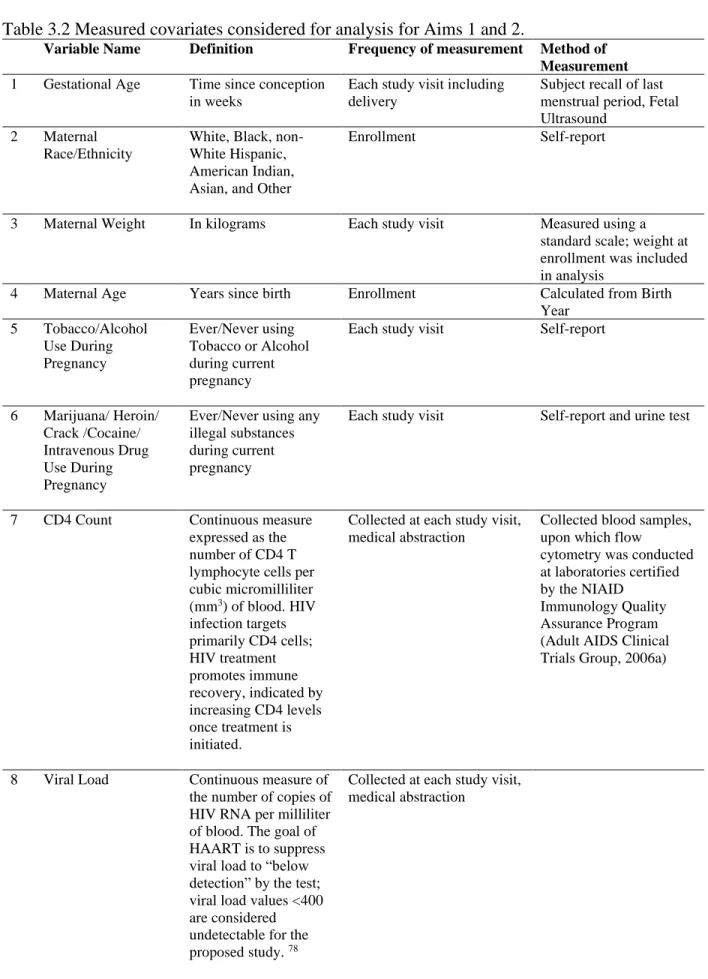
Covariates detailed in Table 3.2 were measured during study follow up and will be considered in estimating effects in the proposed analyses. Because this dataset is publicly available, certain variables have been recategorized or omitted to protect subject privacy, especially since so few infants were born with HIV in the later years of the study. Therefore, study site has been removed entirely from the dataset, and exact year of birth has been categorized as “1996+” for all births occurring 1996 and onward. Other potentially relevant variables, such as maternal educational attainment and insurance status were collected but not included in the cleaned WITS analysis datasets. Additional covariates relevant to specific aims are described in the corresponding sections below. The causal pathway for each aim is described using a causal diagram represented as a directed acyclic graph (DAG) in Appendix A. Covariates determined to be part of the minimally sufficient adjustment set were included in the final effect estimates.
• Functional Form Assessment of continuous variables: We used restricted quadratic
splines with four equally placed knots for all continuous variables for the final adjusted models.
• Effect Measure Modification (EMM): EMM will not be considered for either analysis
aim.
• Missingness: We assessed whether missing values of covariates are conditional on either
or inverse probability weights were used to account for these missing data, depending on the analysis model used for the primary analysis. If analysis showed there was systematic missingness in the data, we conducted sensitivity analyses to assess if the missingness posed a material threat to the study findings. This is described in further detail by aim in the following sections.
3.10 Aim 1 Statistical Analysis
First, we summarized important maternal baseline characteristics. We the estimated the unweighted and weighted cumulative incidence and risk differences (RD) of preterm birth at 37 weeks using the complement of the Kaplan-Meier estimator given exposure to a category of HIV treatment (Formula 1). Inferences are conditional on survival to 20 weeks gestation. The origin for each pregnancy was the date of enrollment or the date of first treatment in pregnancy, whichever occurred first, and the timescale was gestational weeks until end of
pregnancy/delivery. There was no right censoring or loss to follow up because all pregnancies were followed until pregnancy end.
Formula 1: Kaplan-Meier estimator for cumulative incidence
𝐹̂𝐾𝑀(𝑡| 𝐻𝐼𝑉 𝑇𝑟𝑒𝑎𝑡𝑚𝑒𝑛𝑡 = 𝑧) = 1 − ∏ {1 −𝑑𝑘(𝑧) 𝑛𝑘(𝑧)} 𝑘:𝑅𝑘≤𝑡
𝐹̂𝐾𝑀 is risk of preterm birth as estimated by the complement of the Kaplan-Meier estimator. t is a given time; Rk is a time when at least one birth occurred;
switching is handled by censoring a pregnancy at the time of treatment switching; the
observation time then moves to the treatment to which she switched. To estimate the risk and risk difference of PI cART compared to both no treatment, ZDV monotherapy and NNRTI cART, we used the cumulative incidence at 37 weeks, 32 weeks and 28 weeks to calculate absolute risk differences, using PI cART as the common reference. Weighted estimates reflected the changing treatment regimens over gestation and to produce a visual representation of the changing risk over time, accounting for confounding. The visual representation of the weighted risk curve is the counterfactual scenario had pregnancies been exposed to one treatment
throughout gestation.
We used stabilized IPW to control for confounding. If confounders had missing values, we identified important predictors of missingness and included them in a pooled logistic regression model with missinginess as the outcome. We then used the resulting model parameters to generate a stabilized IPW for missingness. This missingness weight was then applied to a multinomial logistic regression model (the propensity score model) to generate a stabilized IPW for the confounder with missing values. If a confounder did not have missing values, we directly estimated stabilized IPW for treatment using a similar propensity score model as described previously. The final analysis weight was the product of the missingness and
treatment weights.
Since we utilized nonparametric methods to estimate risk, we generated 95% confidence intervals for risk and risk difference estimates using 200 bootstrapped samples (with
randomly choose one pregnancy for inclusion into the analysis sample if a woman contributed more than one eligible pregnancy to see if the effect estimates materially changed.
3.11 Aim 2 Statistical Analysis
To estimate causal effects, we designed our analysis for the emulated trial to be comparable to that to the target trial. We first summarized maternal baseline characteristics stratified by exposure group. We then used a log-Poisson model to approximate the log-binomial model in order to estimate risk ratios (RR) for the effect of ART on preterm birth, for both the conditional and unconditional analyses (Formula 2).73 A Poisson model was used because the adjusted log-binomial model failed to converge.74 Generalized estimating equations (GEE) with an exchangeable correlation matrix were used to generate 95% confidence intervals. We
accounted for confounding by including important baseline confounders to emulate randomization in the statistical model.
Formula 2: Poisson regression model
𝑙𝑜𝑔𝑃(Preterm Birth = 1) = α + 𝛽1(𝐴𝑅𝑇 𝐸𝑥𝑝𝑜𝑠𝑢𝑟𝑒) + 𝛽2𝑋2
Where X is a matrix of potential covariates in the final adjustment set.
outcome data, there were several baseline confounders we included in our multivariate models which had missing values and a complete case analysis would dispense of more than 50% of the sample. We therefore used MI for each analysis separately to impute missing covariate values.75 We used fixed chain equations and included predictors of missing values that were used in the analytic models for the main effect, as well as auxiliary variables to improve the overall fit of the imputation model.76 We then generated 30 imputed datasets for each analysis and ran the
3.12 Tables and Figures
Table 3.1. Subject Typology based on CD4 thresholds, and timing of treatment initiation, 1996 to 2005.
Type Pregnancy-related Treatment
Initiation Description
Conception (0 weeks)
1st Trimester (18±2 weeks)
2nd Trimester
(25±2 weeks)
3rd Trimester
(34±2 weeks)
Delivery (Any time)
Pre-Enrollment Visit 1 Visit 2 Visit 3 Delivery
1 Preconceptional User (EXCLUDED) Likely initiated prior to conception, with CD4 < 200 or 350
✓ ✓ [✓] [✓] [✓]
2 Preconceptional User (EXCLUDED) Likely initiated prior to conception, with CD4 < 200 or 350
[✓] o ✓ [✓] [✓]
3
New Initiator (ART Unexposed at Conception)
Initiated before 28w irrespective of CD4
o ✓ [✓] [✓] [✓]
4
New Initiator (ART Unexposed at Conception)
Initiated before 28w irrespective of CD4
o o ✓ [✓] [✓]
5
New Initiator (ART Unexposed at Conception) Initiated after 28w irrespective of CD4 - o or -
o ✓ [✓]
6 No ART during pregnancy
No ART or Prophylaxis only, likely missed/ asymptomat ic
- - - o ✓
Table 3.2 Measured covariates considered for analysis for Aims 1 and 2.
Variable Name Definition Frequency of measurement Method of
Measurement
1 Gestational Age Time since conception in weeks
Each study visit including delivery
Subject recall of last menstrual period, Fetal Ultrasound
2 Maternal Race/Ethnicity
White, Black, non-White Hispanic, American Indian, Asian, and Other
Enrollment Self-report
3 Maternal Weight In kilograms Each study visit Measured using a standard scale; weight at enrollment was included in analysis
4 Maternal Age Years since birth Enrollment Calculated from Birth Year
5 Tobacco/Alcohol Use During Pregnancy
Ever/Never using Tobacco or Alcohol during current pregnancy
Each study visit Self-report
6 Marijuana/ Heroin/ Crack /Cocaine/ Intravenous Drug Use During Pregnancy
Ever/Never using any illegal substances during current pregnancy
Each study visit Self-report and urine test
7 CD4 Count Continuous measure expressed as the number of CD4 T lymphocyte cells per cubic micromilliliter (mm3) of blood. HIV infection targets primarily CD4 cells; HIV treatment promotes immune recovery, indicated by increasing CD4 levels once treatment is initiated.
Collected at each study visit, medical abstraction
Collected blood samples, upon which flow
cytometry was conducted at laboratories certified by the NIAID
Immunology Quality Assurance Program (Adult AIDS Clinical Trials Group, 2006a)
8 Viral Load Continuous measure of the number of copies of HIV RNA per milliliter of blood. The goal of HAART is to suppress viral load to “below detection” by the test; viral load values <400 are considered undetectable for the proposed study. 78
9 Diabetes During Pregnancy
Categorical, Yes/No Confirmed at last visit prior to delivery, corresponding to 28 or 34 week visit
Measured by glucose tolerance test.
10 AIDS-defining illness during pregnancy
Categorical, Yes/No Collected at each study visit, medical abstraction
11 Hypertension During Pregnancy
Categorical, Yes/No Confirmed at last visit prior to delivery, corresponding to 25 or 34 week visit
Blood pressure reading in excess of 140/90 mm Hg and either a blood test/ urine analysis/ fetal ultrasound/ nonstress test confirming
pre-eclampsia.
12 Infection During Pregnancy (trichomonas/ bacterial vaginosis)
Categorical, Yes/No Collected at each study visit Standardized laboratory testing to determine whether woman was infected with bacterial vaginosis, trichomonas, or syphilis.
13 Cohort time Describes the time during which the pregnancy occurred during follow-up, categorized into the following: prior to 2/28/1994; 3/1/1994 to 7/31/1996; and after 7/31/1996
corresponding to HIV treatment eras.
CHAPTER 4: AIM 1 - PROTEASE INHIBITOR-CONTAINING ART REGIMENS AND PRETERM BIRTH: A REEXAMINATION USING SURVIVAL ANALYSIS METHODS
4.1 Introduction
Worldwide, preterm birth is associated with 75% of perinatal mortality and more than half of long-term morbidity of children, including cognitive disability, poor motor skills,
behavioral problems, hearing loss and chronic lung disease.33–36 The causes of preterm birth are
complex, particularly among women living with HIV. Women living with HIV in the United States are at high risk for preterm birth (PTB) not only due to HIV infection itself,79 but also because they experience other preterm birth risk factors like gestational diabetes and gestational hypertension; 3,38 alcohol and drug use;37,39 and smoking cigarettes both prior to and during pregnancy at higher rates than women without HIV infection.40
An increasing number of HIV-infected women of reproductive age are initiating antiretroviral therapy (ART) worldwide. Because of this, the number of women on treatment before and during pregnancy is increasing.37,80 Antiretroviral therapy (ART) significantly reduces the risk of HIV transmission from mother to child, however several studies suggest that ART can cause preterm birth.48,81 Understanding the possible consequences of HIV treatment on
preterm birth is therefore of urgent importance in the growing population of reproductive-aged women living with HIV.
Reconciling these conflicting findings has been a research challenge over the past decade. Controlling HIV infection through ART minimizes the inflammatory response to systemic infection, thereby lowering preterm birth risk.86,87 Use of ART in pregnancy would therefore be expected to reduce, rather than increase, the risk of preterm birth.54,55 Even so, it is possible that certain ART drugs – while preventing transmission of HIV – induce inflammation through immune reconstitution that could cause premature initiation of the labor cascade.38 There is
evidence that Lopinavir and Nelfinavir – both PIs – show declining bioavailability in the third trimester compared to levels prior to pregnancy.88,89 This means that viral suppression may not
be maintained in later gestational weeks, and could cause a reemergence of infection-associated inflammation and the accompanying risk of preterm labor onset.90 PIs are also associated with adrenal dysfunction and metabolic disturbances (i.e. diabetes, hyperglycemia) in pregnant women, which are also associated with preterm birth.91–93
Studies showing PI-based regimens to be harmful may not have sufficiently accounted for confounding by indication, given that PI-based regimens were often reserved for individuals with more severe disease.94,95 Another explanation for the discrepancies could be the
facets of observational pregnancy cohorts. We estimated the risk of preterm birth by ART regimen using the complement of the Kaplan-Meier estimator which accommodates treatments that change during observation (time-varying exposure). Given that these data are derived from an observational context, the use of survival analysis methods also allows us to account for late entry into the cohort and to examine the changing risk of birth over the entire gestational period by exposure to offer further context pertaining to the reported differential effects of PI ART compared to other regimens on preterm birth.
4.2 Methods
We used publicly available data from the Women and Infant Transmission Study
(WITS). WITS was a US-based, multi-center, prospective, interval cohort designed to study the natural course of maternal-infant HIV-1 infection between 1990 and 2005. 1,2 Prospective data collection included structured patient interviews and standardized clinical and laboratory assessments at each study visit. Retrospective data collection consisted of medical record
abstraction. WITS study sites were hospitals located in Boston, MA; Worcester, MA; New York, NY; Houston, TX; San Juan, PR; and Chicago, IL. The entire study population was confirmed to be HIV positive at the enrollment visit. Participants were tested using enzyme-linked
While questions pertaining to the association of ART and preterm birth have been
previously explored in WITS,2 this study differs from past work in the following ways: First, we estimate risk differences of preterm birth by exposure while accommodating late-entry into the cohort and time-varying exposure by utilizing survival (time-to-event) methods instead of conventional binary methods (e.g., logistic or log-binomial regression). Binary methods are useful when both the observation time and exposure plans are known and fixed. Observational settings are by definition non-interventional, meaning the observation time and exposure plans are both variable. In such settings, survival methods flexibly accommodate late-entry, time-varying exposure and censoring, while binary methods do not account for these elements as easily. Survival methods also provide additional context that is often lacking in the available literature describing ART and birth outcomes by visualizing events over time. Second, we analyze a subset of WITS pregnancies occurring between 1996 and 2005 i.e. in the era of combination regimens known as highly-active antiretroviral therapy. Restricting the analysis to the current treatment era facilitates the results to be more relevant in the current clinical context. (We will refer to combination regimens in this paper as cART.) Third, we utilize a causal diagram97 to guide final covariate adjustment to facilitate interpretation of results based on substantive evidence, in contrast to stepwise covariate elimination or other related, statistics-driven methods.
4.3 Study Population
the assumption that those unexposed at enrollment were likely unexposed to ART at the time of conception. Gestational age (GA) was estimated for each pregnancy at entry, at each study visit, and at delivery. GA and length of pregnancy were calculated according to agreement between last menstrual period (LMP) as reported by the mother and first available ultrasound.72 In cases of disagreement between these two measures, GA was determined using ultrasound only and/or neonatal physical examination.
4.4 Outcome Classification
Pregnancies ending in either live birth or stillbirth (hereafter referred to as “birth” or “delivery”) between 20 weeks and 36 6/7 weeks were considered preterm. We included stillbirths in the outcome of interest because it is an adverse outcome that could plausibly be caused by ART exposures. All stillbirths in the analytical sample occurred prior to 37 weeks gestation. Secondary outcomes of interest were very preterm birth (< 32 weeks) and extremely preterm birth (<28 weeks).98 Births occurring on or after 37 weeks were considered term.
4.5 Exposure and Confounder Classification
ART exposures considered in this analysis are regimens comprised of either a single drug or combination of drugs drug classes prescribed at a given time. Exposure regimens considered in this study are PIs; nucleoside reverse transcriptase inhibitors (NRTIs); and non-nucleoside reverse transcriptase inhibitors (NNRTIs). Exposure categories are defined as the following four mutually exclusive groups: no therapy, Zidovudine (ZDV) monotherapy; PI-based cART; NNRTI-based cART; and “mixed” therapies defined as including both PIs and NNRTIs
prescribed concurrently. ZDV monotherapy was the standard of care for pregnant women during the investigated timeframe and was often prescribed concurrently with cART.22 When both ZDV
and cART were prescribed together, women were categorized as exposed to cART. (Appendix B).
enrollment, corresponding to either the 12- or 24-week appointment. Baseline viral load and maternal age were modeled continuously as restricted quadratic splines with four equal knots.100
We used a DAG to identify a minimally sufficient adjustment set of confounders. The final adjustment set included access to prenatal care, baseline viral load, baseline maternal age, AIDS-defining illness and study site. These confounders are accounted for through restriction (access to prenatal care) and standardization (baseline viral load and maternal age). Only three pregnancies had an AIDS-defining illness so this confounder was removed from the adjustment set. Study site was also not considered in the analysis because this variable was removed from public-use dataset to preserve the confidentiality of study participants. Prior preterm birth is often adjusted for in analyses of exposures and preterm birth but we excluded this from the DAG.101 Prior preterm birth is a proxy for other underlying biological factors causing preterm birth, but prior preterm birth itself is unlikely to have a causal link to the exposure of interest or timing of delivery.
4.6 Statistical Methods
We used inverse-probability-of-exposure weighted risk curves using the complement of the Kaplan-Meier estimator to estimate cumulative incidence and risk differences of preterm delivery by time-varying exposure. PI cART was the reference group for all risk difference measures. In these analyses, each pregnancy was followed from the week of enrollment until the week of delivery. There was no right-censoring or lost-to-follow up because all pregnancies were followed until the end of pregnancy.
maternal age at enrollment, baseline ART, race/ethnicity and gestational age at study entry as predictors. We calculated treatment weights for viral load and maternal age using pooled multinomial logistic regression. The missingness weight was included in the treatment weight calculation for viral load. The final analysis weight was the product of the IPWs for missing baseline viral load, confounding by viral load and confounding by maternal age. We accounted for tied event times using the exact method. Confidence intervals for risk differences were calculated using the standard deviation from a bootstrap of 200 samples (with replacement) from the observed data.
Pregnancies were allowed to switch exposure categories in gestation. In the crude Kaplan-Meier context, the pregnancy was censored at each point of exposure-switching and continued on another curve corresponding to the new exposure. The weighted time-varying exposure Kaplan-Meier risk curves illustrate the counterfactual scenario had pregnancies been exposed to only one treatment from enrollment to delivery, accounting for measured
confounding using weights. Exposure contrasts comparing regimens containing both PIs and NNRTIs (“mixed therapies”) to regimens of interest are not reported in this paper since it is a highly heterogeneous exposure group, and comparisons to it are not useful to future policy. We were unable to exclude pregnancies exposed to mixed therapies entirely. Several pregnancies were exposed to both mixed therapies and exposures of interest, and it was necessary to account for all changing treatment plans in the time-varying exposure analysis.
contributing more than one pregnancy to the analysis sample. We also excluded pregnancies with missing singleton status.
4.7 Results
Of the 3,297 pregnancies included in the WITS parent study, 1,270 were excluded because they were enrolled prior to 1996. Among the remaining pregnancies, 48 were excluded because they were multiple gestation, 765 were excluded because the pregnancy ended prior to 20 weeks gestation or were enrolled after 28 weeks gestation, and 147 were excluded because the pregnancies were exposed to ART at conception. Therefore, a total of 1,067 HIV-positive
pregnancies in 932 women were followed until delivery (Figure 4.2).
Enrollment in the WITS analysis sample occurred between 12 and 21 weeks gestation (median 17 weeks).Approximately 42% of women included in the analysis sample were Black (N = 446) and a third were Hispanic (N = 359). Fifty-three percent of women were between the ages of 25 and 34 (N =569), and the median BMI at enrollment was 26.9. Drug and alcohol use in pregnancy was common in this population, with 31% reporting use of cigarettes (N=329), 20% reporting alcohol consumption (N = 213) and 20% using hard drugs (N = 211). (Table 4.1).
Twenty-four per cent of pregnancies had viral load <400 copies/ml3 indicating viral suppression at enrollment (N = 236). All pregnancies were unexposed to ART at conception, of which over half remained on no therapy beyond the enrollment visit (N = 545). At the enrollment visit, 22% of pregnancies were prescribed PI cART (N = 232), 20% were started on ZDV
monotherapy (N = 216) and 3% were prescribed NNRTI cART (n = 32). Total observed gestational weeks contributing to effect estimates for PI cART was more than seven times that for NNRTI cART (6778 weeks versus 940 weeks). By the end of follow-up, 29% of pregnancies had switched treatment regimens at least once (Table 4.1). Thirteen percent of deliveries
gestational age at delivery was 38 weeks, and 18% were delivered prior to 37 weeks (N = 192) (Figure C.2).
As expected, risk of preterm birth (<37 weeks) was highest among pregnancies exposed to no therapy (risk: 23%; 95% CI: 19%, 26%). After adjusting for confounding, the risk of preterm birth was comparable between no therapy and ZDV monotherapy at approximately 20%, followed by PI cART at 17% and NNRTI cART at 7% (Table 4.2 and Figure 4.3A). The
unweighted preterm birth risk for NNRTI cART was 12 percentage points lower than that for PI cART (RD: -12%; 95% CI: -18%, -6%). After applying inverse probability weights to correct for missing data and confounding, the difference was attenuated slightly to 10 percentage points (RD: -10%; 95% CI: -21%, 2%), though the confidence interval remained wide and included the null value (Table 4.2 and Figure 4.3A). We found there to be no meaningful difference in risk of preterm birth between PI cART and ZDV monotherapy in either the unweighted [RD: 0%; 95% CI: -3%, 4%] or weighted [RD: 3%; 95% CI: -2%, 8%] estimates.
(Figure 4.5) stratified by exposure show separation between 20- and 35-weeks with no therapy and ZDV monotherapy exposures showing a higher proportion of deliveries in earlier gestational weeks than both cART regimens. While PI cART risk curve is higher than the NNRTI cART curve throughout gestation, the curves cross at week 34.
None of the above results were materially changed by restricting the sample to a single pregnancy per woman in sensitivity analyses. Thirty-six pregnancies had missing data
confirming singleton status (3.4%), but including them did not significantly affect risk estimates either. Results from the sensitivity analyses are shown in Appendix C.
4.8 Discussion
As expected, combination ART therapies are not associated with increased risk of preterm birth compared to ZDV monotherapy, as presented in the original WITS publication.3 The effect estimates for very preterm birth and the risk curves produced by the complement of the Kaplan-Meier estimator confirm that suppressive regimens confer protection against preterm births at lower gestational ages in contrast to pregnancies exposed to monotherapy and no treatment, and continue to have a protective effect throughout gestation. Non-suppressive regimens are no longer prescribed or clinically relevant due to evolving HIV treatment guidelines.102
Results presented in Figure 4.3 suggest that PI cART, while protective overall compared to no ART, is relatively harmful when compared to NNRTI cART, consistent with several other studies.59,95,102,103 However, Figure 4.5 shows the weighted risk curves crossing between 32 and
sample size of NNRTI-exposed pregnancies. Having small sample sizes of NNRTI-exposed pregnancies compared to PI-exposed pregnancies is common among observational pregnancy cohorts, further lending to the challenges in understanding the comparative risk of preterm birth between PI- and non-PI- containing regimens.59,104,105
The numerous studies implicating PI cART utilized binary regression to report odds ratios or risk ratios at gestational weeks consistent with conventional delivery-timing classification at 28-, 32- and 37 weeks. Because our study employs non-parametric survival methods to estimate risk, we are able to report risk both in terms of delivery-timing
classifications, and as a dynamic risk function by exposure over time as shown in Figures 4.4 and 4.5. The risk curves support better interpretation of risk over time, apart from the rigid preterm birth classifications. In our study, cumulative incidence of preterm delivery at 37 weeks among PI cART-exposed pregnancies was higher than those exposed to NNRTI cART, but NNRTI cART risk estimates had undesirably wide confidence intervals containing the null value. This is likely because pregnancies exposed to NNRTI cART contributed the least number of person-weeks to the overall time at risk for delivery and only two births occurred during NNRTI cART exposure. At the time of the study, PI-based regimens were more frequently prescribed than NNRTI- regimens because there were far more PI drugs approved by the Federal Drug Administration.