Original Research Article
Evaluation of acute physiology and chronic health evaluation IV
predictive scoring as mortality predictor among
individual with cholangitis
Muhammad Yusuf
1, Nurhayat Usman
2, Reno Rudiman
2, Muhammad Bayu Z. Hutagalung
3*
INTRODUCTION
Acute cholangitis is an emergency case cause by acute inflammation and infection in relation with biliary tract obstruction. In 1980, mortality rate of patients with cholangitis reported >50% and became 2.7-10% in last ten years. As a major cause, gallstones are common and mostly asymptomatic. In The United States more than 20 million people have gallstones and 500 thousand underwent cholecystectomy each year. Incidence in Asia
is range from 10 -15%, mostly in East Asia such as Japan where the incidence has doubled since 1940.1-4
As the incidence of gallstones growing in each year the number of cholangitis cases also increased each year as its complication. Neglected cholangitis triggers sepsis and septic shock with multiple organ failures resulting to the death. The severity of cholangitis is divided into mild, moderate or severe conditions based on Tokyo guidelines 2013.1,2
1Digestive Surgery Division, Department of Surgery, Faculty of Medicine, Syiah Kuala University/Dr. Zainoel Abidin
Hospital, Banda Aceh, Aceh, Indonesia
2Digestive Surgery Division, Department of Surgery, Faculty of Medicine, Padjadjaran University/Hasan Sadikin
Hospital, Bandung, West Java, Indonesia
3Department of Surgery, Faculty of Medicine, Syiah Kuala University/Dr. Zainoel Abidin Hospital, Banda Aceh,
Aceh, Indonesia
Received: 30 December 2017
Accepted: 27 January 2018
*Correspondence:
Dr. Muhammad Bayu Z. Hutagalung, E-mail: [email protected]
Copyright: © the author(s), publisher and licensee Medip Academy. This is an open-access article distributed under the terms of the Creative Commons Attribution Non-Commercial License, which permits unrestricted non-commercial use, distribution, and reproduction in any medium, provided the original work is properly cited.
ABSTRACT
Background: Evaluation of the effectiveness of care and clinical outcomes in critically ill patients is dependent on predictive scoring models that calculate measures of disease severity and mortality. Cholangitis is an infection and obstruction of the biliary system. The APACHE IV scoring system is a logistic regression model incorporating physiologic and laboratory parameters. APACHE IV is the most updated scoring system for Intensive Care Unit (ICU) mortality prediction.
Methods: A cohort study with 65 cholangitis patient that fulfilled diagnostic criteria of Tokyo guideline 2013 was included. The APACHE IV score was assessed during first day admission to ICU. APACHE IV score and predicted mortality rate was calculated and evaluated using the area under the ROC curve (AUROC).
Results: Overall in-hospital mortality was 26.2 %. The APACHE IV score mean was 76.7 with the highest score was
133 point. AUROC of the APACHE IV score was 0.97 with the cut point of 0.87, 95% CI (0.94, 0.91) indicating good performance in this cohort.
Conclusions: APACHE IV scoring system has good discrimination in the prediction of mortality models for cholangitis patients.
Keywords: Cholangitis, Infection, Outcomes, Prognostic scoring
There are many scoring systems used to predict the prognosis of patients with sepsis, especially in Intensive Care Unit (ICU) such as Sequential Organ Failure Assessment (SOFA), Simplified Acute Physiology Score (SAPS), Acute Physiology and Chronic Health (APACHE), Mortality Probably Model (MPM) and others. The APACHE IV scoring system has been widely used to assess the severity of illness and mortality of critical patients in ICU. The APACHE IV scoring system has shown good accuracy to assess the severity of illness and mortality of critical patients in ICU. Some studies have conducted to determine the ability of APACHE IV score in predicting the prognosis of critical patients.5,6
METHODS
A cohort study was conducted in Hasan Sadikin Hospital, Bandung, Indonesia during January 2015-September 2016. The subjects were cholangitis patients diagnosed according to Tokyo guidelines 2013 with age >16 years old without previous treatment from other health facilities The APACHE IV scoring system used to assess the severity of each case in the first day admission to Intensive Care Unit (ICU).
Data collected in this study consists of age, gender, temperature, Mean Arterial Pressure (MAP), heart rate, respiratory rate, GCS, urine output, hematocrit, leukocytes, albumin, bilirubin, blood glucose, sodium, ureum, creatine, FiO2, pH, PO2, PCO2 and APACHE IV score as predictive component for assessing mortality rate among cholangitis patients. Based on diagnostic criteria of acute cholangitis from Tokyo guideline 2013, the patients classified into: mild, moderate and severe acute cholangitis.
Descriptive statistics are presented as medians and interquartile ranges, or as numbers with percentages. A univariate logistic regression analysis was performed to evaluate any associations between various risk factors and hospital mortality. Discrimination is defined as the power to distinguish between survivors and non-survivors, and this was evaluated by receiver operating characteristic (ROC) analysis.
RESULTS
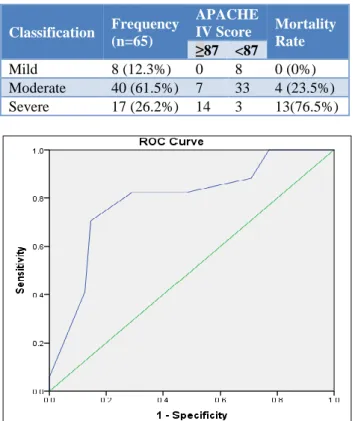
A total 65 patients included in this study. The number of female patients were greater than groups with comparison 43 females and 22 males. The mean age of patient was 49.03±1.498 with range from 17 to 79 years old. The gallstone became the most common etiology of cholangitis 39 cases (60%). The mean APACHE IV score in this study was 76.708±2.57 with range between 45 to 133 points. The prognosis showed 48 cases (73.8%) recovery among acute cholangitis patients. The patient characteristic in this study showed in Table 1. Based on Tokyo guidelines 2013, the severity of each cases is classified into severe cases 17 patients (26.2%), moderate severity cases 40 patients (61.5%) and mild cases 8
patients (12,3 %). The severity of cholangitis and APACHE IV score was classified in Table 2.
Table 1: Patients characteristic.
Gender Frequency (n=65)
Male 22 (33.8%)
Female 43 (66.2%)
Age
Mean±SD 49.03±1.498
Median 50
Range 17-79
Etiolgy
Gallstone 39 (60%)
Tumor 25 (38.5%)
Congenital 1 (1.5%)
Severity
Mild 8 (12.3%)
Moderate 40 (61.5%) Severe 17 (26.2%)
Apache IV score
Mean±SD 76.708±2.57
Median 73
Range 45-133
Prognosis
Recover 48 (73.8%) Mortality 17 (26.2%)
Table 2: Cholangitis severity and APACHE IV score.
Classification Frequency (n=65)
APACHE
IV Score Mortality Rate
≥87 <87
Mild 8 (12.3%) 0 8 0 (0%) Moderate 40 (61.5%) 7 33 4 (23.5%) Severe 17 (26.2%) 14 3 13(76.5%)
The model of predictive, calibration and accuracy of APACHE IV score as mortality prediction tool was assessed using Hosmer-Lemeshow test showed P-value =1.000 with 100% predictive score. Nagelkerke R square test showed significant value of age, gender, temperature, Mean Arterial Pressure (MAP), heart rate, respiratory rate, GCS, urine output, hematocrit, leukocytes, albumin, bilirubin, blood glucose, sodium, ureum, creatine, FiO2, pH, PO2, PCO2 and APACHE IV score as predictive component for assessing mortality rate among cholangitis patients. Statical analysis of Receiver Operating Characteristic (ROC) showed APACHE IV score 0.87 became the cut-off point for mortality predictor with sensitivity 94.1% and specificity 91.7% (Figure 1).
DISCUSSION
The incidence of cholangitis at Hasan Sadikin Hospital Bandung ranges from 70-80 cases per year, with the mortality rate 27%. Gallstones are the major cause of cholangitis ranging from 20-70%, followed by benign stenosis 5-28%, malignancy 10-57%, iatrogenic 18%. As a major cause, gallstones are common and mostly asymptomatic. In The United States >20 million people have gallstones and 500 thousand underwent cholecystectomy each year. The Incidence rate of gallstone in Asia is range from 10-15%. In Indonesia, there is no exact data on the incidence rate but it is expected to follow the pattern in Asia. As the incidence of gallstones increased every year the number of cholangitis as the complication cases also increased each year. Neglected case of acute cholangitis will develop into sepsis and septic shock will induced multiple organ failures resulting to the death.1-4
There are several scoring systems used to assess the mortality and prognosis of patients with sepsis or other infection disease such as Simplified Acute Physiology Score (SAPS), Sequential Organ Failure Assessment (SOFA), Mortality Probably Model (MPM) and Acute Physiology and Chronic Health (APACHE). The APACHE scoring system is one of the most widely used scoring systems to assess sepsis and its related prognosis. The first APACHE score system developed in 1981 and it been developed and improved to APACHE IV scoring system has been in 2004.5,6
The use of APACHE IV scoring system to assess prognosis and mortality among patients with acute cholangitis has never been used before. This study aims to assessed the use of APACHE IV scoring system as mortality and prognosis predictor among patients with acute cholangitis. In this study, age of patients included range from 17 to 79 years old, with an average of 49.03±12.077 (Table 1). Some studies showed that the highest incidence cholangitis is in the mid-40 to 60 years of age, which is consistent with our study. The age of 79 years old is the oldest age and exceeds the limits categorized as a parameter of cholangitis in according to Tokyo guidelines 2013, with age above 75 years as a
determinant of cholangitis severity. Research conducted by Scheineider J et al, in Germany showed the average age is 68, with range from 24 to 97 years old. While study from Ito T et al, in Asia in 2016, the average age in patients with cholangitis was 68.76±14.58.7-9
In this study, the incidence of cholangitis in females was higher 43 patients (66.2%) compared with male 22 patients (33.8%). Although this is inconsistent with the incidence of Tokyo guidelines 2013 which states the incidence of cholangitis between male and female is the same. It is estimated that in Indonesia region especially Bandung City the number of gallstone case as the most common etiology of cholangitis was higher in a woman. A study by Ito T et al showed a greater incidence in the female with 31:28 with mean age 68.76±14.58. Another study by Allam H et al in 2016 showed different results in which higher incidence of cholangitis in male 39 cases (55.7%) than women 14 cases (33.3%).7-9
The most common cause of bile obstruction is 70% due to the gallstone, 10-30% due to both benign and malignant tumor, distal CBD stricture, obstruction due to bile anastomosis, manipulation and stent use. In this study, gallstones found in 39 cases (60%) became the major cause of cholangitis in Hasan Sadikin Hospital, Bandung, Indonesia then the tumor occupied the second etiology with 25 cases (38,5%), and the other is choledochal cyst 1 case (1.5%).3,4,10
In almost all cases of cholangitis, Escherichia coli and
Klebsiella pneumoniae are the most common pathogen found in blood culture. Other pathogens that can found in culture were Enterobacter, Bacteroides, Pseudomonas,
negative stained bacteria and also fungi. The most common anaerobic pathogen found is Bacteroides fragilis. Parasite can also be found in infected liver or biliary system such as Clonorchis sinensis, Opisthorchis viverrini, Opisthorchis felineus and Ascaris lumbricoides.3,4,10,11
In this study, the severity of cholangitis divided into severe cases 17 patients (26.2%), moderate severity cases 40 patients (61.5%) and mild cases 8 patients (12,3 %) (table 2). In severe cases subgroup from 17 cases: 14 cases have APACHE IV score >87 and 3 cases have APACHE score <87. In moderate cases subgroup, 7 cases have APACHE IV score >87 with 4 cases death, the others 33 cases have APACHE IV score <87 and 100% recovery. In mild cases subgroup, all subjects have APACHE IV score <87 with no mortality.
endoscopy should be performed in these patients. Removing the source of biliary obstruction as definitive therapy can be done stabilized patients’ condition.3,12,13
Acute cholangitis with organ failure case are included in severe cholangitis subgropup. In these patients supportive therapy such as inotropic drugs, DIC therapy, ventilators are require in addition to medical therapy. Biliary drainage should be performed in stable condition patient and definitive therapy is performed after acute condition are resolved.3,12,14
Statistical analysis of Area Under the Receiver Operating Characteristic Curve (AUROC) showed 0.87 points became the cut-off point for APACHE IV score for mortality prediction. Area Under Curve (AUC) value from the statistical analysis was 0.971 which implicated the APACHE IV scoring system categorized as an excellent diagnostic scoring system. As the conclusion from statistical analysis total APACHE IV score has a significant result for predicting mortality with the cut-off point of 0.87 as mortality predictor among cholangitis patients in Hasan Sadikin Hospital, Bandung Indonesia with sensitivity 94.1% and specificity 91.7% (CI 95%).8,15
A Study by Zimmerman JE et al in a total 110,558 consecutive ICU patient admission across the US showed similar conclusion as our study. This study reported APACHE IV scoring system had good discrimination (area under the receiver operating characteristic curve = 0.88) and calibration (Hosmer-Lemeshow C statistic = 16.9, p =0.08) as the predictor for hospital mortality assessment. Based on this study the accuracy of APACHE IV mortality prediction was affected by several factors. First, the use of risk adjustment of physiologic abnormalities in APACHE IV scoring system.
Second, the risk adjustment accuracy improvement of physiologic abnormalities by adding rescaled PaO2/FiO2
and GCS variables. Third, increasing the precision of disease labelling with case-mix adjustment. And last, the advanced statistical methods, using the expanded splines for age (9% of explanatory power) and prior length of stay variables.16
A study by Choi JW et al, in single tertiary hospital in South Korea reported excellent results of the ability from APACHE IV scoring system to predict mortality following ICU admission. With total 318 patient admission to the ICU with various diagnosis. This study reported the cut-off point 0.93 as the mortality prediction score for APACHE IV scoring system. APACHE scoring system is based on objective physiological factors, its minimize the possibility of human error by user. The APACHE IV scoring system also allows for simultaneous comparison and prospective analyses of patients from various ICUs. By using simultaneous comparison, this scoring system can be applied to a wide diversity of patients.17
CONCLUSION
The APACHE IV scoring system showed as excellent discrimination and calibration of mortality predictor among acute cholangitis patients. This scoring system can be useful for both assessing patient’s prognosis and also benchmarking ICU performance to treated cholangitis patients. By using this scoring system, the treatment pathway can be adjusted individually based on the mortality prediction score and prognosis assessment of each patient.
Funding: No funding sources Conflict of interest: None declared
Ethical approval: The study was approved by the Institutional Ethics Committee
REFERENCES
1. Boutros C, Espat NJ. Cholangitis in Biliary Infection and Infestation of Blumgart surgery of the liver. Biliary Tract and Pancreas. 5th ed. Elseveir Saunder. 2012;(1):670.
2. Kimura Y, Takada T, Kawarada Y, Nimura Y, Hirata K, Sekimoto M, et al. Definitions, pathophysiology, and epidemiology of acute cholangitis and cholecystitis: Tokyo Guidelines. J Hepato‐Biliary‐Pancreatic Surg. 2007 Jan;14(1):15-26.
3. Williams EJ, Green J, Beckingham I, Parks R, Martin D, Lombard M. Guidelines On The Management Of Common Bile Duct Stones (CBDS). Gut. 2008;57(7):1004-21.
4. Hasan Sadikin Hospital. Medical Record of Cholangitis Patients in 2015-2016. Meical Record Section Hasan Sadikin Hospital, 2016.
5. Bhattacharyya M, Todi S. APACHE IV: benchmarking in an Indian ICU. Critical Care. 2009 Mar;13(1):P510.
6. Knaus WA, Wagner DP, Zimmerman JE, Draper EA. Variations in mortality and length of stay in intensive care units. Annals Inter Med. 1993 May 15;118(10):753-61.
7. Schneider J, Hapfelmeier A, Thöres S, Obermeier A, Schulz C, Pförringer D, et al. Mortality Risk Factor For Acute Cholangitis (MAC) A Risk Prediction Model For In-Hospital Mortality With Acute Cholangitis. BMC Gastroenterology J. 2016 (16):15
8. Allam H, Al Dosouky M, Abdelaziem S, Hashish MS, Farooq A, El Nagar A. Acute calcular cholangitis in a diverse multi-ethnic population. Inter J Surg Open. 2016 Jan 1;2:22-5.
9. Ito T, Sai JK, Okubo H, Saito H, Ishii S, Kanazawa R, et al. Safety of immediate endoscopic sphincterotomy in acute suppurative cholangitis caused by choledocholithiasis. World J Gastrointestinal Endoscopy. 2016 Feb 10;8(3):180. 10. Chetana V. Infections of the Gastrointestinal
11. Lim JH. Liver Flukes: The Malad Neglected. Korean J Radiol. 2011:12(3):269-79.
12. Henry AP, Thomas RG. Anatomy, embryology, anomalies and physiology of biliary tract chapter 102 in Shackelford’s surgery of the alimentary tract. Elsevier Saunder;2013:530.
13. Beckingham, IJ. ABC of diseases of liver, pancreas, and biliary system gallstone disease: BMJ. 2001(322):7278:91-94.
14. Villegas L, Pappas TN. Cholangitis management operative cholecystitis and cholelithiasis. In: Shackelford’s Surgery of the alimentary tract. Elseveir Saunder;2013:654.
15. Chan T, Bleszyniski MS, Buczkowski AK. Evaluation of apache iv predictive scoring in surgical abdominal sepsis: a retrospective cohort study. J Clin Diagn Res. 2016;10(3):16-8.
16. Zimmerman JE, Kramer AA, McNair DS, Malila FM. Acute Physiology and Chronic Health Evaluation (APACHE) IV: Hospital Mortality Assessment for Today's Critically Ill Patients. Crit Care Med. 2016;34(5):1297-310.
17. Choi JW, Park YS, Lee YS, Park YH, Chung C, Park DI, et al. The Ability of the Acute Physiology and Chronic Health Evaluation (APACHE) IV score to predict mortality in a single tertiary hospital. Korean J Crit Care Med. 2016;32(3):275-83.
Cite this article as: Yusuf M, Usman N, Rudiman R,