UDC: 811.111‟276.6:378.147 DOI: 10.22190/JTESAP1703567I
MULTIPLE INTELLIGENCES IN ELP INSTRUCTION
IN TERTIARY EDUCATION:
Integrated Communicative MI-based Activities in Adult ELP/LE
Classrooms
Gordana Ignjatović Faculty of Law, University of Niš, Serbia
e-mail: [email protected]
Abstract. The paper presents the theoretical framework and pedagogical practice of integrating the core principles of the Multiple Intelligences (MI) Theory in English for Legal Purposes (ELP) or Legal English (LE) courses in tertiary education, by focusing on the Integrated Communicative Learning (ICL) approach and implementation of the integrated communicative MI-based activities in adult ELP/LE instruction at the Law Faculty, University of Niš. The article first revisits the MI theory, its core principles, reviews the common criticism and sketches ample applications of the MI theory. The next part refers to its use in the classroom and alignment with the Revised Bloom’s Taxonomy (2001) and Bloom’s Digital Taxonomy (2007). Then, the paper focuses on ELP/LE instruction, explains the rationale of using the ICL approach, provides a brief needs assessment, and discusses ELP/LE instruction considerations. In the central part, the author presents the selected sample of integrated communicative MI-based activities, explains the aims of their use in ELP/LE instruction, and elaborates on their key features: authentic materials, different kinds/types of activities, pedagogical goals, intended communicative competencies, authentic assessment, and the use of technology in a low-tech ELP/LE classroom. Then, the author discusses the findings of students’ qualitative evaluation on materials and activities used in ELP/LE courses. In conclusion, the author consider the benefits and implications for ELP/LE instruction within the framework of e essential 21st century skills.
Key words: ESP/English for Legal Purposes, Integrated Communicative Learning, MI principles, integrated communicative activities, tertiary ELP/LE instruction
1.INTRODUCTION
The history of English Language Teaching (ELT) and related sciences demonstrates the efforts of scholars and practitioners to understand the nature of the learning process and learner needs, to ensure relevant form of instruction and to facilitate learning. These efforts have been embodied in an array of learning theories and methodological approaches, aimed at explaining the complexity of human behavior by focusing on diverse aspect of human learning. From the 1960s onward, various „learning style theories‟ promoted the idea of preferred individual modes of learning as an important component of instructional design. In more recent literature, the validity of this conception has been challenged by a growing number of scholars who consider most of these theories to be outdated and „debunked‟ as
Submitted August 31
they tend to „pigeonhole‟, label and stereotype learners in terms of fixed traits (Coffield, et al., 2004: 53, 101).
Concurrently, some scholars explored other alleys by focusing their research on the human mind and intelligence. These efforts have yielded a huge number of cognitive theories, which are generally classified as: 1) „brain-based‟ learning style theories (e.g. Sperry‟s “Split-brain” theory [1964]; Herrmann‟s “Whole-brain” theory [1982]; and 2) human mind and intelligence theories. The latter are further sub-categorized (Sternberg, 2017) on the basis of four paradigms: a) psychometrics -measuring human intelligence by psychometric tests (Binet, Wechsler); b) cognitive-developmental psychology - studying the functional mental processes (Piaget, Cattell); c) cognitive-contextualism -studying interactions between mental processes and environment (Vigotsky, Gardner, Salovey & Mayer, Sternberg); and d) biological theories.
One of the most popular human intelligence theories is Howard Gardner‟s Multiple Intelligences Theory (1983). Gardner challenged the concept of a single general intelligence by proposing that intelligence is essentially “pluralistic” and modular, like the human brain. He initially indentified seven multiple intelligences: linguistic; logical-mathematical; spatial/visual; bodily-kinesthetic; musical; interpersonal; and intrapersonal (1983), subsequently added the naturalist intelligence (1997) and assessed the existential intelligence (1999) (Gardner, 2005: 7-9). Despite being contested by scholars, the MI Theory has been embraced by practitioners and widely applied in different educational, corporate, management and career counseling.
This paper presents the theoretical framework and application of the core MI principles in the context of English for Legal Purposes (ELP) or Legal English (LE) instructional design in tertiary education. The paper aims to present the implementation of the Integrated Communicative Learning (ICL) approach in higher education ELP/LE classrooms and the use of integrated communicative MI-based activities devised to cater for diverse student needs, learning aptitudes and multiple intelligences. Given the observed lack of literature on pedagogical issues in tertiary ELP/LE instruction, it may be interesting to link theory and practice by offering an ESP practitioner‟s perspective.
2.HOWARD GARDNER‟S MULTIPLE INTELLIGENCES THEORY
The universal appeal of Howard Gardner‟s Multiple Intelligences Theory (1983)may be attributed to the fundamental simplicity of the proposed idea and clarity of the underlying positive message: there is no single way of being smart; we are all intelligent in different ways and there are many types of intelligences. Yet, the presented overview and further research of MI literature reveal a multifaceted and interdisciplinary approach to the development of the MI theory. Namely, drawing upon his experience as a developmental and clinical psychologist (working with children and stroke-affected veterans) and an educational and cognitive psychologist (interested in cognitive neuroscience, neuropsychology and neurobiology), Gardner observed the constraints of traditional psychometric IQ tests in assessing human intelligence and noted that his “psychobiological” intelligence theory was a synergy of prior neurobiological knowledge on the human brain, neuropsychological knowledge on mental processes, and prior human intelligence theories, in conjunction with insights from several social sciences: sociology, anthropology, etc. (Gardner, 2011: 1-4)
Gardner‟s interdisciplinary approach to human mind and intellect led to postulating the landmark Multiple Intelligences Theory (1983), in which he proposed that intelligence is “pluralistic” and modular, like the human brain. Challenging the concept of a single (general) intelligence, Gardner initially identified seven intelligences: linguistic; logical-mathematical; spatial/visual; bodily-kinesthetic; musical; interpersonal; and intrapersonal (1983), later added the naturalist intelligence (1997) and assessed the existential intelligence (1999) (Gardner, 2005:3-4). He considered introducing other intelligences, such as: technological and pedagogical, but they have not been formally recognized as part of the MI theory (Gardner, 2013: 8).
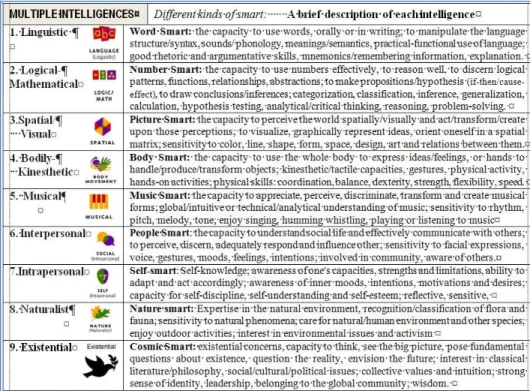
Gardner defined “an intelligence” as “the ability to solve problems, or create products, that are valued in one or more cultural settings”. He also clarified that “an intelligence” differs from “a learning style” because style implies a general way of approaching a task whereas an intelligence implies a mental capacity which includes a set of intellectual strengths and component processes that vary in each individual (Gardner, 2011: 3). Table 1 provides a brief description of each intelligence.
Notably, given the advances in digital technology, Adams (2004: 94-96) proposed including “digital intelligence”. Relying on Gardner‟s definition and criteria for recognizing multiple intelligences, he argued that “digital intelligence” may be defined as the ability to use digital technology, information and tools to interact in the digital environment, to solve problems and create products of consequence in new digital contexts. Although Gardner recognized the impact of the digital revolution, the relevance and potential of using digital technology in the 21st century education, he did not consider it a viable MI “candidate”; he perceived it as “a combination of logical-mathematical, bodily-kinesthetic and spatial/visual intelligences” (Gardner, 2013:15-16). However, the concept of “digital intelligence” is already used in e-learning. It is defined as “the sum of social, emotional, and cognitive abilities essential to digital life”, which provide for “responsible use of technology” and help future leaders “deal with the challenges and demands of the digital era” (DQ Institute, 2017).1 In corporate and management contexts, “digital intelligence” is defined as “the ability to understand and use the power of information technology”, and technical
1
knowledge/skills for commercial and economic purposes (Mithas, 2015).2 Other uses of this concept include IT sector, robotics, artificial intelligence, cyber-security, etc.3
Table 1 Howard Gardner‟s Multiple Intelligences
Adapted from: Armstrong, Thomas (2009). Multiple Intelligences in the Classroom (3rd ed), Alexandria, VA: ASCS, 2009 (p.6-7, 10-11), & http://surfaquarium.com/MI/profiles/existential.htm (accessed 8 August 2017)
3.1. The Basic Tenets of the Multiple Intelligence Theory
In the Multiple Intelligences Theory (1983), Howard Gardner stipulates that “people are born with a given amount of intelligence but we all have various potentials across the intellectual spectrum”, which drive our perceptions of the world, choices, decision-making processes and outcomes. He further posits that “intellect is distinctly pluralistic and modular”, and that each individual has a unique intellectual profile with “a distinctive blend of “multiple intelligences” (Gardner, 2006: 9). The multiplicity of intelligences, described as “multiple lenses on the mind” (Gardner, 2005), implies that each individual has a full range of multiple intelligences which are developed throughout lifetime, at different stages of one‟s life from early childhood onwards, in line with the development of human mind and cognition. They are flexible, and may change under the impact of experience, practice
2See: Mithas, S. (2015). Digital Intelligence: What Every Smart Manager Must Have For Success... (Abstract), Finerplanet, 2015, https://www.abebooks.com/book-search/title/digital-intelligence-what-every-smart-manager-must-have-for-success-in-an-information-age/; (accessed 5 Aug.2017)
and many developmental, pedagogical, socio-cultural, environmental factors (Gardner, 2011: 5), but they are all equally important for a productive life.
Here is a summary of the basic tenets of the MI theory (Armstrong, 2009: 15-16).
1. Each person has capacities in all 9 intelligences. Most people are highly developed in some, moderately developed in others, and relatively underdeveloped in the rest. 2. Each intelligence has its own developmental trajectory: some flourish in adolescence
and others peak in adulthood; some are inherent (e.g. talent for music, dancing) while others may be acquired or developed through practice and experience (Davis, et al., 2011: 8).
3. There are many ways of being intelligent both within each intelligence (e.g., a person may have musical intelligence even if he/she cannot sing or play a musical instrument) and across different intelligences (e.g. one can be good at geometry (spatial/visual) but poor at algebra (logical/mathematical).
4. Each of these “relatively autonomous mental capacities” has its own strengths and constraints (Gardner, 2010: 3). The strength or weakness in one intelligence does not predict (or preclude) the strength or weakness in another intelligence.
5. All intelligences may be cultivated, strengthened or weakened. Most people can develop each intelligence to an adequate level of competence if given appropriate exposure, encouragement, instruction and nourishment.
6. Intelligences may work independently or together, in ways unique to each individual. They are usually correlated and interact in complex ways in a specific cultural context. For example, when making a meal for friends, we make a menu for specific guests (interpersonal), select the recipe you like (intrapersonal), read the recipe (linguistic), measure the ingredients (logical-mathematical), make the meal (bodily-kinesthetic), consider the sitting arrangement (spatial), lay the table (bodily/kinesthetic) and decorate it with flowers (naturalist), create good atmosphere (musical), and consider entertainment and conversation topics (existentialist).
3.2. Criticism of the Multiple Intelligences Theory
Gardner‟s MI Theory has been criticized by scholars on a number of grounds: a) insufficiently objective criteria for recognizing an intellectual strength as an MI (White, 2006); b) inadequate neuroscientific specification of some MI profiles and inadequate conceptualization of the term “intelligences” for what are actually ”mental capacities” (Visser, et al. 2006); c) lack of empirical research to test the theory validity (Waterhouse, 2006; White, 2006); d) lack of MI tests to assess multiple intelligences and measure performance; e) inadequate psychometric evidence from scarce MI-based tests (Willingham, 2004) to support the utility of the MI theory (Davis, et al., 2011: p 9-12).
Gardner was “reluctant to create a new kind of strait jacket” (Gardner, 2011: 5). Next, ample empirical research in education (from 1992 to 2006) proved that the MI assessment tools “transcend traditional assessment” as they “tend to document approaches to meaningful learning”, to identify “the distribution of strengths”, and promote performance, problem-solving and collaboration. Instead of focusing on statistics, the assessment focuses on student/teacher feedback on the MI theory. As “direct experimental tests may be difficult to implement”, Davis, et al (2011: 27-30) urge for “a plurality of the curricula, pedagogy and assessments”.
3.3. Different Applications of the Multiple Intelligences Theory
Gardner‟s MI Theory has been widely used in different contexts: education, business world, management, career counseling and workplace/human resources contexts. Gardner never prescribed how it should be used in education or elsewhere but simply noted that “the essence of the theory is respect for the many differences among people and multiple ways in which they learn” (Armstrong, 2009: x). This flexible approach has sparked the imagination and creativity of many practitioners to further develop practical tools for applying the MI principles for educational, occupational and other purposes.
In education, the MI framework has been used as a “meta-model” (Armstrong, 2009: 55) and a practical tool for instructional design, MI-model lesson plans, MI-based activities, models of delivery and classroom management strategies, assessing learners‟ MIs and fostering the underdeveloped ones, etc. The variety of MI-based contents demonstrates efforts to provide a holistic, diverse and meaningful learning experience. “The MI theory has been a framework for rethinking school education” (Armstrong, 2009: 199); it has caused a change in the mindset of both teachers and students, and it has had a significant impact on institutional curricula and policy-makers worldwide.
The use of the MI theory has expanded far beyond the classroom and inspired the development of other projects worldwide (Chen, et al., 2009): thematic learning parks, community projects for indigenous peoples, gifted children and people with disabilities, MI-based websites, MI self-assessment tools for educational/professional purposes, etc.4 These varied applications demonstrate how MIs can be employed for achieving specific pedagogical goals in different socio-cultural, educational and professional settings.
4.MULTIPLE INTELLIGENCES IN THE CLASSROOM
As Gardner noted that “there is no single royal road to implementing MI ideas in the classroom” (Armstrong, 2009: x), the applications of the MI theory in education are versatile, depending on the specific educational, institutional and socio-cultural context.
The widely accepted MI-model implies: 1) introducing learners to the theory; 2) assessing intelligences via MI inventories (Armstrong, 2009:33) or online self-assessment tools; 3) devising lesson plans and activities on a specific topic/skill from different MI perspectives, including the full range of MIs (Armstrong, 2009:67-68);4) using the MI-model of delivery:
4 See: Explorama project at Danfoss Universe science park in Denmark;
topic/skill-specific learning centers, where students may freely choose among the tasks, rotate or be assigned a task in an underdeveloped MI (Armstrong 2009:103); and 5) devising task-based assessment tools, including different forms of formative assessment and peer/self-assessment (Armstrong, 2009:131-147).
The structure of the MI mode of delivery entails several stages: a) awakening the intelligence though multisensory experience; b) amplifying the intelligence though hands-on activities; c) teaching with/from the intelligence, which is linked to content, goals, outcomes and assessment; d) transfer of the intelligence (relating the learning to real-world contexts) (Richards, Rogers, 2001: 118).
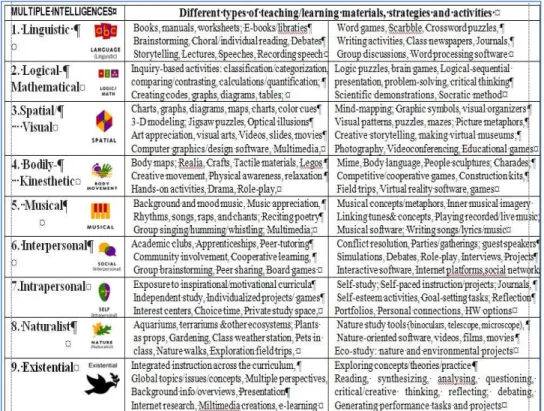
Another commonly used method of implementing the core MI principles entails a more flexible approach, where some of these activities are selectively used in instruction, adjusted to content/context-specific settings, and applied alongside with other learning theories, methods and approaches. This approach gives more latitude to o explore other ways to learning without being bound by a specific educational theory or model, while still taking advantage of the MI theory assets. Table 2 shows different types of materials, strategies and activities that may be used for fostering each intelligence.
Table 2 MI-based teaching/learning materials, strategies and activities
4.1. Aligning the Multiple Intelligences with Bloom’s Taxonomy
Another significant development in the application of the MI theory in educational practice was the alignment of the MI contextual framework with Bloom‟s Taxonomy. A group of educational psychologists, forefronted by Benjamin Bloom, made a huge contribution to education by classifying learning objectives into three domains in line with relevant capacities: 1) Cognitive (thinking capacities); 2) Affective (attitudes and emotions); and 3) Psychomotor (manual and physical skills).
Bloom‟s Taxonomy of Educational Objectives in the Cognitive Domain (Bloom et al., 1956)5 was a classification of measurable learning objectives, which included six levels of cognitive behavior, hierarchically arranged in a pyramid structure from lower-order to higher-order cognitive skills: 1) Knowledge; 2) Comprehension; 3) Application; 4) Analysis; 5) Synthesis; and 6) Evaluation. The subsequently developed Taxonomy of Learning Objectives in the Affective Domain (Krathwohl, et al., 1964)6 indentified five levels of affective behavior in the learning process: 1) Receiving; 2) Responding; 3) Valuing; 4) Organization; and 5) Characterization, which reflect learner interest, awareness, attitudes, responsiveness, responsibility, and values.
In 2001, Bloom‟s Taxonomy (1956) was revised by cognitive psychologists, forefronted by Lorin Anderson and David Krathwohl. The Revised Bloom‟s Taxonomy for Teaching, Learning and Assessment (2001) is a two-dimensional framework including: 1) Knowledge, and 2) Cognitive Process. The Knowledge domain comprises four aspects: a) Factual, b) Conceptual, c) Procedural, and d) Metacognitive, each comprising a set of interrelated elements: content knowledge, principles and theories, methodology and cognition awareness. The Cognitive Process includes six hierarchically arranged levels of processing information (from lower- to higher-order thinking), reflected in action verbs: 1) Remember; 2) Understand; 3) Apply; 4) Analyze; 5) Evaluate; and 6) Create. The complexity of this domain is further depicted in sub-sets of thinking processes (in gerund forms) at each level (Krathwohl, 2002: 212-214).
Besides being a highly practical tool for setting learning goals, lesson planning and instructional design),7 Bloom‟s taxonomy is “a kind of quality-control mechanism” (Armstrong, 2009: 169); it is used as an assessment tool for criteria-based valuation of understanding, performance, production, and achievements in specific learning contexts. Consequently, Gardner‟s MI Theory was aligned with the Revised Bloom‟s Taxonomy (2001), which enables practitioners to cross-reference different multiple intelligences with envisaged learning objectives, outcomes and content-specific assessment criteria.
5
See: Bloom, B.S. (Ed.), Engelhart, M.D., Furst, E.J., Hill, W.H., & Krathwohl, D.R. (1956). Taxonomy of Educational Objectives: The classification of educational goals. Handbook 1: Cognitive Domain. New York: David McKay (accessed 10/8/2017)
6
See: Krathwohl, D.R., Bloom, B.S., & Masia, B.B. (1964). Taxonomy of educational objectives: The classification of educational goals. Handbook II: The Affective Domain. New York: David McKay; http://www.indiana.edu/~global/icab/notebook/LearningTaxonomy_Affective.pdf (accessed 10/8/2017)
7
4.2. Aligning the Multiple Intelligences with Bloom’s Digital Taxonomy
Given the rapid growth of information technology in the late 1990s, the Revised Bloom‟s Taxonomy (RBT) was adapted for E-learning purposes. Recognizing the changing paradigm in the 21st century students‟ learning habits, a New Zealand educator Andrew Churches devised Bloom‟s Digital Taxonomy (2007), where he correlated cognitive processes and learning goals with digital media, web tools and activities that may facilitate collaborative learning and instruction management in digital learning (Churches, 2009: 3-8). He updated the action verbs with new digital technology verbs: to google, retrieve, blog, post, upload/download, tag, bookmark, edit, etc (Churches, 2009: 7). The MI Theory has been aligned with Bloom‟s
Digital Taxonomy (BDT) to support MI-based instruction in digital environments.
All these developments are highly significant for English language teaching methodology. The aligned models (MI/RBT and MI/BDT) serve as frames of reference for ensuring an integrated, holistic and humane approach to active, meaningful and value-based teaching/learning experience. They are also practical tools for setting measurable learning goals and outcomes, for differentiating, individualizing and pluralizing instruction in line with diverse learner needs and MIs in different educational settings, and for ensuring evidence-based authentic assessment. The aligned models have also contributed to rejuvenating and finding new applications for the MI Theory.
5.MULTIPLE INTELLIGENCES IN ESPCONTEXTS
English for Specific Purposes (ESP) is a multi-disciplinary approach to language acquisition/learning which entails discipline-specific instruction carefully tailored to meet learner needs for their current or prospective academic (EAP), occupational (EOP) and vocational (EVP) purposes, by providing a sound balanceof interrelated general/linguistic contents and specific/professional contents, and a sound discipline-specific methodology reflecting the real-world communications in a target community (Dudley-Evans & St-John, 1998: 4-5). The complexity of ESP instruction is further embodied in the key ESP course design components: 1)sound teaching methodology; 2) needs analysis; 3) setting measurable goals and outcomes; 4) authentic texts and genre analysis; 5) syllabus design; 6) material design; 7) lesson planning and learning activities; 8) classroom management; 9) student assessment; and 10) course evaluation.
English for Legal Purposes (ELP) or Legal English (LE) instruction is an interdisciplinary approach to studying English in different legal contexts, including multiple areas of law and related sciences (history, sociology, psychology, anthropology, economics, medicine, etc.). It caters for the needs of individuals who are expected to competently and efficiently communicate in English, in discourse community and/or in different socio-cultural contexts for academic and professional purposes. For a better understanding of the pedagogical framework in ELP/LE instruction at the Law Faculty-Niš, here is a brief overview the target learner assessment and related considerations.
5.1. My ESP (ELP/LE) pedagogical background
aspects, which have to be addressed in instruction. I had ample dilemmas and went through the same developmental/learning stages as any other novice ESP practitioner. Early in my ELP/LE practice, I was fortunate to have had a chance to cooperate with a number of (native) law-and-language experts, which was an eye-opening experience in terms grasping the need to facilitate authentic ELP/LE instruction for real-life purposes. These insights have gradually contributed to charting the ELP/LE land and developing an integrated communicative learning approach.
5.2. The Integrated Communicative Learning Approach
In order to address the complexities of the ELP/LE context,the integrated communicative learning approach has been an obvious choice because it provides sufficient latitude for an eclectic approach to the teaching/learning process by including elements of varied learning theories, methods, strategies and activities. This framework includes a holistic, communicative, learner/learning-oriented, hands-on, content-based, task-based, cooperative and humanistic approach to value-based learning, ultimately aimed at developing learner autonomy and the requisite 21st century life skills.
Canale and Swain (1980) noted that communicative approach provides opportunity for meaningful interaction in realistic communicative settings in order to ensure a balance of communicative competencies. The concept of communication competence (Hymes 1971) includes: a) Linguistic competence: mastery of the language code and conventions: phonetics, phonology, orthography, morphology, grammar, syntax, semantics, phonology; b) Socio-linguistic competence: mastery of socio-cultural and functional/pragmatic rules on appropriate language use in a specific context; c) Discourse competence: mastery of discourse rules, contents (e.g. genres), skills and practices that enable construction of coherent and meaningful communication in a specific community context; and d) Strategic Competence: mastery of rules and strategies to remedy misunderstandings and enhance effective communication: clarification, repetition, turn-taking, etc. (Friedenberg, et al., 2003: viii). To provide for the mastery of these competencies, it is necessary to ensure a multifaceted approach to integrated law-and-language contents, relevant methodology and multiple opportunities for meaningful practice and performance which would facilitate significant learning and personal growth. In my experience, striking the right balance of these complex and multifaceted constituent parts is the most difficult part of any ESP instruction.
5.3. The Target Learner and Needs Analysis
I am currently teaching an introductory ELP course for first-year students (who opt for English among four foreign languages offered in the Law School curriculum) and two elective LE courses (covering subject-specific areas of law) in the 3rd and 4th year of undergraduate curriculum. These courses entail general (linguistic/academic) and discipline-specific/ professional contents, including General English language systems and skills, academic study skills, professional terminology in various areas of law and relevant professional skills. Instruction entails working with mixed-ability groups.
The Target Situation Analysis (TSA), entailing a number of stakeholders (current/ former students, law-subject teachers, prospective employers, etc.) shows the need for competent legal professionals who are well-equipped with relevant linguistic and professional skills in order to competently and efficiently communicate (in oral and written form) in real-world situations requiring relevant LE knowledge and skills.
The Present Situation Analysis (PSA) shows that the target learners (aged 19 to 25+) opt for the ELP/LE courses at different levels of their law study. The language needs assessment at intake shows a range of GE proficiency levels (pre-intermediate to upper-intermediate), different perceptions and assumptions about strengths/weaknesses, different needs/wants and attitudes to learning, and insufficient awareness of linguistic/academic/ professional skills they may need in the future.
The Context Analysis (CA) of the learning environment reveals that ELP/LE courses for the mixed-ability groups are organized in a traditional classroom setting (fixed-desks, low-tech environment, no Internet access) as face-to-face instruction, entailing the use of technology in class and some elements of Blended Learning.
5.4. Related Considerations and Implications for ELP/LE Instruction
Given the complexities of interdisciplinary instruction and diversity of learner needs, the ELP/LE instruction has been based on the integrated communicative learning, which implies the integrated instructional design, the integrated syllabus and integrated communicative activities. In this context, the integrated communicative activities have been the stepping stones in the process of developing the integrated syllabus, which would include all relevant language-and-law competences and skills in order to facilitate and promote meaningful and significant learning. The core MI theory principles have served as a framework for spicing the instruction by a diversity of approaches, materials and tasks that would reach as many students as possible and provide equal opportunity for all to engage in meaningful communication and find their own ways to learning and personal growth. Although these activities have been used in ELP/LE instruction, the Integrated Communicative Learning approach may be implemented in any ESP context.
6.INTEGRATED COMMUNICATIVE MI-BASED ACTIVITIES IN ELP/LEINSTRUCTION
This part of the article presents the selected sample of integrated communicative MI-based activities which have been developed over the past 15 years and used for pedagogical purposes in the ELP/LE instruction at the Law Faculty in Nis (Serbia). The activities include a rational and purposeful use of technology in low-tech classroom settings. They serve as a tool to facilitate and promote authentic, enjoyable, meaningful and significant learning for personal and professional growth.
Considering the vast amount of activities developed in the past period, my greatest challenge in preparing the sample has been threefold:
a) to select a “representative” sample of activities which would reflect classroom
procedures, language-and-law contents, and complexity of classroom management; b) to map the selected activities across a range of MI profiles, even though many of
them entail the use of several intelligences rather than a single one; and
6.1. The Rationale for Communicative MI-based Activities in ELP/LE Instruction
In the context of legal education, many legal scholars (e.g. Posner, 2003) propose “recourse to multiple tools from a variety of disciplinary toolboxes”, and a more extensive application of multiple intelligences (Sherwin, et al, 2006: 238), as well as social and emotional intelligence (Brown, 2013)8.
Given the multifaceted nature of ELP/LE instruction, I have opted for a more flexible and selective approach to incorporating the MI theory into ELP/LE instruction, primarily because it provides more space for using other methods and content-specific procedures.In particular, it entails the use of communicative MI-based activities both across the curriculum and within each class, but without explicitly assessing learners‟ MI profiles, teaching in/for/to the MI theory or a particular MI, or devising sets of nine tasks on each topic. Based on the core MI principles, the activities aim to cater for all MIs, but not necessarily within the same class or on the same topic.
The aims of these communicative activities may be summarized as follows:
a) to provide a flexible communicative approach involving multiple perspectives (not only law-and-language but also contents from related social and natural sciences);
b) to provide multiple opportunities for meaningful learning in a thought-provoking environment by differentiating and individualizing the instruction (Gardner, 2010: 6);
c) to include multiple approaches to change students‟ preconceptions about learning, trigger creativity, critical-thinking, and other cognitive and affective capacities; d) to incorporate multiple strategies and activities to promote engagement, competence
and performance, as well as to provide multiple learning and assessment tools; e) to raise awareness about learners‟ MIs and activate the underdeveloped ones by
encouraging risk-taking, and to facilitate personal and /professional growth; f) to enable learners to play multiple roles, develop multiple perceptions of their
professional identity, and demonstrate multiple applications of their capacities; g) to demonstrate multiple ways of “learning to learn”, to foster learner autonomy
and to promote the development of requisite 21st century skills.
The conceptual framework of essential 21st century skills (P21, 2016)9 defines the goals of contemporary education in response to the observed needs of “millennial” learners. It includes three interrelated areas: 1) sustained life-long learning: creativity, critical thinking, cooperation and collaboration; 2) technology skills: information, media and ICT literacy, including a range of behavioral, cognitive and affective aspects (e.g. awareness of digital privacy rights, cyber-ethics, empathy) (DQ Institute, 2017); and 3) life and career skills: flexibility, adaptability, responsibility, productivity, accountability, initiative and self-direction, leadership, professionalism, social and cross-cultural skills. In a nutshell, it embodies the idea of an individual as a responsible, value-driven, well-learned, productive, socially-responsible and culturally-sensitized citizen of the world.
8
See: Brown, Heidi (2013).The Emotionally Intelligent Law Professor: A Lesson from the Breakfast Club, In: UALR LAW REVIEW, Vol. 36, 2013; http://brooklynworks.brooklaw.edu/cgi/ viewcontent.cgi?article=1498&context=faculty, accessed 10 Aug. 2017
9
6.2. Authentic Materials for Integrated Communicative MI-based Activities
In terms of content, the integrated communicative activities are based on authentic materials compiled from different sources. The authentic texts are either used in the original form or, in cases involving long legal texts or processes, they are abridged, summarized, chunked into manageable learning parts, and adapted for specific pedagogical purposes. The teaching/learning materials include a wide variety of general, academic, professional contents:
a) client interviews, legal memos, reports, counseling, case briefs/studies, contracts; b) legal documents: declarations, conventions, treaties; legislation, judgments, etc. c) law textbooks, law reports; business/legal correspondence, legal forms; complaints d) argumentative/expository essays, academic articles, abstracts, research projects; e) presentations, lectures, public debates; oral arguments, negotiations; mediation; f) videos, songs; audio-visuals, charts, tables, graphs, cartoons, quotations, realia; g) news, articles, advertisements/commercials, promotion videos/leaflets; jokes, h) student-generated materials: poster, recorded interviews, presentations, etc.
6.3. Integrated Communicative MI-based Activities in ELP/LE Instruction
This part of the paper provides a description of the integrated communicative MI-based activities which have been developed in the process of course and material design in the past 15 years, and used in the higher education ELP/LE instruction at the Law Faculty, University of Nis. The selected sample of these activities is only a small fraction of the huge number of authentic process/product-based activities used in the ELP/LE learning contexts. The displayed activities are intended to demonstrate the diversity and complexity of contents underlying the ELP/LE instruction. They are learner and learning-centered activities because they cater for learner‟s immediate/prospective needs, develop all communicative competences and promote learner independence and autonomy. They facilitate communicative and collaborative learning, on-going interaction, cooperation, collaboration, and promote self-awareness, self-assessment and reflection. They are experiential because they encourage learning by discovery and doing, active participation in the learning process and taking responsibility for one‟s own learning. They are holistic because they address the three dimensions of human behaviour: cognitive, affective and physical, and ensure a balanced development of all communicative competences and multiple intelligences. They are humanistic because they take into account distinctive human qualities, feelings, perceptions, socio-cultural and environmental factors, and the principles of cooperative learning.
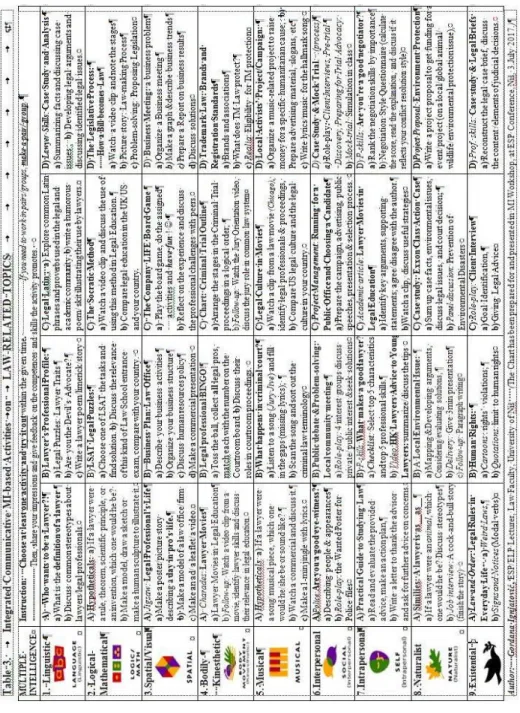
Table 3 (on the next page) shows a Sample Chart of selected communicative MI-based activities. In presenting the various types of activities across the elaborate MI framework, I have opted for using a rubric, as a commonly used MI organizational format for displaying jigsaw activities in learning stations.
Table 3 A Sample Chart of selected Integrated Communicative MI-based activities used in ELP/LE instruction at the Law Faculty, Niš
In the provided Sample Chart, the selected activities are mapped across the full range of multiple intelligences, arranged in four columns, and designated as A, B, C and D. The activities are not mutually related or sequential, and they include various tasks devised on different law-related topics. Yet, the ABCD arrangement illustrates the lesson planning process and development of an instructional sequence of activities in terms of progressive difficulty and complexity of pedagogical issues: law-and-language contents, genre-specific texts and legal processes (rather than stand-alone activities), communicative competences, cognitive skills, and correlated multiple intelligences.
The communicative MI-based activities are arranged in four columns, and designated as A, B, C and D activity. The grouping reflects different types of activities in terms of their role and pedagogical goals in the teaching/learning process:
the activities grouped under A) are warmers, energizers or brainstorming activities;
the activities grouped under B) are presentation and/or practice activities; and
the C) and D) activities are critical-thinking, evaluation, production activities. Each activity includes a set of subject-specific tasks, marked: a), b), c), which are sequential, related to the same topic, and illustrate the process of sequencing tasks within an activity. For example, in Bodily-Kinesthetic intelligence, the activity A) Charades: Lawyer Movies includes: a) Charades (miming movies title); b) Discussion (on lawyer movies in legal education); and c) Watching a video: Discussion on Lawyer skills.
Some of the activities grouped under different columns have a similar topic but they are approached from a different perspective, have different functions and/or calls for a different set of competences, strategies, skills and intelligences. For example, the activity A) Lawyer Movies in Bodily-Kinesthetic is aimed at introducing the topic, activating “the schemata”, engaging learners, personalizing the topic and expressing opinion in a meaningful context. The activity C) Legal Culture in Movies in Musical Intelligence focuses on legal culture and proceedings, while the comparison task calls for critical-thinking, evaluation and more sophisticated linguistic/strategic competences. The activity C) Lawyer Movies in Legal Education in Intrapersonal intelligence has a structural/ functional focus (article writing) and activates all communicative competences and academic skills (analysis, synthesis, critical thinking and evaluation).
The complexity of integrated law-and-language contents and competences necessarily entails multiple approaches to classroom management: seating arrangement, grouping, individual/pair/group work, eliciting prior knowledge, giving effective instructions, error correction, use of technology, conduct rules, etc.
6.4. The Communicative Competence in the Communicative MI-based Activities
Legal professionals need a wide array of communicative competencies:
a)
Linguistic competence: good rhetoric, argumentative and persuasion skills; relevant legal terminology; ability to deconstruct/reconstruct linguistic codes; awareness of grammatical, morphological, syntactic and semantic structures; legal research and legal documents reading; discursive genre-related writings skills;c)
Discourse competence: genre-related contents (case analysis, law reports, judicial decision), requisite professional skills (legal reasoning, critical/analytical thinking, problem-solving) and professional practices (client interview, legal counseling, advocacy skills, conflict resolution: negotiation/mediation), which enable coherent and meaningful communication in a specific discourse community context;d)
Strategic Competence: mastery of functional language rules and communication strategies to present, impart, obtain, structure and use information (argumentation, persuasion, comparison, conclusions or inferences), to remedy misunderstandings (clarification, repetition, emphasis, reminding) and to enhance communication (small talk, turn-taking, facial expressions, gestures, intonation, non-verbal clue).In terms of linguistic competencies, the activities reflect an integrated approach to language systems and integrated language skills. Within the language systems, they are aimed at: exposing students to relevant legal terminology, word building, collocations, intonation, functional grammar, syntactic and semantic structures, and practicing those in real-life contexts. They also focus on practicing all integrated language skills (listening, reading, speaking, writing, and related strategies), demonstrating competence and performance by creating a product or presenting to an relevant standard. There is a special focus on developing study skills, self-assessment and reflection skills, managing the learning process (structuring, prioritizing; collaborating, taking initiative, etc.).
In terms of professional competences, the activities focus on a wide range of specific texts (in written/oral form), which are explored for the purpose of identifying genre-specific “moves” or stages in the process, and performing or producing in line with the provided criteria. There is a special focus on complex legal procedures or interrelated processes which require specific professional skills (rhetoric, argumentation, legal reasoning), higher-order thinking skills (analysis, critical and analytical thinking, problem solving), excellent interpersonal skills (client interview, legal counseling) and socio-cultural awareness (professional conduct, ethics, etc.). ELP?LE practice has shown the the most effective activities of this kind are projects, debates, role-plays, mock trials, moot court simulations, negotiation/mediation processes, business meeting simulations (etc.) Such activities trigger students‟ multiple intelligences and provide ample opportunities to develop the underdeveloped MIs and promote meaningful learning by engaging in activities students are most likely to encounter in real-life.
6.5. Authentic Assessment in ELP/LE Instruction
In my ELP/LE context, the authentic assessment comprises both formative and summative assessment. In order to empower students to assume responsibility for their learning, learn from experience, exchange constructive criticism and consider ways of improving their competence and performance, instructional design entails different forms of self-assessment and peer-assessment.
Formative assessment strategies and tools include: (un)structured observation, interviews, informal feedback, individual/group counseling; needs assessment (Ignjatović, 2009: viii-x)10, content/skills surveys, mock progress tests (Ignjatović, 2009: 62-63, 98-99, 146-149); grammar, functional language and writing reference charts, organization outlines, genre samples (Ignjatović, 2009: 152-186) and photocopiable worksheets (Ignjatović, 2009; Appendix 7:1-22); study/self-assessment guidelines, checklists, genre samples, listening transcripts, key to the exercises (Ignjatović, 2016: 156-214);11 genre-based self-assessment,
criteria-based peer-assessment with descriptor rubrics (Ignjatović, 2016: 170, 174); recorded presentations and simulations; evidence-based documents and work samples; and end-term course evaluation.
Given that formative assessment informs the summative assessment, some of the above instruments are used as part of the final summative assessment: graded students‟ essays, genre-related products (case briefs); average scores from peer-assessed presentations; criteria-based presentations, projects, simulations; ongoing class activity and demonstrated communicative competencies in classroom interactions, etc.
Table 4 (in the Appendix) shows examples of genre-based self-assessment and peer assessment tools: guidelines, checklists, organization outlines, and reference charts.
6.6. The Use of Technology in the Communicative MI-based Activities
In light of the growing use of technology and digital learning in different formal, non-formal and innon-formal educational settings, it should be stressed that communicative MI-based activities are particularly suitable for different forms of E-learning. By using relevant web tools and Bloom’s Digital Taxonomy (Churches, 2007), they may be adapted for web-based or Blended Learning purposes. Technology is MI-friendly because it triggers and boosts all multiple intelligences through interactive, experiential and collaborative activities. “Digital media and virtual realities offer numerous ways” to facilitate individualized, differentiated, pluralized instruction and ensure “a plurality of curricular, pedagogy and assessments” (Davis, et al., 2012: 30) by providing for different ways of learning, individual growth and development of multiple human potentials.
In my ELP/LE practice, the instructional design rests on an eclectic use of diverse pedagogical instruments, which necessarily entails the use of technology. In traditional low-tech classrooms, practitioners use whatever technology is available and resort to incorporating elements of Blended Learning: creating learner Facebook groups for posting content, web-based wikis for collaborative learning, mobile learning by using tablets or
10
Ignjatović (2009). The coursebook includes a range of reference charts, self-study and self-assessment material: Language Needs Analysis, General English Entry Check (pp. viii-x); Progress tests (pp.62-63,98-99,146-149).
11
phones in class, open source learning platforms (if available at the institution), or providing information on content-specific websites for research or self-study which may be accessed from home PCs, tablets or cell phones. In my ELP/LE teaching context, I have used OHP PowerPoint presentations, videos, audio recordings, and some elements of Blended Learning: controlled use of mobile phones in class for data search, and referral to content-specific websites as support for further research or self-study. Such an approach is grounded in the pedagogical goals of promoting learner autonomy, fostering learners‟ responsibility and putting them in charge of their own learning.
As technology has become an indispensable part of the “digital natives” lives for educational, socializing, information and entertainment purposes, educators should have a rational approach to using technology in their educational practice. Technology should be used as a tool to facilitate and promote essential, meaningful, value-driven and purposeful learning. We are there to facilitate instruction that will awaken their curiosity, challenge their minds, develop their creativity and critical thinking skills, promote cooperation and collaboration, raise awareness about alternative ways of learning for life, but we cannot learn for them. Instead, they should be challenged to explore complex concepts, processes and events (both individually and collaboratively), equipped with relevant skills and tools, provided relevant support and guidance, and sent on their own quests, not only in pursuit of developing deeper understanding of the content area but also in terms of using the acquired knowledge and skills in authentic contexts. In the process of learning by doing and discovery, they gradually construct their own understanding, generate solutions for real-life problems, consider best ways of sharing their insights with other members of the specific discourse community, either through competent performance or by creating subject-specific products that demonstrate significant understanding, achievement and personal/professional growth.
7.STUDENT EVALUATION OF COMMUNICATIVE MI-BASED ACTIVITIES
In line with good ESP practices, my ELP/LE instruction includes regular needs assessment at intake and end-term course evaluation. In the latter, learners assess the course as a whole As students‟ feedback and course evaluation have always been a valuable source of information for further consideration, reflection, revision, adjustment and change in instructional design and delivery, I will discuss the findings from end-term course evaluations, conducted in two ESP courses and two LE courses.
Under the former Law Faculty curriculum (2008), the first ELP course was offered in the 4th year of study, which was a source of considerable frustration to many generations of students who felt that they were inadequately equipped for the ELP/LE courses as they had not been exposed to English since high schools.
7.1. Considerations and Implications for ESP (ELP/LE) instruction
of technology as a tool and support for inquiry-based learning, and exposure to value-based discourse community contents and practices in meaningful authentic discourse community contexts. Such an integrative approach is most likely to trigger learners‟ multiple potentials and lead to deeper understanding, competence-building, effective performance/production and ultimate personal/professional growth.
In light of the essential 21st century skills (P21, 2016), which provides a set of value-driven educational goals addressing the observed needs of “millennial” learners, the universal values embodied in this construct are worth “nurturing” in the generations of “digital natives” because they promote the concept of self-directed, process-oriented and product-driven approach to life-long learning. Such holistic and value-based approach to learning, including full respect for individual differences and multiple intellectual strengths, may open up students‟ minds to the multiple opportunities for personal and professional growth and, as Gardner (2009) noted, “almost infinite number of ways in which they may leave a mark on the world” (Armstrong, 2009: x).
8.CONCLUSION
The universal appeal of Howard Gardner‟s Multiple Intelligence Theory (1983) rests on a simple idea: we are all smart but in multiple ways. Almost 35 years after being established and widely used in education and many other contexts, it seems to have survived the test of time. After being aligned with the Revised Bloom‟s Taxonomy (2001) and Bloom‟s Digital Taxonomy (2007), it has been rejuvenated and reinvented to cater for the contemporary 21st century learning in different educational contexts.
The integrated communicative MI-based activities presented in this article illustrate a possible approach to incorporating the core MI principles into ELP/LE instruction in order to facilitate Integrated Communicative Learning. They have been discussed from the aspect of key stages in ESP instructional design: ESP methodology, needs assessment, course material design, pedagogical goals and outcomes, authentic assessment, classroom management, and evidence-based competence and performance.
Besides activating multiple intelligences, the activities have facilitated contextual practice on interdisciplinary law-and-language contents, development of all communicative competences and professional skills, and performance in situations which learners are most likely to encounter in the real world. They include a purposeful use of technology in low-tech classrooms and students‟ referral to subject-specific contents to be explored outside the class. In light of the essential 21st century skills, these activities and related technology serve as a tool to facilitate and promote authentic, enjoyable, meaningful and significant learning for personal and professional growth.
The presented theoretical and methodological framework, the examples from ELP/LE practice and the action research findings demonstrate that it is essential to strike the right balance of law and language, contents and skills, developing communicative competencies and providing space for performance, ensuring enjoyable but challenging learning experience, etc. The survey findings show that the provided ESP/LE instruction seems to have struck the right balance and proven to be practical, valuable and meaningful for learners‟ personal and professional growth.
and value-driven learning for ESP purposes, promoting learner autonomy as a cornerstone for sustained life-long learning, and developing transferable technological, life and career skills for personal growth and productive professional life. Yet, considering the current educational, socio-cultural, economic and other circumstances in many 21st century societies, the implementation of this holistic educational framework calls for a change in the mindsets of all stakeholders involved in education.
Whatever the odds, the instructional design is an ongoing process and each new class brings new challenges. Efficient solutions depend on balancing quite a number of factors that may hinder or foster communication and learning. We have to stay alert and responsive to the ever-changing realities in ESP instruction. Above all, our instruction has to demonstrate the change in our mindset. We have to model value-based and purposeful life-long learning and inspire change in others.
REFERENCES
Adams, Nan B. 2004. Digital Intelligence Fostered by Technology, in: Journal of Technology Studies, Spring 2004: (93-97), retrieved 5 August 2017http://scholar.lib.vt.edu/ejournals/ JOTS/v30/v30n2/pdf/adams.pdf (p.94-96)
Armstrong, Thomas. 2009. Multiple Intelligences in the Classroom, 3rded,ASCD, Alexandria, Virginia, USA, 2009: (1-246)
Churches, Andrew. 2009. Bloom’s Digital Taxonomy, Endorigami, 2009: (1-75); http://edorigami.wikispaces.com/file/view/bloom%27s%20Digital%20taxonomy%20v3.0 1.pdf/65720266/bloom%27s%20Digital%20taxonomy%20v3.01.pdf (pp.3-8); retrieved 10 August 2017
Coffield, F., Moseley D., Hall E., Ecclestone K. 2004. Learning styles and pedagogy in post-16 learning: A systematic and critical review, London: Learning and Skills Research Centre, 2004: (1-174); http://www.leerbeleving.nl/wp-content/uploads/2011/09/learning-styles.pdf (p. 53, 101); retrieved 18 July 2017
Chen, J-Q, Moran S, Gardner H (eds). Multiple Intelligences around the World, Jossey-Bass, Wiley Imprint, San Francisco, CA: 2009; https://www.amazon.com/Multiple-Intelligences-Around-World-Jie-Qi/dp/0787997609, accessed 9 August 2017.
Davis, Katie, Christodoulou J., Seider S., Gardner H. 2011. The Theory of Multiple Intelligences, In: Cambridge Handbook of Intelligence, Sternberg R., Kaufman S.(eds), New York: Cambridge University Press, 2011: (485-503); https://howardgardner01. files.wordpress.com/2012/06/443-davis-christodoulou-seider-mi-article.pdf (pp 8-12, 27-30), retrieved 5 August 2017
Dudley-Evans, Tony; St.John M.J. 1998. Developments in English for Specific Purposes: A multi-disciplinary approach. Cambridge University Press, 1998; (pp.4-5)
Friedenberg, J., Kennedy D., Lomperis A., Martin W., Westerfield K. Effective Practices in Workplace Language Training: Guidelines for Providers of Workplace English Language Training Services, Alexandria, VA: TESOL, 2003. Print. (p.viii) http://www.tesol.org/ docs/books /bk_EffectiveWorkplace_00X; retr.11 August 2017
Gardner, H. 2005. Multiple Lenses on the Mind, (paper delivered at Expo-Gestion Conf., Bogota, Colombia, May 2005: (1-29); retrieved 5 August 2017 (pp 3-4, 7-9);
https://howardgardner01.files.wordpress.com/2012/06/multiple-lenses-on-the-mind2.pdf Gardner, H. 2006. Multiple Intelligences: New Horizons, Chapter 1: In a Nutshell, 2006:
(5-31), New York: Basic Books; http://multipleintelligencesoasis.org/wp-content/uploads/ 2013/06/in-a-nutshell-minh.pdf (p.9), retrieved 5 August 2017
Gardner, H. 2010. Multiple Intelligences: The First Thirty Years, 2010: (1-12); MI Oasis http://multipleintelligencesoasis.org/wp-content/uploads/2013/06/intro-frames-10-23-10.pdf (p. 3, 5), retrieved 5August 2017
Gardner, H. 2011. The Theory of Multiple Intelligences: As Psychology, As Education, As Social Science (address delivered at José Cela University, Madrid, Spain, 22 Oct.2011), 2011 (1-11); http://multipleintelligencesoasis.org/wp-content/uploads/2013/06/473-madrid-oct-22-2011.pdf (p.3, 5); retrieved 5 August 2017
Gardner, H. 2013. Frequently Asked Questions: Multiple Intelligences and other educational topics, 2013: (1-23), MI-Oasis; http://multipleintelligencesoasis.org/wp-content/uploads/ 2013/06/faq.pdf (p. 8, 15-16); retrieved 8 August 2017
Ignjatović, Gordana. 2009. Legal English Files (Intermediate) Coursebook, Pravni fakultet, Univerzitet u Nišu, Niš: 2009: (1-209), and Appendix 7: Photocopiable Worksheets (p.1-22), published as supplementary materials booklet
Ignjatović, G. (2016). Legal English Files 1(Intermediate) Coursebook, 3rded, Pravni fakultet, Univerzitet u Nišu, Niš: 2016 (1-216).
Krathwohl, David. 2002. A Revision of Bloom‟s Taxonomy: An Overview, in: Theory into Practice, Vol.41, No4, Autumn 2002: (212-218), Ohio State University School of Education; http://www.depauw.edu/files/resources/krathwohl.pdf (p.212-214), retrieved 10 August 2107
P21- Partnership for 21st Century Learning. 2016. Framework for 21st Century Learning, Partnership for 21st Century Learning, Washington DC: 2016; (publ. online 01/16);
http://www.p21.org/storage/documents/docs/P21_framework_0816.pdf (18.07.2017) Richards, J., Rodgers Th. 2001. Approaches and Methods in Language Teaching (2.ed),
Chapter 10: Multiple Intelligences (115-124), Cambridge: CUP, 2001 [Original 1986]) , https://ia801204.us.archive.org/6/items/ApproachesAndMethodsInLanguageTeaching2nd EditionCambridgeLanguageTeachingLibrary_201610/__Approaches_and_Methods_in_L anguage_Teaching__2nd_Edition__Cambridge_Language_Teaching_Library_.pdf
(p.118) retrieved 9/ August 20117
Sternberg, Robert J. 2017. Human Intelligence, in: Encyclopaedia Britannica, publ.online 26 April 2017; https://www.britannica.com/topic/human-intelligence-psychology; (accessed 27 July 2017)
Sherwin, R.K, Feigenson N., Spiesel Ch., 2006. Law in the Digital Age: How visual communication technologies are transforming the practice, theory and teaching of law; in: