ORIGINAL RESEARCH ARTICLE
Outcome of Pregnancy in Saudi Women with Sickle Cell Disease
Attending the Tertiary Care University Hospital in Eastern
Province of Saudi Arabia
DOI: 10.29063/ajrh2019/v23i3.4
Yasmeen Akhtar Haseeb* and Nourah Hasan Al Qahtani
Department of Obstetrics and Gynaecology, College of Medicine, Imam Abdulrahman Bin Faisal University, Dammam, Saudi Arabia
*For Correspondence: Email: [email protected]; Phone: +966597174558
Abstract
Sickle cell disease (SCD) is a chronic genetic hematological disorder with multiorgan involvement and is associated with complications during the pregnancy. This is a well-known disorder in Saudi Arabia, but no study has reported its outcomes in pregnant Saudi females of the Eastern region. This study was carried out to compare the fetomaternal outcome in patients with SCD with those without SCD. This was a retrospective cohort study done in the Eastern Province of Saudi Arabia in a tertiary care, teaching hospital, by retrieving the data through the code ICD-9 for SCD, the control group was also selected with comparable characteristics. A total of 302 SCD pregnant patients were included for comparison with 600 pregnant women without SCD as control, during the period of Jan 1, 2008 to December 31, 2018. After the data retrieval, percentages of complications were calculated between the study and control groups. Fischer‘s exact test and t-test were used for statistical analysis by using SPSS version 22. The results showed higher complication rates in pregnancies of patients with SCD. Hypertensive disorders (13.3%), abruptio placenta (1.6%), intrauterine growth restriction (19.2%), thromboembolism (6.6%) and stroke (2.6%) were all higher in SCD as compared to the control group .The complications of SCD itself including anemia (89.4%), acute chest syndrome (13.2%) and sickle cell crisis (39.2%) were also increased during the pregnancy. Both still birth (3.3%) and neonatal intensive care unit admission (1.6%) were also higher in SCD. SCD during the pregnancy is a high-risk situation and can lead to many fetomaternal complications; however, preconceptional counselling, early booking, a careful monitoring during pregnancy and multidisciplinary management approach can prevent potential adverse outcome in this regard.
(Afr J Reprod Health 2019; 23[3]: 42-48).
Keywords: Fetomaternal outcome, Maternal Complications, Vaso-occlusive crisis, Venous thromboembolism
Résumé
(3.3%) étaient également plus élevés chez les patients atteints de MD. La MD pendant la grossesse est une situation à haut risque et peut entraîner de nombreuses complications fœto-maternelles; Cependant, les conseils d‘avant-conception, les réservations précoces, une surveillance attentive pendant la grossesse et une approche de gestion multidisciplinaire, peuvent empêcher des résultats défavorables potentiels à cet égard. (Afr J Reprod Health 2019; 23[3]: 42-48).
Mots-clés: Issue fœto-maternel, complications maternelles, crise vaso-occlusive, Thromboembolie veineuse
Introduction
Sickle cell disease (SCD) is an inherited hemoglobinopathy affecting many people across the globe. It is associated with fetomaternal morbidities and mortalities during the pregnancy. Chronic red blood cell destruction, anemia and hypoxia along with decreased placental circulation seems to be the most plausible explanation for high risk nature of these pregnancies1. The origin of SCD is thought to be in sub-Saharan countries2. About 300,000 children are born with SCD each year in the world and two third of them are born in Africa3,4. It is a lifelong, chronic disorder which can even be life threatening sometimes. However, recent advances in genetic engineering, molecular medicine and pharmacotherapy has generated new medications to treat SCD which has increased the life expectancy of the affected individuals5.
In obstetrical clinics, a significant number of pregnant patients suffering from SCD are encountered. Although existing guidelines of evidence-based medicine and multidisciplinary team approach has improved the obstetrical outcomes in SCD patients, still their management is a challenging matter due to increased rate of fetomaternal complications. The obstetrical outcome in such pregnancies is affected by chronic anemia, vaso-occlusive crisis, venous thromboembolism, infections, end organ damage and placental insufficiency. All these complications can ultimately lead to decreased fetal growth, preterm deliveries, intrauterine fetal death (IUFD), neonatal morbidities and mortalities6.
In local context, SCD is one of the highly prevalent medical conditions in pregnant Saudi women. Al Kahtani et al reported the prevalence of sickle cell trait to be 25% among the Eastern province7. Over the years, it has been observed that many obstetricians consider pregnancy in
SCD patients as a high-risk pregnancy. Despite the severity of this condition, the literature shows a paucity of research in this domain. Till date, there are very few studies regarding the obstetrical outcome in SCD, especially in the Eastern region of Saudi Arabia. Realizing the importance, high risk nature, and burden of this disease in pregnancy, this study was conducted to find out the outcomes and impact of this disease in pregnant women at King Fahad Hospital of the University Al-Khobar, a tertiary care centre, Eastern province of Saudi Arabia where many referral cases of SCD are received.
Methods
It was a retrospective cohort study where all pregnant SCD patients with homozygous status (HBSS) who came for antenatal care or delivered at King Fahad Hospital of the University Al-Khobar, were included. Most of the SCD patients were referral cases who presented in their first or second trimester of pregnancy. Almost all of them were already diagnosed with SCD but in few cases hemoglobin electrophoresis was performed to confirm their status. The data was retrieved by using International Classification of Diseases, 9th Revision (ICD-9) from Jan 1, 2008 to Dec 31, 2018. Only Saudi nationals with singleton pregnancies were included. Twins and other multifetal gestations were excluded to avoid confounding errors. 302 Saudi women with homozygous (HBSS) disease were included; and sickle cell traits as well as other hemoglobinopathies were excluded from the study. Epidemiological data including age, parity, education, HBSS status was also recorded in the study.
pregnancy who served as control. Antepartum, intrapartum and postpartum follow up was retrieved from the data, antenatal, delivery and discharge registers as well, with special attention to any fetomaternal complications. Data regarding the complications was calculated as percentages. To calculate and compare the difference in complications between the study and the control groups, Fischer exact test and student t-test was applied by using the SPSS version 22. A P-value ≤ 0.05 was considered to be significant.
Results
Demographic features
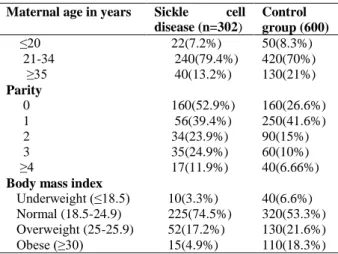
During the period of study, 25,830 deliveries occurred in the hospital including both vaginal and cesarean sections, out of which, 302 were found to have SCD with incidence of 1.16% (Table 1). Most of the pregnancies were in the age bracket of 21-34 years (79.4%), 7.2% were ≤ 20 years and 13.2% in women ≥ 35 years. Regarding the parity, 52.9% were nulliparous, and 47 % were multiparous. The body mass index (BMI) in SCD, 225(74%) women had normal BMI, 52(17.2%) were overweight, 15(4.9%) were obese and 10(3.3%) were underweight.
Table 1: Demographic features of pregnant women with SCD in the Eastern Province, Saudi Arabia
Maternal age in years Sickle cell disease (n=302)
Control group (600)
≤20 22(7.2%) 50(8.3%) 21-34 240(79.4%) 420(70%) ≥35 40(13.2%) 130(21%)
Parity
0 160(52.9%) 160(26.6%) 1 56(39.4%) 250(41.6%) 2 34(23.9%) 90(15%) 3 35(24.9%) 60(10%) ≥4 17(11.9%) 40(6.66%)
Body mass index
Underweight (≤18.5) 10(3.3%) 40(6.6%)
Normal (18.5-24.9) 225(74.5%) 320(53.3%)
Overweight (25-25.9) 52(17.2%) 130(21.6%)
Obese (≥30) 15(4.9%) 110(18.3%)
Maternal complications due to sickle disease
Table 2 shows that pregnancy complications in SCD are more pronounced as compared to the control group. Anemia was seen in 270 (89%) of SCD while it was 70 (11%) in control group (p=0.03). Blood transfusion was required in 280 (92.5%) in SCD while it was 93 (15.5%) in control group (p=0.001). Sickle cell crisis was seen in 120 (39.2%) of SCD patients and none in the control group (p=0.0001). Acute chest syndrome was seen in 40 (13.2%) of SCD patients while none in the control group (p=0.001). Similarly, urinary tract infection (UTI) was observed in 42(13.9%) of SCD patients and 28 (5.1%) in control group patients (p=0.003). Venous thromboembolism was seen in 20 (6.65%) of SCD and 8(1.3%) of control group patients (p=0.002), while stroke was seen in 8(2.6%) in SCD and none in control group patients (p=0.005). Intensive care unit admission was seen in 35 (11.55%) of SCD and none in control group (p=0.003). No maternal deaths were recorded in either group.
Obstetrical outcome in sickle cell disease
versus control group
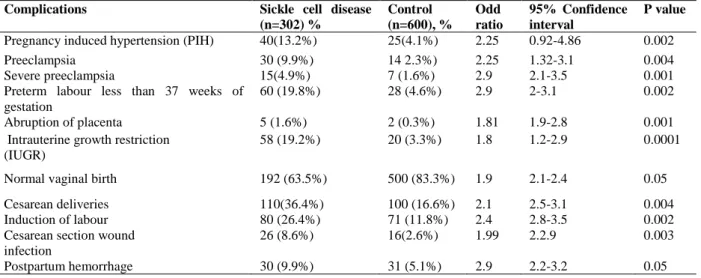
Table 3 shows the obstetrical complications in SCD and its comparison with the control group. Pregnancy induced hypertension was seen in 40(13.2%) in SCD and 25 (4.1%) in the control group (p=0.002). Both preeclampsia and severe preeclampsia had higher prevalence in the SCD as compared to the control group. (p = 0.004 and 0.001 respectively). Pre-term labour (< 37 weeks) was observed in 60(19.8%) in SCD and 7 (4.6%) in the control group (p=0.002). Placental abruption 5 (1.6%) in SCD while it was 2(0.3%) in the control group (p=0.001). Intrauterine growth restriction (IUGR) was also high in SCD 58(19.2%) and 20(3.3%) in the control group (p=0.0001). Induction of labour was higher in SCD 80 (26.45%) as compared to the control group 71(11.8%) (p=0.02). Most of the cases with
Table 2: Maternal complications in pregnant women with SCD versus the control group in the Eastern Province, Saudi Arabia
Complications Sickle cell disease (n=302), %
Control (n=600), %
Odd ratio 95% confidence interval
p- value
Anemia 270(89.4%) 70(11.6%) 2.02 1.2-1.9 0.03 Blood transfusion 280(92.7%) 93(15.5%) 2.21 1.25-2.2 0.001 Sickle cell crisis 120(39.2%) - 0.9 0.09-1.2 0.0001 Painful crisis 72(60 %%) -
Hemolytic crisis 48(40%) -
Acute chest syndrome 40(13.2%) - 2.23 2.1-3.2 0.0001 Urinary tract infection (UTI) 42(13.9%) 28(5.1%) 2.5 2.3-2.9 0.003 Venous thromboembolism
(VTE)
20(6.6%) 8(1.3%) 2.6 1.9-2.23 0.002
Stroke 8(2.6%) - 1.9 2.0-3.2 0.05
Admission to intensive care unit 35(11.5%0 - 1.5 1,8-2,2 0.003
Table 3: Obstetrical complications in pregnant women with SCD in the Eastern province, Saudi Arabia versus control group
Complications Sickle cell disease (n=302) %
Control (n=600), %
Odd ratio
95% Confidence interval
P value
Pregnancy induced hypertension (PIH) 40(13.2%) 25(4.1%) 2.25 0.92-4.86 0.002 Preeclampsia 30 (9.9%) 14 2.3%) 2.25 1.32-3.1 0.004 Severe preeclampsia 15(4.9%) 7 (1.6%) 2.9 2.1-3.5 0.001 Preterm labour less than 37 weeks of
gestation
60 (19.8%) 28 (4.6%) 2.9 2-3.1 0.002
Abruption of placenta 5 (1.6%) 2 (0.3%) 1.81 1.9-2.8 0.001 Intrauterine growth restriction
(IUGR)
58 (19.2%) 20 (3.3%) 1.8 1.2-2.9 0.0001
Normal vaginal birth 192 (63.5%) 500 (83.3%) 1.9 2.1-2.4 0.05 Cesarean deliveries 110(36.4%) 100 (16.6%) 2.1 2.5-3.1 0.004 Induction of labour 80 (26.4%) 71 (11.8%) 2.4 2.8-3.5 0.002 Cesarean section wound
infection
26 (8.6%) 16(2.6%) 1.99 2.2.9 0.003
Postpartum hemorrhage 30 (9.9%) 31 (5.1%) 2.9 2.2-3.2 0.05
Table 4: Perinatal outcome in pregnant women with sickle cell disease versus the control group in the Eastern province Saudi Arabia
Outcome Sickle cell disease n=302
Control group n=600
P value
Fetal anomalies 5 (1.6%) 8 (1.4%) Not significant Mean gestational age at delivery 34.8±5 days 38.5±4 days 0.01
Still births 10 (3.3%) 2 (0.3%) 0.001 Average birth weight 2.5±450g 3.32kg ±540g 0.002 Apgar score at 5 minutes (A/S) 7 10 0.01
Mean A/S < 7 20 (6.6%) 11 (1.8%) 0.04 Neonatal intensive care unit admission 25 (8.2%) 12 (2%) 0.001 Neonatal deaths 5 (1.6%) 5 (0.833%) 0.003
labour, the patients were hydrated, kept warm and fetuses were monitored continuously with electronic monitoring of fetal heart rate. The
cause of cesarean section in SCD was fetal distress, IUGR, and abruption of placenta. Postpartum hemorrhage was 30(9.9%) in SCD as compared to 31(5.1%) in the control group (p=0.005). Cesarean section wound infection was higher in SCD 26(8.6%) as compared to the control group 16(2.6%) (p=0.003).
Perinatal outcome in sickle cell disease
versus the control group
Table 4 shows the different aspects of perinatal outcome in SCD and the control group. Regarding the fetal anomalies, 5 (1.6%) in SCD and 8 in the control group (1.4%), which means that there is no significant difference between the two groups. Mean gestational age was found to be 34.8 weeks±5days in SCD and 38.6±4 in the control group (p= 0.01). Still births were 10 (3.3%) in SCD and 2 (0.3%) in the control group (p= 0.001). The main causes of still birth in SCD patients were prematurity and abruption of placenta, whereas, in the control group, it was abruption of placenta (one case) and pre-term labour due to multiple congenital anomalies. The mean birthweight was 2.5kg±450grams and 3.32kg±540grams in the SCD and the control group, respectively, (p=0.002). Admission to the neonatal intensive care unit was significantly higher 5(1.6%) in SCD deliveries as compared to the control group5 (0.8%) (p=0.03). The main reasons for higher neonatal admissions were prematurity, IUGR, and respiratory distress syndrome.
Discussion
Pregnant patients with SCD are usually at high risk due to pathological changes in the erythrocytes which make the blood more coagulable. This leads to sickling and clogging of blood vessels as well as placental bed. At the same time hemolysis is another challenging issue in this condition which can cause anemia, thus, making the situation even worse. These pathological changes lead to both maternal and fetal complications. In these cases, an earlier recognition of complications, followed by
intervention, is the key to successful obstetric care7.
The complication usually seen in SCD cases are; sickle cell crisis, deep vein thrombosis, acute chest syndrome, cerebral stroke, anemia and urinary tract infection8. A meta-analysis by Oteng-Ntim et al has also highlighted the adverse maternal and perinatal outcomes due to SCD and the complications reported are consistent with our findings9. The obstetrical complications, such as, hypertensive disorders, preeclampsia, abruption of placenta and deep vein thrombosis increase the chances of preterm labour and cesarean sections in SCD patients, leading to early interventions in the interest of fetus or the mother. Moreover, increased IUGR, low birth weight babies and respiratory distress syndrome have usually been seen in fetuses of such pregnancies. These complications have also been reported by other studies10-13. Other medical conditions due to damage to end organs have also been reported in SCD patients which include renal damage, stroke, and venous thrombosis14-17. Similar findings have been iterated in the United Kingdom Obstetrics Surveillance system (UKOSS) report which documented that the pregnancy in SCD showed an increased risk of sickle cell crisis, acute chest syndrome and urinary tract infection18. These findings have also been observed in our study and are consistent with the previous research.
Many studies have been conducted to find the prophylactic measures which can help in controlling complications in SCD patients. One of which is the prophylactic blood transfusion. Only few non-randomized studies have reported decrease rate in IUGR as a result of prophylactic blood transfusion19.
short- and long-term complications. Regardless of this, many authors support the prophylactic red blood cell transfusion in selected cases, such as, SCD patients presenting with history of perinatal death, chronic organ dysfunction, recurrent painful crisis and anemia. This transfusion is usually planned at least 3-4 weeks apart with the targeted hemoglobin of 10-11 gm /dl22,.
The management of SCD in pregnancy starts from the preconceptional care which includes risk assessment, fitness for pregnancy, comprehensive counselling of couple and an effective contraception. Vaccination for hepatitis, meningococcal and pneumococcus is mandatory during this time to avoid any morbidity and mortality during the pregnancy. RCOG guideline in this respect is a very good source to go for evidence-based management23. Moreover, the antenatal care must be multidisciplinary in collaboration with hematologist and other health care professionals. Frequent visits, counselling and fetomaternal monitoring is recommended for reducing maternal and fetal complications.
Planned induction of labour has been strongly recommended and the decision should only be made by the consultant obstetrician. Adequate analgesia, rehydration, patient warming, and active management of 3rd stage of labour and continuous electronic fetal heart rate monitoring can help in getting better outcomes in such cases24. Postpartum pain management, treatment of anemia and thromboprophylaxis are also very important in SCD patients. In addition to it, sickle cell status of the baby should also be determined immediately after the birth so that the child can be diagnosed at an early stage and neonatal management can be provided at the earliest.
Conclusion
Sickle cell disease is a chronic multisystem disease and it requires special care during the pregnancy. All such patients should be offered periconceptional assessment and counselling. Antenatal, intrapartum, and postpartum care should be provided with multidisciplinary approach to avoid the complications. Anemia
correction, thromboprophylaxis and urgent treatment of infections can avoid fetomaternal complications.
Disclosure
Authors declared that they have no conflicts of interest. This work was non-funded.
Contribution of Authors
YH and NQ, conceived and designed the study. YH collected the data, analyzed and prepared the manuscript. NQ provided the review of manuscript. YH and NQ have revised and approved the final version of the manuscript for the publication.
References
1. Al-Farsi SH, Al-Riyami NM, Al-Khabori MK, Al- Hunaini MN. Maternal complications and The Association with Baseline Variables in Pregnant Women with Sickle Cell Disease. Hemoglobin 2013;37(3):219-26
2. Angastiniotis M, Modell B, Englezos P and Boulyjenkov V. Prevention and control of haemoglobinopathies. Bull World Health Organ 1995; 73: 375–86. 3. Diallo D and Tchernia G. Sickle cell disease in Africa.
Curr Opin Hematol 2002;9(2): 111-6.
4. Quinn CT, Rogers ZR and Buchanan GR. Survival of children with sickle cell disease. Blood 2004;103(11):4023–8.
5. Wierenga KJJ, Hambleton IR, Lewis NA and Unit SC. Survival estimates for patients with homozygous sickle-cell disease in Jamaica: a clinic-based population study. Lancet 2001; 357(9257):680–3. 6. Serjeant GR, Loy LL, Crowther M, Hambleton IR,
Thame M and Paed DM. Outcome of pregnancy in homozygous sickle cell disease. Obstet Gynecol 2004;103(6):1278–85.
7. Al Kahtani MA, Alqahtani M, Alshebaily MM, Abd M, Moawad A and Aljohani N. Morbidity and pregnancy outcomes associated with sickle cell anemia among Saudi women. Int J Gynecol Obstet 2012;119(3):224–6.
8. Villers MS, Jamison MG, De Castro LM and James AH. Morbidity associated with sickle cell disease in pregnancy. Am J Obstet Gynecol 2008;199(2):125-e1.
Blood 2015; 125(21):3316–26.
10. Barfield WD, Barradas DT, Manning SE, Kotelchuck M and Shapiro-Mendoza CK. Sickle cell disease and pregnancy outcomes: women of African descent. Am J Prev Med 2010; 38(4):S542-9.
11. Howard J and Oteng-Ntim E. The obstetric management of sickle cell disease. Best Practice & Research Clinical Obstetrics & Gynaecology. Best Pract Res Clin Obstet Gynaecol 2012; 26(1):25-36.
12. Rogers K. Sickle cell disease in pregnancy. Obstet Gynaecol Reprod Med 2019;29(3):61–9. 13. Hanley JA, Negassa A and Forrester JE. Statistical
analysis of correlated data using generalized estimating equations: an orientation. Am J Epidemiol 2003; 157(4):364-75.
14. Thame M, Lewis J, Trotman H, Hambleton I and Serjeant G. The mechanisms of low birth weight in infants of mothers with homozygous sickle cell disease. Pediatrics 2007; 120(3):e686-93.
15. Muganyizi PS and Kidanto H. Sickle cell disease in pregnancy: trend and pregnancy outcomes at a tertiary hospital in Tanzania. PLoS One 2013; 8(2):e56541.
16. Desai G, Anand A, Shah P, Shah S, Dave K, Bhatt H,Desai S and Modi D . Sickle cell disease and pregnancy outcomes: a study of the community-based hospital in a tribal block of Gujarat, India. J Heal Popul Nutr 2017;36(1)1–3.
17. Barfield WD, Barradas DT, Manning SE, Kotelchuck M and Shapiro-mendoza CK. Sickle cell disease and
pregnancy outcomes. AMEPRE 2010; 38(4):S542– 9.
18. Knight M, McClymont C and Fitzpatrick K. on behalf of UKOSS. United Kingdom Obstetric Surveillance System (UKOSS) Annual Report 2012. National Perinatal Epidemiology Unit. Oxford; 2012. 19. Gilli SC, Paula EV De, Biscaro FP, Marques JF, Costa
FF and Saad ST. Third-trimester erythrocytapheresis in pregnant patients with sickle cell disease. Int J Gynaecol Obstet 2007;96(1):8–11. 20. Asma S, Kozanoglu I, Gereklioglu C, Akdeniz A, Kasar
M, Turgut NH,Yeral M,Kandemir F,Boga C and Ozdogu H . Prophylactic red blood cell exchange may be beneficial in the management of sickle cell disease in pregnancy. Transfusion 2015; 55(1):36– 44.
21. Sharif J, Byrd L, Stevenson K, Raddats J, Morsman E and Ryan K. Transfusion for sickle cell disease in pregnancy: a single‐centre survey. Transfusion 2018; 28(3):231-5.
22. Ngo C, Kayem G, Habibi A, Benachi A, Goffinet F, Galacteros F and Haddad B. Pregnancy in sickle cell disease: maternal and fetal outcomes in a population receiving prophylactic partial exchange transfusions. Eur J Obstet Gynecol Reprod Biol 2010; 152(2):138-42.
23. RCOG Green top guideline no 61. Management of Sickle Cell Disease in Pregnancy. July,2011;(61). 24. Hassell Kathryn. Pregnancy and Sickle Cell Disese.