Journal of Algebra Combinatorics Discrete Structures and Applications
On the resolutions of cyclic Steiner triple systems with
small parameters
∗
Research Article
Svetlana Topalova
Abstract: The paper presents useful invariants of resolutions of cyclicST S(v)withv≤39, namely of all reso-lutions of cyclic ST S(15),ST S(21)and ST S(27), of the resolutions with nontrivial automorphisms of cyclicST S(33)and of resolutions with automorphisms of order13of cyclicST S(39).
2010 MSC:05B07, 05E18
Keywords: Resolutions, Cyclic designs, Point-cyclically resolvable, CyclicST S(v),KT S(v)
1.
Introduction
1.1.
Basic definitions and notations
For the basic concepts and notations concerning combinatorial designs and their resolvability refer, for instance, to [2], [3], [13], [22].
LetV ={Pi} v
i=1 be a finite set ofpoints, andB={Bj} b
j=1 a finite collection ofk-element subsets of
V calledblocks. If any2-subset ofV is contained in exactlyλblocks ofB, thenD= (V,B)is a2-(v,k,λ)
design, orbalanced incomplete block design (BIBD). Each point of Dis incident withrblocks.
Two designs areisomorphicif there exists a one-to-one correspondence between the point and block sets of the first design and respectively, the point and block sets of the second design, and if this one-to-one correspondence does not change the incidence. Anautomorphismis an isomorphism of the design to itself, i.e. a permutation of the points that maps each block to a block of the same design.
A2-(v,k,λ) design iscyclic if it has an automorphism permuting its points in one cycle of lengthv.
∗
Aresolutionof the design is a partition of the collection of blocks intoparallel classes, such that each point is in exactly one block of each parallel class. A design isresolvableif it has at least one resolution. Two resolutions areisomorphicif there exists an automorphism of the underlying design which maps each parallel class of the first resolution to a parallel class of the second one. An automorphism of a resolution is an automorphism of the underlying design which maps each parallel class to a parallel class of the same resolution.
A resolution ispoint-cyclicif it has an automorphism permuting the points in one cycle. Only designs which are cyclic can have point-cyclic resolutions. A design ispoint-cyclically resolvableif it has at least one point-cyclic resolution.
A2-(v,3,1) design is called a Steiner triple system of orderv (ST S(v)) and its resolutions are called Kirkman triple systems of order v(KT S(v)).
1.2.
Motivation and known results
Design resolutions have various important applications (see, for instance, [4], [9], [11], [19], [20], [21], [23]). Resolutions with rich automorphism groups might be very useful for some of them ( For instance, point-cyclic resolutions of Steiner systems are used in some constructions of regular low-density parity-check codes providing a fast decoding algorithm [11] and of systematic repeat-accumulate codes [8]). That is why resolutions of cyclic designs are of particular interest and have been the subject of many papers.
General constructions of resolutions of cyclic designs are presented in [7], [14], [17], [18]. Cyclic ST S(v)are resolvable iffv≡3 (mod6) andv≥15. There are several computer-aided classifications of KT S(v)from cyclic designs. All resolutions ofST S(15)[12] and of cyclicST S(21)[16] are known. The point-cyclic KT S(21)andKT S(39)are subject of [15], KT S(33)with automorphisms of order 11and cyclic underlying designs are constructed in [24] and the point-cyclicKT S(27)are part of the constructed in [5] transitiveKT S(27). There exist many other works on KT S(v)withv ≤39, but the author does not know classification results for the rest of the cyclicST S(v)cases considered below.
Subject of the present work is the classification of the resolutions of cyclicST S(v)with smallv. As it can be seen from the previous paragraph, not all of the results are new. The aim of the paper is on the one hand to obtain newKT S(v)and on the other to present the properties of all known resolutions of cyclic ST S(v)withv≤39and to make all of them available at a web-page for possible future applications.
2.
Classification method
Cyclic 2-(v,k,1) designs with small parameters were first classified in [6]. This classification was extended for some of the next parameters in [1]. Since all necessary designs are available, the focus of the present paper is only the construction and study of their resolutions. The resolutions of each cyclic ST S(v)are found in the following two ways.
2.1.
Construction of all nonisomorphic resolutions
The blocks of the design are first sorted in lexicographic order and then backtrack search is applied on them. The parallel classes are constructed block by block. If nblocks have been added to a class, then+ 1-st one is chosen among the blocks which
• contain the smallest point that is in none of the already added blocks and
The resolutions are thus constructed in lexicographic order. To make the classification feasible the algorithm is speeded up by performing aminimality testafter adding each whole parallel class. This test checks if the current partial solution can be mapped to a lexicographically smaller one by some of the automorphisms of the design. If it can, an equivalent partial solution has already been considered and therefore the current one is rejected, namely a next possibility for the latest added block is looked for.
As a result all non isomorphic resolutions of the design are obtained.
2.2.
Construction of all nonisomorphic resolutions with a given
automor-phism
α
of prime order
p
There are two possibilities for the length of the parallel class orbits underα: lengthpand length 1 (fixed parallel classes). Since the number of parallel classes is(v−1)/2, there must be at least
cf =
v−1 2 mod p
parallel classes which are fixed byα. The number of blocks in a parallel class isv/3and therefore a fixed parallel class must contain at least
bf =
v 3 mod p
fixed blocks. That is why with respect toαthere must be
• at leastbfcf fixed blocks and
• at least cf(
j
v
3p
k
+bf)block orbits such that any point is contained in at most one block of the
orbit.
Therefore the algorithm starts with checking if these two conditions hold and stops if not. The construction algorithm itself is a modification of the general one described in the previous subsection. This modification adds more requirements, namely:
• Any two blocks of a non fixed parallel class should be from different orbits underα
• If a block is contained in a fixed parallel class, then all blocks of its orbit underαshould be in the same parallel class
These requirements lead to a differently defined lexicographic order and respectively to a more complex minimality test which must take in account the orbit length ( 1 or p ) under α of the added parallel classes.
3.
Classification results
3.1.
Resolution invariants
The blocks of all cyclicST S(v) with v ≡ 3 (mod 6) are partitioned by the automorphism of ordervin(v−3)/6orbits of lengthvand one short block orbit of lengthv/3. Three types of point-cyclic resolutions of cyclic Steiner triple systems are defined in [17] with respect to the role of the short block orbit in the resolution. In a similar way we can define three types of resolutions (which may not be point-cyclic) as follows.
• T1 if the short orbit is a parallel class for all resolutions of the isomorphism class.
• T2 if the short orbit is not a parallel class for any resolution of the isomorphism class.
• T3 if the short orbit is a parallel class for some resolutions of the isomorphism class and is not a
parallel class for the rest.
In the present paper the resolution type, the order of the full automorphism group and the orbits of this group on the parallel classes are found for each constructed resolution. The resolution properties are arranged in tables containing 8 columns. The first four of them contain the invariants which are computed for each resolution. Namely:
• autD is the order of the full automorphism group of the design from which the resolution was obtained
• autRis the order of the full automorphism group of the resolution
• T is the type of the resolution
• orbR is the number of orbits of the parallel classes under the full automorphism group of the resolution
The number of solutions with such invariants is presented in the last four columns. Namely:
• D is the number of designs from which resolutions with these invariants are obtained
• Dcycis the number of those of theD designs which admit point-cyclic resolutions
• Ris the number of resolutions with these invariants
• Rcycis the number of those of theRresolutions which are point-cyclic
Some comments on the properties of the constructed resolutions follow.
3.2.
KTS(15)
All the 7KT S(15)are well known [12]. There are two cyclicST S(15)with full automorphism groups of orders 60 and20160. One of them is resolvable (Table1) and this is theST S(15)which can be obtained from the point-line incidence in P G(3,2). There are two nonisomorphic resolutions which correspond to the two well-known doubly transitive parallelisms of P G(3,2) [10]. The transitivity is, however, on the parallel classes (orbR= 1), while these resolutions are not point-cyclic.
Table 1. Resolutions of cyclic ST S(15)
autD autR T orbR D Dcyc R Rcyc
20160 168 3 1 1 0 2 0
3.3.
KTS(21)
Table 2. Resolutions of cyclic STS(21)
autD autR T orbR D Dcyc R Rcyc
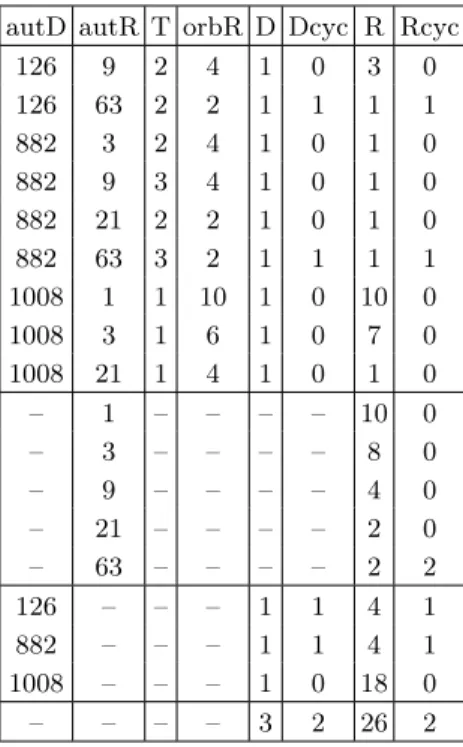
126 9 2 4 1 0 3 0
126 63 2 2 1 1 1 1
882 3 2 4 1 0 1 0
882 9 3 4 1 0 1 0
882 21 2 2 1 0 1 0
882 63 3 2 1 1 1 1
1008 1 1 10 1 0 10 0
1008 3 1 6 1 0 7 0
1008 21 1 4 1 0 1 0
– 1 – – – – 10 0
– 3 – – – – 8 0
– 9 – – – – 4 0
– 21 – – – – 2 0
– 63 – – – – 2 2
126 – – – 1 1 4 1
882 – – – 1 1 4 1
1008 – – – 1 0 18 0
– – – – 3 2 26 2
3.4.
KTS(27)
There are 8 cyclic ST S(27) with full automorphism groups of order 27. Four of them are resolvable yielding19336nonisomorphic resolutions (Table3). None of them has a trivial automorphism group. TransitiveKT S(27)are constructed in [5] which intersect the constructed hereKT S(27)in the 4 point-cyclic ones.
Table 3. Resolutions of cyclic STS(27)
autD autR T orbR D Dcyc R Rcyc
27 3 1 9 2 0 8 0
27 3 1 11 2 0 64 0
27 3 1 13 2 0 112 0
27 3 2 9 3 0 390 0
27 3 2 11 2 0 5088 0
27 3 2 13 2 0 13648 0
27 9 1 7 2 0 4 0
27 9 2 3 1 0 2 0
27 9 2 5 2 0 16 0
27 27 1 3 2 2 4 4
27 3 – – – – 19310 0
27 9 – – – – 22 0
27 27 – – – – 4 4
3.5.
KTS(33)
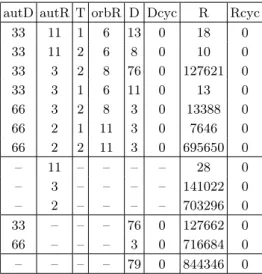
There are 84 cyclic ST S(33) with full automorphism groups of orders 33(78), 66(3), 165(2) and 330(1). Seventy-nine of them possess altogether 28 resolutions with automorphisms of order 11 which were constructed in [24],141022resolutions with automorphisms of order3and703296resolutions with automorphisms of order 2. All the designs which have resolutions with automorphisms of order11 possess resolutions with automorphisms of order 3too, but they do not possess point-cyclic resolutions. The present investigation shows that all resolutions of cyclicST S(33)have full automorphism groups of prime orders 11,3or 2(Table4). There are no resolutions with automorphisms of order 5.
Table 4. Resolutions of cyclic STS(33) with nontrivial automorphisms
autD autR T orbR D Dcyc R Rcyc
33 11 1 6 13 0 18 0
33 11 2 6 8 0 10 0
33 3 2 8 76 0 127621 0
33 3 1 6 11 0 13 0
66 3 2 8 3 0 13388 0
66 2 1 11 3 0 7646 0
66 2 2 11 3 0 695650 0
– 11 – – – – 28 0
– 3 – – – – 141022 0
– 2 – – – – 703296 0
33 – – – 76 0 127662 0
66 – – – 3 0 716684 0
– – – – 79 0 844346 0
3.6.
KTS(39)
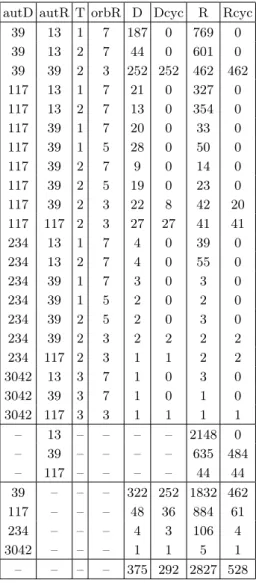
There are798cyclic ST S(39)with full automorphism groups of orders39(730),78(4),117(55), 156(2), 234(4), 468(2)and3042(1). There are375 of them which have resolutions with automorphisms of order 13 with no fixed points (Table 5). Note that an automorphism of order 13 with fixed points (one of the798 cyclic designs possesses such a one) cannot fix any parallel class and thus cannot be an automorphism of a resolution. The number of resolutions with automorphisms of order13is2827. There are 528 point-cyclic ones among them (constructed in [15]). Some of the other resolutions have a full automorphism group of order39, but are not point-cyclic. Their underlying designs possess automorphism groups of orders 117, 234 and3042. Only the resolutions of the design with an automorphism group of order 3042are of typeT3.
4.
Conclusion
The classified KT S(v) with cyclic underlying designs can be of use both directly in relevant applications, and as parts of constructions of new infinite families. The results obtained in this paper coincide with those of other authors who have constructed part of the presented resolutions.
Table 5. Resolutions of cyclic STS(39) with automorphisms of order 13
autD autR T orbR D Dcyc R Rcyc
39 13 1 7 187 0 769 0
39 13 2 7 44 0 601 0
39 39 2 3 252 252 462 462
117 13 1 7 21 0 327 0
117 13 2 7 13 0 354 0
117 39 1 7 20 0 33 0
117 39 1 5 28 0 50 0
117 39 2 7 9 0 14 0
117 39 2 5 19 0 23 0
117 39 2 3 22 8 42 20
117 117 2 3 27 27 41 41
234 13 1 7 4 0 39 0
234 13 2 7 4 0 55 0
234 39 1 7 3 0 3 0
234 39 1 5 2 0 2 0
234 39 2 5 2 0 3 0
234 39 2 3 2 2 2 2
234 117 2 3 1 1 2 2
3042 13 3 7 1 0 3 0
3042 39 3 7 1 0 1 0
3042 117 3 3 1 1 1 1
– 13 – – – – 2148 0
– 39 – – – – 635 484
– 117 – – – – 44 44
39 – – – 322 252 1832 462
117 – – – 48 36 884 61
234 – – – 4 3 106 4
3042 – – – 1 1 5 1
– – – – 375 292 2827 528
References
[1] T. Baicheva, S. Topalova, Classification results for (v, k, 1) cyclic difference families with small parameters, Mathematics of Distances and Applications. M. Deza, M. Petitjean, K. Markov (Eds.), in International book series: Information Science and Computing, 25 (2012), 24–30.
[2] T. Beth, D. Jungnickel, H. Lenz, Design Theory, Cambridge University Press, Cambridge, 1993. [3] C. J. Colbourn, J. H. Dinitz (Eds.), The CRC Handbook of Combinatorial Designs, CRC Press,
Boca Raton, FL, 2007.
[4] C. J. Colbourn, J. H. Dinitz, D. R. Stinson, Applications of Combinatorial Designs to Communica-tions, Cryptography, and Networking, Surveys in Combinatorics, 1999, Edited by J. D. Lamb and D. A. Preece, London Mathematical Society Lecture Note Series 267 (1999), 37–100.
[6] M. J. Colbourn, R. A. Mathon, On cyclic Steiner 2-designs. Topics on Steiner systems, Ann. Discrete Math. 7 (1980) 215–253.
[7] M. Genma, M. Mishima, M. Jimbo, Cyclic resolvability of cyclic Steiner 2-designs, J. Combin. Des. 5(3) (1997) 177–187.
[8] A. Gruner, M. Huber, New combinatorial construction techniques for low-density parity-check codes and systematic repeat-accumulate codes, IEEE Trans. Commun. 60(9) (2012) 2387–2395.
[9] M. Huber, Combinatorial designs for authentication and secrecy codes, Found. Trends Commun. Inf. Theory 5(6) (2008) 581–675.
[10] N. L. Johnson, Two-transitive parallelisms, Des. Codes Cryptogr. 22(2) (2001) 179–189.
[11] S. J. Johnson, S. R. Weller, Resolvable 2-designs for regular low-density parity-check codes, IEEE Trans. Commun. 51(9) (2003) 1413–1419.
[12] S. Kageyama, A survey of resolvable solutions of balanced incomplete block designs, Int. Stat. Rev. 40(3) (1972) 269–273.
[13] P.Kaski, P.Östergård, Classification Algorithms for Codes and Designs, Springer, Berlin, 2006. [14] C. Lam, Y. Miao, On cyclically resolvable cyclic steiner 2-designs, J. Combin. Theory Ser. A 85(2)
(1999) 194–207.
[15] C. W. H. Lam, Y. Miao, Cyclically resolvable cyclic Steiner triple systems of order 21 and 39, Discrete Math. 219(1-3) (2000) 173–185.
[16] R. A. Mathon, K. T. Phelps, A. Rosa, A class of Steiner triple systems of order 21 and associated Kirkman systems, Math. Comp. 37(155) (1981) 209–222.
[17] M. Mishima, M. Jimbo, Some types of cyclically resolvable cyclic Steiner 2-designs, Congr. Numer. 123 (1997) 193–203.
[18] M. Mishima, M. Jimbo, Recursive constructions for cyclic quasiframes and cyclically resolvable cyclic Steiner 2-designs, Discrete Math. 211(1-3) (2000) 135–152.
[19] N. V. Semakov, V. A. Zinoviev, Equidistant q−ary codes with maximal distance and resolvable balanced incomplete block designs, Probl. Peredachi. Inf. 4(2) (1968) 3–10.
[20] T. Etzion, N. Silberstein, Codes and designs related to lifted MRD codes, IEEE Trans. Inform. Theory 59(2) (2013) 1004–1017.
[21] D. Stinson, Combinatorial Designs: Constructions and Analysis, Springer, New York, 2004. [22] V. D. Tonchev, Combinatorial Configurations, Longman Scientific and Technical, New York, 1988. [23] V. D. Tonchev, Steiner systems for two-stage disjunctive testing, J. Comb. Optim. 15(1) (2008) 1–6.