TECHNICAL UNIVERSITY OF CLUJ-NAPOCA
ACTA TECHNICA NAPOCENSIS
Series: Applied Mathematics, Mechanics, and Engineering Vol. 61, Issue I, March, 2018
APPLICATIONS OF CERAMIC COATINGS AS TBCs ON THE INTERNAL
COMBUSTION ENGINE VALVES
Marius PANȚURU, Daniela CHICET, Ștefan LUPESCU, Bogdan ISTRATE, Corneliu MUNTEANU
Abstract: This study was started to see whether the use of thermal barrier coatings (TBC) can be extended to internal combustion engines using gasoline as fuel as to see the viability of other types of coatings with role of the thermal barrier than the usual zirconia. To this end, we covered three different types of powders on a set of valves, and then we tested them as close to reality as possible on a stand made up of a Dacia 1310 engine. It was noteworthy in the first instance that the exhaust gases resulted fall within the permissible limits, and after a while on the surface of the valve discs the specific tribofilm formed by the combustion residues is deposited together with a very fine film of carbon which continues to act by doubling the thermal barrier effect of the coating.
Key words: ceramic coatings, TBC, valve discs, internal combustion gasoline engine.
1. INTRODUCTION

The automotive industry is constantly on the rise both because of the competition between vehicle manufacturers and the growing demands on the market. It is known that with the increase of the rolling of the vehicle its performance gradually decreases, mainly due to the wear of the parts in contact in relative motion. One of the most important parts in the proper functioning of the internal combustion engine are the intake and exhaust valves. Due to the working conditions in relation to the valve construction, the following requirements are needed: high mechanical strength which can be maintained at high temperatures, high stiffness, high hardness of the sealing surface and valve actuation surface, good resistance to oxidation and corrosion [1].
One tendency that wins more and more ground is the one regarding the coating of the whole combustion chamber with thermal barrier coatings, the literature presenting only studies regarding the diesel engines. This technique is taken into consideration because is able to improve engine efficiency by eliminating cooling systems, to improve the thermal cycle
efficiency by reducing heat losses, to increase the engine components lifetime and to determine low exhaust gas emissions [2,3,4].
The most coating systems (coating system = top coat + intermediate layer + substrate) used as TBC are based on the zirconia powder stabilized with rare earths. One of the most efficient top coat includes Y2O3 stabilized ZrO2 (YSZ) as a
thermal insulation layer and a bond coat layer typically from MCrAlY (M = Ni, Co, Fe or a combination of these elements) as an oxidation resistant layer [5,6,7].
Therefore, in this study we analyzed the possibility to use other powders than the ones based on zirconia in order to produce thermal barrier coatings for engine applications. Also, considering the newest trends in automotive industry – the phasing out the diesel engines, we proposed to study how the gasoline engines would behave when some elements of the combustion chamber are coated with TBC systems and if they demonstrate the same benefits as the diesel engines.
of the internal combustion gasoline engine during operation.
2. MATHERIALS AND METHODS
Four sets of intake and exhaust valves (three for spraying and one for control) were prepared for this study. Four types of commercial powders (manufactured by Metco - Oerlikon) to be deposited on the internal surfaces of the valve discs by the atmospheric plasma spray (APS) method were chosen as follows:
- the bonding layer - the same for all samples: commercial grade 410NS powder, with the composition Al2O3 - 30 (Ni20Al);
- thermal barrier layer for set 1(S1): 81NS powder with composition Cr2C3 - Ni20Cr;
- thermal barrier layer for set 2 (S2): 303NS powder with MgZrO3 - 35NiCr composition;
- thermal barrier layer for set 3 (S3): 201NS powder with ZrO2 - 5CaO composition.
In figure 1 is presented one aspect captured during the production process, composed from the following steps:
- the valves were chosen by sets,
- the valves stems were protected using a metallic adhesive ”paper”,
- the valve discs were sandblasted and cleaned with isopropilic alchool,
- the valves were mounted on the rotative table of the thermal deposition facility (SPRAY-WIZARD 9MCE for atmospheric plasma spraying) and the coatings were sprayed;
- the samples were sprayed at first with the bonding powder, afterwich were coated, secventially all three TBCs, using the parameters prescribed by the producer. In figure 2 is presented the final aspect of samples. To test these coatings in conditions as close to the actual operating conditions, a test stand was carried out by taking a motor from a Dacia 1400 model 102/13 and assembling it in such a way as to be able to follow the parameters that are of interest to us: chemical composition of combustion gases, fuel consumption and the continuity of engine functioning.
Fig. 1. Aspect of the samples coating process.
Fig.2. Aspect of the samples after coating.
Figure 3 presents one aspect of the test stand, where is visible the exhaust gas monitoring ensemble.
For each set of valves, the tests were designed as follows: day 1 – 5 hours of functioning at the engine idling speed (for engine valve rotation), followed by the functioning at the accelerated engine idling speed: day 2 – 8 hours, day 3 – 9 hours; day 4 – 8 hours; day 5 – 6 hours.
atmosphere) for 2 hours, followed by a slow cooling. The observations were made X-ray diffraction with the XPERT PRO MD diffractometer (Panalitycal, 2009).
Fig. 3. Partial aspect of the test stand which presents the exhaust gases monitoring.
3. RESULTS
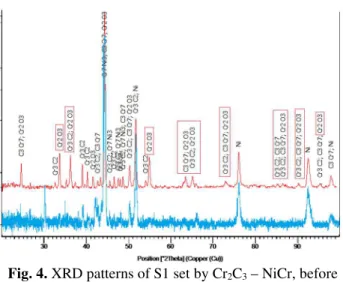
At the end of the tests, the observed aspects resulted after the XRD investigations were correlated with the previous recorded results, as presented in figures 4, 5 and 6.
Fig. 4. XRD patterns of S1 set by Cr2C3 – NiCr, before
the tests (blue) and after the tests (red).
The blue graph is the one recorded after the plasma coating of the TBCs and the red one is the graph generated after the thermal treatment of the test plates.
It is obvious, as expected, that after the heating process (similar with the one registered during the operation), the amount of oxide phases increased in all cases, as visually marked
on each figure with the red cassettes. Their presence is not endangering the thermal barrier role, which is even improved by their presence.
Fig. 5. XRD patterns of S2 set by MgZrO – NiCr, before the tests (blue) and after the tests (red).
Fig. 6. XRD patterns of S3 set by ZrO – CaO, before the tests (blue) and after the tests (red).
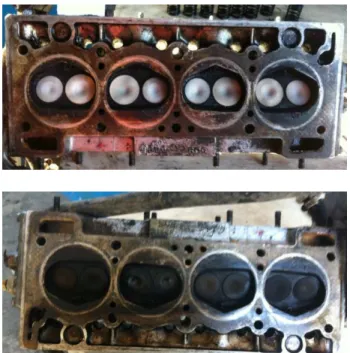
Fig. 7. Operating configurations for S1 (Cr2C3 – NiCr): a)
before the tests; b) after the tests (the second row).
Fig. 8. Operating configurations for S2 (MgZrO – NiCr): a) before the tests; b) after the tests (the second row).
Fig. 9. Operating configurations for S2 (ZrO – CaO): a) before the tests; b) after the tests (the second row).
During each test, the gas parameters were registered, on a gas analyser – AG001 – and it
was observed that the hydrocarbonates and other regulated combustion gases level is normal; one bulletin generated during the functioning at the accelerated engine idling speed (almost 3000 rpm) is presented in figure 10.
After the tests, the valves were extracted and it was observed that they are covered already with the wastes resulted after combustion – the well-known tribofilm, as presented in figure 11.
Fig. 10. Gas level registration for S2 coated valves set.
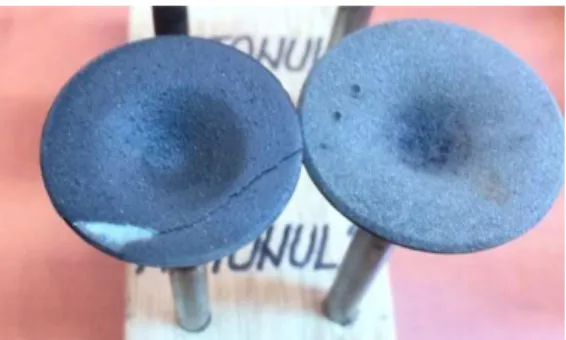
Fig. 12. Valves aspect failure after tests
Although the functioning parameters were situated between the accepted limits regarding the fuel consumption and the combustion gases composition, two of the coating failed by exfoliation: one from sample 3 – complete exfoliation of the valve disc and one from sample 2 – cracking with partial exfoliation, the second case being presented in figure 12.
4. CONCLUSIONS
The method of plasma spray coating in a normal atmosphere is suitable for the deposition of the thermal barrier layers, thereby obtaining uniform surfaces with a roughness comparable to that of the tribofilms deposited during the normal operation of the internal combustion engine.
As a result of the tests carried out on the specially designed stand, it was observed that the engine works correctly with sets of valves whose plates were covered by plasma jet deposition with three types of thermal barrier and bonding layers, others than the usual ones based on zirconia.
As a result of the testing of the levels of pollutants (test conducted to date) it was observed that the exhaust gases have a composition that meets the accepted norms.
It has also been noticed that all the valves used have begun to cover with that layer composed of burning residues (a layer called in
the literature as a tribofilm due to the role it performs) and two of the coatings - in sample set 2 and 3 has been peeled off.
5. REFERENCES
[1] Z.J. Sroka, Some aspects of thermal load and operating indexes after downsizing for
internal combustion engine, J. Therm. Anal.
Calorim. 110 (1) (2011) 51–58.
[2] E. Buyukkaya T. Engin, M. Cerit, Effects of thermal barrier coating on gas emissions and performance of a LHR engine with different
injection timings and valve adjustments,
Energy Conversion and Management 47 (2006) 1298–1310.
[3] B. Iscan, Application of ceramic coating for improving the usage of cottonseed oil in a
diesel engine, Journal of the Energy Institute
89 (2016) 150-157
[4] Woschni G, Spindler W, Kolesa K. Heat insulation of combustion chamber walls - a measure to decrease the fuel combustion of
I.C. engines. SAE paper 850359.
[5] A.H. Pakseresht, A.H. Javadi, E. Ghasali, A. Shahbazkhan, S. Shakhesi, Evaluation of hot corrosion behavior of plasma sprayed thermal barrier coatings with graded intermediate layer and double ceramic top
layer, Surface & Coatings Technology 288
(2016) 36 – 45.
[6] X.Q. Cao, R. Vassen, F. Tietz, D. Stoever,
New double-ceramic-layer thermal barrier coatings based on zirconia–rare earth
composite oxides, Journal of the European
Ceramic Society 26 (2006) 247–251.
[7] M. Ekström, A. Thibblin, A. Tjernberg, C. Blomqvist, S. Jonsson, Evaluation of internal thermal barrier coatings for exhaust
manifolds Surface & Coatings Technology
Aplicații ale acoperirilor ceramice cu rol de barieră termică pe talerele supapelor motoarelor cu ardere internă
Rezumat: Acest studiu a fost demarat pentru a se observa dacă utilizarea straturilor cu rol de barieră termică (TBC =
thermal barrier coating) poate fi extinsăși la motoarele cu ardere internă ce folosesc drept combustibil benzina, dar și
pentru a observa viabilitatea altor tipuri de acoperiri cu rol de bariera termică decât cele uzuale pe baza de zirconia.
În acest scop, am acoperit trei tipuri diferite de pulberi pe câte un set de supape pecare apoi le-am testat în condiții cât
mai apropiate de realitate pe un stand format dintr-un motor de Dacia 1310. S-a observant în prima instanță faptul că
noxele rezultate se încadrează în limitele admise, iar după un timp pe suprafața discurilorde valvă se depune tribofilmul
specific format din reziduurile de ardere împreună cu o peliculă foarte fină de carbon ce acționează în continuare
dublând efectul de barieră termică al acoperirii.
Marius PANȚURU,Eng.PhD Student at Mechanical Engineering Department, Technical University
”Gheorghe Asachi” of Iasi, 6 D. Mangeron Blvd, Iasi, Romania, [email protected]
Daniela CHICET, Lecturer PhD. Eng. at Technical University ”Gheorghe Asachi” of Iasi, Materials
Science and Engineering Department, 41 D.Mangeron Blvd, Iasi, Romania, [email protected]
Ștefan LUPESCU,Eng.PhD Student at Mechanical Engineering Department, Technical University
”Gheorghe Asachi” of Iasi, 6 D. Mangeron Blvd, Iasi, Romania, [email protected]
Bogdan ISTRATE, Assist. Eng.PhD at Mechanical Engineering Department, Technical University
”Gheorghe Asachi” of Iasi, 6 D. Mangeron Blvd, Iasi, Romania, [email protected]
Corneliu MUNTEANU, PhD.. Prof. at Mechanical Engineering Department, Technical University