Representations of Fundamental Chemistry Concepts in Relation to the
Particulate Nature of Matter
www.ijemst.com
Representations of Fundamental
Chemistry Concepts in Relation to the
Particulate Nature of Matter
Zübeyde Demet Kırbulut1 , Michael Edward Beeth2
1Harran University
2University of Wisconsin Oshkosh
To cite this article:
Kirbulut, Z. D. & Beeth, M. E. (2013). Representations of fundamental chemistry concepts
in relation to the particulate nature of matter.
International Journal of Education in
Mathematics, Science and Technology, 1
(2), 96-106.
This article may be used for research, teaching, and private study purposes.
Any substantial or systematic reproduction, redistribution, reselling, loan, sub-licensing,
systematic supply, or distribution in any form to anyone is expressly forbidden.
Authors alone are responsible for the contents of their articles. The journal owns the
copyright of the articles.
Volume 1, Number 2, April 2013, 96-106
ISSN: 2147-611X
Representations of Fundamental Chemistry Concepts in Relation to the
Particulate Nature of Matter
Zübeyde Demet Kırbulut1*, Michael Edward Beeth2
1
Harran University 2 University of Wisconsin Oshkosh
Abstract
This study investigated high school students’ understanding of fundamental chemistry concepts - states of matter, melting, evaporation, condensation, boiling, and vapor pressure, in relation to their understanding of the particulate nature of matter. A sample of six students (four females and two males) enrolled in a second year chemistry course at a midwestern high school in the USA was interviewed about their conceptions of states of matter, melting, evaporation, condensation, boiling, and vapor pressure. Interviewees were also asked to apply these concepts to explain everyday phenomena. Purposeful typical case sampling method was used to identify the students who were interviewed for this study. Evidence from these interviews indicates that multiple representations of the particulate nature of matter by students contribute to their understanding of the aforementioned fundamental concepts.
Key words: Chemistry education, Conceptions, States of matter, Phase change, Particulate nature of matter
Introduction
Research on students’ conceptions has shed light on a wide range of issues related to learning science concepts in school, to applying concepts when explaining everyday phenomena and to teaching for conceptual understanding. Numerous studies have reported misconceptions with specific science concepts. These misconceptions have serious implications for understanding conceptually related ideas by the student as well as implications for teaching for conceptual understanding (see Duit, 2007 for a bibliography of literature on students’ and teachers’ conceptions and science education). With respect to chemistry, many high school age students are unsuccessful in their struggle to learn fundamental concepts such as states of matter, melting, evaporation, condensation, boiling, and vapor pressure (Aydeniz & Kotowski, 2012; Canpolat, 2006). One possible explanation for why learning these concepts is difficult is that many students are not invoking multiple representations of a foundational chemistry concept, the particulate nature of matter, that could help a student explain most fundamental chemistry concepts (Gabel, Samuel, & Hunn, 1987). Consequently, students are not able to explain their understanding of concepts at the macroscopic, microscopic and submicroscopic levels of representation (Gilbert & Treagust, 2009).
Theoretical Framework
States of matter, melting, evaporation, condensation, boiling, and vapor pressure are fundamental concepts in many chemistry courses. Foundational to solid explanations for each of these is a well-articulated understanding of the particulate nature of matter that includes references to the kinetic molecular theory, the structure of matter and bonding. While many studies have investigated student conceptions related to these concepts individually (Bar & Galili, 1994; Bar & Travis, 1991; Canpolat, 2006; Chang, 1999; Gopal, Kleinsmidt, & Case 2004; Johnson, 1998a, b; Osborne & Cosgrove, 1983; Paik, Kim, Cho, & Park, 2004; Tytler, 2000), few studies have looked across students’ explanations for these conceptually related topics. Osborne and Cosgrove (1983) conducted clinical interviews with children from eight to 17 years of age to investigate their conceptions of the changes in the states of water. They reported that younger children had superficial understanding about evaporation, condensation, boiling, and melting while older children held similar views to the younger children
*
Corresponding Author:
even though they were exposed to formal teaching related to these concepts. Similarly, Chang (1999) investigated college students’ conceptions of evaporation, condensation, and boiling and concluded that college students had superficial understanding about these concepts, especially in relationship to their understanding of water vapor. Johnson (1998a, b) indicated that students had difficulty in understanding the bubbles in boiling water, evaporation, condensation and thus the gaseous state. He concluded that a robust understanding of the particulate nature of matter was problematic for these learners. Also, Gopal et al. (2004) interviewed second-year chemical engineering students and concluded that these students had inadequate understanding of evaporation and condensation.
Bar and Travis (1991) further explored children’s conceptions of phase changes, liquid to gas, and reported that children’s understanding of boiling preceded their understanding of evaporation. Following this line of work, Bar and Galili (1994) investigated conceptions of evaporation in children from 5 to 14 years of age. They indicated four views regarding children’s conceptions of evaporation: i) water disappeared; ii) water was absorbed in the floor or/and ground; iii) when water evaporated, it was unseen and being transferred into an alternative location such as in the sky, air or ceiling; and iv) water was transformed into air. Tytler (2000) also found that young children did not show greater appreciation related to evaporation and condensation in a study which he compared year 1 and year 6 students’ conceptions of evaporation and condensation. Canpolat (2006) used open-ended questions and interviews to explore undergraduate students’ misconceptions related to evaporation, evaporation rate, and vapor pressure. He found that students had superficial understanding related to these concepts, with the following main misconceptions: i) in order for evaporation to take place, a liquid has to take heat from its environment; ii) the evaporation rate of a liquid in an open container is different from that of the liquid in a closed container; iii) in a closed container, the evaporation rate decreases as time passes; and iv) the evaporation rate changes with surface area; v) in the case of adding or removing vapor, the vapor pressure changes. Collectively, these studies support the need to continue investigating relationships among fundamental concepts in chemistry and to seek information related to the extent to which students use multiple representations of the particulate nature of matter when expressing formal chemistry concepts and everyday phenomena.
The purpose of this study was to investigate advanced high school chemistry students’ understanding of states of matter, melting, evaporation, condensation, boiling, and vapor pressure in relation to understanding of the particulate nature of matter and students’ application of these concepts. This study is intended to identify the role that a sound understanding of the particulate nature of matter has on other fundamental chemistry concepts. This study addressed the following research questions:
1. How do students represent their understanding of the particulate nature of matter when asked to explain states of matter, melting, evaporation, condensation, boiling and vapor pressure?
2. How do students apply their understanding of evaporation, condensation, and boiling in relation to the particulate nature of matter when explaining everyday phenomena related to these concepts?
Method
Sample
The study employed a phenomenological method involving a small number of subjects through extensive and prolonged engagement to develop patterns and relationships of meaning (Creswell, 1994). Six students (four females, two males, ages 16 to 18, and grades 10-12) enrolled in a midwestern high school in the USA were interviewed for this study. The students were enrolled in an advanced chemistry course at this high school. Total enrollment for this high school was 1,153 with 22 students enrolled in the advanced chemistry course. Purposeful typical case sampling method was used to identify the students who were the focus of the study (Patton, 1990). As key informants, teachers were asked to identify those students who displayed average or above achievement in and positive attitudes toward learning chemistry based on their observations, students’ grades in chemistry and students’ engagement in classroom activities.
Procedure
consisted of seven questions and follow-up probes to investigate advanced high school chemistry students’ understanding of states of matter, melting, evaporation, condensation, boiling, and vapor pressure. During the interview, students were also asked to explain everyday phenomena related to the concepts of interest and to interpret graphs representing phase change (see Appendix for the interview protocol). Interviews lasted up to 55 minutes, were video recorded and transcribed for analysis. The interview protocol was piloted by the researchers and revised for face validity prior to implementing it with the students in this study.
Data Analysis
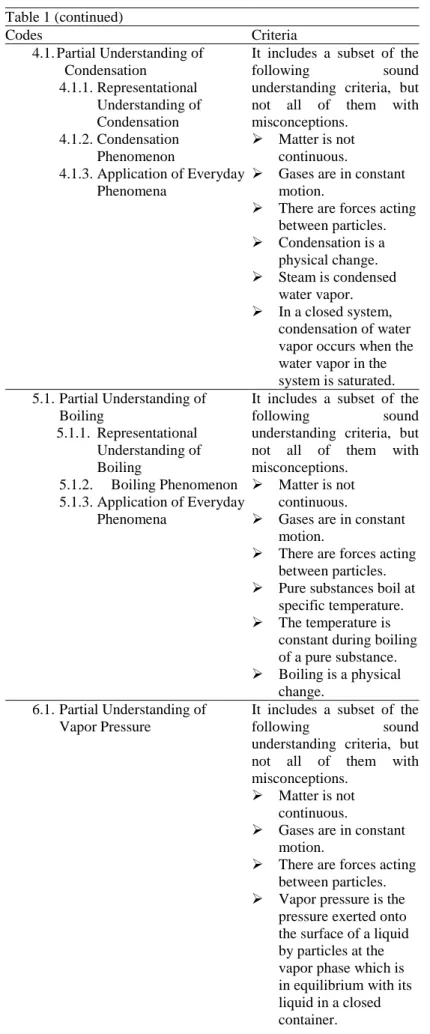
Interviews were analyzed based on Creswell’s (1994) six generic steps: i) organize and prepare the data for analysis, ii) read through all the data, iii) code the data, iv) generate themes or categories using the coding, v) organization and the description of the data in terms of the coding and themes, vi) interpretation of the data. The authors and their colleague independently coded the data according to a priori criteria (see Table 1), discussed any conflicts between categories, and the categories were finally verified. Students’ responses to interview questions were categorized as sound, partial or no understanding of the aforementioned concepts. However, it should be noted in what follows that a category for “no understanding” was only necessary for the concept of vapor pressure. Table 1 contains the complete coding scheme and criteria used for categorization of students’ understanding for each of the concepts as well as the phenomenon questions used in the study. In the transcripts that follow, the number of the specific code that was applied to a statement is given in parenthesis immediately following that segment.
Table 1 Coding and categorization scheme for students’ interview data
Codes Criteria
1.1.Sound Understanding of Solids, Liquids, and Gases 1.1.1 Solids
1.1.2 Liquids 1.1.3 Gases
Particles in solids are tightly packed.
Particles in solids have restricted movement.
Particles in solids have low kinetic energy.
Particles in solids have strong attractions between them.
Particles in liquids are further apart than in solids.
Particles in liquids move freely than in solids.
Particles in liquids have higher kinetic energy than in solids.
Particles in liquids have weaker attractions between them than in solids.
Particles in gases are further apart than liquids.
Particles in gases move freely than in liquids.
Table 1 (continued)
Codes Criteria
1.1.Sound Understanding of Solids, Liquids, and Gases
Particles in gases have the weakest attractions between them
compared to particles in liquids and solids. 1.2.Partial Understanding of
Solids, Liquids, and Gases 1.2.1 Solids
1.2.2 Liquids 1.2.3 Gases
It includes a subset of the sound understanding criteria, but not all of them with misconceptions.
2.1.Sound Understanding of Melting
2.1.1.Representational Understanding of Melting
2.1.2.Melting Phenomenon
Matter is not continuous.
There are forces acting between particles.
Melting is a physical change.
Pure substances melt at specific temperature.
The temperature is constant during melting of a pure substance.
The kinetic energy of particles increases during melting. 2.2.Partial Understanding of
Melting
2.2.1.Representational Understanding of Melting
2.2.2.Melting Phenomenon
It includes a subset of the sound understanding criteria, but not all of them with misconceptions.
3.1.Sound Understanding of Evaporation 3.1.1.Representational Understanding of Evaporation 3.1.2.Evaporation Phenomenon
3.1.3.Application of Everyday Phenomena
Matter is not continuous.
Gases are in constant motion.
There are forces acting between particles.
Evaporation of liquid occurs at every temperature without heating by using its internal energy.
Evaporation is a physical change. 3.2. Partial Understanding of
Evaporation 3.2.1.Representational Understanding of Evaporation 3.2.2.Evaporation Phenomenon
3.2.3.Application of Everyday Phenomena
Table 1 (continued)
Codes Criteria
4.1.Partial Understanding of Condensation
4.1.1.Representational Understanding of Condensation 4.1.2.Condensation Phenomenon
4.1.3.Application of Everyday Phenomena
It includes a subset of the
following sound
understanding criteria, but not all of them with misconceptions.
Matter is not continuous.
Gases are in constant motion.
There are forces acting between particles.
Condensation is a physical change.
Steam is condensed water vapor.
In a closed system, condensation of water vapor occurs when the water vapor in the system is saturated. 5.1.Partial Understanding of
Boiling
5.1.1. Representational Understanding of Boiling
5.1.2. Boiling Phenomenon 5.1.3.Application of Everyday
Phenomena
It includes a subset of the
following sound
understanding criteria, but not all of them with misconceptions.
Matter is not continuous.
Gases are in constant motion.
There are forces acting between particles.
Pure substances boil at specific temperature.
The temperature is constant during boiling of a pure substance.
Boiling is a physical change.
6.1.Partial Understanding of Vapor Pressure
It includes a subset of the
following sound
understanding criteria, but not all of them with misconceptions.
Matter is not continuous.
Gases are in constant motion.
There are forces acting between particles.
Table 1 (continued)
Codes Criteria
6.1. Partial Understanding of Vapor Pressure
Vapor pressure is dependent on temperature.
Vapor pressure is independent from surface area. 6.2.No Understanding of Vapor
Pressure
There is no or enough evidence to evaluate students’ understanding as sound or partial.
Results
Students’ Conceptions of States of Matter
Students’ conceptions of states of matter were categorized as sound understanding or partial understanding in terms of their representations of the particulate nature of matter. Data excerpts selected for the sound understanding category included statements consistent with the kinetic molecu lar theory, the structure of matter and bonding. Excerpts categorized as partial understanding included one of these criteria and one or more of the misconceptions known for that concept. Two students showed sound understanding of states of matter. In the excerpt below, information consistent with the kinetic molecular theory, the structure of matter and bonding are identified by the coding categories for sound understanding:
David: Solids retain their shape (1.1.1), and at any temperature they don’t fill t he container they’re put in. They have a set mass, like a pressure as opposed to gas. If you compress [a gas], it gets smaller. So a solid, if it is like a real solid, not like something flexible (1.1.1), it won’t compress under pressure (1.1.1) until pressure gets too great and then it will just compact all the way. Liquids fill whatever container they are in and fill all those space and flow downwards or in the direction of gravity if they are poured out of a container (1.1.2). Molecules of gas move aroun d the most (1.1.3)– they have kinetic energy and they move around the fastest, and then liquids move around slightly less (1.1.2) and they hold together because of bonds (1.1.2), for solids- all the molecules compact in one area (1.1.1) so they don’t move around as much as the other two (1.1.1).
The other students interviewed were coded as having partial understanding of states of matter in terms of the particulate nature of matter. In the excerpt that follows, one of the students mentioned the structure o f substances when explaining the characteristics of solids, liquids and gases but she did not mention anything about the kinetic molecular motion of particles:
Mary: I believe for gases, the molecules are further apart (1.2.3). They are spread out all over the place. And liquids, the molecules are kind of closer to each other (1.2.2). And then solids, the molecules don’t even have any space between them. They are very close to each other (1.2.1).
Students’ Conceptions of Melting
Student interview data could be categorized into sound and partial understanding for the concept of melting as well. The first category included six criteria for sound understanding of melting; the second category addresses a subset of these criteria with one or more of the miscon ceptions known for that concept. Two students were identified with sound understanding of melting, the same two students who expressed sound understanding of states of the particulate nature of matter. One of these students (David) described melting as follows:
David: Change of a solid into its’ liquid state (2.1.2) - so going from being compacted to fluid and able to move, so breaking apart the bonds that are holding the molecules together so they can move around slightly (2.1.2).
Four students expressed ideas categorized as partial understanding. None of the students in this group had sound understanding of the particulate nature of matter according to our earlier analysis. Students placed in this category indicated definitions of melting that were between the macroscopic and microscopic level of understanding as indicated in the following excerpt:
Interviewer: How would you describe melting? Lisa: The molecules - like the ice would break up. Interviewer: Break up?
Lisa: I don’t know what they do. They jut get warmer so they melt (2.2.2). Interviewer: Ok. When you think about melting what comes to your mind?
Lisa: I really just think the temperature changes. It’s dripping because it is not solid anymore (2.2.2).
Students’ Conceptions of Evaporation
Only one student had sound understanding of evaporation. This understanding was consistent with and supported by his sound understanding of the particulate nature of matter:
Interviewer: How would you define evaporation?
David: Liquid forming into a gas (3.1.2) - so the bonds that are holding the liquid together (3.1.2), kind of loosely so that they stay in whatever container they are in if it is open (3.1.2), are gone completely. They just are free to go wherever there is space. So as a liquid they just stay in whatever container they are in, and as a gas they flow free in the environment (3.1.2).
David understood that evaporation involved a physical change, matter was not continuous, gases were in constant motion, and that forces acting between particles needed to be included in his explanation. In addition, he is one of the only students who indicated previously that evaporation of water could occur at any temperature where it was in the liquid phase:
Interviewer: Can you show on the phase change graph where evaporation occurs?
David: Anywhere where it is liquid it would evaporate because water evaporates and it is not at 100 0C so as long as it is a liquid it would evaporate into a gas so anywhere [on the graph where it is a] liquid.
The other five students had partial understandings of evaporation in terms of the particulate nature of matter with known misconceptions. Lisa, for example, states her confusion over temperatures at which water could evaporate and the misconception that when wate r does evaporate, it breaks into hydrogen and oxygen gases:
Interviewer: How would you describe evaporation?
Lisa: Evaporation is when the water molecules break up (3.2.2) and turn into a gas and go into the air (3.2.2).
Interviewer: Ok. Is there any specific temperature for evaporation?
Lisa: I thought it was at 100 0C but it might be like in a range or something. No, I guess it can’t be because there is evaporating when it is not at hot that boiling temperature. I don’t really know when it would evaporate (3.2.2).
Another student, Martha, also indicated partial understanding of the particulate nature of matter when describing evaporation of water:
Martha: The water would just evaporate out and then go into the sky. Once it gets too much, it would come down and then it would be like a cycle (3.2.2).
Interviewer: In terms of the particles, how would you describe this process?
Martha: The particles would go from the water and it move faster evaporating to the… Interviewer: Do you think there is any change in terms of particles?
Martha: I don’t think they get bigger or smaller, they just move faster (3.2.1).
Interviewer: How would you write the formula for water? What would happen to water when it evaporates?
Martha: It loses its oxygen. Like the oxygen goes to O2 and then the hydrogen bonds together to make H2 (3.2.1).
David: I guess if it’s open then some of it would evaporate. So I guess it goes down a little bit because it evaporates. So if you have an open container it would evaporate and it would be a little bit lower, some of the water would leave the container (3.1.3).
The majority of students made statements we categorized as partial understanding of the evaporation concept. One area of misunderstanding for these students was that they indicated water would only evaporate at or above 100 0C. However, when students were asked the everyday phenomenon question - “after you wash your laundry and leave it out to dry, what happens to water” – all indicated that water could evaporate at temperatures less than 100 0C. The students failed to recognize this inconsistency in their explanations.
Students’ Conceptions of Condensation
All students’ conceptions of condensation were categorized as partial understanding. Although the students knew that condensation involved a phase change from gas to liquid, none were able to identify the condensation point for water on a phase change graph correctly. Most of them thought that condensation could only occur after evaporation.
When the students were asked to define condensation, they also indicated a lack of understanding about condensation in terms of the particulate nature of matter. For example, Lisa thought that hydrogen and oxygen gases would come together when water condensed. She stated: “…particles, and they stack together and they are colder and then it gets hotter and they break up and then when they are close to the colder thing, again they come back together (4.1.2).”
The above excerpt also indicated that Lisa had conflicting ideas in relating heat and temperature to her understanding of condensation. She indicated there must be an abrupt change in temperature for condensation to occur. In addition, it was found that most of the students did not differentiate between steam and water vapor. They thought steam and water vapor wer e the same as indicated below:
Interviewer: How can you describe condensation of water?
Kate: There was steam. They were moving faster and as it meets something a little bit colder than so it becomes water and the particles aren’t moving as fast, they’re slowing down a little bit (4.1.1).
When students were also asked to explain everyday the phenomena - “a cold beverage is taken out of the refrigerator. After a few minutes water droplets form on the outer surface of the bottle. Where do these droplets come from?” - their responses were highly varied and involved explanation that included water vapor, air, hydrogen and oxygen gas, and ‘I don’t know’.
None of the students could relate the notion of saturated vapor across different formal or everyday contexts. They thought that condensation was caused by the decrease in temperature without considering saturated vapor concept. For example, the following excerpt shows that David had confusion regarding the condensation of water in a closed system:
Interviewer: At room temperature, there is a tightly capped plastic bottle half -filled with water. If this bottle is left for several days, you can see many tiny water droplets appear on the lid of the bottle. Where do these water droplets come from?
David: The water in there evaporates and then condenses on the inside the cap in the plastic. So water evaporates and then condenses on the inside of, the droplets came from what’s in the container (4.1.3).
Students’ Conceptions of Boiling
The students had partial understandings of boiling in terms of the particulate nature of matter. One student with partial understanding, Kate, stated: “The particles are moving extremely fast and there are little air bubbles that are often there. They are warming up so they are moving faster because they are boiling (5.1.1).”
When the students were posed another everyday phenomenon related to boiling, they indicated their confusion between steam and vapor:
Interviewer: When water is boiling in a pan on a stove, you see a white fog coming out and rising from the pan. What do you think the white fog is?
Aaron: Steam (5.1.3).
Interviewer: What do you mean by steam? Aaron: Gaseous water.
Students’ Conceptions of Vapor Pressure
Only one student, David, had partial understanding of vapor pressure in terms of the particulate nature of matter. Although his definition of vapor pressure below reflects sound understanding of the particulate nature of matter, his response was categorized as partial understanding of vapor pressure since he thought that vapor pressure depended on surface area. He said, “The gas molecules of vapor are colliding and hitting the sides of the container that they’re in so the greater the temperature the more times they collide and hit other things in a certain time frame (6.1).”
The other students showed no understanding of vapor pressure. For example, when Martha was asked to define vapor pressure, she stated: “The amount of vapor that a container is able to hold (6.2)”.
Conclusions and Implications
This study highlighted a series of difficulties students had across seve ral fundamental concepts in chemistry. Evidence from the interview data presented above indicated that when students had limited understanding of the particulate nature of matter, they had difficulties in explaining the concepts of states of matter, melting, evaporation, condensation, boiling and vapor pressure. For example, most of the students thought that when a substance changed phase, bonds within a molecule were broken, that when water boiled or evaporated, water molecules would break apart into hydro gen and oxygen gases, and that hydrogen and oxygen gases come together when water condensed. All of these misconceptions indicate a limited ability to invoke a component of the particulate nature of matter, namely the structure and bonding of substances. Similar to the findings of this study, Johnson (1998a, b) indicated that students had difficulty in understanding evaporation and condensation compared to understanding melting and freezing since changes involving the gaseous state were more problematic for students. In addition, Johnson (1998b) also cited the importance of particulate ideas in understanding the nature of bubbles in boiling water. Likewise, Bar and Travis (1991) claimed that boiling preceded the understanding of evaporation. However, Johnson (1998a) reported that although the mist rising from boiling water was helpful for students to understand that water was leaving, it did not mean that students understood the state change from liquid to gas in terms of what a gas was. In our study, David too did not understand boiling completely, although he had a sound understanding of evaporation.
In addition, the students held inconsistencies when linking theoretical principles related to the aforementioned concepts with everyday phenomena. For example, when the students were describing evaporation, they indicated that water would only evaporate at or above 100 0C (Paik et al., 2004). However, they could not maintain this idea when they were posed the everyday question about laundry drying. A possible reason for this inconsistency could be their everyday experiences. For example, when students were asked what the white fog was coming out and rising from boiling water, most of the students claimed that the white fog was water vapor although it was tiny wat er droplets (this is consistent with a findings of Johnson, 1998b). Since they experience this phenomenon in their everyday life, they might think that evaporation could only occur at or above 100 0C.
evaporation occurred, she showed that evaporation occurred only at and above 100 0C for water. However, when she was asked an everyday phenomenon like “after you wash your laundry and leave it for drying, what happens to water”, she answered that water would evaporate, even the temperature was below 100 0C. Furthermore, it was seen that she had difficulty in understanding submicroscopic perspective since she thought that hydrogen bonding occurred within molecules when explaining evaporation in terms of particulate nature of matter.
Some practical implications from this study are that teachers should expect students to link the concepts they are learning at multiple levels of representation. Also, the ability of students to explain everyday phenomena with a microscopic level of detail should be emphasized. Curriculum developers should also integrate related topics and disciplines such as the particulate nature of matter, saturated vapor, heat and temperature, and conservation of matter in logical ways to support better understanding of these fundamental topics. Metaconceptual teaching activities such as poster drawing, journal writing, group discussion, and class discussion could be helpful for students to connect the aforementioned concepts.
References
Aydeniz, M., & Kotowski, E. L. (2012). What do middle and high school students know about the particulate nature of matter after instruction? Implications for practice. School Science and Mathematics, 112(2), 59-65.
Bar, V., & Galili, I. (1994). Stages of children’s views about evaporation. International Journal of Science Education, 16(2), 157-174.
Bar, V., & Travis, A. S. (1991). Children's views concerning phase changes. Journal of Research in Science Teaching, 28(4), 363-382.
Boz, Y. (2006). Turkish pupils’ conceptions of the particulate nature of matter. Journal of Science Education and Technology, 15(2), 203-213.
Canpolat, N. (2006). Turkish undergraduates’ misconceptions of evaporation, evaporation rate, and vapour pressure. International Journal of Science Education, 28(15), 1757-1770.
Canpolat, N., Pinarbasi, T., & Sozbilir, M. (2006). Prospective teachers’ misconceptions of vaporization and vapor pressure. Journal of Chemical Education, 83(8), 1237-1242.
Chang, J-Y. (1999). Teachers college students’ conceptions about evaporation, condensation, and boiling.
Science Education, 83, 511-526.
Creswell, J. W. (1994). Research design qualitative and quantitative approaches. California, Sage Publications, Inc.: Thousand Oaks.
De Jong, O., & Taber, K. S. (2007). Teaching and learning the many faces of chemistry. In S. K. Abell & N. G. Lederman (Eds.), Handbook of research on science education (pp. 631-652). Mahwah, New Jersey: Lawrence Erlbaum Associates.
Duit, R. (2007). Bibliography. Students’ and Teachers’ Conceptions and Science Education. Retrieved March 28, 2008, from http://www.ipn.uni-kiel.de/aktuell/stcse/
Gabel, D. L., Samuel, K. V., & Hunn, D. (1987). Understanding the particulate nature of matter. Journal of Chemical Education, 64(8), 695-697.
Gilbert, J., & Treagust, D. (2009). Multiple representations in chemical education. New York: Springer. Gopal, H., Kleinsmidt, J., & Case, J. (2004). An investigation of tertiary students’ understanding of evaporation,
condensation and vapor pressure. International Journal of Science Education, 26(13), 1597-1620. Johnson, P. (1998a). Children’s understanding of changes of state involving the gas state, Part 1: Boiling water
and the particle theory. International Journal of Science Education, 20(5), 567-583.
Johnson, P. (1998b). Children’s understanding of changes of state involving the gas state, Part 2: Evaporation and condensation below boiling point. International Journal of Science Education, 20(6), 695-709. Johnstone, A. H. (1993). The development of chemistry teaching. Journal of Chemical Education, 70(9),
701-705.
Osborne, R. J., & Cosgrove, M. M. (1983). Children’s conceptions of the changes of state of water. Journal of Research in Science Teaching, 20(9), 825-838.
Paik, S. H., Kim, H. N., Cho, B. K., & Park, J. W. (2004). K-8th grade Korean students’ conceptions of ‘changes of state’ and ‘conditions for changes of state’, International Journal of Science Education, 26(2), 207-224.
Patton, M. Q. (1990). Qualitative evaluation and research methods. Newbury Park: Sage Publications, Inc. Shepherd, D. L., & Renner, J. W. (1982). Student understandings and misunderstandings of states of matter and
Tytler, R. (2000). A comparison of year 1 and year 6 students’ conceptions of evaporation and condensation: Dimensions of conceptual progression. International Journal of Science Education, 22(5), 447-467.
Appendix. Sample interview questions
1. How would you describe the difference between solids, liquids and gases?
Why do solids stay the same shape while liquids and gases do not?
How can you draw the picture of solids, liquids and gases in terms of the particles that make up each?
How do the motion of particles in solids, liquids and gases compare?
2. In a room, there is an open plastic bottle half-filled with water. If this bottle were left for several days, what would happen to the level of water in the bottle?
After you wash your laundry and leave it for drying, what happens to water?
If I spill water on the ground, what happens to water when the ground dries?
When pure water in an open container at 25°C (77 °F) is left out to 10°C (50 0F) for a while, what would happen to the level of water?
What is evaporation?
3. At room temperature, there is a tightly capped plastic bottle half-filled with water. If this bottle is left for several days, you can see many tiny water droplets appear on the lid of the bottle. Where do these water droplets come from?
A bottle of liquid beverage which is cold enough is taken out of the refrigerator. When you wait for some time, you see water droplets formed on the outer surface of the bottle. What do you think where these droplets come from?
How can you draw the picture of your idea for the above question in terms of the particulate nature of matter?
When you hold your hand above the boiling water, your hand gets wet. How can you explain this?
What is condensation?
4. At a particular constant temperature, the following closed three systems contain the same type of liquid. System I have 1 L volume and contain 50 mL liquid, system II has 2L volume and contain 50 mL liquid and system III has 1 L volume and contain 25 mL volume. How can you compare the vapor pressures of these three systems?