TECHNICAL UNIVERSITY OF CLUJ-NAPOCA
ACTA TECHNICA NAPOCENSIS
Series: Applied Mathematics, Mechanics, and Engineering Vol. 61, Issue IV, November, 2018
TECHNIQUES FOR ENSURING COST SAVINGS AND ENVIRONMENT
PROTECTION IN BUILDINGS
Emilia BRAD, Anca SARB, Razvan-Marius POPA, Sanda TIMOFTEI
Abstract: Taking into consideration the fact that natural resources are scarcer day by day, current inhabitants of our planet must use these resources at maximum of potential and must find alternative ways to use regenerable substitutes, whenever possible. From textiles to automotive to construction, industry is interested and invested in protecting resources and the environment. This paper addresses this need and helps professionals and investors in the field of construction to choose the best materials and technologies in terms of costs and environment protection, while incorporating innovative technology into the buildings and taking care of inhabitants. The process of choosing which material or technology to use will be done with the help of a tool that will guide professionals take an informed decision on whether to use one material/technology or another.
Key words:Sustainable building, environment protection, cost reduction, intelligent building, inclusive building.
1. INTRODUCTION
The construction sector is one of the most influential and important sectors of the European economy. At European Union level, this sector creates over 20 million jobs and has a 10% contribution to the gross domestic product [1].
Setting aside the economic impact,
constructions also play a key role in protecting the environment, climate change, reducing the consumption of non-renewable resources, the digitalization of the industry and in the lives of both able and disabled persons.
The prospect of sustainability is an intense desire for more and more designers and builders worldwide. Taking into account the global trend, there are buildings in every corner of the globe that ascent to be the most sustainable buildings ever built. These sustainable buildings, buildings that are capable, to a certain extent or to all extents, of self-sustaining production of renewable resources, are considered to be the buildings of the future. Both the beneficiaries and the investors are increasingly interested in using the technologies and materials that define these buildings, both in terms of protecting the
environment and the inhabitants, and in terms of the cost savings generated by these buildings. To meet these criteria, specialists use: eco-building materials, technologies used for thermal and acoustic insulation, technologies to generate thermal energy and technologies to generate electricity.
Due to technical progress and innovation, the desire to include people with disabilities in society has also emerged in most of the areas of the globe. Since the 1990s, governments have realized that responsibility for including people with disabilities in society is not only for doctors, therefore they have begun drafting laws for full inclusion of the disabled persons into society. When talking about disabilities, we refer to both permanent or physical or psychological ones, as well as temporary ones that can affect mobility, dexterity, balance, hearing, vision, resistance, strength, memory, etc. [3]. Therefore, it is desirable to create environments that can be used by anyone, regardless of gender, age or ability. Because the built environment is one of the most important factors when deciding to include people with disabilities in society, building the so called inclusive buildings has begun.
Taking into consideration the basis and starting point of Europe 2020 strategy: A smart, sustainable and inclusive growth strategy, AGE Platform Europe has created a manifesto to create "places" (whether public buildings, private buildings, transport etc.) for Europeans incorporating all three characteristics [4]. Therefore, this paper presents a new and innovative way of building these sustainable, intelligent, inclusive buildings, taking into consideration these three criteria.
The first step in developing these buildings is choosing the right technologies and materials, while taking into consideration the entire life-cycle of a building.
2. MATERIALS AND TECHNOLOGIES
2.1 Sustainable buildings
Sustainable buildings must be designed both from the point of view of the materials used and from the point of view of the technologies needed to ensure the environmental quality and effects of the carbon footprint in the environment. The durability of the materials and technologies used is also important. Ideal is that solution that does not require any kind of intervention throughout the entire life span of a
building (however, nowadays this is a mere ideal).
When designing sustainable buildings, one must take into consideration using eco-materials. Eco-materials must differ from conventional ones by at least one of the following features: green resource profile,
minimal environmental impact in the
manufacturing process, high productivity at use, have a minimum of hazardous substances,
recyclable, high cleaning efficiency
environment [5].
Sound insulation of a building means noise reduction in the building whether it is from interior or exterior sources and is achieved by using building materials that have the property of inhibiting sound transmission. It is necessary to use insulating materials for both the façade and the roof as well as the walls, floors and interior ceilings [6]. Thermal insulation is not only needed to reduce energy consumption, it is also beneficial to the environment as it reduces CO2 emissions and the use of non-renewable natural resources. Thermal insulation materials must have the following properties: thermal conductivity, apparent density, water vapor diffusion resistance factor [7].
Based on renewable resources, technology evolved to create electricity and thermal energy with the help of [8], [9]:
• Solar power plants
• Solar-thermal power stations • Solar Panels
• Biomass thermal, wind, biomass, etc. • Geothermal power plants, etc.
2.2 Intelligent buildings
2.3 Inclusive buildings
There are several materials and technologies that can be used when constructing an inclusive building. These materials should be well chosen while developing the exterior environment of the building, entrances and horizontal movement inside the building, vertical circulation within the building, the interior environment, and toilets and baths.
Inclusive buildings have the following characteristics:
• Access roads and car parks must be
accessible and secure
• Properly dimensioned and signalled
number and surfaces of parking lots
• Multi-storey car parks must have by lifts • Well-signalled ticket machines with
visual and hearing aids
• Touch-accessible access ways to
facilitate easy travel and prevent slipping
• Provide resting areas on long access
routes and long corridors
• Barriers and rails should be provided for
unlevelled surfaces
• The slopes must have a slide between
1-33%
• Appropriate illumination of access
points [10]
• Entries must also be accessible and
secure
• Hearing, tactile and visual warnings
throughout the building and signalling of building navigation through all three of the aforementioned methods
• The interior surfaces should also be
levelled and constructed with materials that prevent slipping and facilitate easy movement; avoiding carpets is advisable
• Avoidance of doors if there are
alternatives, especially swinging doors [11]
• For travelling between floors, elevators
are the optimal solution, but there must also be stairs, although they will be rarely used
• Stairs should have rails on both sides and
be properly lit
• Interior ramps must be no more than 900
m in length and have no more than 20% tilt [12]
• The building must be lit naturally as
much as possible
• Ventilation for all interior spaces must
exist [13]
• Sanitary groups must be properly
signalled, equipped and sized and accessible to all persons, they must also have an alarm button positioned appropriately so that it can be accessed by anyone [14]
• All pieces of furniture must be accessible
to all persons
• The light and colours in the room must
be designed to avoid confusion and help the inhabitants make the most of its potential
• Windows must be secure and provide the
necessary luminosity [15]
Emergency escape from the building must be provided with the highest standards of efficiency and safety [16].
3. CHOOSING MATERIALS AND
TECHNOLOGIES
Starting from the premise that each building is unique in its own way, it can still be said that any building has a life cycle with the same stages. Although general, these stages allow professionals in the field to estimate the possible needs of each building, depending on the life stage of the building. These needs are not generally valid and depend on a number of factors such as: design details, construction quality, climate conditions, exposure level of the building and ownership involvement of the owners, etc.
Generally, the lifecycle of a building has five stages [17], [18]:
• Designing the building
• Selection, acquisition and transportation
of materials
• Building stage
• Use of the construction
• End of life, reuse and recycling
finite materials/products, the design of the materials’ manufacturing process and the actual manufacture. The design stage of the building clearly includes the design of the whole building. The building stage, as one would assume, deals with “assembling” the materials purchased as instructed. The use of the construction refers to the installation of the appliances to be used as well as to the use of resources such as water, electricity, etc. with all the networks involved, but also with repairs, renovations, replacements and maintenance. The final stage, the end of life, involves demolition, waste disposal and the disposal of construction materials, as well as their transport from the construction site to a recycling centre or to another building site.
The cost over the entire life cycle of an investment often reaches two or three times its initial cost [19], [20]. Failure to take into account the construction life cycle is an overwhelming mistake at management level, as each supplier of construction products or services should be interested in implementing integrated planning to create a solution that is profitable for both the beneficiary and for this provider.
In the current competitive economy, the need to use resources, monetary or otherwise, at an optimal level, has become indisputable. In construction, as in all other areas, cost optimization throughout a building's life cycle is vital. Cost optimization can not be done without taking into consideration a series of factors, amongst which, one of the most important is choosing the materials a building will be made of and choosing the technologies a building will incorporate.
Therefore, when choosing the materials, their entire life span must be taken into consideration: initial buying costs, repair costs, demolition costs and at what point in time they will need to be replaced entirely. Furthermore, the amount of cost savings that each and every material generates has also been considered, as well as the inflation rate for every year. More so, resource consumption has been taken into account: electricity, thermal energy, water etc.
All these considered, it is very difficult to calculate and compare costs for the materials in a building for the entire life-cycle of that building as there are so many variables (number
of inhabitants, square footage of the house etc.). That is why we have developed a tool that calculates these costs for us and enables us to foresee which material will be cheaper in the long run, on an average life span of a building of 50 years.
In order to have a better understanding, let us consider we have three options material-wise when discussing the foundation of a house: concrete, reinforced concrete and masonry. Let’s also consider the options for the structural strength (reinforced concrete, load-bearing brickwork, wood), ceilings (concrete, wood), structural walls (brick, autoclaved cellular concrete – AAC, wood), non-structural walls (brick, AAC, wood), roof (tiles, bituminous shingles, tin), thermal insulation (expanded polystyrene, extruded polystyrene, mineral wool) etc. In table 1 some of these costs can be observed during the entire life of a building. This table is at the basis of choosing what material to use over two other valid alternatives. The choosing of the material is done by the mentioned tool and the main criteria on whether what material is chosen over another is the price on the entire life span of the building (50 years) and the cost savings one material encompasses in terms of reusable resources.
In order to define the simulation scenarios and enter information into the tool, we need information about the buildings that are about to be built.
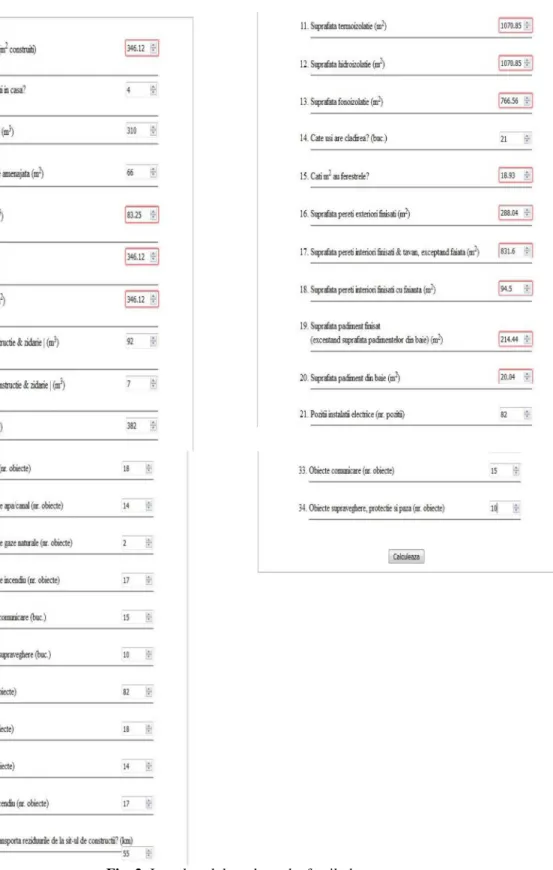
This information will be extracted from a number of 34 questions that project managers / beneficiaries / investors will answer, such as:
• How many square meters does the house
have?
• How many people will live in the house? • How many cubic meters of land will be
excavated?
• How many cubic meters of material are
necessary for the resistance structure?
• How many square feet do the
foundations have?
• How many square feet do the ceilings
have?
• How many cubic meters do the structural
• How many cubic meters do the
non-structural walls have?
• How many square meters does the roof
have?
• How many doors does the building have? • How many square meters of windows
will the building have?
• How many square feet of exterior walls
will be painted?
• How many square meters of yard and
garden will be arranged?
• To what distance will the residues from
the construction site be carried?
• How many communication equipment
positions will the house have?
• How many surveillance equipment
positions will the house have?
Table 1
Initial costs and operating expenses for materials
G.04. Doors - unit: lei/ square meter G.04.1. Wooden doors 163.0
4 0 0 0 0
163.0
4 0 0 0 0 0
Operating expenses
wooden doors 0.5 0 0 0 0 0.5 0 0 0 0 0
G.04.2. Veneer doors 76.08 0 0 76.0
8 0 0 76.08 0 0
76.0
8 0
Operating expenses
veneer doors 0.5 0 0 0.5 0 0 0.5 0 0 0.5 0
G.04.3. Metallic doors (aluminum)
206.5
2 0 0 0 0 0 0
206.5
2 0 0 0
Operating expenses
metallic doors 0.5 0 0 0 0 0 0 0.5 0 0 0
G.04.4. PVC doors 132.6 0 0 0 132.
6 0 0 0 132.6 0 0
Operating expenses PVC
doors 0.5
gcen -2% gcen -2% gcen -2% gcen -2% gcen-2% gcen-2% gcen-2% gcen-2% gcen -2% gcen -2% G.05. Windows - unit: lei/ square meter
G.05.1. Wooden joinery
windows 54.34 0 0 0
54.3
4 0 0 0 54.34 0 0
Operating expenses
wooden joinery windows 0.25 0 0 0 0.25 0 0 0 0.25 0 0
G.05.2. Laminated wood joinery windows
163.0
4 0 0 0 0 0
163.0
4 0 0 0 0
Operating expenses laminated wood joinery windows
0.25 gcen -15% gcen -15% gcen -15% gcen -15% gcen-15% gcen-15% gcen-15% gcen-15% gcen -15% gcen -15% G.05.3. PVC joinery
windows
119.5
6 0 0 0 0 0
119.5
6 0 0 0 0
Operating expenses PVC joinery windows 0.25
gcen -gcen -gcen -gcen - gcen-14% gcen-14% gcen-14% gcen-14% gcen -gcen -G.05.4. Aluminum
joinery windows
179.3
4 0 0 0 0 0 0 0
179.3
4 0 0
Operating expenses aluminum joinery windows
0.5 gcen -4% gcen -4% gcen -4% gcen -4% gcen-4% gcen-4% gcen-4% gcen-4% gcen -4% gcen -4% G.06. Exterior wall finishes - unit: lei/ square meter
G.06.1. Washable paint 3.91 0 0 0 3.91 0 3.91 0 3.91 0 3.91
Operating expenses
washable paint 0 0 0 0 0 0 0 0 0 0 0
G.06.2. Wood 11.95 0 0 0 11.9
5 0 0 0 11.95 0 0
Operating expenses
wood 0.25 0 0 0 0.25 0 0 0 0.25 0 0
G.06.3. Natural stone 54.34 0 0 0 54.3
4 0 0 0 54.34 0 0
Operating expenses
G.06.4. Decorative
plaster 6.52 0 0 0 6.52 0 0 0 6.52 0 0
Operating expenses
decorative plaster 0.25 0 0 0 0.25 0 0 0 0.25 0 0
G.07. Wall and ceiling finishes - unit: lei/ square meter
G.07.1. Washable paint 3.91 0 3.91 0 3.91 0 3.91 0 3.91 0 0 Operating expenses
washable paint 0.25 0 0.25 0 0.25 0 0.25 0 0.25 0 0 G.07.2. Non-washable
paint 3.26 1 3.26 1 3.26 1 3.26 1 3.26 1 1
Operating expenses non-washable paint
0.25 0.25 0.25 0.25 0.25 0.25 0.25 0.25 0.25 0.25 0.25
G.07.3. Crockery 18.47 0 0 0 18.4
7 0 0 0 18.47 0 0
Operating expenses
crockery 0.25 0 0 0 0.25 0 0 0 0.25 0 0
G.07.4. Decorative
plaster 6.52 0 6.52 0 6.52 0 6.52 0 6.52 0 0
Operating expenses
decorative plaster 0.5 0 0.5 0 0.5 0 2 0 0.5 0 0
G.08. Floor finishes - unit: lei/square meter
G.08.1. Wood floors 39.13 0 0 0 39.1
3 0 0 0 39.13 0 0
Operating expenses
wood floors 0.25 0 0 0 0.25 0 0 0 0.25 0 0
G.08.2. Tile floors 18.47 0 0 0 18.4
7 0 0 0 18.47 0 0
Operating expenses tile
floors 0.5 0 0 0 0.5 0 0 0 0.5 0 0
G.08.3. Synthetic
material floors 14.13 0
14.1
3 0
14.1
3 0 14.13 0 14.13 0 0
Operating expenses
synthetic material floors 0.5 0 0.5 0 0.5 0 0.5 0 0.5 0 0 G.08.4. Natural rock
floors 54.34 0 0 0
54.3
4 0 0 0 54.34 0 0
Operating expenses
natural rock floors 0.25 0 0 0 0.25 0 0 0 0.25 0 0
After introducing the answer to all 34 question, the tool will advise on which material should be used at every step when developing
the building. For example, data about a building (Fig. 1) was introduced into the tool (Fig. 2).
Fig. 2: Introduced data about the family house
This particular building is a family house of 346 square meters, where 4 persons will live.
architectural technical design, technical design of interior design, technical design of the structure of resistance, technical project of installations (electrical, gas, water, heating, fire safety, communication, security, protection and surveillance, project obtaining construction permit, technical design of the yard and surrounding area. In the material and execution part, includes: excavation of the land, resistance structure in bearing brickwork, masonry foundations, wooden ceilings, structural and non-structural walls made of AAC and bituminous shingle roof. In addition to this, it also includes the costs of organizing the site and labour.
The total cost of the investment for the house at the turnkey stage is 95417 euros and includes as materials and construction: thermal insulation with products of expanded polystyrene, waterproofing with acrylic layers, sound insulation with mineral wool slabs, PVC doors, windows with carpentry laminated wood, finishing on the exterior walls with wood, finishing the interior walls with washable paint, in bathrooms finishing on the walls with tiles, synthetic material padding, ceramic tile flooring, the installations related to the energy supply, the thermal installations, the installations necessary for the adduction water supply and sewerage systems, natural gas supply facilities, all necessary fire safety installations and, of course, total building work for the turnkey building.
The total cost of the investment for the building at the finish stage is 44150 euros and includes, both materials and execution: non-economic usual electrical equipment, thermal equipment, sanitary equipment, fire safety equipment, yard and garden exterior, transport of waste and unused materials from the construction site and workmanship at this stage of the building.
With regard to additional investments, the most optimal source for obtaining electricity and thermal energy is the 5kW wind turbine power plant. With regard to water, the 2000 L rainwater collection system is best suited. Additional investments also include all the necessary communication facilities and equipment, all the necessary surveillance, guarding and protection facilities, as well as total workmanship for additional investments. Other costs at this stage
include: electricity, heat and drinking and household water. The cost of additional investments is 188764 euros.
Fig. 3: House costs with usual materials vs. additional investments
If the building did not incorporate any smart and sustainable technologies, the electricity, heat and water consumption would reach in 50 years a price point of 311408 euros. With the help of these technologies, the investor pays only 188764 euros for these technologies (including utilities for the entire period of 50
years), surveillance and communication
equipment for the building.
4. CONCLUSION
As a result, if designers and builders were not to include any sustainable and intelligent materials and technologies, the cost of the house for its entire life-cycle of 50 years will be 525.192 euros (Fig. 3). Including the materials and technologies mentioned before will result in a cost of 402.518 euros on the entire life-span of the building, which is a 23.35% reduction in costs (Fig. 3).
account, starting with the design phase, the purchase of materials, workmanship, the actual construction, all the running and maintenance
costs of all building subcomponents.
Furthermore, the demolition of the building and the disposal of waste were also taken into account.
If it were not for any other reason, like protecting the environment or caring for the most unfortunate of us and for out comfort, there would still be a valid point in using these materials and technologies from the costs’ point of view.
7. REFERENCES
[1] European Commission, Communication from the Commission to the European Parliament and Council, Strategy for the
sustainable competitiveness of the
construction sector and its enterprises, Brussels (2012).
[2] Caffrey, R., The Intelligent Building – An ASHRAE Opportunity, ASHRAE Technical Data Bulletin, Vol. 4, Nr. 1 (1985).
[3] Centre for Excellence in Universal Design, Building for Everyone: A Universal Design Approach, National Disability Authority Ireland, Dublin (2012)
[4] Bond, R., Georgantzi, N., Kucharczyk, M., Mollenkopf, H., Rayne, P., Towards Smart, Sustainable and Inclusive Places for All Ages, Age Platform Europe (2011)
[5]Yagi, K., Concept and Development of Eco-materials. Proceedings of International
Workshop on Eco-materials, National
Institute for Materials Science, Tokyo, Japan (2002)
[6] http://www.proidea.ro/rockwool-România-228330/izolatii-pentru-clă diri-rockwool-338801/a_34_d_20_1271767805089_fatade _informatii_generale.pdf (Accessed January 2018).
[7] Bauer, M., Mosle, P., Schwarz, M., Green
Building – Guide for Sustainable
Architecture, Springer, Germany (2010)
[8] Encyclopaedia Britannica, definition (2017)
[9] http://study.com/academy/lesson/what-is-thermal-energy-definition-examples.html [Accessed January 2018]
[10]Centre for Excellence in Universal Design National Disability Authority, Building for Everyone: A Universal Design Approach – Booklet 1 External Environment and approach, Dublin, Ireland (2012)
[11]Centre for Excellence in Universal Design National Disability Authority, Building for Everyone: A Universal Design Approach – Booklet 2 - Entrances and horizontal circulation, Dublin, Ireland (2012)
[12]Centre for Excellence in Universal Design National Disability Authority, Building for Everyone: A Universal Design Approach – Booklet 3 – Vertical circulation, Dublin, Ireland (2012)
[13]Centre for Excellence in Universal Design National Disability Authority, Building for Everyone: A Universal Design Approach – Booklet 4 – Internal Environment and Services, Dublin, Ireland (2012)
[14]Centre for Excellence in Universal Design National Disability Authority, Building for Everyone: A Universal Design Approach – Booklet 5 – Sanitary facilities, Dublin, Ireland (2012)
[15]Centre for Excellence in Universal Design National Disability Authority, Building for Everyone: A Universal Design Approach – Booklet 6 – Facilities în buildings, Dublin, Ireland (2012)
[16]Centre for Excellence in Universal Design National Disability Authority, Building for Everyone: A Universal Design Approach – Booklet 8 – Building management, Dublin, Ireland (2012)
[17]Building Asset Management, What happens over the life of a building? Information Bulletin No. 4, CHOA, RDH Building Engineering Ltd. and the Real Estate Foundation of BC (2016)
[18]Sârb, A., Brad, S., Stan, O., Timoftei, S., Life-Cycle Building Costs Based on Particle Swarm Optimization, • Anca Sârb, Stelian Brad, Ovidiu Stan, Sanda Timoftei, Life-Cycle Building Costs Based on Particle
Swarm Optimization, Acta Technica
Architecture, Vol. 59, Issue 2, pg. 61-70, ISSN 1221-5848 (2016)
[19]Hart, J. M. S., Strategy and specification, Terotechnology Handbook, ed D. Parkes. Department of Industry, HMSO London, pg. 20-28 (1978)
[20]Hyson, J. L, Life cycle costing in energy conservation analysis, Journal of Proper Management, Vol. 44, pg. 332-337 (1979)
TEHNICI PENTRU ASIGURAREA UNOR COSTURI MINIMALE ȘI PROTECȚIA MEDIULUI ÎN CLĂDIRI
Rezumat: Având în vedere faptul că resursele naturale sunt mai rare din zi în zi, locuitorii actuali ai planetei noastre trebuie să utilizeze aceste resurse la maximum de potențial și trebuie să găsească
modalități alternative de a utiliza substituenți regenerabili, ori de câte ori este posibil. De la industria textilă până la industria automobilelor până la construcții, industria este interesată și investită în protejarea resurselor și a mediului. Această lucrare abordează această nevoie și îi ajută pe profesioniștii și investitorii din domeniul construcțiilor să aleagă cele mai bune materiale și tehnologii în ceea ce privește costurile și protecția mediului, încorporând tehnologia inovatoare în clădiri și îngrijindu-i pe locuitori. Procesul de alegere a materialului sau a tehnologiei folosite va fi făcut cu ajutorul unui instrument care va ghida profesioniștii să ia o decizie în cunoștință de cauză cu privire la utilizarea unui material / tehnologie sau a altui produs.
Emilia BRAD, Technical University of Cluj-Napoca, Department of Design Engineering and Robotics, [email protected]
Anca SARB, Technical University of Cluj-Napoca, Department of Design Engineering and Robotics, [email protected]
Razvan-Marius POPA, Technical University of Cluj-Napoca, Department of Design Engineering and Robotics, [email protected]