TECHNICAL UNIVERSITY OF CLUJ-NAPOCA
ACTA TECHNICA NAPOCENSIS
Series: Applied Mathematics, Mechanics, and Engineering Vol. 62, Issue III, September, 2019
ANALYSIS OF THE FREQUENCY CHARACTERISTICS OF THE
AUTOMATIC CONTROL SYSTEM OF MANUFACTURING PROCESS
PARAMETERS
Oleksandr YENIKIEIEV, Fatyma YEVSIUKOVA, Olga PRIHODKO, Maryna IVANOVA, Yevheniia BASOVA, Magomediemin GASANOV
Abstract: A technique for the synthesis of hardware controls of the manufacturing processes parameters with specified accuracy and capacity has been developed on basis of the frequency characteristics method. The mathematical model of a computing unit in the form of an aperiodic circuit with delay is proposed for the first time. An information technology for analyzing the frequency characteristics of a control system with using the capabilities of the Matlab has been developed. An amplitude frequency characteristics, the Nyquist hodograph, transfer and pulse response transfer characteristics were obtained by computer simulations. Moreover the stability margin of the system by the amplitude was determined. It is proved that the application of developed techniques increases the productivity of the process of hardware synthesis.
Key words: frequency-response method, automatic control system, hardware, capacity, mathematics and computer modeling.
1. INTRODUCTION
By the adoption of the modern information and energy-saving technologies into engineering industry of Ukraine distributed computer systems of coordinate control software for machine tools have found application [1-4]. The expediency of using these systems is ensured by decreasing of the processing time and obtaining a specified roughness of the workpiece surface. In turn, the accuracy and performance of hardware determine the quality indicators of software control systems by the parameters of manufacturing processes.
Modern computer mathematics offers integrated software (Eureka, Gauss, Derive, MathCAD, Mathematical, Matlab etc.) and application packages that make it possible to significantly simplify mathematical calculations in the synthesis of hardware with specified metrological characteristics and processing of input information [5-8]. In addition, the computational approach for using artificial neural networks with the related software is proposed in paper [9-10]. On basis of the use of matrix operations, these software environments
also provide the solution to the problems of studying the dynamics of automatic control systems (ACS) by the parameters of manufacturing processes.
1.1 Analysis of the current state of knowledge and the formulation of the problem
processing hardware, specified accuracy and productivity, solves such tasks [16]:
- mathematical modeling of components with taking into account the uncertainty factor;
- equivalent transformation of the ACS structural scheme;
- setting of zeros and poles of the transfer function;
- determination of the stability reserve of the ACS and the corresponding adjustment of its transfer function;
- construction and analysis of frequency characteristics of ACS;
- synthesis under the conditions of random interference of the input signal processing device on the basis of minimization of the quadratic quality criterion using the reference ACS model;
- constructing a computer simulation scheme for the process of transformation of information; - establishing the quality, accuracy and speed of ACS hardware.
Practical implementation of this technique involves the use of a sufficiently large amount of manual labour, which significantly reduces the productivity of the process of synthesizing hardware for program control of the parameters of manufacturing processes of machining of parts.
1.1 The aim and tasks of research
The aim of the research is to increase the productivity of the hardware synthesis process with the corresponding metrological characteristics and productivity based on the using of Matlab capabilities.
To achieve the aim it is necessary to solve the following tasks:
- obtaining a mathematical model of the lathe actuator;
- plotting a structural diagram of the ACS with longitudinal feed of the lathe;
- carrying out mathematical modeling of the components of the ACS taking into account the uncertainty factor caused by random interference and measurement errors;
- development a technique for analyzing the frequency characteristics of the ACS by an longitudinal feed of a lathe in a Matlab.
2. RESEARCH MATERIALS AND
METHODS OF FREQUENCY
CHARACTERISTICS OF ACS
2.1 Mathematical modeling of components The object of regulation of the system for controlling the parameters of the technological process of machining a workpiece is a direct current (DC) motor or alternating current (AC) motor. The instantaneous rotation speed of the shaft is its output signal. The behavior of the DC motor in the transient states is described by the following system of integro-differential equations [17]:
(1)
where c1 – counterelectromotive force coefficient; U – control voltage; L, R, I – respectively inductance, winding resistance and current strength of anchor; Ω, φ – respectively instantaneous speed and angle of rotation of engine; J – moment of inertia; М1, М2 – the rotational and load moment, respectively.
In the operator form under zero initial conditions, the equations (1) of the motion of the DC motor acquire this view
(2)
where c2 is the coefficient of moment.
In the system of equations (2) we take into account the fact that
(3)
or
(4 )
where for the engine type SL281: k– conversion coefficient, k = k1k2 = 0.87 ∙ 25.39 = 22.1; T1 – electromagnetic time constant,
T1=L/R=0.00043C; T2 – mechanical time
constant, ; F -
damping Coefficient, F = c1c2/R = 0.0018.
Taking into account that M2 = 0, the transfer function of the DC motor with control action is obtained from expression (4)
(5)
Or in the form of a sequential connection of elementary chains
(6)
Taking into account that U = 0, the transferfunction of a DC motor with perturbing influence is obtained from expression (4)
(7)
Or in the form of a sequential connection of elementary chains
(8)
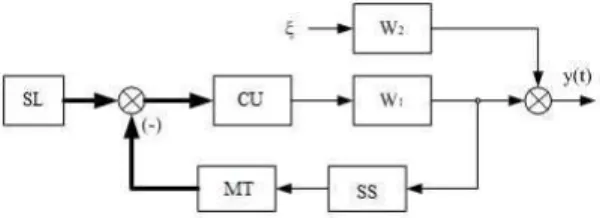
Expressions (6) and (8) were used by the authors for the development of the structural scheme of the ACS of the lathe longitudinal feed (fig. 1). The foundation of its construction is based on the principle of deviation control. This
scheme is made up from the following elements: comparison node (CN), actuator (A), sensor of law of variation of longitudinal feed (SL); computing unit (CU) based on the microcontroller STM32F745; speed sensor (SS); measuring transducer of rotation speed (MT); ξ – perturbing influence, which acts on the output signal of the ACS. In order to obtain an expression for the transfer function, the development of mathematical models of components and analysis of the structural scheme of the ACS was performed.
Fig. 1. Structural scheme of ACS of the lathe longitudinal feed
CU performs a comparison of the instantaneous rotation speed with the optimal value that the block SL sets. It also forms a control action for the corresponding A. Computing procedures take some time, the duration of which is calculated on the basis of the number of commands of the control program and the clock frequency of the system generator. Therefore, during the execution of these computational procedures, we submit the CU in the form of a proportional chain with a delay. The output signal CU is the control action for the DC motor. Thus, taking into account expression (6), the representation of the transfer function OB has the following form
(9)
where τ3 – delay of CU, τ3 = 0.0001С ; k3 – conversion coefficient.
Taking into account that after mathematical transformations the transfer function CU acquires the following form
The conversion coefficient CU is determined on basis of following normalization condition
(11)
Information on the optimum values of the longitudinal feed of the tool is located in the microcontroller database. Therefore, the block SL is shown in the form of a proportional chain with such a transfer function
(12)
The specificity of the operation of the SS and MT blocks in the ACS of the lathe longitudinal feed makes it possible to present them in the form of a proportional chain with a delay. The transfer function of a such chain has the following form
(13)
where k5 = 27.669, τ5 = 0.0002 С.
The transfer function of the SS and MT blocks, taking into account the dead band Δ1 around their nominal conversion characteristics, takes the following form
(14)
The error in the processing of the input signal by SS and MT blocks is quantitatively manifested in changes in the source code. Its quantitative estimation was obtained on basis of the statistical manipulation of research data
(15)
The transfer function of the SS and MT blocks after mathematical transformations takes the following form
(16)
As a result of the analysis of the structural scheme and mathematical transformations, the transfer function of the ACS of the lathe longitudinal feed was obtained in this view
(17 )
where
After the transfer function of the ACS of the lathe longitudinal feed has been established, the development of information technology for analyzing its frequency characteristics in the Matlab is made.
2.2 Information technology of analysis of frequency characteristics
The corresponding transfer functions of the components of the ACS of the lathe longitudinal feed (expressions 6, 10 and 16) are the initial data for the Matlab software. They are presented in this forms
W1=tf([k]),[T1*T2 T2 1]); W3=tf([k1*k2],[τ3*T1 τ3+T1 1]); W5=tf([Δ1*k5]),[τ5 1]).
The calculation of the frequency characteristics of the ACS is performed in command mode. The Matlab software functionalities allow to directly determine the transfer function of the ACS of lathe. To calculate it the following expression was used W6=W1*W3/(1+W1*W3*W5).
Information technology for calculation in the Matlab software of the frequency response characteristics of the ACS of the lathe longitudinal feed consists of the following computational procedures:
- logarithmic amplitude and phasefrequency characteristics (LAFC and LPFC) are constructed using the command bode(W6);
- using the nyquist(W6) command, the Nyquist hodograph is been defining;
- the stability margin of the ACS in amplitude is calculated with the command margin(W6);
- the transient characteristic of the ACS of the lathe longitudinal feed is built with the command step (W6);
- the impulse response of the ACS is built using the command impulse(W6);
- similar results were obtained using the ltiview(W6) command, with the corresponding settings in the menu "Plot Configuration".
For the further synthesis of signal processing devices the LAFC of the mathematical model of the ACS of the lathe longitudinal feed is used. The synthesis procedure consists of such computational procedures:
- its linearization is carried out;
- the desired characteristic is constructed; - the difference between them gives the LAFC of the regulator;
- the transfer function of the regulator is determined;
- the transfer function ACS with the regulator is calculated;
- the scheme of computer modeling of theprocess of input information transformation is constructed.
3. THE RESULTS OF RESEARCH OF FREQUENCY CHARACTERISTICS
The results of searching for zeros and poles of the transfer function of the mathematical model of the ACS of the lathe longitudinal feed are given in table 1. Analysis of this table data allows concluding the following:
- all the roots of the characteristic equation are obeyed to the stability condition of the ACS; - root eight affects the start of the transition process because it's small;
- the roots of the numerator and denominator of the transfer function, which roughly coincide in magnitude, are reduced;
- ACS of the lathe longitudinal feed without significant loss of precision, can be given such a transfer function
(18 )
where Т4, Т6, Т7, Т8 – time constants, which are determined in accordance as the first, fourth, seventh and eighth roots of the characteristic equation.
Table 1
Zeros and poles of the transfer function.
After mathematical transformations, expression (18) takes the following view
(19)
where
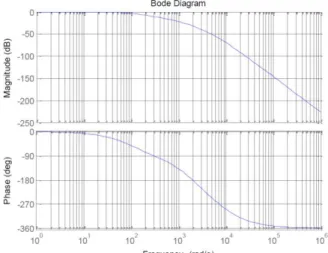
Fig. 2. Comparison of LAFC and LPFC of the ACS Similarly, the Nyquist hodograph, transitional and impulse transition characteristics of the ACS of the lathe longitudinal feed can be studied.
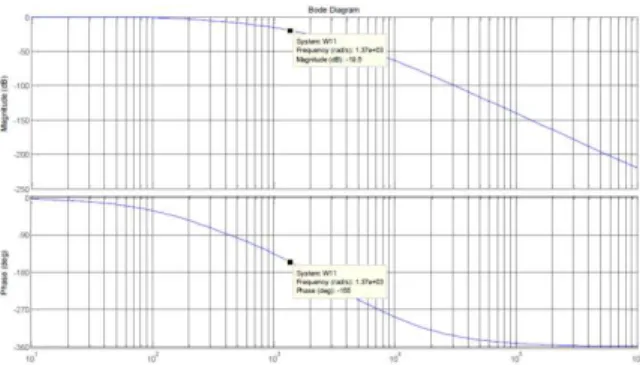
Calculation of the stability margin for the amplitude of the ACS of the lathe longitudinal feed is shown in Fig. 3.
Fig. 3. Calculation of the stability margin of the ACS for the amplitude
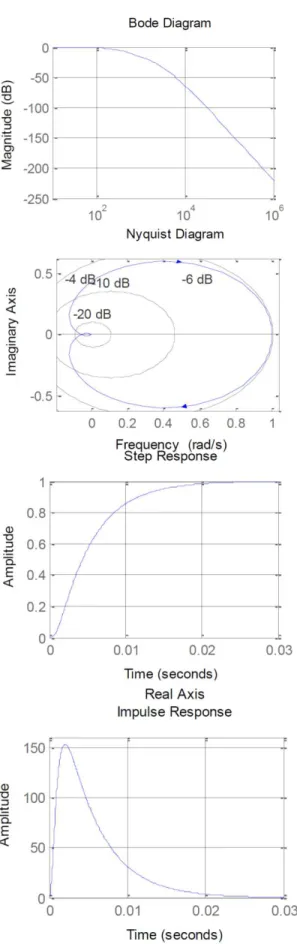
The results of the LAFC calculations, the Nyquist hodograph, the transitional and impulse transition characteristics of the ACS were obtained using the ltiview (W) command, with the corresponding settings in the "Plot Configuration" menu, and are shown in Fig. 4.
As a result of the analysis of the transitional characteristic of the ASC with longitudinal feed of the lathe, it is established that under the influence of a signal as a unit function at the its input the transitional characteristic is aperiodic.
Therefore, there is no overshoot of the output signal of the ACS. A comparison of the Bode diagrams of a closed ACS (See Fig. 3) and its simplified model (See Fig. 4) makes possible to conclude that this computational procedure is correct.
Thus, the authors propose a technique for simplifying expressions for the transfer functions of the ACS by eliminating the roots of the numerator and the denominator, and also in rejecting the roots of the second order infinitesimal.
The method of frequency characteristics in calculating the parameters of the regulator provides for the use of the transfer function of an open ACS by longitudinal feed of a lathe. It was obtained as a result of an analysis of the structural scheme and mathematical transformations in the next form
(20 )
where
The Bode diagram of an open ACS by an longitudinal feed of a lathe is shown in Fig. 5.
The transition to the frequency domain after mathematical transformations gives such a transfer function of the closed ACS with the longitudinal feed of the lathe
(21 )
Fig. 5. The Bode diagram of an open ACS where amplitude and phase-frequency characteristics are defined as
(22 )
(23 )
To determine the LAFC of a closed ACS, the following expression can be used
(24 )
The transfer function of a closed ACS by the longitudinal feed of a lathe is four series connected periodic chains. Therefore, its asymptotic amplitude characteristic has four salient points. Knee frequencies are
Fig. 6. The Bode diagram of closed ACS The phase characteristic of the automaticcontrol system is obtained by adding the corresponding characteristics of the chains
(26)
From Table 1 it can be seen that the transfer function of a closed ACS by a longitudinal feed of a lathe has one dominating pole. The circular frequency of this pole is 1369.04 rad/sec. The gain and the phase delay of the ACS were determined with a Bode diagram (Fig. 6). Similarly, it is possible to investigate the knee frequencies of the logarithmic amplitude and phase-frequency characteristics of the transfer function, as well as the limiting frequency of a closed ACS by lathe longitudinal feed.
4. DISCUSSION OF THE RESEARCH RESULTS
As a result of theoretical studies, equations (6) and (8) were obtained which establish information links between control signals and disturbances influencing and instantaneous rotation speed of the actuator shaft. On the basis of these expressions, a structural scheme of the ACS of the lathe longitudinal feed has been developed and a transfer function has been obtained. The information technology of the analysis of frequency characteristics is constructed taking into account the possibilities of Matlab software for appropriate calculations. A technique for studying and adjusting the frequency characteristics of the ACS, simplification of the expression for its transfer function by cancellation the roots of the
numerator and denominator with coincided or close numerical values are proposed. Confirmation of the high productivity of the computational procedure for analyzing the frequency characteristics of the ACS of the longitudinal feed of the lathe was received.
5. CONCLUSION
1. An ACS of the longitudinal feed of a lathe on the basis of the mathematical model of a DC motor was developed.
2. The mathematical model of a computing unit in the form of an aperiodic circuit with delay is proposed for the first time. The parameters of the circuit are set by the load of the corresponding communication line, and the delay is calculated as a result of summing the execution time of the commands of the control program.
3. Mathematical models of components are constructed. The error in measuring the rotational speed of the executing mechanism was determined as a result of statistical processing of experimental data using an information approach.
4. Based on the capabilities of the Matlab software, a methodology and information technology for analyzing the frequency characteristics of a control system for the parameters of technological processes was developed. A technique for studying and adjusting the frequency characteristics of the ACS based on simplification of the expression for its transfer function by cancellation the roots of the numerator and denominator with coincided or close numerical values are proposed. The correctness of the proposed technique was established by comparison of the Bode diagrams of a closed system and its simplified mathematical model.
5. It is established that the using of methodology and information technology improves the efficiency of the hardware synthesis process with specified metrological characteristics and productivity.
6. REFERENCES
scheduling service, Int. J. Time-Critical Comput. Syst, 1999.
http://citeseerx.ist.psu.edu/viewdoc/download? doi=10.1.1.136.2454&rep=rep1&type=pdf [2] Martinov G.M., Martinova L.I., Kozak N.V.,
Nezhmetdinov R.A., Pushkov R.L. Princip postroeniya raspredelennoj sistemy chpu s otkrytoj modul'noj arhitekturoj [Principles of constructing a distributed CNC system by technological machines using an open modular architecture]. Engineering Journal, ISSN 2072-3172, No 12, 2011; pp. 44-50. Russian.
[3] Weck M., Wolf J. Introduction to STEP-NC, A standard providing data for modern NC machining enabling enhanced functionality. Laboratory for Machine Tools and Production Engineering Aachen University of Technology. Aachen. 2003. February 12. P. 52.
[4] William C. Dunn. Fundamentals of Industrial Instrumentation and Process Control. ISBN:9780071457354. McGraw Hill Professional; 2005. USA. DOI: 10.1036/0071466932
[5] Rybin Yu.K. Measuring Signal Generators, Signals and Communication Technology. ISSN 1860-4862. Springer International Publishing Switzerland; 2014. DOI: 10.1007/978-3-319-02833-0.
[6] Kiryanov D.V. Samouchitel Mathcad [Tutorials Mathcad]. ISBN 5-94157-348.0 St. Petersburg, 2003. Russian.
[7] Domnisoru, C. Using Mathcad in Teaching Power Engineering. ISSN 0018-9359. IEEE Transactions on Education, Vol 48, No 1,
2005, pp. 157-161. DOI:
10.1109/TE.2004.837043.
[8] Klepka A. Real time estimation of modal parameters of non-stationary systems using adaptive wavelet filtering and recursive least square algorithm. ISSN 1641-6414. Diagnostyka, Vol. 16, No 1, 2015, pp. 3-8. [9] Pavlenko I., Trojanowska J., Ivanov V.,
Liaposhchenko O. (2019) Scientific and Methodological Approach for the Identification of Mathematical Models of Mechanical Systems by Using Artificial Neural Networks. In: Machado J., Soares F., Veiga G. (eds), pp. 299-306, ISBN
978-3-319-91333-9. Innovation, Engineering and Entrepreneurship. HELIX 2018. Lecture Notes in Electrical Engineering, vol 505. Springer, Cham. DOI: 10.1007/978-3-319-91334-6_41.
[10] Pavlenko I., Simonovskiy V., Ivanov V., Zajac J., Pitel J. (2019) Application of Artificial Neural Network for Identification of Bearing Stiffness Characteristics in Rotor Dynamics Analysis. In: Ivanov V. et al. (eds), pp. 325-335, ISBN 978-3-319-93586-7. Advances in Design, Simulation and Manufacturing. DSMIE 2018. Lecture Notes in Mechanical Engineering. Springer, Cham.DOI:10.1007/978-3-319-93587-4_34. [11] Dorf R.C., Bishop R.H. Modern Control
Systems. ISBN-10: 0-13-602458-0, Addison: Wesley: Prentice Hall; 2010.
[12] A. Kotowski. The method of frequency determination of impulse response components based on cross-correlation vs. fast Fourier transform. ISSN 1641-6414. Diagnostyka, Vol. 17, No 1, 2016, pp.59-64. [13] Ayasun S, Nwankpa CO. Transformer tests
using MATLAB/Simulink and their integration into undergraduate electric machinery courses. Online ISSN:1099-0542 Wiley Periodicals, Inc. Comput Appl Eng Educ, Vol. 14, No.2, 2006, pp. 142–150. DOI 10.1002/cae.20077.
[14] Chaparro LF. Signals and systems using MATLAB. ISBN 978-0-12-374716-7 Elsevier Inc. 2011.
[15] Dyakonov VP. Maple 9.5/10 v matematike, fizike i obrazovanii [Maple 9.5/10 in mathematics, physics and education]. ISBN: 5980032584. SOLON-PRESS; 2009. Russian.
[16] Yenikieiev OF, Abramskaya IB, Yarovoy RA. Komp'yuternaya sistema programmnogo zadaniya poperechnoj podachi shlifoval'nogo kruga [Computer system for program specification of the transverse feed of a grinding wheel]. ISSN 1991-3087. Journal of Scientific Publications of Post-Graduate Students and Doctoral Students. Fuel, No 11, 2014, pp. 174 - 181. Russian.
[Fundamentals of synthesis and design of follow-up systems of machine tools and industrial robots]. DDMA; 2008. Ukrainian.
Analiza caracteristicilor de frecvență ale sistemului automat de control al parametrilor procesului de producție
Rezumat: O tehnică pentru sinteza controalelor hardware ale parametrilor proceselor de fabricație cu precizie și capacitate specificată a fost dezvoltată pe baza metodei caracteristicilor de frecvență. Modelul matematic al unei unități de calcul sub forma unui circuit aperiodic cu întârziere este propus pentru prima dată. A fost dezvoltată o tehnologie de informare pentru analiza caracteristicilor de frecvență ale unui sistem de control cu utilizarea capacităților Matlab. O caracteristică a frecvenței de amplitudine, caracteristicile de transfer ale spectrului de frecvență Nyquist, transfer și răspunsul la impulsuri au fost obținute prin simulări pe calculator. Mai mult decât atât, marja de stabilitate a sistemului prin amplitudine a fost determinată. Se demonstrează că aplicarea tehnicilor dezvoltate sporește productivitatea procesului de sinteză hardware.
Oleksandr YENIKIEIEV, Doctor of technical sciences, Head of Department (BrE), Donbass State Engineering Academy, Faculty of Automation of mechanical engineering and information technologies, Department of intellectual decision making systems, [email protected], 72, Akademichna str., 84313, Kramatorsk, Donetsk region., Ukraine.
Fatyma YEVSIUKOVA, Senior Lecturer, National Technical University «Kharkov Polytechnic Institute», Department of Technology of Mechanical Engineering and Metal-Cutting Machine Tools, [email protected], 2, Kyrpychova str., 61002, Kharkov, Ukraine.
Olga PRIHODKO, PhD, Docent, Associate Professor at the Department of technology of mechanical engineering and metal-cutting machine tools of the Educational and scientific institute of mechanical engineering and transport of the NTU «KhPI», [email protected], 2, Kyrpychova str., 61002, Kharkov, Ukraine.
Maryna IVANOVA, PhD, Associate Professor at the Department of technology of mechanical engineering and metal-cutting machine tools of the Educational and scientific institute of mechanical engineering and transport of the NTU «KhPI», [email protected], 2, Kyrpychova str., 61002, Kharkov, Ukraine.
Yevheniia BASOVA, PhD, Associate Professor at the Department of technology of mechanical engineering and metal-cutting machine tools of the Educational and scientific institute of mechanical engineering and transport of the NTU «KhPI», [email protected], 2, Kyrpychova str., 61002, Kharkov, Ukraine.