TECHNICAL UNIVERSITY OF CLUJ-NAPOCA
ACTA TECHNICA NAPOCENSIS
Series: Applied Mathematics, Mechanics, and Engineering Vol. 61, Issue Special, September, 2018
OPTIMAL FLOW CONTROL FOR INCREASED ELECTRICITY
PRODUCTION IN SMALL HYDROPOWER PLANTS
Daniel Vasile BANYAI, Ionel Radu POP, Dan OPRUTA, Liviu Ioan VAIDA
Abstract: Hydropower is the most flexible and consistent of the renewable energy resources. A particular importance should be given to small hydropower plants, because of their large number. Small hydropower plants are sized so the servitude flow is obtained at minimum level of water, and when the level increase this flow increases. The difference between effective servitude stream flow and the amount required by the law, may be considered as a loss of energy in the sense that it could be sent to the turbine, thus increasing the produced energy. For this, it is necessary the use of a sluice gate for flow section adjustments. The paper presents the mathematical model for hydropower constructions of this type (up to 5 MW), which was utilized for numerical simulations, showing the main advantage mentioned above. The flow coefficients in the model were corrected after measurements made at two different hydropower plants. Then, a software application was made for dimensioning: the water intake, accumulation reservoir, desander, charging chamber and supply duct, so all the available flow is used.
Keywords: Renewable energy, Hydropower, Energy efficiency, Ecosystem, Numerical simulations, Flow control.
1. INTRODUCTION
Hydropower is the leading renewable source for electricity generation globally, supplying 71% of all renewable electricity, it generated 16.4% of the world’s electricity from all sources in 2016. [1] Hydropower is the most flexible and consistent of the renewable energy resources, capable of meeting base load electricity requirements as well as peak and unexpected demand. A particular importance should be given to small hydropower plants, because of their large number, also designing at maximum energy efficiency is mandatory. Analysing several such constructions in Romania, designed by different engineering companies from Europe, it was found that the stream flow that must be maintained on the bedside, imposed by the legislation, it is not controlled/adjustable. The servitude flow is defined as the minimum flow required to be permanently left on a stream
implementing of the flow control system, optimizing the existing plants. For this purpose, the mathematical model was made for each elements characteristic to small hydropower plants, and then measurements were made on two such constructions in order to correct the values of the coefficients introduced in the equations.
2. CASE STUDY
In the following, is presented the case of one of the hydropower plant from the studied ones. It is located in Romania, Cluj country, using the water of Răcătau stream. The main features are
[2]:
● Flow rate: 200 to 1500 l/s. ● Total Head: 123 m.
● Water intake: margin Tyrolian type (surface
intake) and bottom with sluice gate (winter intake)
● Turbine: Pelton; 6 Nozzles; Power: 1.6 MW. ● The average annual energy: 5877 MWh.
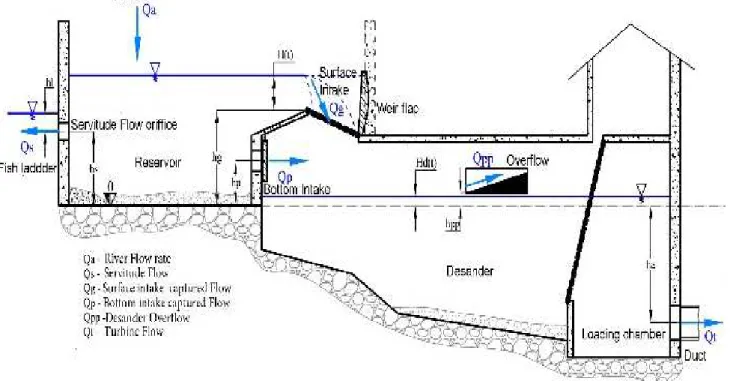
The construction elements of the hydroelectric plant, that make the subject of this paper, are presented in the 3D model of Figure 1. Figure 2 represent a general scheme of micro-hydropower plants, used to achieve the mathematical model and after the standalone simulator software.
Fig. 1: 3D model of the water intake – HPP Răcătău [2]
Fig. 2: Small Hydropower plant general scheme
In this times, the water intakes, capture the stream in two ways, depending on season: in summer at the surface through a inclined rack (1) and in winter by an immersed hole, below freezing level, called winter intake (2). The captured water flow for energy production is influenced by the fish ladder flow (3), which
high enough that the required value for the servitude flow is much higher that the required value, for optimum performance, the winter intake (bottom intake) should open, by changing the gate position, thus increasing (from zero when close) the flow passing through. Consequently, the servitude flow decreases, of course it can not fall below the legal limit.
3. MATHEMATICAL MODEL
Within engineering concerns, the mathematical model focuses on describing the evolution of physical entities in a system. Through their informational, qualitative and quantitative content, mathematical relationships, often prove to be highly performing for engineering research. [3] [4] The analogue model of the system will be described by a set of mass continuity equations, with the expressions of the flows depending on each type of constructive element represented. The system consists of three equations, two continuity of the mass and one for the PID controller:
( )
( )
( ) ( ) ( ) ( )
0
res A S G P
De
des G P T PP
t
P I D
dH t
S Q Q Q Q
dt
dH t
S Q Q Q Q
dt
de t
y t k e t k e d k
dt τ τ = − − − = + − − = +
∫
+ (1) where,Sres – surface area in square meters of the resorvoir.
Sdes – surface area in square meters of the desander.
H(t) – Water level in reservoir. HDe(t) - Water level in desander.
QA; Qs; QG; QP; QT; QPP – see Fig. 2.
( )
1 2
S D o G S l
Q =C S g H t +h −h −h (3)
( ) 1.5 2 2 2 3
G D G
Q =C l H t g (4)
( ) ( )
3 2
P D P G P
Q =C y t b g H t +h −h (5)
( )
(
)
2
4 2
4
T D De A
D
Q =C π g H t +h (6)
( )
1.5
5 2
PP D PP De
Q =C l H t g (7)
( ) S( ) seritude flow imposed
e t =Q t −Q (8)
CD1…5 – flow coefficients.
KP; KI; KD – PID controller constants.
S0=lS·bs – oriffice area for servitude flow, in a
plane perpendicular to the flow.
hG – height from datum to the capture rack.
hS – height from datum to the center of the
oriffice for servitude flow.
hl – water level downstream the oriffice for
servitude flow.
lG – length of the rack perpendicular to flow
direction.
bp – width of the bottom intake.
hp – height from datum to the center of the
bottom intake.
y(t) – variable height of the bottom intake, sluice gate stroke.
lpp – length of the overflow oriffice.
hA – height from datum to the center of the duct.
D – duct diameter.
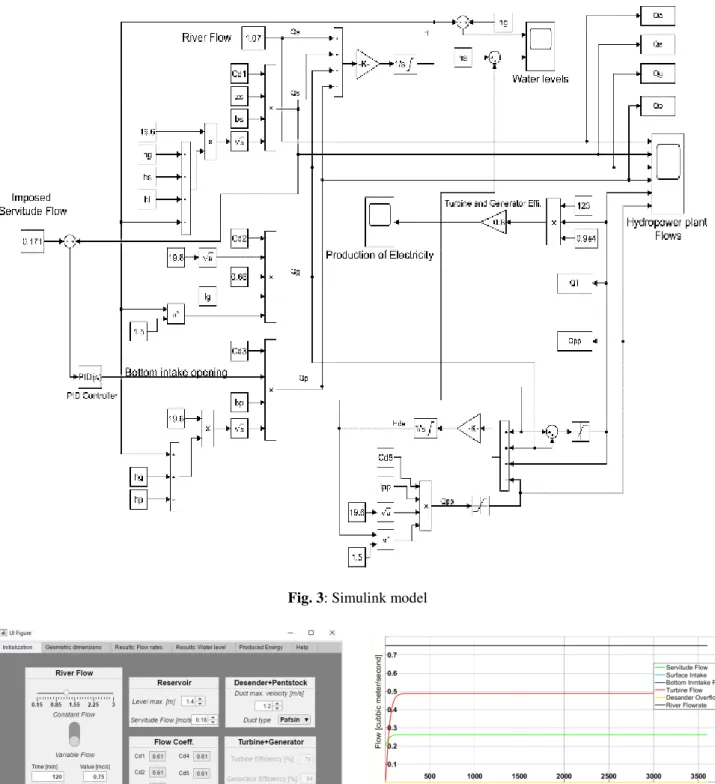
For solving the equations a Simulink model was created, shown in Fig. 3.
After completing the simulation model, it was verified with measurements taken from the plant described in the paper. Thus, the value of coefficients that appear in the equations have been adjusted for each flow, in different scenarios, but these aspects are not the subject of this paper.
Figure 4 contains an image for the software user interface, in order to transform the model into a very easy to use stand-alone application tool.
4. RESULTS AND CONCLUSIONS
In the user interface of the simulation program, the desired river flow rates, the position for the gate of the bottom intake (like a constant or it can work in automated mode, controlled by a PID), the geometric parameters are all settable.
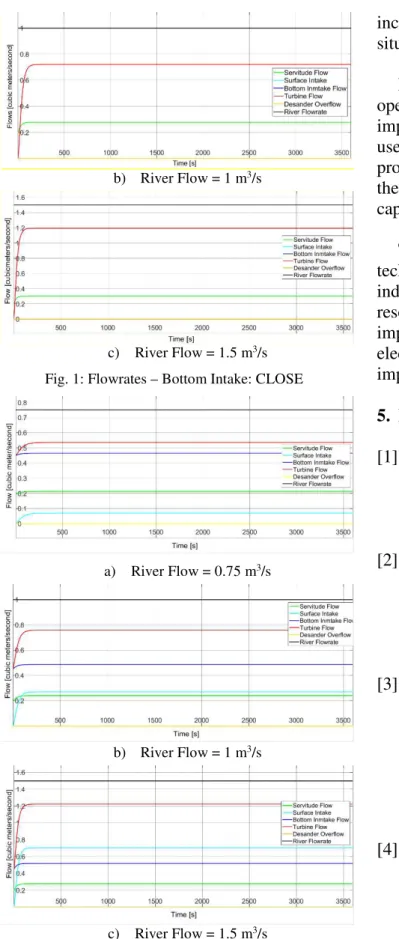
Analysing the graphs, we find that the servitude flow is above the required value, so if this difference had been captured, or at least part of it, the energy production would be higher. The results, under the same conditions for the river
flow, but with bottom intake (winter intake) fully open, are presented in Figure 6.
Fig. 3: Simulink model
Fig. 4: Software User interface
b) River Flow = 1 m3/s
c) River Flow = 1.5 m3/s
Fig. 1: Flowrates – Bottom Intake: CLOSE
a) River Flow = 0.75 m3/s
b) River Flow = 1 m3/s
c) River Flow = 1.5 m3/s
Fig. 2: Flowrates – Bottom Intake: OPEN
By comparing the results, the importance of using an automatic intake system is justify,
increasing thus the energy production, in this situation with about 4…5%.
Even in this situation, with bottom intake open, the servitude flow has a value above that imposed by the operating license (+13%). The usefulness of the simulation application, is proven at the design stage, thus dimensioning the constructive elements more convenient, to capture all the available free energy.
The development of this type of tools, in all technical domains is a necessary aspect for industry 4.0. In the field of renewable energy resources, there is much to be researched to improve them constructively, thus increasing electricity production without cost or negative impact on the natural environment.
5. REFERENCES
[1] Whiteman, A., Rinke, T., Esparrago, J., Elsayed, S., Renewable Capacity Statistics, IRENA - The International Renewable Energy Agency, ISBN :978-92-95111-83-7, (2016)
[2] Pop, R., Vaida, L., Bot, A., Water intake flow efficiency study for micro-hydro power plant, AIP Conference Proceedings, Vol. 1917,
No.1, DOI:
doi.org/10.1063/1.5019452, (2017). [3] Marcu, I.L., Functional parameters
monitoring for an alternating flow driven hydraulic system, 2008 IEEE International Conference on Automation, Quality and Testing, Robotics, DOI: 10.1109/AQTR.2008.4588919, Cluj-Napoca, Romania, (2008).
CONTROLUL OPTIM AL DEBITELOR PENTRU CREȘTEREA PRODUCȚIEI DE ENEGRIE ELECTRICĂ LA HIDROCENTRALE MICI
Abstract: Hidrocentralele sunt cele mai flexibile și numeroase dintre resursele de energie regenerabile. O importanță deosebită ar trebui acordată micilor hidrocentrale, datorită numărului lor mare. Microhidrocentralele sunt dimensionate astfel încât debitul de servitute să se obțină la un nivel minim de apă iar atunci când nivelul crește acest debit crește. Diferența dintre debitul de servitute efectiv și cantitatea cerută de lege poate fi considerată ca o pierdere de energie în sensul că ar putea fi trimisă la turbină, mărind astfel energia electică produsă. Pentru aceasta, este necesar să se utilizeze o stavilă mobilă pentru reglajele secțiunii de curgere. Lucrarea prezintă modelul matematic pentru construcțiile hidroelectrice de acest tip (până la 5 MW), care a fost utilizat pentru simulări numerice, arătând principalele avantaje menționate mai sus. Coeficienții de debit din model au fost corectați după măsurătorile efectuate la două centrale hidroelectrice diferite. Apoi, s-a realizat o aplicație software pentru dimensionare: prizei de captare a apei, rezervorul de acumulare, deznisipator, camera de încărcare și conducta de aductiune la turbină, astfel încât se utilizează tot debitul disponibil.
Daniel Vasile BANYAI, Technical University of Cluj-Napoca, [email protected]
Ionel Radu POP, National Institute for Research and Development of Isotopic and Molecular Technologies Cluj-Napoca, [email protected]
Dan OPRUTA, Technical University of Cluj-Napoca, [email protected]