Minimum Financial
Requirements
Effective 1 October 2014
1 October 2014 1 | P a g e
Contents
1. Financial Requirements ... 4 1.1 Financial Requirements ... 4 1.2 Objectives ... 41.3 Application of this policy ... 4
1.4 Applicants and Licensees must comply with this policy ... 4
1.5 Information provided by an Applicant or Licensee ... 4
1.6 Parts 2 - 7 not applicable in certain circumstances ... 5
1.7 Forms ... 6
2. Net Tangible Assets ... 7
2.1 Financial Requirement - Net Tangible Assets ... 8
2.2 Demonstrating Sufficient Net Tangible Assets ... 8
2.3 Decreases in Net Tangible Assets ... 8
2.4 Negative Net Tangible Assets ... 8
2.5 Asset Valuations ... 8
2.6 Related Entity Loans and Investments Assets ... 9
2.7 Deed Of Covenant And Assurance ... 9
3. Maximum Revenue ... 10
3.1 Financial Requirement – Maximum Revenue ... 11
3.2 Calculating Maximum Revenue ... 11
3.3 Exceeding Maximum Revenue ... 11
4. Current Ratio ... 11
4.1 Financial Requirement – Current Ratio ... 13
4.2 Calculating the Current Ratio ... 13
4.3 Determining Current Assets and Current Liabilities based on Licensee Structure ... 13
4.4 Current Ratio for declaration categories (SC1 & SC2) ... 13
5. Financial Monitoring ... 14
5.1 Financial Requirement – Financial Monitoring ... 14
5.2 Provision of Internal Management Accounts to the Commission ... 14
6. Accepted Independent Accountants ... 14
6.1 Qualifications for Accepted Independent Accountants ... 15
6.2 Another Responsible Person... 15
1 October 2014
2 | P a g e
6.4 Warning to Accepted Independent Accountants ... 16
6.5 Reporting Requirements for Accepted Independent Accountants ... 16
6.6 Determining Collectability of Related Entity Loans or Investment Assets ... 16
6.7 Implied Warranty by Accepted Independent Accountant ... 17
7. Submission of Financial Information to the Commission ... 17
7.1 Applicants for a Licence ... 17
7.2 Existing Licensees Applying for a New Licence ... 18
7.3 Self-Certification Categories (SC1 & SC2)... 18
7.4 Financial information for Categories 1-7 ... 18
7.5 Applicants and Licensees subject to ASIC Audit Requirements ... 18
7.6 Applicant and Licensees not previously audited who become subject to ASIC Audit Requirements 19 7.7 Applicants and Licensees in Categories 3-7 Not Required by ASIC to be Audited ... 19
7.8 Overseas Companies in Categories 3-7 ... 20
7.9 Compliance Audit ... 20
7.10 Restructure of Licensee ... 20
8. Assessment of Financial Information by the Commission ... 21
8.1 Assessment of financial information ... 21
8.2 Failure to meet minimum financial requirements ... 21
9. Payment of Debts ... 21
9.1 Financial requirement – payment of debts ... 22
9.2 Financial requirement does not apply in certain circumstances ... 22
9.3 Documents and evidence to be provided to the Commission ... 22
10. Professional Indemnity Insurance ... 22
10.1 Financial Requirement - Professional Indemnity Insurance ... 23
Sprinkler and suppression systems (reticulated water based) – Certify ... 23
10.2 Terms and Conditions of Insurance Policy ... 24
10.3 Insurance requirements for Fire detection, alarm and warning systems – Certify licence .. 25
10.4 Evidence of Cover ... 25
10.5 Implied warranty by insurance companies and insurance brokers ... 25
10.6 Circumstances when insurance is not required ... 25
10.7 Commission may impose licence conditions ... 26
11. Incorrect Information ... 26
12. Confidentiality ... 26
1 October 2014
3 | P a g e
13.1 Repeal of financial requirements policies existing prior to 1 October 2014 ... 27
13.2 Transitional provisions ... 27
13.3 Continuing classes of fire protection licence ... 27
14. Definitions ... 27
Tables
Table 1 - Possible Assurers – Deeds of Covenant and Assurance 10Table 2 - Ratio – Structure 13 Table 3 - Accepted Independent Accountant Categories 15 Table 4 - Licence Classes Requiring Professional Indemnity Insurance 23 Table A - Minimum Financial Requirements 44
Attachments
Attachment 1 - MFR Report 32Attachment 2 - Declaration – Maximum Revenue up to $200,000 35
Attachment 3 - Declaration – Maximum Revenue up to $600,000 36 Attachment 4 - Declaration – Professional Indemnity Insurance 37 Attachment 5 - Statement of Financial Position – Covenantors 39
1 October 2014
4 | P a g e
1.
Financial Requirements
1.1
Financial Requirements
The Queensland Building and Construction Board Policy which constitutes the financial requirements for the Queensland Building and Construction Commission Act 1991 (“Act”) consists of:
• Maximum Revenue; • Net Tangible Assets; • Current Ratio; • Payment of Debts;
• Financial Monitoring; and
• Professional indemnity insurance.
1.2
Objectives
This policy is made by the Queensland Building and Construction Board and states the minimum financial requirements for licensing under the Queensland Building and Construction Commission Act 1991.
The objectives of the minimum financial requirements in this policy are to promote financially viable businesses and foster professional business practices in the Queensland building industry.
To achieve these objectives and minimise the incidence of financial failure in the building industry, this policy requires all Applicants and Licensees to comply with the minimum financial requirements.
1.3
Application of this policy
This policy applies to all applicants for, and holders of, a licence under the QueenslandBuilding and Construction Commission Act 1991 (the Act) except applicants for, or holders of, a nominee
supervisor’s licence, site supervisor’s licence or any occupational licence.
All relevant current Australian Accounting Standards must be applied to the financial information of the Licensee. The Minimum Financial Requirements are additional requirements that are to be applied after all relevant Australian Accounting Standards have been applied.
Where the policy mentions Australian Accounting Standards its meaning is to be taken as a reference to the standard currently in force.
1.4
Applicants and Licensees must comply with this policy
Under the Act, the Commission cannot lawfully issue a licence to an Applicant unless it is satisfied that the Applicant satisfies the minimum financial requirements stated in this policy, as well as other requirements stated in the Act.
It is also a statutory condition of holding a licence that the Licensee’s financial circumstances must at all times continue to satisfy the relevant minimum financial requirements stated in this policy. If a Licensee breaches a condition on their licence, their licence may be suspended or cancelled under section 48 of the Act.
1.5
Information provided by an Applicant or Licensee
To allow the Commission to make a determination as to the Applicant or Licensee’s compliance with this policy, the Applicant or Licensee is required to provide the specified financial report and other
1 October 2014
5 | P a g e relevant evidence to support their application for a licence, or for an increase in their Maximum Revenue.
If the Commission has concerns about the adequacy or accuracy of the information provided, the Commission may require further information. The Act allows the Commission to request the further information from the Applicant, Licensee or the Accepted Independent Accountant who provided information on behalf of the Applicant or Licensee.
Under the Act, an Applicant or Licensee may also be requested by the Commission to provide further information or evidence that the Commission requires to determine whether the Applicant is, or the Licensee continues to be, eligible to hold the licence. This may include information or evidence about their continued compliance with the financial requirements in this policy. If an Applicant or a Licensee fails to comply with a notice requesting this information, their licence may be refused, suspended or cancelled.
A person who provides false or misleading documents or information to the Commission about an Applicant or Licensee’s compliance with this policy may be liable for prosecution for an offence under the Act.
1.6
Parts 2 - 7 not applicable in certain circumstances
All Parts in this policy apply to an Applicant or Licensee unless expressly excluded under this section or another provision of this policy.
Applicants or Licensees who may rely on an exemption from Parts 2-7 of this policy will need to provide the following information at the time of application and or any other time as required by the Commission:
a) A certificate of currency for professional indemnity insurance which complies with this document, for the class of licence; and
b) An Estimated Maximum Revenue Declaration based on the Applicant or Licensee’s Maximum Revenue, as defined in this document, for the financial year.
1.6.1 Special Purpose
Vehicles
Parts 2 - 8 of this policy do not apply to an Applicant or Licensee applying for, or holding, a licence if the Applicant or Licensee is a special purpose vehicle. For the purposes of this policy a special purpose vehicle is an entity established for the sole purpose of carrying out building work under a public private partnership arrangement.
To remove doubt, the exemption in this section does not apply to an Applicant or Licensee who intends to carry out, or carries out, both building work under a public private partnership
arrangement and other building work independent of the arrangement. In these circumstances, the Applicant or Licensee must comply with all Parts of this policy, including Parts 2 - 8.
1.6.2 Builder – Project Management Services Licence
This section applies to an Applicant for, or a Licensee holding, a licence in the class of “Builder – Project Management Services”.
An Applicant or Licensee to which this section applies is not required to comply with Parts 2 - 7 of this policy if all of the following apply:
1 October 2014
6 | P a g e a) the Applicant or Licensee holds professional indemnity insurance for the services specified in
the scope of work for the licence; and
b) the policy terms and conditions for the professional indemnity insurance referred to in paragraph (i) provide for a minimum limit of indemnity for any one claim and the sum of all claims during
any one period of insurance of not less than $1,000,000; and
(ii) are otherwise equivalent to those stated in section 10.2(1) to (7) of this policy.
(iii) The Applicant or Licensee is not applying for, and does not hold, a licence in another class which requires the Applicant or Licensee to comply with Parts 2 - 7 of this policy.
1.6.3 Part 10 Licences
This section applies to an Applicant for, or a Licensee holding, a licence in one or more of the following licence classes:
(a) Building design – low rise; (b) Building design – medium rise; (c) Building design - open;
(d) Hydraulic services design;
(e) Hydraulic services design excluding design of on-site domestic waste water management; (f) Site classifier;
(g) Site classifier excluding on-site domestic waste management.
An Applicant or Licensee is not required to comply with Parts 2 - 7 of this policy if all of the following apply:
a) The Applicant or Licensee has complied with the requirements specified in Section 10 of this policy without relying upon section 10.6 to satisfy the insurance requirements in that Part; and b) The Applicant or Licensee is not applying for, and does not hold a licence in another class which
requires the Applicant to comply with Parts 2 - 7 of this policy.
1.7
Forms
The forms required to be submitted to the Commission in order to demonstrate an Applicant or Licensee’s compliance with this policy are attached to this document and may be reissued by the Commission from time to time. These forms can be downloaded for appropriate use from the Commission’s website at www.qbcc.qld.gov.au.
Forms submitted with alterations, other than the completion of the spaces provided, may be refused by the Commission.
If the requirements of this policy are not applied as prescribed the information submitted in the forms will not be accepted by the Commission. In the case of an Applicant for a licence, the application will be deferred until such time as the correct information is provided or the application is rejected. In the case of a Licensee, the licence may be suspended or cancelled if the requirements are not met.
1 October 2014
7 | P a g e
2.
Net Tangible Assets
Definitions for Section 2: In this section:
Assets –
means assets owned both legally and beneficially by the entity (that is, it does not include assets which are held on trust for another person or corporation) and includes but is not limited to the following:
(a) Cash;
(b) Construction Contract Work in Progress; (c) Debtors (if collectible);
(d) Inventory;
(e) Investments (if collectible);
(f) Investments valued using equity accounting methodology only where included in general purpose financial statements;
(g) Motor vehicles;
(h) Plant and equipment at written down value; (i) Real estate;
(j) Related entity loans and investments (only if assessed as collectible); (k) Shares in publicly listed companies;
(l) Tools of trade.
Assets do not include the following: (a) Intangible assets;
(b) Assets not assessed as collectible;
(c) Boats, ships, jet skis, planes, helicopters, race horses and racing cars; (d) Collectors’ items (e.g. paintings, stamps, coins);
(e) Contingent assets; (f) Furniture (personal);
(g) Investments or shares in companies that are not publicly listed companies;
(h) Investments valued using equity accounting methodology where included in special purpose financial statements;
(i) Trade or barter dollars and any equivalent scheme; (j) Trust assets; and
(k) Units in trusts that are not publicly listed; (l) Unvested superannuation benefits;
(m) Life or income protection insurance policy benefits.
For clarity and calculation purposes, excluded assets at (b) to (m) above are Disallowed Assets. Liabilities –
means all debts or obligations which are owed by an Applicant, or Licensee, which are payable on demand, legally enforceable or a statutory requirement.
Liabilities include all amounts owed by the Licensee to any related entities, and any deficiency in trusts for which the Licensee is Trustee.
Where a Licensee has received notification of a breach of banking or loan covenants the full amount of the loan or finance facility is classified as a current liability until such time as the lender has waived their rights in relation to the breach.
1 October 2014
8 | P a g e
Net Tangible Assets –
is calculated using the following formula:
NTA = Assets - Liabilities - Intangible Assets – Disallowed Assets
2.1 Financial Requirement - Net Tangible Assets
It is a financial requirement that Applicants and Licensees must have sufficient Net Tangible Assets (NTA) in their own right sufficient for the higher of the level of Maximum Revenue or the actual
Revenue being generated as stated in Table A. The Net Tangible Assets of an Applicant or Licensee must be at least $0.
2.2 Demonstrating Sufficient Net Tangible Assets
NTA may be evidenced, either through a Declaration completed by the Applicant or Licensee, or a Minimum Financial Requirements Report completed by the Accepted Independent Accountant depending on the entity’s level of Revenue.
In determining the entity’s NTA position, the person completing the Declaration or Report must consider the entity’s entire financial position, including related entities and those entities providing Deeds of Covenant and Assurance in order for the entity to meet the minimum financial requirements. Only the estimated net realisable amount of the entity’s assets should be brought to account. All liabilities, intangible assets and disallowed assets of the entity must be deducted in calculating NTA in accordance with this policy.
2.3 Decreases in Net Tangible Assets
All licences are subject to a condition that the Licensee’s NTA position is not to decrease by more than 30% from its last financial year end position unless the Licensee provides a new Declaration or Report within 30 days of the decrease occurring. The Declaration or Report must substantiate the Licensee’s adjusted NTA position. This includes a decrease in the Net Real Unencumbered Assets which have been assured to the Licensee by Deed of Covenant and Assurance.
In the event a Licensee has a decrease in NTA by more than 30% from its last financial year end position, and does not provide the relevant financial information within 30 days of the decrease occurring, the Licensee will have breached a condition of licence. This may result in the suspension or cancellation of the licence. Licensees may also be subject to disciplinary proceedings pursuant to the Act.
2.4 Negative Net Tangible Assets
Licensees and Applicants must have an NTA position in their own right of not less than $0. Entities which have a negative (deficit) NTA position do not meet the Minimum Financial Requirements and are not permitted to rely upon a Deed of Covenant and Assurance to cover the deficiency.
2.5 Asset Valuations
Licensees and Applicants are permitted to value assets that are to be relied upon in support of Net Tangible Assets, provided those values can be substantiated and the revalued assets are non-current assets. Any assets valued at sale price may not be included as current assets.
Where required by the Commission, such valuations are to be substantiated by way of a valuation by an accredited, registered or recognised valuer.
1 October 2014
9 | P a g e
2.6 Related Entity Loans and Investments Assets
Related Entity Loans and Investments recorded as an asset in the entity’s accounts must not be included or relied upon in determining the entity’s NTA, unless the Appropriately Qualified Independent Person preparing the Minimum Financial Requirements Report has independently verified that the related entity loan or investment asset is collectible. It is not sufficient for the Accepted Independent Accountant to accept the Directors advice without performing reasonable checks or tests.
The Accepted Independent Accountant preparing the Report is required to specify in the Report that they have independently verified the collectability of the Related Entity Loan or Investment asset. When required by the Commission, the Accepted Independent Accountant must provide evidence of the verification of collectability of the Related Entity Loan or Investment asset.
2.7 Deed Of Covenant And Assurance
Where an eligible Licensee or Applicant does not have sufficient NTA in its own right for the level of Maximum Revenue required or the actual Revenue being generated it may, dependent on the entity’s structure, rely upon a Deed of Covenant and Assurance based on the Net Real Unencumbered Assets from an eligible entity as stated in this policy, in order to meet the NTA requirement. The Covenantor must have and continuously maintain sufficient Net Real Unencumbered Assets in their own right to meet the value of the Defined Amount stated in the Minimum Financial
Requirements Report.
The Net Real Unencumbered Assets of the Covenantor may not include any Related Entity Loans or Investments owed to the Covenantor by the Licensee. All liability amounts owing by the Covenantor to the Applicant or Licensee must be brought to account. Assets held in trust (by any entity) cannot be assured to the Applicant or Licensee by way of Deed of Covenant and Assurance.
Licensees and Applicants providing a Declaration must have sufficient assets in their own right, and cannot rely on a Deed of Covenant and Assurance in order to meet the NTA requirements for SC1 or SC2.
Entities relying upon a Deed of Covenant and Assurance must provide a Minimum Financial Requirements Report, and must meet Category 1 requirements in accordance with Table A, at a minimum.
The original Deed of Covenant and Assurance is required to be submitted to the Commission
together with the Minimum Financial Requirements Report and is retained by the Commission unless a Liquidator or Trustee in bankruptcy is appointed to the Licensee, in which case the original will be provided to the Liquidator or Trustee in bankruptcy.
The Accepted Independent Accountant completing a Minimum Financial Requirements Report which relies on a Deed of Covenant and Assurance will be required to:
a) state in the Report the full name and the relationship of each Covenantor to the Applicant or Licensee,
b) state within the Report the defined amount that is secured by the Deed, or if more than one - each Deed; and
c) provide a Statement of Financial Position (Attachment 5)and any other appropriate documentation detailing each Covenantor’s financial position at the time the Report was signed, and be based on accounts no earlier than the year end date on which the Report has been based.
1 October 2014
10 | P a g e The Covenantor’s Statement of Financial Position is required to be completed by the same Accepted Independent Accountant completing the Report signifying all reasonable checks have been made with regard to each Covenantor’s entire financial position, to ensure the existence, collectability and unencumbered value of assets being assured to the entity.
A Licensee who no longer wishes to rely on amounts assured by way of a Deed of Covenant and Assurance is required to provide an updated Minimum Financial Requirements Report demonstrating sufficient Net Tangible Assets held in their own right.
Covenantors who have assured assets by way of a Deed of Covenant and Assurance to a Licensee who become insolvent may be called upon by a Liquidator or Trustee in bankruptcy to pay the defined amount relied upon by the Licensee at the time any outstanding debts were incurred by the Licensee, regardless of whether the Licensee relied on a Deed of Covenant and Assurance to meet the
requirements of this policy at the time of appointment of the Liquidator or Trustee in bankruptcy.
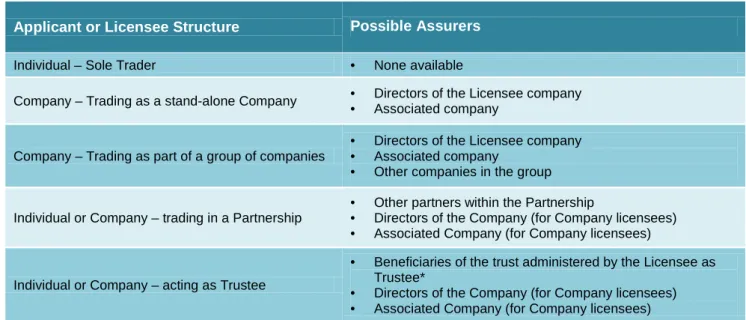
Table 1 – Possible Assurers
* limited to only those direct Beneficiaries which are not subject to or under a legal disability,and have sufficient assets in their own right to assure to the Applicant or Licensee.
3.
Maximum Revenue
Definitions for Section 3: In this section:
Maximum Revenue –
means the maximum Revenue from all sources a licensed entity may earn in each financial year. The Maximum Revenue issued to a Licensee applies to the licensed entity in combination with all trusts or partnerships through which it is trading. In the case of a company trading as part of a group of
companies under ASIC class order 98/1418, the Maximum Revenue applies to the entity as it has reported to the Commission under this policy: either the consolidated group; closed group or the company on a stand-alone basis.
Revenue –
means the total income received by the Applicant or Licensee, derived from all sources. Further:
Applicant or Licensee Structure Possible Assurers
Individual – Sole Trader • None available
Company – Trading as a stand-alone Company • Directors of the Licensee company • Associated company
Company – Trading as part of a group of companies
• Directors of the Licensee company • Associated company
• Other companies in the group
Individual or Company – trading in a Partnership
• Other partners within the Partnership
• Directors of the Company (for Company licensees) • Associated Company (for Company licensees)
Individual or Company – acting as Trustee
• Beneficiaries of the trust administered by the Licensee as Trustee*
• Directors of the Company (for Company licensees) • Associated Company (for Company licensees)
1 October 2014
11 | P a g e • For Applicants or Licensees engaged directly in project or construction management (where
project costs are paid directly by the Principal to parties lower in the contractual chain), or who have a building design licence, the revenue in respect of those activities is calculated on the total amount received by the Licensee rather than the value of projects. Alternatively, the component of the work processed via the Applicant or Licensee is deemed Revenue. • In the case of a partnership, the Revenue is to be the revenue of the Applicant or Licensee
and the partnership/s in combination.
• In the case of a trustee, the Revenue is to be the revenue of the Applicant or Licensee and the trust/s in combination.
• Includes the reference to turnover in section 35 of the Act. Revenue excludes:
a) Salary and/or wages received as an employee; and
b) GST collected as an agent, from which the Applicant or Licensee obtains no benefit.
3.1 Financial Requirement – Maximum Revenue
It is a financial requirement that a Licensee must not exceed their Maximum Revenue by more than 10% in each financial year.
3.2 Calculating Maximum Revenue
A Licensee’s Maximum Revenue is calculated based on the Net Tangible Asset (NTA) position of the Applicant or Licensee as stated in the Declaration or Minimum Financial Requirements Report by applying the formula stated in Table A.
Amounts being assured by way of one or more Deeds of Covenant and Assurance may be added to the NTA of the Licensee when calculating Maximum Revenue.
The Commission will advise an Applicant or Licensee of the Maximum Revenue it may generate per Financial Year upon granting the licence and upon acceptance of updated Declarations or Reports. The Maximum Revenue applies for all financial years until such time as it is updated by the provision of a new Declaration or Report and the Commission has notified the Licensee of the new Maximum Revenue.
3.3 Exceeding Maximum Revenue
Pursuant to section 35 of the Act, it is a condition that Licensees must not exceed their Maximum Revenue by more than 10% in a financial year without first providing a new Declaration or Report to the Commission substantiating sufficient NTA to support a higher level of Maximum Revenue. Licensees who exceed their Maximum Revenue by more than 10% and do not report to the Commission as required do not meet the Minimum Financial Requirements and may be subject to licence suspension or cancellation or disciplinary action and a penalty.
4.
Current Ratio
Definitions for Section 4: In this section:
1 October 2014
12 | P a g e
Current Assets –
means assets:
a) which are realised, sold or consumed in the normal operating cycle of the business; b) which are realised within twelve months after the reporting period;
c) which are held primarily for the purpose of trading (refer AASB 139);
d) the assets is cash or a cash equivalent (as defined in AASB 107) unless the asset is restricted from being exchanged or used to settle a liability.
Related entity loans and/or investments included as current assets must be collectible and convertible into cash as at balance date.
Real property listed as a current asset is to be shown at the lower of cost or net realisable value. Trade debtors that are a current asset and not contingent are only included to the extent they are collectible and as a minimum requirement overdue debtors must be written off as follows:
a) Trade debtors at or over 180 days old from invoice date, to be 50% written off; and b) Trade debtors at or over 365 days old from invoice date, to be 100% written off. Current Assets do not include:
a) Any related entity loans or investments assets which are not collectible; b) Contingent assets
c) Intangible assets;
d) Real property not currently listed on the market for sale; e) Disallowed assets.
Current Liabilities –
means liabilities:a) which are expected to settle in the normal operating cycle of the business; b) which are due to be settled within twelve months after the reporting period; c) which are held primarily for the purpose of trading;
d) the entity does not have an unconditional right to defer settlement of the liability for at least twelve months after the reporting period.
Current liabilities include:
a) the amount of any non-current liabilities which must be paid by the Applicant or Licensee in the 12 months following the reporting period; and
b) all related entity loans payable by the Applicant or Licensee in the 12 months following the end of the reporting period.
c) The full amount of all bank loans or finance facilities where the lender or syndicate of lenders has notified the Applicant or Licensee of a breach of bank or lending covenants.
Current Ratio –
means the ratio calculated by using the following formula:
Current Assets
Current Liabilities
1 October 2014
13 | P a g e
4.1 Financial Requirement – Current Ratio
It is a financial requirement that Applicants and Licensees must meet the Current Ratio requirement at time of Application, and at all times whilst the licence is held.
4.2 Calculating the Current Ratio
The Current Ratio is calculated in accordance with the defined formula.
Current assets included in the calculation of the Current Ratio must be in accordance with the definition of current assets in this policy.
The Commission may require the Applicant, Licensee or Accepted Independent Accountant to provide evidence of the classification of an asset as a current asset. Where such evidence is not provided the Commission may automatically reclassify such assets as non-current assets without further notice to the Applicant or Licensee.
All current liabilities of an Applicant or Licensee must be included in the calculation of the Current Ratio, including any loans to related entities payable by the Applicant or Licensee in the 12 months following the end of the reporting period.
Amounts assured by way of a Deed of Covenant and Assurance must not be included in calculating the Current Ratio.
The Current Ratio is required to be expressed as a ratio and may not be rounded up.
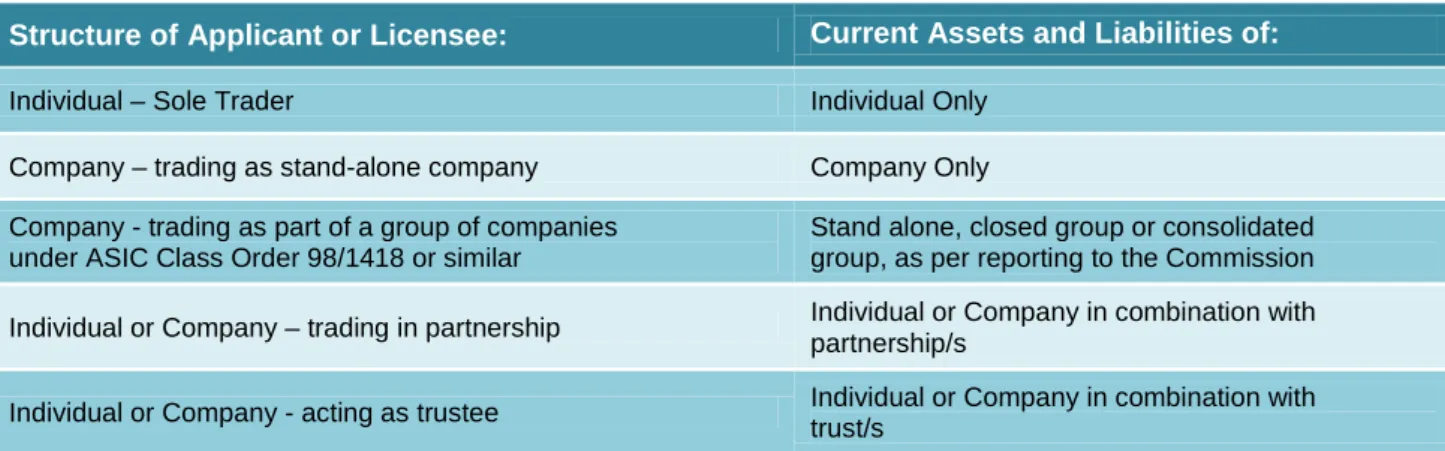
4.3 Determining Current Assets and Current Liabilities based on Licensee
Structure
Depending on the structure of the Applicant or Licensee, the Current Ratio may only be met from current assets and current liabilities, as follows:
Table 2 – Ratio Structure
4.4 Current Ratio for declaration categories (SC1 & SC2)
Licensees and Applicants in categories SC1 and SC2 are not required to state their Current Ratio on their Declaration. The Commission may at any time require an Applicant or Licensee in categories SC1 and SC2 to provide a MFR Report demonstrating compliance with the minimum Current Ratio requirement.
Structure of Applicant or Licensee: Current Assets and Liabilities of:
Individual – Sole Trader Individual Only
Company – trading as stand-alone company Company Only Company - trading as part of a group of companies
under ASIC Class Order 98/1418 or similar
Stand alone, closed group or consolidated group, as per reporting to the Commission Individual or Company – trading in partnership Individual or Company in combination with
partnership/s
Individual or Company - acting as trustee Individual or Company in combination with trust/s
1 October 2014
14 | P a g e
5.
Financial Monitoring
Definitions for Section 5: In this section:
Internal Management Accounts –
means reports prepared by the Licensee showing the financial position and performance of the Licensee’s business. Internal Management Accounts include at a minimum:
a) Statement of Financial Performance (also known as a Trading and Profit and Loss Statement);
b) Statement of Financial Position (also known as a Balance Sheet); c) Aged listings of trade debtors and creditors; and
d) Statement of Cash Flows.
5.1 Financial Requirement – Financial Monitoring
It is a financial requirement that a Licensee must prepare and maintain internal management accounts at quarterly intervals in each financial year at a minimum.
5.2 Provision of Internal Management Accounts to the Commission
Licensees are required to submit their internal management accounts if required by the Commission. The Commission may notify any Licensee of the requirement to provide their internal management accounts after the end of a quarter. The Commission will notify the Licensee of the timeframe to provide the information. Failure to provide the required information may result in the Commission determining the Licensee fails to meet the Minimum Financial Requirements.
6.
Accepted Independent Accountants
Definitions for Section 6: In this section:
Accepted Independent Accountant –
means a person with the qualifications specified in this policy who is permitted to complete Minimum Financial Requirements Reports regarding the financial position of an Applicant or Licensee.
An Accepted Independent Accountant must be independent of the Applicant or Licensee and must not be:
a) A director, secretary or employee of the Applicant or Licensee or their related entities; or b) A spouse of the Applicant or Licensee; or
c) A business partner of the Applicant or Licensee or their related entities; or d) An investor or shareholder of the Applicant or Licensee or their related entities. An Accepted Independent Accountant does not include a person who:
a) Has been convicted of, or plead guilty to, providing false or misleading information to the Commission about an Applicant or Licensees satisfaction of the financial requirements pursuant to s53B of the Act; or
1 October 2014
15 | P a g e b) Has been notified in writing the Commission considers they have provided incorrect
information about an Applicant or Licensees satisfaction of the financial requirements; or c) Has been notified in writing the Commission considers they have failed to appropriately
apply the requirements of this policy.
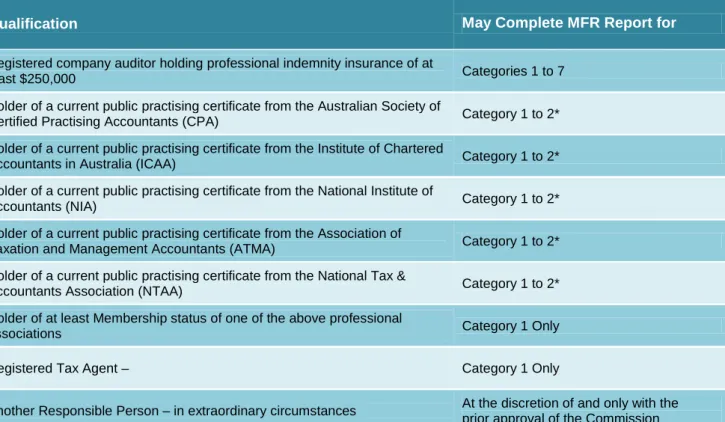
6.1 Qualifications for Accepted Independent Accountants
The qualifications required of Accepted Independent Accountants for completion of Minimum Financial Requirements Reports are set out in Table 3.
Table 3 – Accepted Independent Accountant Categories
*May also complete MFR Reports for Categories 3-7 only where the Applicant or Licensee is not subject to ASIC audit requirements.
All work must be performed in accordance with all applicable Australian Accounting and Auditing Standards, and other mandatory reporting requirements. The Accepted Independent Accountant completing the Report may be required by the Commission to demonstrate suitable audit experience.
6.2 Another Responsible Person
Where a Minimum Financial Requirements Report is provided by ‘another responsible person’, details of the extraordinary circumstances and the reporter’s professional qualifications, audit experience (if any), business relationship and length of time of association with the Applicant or Licensee must be provided. Approval as ‘another responsible person’ will only be given on a case by case basis and is entirely at the discretion of the Commission.
6.3 Notice to Accepted Independent Accountants for Minimum Financial
Requirements Reports
The following Australian Accounting Standards are mandatory when submitting Minimum Financial Requirements Reports to the Commission:
Qualification May Complete MFR Report for
Registered company auditor holding professional indemnity insurance of at
least $250,000 Categories 1 to 7
Holder of a current public practising certificate from the Australian Society of
Certified Practising Accountants (CPA) Category 1 to 2*
Holder of a current public practising certificate from the Institute of Chartered
Accountants in Australia (ICAA) Category 1 to 2*
Holder of a current public practising certificate from the National Institute of
Accountants (NIA) Category 1 to 2*
Holder of a current public practising certificate from the Association of
Taxation and Management Accountants (ATMA) Category 1 to 2* Holder of a current public practising certificate from the National Tax &
Accountants Association (NTAA) Category 1 to 2*
Holder of at least Membership status of one of the above professional
associations Category 1 Only
Registered Tax Agent – Category 1 Only
Another Responsible Person – in extraordinary circumstances At the discretion of and only with the prior approval of the Commission
1 October 2014
16 | P a g e • AASB Framework for the Preparation and Presentation of Financial Statements;
• AASB 101 Presentation of Financial Statements; • AASB 102 Inventories;
• AASB 107 Cash Flow Statements;
• AASB 108 Accounting Policies, Changes in Accounting Estimates and Errors; • AASB 110 Events after the Balance Sheet Date;
• AASB 111 Construction Contracts; • AASB 136 Impairment of Assets;
• AASB 137 Provisions, Contingent Liabilities and Contingent Assets; • AASB 1048 Interpretation and Application of Standards;
• Plus any other standards relevant to the Licensee’s business.
All Minimum Financial Requirements Reports are to be prepared by an Accepted Independent Accountant based on financial information of the Applicant or Licensee.
Minimum Financial Requirements Reports are required to be completed by the Accepted Independent Accountant at the time of an initial licence application and from time to time as the need arises, in accordance with this policy. A review of the Applicant or Licensee’s financial position is required to be conducted by the Accepted Independent Accountant in order to provide the Minimum Financial Requirements Report.
The processes and utilisation of the Review Control Sheet (Attachment 6) is a minimum requirement only. Applicants and Licensees may opt to have their financial situation reviewed on a more rigorous basis.
6.4 Warning to Accepted Independent Accountants
Accepted Independent Accountants have obligations under the Act not to provide false or misleading information.
It is an offence for a person to provide the Commission with any information that is false or misleading in circumstances where the person has either knowingly provided the information, or has not taken appropriate steps to ensure the information is not false or misleading. The maximum penalty for providing false or misleading information to the Commission is 2 years imprisonment.
The Commission may require an Accepted Independent Accountant to provide evidence of the tests and checks performed in completing a Minimum Financial Requirements Report at any time.
6.5 Reporting Requirements for Accepted Independent Accountants
The Accepted Independent Accountant providing Reports must make appropriate enquiries of the Applicant or Licensee, and seek independent evidence that is appropriate in the circumstances, in their professional opinion, to justify the information stated in the Minimum Financial Requirements Report.The Accepted Independent Accountant providing the Minimum Financial Requirements Report must carry out the tests and checks referred to in the Review Control Sheet as a minimum requirement. Minimum Financial Requirements Reports will be deemed incomplete for assessment where they are qualified by disclaimer clauses by the Accepted Independent Accountant giving the report.
6.6 Determining Collectability of Related Entity Loans or Investment
Assets
1 October 2014
17 | P a g e The Accepted Independent Accountant must determine collectability of any related entity loan or investment assets based on the financial position of the related entity as at the same balance date as the Minimum Financial Requirements Report.
As a minimum the Accepted Independent Accountant is required to view the balance sheet of the related entity, for the relevant balance date and ensure the related entity loan or investment is shown as a liability for the same amount, and classification, as stated by the Applicant or Licensee. The related entity must then have a positive net asset position in its own right as at the relevant balance date.
Where the related entity in question is owed loans by other related entities, the Accepted Independent Accountant must also determine those loans are collectible or deduct those amounts from the related entities net assets.
Where a related entity has a deficiency of assets, any loans owed to the Applicant or Licensee by that related entity must be deducted from the Net Tangible Assets and Current Ratio of the Applicant or Licensee. Evidence of collectability is required to be provided to the Commission upon request.
6.7 Implied Warranty by Accepted Independent Accountant
Where an Applicant or Licensee is relying upon one or more Deeds of Covenant and Assurance to meet the Minimum Financial Requirements, the Accepted Independent Accountant signing the Report is warranting to the Commission they have conducted all reasonable checks into each Covenantor’s entire financial position to ensure they have Net Real Unencumbered Assets to cover the amount secured by the Deed.
Where amounts are considered not collectable, have not been sufficiently evidenced with regard to their value or ownership, are intangible, or are disallowed assets the Accepted Independent
Accountant signing the Report must reduce the Covenantor’s total Net Real Unencumbered Asset position by that disallowed amount.
The Accepted Independent Accountant accepts that the Commission relies upon this warranty in order to grant or maintain the entity’s licence.
7. Submission of Financial Information to the
Commission
7.1 Applicants for a Licence
Applicants for a licence must satisfy the relevant financial requirements stated in this policy. Applicants are required to advise the Commission on application the financial year applicable to the entity applying for a licence. For Australian residents and most companies incorporated in Australia the financial year applicable will be 1 July to 30 June. However, for overseas companies or for Australian companies where ASIC has approved a different financial year, the applicant is to notify the Commission of the applicable financial year. If no notification is given the Applicant or Licensees financial year will be 1 July to 30 June.
Applicants must demonstrate at the time of application satisfaction of the relevant financial requirements for the level of maximum revenue being sought per financial year by providing information in the form set out in Table A.
1 October 2014
18 | P a g e
7.2 Existing Licensees Applying for a New Licence
Where an Applicant holds a current licence and the Applicant is not seeking to increase its Maximum Revenue it is not required to submit new financial information.
Existing Licensees applying for a Builder class of licence for the first time will need to provide a Declaration or Report where it is reasonable to expect they will exceed their maximum revenue for the financial year, or do not meet minimum requirements for a Builder class of licence.
7.3 Self-Certification Categories (SC1 & SC2)
Self-Certification Category 1 (SC1) is available to all Applicants and Licensees not seeking or holding a Builder class of licence, provided their revenue remains within the limit. Applicants for and holders of Builder classes of licence are not eligible to hold a licence in SC1.
Self-Certification Category 2 (SC2) is available to all Applicants and Licensees irrespective of the classes of licence sought or held, provided their revenue remains within the limit, and is the minimum financial category available to Builder classes of licence.
If notified by the Commission, Applicants and Licensees in a self-certification category will be required to submit a Minimum Financial Requirements Report demonstrating compliance with the
requirements of this policy.
7.4 Financial information for Categories 1-7
The Applicant or Licensees financial information in the Minimum Financial Requirements Report can be no more than 4 months in age, from the end of the financial reporting period being relied upon, at the time the Accepted independent Accounts signs the Report, unless otherwise stated in this policy, or as approved by the Commission.
To comply with this requirement, the financial information may be based on the Applicant or Licensee’s most recent financial information, being either:
a) last financial year end accounts; or
b) the current financial year to date accounts.
The Report must not be signed more than 30 days prior to the date the Report is provided to the Commission.
A copy of the signed financial statements being relied upon must accompany the Report.
7.5 Applicants and Licensees subject to ASIC Audit Requirements
Applicants or Licensees subject to ASIC audit requirements, are required to provide a Minimum Financial Requirements Report based on the most recently audited financial statements. These accounts may be more than 4 months in age. A copy of the signed audited financial statements on which the Report is based must accompany the Audit Report.If the Applicant or Licensee is operating as a stand-alone company, the Minimum Financial Requirements Report is to be based on the company in its own right.
If the Applicant or Licensee is a company operating within a group of companies, and is party to a Deed of Cross Guarantee (ASIC Class Order 98/1418) the Minimum Financial Requirements Report is to be based on either:
1 October 2014
19 | P a g e b) the “closed group” of companies, being only those companies subject to the Deed of Cross
Guarantee; or
c) the Applicant or Licensee in its own right as a stand-alone company.
The Applicant or Licensee will be required to provide evidence the Class Order was in place for the period of review on which the Report is based.
7.6 Applicant and Licensees not previously audited who become subject to
ASIC Audit Requirements
An Applicant or Licensee who has not been audited previously and becomes subject to ASIC audit requirements is required to provide a Minimum Financial Requirements Report completed by the Registered Company Auditor based on the first set of financial statements prepared which are audited.
If the Applicant or Licensee is operating as a stand-alone company, the Minimum Financial Requirements Report is to be based on the company in its own right.
If the Applicant or Licensee is a company operating within a group of companies, and is party to a Deed of Cross Guarantee (ASIC Class Order 98/1418) the Minimum Financial Requirements Report is to be based on either:
a) the consolidated group of companies;
b) the “closed group” of companies, being only those companies subject to the Deed of Cross Guarantee; or
c) the Licensee in its own right as a stand-alone company.
The Applicant or Licensee will be required to provide evidence the Class Order was in place for the period of review on which the Report is based.
7.7 Applicants and Licensees in Categories 3-7 Not Required by ASIC to be
Audited
An Applicant or Licensee in Categories 3-7 who is not currently subject to ASIC audit requirements and expect to continue to be relieved from such requirements under Corporations Act 2001, are required to submit a Minimum Financial Requirements Report and a copy of the signed financial statements on which the Report is based. The Applicant or Licensee that is a company may be required to provide information evidencing the exemption to ASIC audit requirements.
The Commission reserves the right to require a company to be audited for the purposes of demonstrating compliance with the Minimum Financial Requirements. Where the Commission
exercises this right, written notice of the audit requirement will be issued to the Licensee or Applicant. In considering whether an applicant or Licensee should be audited, the Commission will consider whether the Applicant or Licensee is currently, or will be, subject to audit requirements pursuant to Section 45A(3) of the Corporations Act 2001, and one of the following:
• Individuals
• Small proprietary companies
• Large Proprietary companies with Class Order 98/1417 or similar • Overseas companies
Where an Applicant or Licensee has obtained relief from ASIC audit requirements under Class Order 98/1417 or similar, evidence the Class Order was in place for the period of the financial statements is required to be provided with the Report.
1 October 2014
20 | P a g e
7.8 Overseas Companies in Categories 3-7
If an Applicant or Licensee is based overseas and does not have its financial accounts audited by an Australian Registered Company Auditor, the Applicant or Licensee may rely upon an Minimum Financial Requirements Report with any appropriate qualifications as agreed to by the Commission, signed by an Australian Registered Company Auditor.
The Financial Information stated in the Report is required to be stated in Australian Dollar (AUD) equivalents.
If the company is audited overseas, it may rely on its last audited accounts, which may be more than 4 months in age.
If the company is not audited overseas, it is required to provide a Report based on accounts no older than 4 months in age.
A copy of the financial statements for the respective period in review must be provided with the Report, and are required to be translated into English.
7.9 Compliance Audit
Pursuant to section 50C of the Act, the Commission may give written notice to a Licensee requiring delivery of, or access to, specified financial records in circumstances where the Licensee is selected to be audited under an approved compliance audit program or where the Commission is satisfied, because of information received, that there are reasonable grounds for concern that the Licensee does not satisfy the minimum financial requirements stated in this policy.
If Licensees do not comply with the Commission’s written notice within 21 days, the Licensee may be subject to disciplinary proceedings. Licensees will also be taken to have contravened a condition imposed on the licence and the Commission may suspend or cancel the licence.
7.10 Restructure of Licensee
When a Licensee undertakes a restructure in relation to its ownership, management or financial structure, updated financial information may be required to satisfy the Commission the Licensee continues to comply with this policy. Restructures will usually result in a change to the Licensee’s financial position from that last advised to the Commission. Such restructures may include, but are not limited to:
• Changes of Ownership or Officeholders; • Restructure to partnership or trust structure; • Change or withdrawal of Covenantors.
In instances where a restructure has occurred, the Licensee is required to provide either a
Declaration or Minimum Financial Requirements Report, and if necessary new Deed/s of Covenant and Assurance, which reflect the Licensee’s new business structure or financial position.
Upon receipt of the financial information which meets the requirements of the policy, the Commission will advise the Licensee of its adjusted Maximum Revenue based on the Licensee’s Net Tangible Assets in relation to its new financial position.
1 October 2014
21 | P a g e
8. Assessment of Financial Information by the
Commission
8.1 Assessment of financial information
The Commission has the right to assess Applicants and Licensees financial information at the times set out below:
• on application for a licence;
• where the Maximum Revenue requires adjustment;
• where the Net Tangible Asset position has decreased by more than 30%; • on compliance audit;
• pursuant to an approved audit program
• on expiry of the Licensee’s Professional Indemnity Insurance Policy; • on request by the Licensee; or
• at the discretion of the Commission.
Where the requirements of this policy have been met, the Applicant or Licensee will be notified of the Maximum Revenue that can be performed per financial year.
8.2 Failure to meet minimum financial requirements
If an Applicant fails to meet the requirements of this policy their application will be rejected.
Licensees are required to notify the Commission at the time of their licence renewal if they fail to meet any of the requirements stated in this policy.
If a Licensee fails to meet the requirements of this policy their licence may be suspended. To reinstate a suspended licence, the Licensee will be required to demonstrate to the Commission’s satisfaction they meet the requirements of this policy. The licence may be subsequently cancelled where the Commission has not been satisfied.
Where the Licensee has submitted a Report relying upon a Deed of Covenant and Assurance, regardless of whether the Licensee meets the requirements of this policy, the Commission may accept the Defined Amount stated in the Report and advise the Licensee of any other deficiency. The Covenantor is liable for the Defined Amount stated in the Report, despite any other deficiencies, until at least a compliant Report is provided and accepted by the Commission.
If a licence is cancelled, the Licensee is required to reapply for the licence and satisfy all of the licensing requirements that are applicable at the time the new application is received.
9.
Payment of Debts
Definitions for Section 9: In this section:
Creditor –
means the entity owed an amount of money by a Licensee or Applicant.
Debt –
means an amount of money owing by a licensed contractor for the provision of goods or services or for a legally enforceable obligation or statutory obligation.
1 October 2014
22 | P a g e
Industry Trading Terms -
means:
a) Payment within 25 business days of invoice date for debts owing to subcontractors; b) Payment within 30 days of invoice date for debts owing to suppliers; or
c) Terms as agreed between the parties in writing.
9.1 Financial requirement – payment of debts
It is a financial requirement that a Licensee must at all times pay all undisputed debts as and when the debts fall due and within industry trading terms. It is also a financial requirement that a Licensee or Applicant must pay all debts as ordered by a Court or Tribunal within 28 days of the order or a longer period if allowed by the Court or Tribunal.
9.2 Financial requirement does not apply in certain circumstances
The financial requirement stated in paragraph 9.1 will not apply if the Commission is satisfied that one or more of the following apply to the unpaid debt:
a) the debt owed is the subject of a genuine dispute by the Applicant or Licensee and evidence of the reasons for the dispute is provided to the Commission;
b) in the case of a genuine dispute, any undisputed portion of the debt has been paid;
c) the creditor has extended the terms for payment of the debt and documents exist to evidence the extended trading terms;
d) the Licensee or Applicant and the creditor have entered into a payment arrangement in relation to the debt and the licensed contractor is not in breach of that arrangement.
e) legal proceedings have been commenced in relation to the debt and have not yet concluded; f) a Court or Adjudicator has made a determination the Licensee or Applicant does not owe the
debt;
g) the Licensee or Applicant has appealed the decision of the Court or Tribunal;
h) the order of the Court or Tribunal has been set aside or the Licensee or Applicant has made an application to have the order set aside.
9.3 Documents and evidence to be provided to the Commission
Where a Licensee or Applicant has an unpaid debt, the Commission may require the provision of any documents or evidence deemed necessary to determine whether the Licensee or Applicant meets the Minimum Financial Requirements. The Commission will notify the Licensee or Applicant of a
timeframe to provide the information. Failure to provide the required information may result in the Commission determining the Licensee or Applicant fails to meet the Minimum Financial
Requirements.
10. Professional Indemnity Insurance
Definitions for Section 10:1 October 2014
23 | P a g e
Individual consumer –
means:
a) a person who intends to reside in the building that is the subject of the contract upon completion (or within six months of completion); or
b) a person who currently resides in the building where the work that is the subject of the contract is to be carried out; or
c) a person who is the owner of the building.
10.1 Financial Requirement - Professional Indemnity Insurance
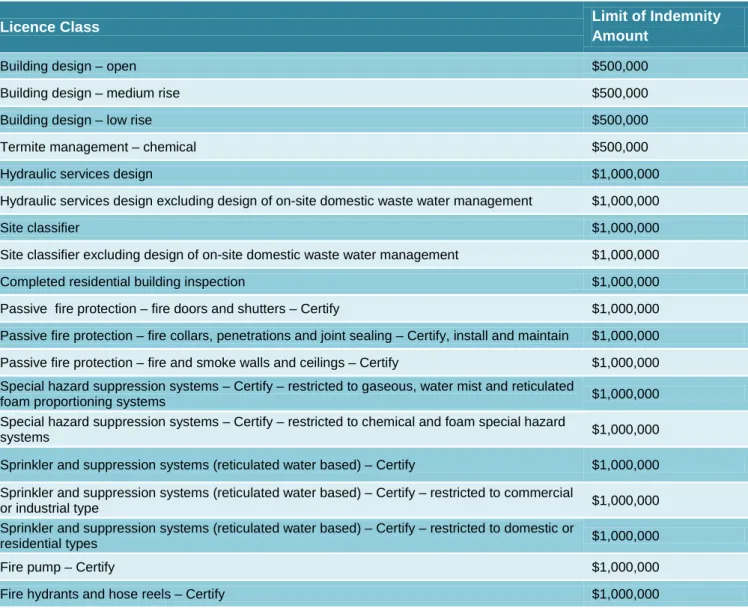
It is a financial requirement that Applicants for and Licensees who hold a class of licence specified in Table 4 must hold professional indemnity insurance, in addition to satisfying any other requirements in this policy.
The policy conditions for the required professional indemnity insurance must have a minimum limit of indemnity for any one claim and the sum of all claims during any one period of insurance of not less than the limits specified in Table 4.
Table 4 – Licence Classes Requiring Professional Indemnity Insurance
Licence Class Limit of Indemnity
Amount
Building design – open $500,000
Building design – medium rise $500,000
Building design – low rise $500,000
Termite management – chemical $500,000
Hydraulic services design $1,000,000
Hydraulic services design excluding design of on-site domestic waste water management $1,000,000
Site classifier $1,000,000
Site classifier excluding design of on-site domestic waste water management $1,000,000
Completed residential building inspection $1,000,000
Passive fire protection – fire doors and shutters – Certify $1,000,000 Passive fire protection – fire collars, penetrations and joint sealing – Certify, install and maintain $1,000,000 Passive fire protection – fire and smoke walls and ceilings – Certify $1,000,000 Special hazard suppression systems – Certify – restricted to gaseous, water mist and reticulated
foam proportioning systems $1,000,000
Special hazard suppression systems – Certify – restricted to chemical and foam special hazard
systems $1,000,000
Sprinkler and suppression systems (reticulated water based) – Certify $1,000,000 Sprinkler and suppression systems (reticulated water based) – Certify – restricted to commercial
or industrial type $1,000,000
Sprinkler and suppression systems (reticulated water based) – Certify – restricted to domestic or
residential types $1,000,000
Fire pump – Certify $1,000,000
1 October 2014
24 | P a g e *Continuing licence class under section 50 of the Queensland Building and Construction Commission Regulation 2003.
10.2 Terms and Conditions of Insurance Policy
An Applicant or Licensee in one of the classes specified in section 10.1 must have a professional indemnity insurance policy that:
1. Indemnifies the Licensee against legal liability resulting from any claims first made against the Licensee during the period of insurance arising out of any act, error or omission on the part of the Licensee in the conduct of the Licensee's business in respect of one of the classes referred to in section 10.1, whether as a director, principal, partner or employee. 2. At all times ensures the Licensee is covered to the minimum amount stated in section 10.1 of
the Minimum Financial Requirements Policy for their respective class.
3. Provides indemnity against legal liability in respect of claims for damages or compensation made against the Licensee for misleading or deceptive conduct, but excludes any claims arising from dishonest, fraudulent, malicious or criminal conduct.
4. Names as the Insured the Licensee, or the company or partnership of which the licence holder is a director, partner or employee, including if the Insured is a company:
(i) persons who are or become partners, directors or employees of the company during the period of insurance and are licensed in the appropriate class; and
(ii) persons who are former partners, directors or employees of the company and who are, or have been but no longer are, licensed in the appropriate class, in respect of acts, errors or omissions committed or allegedly committed by them whilst they were partners, directors or employees of the company.
5. Does not exclude liability for loss or damage arising out of or concerning building work as defined under the Queensland Building and Construction Commission Act 1991 in the State of Queensland unless that liability would otherwise have been excluded by the Insurer’s standard wording for professional indemnity insurance policy for businesses of the type conducted by the Licensee;.
6 Includes, in addition to the limit of indemnity, provision for payment of the costs and
expenses incurred by the Insured with the consent of the Insurer in defending or settling any claim and, in respect of any one claim, the policy may limit this sum to $100,000 or 20% of the limit of indemnity, whichever is the greater.
7. Must:
(a) comply with the all relevant State and Commonwealth legislation; or (b) placed by a general insurance broker registered in Australia.
Portable fire equipment and hose reels (hose reels down stream of stop cock only) – Certify $500,000
Fire detection, alarm and warning systems – Certify See 10.3 below
Emergency lighting – Certify $1,000,000
Fire suppression systems - special hazards* $1,000,000
Fire suppression systems – special hazards restricted to certification of, and preparation of
1 October 2014
25 | P a g e
10.3 Insurance requirements for Fire detection, alarm and warning systems –
Certify licence
For the licence class of Fire detection, alarm and warning systems – Certify, the Applicant or Licensee must hold one of the following:
(a) Broad form public and products liability insurance with a minimum limit of indemnity of $5 million with policy extension to include the certification of the installation of fire detection systems under the Building Act 1975 and its subordinate legislation; or
(b) Professional indemnity insurance that specifies a limit of indemnity for any one claim and the sum of all claims during any one period of insurance of not less than $5 million.
10.4 Evidence of Cover
Evidence of insurance must be produced at the time of application, renewal, audit or any other time as requested by the Commission. The following may be accepted as evidence of the insurance:
(a) if the policy complies with all relevant State and Commonwealth legislation - a certificate of currency issued by the Insurer; or
(b) if the policy has been arranged by a general insurance broker registered in Australia - a certificate of currency plus a receipt from the broker.
10.5 Implied warranty by insurance companies and insurance brokers
By supplying a certificate of currency to the Commission, the Licensee and/or the general broker is warranting to the Commission that the professional indemnity policy taken out by theApplicant/Licensee complies with Section 10 of the Minimum Financial Requirements Policy.
10.6 Circumstances when insurance is not required
The requirement for a Licensee to have the level of insurance specified in this Section will not apply if: (a) the insurance is not available in the market place; or
(b) the insurance would be economically unviable for the Applicant, taking into consideration relevant factors, including:
(i) the cost of the insurance; and
(ii) the previous and expected future turnover of the relevant business or part of the business.
The onus is on the person who is applying for, or seeking to renew a licence to establish to the Commission (including a declaration in the form at Attachment 4 that the Applicant has been unable to obtain the insurance in the market place because it is unavailable, or that it is economically unviable for the Applicant’s business to obtain it.
If a Licensee ceases to hold relevant insurance under this Section at any time during the licence period, and the Licensee is unable to obtain replacement insurance or it is economically unviable for the Licensee to obtain replacement insurance, the Licensee must:
(a) notify the Commission in writing of the Licensee’s non-compliance with the requirement to hold insurance; and
1 October 2014
26 | P a g e (b) establish by providing documentation to the Commission (including a declaration in the
form at Attachment 4) that the Licensee has been unable to obtain the insurance in the market place because it is unavailable or that it is economically unviable for the
Licensee’s business to obtain it.
10.7 Commission may impose licence conditions
If, because of circumstances described in 10.6, a Licensee who contracts with individual consumers does not hold professional indemnity insurance as prescribed by this Policy, they should clearly and unequivocally notify every individual consumer in writing, either by way of a clause in a contract or by a separate notice.
The Commission has power to impose a condition on the licence to that effect if it considers it appropriate. In making a decision as to whether a condition is to be imposed on a licence, the Commission must comply with the requirements of the Act.
11.
Incorrect Information
It is an offence, with a maximum penalty of 2 years imprisonment, for a person to give a document to the Commission about a Licensee’s satisfaction of the minimum financial requirements stated in this policy where:
(a) the person knows the document contains information that is false or misleading; or (b) the document contains information that is false or misleading and the person did not take
reasonable steps to make sure that the information was not false or misleading.
The Commission may refuse to accept Minimum Financial Requirements Reports or other financial information from a person who has provided incorrect information to the Commission.
12.
Confidentiality
The Information Privacy Act 2009 applies to information and documents held by the Commission containing personal information. The Right to Information Act 2009 (RTI Act) applies to all information and documents held by the Commission.
Information provided about an Applicant’s or Licensee’s compliance with this policy may be disclosed by the Commission to another party with the consent of the Applicant or Licensee or otherwise as authorised or required by law. In addition, the Commission may provide all or some of this information to a financial specialist engaged by the Commission to provide advice relevant to the Applicant’s or Licensee’s ability to satisfy the Minimum Financial Requirements Policy.
An application may be made under the Information Privacy Act 2009 for access to personal information by the person to whom that information relates.
An application may be made to the Commission, or the State, under the RTI Act seeking access to information held by the Commission. Applications will be reviewed in accordance with legislative requirements. The RTI Act provides the Licensee with the right to review a decision made by an RTI Officer.
1 October 2014
27 | P a g e
13.
Transitional Provisions
13.1 Repeal of financial requirements policies existing prior to 1 October 2014
Effective on and from 1 October 2014, the Board repeals all financial requirements policies which existed immediately prior to this Policy coming into effect on 1 October 2014.13.2 Transitional provisions
The following provisions apply if, before the repeal of the Board’s policies mentioned above, (the repealed policies), an applicant for a licence or a licensee has:
(a) completed a Declaration in compliance with a repealed policy immediately before commencement of this Policy on 1 October 2014; or
(b) provided an Independent Review Report or Audit Report in compliance with the repealed policy which has a review year end date before 1 October 2014.
The Allowable Annual Turnover applicable under the repealed policy declared or reported by an Applicant or Licensee will become the Applicant or Licensee’s Maximum Revenue limit per financial year under the new policy until such time as the Applicant, Licensee or Commission amends this limit. Despite the repeal of the policies which existed immediately prior to this Policy coming into effect on 1 October 2014 pursuant to the above clause, if a Deed of Covenant and Assurance provided under a repealed policy is in force immediately before the commencement of the New Policy on 1 October 2014, the Deed is taken to have been given under this Policy.
To remove doubt, this Policy does not allow or authorise a Licensee to:
(a) complete a declaration under a repealed policy after the 1 October 2014; or
(b) provide an Independent Review Report or Audit Report in compliance with a repealed policy with a review year end date on or after 1 October 2014.
13.3 Continuing classes of fire protection licence
To remove doubt, this policy applies to the holder of a continuing class of licence referred to in section 50 of the Queensland Building and Construction Commission Regulation 2003.
14.
Definitions
Act –
means the Queensland Building and Construction Commission Act 1991.
Applicant –
means an applicant for a contractor’s licence issued under the Queensland Building and Construction Commission Act 1991.
Associated entity –
means an entity that:a) is related to the Applicant or Licensee within the meaning of section 50 of the Corporations Act 2001; or