Available online through
ISSN 2229 – 5046MAXIMUM NUMBER OF NON-INTERSECTING DIAGONALS IN SQUARE ARRAYS
MARBARISHA M. KHARKONGOR*
1AND JOSEPH VARGHESE KUREETHARA
21Postgraduate Student,
Department of Mathematics, Christ (Deemed to be University), Bengaluru.
2Department of Mathematics, Christ (Deemed to be University), Bengaluru.
(Received On: 11-12-19; Revised & Accepted On: 18-01-20)
ABSTRACT
I
n this paper, we derive a formula to express the maximum number of non-intersecting diagonals of arbitrary length that can be drawn in 𝑛𝑛×𝑛𝑛 square arrays, where 𝑛𝑛is a multiple of 𝑙𝑙+ 1.Keywords: Array, Diagonal Placement, Constrained Optimization, Path.
1. INTRODUCTION
Spatial filling problems have been extensively explored and examined over the years and the results obtained along the way are important as they are applied to various branches of Science. In this paper, we shall study one aspect of such a filling problem. The problem of finding the maximum number of non-intersecting diagonals of length 1 that can be accommodated in an array [3] is the motivation of this paper. The problem of finding maximum number of non-intersecting diagonals was reminiscent of classical chessboard problems that involve placing the maximum number of certain types of chess pieces (e.g., queens, bishops, rooks or pawns) on the board so that no piece attacks another [2].
In this paper, we will generalize the results to diagonals of arbitrary length subject to certain constraints.
This work is an improvement of a study already done on the maximum number of non-intersecting diagonals of length 1 (length of a diagonal is elaborated later in this paper) in an array [3]. In the earlier study by Boyland et.al [3], extensive work has been done in obtaining results for diagonals of length 1 in square as well as rectangular arrays.
In the context of the earlier work [3], this paper explores the idea of diagonals of any finite length, where a general formula for the maximum number of non-intersecting diagonals of any finite length 𝑙𝑙is obtained as the final result.
However, generalizing the length of the diagonals brings about certain complexities which require certain conditions to be imposed so as to get meaningful results. In this paper, only positive diagonals are considered in square arrays of size
𝑛𝑛×𝑛𝑛 where 𝑛𝑛 is a multiple of 𝑙𝑙+ 1.
There is also a scope for further study on this topic, where the constraints may be removed. The problem can also be extended to diagonals of finite length in 3-dimensional space.
An array is a systematic arrangement of similar objects in rows and columns. In this paper, we deal with two-dimensional square arrays. An 𝑛𝑛×𝑛𝑛squarearray will be denoted as an 𝑛𝑛-array.
A diagonal of a unit square in an array is a straight line joining the opposite corners (or opposite lattice points) of the unit square.
In this paper, we will be considering only positive diagonals, i.e., diagonal having positive slope.
Corresponding Author: Marbarisha M. Kharkongor*1,
A diagonal of a unit square in an array can be thought of as having length 1, and is denoted as a 1-diagonal. Two 1-diagonals in an array are said to intersect if they share a common lattice point or if they belong to the same unit square.
Definition 1:Consider 𝑙𝑙consecutive unit squares in an array, such that anytwo adjacent unit squares will have exactly
one lattice point in common. Adiagonal of length𝑙𝑙is a diagonal which is contained in all of these 𝑙𝑙unitsquares in such a way that the diagonal passes through the common lattice points. Such a diagonal is denoted as a 𝑙𝑙-diagonal.
Any two 𝑙𝑙-diagonals in an array are said to intersect if any of the 1-diagonals that form them intersect each other.
Definition 2: The L-arrangement is a way of arranging diagonals in an n-array. This method of arrangement is as
follows:
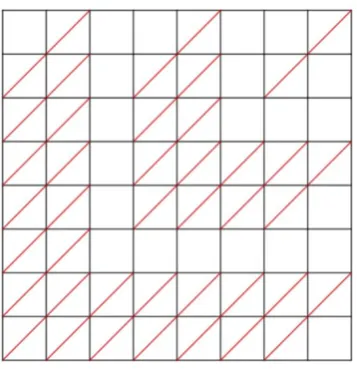
(i) 𝑙𝑙-diagonals are drawn starting from the leftmost column of the array in such a way that each diagonal occupies the first 𝑙𝑙lef tmost columns. Then 𝑙𝑙-diagonals are drawn starting from the bottom row in such a way that each diagonal occupies the last l bottom rows. This step forms the outermost L.
(ii) A column is skipped after the columns that are accommodating the previous 𝑙𝑙-diagonals, and then
𝑙𝑙-diagonals are drawn starting from the next column and are continued downwards. A row is skipped after the rows that are accommodating the previous 𝑙𝑙-diagonals and 𝑙𝑙-diagonals are drawn starting from the row above the skipped row and are continued towards the right.
(iii)Steps (i) and (ii) are repeated until the number of columns and rows that are left is less than 𝑙𝑙+ 1.
Figure 1 is an illustration of the L-arrangement of 2-diagonals in an 8 × 8 array.
Figure-1: L-arrangement of 2-diagonals in an 8 × 8 array.
Definition 3: [1] Let 𝑃𝑃𝑥𝑥 be a path on x vertices. A sub path 𝑃𝑃𝑦𝑦of 𝑃𝑃𝑥𝑥 is a path on y vertices where 𝑦𝑦 ≤ 𝑥𝑥
We use the following notations:
• 𝐷𝐷𝑙𝑙(𝑛𝑛) : The maximum number of 𝑙𝑙-diagonals that can be accommodated in an n-array. • 𝐿𝐿𝑙𝑙(𝑛𝑛): The number of 𝑙𝑙-diagonals that can be accommodated in an n-array.
• 𝑚𝑚𝑙𝑙(𝑃𝑃𝑘𝑘): The maximum number of subpaths of length 𝑙𝑙in a path 𝑃𝑃𝑘𝑘, such that every sub path is at a distance of at least one in 𝑃𝑃𝑘𝑘(Note that the sub path has 𝑙𝑙+ 1 vertices).
2. Maximum Number of Non-Intersecting l-Diagonals in an n-array
Theorem 1: For any 𝑙𝑙-diagonal in an n-array, where n is a multiple of 𝑙𝑙+ 1 and 𝑙𝑙 is a positive integer, we have
𝐿𝐿𝑙𝑙(𝑛𝑛) =𝑛𝑛 2−𝑛𝑛(𝑙𝑙−2)
𝑙𝑙+1
Proof: Since𝑛𝑛is a multiple of 𝑙𝑙+ 1, we have
𝑛𝑛 ≡0�𝑚𝑚𝑚𝑚𝑚𝑚(𝑙𝑙+ 1)�
⟹ 𝑛𝑛= (𝑙𝑙+ 1) ×𝑎𝑎
where 𝑎𝑎is a positive integer.
𝐿𝐿𝑙𝑙(𝑛𝑛) =�𝑛𝑛 −(𝑙𝑙 −1)�+ (𝑛𝑛 − 𝑙𝑙) +�𝑛𝑛 −(𝑙𝑙+ 1)−(𝑙𝑙 −1)�+ (𝑛𝑛 −(𝑙𝑙+ 1)− 𝑙𝑙)(𝑛𝑛 −2(𝑙𝑙+ 1)−(𝑙𝑙 −1))
+ (𝑛𝑛 −2(𝑙𝑙+ 1)− 𝑙𝑙) +�𝑛𝑛 −3(𝑙𝑙+ 1)−(𝑙𝑙 −1)�+ (𝑛𝑛 −3(𝑙𝑙+ 1)− 𝑙𝑙) +⋯
+�𝑛𝑛 −(𝑎𝑎 −1)(𝑙𝑙+ 1)−(𝑙𝑙 −1)�+ (𝑛𝑛 −(𝑎𝑎 −1)(𝑙𝑙+ 1)− 𝑙𝑙)
⟹ 𝐿𝐿𝑙𝑙(𝑛𝑛) =�𝑛𝑛 −(𝑙𝑙 −1)�+ (𝑛𝑛 − 𝑙𝑙) +��𝑛𝑛 − 𝑗𝑗(𝑙𝑙+ 1)−(𝑙𝑙 −1)�+�(𝑛𝑛 − 𝑗𝑗(𝑙𝑙+ 1)− 𝑙𝑙) 𝑎𝑎−1
𝑗𝑗=1
𝑎𝑎−1
𝑗𝑗=1
⟹ 𝐿𝐿𝑙𝑙(𝑛𝑛) = 2𝑛𝑛 −2𝑙𝑙+ 1 + 2𝑛𝑛(𝑎𝑎 −1)−2�(𝑎𝑎 −21)𝑎𝑎�(𝑙𝑙+ 1)−(𝑎𝑎 −1)(𝑙𝑙 −1)−(𝑎𝑎 −1)𝑙𝑙
⟹ 𝐿𝐿𝑙𝑙(𝑛𝑛) = 2𝑛𝑛 −2𝑙𝑙+ 1 + (𝑎𝑎 −1)(2𝑛𝑛 − 𝑎𝑎(𝑙𝑙+ 1)−(𝑙𝑙 −1)− 𝑙𝑙) Substituting 𝑎𝑎= 𝑛𝑛
𝑙𝑙+1 , we have,
𝐿𝐿𝑙𝑙(𝑛𝑛) = 2𝑛𝑛 −2𝑙𝑙+ 1 +�𝑙𝑙+ 1𝑛𝑛 −1�(2𝑛𝑛 − 𝑛𝑛 −2𝑙𝑙+ 1)
⟹ 𝐿𝐿𝑙𝑙(𝑛𝑛) = 2𝑛𝑛 −2𝑙𝑙+ 1 +�𝑛𝑛 − 𝑙𝑙 −𝑙𝑙+ 11�(𝑛𝑛 −2𝑙𝑙+ 1)
⟹ 𝐿𝐿𝑙𝑙(𝑛𝑛) =2𝑛𝑛(𝑙𝑙+ 1)−2𝑙𝑙(𝑙𝑙+ 1) + (𝑙𝑙𝑙𝑙+ 1) + (+ 1 𝑛𝑛 − 𝑙𝑙 −1)(𝑛𝑛 −2𝑙𝑙+ 1)
⟹ 𝐿𝐿𝑙𝑙(𝑛𝑛) =2𝑛𝑛+𝑛𝑛
2− 𝑛𝑛𝑙𝑙 𝑙𝑙+ 1
⟹ 𝐿𝐿𝑙𝑙(𝑛𝑛) =𝑛𝑛
2− 𝑛𝑛(𝑙𝑙 −2) 𝑙𝑙+ 1
Since L-arrangement is one form of arrangement, we have 𝐿𝐿𝑙𝑙(𝑛𝑛) as a lower bound for 𝐷𝐷𝑙𝑙(𝑛𝑛),
𝑖𝑖.𝑒𝑒. ,𝐿𝐿𝑙𝑙(𝑛𝑛)≤ 𝐷𝐷𝑙𝑙(𝑛𝑛)
𝑖𝑖.𝑒𝑒. ,𝐷𝐷𝑙𝑙(𝑛𝑛)≥𝑛𝑛
2− 𝑛𝑛(𝑙𝑙 −2)
𝑙𝑙+ 1 (2.1)
In order to find an upper bound for 𝐷𝐷𝑙𝑙(𝑛𝑛), the concept of paths is being used [1].
We consider the lattice points of an array to be synonymous with the vertices of a graph as shown in Figure 2.
Let 𝑣𝑣𝑖𝑖𝑗𝑗denote the lattice points of the array. Since we are dealing with positive diagonals only, then any l-diagonal can be understood as a path having𝑙𝑙edges and 𝑙𝑙+ 1 vertices. As shown in Figure 1, 𝑃𝑃𝑟𝑟 and 𝑃𝑃𝑟𝑟′ are paths of length 𝑘𝑘 − 𝑟𝑟, where 2≤ 𝑟𝑟 ≤ 𝑘𝑘 and 𝑃𝑃𝑟𝑟 =𝑃𝑃𝑟𝑟′ when 𝑟𝑟= 0. In order to obtainan𝑙𝑙-diagonal in the path 𝑃𝑃𝑟𝑟, we need to find a sub-path
𝑃𝑃𝑙𝑙+1 of 𝑃𝑃𝑟𝑟. Similarly with path 𝑃𝑃𝑟𝑟′.
From the figure, we observe the following:
• 𝑃𝑃𝑟𝑟=�𝑣𝑣𝑝𝑝,𝑘𝑘−𝑞𝑞−𝑝𝑝+1�𝑤𝑤ℎ𝑒𝑒𝑟𝑟𝑒𝑒 1≤ 𝑝𝑝 ≤ 𝑘𝑘, 1≤ 𝑞𝑞 ≤ 𝑘𝑘 −2 𝑎𝑎𝑛𝑛𝑚𝑚𝑘𝑘 − 𝑞𝑞 − 𝑝𝑝+ 1 > 0. • 𝑃𝑃𝑟𝑟′=�𝑣𝑣
𝑟𝑟+1,𝑘𝑘−𝑝𝑝+1�𝑤𝑤ℎ𝑒𝑒𝑟𝑟𝑒𝑒 1≤ 𝑝𝑝 ≤ 𝑘𝑘 −1, 1≤ 𝑟𝑟 ≤ 𝑘𝑘 −2 𝑎𝑎𝑛𝑛𝑚𝑚𝑘𝑘 − 𝑝𝑝+ 1 > 0.
Thus, as can be seen in Figure 2, an n-array can be represented by a 𝑘𝑘×𝑘𝑘matrix, where 𝑘𝑘=𝑛𝑛+ 1.
We shall prove a Lemma that will assist us in obtaining our main aim.
Lemma 1:For every positive integer 𝑘𝑘 ≥2, let 𝑃𝑃𝑘𝑘 be a path with k vertices. Then, the maximum number of subpaths of
length 𝑙𝑙 in 𝑃𝑃𝑘𝑘, 𝑖𝑖.𝑒𝑒. ,𝑚𝑚𝑙𝑙(𝑃𝑃𝑘𝑘) =�𝑙𝑙+1𝑘𝑘 �
Proof: First, we find the number of subpaths 𝑃𝑃′of length 𝑙𝑙in 𝑃𝑃𝑘𝑘, whereevery 𝑃𝑃′is at a distance one. Let 𝑞𝑞 denote this
number.
Case-1: When 𝑙𝑙=𝑘𝑘 −1(i.e., length of the subpath is equal to length of the path).
Since the total number of vertices in 𝑃𝑃𝑙𝑙 is 𝑙𝑙, so the length of 𝑃𝑃𝑙𝑙 is 𝑙𝑙 −1 =𝑘𝑘.
Clearly, we have exactly one subpath 𝑃𝑃𝑙𝑙 in 𝑃𝑃𝑘𝑘, which gives
𝑞𝑞= 1 (2.2)
Now,
�𝑙𝑙+ 1𝑘𝑘 �=�𝑘𝑘 −𝑘𝑘1 + 1�=⌊1⌋= 1 (2.3)
From (2.2) and (2.3), we have
𝑞𝑞=�𝑙𝑙+ 1𝑘𝑘 �
Case-2: When 𝑙𝑙<𝑘𝑘 −1(i.e., length of the subpath is less than length of the path).
Every subpath 𝑃𝑃𝑙𝑙 involves 𝑙𝑙+ 1 vertices.
Therefore, number of subpaths 𝑃𝑃𝑙𝑙 is equal to the number of vertices in 𝑃𝑃𝑘𝑘 divided by the number of vertices in each 𝑃𝑃𝑘𝑘,
𝑖𝑖.𝑒𝑒. ,𝑞𝑞=𝑙𝑙+1𝑘𝑘
By Euclidean Algorithm,
𝑘𝑘= (𝑙𝑙+ 1)𝑞𝑞+𝑟𝑟,𝑤𝑤ℎ𝑒𝑒𝑟𝑟𝑒𝑒 0≤ 𝑟𝑟<𝑙𝑙+ 1
Case-2.1: If 𝑟𝑟= 0, then
𝑘𝑘= (𝑙𝑙+ 1)𝑞𝑞 ⟹𝑙𝑙+ 1 =𝑘𝑘 𝑞𝑞
Case-2.2: If 𝑟𝑟 ≠0, then
𝑘𝑘= (𝑙𝑙+ 1)𝑞𝑞+𝑟𝑟 ⟹𝑙𝑙+ 1 =𝑘𝑘 𝑞𝑞+𝑙𝑙+ 1𝑟𝑟
Since 𝑟𝑟<𝑙𝑙+ 1, we have,
𝑟𝑟 𝑙𝑙+ 1 < 1
Therefore, from Case 1 and Case 2, the number of subpaths 𝑃𝑃′where every subpath is at a distance 1 is,
𝑞𝑞=� 𝑘𝑘 𝑙𝑙+ 1�
Now we claim that the maximum number of subpaths 𝑃𝑃′occur when every subpath is at a distance one and this will conclude our proof.
On the contrary, suppose that the maximum number of subpaths occur in such a way that some subpaths are not at a distance one.
We first consider the case where 𝑘𝑘= (𝑙𝑙+ 1)𝑞𝑞
In this case, if two subpaths 𝑃𝑃𝑘𝑘are not at a distance one, then the number of subpaths 𝑃𝑃𝑘𝑘will be at least 1 less than 𝑞𝑞, i.e., atleast � 𝑘𝑘
𝑙𝑙+1� −1
This is a contradiction since number of subpaths where every edge is at a distance 1 is
� 𝑘𝑘 𝑙𝑙+ 1�>�
Next, we consider the case where𝑘𝑘= (𝑙𝑙+ 1)𝑞𝑞+𝑟𝑟𝑤𝑤ℎ𝑒𝑒𝑟𝑟𝑒𝑒 0 <𝑟𝑟<𝑙𝑙+ 1
If the number of vertices which are not in any of the subpaths 𝑃𝑃′is greater than 𝑟𝑟, then the number of subpaths will be at least 1 less than 𝑘𝑘, i.e., �𝑙𝑙+1𝑘𝑘 � −1
This is again a contradiction as in the above case.
If the number of vertices which are not in any of the subpaths 𝑃𝑃′is lessthan or equal to 𝑟𝑟, then the number of subpaths will be � 𝑘𝑘
𝑙𝑙+1�
This is the same as 𝑞𝑞, where every subpath 𝑃𝑃′is at a distance one.
Therefore, the claim holds, and hence the result.
Applying Lemma 1 to each of the paths 𝑃𝑃𝑟𝑟and 𝑃𝑃𝑟𝑟′for every 𝑟𝑟= 2,3,4, … ,𝑘𝑘, we will get the maximum number of non-intersecting 𝑙𝑙-diagonals for each of the paths. Any arrangement of the 𝑙𝑙-diagonals in each path 𝑃𝑃𝑟𝑟 and 𝑃𝑃𝑟𝑟′will never exceed 𝑚𝑚𝑙𝑙(𝑃𝑃𝑟𝑟) and 𝑚𝑚𝑙𝑙(𝑃𝑃𝑟𝑟′) respectively for all r.
Triangular Inequality of real numbers states that for any real number𝑥𝑥 and 𝑦𝑦, we have
|𝑥𝑥| + |𝑦𝑦|≤|𝑥𝑥+𝑦𝑦|
But if 𝑥𝑥and 𝑦𝑦are non-negative, we have,
|𝑥𝑥| + |𝑦𝑦| = |𝑥𝑥+𝑦𝑦| (2.4)
Since the number of diagonals is a non-negative number then by (2.4), the sum of the number of diagonals in each path is equal to the total number of diagonals in all the paths. Since number of 𝑙𝑙-diagonals in each path 𝑃𝑃𝑟𝑟 and 𝑃𝑃𝑟𝑟′ will never exceed 𝑚𝑚𝑙𝑙(𝑃𝑃𝑟𝑟) and 𝑚𝑚𝑙𝑙(𝑃𝑃𝑟𝑟′) respectively, for all 𝑟𝑟, therefore, thenumber of 𝑙𝑙-diagonals in all the paths will not exceed the sum of 𝑚𝑚𝑙𝑙(𝑃𝑃𝑟𝑟) and 𝑚𝑚𝑙𝑙(𝑃𝑃𝑟𝑟′) for all 𝑟𝑟. This will give an upper bound for the maximum number of non-intersecting
𝑙𝑙-diagonals in an 𝑛𝑛-array.
Lemma 2: 𝐷𝐷1(𝑛𝑛) =𝑛𝑛2+𝑛𝑛
2 , where 𝑛𝑛 ≡0 (𝑚𝑚𝑚𝑚𝑚𝑚 2).
Proof: By a result [3], for any n-square matrix where𝑛𝑛 is even, we have, 𝐷𝐷1(𝑛𝑛) =𝐿𝐿1(𝑛𝑛)
Therefore, using Theorem 1, we have,
𝐷𝐷1(𝑛𝑛) =𝑛𝑛
2− 𝑛𝑛(1−2)
1 + 1
⟹ 𝐷𝐷1(𝑛𝑛) =𝑛𝑛 2+𝑛𝑛
2
Lemma 3: 𝐷𝐷2(𝑛𝑛)≤𝑛𝑛2
3, where 𝑛𝑛 is a positive integer and 𝑛𝑛 ≡0 (𝑚𝑚𝑚𝑚𝑚𝑚 3).
Proof: Let 𝑀𝑀 denote the number of non-intersecting 2-diagonals in any arrangement in an 𝑛𝑛array. This array can be
represented as a 𝑘𝑘×𝑘𝑘 matrix, where 𝑘𝑘=𝑛𝑛+ 1.
Now, 𝑛𝑛 ≡0 (𝑚𝑚𝑚𝑚𝑚𝑚 3)⟹ 𝑛𝑛= 3𝑎𝑎, where 𝑎𝑎 is a positive integer. By Lemma1, we have,
𝑀𝑀 ≤ �𝑘𝑘3�+ 2�𝑘𝑘 −31�+ 2�𝑘𝑘 −32�+ 2�𝑘𝑘 −33�+⋯+ 2�43�+ 2�33�+ 2�23� (2.5)
Each term inside the floor function on the right hand side of (2.5) can be represented as �𝑘𝑘−𝑥𝑥3 �,𝑤𝑤ℎ𝑒𝑒𝑟𝑟𝑒𝑒𝑥𝑥= 1,2,3, … ,𝑘𝑘 −2.
We have the following cases:
Case-1: When 𝑥𝑥 ≡0 (𝑚𝑚𝑚𝑚𝑚𝑚 3)⟹ 𝑥𝑥= 3𝑧𝑧, where 𝑧𝑧 is a positive integer.
Then,
Case-2: When 𝑥𝑥 ≡1 (𝑚𝑚𝑚𝑚𝑚𝑚 3)⟹ 𝑥𝑥= 3𝑧𝑧+ 1, where 𝑧𝑧 is a positive integer. Then,
�𝑘𝑘 − 𝑥𝑥3 �=�3𝑎𝑎+ 13−3𝑧𝑧 −1�=⌊(𝑎𝑎 − 𝑧𝑧)⌋=𝑎𝑎 − 𝑧𝑧
Case-3: When 𝑥𝑥 ≡2 (𝑚𝑚𝑚𝑚𝑚𝑚 3)⟹ 𝑥𝑥= 3𝑧𝑧+ 2, where 𝑧𝑧 is a positive integer.
Then,
�𝑘𝑘 − 𝑥𝑥3 �=�3𝑎𝑎+ 13−3𝑧𝑧 −2�=�(𝑎𝑎 − 𝑧𝑧)−13�=𝑎𝑎 − 𝑧𝑧 −1
Therefore, we have the following, When 𝑧𝑧= 0,
𝐵𝐵𝑦𝑦𝐶𝐶𝑎𝑎𝐶𝐶𝑒𝑒 1, 3𝑧𝑧= 0⟹ 𝑥𝑥= 0⟹ �𝑘𝑘 − 𝑥𝑥3 �=�𝑘𝑘3�=𝑎𝑎 −0
𝐵𝐵𝑦𝑦𝐶𝐶𝑎𝑎𝐶𝐶𝑒𝑒 2, 3𝑧𝑧+ 1 = 1⟹ 𝑥𝑥= 1⟹ �𝑘𝑘 − 𝑥𝑥3 �=�𝑘𝑘 −3 1�=𝑎𝑎 −0
𝐵𝐵𝑦𝑦𝐶𝐶𝑎𝑎𝐶𝐶𝑒𝑒 3, 3𝑧𝑧+ 2 = 2⟹ 𝑥𝑥= 2⟹ �𝑘𝑘 − 𝑥𝑥
3 �=�
𝑘𝑘 −2
3 �=𝑎𝑎 −0−1
When 𝑧𝑧= 1,
𝐵𝐵𝑦𝑦𝐶𝐶𝑎𝑎𝐶𝐶𝑒𝑒 1, 3𝑧𝑧= 3⟹ 𝑥𝑥= 3⟹ �𝑘𝑘 − 𝑥𝑥3 �=�𝑘𝑘 −3 3�=𝑎𝑎 −1
𝐵𝐵𝑦𝑦𝐶𝐶𝑎𝑎𝐶𝐶𝑒𝑒 2, 3𝑧𝑧+ 1 = 4⟹ 𝑥𝑥= 4⟹ �𝑘𝑘 − 𝑥𝑥3 �=�𝑘𝑘 −3 4�=𝑎𝑎 −1
𝐵𝐵𝑦𝑦𝐶𝐶𝑎𝑎𝐶𝐶𝑒𝑒 3, 3𝑧𝑧+ 2 = 5⟹ 𝑥𝑥= 5⟹ �𝑘𝑘 − 𝑥𝑥3 �=�𝑘𝑘 −3 5�=𝑎𝑎 −1−1
⋮ ⋮ ⋮ ⋮
When 𝑧𝑧=𝑘𝑘
3−2
𝐵𝐵𝑦𝑦𝐶𝐶𝑎𝑎𝐶𝐶𝑒𝑒 1, 3𝑧𝑧=𝑘𝑘 −6⟹ 𝑥𝑥=𝑘𝑘 −6⟹ �𝑘𝑘 − 𝑥𝑥3 �=�63�=𝑎𝑎 − �𝑘𝑘3−2� −1
𝐵𝐵𝑦𝑦𝐶𝐶𝑎𝑎𝐶𝐶𝑒𝑒 2, 3𝑧𝑧+ 1 =𝑘𝑘 −5⟹ 𝑥𝑥=𝑘𝑘 −5⟹ �𝑘𝑘 − 𝑥𝑥3 �=�53�=𝑎𝑎 − �𝑘𝑘3−2�
𝐵𝐵𝑦𝑦𝐶𝐶𝑎𝑎𝐶𝐶𝑒𝑒 3, 3𝑧𝑧+ 2 =𝑘𝑘 −4⟹ 𝑥𝑥=𝑘𝑘 −4⟹ �𝑘𝑘 − 𝑥𝑥3 �=�43�=𝑎𝑎 − �𝑘𝑘3−2�
When 𝑧𝑧=𝑘𝑘3−1
𝐵𝐵𝑦𝑦𝐶𝐶𝑎𝑎𝐶𝐶𝑒𝑒 1, 3𝑧𝑧=𝑘𝑘 −3⟹ 𝑥𝑥=𝑘𝑘 −3⟹ �𝑘𝑘 − 𝑥𝑥3 �=�33�=𝑎𝑎 − �𝑘𝑘3−1� −1
𝐵𝐵𝑦𝑦𝐶𝐶𝑎𝑎𝐶𝐶𝑒𝑒 2, 3𝑧𝑧+ 1 =𝑘𝑘 −2⟹ 𝑥𝑥=𝑘𝑘 −2⟹ �𝑘𝑘 − 𝑥𝑥3 �=�23�=𝑎𝑎 − �𝑘𝑘3−1�
Substituting in (2.5), we get,
𝑀𝑀 ≤(𝑎𝑎 −0) + 2(𝑎𝑎 −0) + 2(𝑎𝑎 −0−1) + 2(𝑎𝑎 −1) + 2(𝑎𝑎 −1) + 2(𝑎𝑎 −1−1) +⋯+ 2�𝑎𝑎 − �𝑘𝑘3−2��
+ 2�𝑎𝑎 − �𝑘𝑘3−2��+ 2�𝑎𝑎 − �𝑘𝑘3−2� −1�+ 2�𝑎𝑎 − �𝑘𝑘3−1��+ 2�𝑎𝑎 − �𝑘𝑘3−1��
= 9𝑎𝑎+ 2−43𝑘𝑘+ 4�4(𝑎𝑎 − 𝑡𝑡) +
𝑘𝑘
3−2
𝑡𝑡=1
�2(𝑎𝑎 − 𝑡𝑡 −1)
𝑘𝑘
3−2
𝑡𝑡=1
= 9𝑎𝑎+ 2−43𝑘𝑘+ 2(𝑎𝑎 −1)�3𝑘𝑘−2� −22�𝑘𝑘3−2� �𝑘𝑘3−1�+ 4𝑎𝑎 �𝑘𝑘3−2� −24�𝑘𝑘3−2� �𝑘𝑘3−1�
= 9𝑎𝑎+ 2−43𝑘𝑘+�𝑘𝑘3−2� �2(𝑎𝑎 −1)− �𝑘𝑘3−1�+ 4𝑎𝑎 − �𝑘𝑘3−1��
Substituting the values of 𝑎𝑎 and 𝑘𝑘 in terms of 𝑛𝑛, we get
=13[5𝑛𝑛+ 2 + (𝑛𝑛 −5)𝑛𝑛]
=13(𝑛𝑛2+ 2)
Thus,
𝑀𝑀 ≤𝑛𝑛23 (2.6)+ 2
However, the number of non-intersecting 𝑙𝑙-diagonals is always a non-negative integer. Therefore, we have (2.6) as
𝑀𝑀 ≤ �𝑛𝑛23+ 2�=�𝑛𝑛3 +2 23�=𝑛𝑛32
Since 3 is a factor of 𝑛𝑛.
Therefore,
𝐷𝐷2(𝑛𝑛)≤𝑛𝑛 2
3
Lemma 4: 𝐷𝐷𝟑𝟑(𝑛𝑛)≤𝑛𝑛24−𝑛𝑛, where 𝑛𝑛 is a positive integer and 𝑛𝑛 ≡0 (𝑚𝑚𝑚𝑚𝑚𝑚 4).
Proof: Let 𝑀𝑀 denote the number of non-intersecting 3-diagonals in any arrangement in an 𝑛𝑛 array. This array can be
represented as a 𝑘𝑘×𝑘𝑘 matrix, where 𝑘𝑘=𝑛𝑛+ 1.
Now, 𝑛𝑛 ≡0 (𝑚𝑚𝑚𝑚𝑚𝑚 4)⟹ 𝑛𝑛= 4𝑎𝑎, where 𝑎𝑎 is a positive integer.
Using Lemma 1, we have,
𝑀𝑀 ≤ �𝑘𝑘4�+ 2�𝑘𝑘 −41�+ 2�𝑘𝑘 −42�+ 2�𝑘𝑘 −43�+⋯+ 2�44�+ 2�34�+ 2�24� (2.7)
Each term inside the floor function on the right hand side of (2.7) can be represented as �𝑘𝑘−𝑥𝑥
4 �,
where 𝑥𝑥= 1,2,3, . . . ,𝑘𝑘 −2.
We have the following cases:
Case-1: When 𝑥𝑥 ≡0 (𝑚𝑚𝑚𝑚𝑚𝑚 4)⟹ 𝑥𝑥= 4𝑧𝑧, where 𝑧𝑧 is a positive integer.
Then,
�𝑘𝑘 − 𝑥𝑥4 �=�4𝑎𝑎+ 14−4𝑧𝑧�=�(𝑎𝑎 − 𝑧𝑧) +14�=𝑎𝑎 − 𝑧𝑧
Case-2: When 𝑥𝑥 ≡1 (𝑚𝑚𝑚𝑚𝑚𝑚 4)⟹ 𝑥𝑥= 4𝑧𝑧+ 1, where 𝑧𝑧 is a positive integer.
Then,
�𝑘𝑘 − 𝑥𝑥4 �=�4𝑎𝑎+ 14−4𝑧𝑧 −1�=⌊(𝑎𝑎 − 𝑧𝑧)⌋=𝑎𝑎 − 𝑧𝑧
Case-3: When 𝑥𝑥 ≡2 (𝑚𝑚𝑚𝑚𝑚𝑚 4)⟹ 𝑥𝑥= 4𝑧𝑧+ 2,where 𝑧𝑧 is a positive integer.
Then,
�𝑘𝑘 − 𝑥𝑥4 �=�4𝑎𝑎+ 14−4𝑧𝑧 −2�=�(𝑎𝑎 − 𝑧𝑧)−14�=𝑎𝑎 − 𝑧𝑧 −1
Case-4: When𝑥𝑥 ≡3 (𝑚𝑚𝑚𝑚𝑚𝑚 4)⟹ 𝑥𝑥= 4𝑧𝑧+ 3, where 𝑧𝑧is a positive integer.
Then,
�𝑘𝑘 − 𝑥𝑥4 �=�4𝑎𝑎+ 14−4𝑧𝑧 −3�=�(𝑎𝑎 − 𝑧𝑧)−12�=𝑎𝑎 − 𝑧𝑧 −1
Therefore, we have the following: When 𝑧𝑧= 0,
𝐵𝐵𝑦𝑦𝐶𝐶𝑎𝑎𝐶𝐶𝑒𝑒 1, 4𝑧𝑧= 0⟹ 𝑥𝑥= 0⟹ �𝑘𝑘 − 𝑥𝑥4 �=�𝑘𝑘4�=𝑎𝑎 −0
𝐵𝐵𝑦𝑦𝐶𝐶𝑎𝑎𝐶𝐶𝑒𝑒 2, 4𝑧𝑧+ 1 = 1⟹ 𝑥𝑥= 1⟹ �𝑘𝑘 − 𝑥𝑥4 �=�𝑘𝑘 −4 1�=𝑎𝑎 −0
𝐵𝐵𝑦𝑦𝐶𝐶𝑎𝑎𝐶𝐶𝑒𝑒 4, 4𝑧𝑧+ 3 = 3⟹ 𝑥𝑥= 3⟹ �𝑘𝑘 − 𝑥𝑥4 �=�𝑘𝑘 −4 3�=𝑎𝑎 −0−1
When 𝑧𝑧= 1,
𝐵𝐵𝑦𝑦𝐶𝐶𝑎𝑎𝐶𝐶𝑒𝑒 1, 4𝑧𝑧= 4⟹ 𝑥𝑥= 4⟹ �𝑘𝑘 − 𝑥𝑥4 �=�𝑘𝑘 −4 4�=𝑎𝑎 −1
𝐵𝐵𝑦𝑦𝐶𝐶𝑎𝑎𝐶𝐶𝑒𝑒 2, 4𝑧𝑧+ 1 = 5⟹ 𝑥𝑥= 5⟹ �𝑘𝑘 − 𝑥𝑥4 �=�𝑘𝑘 −4 5�=𝑎𝑎 −1
𝐵𝐵𝑦𝑦𝐶𝐶𝑎𝑎𝐶𝐶𝑒𝑒 3, 4𝑧𝑧+ 2 = 6⟹ 𝑥𝑥= 6⟹ �𝑘𝑘 − 𝑥𝑥4 �=�𝑘𝑘 −4 6�=𝑎𝑎— 1−1
𝐵𝐵𝑦𝑦𝐶𝐶𝑎𝑎𝐶𝐶𝑒𝑒 4, 4𝑧𝑧+ 3 = 7⟹ 𝑥𝑥= 7⟹ �𝑘𝑘 − 𝑥𝑥4 �=�𝑘𝑘 −4 7�=𝑎𝑎 −1−1
⋮ ⋮ ⋮
When 𝑧𝑧=𝑘𝑘
4−2;
𝐵𝐵𝑦𝑦𝐶𝐶𝑎𝑎𝐶𝐶𝑒𝑒 1, 4𝑧𝑧=𝑘𝑘 −8⟹ 𝑥𝑥=𝑘𝑘 −8⟹ �𝑘𝑘 − 𝑥𝑥4 �=�84�=𝑎𝑎 − �𝑘𝑘4−2�
𝐵𝐵𝑦𝑦𝐶𝐶𝑎𝑎𝐶𝐶𝑒𝑒 2, 4𝑧𝑧+ 1 =𝑘𝑘 −7⟹ 𝑥𝑥=𝑘𝑘 −7⟹ �𝑘𝑘 − 𝑥𝑥4 �=�74�=𝑎𝑎 − �𝑘𝑘4−2�
𝐵𝐵𝑦𝑦𝐶𝐶𝑎𝑎𝐶𝐶𝑒𝑒 3, 4𝑧𝑧+ 2 =𝑘𝑘 −6⟹ 𝑥𝑥=𝑘𝑘 −6⟹ �𝑘𝑘 − 𝑥𝑥4 �=�64�=𝑎𝑎 − �𝑘𝑘4−2� −1
𝐵𝐵𝑦𝑦𝐶𝐶𝑎𝑎𝐶𝐶𝑒𝑒 4, 4𝑧𝑧+ 3 =𝑘𝑘 −5⟹ 𝑥𝑥=𝑘𝑘 −5⟹ �𝑘𝑘 − 𝑥𝑥4 �=�54�=𝑎𝑎 − �𝑘𝑘4−2� −1
When 𝑧𝑧=𝑘𝑘4−1;
𝐵𝐵𝑦𝑦𝐶𝐶𝑎𝑎𝐶𝐶𝑒𝑒 1, 4𝑧𝑧=𝑘𝑘 −4⟹ 𝑥𝑥=𝑘𝑘 −4⟹ �𝑘𝑘 − 𝑥𝑥4 �=�44�=𝑎𝑎 − �𝑘𝑘4−2�
𝐵𝐵𝑦𝑦𝐶𝐶𝑎𝑎𝐶𝐶𝑒𝑒 2, 4𝑧𝑧+ 2 =𝑘𝑘 −3⟹ 𝑥𝑥=𝑘𝑘 −3⟹ �𝑘𝑘 − 𝑥𝑥4 �=�34�=𝑎𝑎 − �𝑘𝑘4−2�
𝐵𝐵𝑦𝑦𝐶𝐶𝑎𝑎𝐶𝐶𝑒𝑒 3, 4𝑧𝑧+ 3 =𝑘𝑘 −2⟹ 𝑥𝑥=𝑘𝑘 −2⟹ �𝑘𝑘 − 𝑥𝑥
4 �=� 2
4�=𝑎𝑎 − �
𝑘𝑘
4−2� −1
Substituting in (2.7) we get,
𝑀𝑀 ≤(𝑎𝑎 −0) + 2(𝑎𝑎 −0) + 2(𝑎𝑎 −0−1) + 2(𝑎𝑎 −0−1) + 2(𝑎𝑎 −1) + 2(𝑎𝑎 −1) + 2(𝑎𝑎 −1−1) + 2(𝑎𝑎 −1−1) +⋯+ 2�𝑎𝑎 − �𝑘𝑘4−2��+ 2�𝑎𝑎 − �𝑘𝑘4−2��+ 2�𝑎𝑎 − �𝑘𝑘4−2� −1�+ 2�𝑎𝑎 − �𝑘𝑘4−2� −1�
+ 2�𝑎𝑎 − �𝑘𝑘4−1��+ 2�𝑎𝑎 − �𝑘𝑘4−1��+ 2�𝑎𝑎 − �𝑘𝑘4−1� −1�
= 13𝑎𝑎 −32𝑘𝑘+�4(𝑎𝑎 − 𝑡𝑡) + 4�4(𝑎𝑎 − 𝑡𝑡 −1)
𝑘𝑘
3−2
𝑡𝑡=1
𝑘𝑘
3−2
𝑡𝑡=1
= 13𝑎𝑎 −32𝑘𝑘+ 4𝑎𝑎 �𝑘𝑘4−2� −42�𝑘𝑘4−2� �𝑘𝑘4−1�+ 4(𝑎𝑎 −1)�𝑘𝑘4−2� −24�𝑘𝑘4−2� �𝑘𝑘4−1�
= 13𝑎𝑎 −32𝑘𝑘+�𝑘𝑘4−2� �4𝑎𝑎 −2�𝑘𝑘4−1�+ 4(𝑎𝑎 −1)− �𝑘𝑘4−1��
=1
4[52𝑎𝑎 −6𝑘𝑘+ (𝑘𝑘 −8)(8𝑎𝑎 − 𝑘𝑘)]
Substituting the value of 𝑎𝑎 and 𝑘𝑘 in terms of 𝑛𝑛, we get,
=14[7𝑛𝑛 −6−(𝑛𝑛 −7)(𝑛𝑛 −1)]
=14(𝑛𝑛2− 𝑛𝑛+ 1)
Thus,
𝑀𝑀 ≤14(𝑛𝑛2− 𝑛𝑛+ 1) (2.8)
However, the number of non-intersecting 𝑙𝑙-diagonals is always a non-negative integer. Therefore, we have (2.8) as
𝑀𝑀 ≤ �14(𝑛𝑛2− 𝑛𝑛+ 1)�=�𝑛𝑛2− 𝑛𝑛
4 − 1 4�=
𝑛𝑛2− 𝑛𝑛
Since 4 is a factor of 𝑛𝑛.
Therefore,
𝐷𝐷3(𝑛𝑛)≤𝑛𝑛 2− 𝑛𝑛
4
From Lemma 2, Lemma 3 and Lemma 4, we observe that the results follow the same pattern and hence we can get a general result,
𝐷𝐷𝑙𝑙(𝑛𝑛)≤𝑛𝑛
2− 𝑛𝑛(𝑙𝑙 −2)
𝑙𝑙+ 1 (2.9)
From (2.1) and (2.9), we have
𝐷𝐷𝑙𝑙(𝑛𝑛) =𝑛𝑛
2− 𝑛𝑛(𝑙𝑙 −2) 𝑙𝑙+ 1
3. CONCLUSION
In this paper, we have derived a formula for the maximum number of non-intersecting diagonals in an 𝑛𝑛×𝑛𝑛 array, for any arbitrary length l of the diagonal and for𝑛𝑛 ≡0 (𝑚𝑚𝑚𝑚𝑚𝑚(𝑙𝑙+ 1)). In the process of deriving this formula, a result for the maximum number of independent subpaths in a given path has also been obtained. This result was used to assist in attaining the desired formula.
REFERENCES
1. D. B. West, Introduction to Graph Theory, Pearson Education, 2014.
2. Distinct Diagonals, NRICH enriching mathematics, https://nrich.maths.org/6784.
3. P. Boyland, et al., “On the Maximum Number of Non-intersecting Diagonals in an Array," Journal of Integer Sequences, Vol. 20 Issue 4 (2017), pages 1-24.
Source of support: Nil, Conflict of interest: None Declared.