© 2019 by the Serbian Biological Society How to cite this article: Uzundumlu S, Büyükateş Y. Stable isotope compositions 177 of dominant zooplankton species in relation to environmental factors in the
Dardanelles. Arch Biol Sci. 2019;71(1):177-85.
Stable isotope compositions of dominant zooplankton species in relation to
environmental factors in the Dardanelles
Sinan Uzundumlu and Yeşim Büyükateş*
Marine Sciences and Technology Faculty, Canakkale Onsekiz Mart University, Canakkale, Turkey
*Corresponding author: [email protected]
Received: October 3, 2018; Revised: November 30, 2018; Accepted: December 18, 2018; Published online: December 27, 2018
Abstract: Samples were collected seasonally from three stations in the Dardanelles between April 2016 and October 2017 to
determine the effects of biological and physicochemical properties of the coastal system on the isotopic compositions of the most abundant copepod species, Acartia clausi and Calanus helgolandicus, and a cladoceran, Penilia avirostris. Plankton samples were collected horizontally with a 200-µm-mesh plankton net and isotopic analyses were performed by mass spectrometry after identification to species level. Total zooplankton abundance reached its maximum in spring and summer. The δ13C values of copepods showed statistically significant differences both between stations and seasons. As a selective feeder, C. helgolandicus
had the highest values in both δ13C and δ15N. Being a filter feeder, P. avirostris distinctly differed from C. helgolandicus and A. clausi. Enrichment was observed in δ15N values of copepods in winter, when the highest values of total suspended solids and chlorophyll-a were determined. The results showed that δ13C values of the copepods were under the influence of envi-ronmental and biological factors. Additionally, dietary differences between herbivorous groups and other groups were clearly demonstrated, as well as differences in the diets of filter-feeding and selectively-feeding zooplanktonic species.
Keywords: δ13C; δ15N; zooplankton; environmental variables; Dardanelles
INTRODUCTION
Zooplanktonic organisms have an important role when transferring organic matter from primary producers to consumers at higher trophic levels [1]. There are various factors affecting the stable isotope ratios in marine ecosystems, especially in coastal systems, which are known to be influenced by many physicochemical processes. Physical processes play a major role and result in variations in spatial and temporal variabilities of the marine coastal systems [2]. The lower layer of the trophic level is very sensitive to these changes and the variation in the zooplankton isotopic signatures mostly depends on physical dynamics, river discharges, dust input and other effects [2-6]. The trophic structure of plankton communities can only be described using stable isotopes if the factors influencing variations are considered [2,7-9]. Stable δ13C and δ15N isotopes
are frequently used to determine these conditions and have an effective role in identifying the carbon sources and trophic position of planktonic organisms in the food web.
Stable isotopes show the transformation and origin of the organic matter [10]. The nitrogen isotope ratio is used to help define the trophic levels of organisms, as δ15N usually increases by 2.5-4.5‰ (mean 3.4‰)
from prey to predator [11,12]. As an increase in δ13C
of 0.4-2‰ only occurs from diet to consumer [12,13], a consumer’s carbon isotope composition can give clues about the sources of its diet, particularly in systems with distinct organic matter sources [14]. The relative importance of these sources may differ in space and time, and stable isotope ratios at the base of food webs in the marine environment can be highly variable [15,16].
The present study was conducted in the Strait of the Dardanelles, which is a part of the Turkish Straits system known to have unique flow characteristics, consisting of an upper layer with low salinity from the Black Sea and a lower layer with higher salinity from the Mediterranean [19-22]. As a biological corridor, the Turkish Straits system plays a crucial role in the transport of nutrients, planktonic organisms and fish between the Mediterranean and the Black Sea [23]. In addition, daily changes are observed in nutrient concentrations resulting from the domestic inputs in the region and the pollution load carried by the Turkish Straits System [24,25]. This directly affects the biological diversity of the system. Thus, previous studies in the Dardanelles have generally focused on the density and composition of plankton, the changes of nutrients in the region, and the physiological and hydrobiological characteristics of the Turkish Straits system [24-29]. Stable isotope studies that have been conducted in the region were limited to the isotopic composition of some fish and their feeding habits in close-by rivers and lakes [30,31].
In the present study, samples were collected sea-sonally from three stations in the Dardanelles. The objectives were: (i) to establish the most abundant zooplankton species in the region, (ii) to determine the seasonal and spatial isotopic compositions of these species, (iii) to reveal the effects of biological and physicochemical properties of the system on the iso-topic composition of the abundant species, and (iv) to observe variations in stable isotope signatures of different species in the study area.
MATERIALS AND METHODS
Sampling sites
The study was carried out between April 2016 and August 2017 at three stations in the Dardanelles; however, sam-pling was not performed during the summer of 2016. The 1st station was located in the coastal zone of the harbor,
and the 2nd station is the harbor. The reference station
was located 10 km away from the 1st and 2nd stations and
chosen far from settlements and terrestrial inputs; it had a depth of about 2-3 m (Supplementary Fig. S1). The 1st
and 2nd stations were under the influence of high flow
and were exposed to vertical and horizontal currents,
whereby they differed from the reference station. The difference between the 1st and the 2nd stations was in the
depth, which was 2-3 m for the 1st station and about 30
m for the 2nd. All samplings for all seasons and stations
were performed during daytime.
Environmental variables
Environmental variables, i.e. temperature and salinity, were measured in situ using an YSI 650 multiple water analysis probe from the surface to about a depth of 2-5 m. Water samples for the measurement of chlorophyll-a
(chl-a) and total suspended solids (TSS)were collected using a 5-L water sampler. For chl-a, the samples were filtered using 47-mm GF/F filters by gentle vacuum and then frozen until laboratory analysis. The chl-a
concentration was determined spectrophotometrically after extraction with 90% acetone [32]. For TSS, the previously weighed and dried GF/C filters were used to filter the water samples; gravimetric analysis was performed according to Clesceri et al. [33].
Zooplankton sampling for abundance
The aim of observing the abundance was to deter-mine the most abundant zooplankton species in the study area. The most abundant zooplankton species were used for stable isotope analyses (SIA). Detecting microzooplankton (<200 µ) abundance was not tar-geted. Samples for abundance were collected using a 5-L water sampler from the surface at all stations and preserved in 4% buffered formalin (v/v). The samples were settled for two weeks and reduced first to 250 mL and then to 10 mL subsamples. Ten percent or 50% of the samples were counted depending on plankton abundance. Species identification was performed ac-cording to Tregouboff et al. and Todd et al. [34,35].
Zooplankton sampling for stable isotope analyses (SIA)
Zooplankton samples for stable δ13C and δ15N isotope
laboratory. After drying the frozen bulk samples in the drying oven at 60°C for 24 h, each sample was weighed to 0.150 mg and placed in tin capsules. Measurements were conducted using an Isotope Ratio Mass Spectrometer (Delta V Thermo Finnigan; Thermo, Waltham, USA) in the Akdeniz University Food Safety and Agricultural Research Center. Since acidification can affect nitrogen and carbon isotope values, the samples were not acidi-fied [36-41]. The obtained results are expressed by δ using the following equation:
δ13C or δ15N (‰) = (Rsample/Rstandard-1)x1000,
where the stable isotope abundance of C and N was expressed as δ13C or δ15N, 13C/12C or 15N/14N and was
represented by R, with the reference being V-PDB (Vienna Pee Dee Belemnite) and atmospheric N2 isotope standards.
Statistical analysis
The differences between mean seasonal and spatial groups of stable isotope values of the zooplankton were analyzed by one-way analysis of variances (ANOVAs) (significance level p<0.05), followed by Tukey’s honestly significant difference (HSD) test for unequal sample sizes for post hoc comparisons among regions and seasons. Levene’s test was applied for the homogene-ity of variances. Pearson’s correlation and Spearman’s rank correlation analyses were applied to determine the linear relationship between stable δ13C and δ15N
values vs the environmental variables and abundance of zooplankton. SPSS 18.0 and Minitab 17.1.0 programs were used in the statistical analysis.
RESULTS
Seasonal and spatial variations in environmental variables
The surface temperatures ranged from 7.64 to 24.81ºC, following a seasonal progression, and variations were significant between the seasons as expected (Table 1; p<0.001). The surface temperature did not significantly differ between the stations. The reference station was significantly different from the 1st and the 2nd stations,
having higher values of surface salinity, which varied between 24.20 and 29.80‰ between stations (Table 1; p<0.001). No significant differences in salinity values were observed between seasons. The winter values of chl-a were significantly higher than in other seasons, with a value at 6.79 µg L-1 (Table 1; p<0.001). The TSS
values ranged between 1.96 and 74.50 mg L-1, with the
highest value measured in winter and significantly differing from other seasons, similar to chl-a (Table 1; p<0.001). There were no significant differences in chl-a and TSS among the stations.
Abundance of mesozooplankton
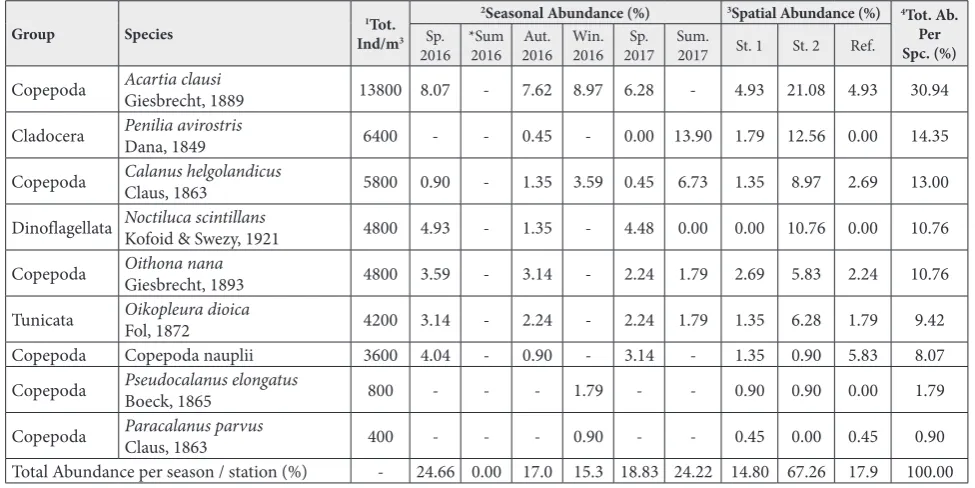
Total mesozooplankton abundance had the highest value in spring 2016 (24.66%), followed by summer 2017 (24.22%) and spring 2017 (18.83%). In winter, when surface temperatures were low, the abundance values decreased (15.25%) when compared to other seasons (Table 2). When evaluating all of the obtained species, the spatial ratios of mesozooplankton total abundance had the highest value in the 2nd station
(67.26%), followed by the reference station and the 1st station (Table 2).
At the species level, A. clausi was the most dominant species (30.94%) when compared with other species, and with the exception of summer, it was present in the pelagic waters of all stations during the study.
C. helgolandicus, on the other hand, was observed in summer with a total abundance of 13.00% (Table 2). Cladoceran P. avirostris had a total abundance of 14.35% and was mostly present in summer (Table 2). Other species observed in the study included Noctiluca scintillans and Oikopleuradioica with an abundance of 10.76%. Copepod nauplii had an abundance value of 8.07%; it was followed by Pseudocalanus elongatus
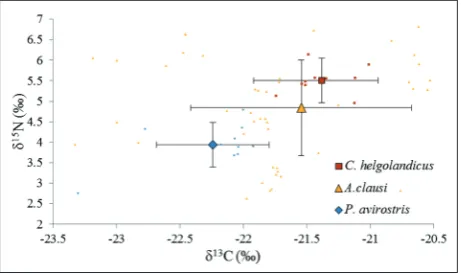
Fig. 1. Scatter plot (mean±SD) of δ13C and δ15N values of species
Table 1. Results of one-way ANOVA and Tukey’s HSD post hoc tests on seasonal and spatial variations of environmental variables in the Dardanelles.
1Var. ***Factor n ****mean±SD p value 2Factor n ****mean±SD p value
Tepm. (°C)
Spring 2016 9 15.652±2.409d
<0.001*
St. 1 15 17.09±6.31
**n.s.
Autumn 2016 9 20.6122±0.2509b St. 2 15 16.67±6.42
Winter 2017 9 7.664±0.895e Ref. 15 18.08±5.20
Spring 2017 9 17.650±0.639c
Summer 2017 9 24.811±0.669a
Salinity (‰)
Spring 2016 9 28.086±1.578
**n.s.
St. 1 15 25.837±1.435b
<0.001*
Autumn 2016 9 26.351±2.287 St. 2 15 24.778±1.442b
Winter 2017 9 27.02±3.37 Ref. 15 29.877±0.504a
Spring 2017 9 26.682±2.674
Summer 2017 9 26.016±2.380
Chl-a (µg L-1)
Spring 2016 9 3.071±10.617b
<0.001*
St. 1 15 2.273±0,563
**n.s.
Autumn 2016 9 3.239±2.742a St. 2 15 4.03±4.23
Winter 2017 9 6.79±4.23b Ref. 15 3.967±2.113
Spring 2017 9 1.981±0.423b
Summer 2017 9 2.0389±0.2512b
TSS (mg L-1)
Spring 2016 9 3.422±1.259b
<0.001*
St. 1 15 8.04±8.34
**n.s.
Autumn 2016 9 24.0±37.4b St. 2 15 33.7±59.9
Winter 2017 9 74.5±57.7a Ref. 15 30.77±29.91
Spring 2017 9 1.967±0.529b
Summer 2017 9 16.88±5.40b
1Variable.
2St. 1 – 1st station; St. 2 – 2nd station; Ref – Reference station. *Statically significant difference (one-way ANOVA); **statically not significant;
***sampling could not be performed during summer 2016; ****in each line, different letters indicate significantly different means (one-way ANOVA, Tukey’s post hoc tests at P<0.05) among the seasons and stations (“a” indicated the highest value).
Table 2. Seasonal and spatial abundance percentages (%) of the plankton species collected in the Dardanelles.
Group Species Ind/m1Tot.3
2Seasonal Abundance (%) 3Spatial Abundance (%) 4Tot. Ab. Per Spc. (%)
Sp.
2016 *Sum2016 2016Aut. Win. 2016 2017Sp. Sum. 2017 St. 1 St. 2 Ref.
Copepoda Acartia clausi Giesbrecht, 1889 13800 8.07 - 7.62 8.97 6.28 - 4.93 21.08 4.93 30.94
Cladocera Penilia avirostrisDana, 1849 6400 - - 0.45 - 0.00 13.90 1.79 12.56 0.00 14.35
Copepoda Calanus helgolandicusClaus, 1863 5800 0.90 - 1.35 3.59 0.45 6.73 1.35 8.97 2.69 13.00
Dinoflagellata Noctiluca scintillansKofoid & Swezy, 1921 4800 4.93 - 1.35 - 4.48 0.00 0.00 10.76 0.00 10.76
Copepoda Oithona nanaGiesbrecht, 1893 4800 3.59 - 3.14 - 2.24 1.79 2.69 5.83 2.24 10.76
Tunicata Oikopleura dioicaFol, 1872 4200 3.14 - 2.24 - 2.24 1.79 1.35 6.28 1.79 9.42
Copepoda Copepoda nauplii 3600 4.04 - 0.90 - 3.14 - 1.35 0.90 5.83 8.07
Copepoda Pseudocalanus elongatusBoeck, 1865 800 - - - 1.79 - - 0.90 0.90 0.00 1.79
Copepoda Paracalanus parvusClaus, 1863 400 - - - 0.90 - - 0.45 0.00 0.45 0.90
Total Abundance per season / station (%) - 24.66 0.00 17.0 15.3 18.83 24.22 14.80 67.26 17.9 100.00
and Paracalanus parvus with total abundance values of 1.79% and 0.90%, respectively (Table 2). Therefore, the three most abundant species, A. clausi, C. helgo-landicus and P. avirostris, were chosen for the study.
Stable isotope compositions of the zooplankton in the study area
The δ13C values of the copepods A. clausi and C.
helgolan-dicus showed statistically significant differences among stations and seasons. Further, δ13C of the copepods had
a maximum value in spring 2016 (-20.983±0.683‰) while the lowest value was observed in winter 2017 (-22.4950±0.5180‰) with statistically significant dif-ferences (Table 3; p<0.001). Among stations, the δ13C
values of the copepods A. clausi and C. helgolandicus
significantly differed in the reference station when compared to the other stations (Table 3; p<0.001).
Seasonal differences of total δ15N values of copepods
were also statistically significant (Table 3). The highest value was observed in winter 2017 (6.271±0.337‰), while the lowest value was measured in spring 2017 (4.211±0.899‰). At all three stations, the total δ15N
values of the copepods ranged between 4.544±1.219 and 5.115±1.173‰, showing no significant differences; however, when comparing the stations in each season, significant differences were observed in winter 2017. In winter, copepod total δ15N values in the 2nd station
were significantly higher than in the other stations (Table 4; p=0.002).
Table 3. Results of one-way ANOVA and Tukey’s HSD post hoc tests on seasonal and spatial stable isotope ratios (±SD) of Copepods.
1Var. ***2Factor n ****mean±SD p value 3Factor n ****mean±SD p value
δ
13C (‰)
Sp. 2016 23 -20.9830±0.6830a
<0.001*
St. 1 14 -21.8936±0.3501b
<0.001*
Aut. 2016 8 -21.7090±1.2360abc St. 2 26 -21.8600±0.5720b
Win. 2017 8 -22.4950±0.5180c Ref. 23 -20.9100±0.8700a
Sp. 2017 14 -21.8357±0.2037bc
Sum. 2017 10 -21.3830±0.2304ab
δ
15N (‰)
Sp. 2016 23 4.933±1.152bc
<0.001*
St. 1 14 4.544±1.219
**n.s.
Aut. 2016 8 4.261±0.887c St. 2 26 5.018±0.958
Win. 2017 8 6.271±0.337a Ref. 23 5.115±1.173
Sp. 2017 14 4.211±0.899c
Sum. 2017 10 5.508±0.337ab
1Variable.
2Sp – spring; Sum – Summer; Aut – autumn; Win – winter; 3St. 1 – 1st station; St. 2 – 2nd station; Ref – reference station.
*Statically significant difference (one-way ANOVA); **statically not significant; ***sampling could not be performed during summer 2016; ****in each line, different letters indicate significantly different means (one-way ANOVA, Tukey’s post hoc tests at P<0.05) among the seasons and stations (“a” indicates the highest value).
Table 4. Results of one-way ANOVA and Tukey’s HSD post hoc
tests on spatial δ15N values (±SD) of Copepods in Winter 2017.
Variable Factor n **mean±SD p value
δ15N
1st station 3 6.050±0.178b
*0.002 2nd station 3 6.660±0.053a
Reference St. 2 6.020±0.042b
*Statically significant difference (one-way ANOVA); **different letters indicate significantly different means (one-way ANOVA, Tukey’s post hoc tests at P<0.05) among the stations (“a” indicate the highest value).
Table 5. Results of one-way ANOVA and Tukey’s HSD post hoc
tests on stable isotope ratios (±SD) of abundant species detected in study area throughout the year.
Variable Factor n **mean±SD p value
δ
13C (‰)
A. clausi 53 -21.546±0.8690a
*0.023 C. helgolandicus 10 -21.383±0.2304a
P. avirostris 10 -22.242±0.4460b
δ
15N (‰)
A. clausi 53 4.843±1.167a
*0.004 C. helgolandicus 10 5.508±0.337a
P. avirostris 10 3.942±0.538b
*Statically significant difference (one-way ANOVA); **different letters indicate significantly different means (one-way ANOVA, Tukey’s post hoc tests at P<0.05) among the species (“a” indicates the highest value).
Table 6. Spearman’s correlation results between δ13C and δ15N
values of Copepods vs. environmental variables and abundance of zooplankton in study area (n=8).
Temperature Salinity Chl-a TSS
δ13C r 0.518 -0.218 0.118 0.018
p value 0.102 0.519 0.729 0.958
δ15N r -0.464 -0.118 0.600 0.673*
p value 0.151 0.729 0.051 0.023
When species-specific isotopic compositions were considered, as a selective feeder C. helgolandicus had the highest values in both δ13C and δ15N (Table 5). Being
a filter feeder, the δ13C and δ15N values of P. avirostris
were significantly different from both C. helgolandicus
and A. clausi (Table 5; p=0.023, p=0.004, respectively).
DISCUSSION
Spatial variations in stable isotope composition of zooplankton showed significant differences between the stations. The total mean δ13C values of the
cope-pods in the 1st and the 2nd stations, which are known
to be exposed to intense currents between the Black Sea and the Mediterranean Sea, and known to have a high plankton density [42], were lower than in the reference station. On the other hand, the 2nd station had
the highest total zooplankton abundance. It is known that isotopic values depend on the characteristics of zooplankton communities [39,43]. Therefore, the high abundance in zooplankton could be one of the reasons for the depletion in δ13C values of zooplankton.
Furthermore, environmental and biological conditions can change depending on the horizontal and vertical flows as well as the vertical migration of zooplankton and phytoplankton in marine systems [44,45]. This migration and the changes in environmental condi-tions affect the feeding habits of the species living in the epipelagic zone. Therefore, when these factors were compared between the sampling stations, the feeding habits of zooplankton found in the 1st and the 2nd
sta-tions were expected to be different from those at the reference station since the origins of carbon sources and other nutrients varied. Thus, both the flow and depth at the 1st and the 2nd stations, as well as the biological
properties of the environment, altered the δ13C values.
Previous studies of zooplankton isotopic composition showed that environmental factors, especially terres-trial inflows, as well as biological parameters such as primary production, affected δ13C values [39,46] as
we observed in this present study. Furthermore, the δ13C values of the copepods obtained in this study also
coincided with studies conducted in different regions of the Mediterranean [10,15,46].
The δ15N values obtained in the Mediterranean
and Aegean are lower than those observed in open seas and ocean waters because primary production
in the Mediterranean and the Aegean has low δ15N
values [17,47-49]. Except in winter, the δ15N values
obtained for all zooplankton groups (both copepods and cladocerans) in the present study were consistent with the results obtained in previous studies in the Mediterranean [2,15,50]. The highest value of δ15N
for copepods was observed in winter when the highest values of TSS and chl-a were estimated. This suggests that high densities of terrestrial and nutrient inputs after heavy rains during winter sampling were one of the reasons for the enrichment in δ15N. Indeed, a positive
correlation between the δ15N values of copepods and
TSS supports this idea. Furthermore, winter values of copepod δ15N were similar to the values obtained in
ocean waters [48] where nitrate was the main nitrogen supply for primary production [17]. Besides, copepod δ15N values were significantly higher at the 2nd station
than at other stations in winter, indicating that primary producers had high δ15N values during the study period.
The high chl-a content in winter sampling supports this. The total δ15N values for copepods and the chl-a
values showed close correlation, indicating a linear relationship between the two variables.
When the stable isotope ratios of most abundant species were evaluated, we found that C. helgolandicus
and A. clausi consistently differed from P. avirostris. The total mean δ13C values for both A. clausi and C.
helgolandicus were prominently higher than for P. avirostris, which could be an indication that C. helgo-landicus and A. clausi behaved differently with regard to their food choices as compared to the cladoceran P. avirostris. Being selective feeders, both C. helgolandicus
and A. clausi prefer to feed on high-carbon-content phytoplankton species [51-53], which supports the results above. P. avirostris is typically a warm-water species and is known to make significant contributions to zooplankton abundance in the region, particularly in summer [26,44]. Itis a filter feeder, preferring not only algae but also bacteria and nanoflagellates as food sources [54-56]. In the present study, P. aviros-tris was the most abundant in the 2nd station and in
summer in warm waters, when the chl-a content had the lowest value. Considering that chl-a is an indica-tor of primary production, it can be concluded that depletion in δ13C values of P. avirostris was related to
primary production, which supports the findings of this study [10,26,55,57].
Similar to δ13C values, the δ15N values of A. clausi
and C. helgolandicus significantly differed from P. avirostris. Filter feeders, which have the lowest δ15N
values, are accepted to be in the lower layer of the food web [46]. Indeed, P. avirostris, with the lowest δ15N values in this study, was also located below the
two copepod species, A. clausi and C. helgolandicus. Additionally, although there were no significant dif-ferences between the δ15N values of A. clausi and C.
helgolandicus, the δ15N values of C. helgolandicus were
higher than the δ15N values of A. clausi. This may
in-dicate that C. helgolandicus can be considered closer to the upper layer of the trophic level than A. clausi. As a result, when examining the food web structure of the Dardanelles, C. helgolandicus and A. clausi can be considered to be closer to the higher trophic level than P. avirostris.
CONCLUSIONS
Although the sampling stations were close to each other, the stable isotope signatures of primary consumers varied, being under the influence of seasonal changes as well as environmental and biological factors. The observed significant variations in stable isotope signa-tures of abundant zooplankton species between seasons were expected because of the differences in available food sources depending on seasonal changes. However, significant differences in the stable isotope signatures of dominant zooplankton among the stations during the same sampling period indicated that food sources varied in different regions of the coastal system in the Dardanelles; this may be helpful in planning further studies about the food web of the system. Addition-ally, the study showed that stable isotope signatures of copepods, which are known as selective feeders, differed from filter feeders with high values of stable carbon and nitrogen isotopes, indicating that selective feeders were closer to a higher trophic level than filter feeders. Furthermore, seasonal and spatial δ13C and
δ15N values of different zooplankton groups in the
Dardanelles were consistent with previous studies in nearby regions [1,2,15,17,46] and no high deviation was detected. This was the first study of the isotopic composition of zooplanktonic organisms in the area.
Because the study was performed at the species level, it differs from previous studies that were conducted in the Mediterranean and the Aegean. We believe that it provides an important reference for future work in coastal areas of these systems.
Funding: This research was funded by the Çanakkale Onsekiz Mart University Research Foundation (BAP, Project #FDK 2016/869).
Acknowledgments: We are grateful to Şükran Yalçın Özdilek for the constructive criticism of an earlier draft of the manuscript and to Selin Ertürk for her support in the laboratory.
Author contributions: SU, designed the research and wrote the paper; YB checked the results, the language and the content of the paper.
Conflict of interest disclosure: The authors declare no conflict of interest.
REFERENCES
1. Saiz E, Calbet A, Atienza D, Alcaraz M. Feeding and produc-tion of zooplankton in the Catalan Sea (NW Mediterranean). Prog Oceanogr. 2007;74(2-3):313-28.
2. Espinasse B, Tiano M, Guilloux L. Patterns of variations in C and N stable isotope ratios in size-fractionated zooplankton in the Gulf of Lion, NW Mediterranean Sea. J Plankton Res. 2018;36(05):1204-15.
3. Darnaude AM, Salen-Picard C, Polunin NVC, Harmelin-Vivien ML. Trophodynamic linkage between river run-off and coastal fishery yield elucidated by stable isotope data in the Gulf of Lions (NW Mediterranean). Oecologia. 2004;138(3):325-32.
4. Bode A, Alvarez-Ossorio MT, Varela M. Phytoplankton and macrophyte contributions to littoral food webs in the Galician upwelling estimated from stable isotopes. Mar Ecol Prog Ser. 2006;318:89-102.
5. Hauss H, Franz JMS, Hansen T, Struck U, Sommer U. Rela-tive inputs of upwelled and atmospheric nitrogen to the east-ern tropical North Atlantic food web: Spatial distribution of δ15N in mesozooplankton and relation to dissolved nutrient
dynamics. Deep Sea Res Part I Oceanogr Res. 2013;75:135-45. 6. Mompeán C, Bode A, Benítez-Barrios VM, Domínguez-Yanes JF, Escánez J, Fraile-Nuez E. Spatial patterns of plank-ton biomass and stable isotopes reflect the influence of the nitrogen-fixer Trichodesmium along the subtropical North Atlantic. J Plankton Res. 2013;35(3):513-25.
7. Tarling G A, Stowasser G, Ward P, Poulton AJ, Zhou M, Ven-ables HJ, McGill RAR, Murphy EJ. Seasonal trophic structure of the Scotia Sea pelagic ecosystem considered through bio-mass spectra and stable isotope analysis. Deep Sea Res Part II Top Stud Oceanogr. 2012;59-60:222-36.
flexibility in the southern California current ecosystem. Lim-nol Oceanogr. 2013;58(2):624-34.
9. Sano M, Maki K, Nishibe Y, Nagata T, Nishida S. Feeding habits of mesopelagic copepods in Sagami Bay: Insights from integrative analysis. Prog Oceanogr. 2013;110:11-26. 10. Fanelli E, Cartes JE, Papiol V. Food web structure of deep-sea
macrozooplankton and micronekton off the Catalan slope: Insight from stable isotopes. J Mar Syst. 2011;87(1):79-89. 11. Minagawa M, Wada E. Stepwise enrichment of 15N along food
chains: Further evidence and the relation between δ15N and
animal age. Geochim Cosmochim Acta. 1984;48(5):1135-40. 12. Post D M. Using stable isotopes to estimate trophic position:
models, methods, and assumptions. Ecology. 2002;83(3):703-18. 13. DeNiro M J, Epstein S. Influence of diet on the distribution of carbon isotopes in animals. Geochim Cosmochim Acta. 1978;42:495-506.
14. Fry B, Sherr E B. 13C measurements as indicators of carbon
flow in marine and freshwater ecosystems. Contr Mar Sci. 1984;27:13-47.
15. Bănaru D, Carlotti F, Barani A, Grégori G, Neffati N, Harme-lin-Vivien M. Seasonal variation of stable isotope ratios of size-fractionated zooplankton in the Bay of Marseille (NW Mediterranean Sea). J Plankton Res. 2014;36(1):145-56. 16. Vizzini S, Mazzola A. Sources and transfer of organic matter
in food webs of a Mediterranean coastal environment: Evi-dence for spatial variability. Estuar Coast Shelf Sci. 2006;66(3-4):459-67.
17. Koppelmann R, Böttger-Schnack R, Möbius J, Weikert H. Trophic relationships of zooplankton in the eastern Mediter-ranean based on stable isotope measurements. J Plankton Res. 2009;31(6):669-86.
18. Sommer F, Sommer U. δ15N signatures of marine
mesozoo-plankton and seston size fractions in Kiel Fjord, Baltic Sea. J Plankton Res. 2004;26(4):495-500.
19. Gunnerson CG, Ozturgut E. The Bosporus. In: Degens E, Ross D, editors. The Black Sea geology, chemistry, and biol-ogy. Oklahama: AAPG Memoir 20; 1974;99-114.
20. Latif M A, Özsoy E, Oguz T, Ünlüata Ü. Observations of the Mediterranean inflow into the Black Sea. Deep Sea Res A. 1991;38:711-23.
21. Besiktepe Ş T, Sur H I, Özsoy E, Abdul Latif M, Temel O, Ünlüata Ü. The circulation and hydrography of the Marmara Sea. Prog Oceanogr. 1994;34(4):285-334.
22. Tarkan AN, İşinibilir M, Tarkan AS. Seasonal variations of the zooplankton composition and abundance in the istanbul strait. Pak J Biol Sci. 2005;8(9):1327-36.
23. Ozturk B, Ozturk A A. On the biology of the Turkish straits system. Bull Inst Oceanogr. 1996;17:205-21.
24. Türkoğlu M, Yenici E, İşmen A, Kaya S. Çanakkale Boğazı ’nda Nütrient ve Klorofil-a Düzeylerinde Meydana Gelen Aylık Değişimler. Ege Üniversitesi Su Urunleri Dergisi. 2004;21(1-2):93-8.
25. Odabaşi S, Büyükateş Y. Klorofil-a, Çevresel parametreler ve besin elementlerinin günlük değişimleri: Sariçay akarsuyu örneği (Çanakkale, Türkiye). Ekoloji. 2009;19(73):76-85. 26. Buyukates Y, Inanmaz Ö E. Cladocerans of an urbanized
harbour: Effects of environmental parameters on vertical distribution, occurrence, abundance, and seasonal variation. Crustaceana. 2009;82(5):543-54.
27. Buyukates Y, Inanmaz Ö E. The Annual Mesozooplankton Dynamics and Influence of Environmental Parameters in an Urbanized Harbor (Kepez Harbor-Dardanelles Strait, Tur-key). Ekoloji. 2010;68:60-8.
28. Cihangir H., Papadopoulou M A. Spatial and temporal variation of soft-bottom peracarid (Crustacea: Peracarida) infauna in the Canakkale Strait (Turkey). Mediterr Mar Sci. 2011;12:153-82.
29. Turkoglu M, Oner C. Short Time Variations of Winter Phy-toplankton, Nutrient and Chlorophyll a of Kepez Harbor in the Dardanelles (Çanakkale Strait, Turkey). Turk J Fish Aquat Sci. 2010;10(4):537-48.
30. Özdilek Ş Y, Jones R I. The Diet Composition and Trophic Position of Introduced Prussian Carp Carassius gibelio (Bloch, 1782) and Native Fish Species in a Turkish River. Turk J Fish Aquat Sci. 2014;14:713-26.
31. Tarkan A, Karakus U, Tepekoy EG, Top N, Ozdilek SY, Par-tal N, Britton JR. Trophic interactions of two Ponto-Caspian gobies in the Turkish part of their native range. Turk J Fish Aquat Sci. 2018;18:1279-86.
32. American Public Health Association (USA); American Water Works Association (USA); Water Environment Federation (USA). Standard methods for the examination of water and wastewater. Washington DC;. 1995.
33. Clesceri LS, Greenberg A E, Eaton A D. Standard methods for the examination of water and wastewater. 20th ed. Washing-ton, DC: American Public Health Association; 1998. 1220 p. 34. Tregouboff G, Rose M. Manuel de planctonologie
Mediter-ranéenne. Paris: Centre National de la Recherce Scientifique; 1957. 587 p.
35. Todd C, Laverack M S, Boxshall G A. Coastal marine zoo-plankton: a practical manual for students. Cambridge: Cam-bridge University Press; 2006. 106 p.
36. Bode A, Carrera P, Lens S. The pelagic foodweb in the upwell-ing ecosystem of Galicia (NW Spain) durupwell-ing sprupwell-ing: Natural abundance of stable carbon and nitrogen isotopes. ICES J Mar Sci. 2003;60(1):11-22.
37. Bunn S., Loneragan NR, Kempster MA. Effects of acid wash-ing on stable isotope ratios of C and N in penaeid shrimp and seagrass: Implications for food-web studies using multiple stable isotopes. Limnol Oceanogr. 1995;40(3):622-5. 38. Jennings S, Reñones O, Morales-Nin B, Polunin N V C,
Moranta J, Coll J. Spatial variation in the δ15N and δ13C
sta-ble isotope composition of plants, invertebrates and fishes on Mediterranean reefs: Implications for the study of trophic pathways. Mar Ecol Prog Ser. 1997;146(1-3):109-16. 39. Yang G, Li C, Guilini K, Wang X, Wang Y. Regional patterns
of δ13C and δ15N stable isotopes of size-fractionated
zooplank-ton in the western tropical North Pacific Ocean. Deep Sea Res Part I Oceanogr Res Pap. 2017;120(12):39-47.
40. Smyntek P M, Teece M A, Schulz K L, Thackeray S J. A stan-dard protocol for stable isotope analysis of zooplankton in aquatic food web research using mass balance correction models. Limnol Oceanogr. 2007;52(5):2135-46.
42. Buyukates Y, Celikkol B, Yigit M, Decew J, Bulut M. Envi-ronmental Monitoring Around an Offshore Fish Farm with Copper Alloy Mesh Pens in the Northern Aegean Sea. Am J Environ Protect. 2017;6(2):50-61.
43. Matthews B, Mazumder A. Compositional and interlake variability of zooplankton affect baseline stable isotope sig-natures. Limnol Oceanogr. 2003;48(5):1977-87.
44. Buyukates Y, Inanmaz Ö E. Temporal variations in verti-cal distribution and occurrence of marine cladocerans in an urbanized harbour, Dardanelles, Turkey. Crustaceana. 2007;80(11):1293-302.
45. Zervoudaki S, Christou E D, Assimakopoulou G, Örek H, Gucu A C, Giannakourou A, Pitta P, Terbiyik T, Yücel N, Moutsopoulos T, Pagou K, Psarra S, Özsoy E, Papathanas-siou E. Copepod communities, production and grazing in the Turkish Straits System and the adjacent northern Aegean Sea during spring. J Mar Syst. 2011;86(3-4):45-56.
46. Fanelli E, Cartes J E, Rumolo P, Sprovieri M. Food-web structure and trophodynamics of mesopelagic-suprabenthic bathyal macrofauna of the Algerian Basin based on stable iso-topes of carbon and nitrogen. Deep Sea Res Part I Oceanogr Res Pap. 2009;56(9):1504-20.
47. Mullin M M, Rau G H, Eppley R W. Stable nitrogen isotopes in zooplankton: some biographic and temporal variations in the North Pacific. Limnol Oceanogr. 1984;29(6):1267-73. 48. Fry B, Quinones R B. Biomass spectra and stable isotopes
indicators of trophic level in zooplankton in the northwest Atlantic. Mar Ecol Prog Ser. 1994;112(1):201-4.
49. Bode A, Alvarez-Ossorio M T, Cunha M E, Garrido S, Pele-teiro J B, PorPele-teiro C, Valdes L, Varela M. Stable nitrogen iso-tope studies of the pelagic food web on the Atlantic shelf of the Iberian Peninsula. Prog Oceanogr. 2007;74(2-3):115-31. 50. Costalago D, Navarro J, Álvarez-Calleja I, Palomera I. Onto-genetic and seasonal changes in the feeding habits and trophic levels of two small pelagic fish species. Mar Ecol Prog Ser. 2012;460:169-81.
51. Meyer B, Irigoien X, Graeve M, Head R., Harris R. Feeding rates and selectivity among nauplii, copepodites and adult females of Calanus finmarchicus and Calanus helgolandicus. Helgol Mar Res. 2002;56(3):169-76.
52. Felpeto A B, Frangopulos M. Feeding strategies of the cope-pod Acartia clausi on single and mixed diets of toxic and non-toxic strains of the dinoflagellate Alexandrium minutum. Mar Ecol Prog Ser. 2006;316:115-25.
53. Calliari D, Tiselius P. Feeding and Reproduction in a Small Calanoid Copepod: Acartia Clausi Feeding and reproduction in a small calanoid copepod: Acartia clausi can compensate quality with quantity. Mar Ecol Prog Ser. 2014;298(05):241-50.
54. Turner JT, Tester PA, Ferguson RL. The marine cladoceran Pennilia arrostis and the microbial loop of pelagic food webs. Limnol Oceanogr. 1988;33(2):245-55.
55. Katechakis A, Stibor H, Sommer U, Hansen T. Feeding selec-tivities and food niche separation of Acartia clausi, Penilia avirostris (Crustacea) and Doliolum denticulatum (Thalia-cea) in Blanes Bay (Catalan Sea, NW Mediterranean). J Plankton Res. 2004;26(6):589-603.
56. Atienza D, Calbet A, Saiz E, Alcaraz M, Trepat I. Trophic impact, metabolism, and biogeochemical role of the marine cladoceran Penilia avirostris and the co-dominant copepod Oithona nana in NW Mediterranean coastal waters. Mar Biol. 2006;150(2):221-35.
57. Paffenhöfer G A, Strıckland JDH. A note on the feeding of Calanus helgolandicus on detritus. Mar Biol. 1970;5:97-9.
Supplementary Data
Supplementary Fig. S1.