Research Article
July
2017
Computer Science and Software Engineering
ISSN: 2277-128X (Volume-7, Issue-7)
Pixel Analysis Technique for Image Denoising
Diksha Thakur
Dept, of Elec. & Comm. Eng. Punjabi Univerity, Patiala, Punjab, India
Er. Mandeep Singh
Assistant Prof. Dept. of Elec.& Comm. Eng. Punjabi University, Patiala, Punjab, India
DOI: 10.23956/ijarcsse/V7I7/0124
Abstract-The image de-noising is the technique which is applied to de-noise the image. The noise is the extra pixels which are added on the image to reduce image quality. In the previous times, various techniques have been proposed which remove noisy pixels from the image. In the base paper, technique of sparse matrix technique proposed which divide the whole image into small matrixes and similarity of each matrix is calculated. The matrix which is maximum dissimilarity is removed from the image. This leads to remove noisy pixels from the image and increase image quality in terms of various parameters. In this work, technique of probability is proposed which calculate probability of each pixel and pixels which has maximum probability to be noisy is remove the image. The proposed technique is implemented in MATLAB and compare with existing technique of sparse matrix. It is been analyzed that proposed technique performs well in terms of various matrix.
Keywords: External denoising, Internal denoising, WJSR technique, Probability calculation.
I. INTRODUCTION
A method which is used to transform an image into digital form and applied some operations on it is called an image processing. As a result, get an improved image of better quality or to take out some important information from it. The process in which input is image i.e. video frame and photograph and output may be image or characteristics associated with that image are a type of signal dispensation [1]. Image processing system set signal rules to the two dimensional images. In computer vision and image processing the concept of feature detection refers to methods that aim at computing abstractions of image information and making local decisions at every image point whether there is an image feature of a given type at that point or not [2]. The resulting features will be subsets of the image domain, often in the form of isolated points, continuous curves or connected regions. Remote sensing is the small or large-scale acquisition of information of an object or phenomenon, by the use of either recording or real-time sensing device(s) that are wireless, or not in physical or intimate contact with the object [3]. In practice, remote sensing is the collection through the use of a variety of devices for gathering information on a given object or area. Image compression is minimizing the size in bytes of a graphics file without degrading the quality of the image to an unacceptable level. The reduction in file size allows more images to be stored in a given amount of disk or memory space. It also reduces the time required for images to be sent over the Internet or downloaded from Web pages [4]. The objective of image compression is to reduce irrelevance and redundancy of the image data in order to be able to store or transmit data in an efficient form. Image compression is minimizing the size in bytes of a graphics file without degrading the quality of the image to an unacceptable level. The reduction in file size permits more images to be stored in a given amount of disk or memory space. It likewise reduces the time required for images to be sent over the Internet or downloaded from Web pages. There are a few different ways in which image files can be compressed. Unwanted information in an image is known as noise [5]. Noise produces undesirable effects such as artifacts, unrealistic edges, unseen lines, corners, blurred objects and disturbs background scenes. Prior learning of image is required to reduce effects of the noise. Here we will discuss few noise models, their types and categories in digital images [6]. There are various complementary strengths for both single image based (internal) as well as learning based (external) denoising methods. So, the denoising performance can be enhanced by combining both of these techniques. To achieve number of tasks such as reduction of noise and re-sampling basic function of image processing is applied known as filtering. In the entire image processing, filtering is used as a basic process. The behavior of data and task performed by the each filter is determined by the filtering. By preserving important and useful information, filtering is used to remove noise of the image.
A. Image De-noising techniques
1) Linear Filters: To remove particular type of noise, linear function is used. Averaging filters or Gaussian are suitable for this purpose [7]. These filters are used to blur the sharp edges, destroy the lines and other fine details of image, and perform badly in the presence of signal dependent noise.
2) Non-Linear Filters: Weighted median, rank conditioned, relaxed median, rank selection, are types of non-linear median filter which are developed to overcome the shortcoming of linear filter.
II. LITERATURE REVIEW
ISSN(E): 2277-128X, ISSN(P): 2277-6451, DOI: 10.23956/ijarcsse/V7I7/0124, pp. 25-29
Ruiqin Xiong, et.al (2016) proposed in this paper [9], another picture denoising algorithm in view of adaptive signal modeling and regularization. It improves the quality of pictures by regularizing each picture patch utilizing bandwise distribution modeling in transform domain. The picture is at last restored by means of bandwise adaptive soft-thresholding, in light of a Laplacian approximation of the distribution of similar-patch group transform coefficients. Experimental results exhibit that the proposed plot outperforms a few best in class denoising techniques in both the objective and the perceptual qualities.
Azam Karami, et.al (2016) presents [10], another lossy compression method for hyperspectral images that aims to optimally compress in both spatial and spectral spaces and all the while minimizes the impact of the compression on linear spectral un-mixing performance. To accomplish this, a nonnegative Tucker decomposition is connected. This decomposition is a function of three dimension parameters. The proposed algorithm achieves a superior performance (higher SNR variance and smaller MSE) in comparison with two state-of-the-art compression algorithms, particularly at high CRs. A fast approximate method that fixes the core tensor dimensions is introduced.
Mansour Nejati, et.al, (2016) proposed in this paper [11] that sparse representations over redundant dictionaries have shown to produce high quality results in different signal and image processing tasks. Based on the proposed ensemble model, the paper develops a new image compression algorithm utilizing boosted multiscale dictionaries learned in the wavelet domain. This algorithm is evaluated for compression of natural images. Test results demonstrate that the proposed algorithm has better rate distortion performance as compared with several competing compression methods including analytic and learned dictionary schemes.
Miguel Hernandez-Cabronero, et.al (2015) discussed in this paper [12] that analysis techniques connected to DNA microarray images are under active development. The recently proposed Relative Quantizer (RQ) coder provides the most competitive lossy compression ratios while introducing just acceptable changes in the images. In this work, a progressive lossy-to-lossless plan is presented to tackle this problem. Experiments indicate that the PRQ coder offers progressivity with lossless and lossy coding performance practically identical to the best techniques introduced, none of which is progressive.
Younghee Kwon, et.al, (2015) proposed in [13], that improving the quality of debased images is a key problem in image processing, yet the breadth of the problem prompts to domain-specific approaches for tasks, for example, super-resolution and compression artifact removal. An efficient semi-local approximation scheme is proposed to large-scale Gaussian processes. This allows efficient learning of task-specific image enhancements from example images without reducing quality. This algorithm provides interesting conceptual insights, allows for high-quality image enhancement in different scenarios, and allows us to alter the degradation models efficiently since the training time is short.
III. RESEARCH METHODOLOGY
ISSN(E): 2277-128X, ISSN(P): 2277-6451, DOI: 10.23956/ijarcsse/V7I7/0124, pp. 25-29
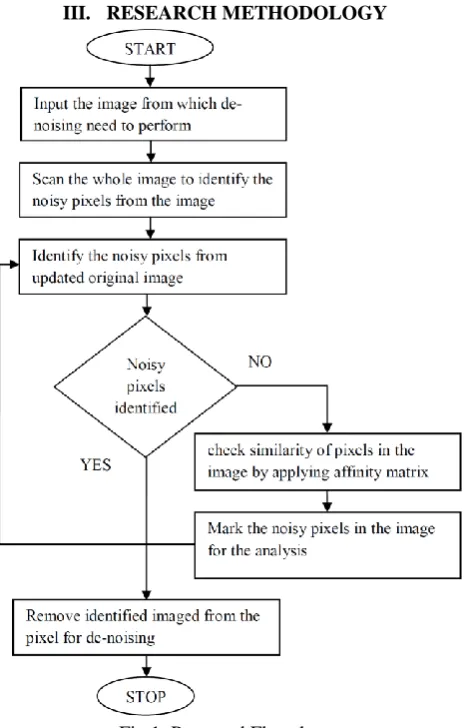
The weight based joint sparse representation technique is the efficient technique to remove noise from the image. In the weight based sparse representation technique two steps are mainly followed, in the first step technique of image registration is applied which will register the pixels of the image for processing. In the second phase the internal and external features of the image are processed for the image de-noising. In the proposed technique new step is added for the image de-nosing which is the probability step to find noisy pixels from the input image.
IV. EXPERIMENTAL RESULTS
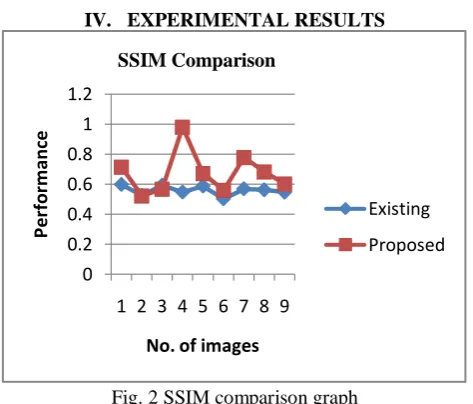
Fig. 2 SSIM comparison graph
As shown in figure 1, the comparison between the existing technique (WJSR) and proposed technique (Probability algorithm) is done on the basis of Parameter SSIM. In this parameter shows the number of images along the y-axis and shows the performance of pixels along the x-axis.
Fig. 3 MSE comparison
As shown in figure 2, the comparison between the existing technique (WJSR) and proposed technique (Probability algorithm) on the basis of Parameter MSE is depicted.
Fig. 4 PSNR comparison
0 0.2 0.4 0.6 0.8 1 1.2
1 2 3 4 5 6 7 8 9
P
e
rf
or
m
an
ce
No. of images
SSIM Comparison
Existing
Proposed
0 10 20 30 40 50 60 70
1 2 3 4 5 6 7 8 9
P
e
rf
or
m
an
ce
No. of images
MSE Comparison
Existing
Proposed
0 5 10 15 20 25 30 35
1 2 3 4 5 6 7 8 9
P
e
rf
or
m
an
ce
No. of images
PSNR Comparison
Existing
ISSN(E): 2277-128X, ISSN(P): 2277-6451, DOI: 10.23956/ijarcsse/V7I7/0124, pp. 25-29
As shown in figure 3, the comparison between the existing technique (WJSR) and proposed technique (Probability algorithm) on the basis of Parameter PSNR is depicted. In this parameter shows the proposed technique is higher than the existing technique.
Fig. 5 Execution time
As shown in figure 4, the comparison between the existing technique (WJSR) and proposed technique (Probability algorithm) is shown on the basis of Parameter Execution time. In this parameter the time will be shown in seconds. In this, the existing technique takes the more time as compared the proposed technique. The proposed technique takes less time and shows the better quality of the image.
Fig. 6 Accuracy comparison
As shown in figure 5, the comparison between the existing technique (WJSR) and proposed technique (Probability technique) is given on the basis of Parameter Accuracy. Accuracy shows the quality of the image is true. In this parameter shows performance of the existing technique and the proposed technique.
V. CONCLUSION
A method which is used to transform an image into digital form and applied some operations on it is called an image processing. As a result, get an improved image of better quality or to take out some important information from it. Noise is an unwanted signal incorporated in an image during acquisition and can deteriorate human annotation and computer aided analysis of images. It adversely affects MSE and PSNR of an image. The probability based algorithm will be applied which will find the most dissimilar pixels in the image. The simulation of the proposed and existing technique is done in MATLAB. The result analysis shows that PSNR, MSE and SNR of the proposed technique is better than existing technique.
ACKNOWLEDGMENT
We thanks the reviewers for comments and suggesting and additional references. We also thanks to ECE department faculties to giving some useful suggestions. Finally we thanks all those authors who made their technical reports and publications readily available on the internet and the world wide web.
REFERENCES
[1] Tilo Strutz,” Context-Based Predictor Blending for Lossless Colour Image Compression”, IEEE Transactions on Image Processing, vol. 24, no. 6, 2015.
0 0.1 0.2 0.3 0.4 0.5 0.6
1 2 3 4 5 6 7 8 9
P
e
rf
or
m
an
ce
No. of images
Execution Time
Existing
Proposed
0 20 40 60 80 100 120
1 2 3 4 5 6 7 8 9
P
e
rf
or
m
an
ce
No. of images
Accuracy Comparison
Existing
ISSN(E): 2277-128X, ISSN(P): 2277-6451, DOI: 10.23956/ijarcsse/V7I7/0124, pp. 25-29
[2] V. Rohit, Dr A. Jahid, “A comparative study of various types of image noise and efficient noise removal techniques”, International journal of advanced research in computer science and software engineering, Vol.3, Issue10, pp. 617-622,2013
[3] W., L. Xiong, “Salt-and-pepper noise removal based on image sparse representation”, Optical Engineering Vol. 50, Issue 9, pp. 097007-097007,2011.
[4] Wangmeng Zuo, Lei Zhang, and Weiwei Wang, Chunwei Song, David Zhang " Gradient Histogram Estimation and Preservation for Texture Enhanced Image Denoising”, IEEE transactions on image processing, vol. 23, no. 6,2014.
[5] Xianhua Zeng, Wei Bian, Wei Liu, Jialie Shen, Dacheng Tao, Fellow, “Dictionary Pair Learning on Grassmann Manifolds for Image Denoising”, IEEE transactions on image processing,2015.
[6] Xuande Zhang, Xiangchu Feng, and Weiwei Wang, “Two-Direction Nonlocal Model for Image Denoising”,IEEE transactions on image processing, vol. 22, no. 1,2013.
[7] Y. Huanjing, S.Xiaoyan, Y.Jingyu, W.Feng, “Image Denoising by Exploring External and Internal Correlations”, IEEE Transactions On Image Processing, vol. 24, no. 6,2015.
[8] Christian Rathgeb, Anika Pflug, Johannes Wagner, Christoph Busch,” Effects of image compression on ear biometrics”, IET Biom., 2016, vol. 5, Iss. 3, pp. 252–261,2016.
[9] Ruiqin Xiong, Hangfan Liu, Xinfeng Zhang, Jian Zhang, Siwei Ma, Feng Wu, and Wen Gao, “Image Denoising via Bandwise Adaptive Modeling and Regularization Exploiting Nonlocal Similarity”,IEEE Transactions on Image Processing,2016
[10] Azam Karami, Rob Heylen, and Paul Scheunders,” Hyperspectral Image Compression Optimized for Spectral Unmixing”, IEEE TRANSACTIONS ON GEOSCIENCE AND REMOTE SENSING, 2016
[11] Mansour Nejati, Shadrokh Samavi, Nader Karimi, S. M. Reza Soroushmehr, and Kayvan Najarian,” Boosted Dictionary Learning for Image Compression”, IEEE,2016.
[12] Miguel Hernandez-Cabronero, Ian Blanes, Armando J. Pinho, Michael W. Marcellin, and Joan Serra-Sagrista,” Progressive Lossy-to-Lossless Compression of DNA Micro array Images”, IEEE,2016.
[13] Younghee Kwon, Kwang In Kim, James Tompkin, Jin Hyung Kim, and Christian Theobalt,” Efficient Learning of Image Super-resolution and Compression Artifact Removal with Semi-local Gaussian Processes”, IEEE Trans. Image Process., vol. 15, no. 6, pp. 1506–1516, June.2015.