637
© 2017 by the Serbian Biological Society How to cite this article: Duscher T, Nopp-Mayr U. Species distribution modeling for the invasive raccoon dog (Nyctereutes procyonoides) in Austria and first range predictions for alpine environments. Arch Biol Sci. 2017;69(4):637-47
Species distribution modeling for the invasive raccoon dog (
Nyctereutes procyonoides
) in
Austria and first range predictions for alpine environments
Tanja Duscher1 and Ursula Nopp-Mayr2,*
1Research Institute of Wildlife Ecology, Department of Integrative Biology and Evolution, University of Veterinary Medicine
Vienna, Savoyenstraße 1, 1160 Vienna, Austria
2Institute of Wildlife Biology and Game Management, Department of Integrative Biology and Biodiversity Research,
University of Natural Resources and Life Sciences, Vienna, Gregor Mendelstraße 33, 1180 Vienna, Austria
*Corresponding author: [email protected]
Received: November 24, 2016; Revised: February 17, 2017; Accepted: March 1, 2017; Published online: March 16, 2017
Abstract: Species distribution models are important tools for wildlife management planning, particularly in the case of invasive species. We employed a recent framework for niche-based invasive species distribution modeling to predict the probability of presence for the invasive raccoon dog (Nyctereutes procyonoides) in Austria. The raccoon dog is an adap-tive, mobile and highly reproductive Asiatic canid that has successfully invaded many parts of Europe. It is known to occur in Austria since 1963 and is now widespread in the northern and eastern parts of the country, but its population density remains low. With the help of a species distribution model we identified focal areas for future monitoring and manage-ment actions, and we address some managemanage-ment implications for the raccoon dog in Austria. We also determined the environmental predictors of raccoon dog distribution in this alpine country. Its distribution seems to be mainly limited by climatic factors (snow depth, duration of snow cover, winter precipitation and mean annual temperature) and is thus linked to elevation. Consequently, we assumed the Alps to be a barrier for the spread of the invasive raccoon dog in Europe; however, its ecological permeability is expected to increase with ongoing climate change.
Key words: raccoon dog; Nyctereutes procyonoides; species distribution model; MaxEnt; Alps
INTRODUCTION
Understanding species-habitat relationships is a fun-damental issue in landscape ecology, allowing for the formulation of specific management demands. For invasive alien species (IAS), hindcasting and forecast-ing range expansions as well as range shifts are high-priority research issues that support decisions in eco-logical management. Explicitly incorporating species’ physiological limits and range-limiting processes pro-vides a realistic approach for modeling and forecasting species’ distributions [1]. This in turn might help to delineate focal areas for management where the spread of IAS should be prevented and negative effects mini-mized, or at least it may help to improve surveillance and monitoring of the species. Thus, understanding invasion dynamics is particularly important at the edges of IAS distributions or at potential barriers, as
in the case of the raccoon dog (Nyctereutes
procyonoi-des) in Austria. However, species distribution models
for the raccoon dog (RD) in the European landscape are rare. Melis et al. [2] analyzed coarse scale habitat use and distribution in Norway and Sweden, based on telemetry studies and mechanistic habitat suitability models. Sutor et al. [3] and Drygala et al. [4] also used telemetry data for habitat analyses of RDs in German lowland study areas. However, for alpine surround-ings, large-scaled approaches were lacking.
The raccoon dog is a medium-sized carnivore native to the Far East. It was released as a huntable furbearer in the western parts of the former Soviet Union between 1928 and 1955 [5]. As an opportunis-tic generalist, the RD is highly adaptable [6]. Studies
of the introduced range of the RD subspecies N. p.
ussuriensis showed that each monogamous pair can
both males and females have been shown to disperse from their natal home ranges with a mean distance of 13.5 km in northeastern Germany [8], and 14 km (females) and 19 km (males) in southeastern Finland [9]. The maximum dispersal distance detected so far in juvenile RDs in invaded areas is 108 km in Ger-many [6] and 145 km in Finland [7]. Thus, the RD has a high potential for both rapid population growth and fast range expansion of approximately 37000 km² per year [5]. Accordingly, it has successfully invaded many European countries in the past [7] and is de-fined as an invasive species due to its vast spreading. In some parts of the invaded range, RD densities have increased exponentially [7] and in some areas, the spe-cies has become the most common carnivore.
In some areas of their invaded range it has been presumed that RDs could threaten local populations of waterfowl and amphibians [10]. However, it was concluded that little is known about its impact [7]. The most serious issue concerning RD invasion seems to be the transmission of diseases [7]. The RD is an
important vector of rabies [11], fox tapeworm (
Echi-nococcus multilocularis) [12] and other parasites and
pathogens, constituting a health risk for livestock, wildlife and humans [7]. So far, there are no Austrian studies about its impact, but it is assumed to be a po-tential risk to Austrian native fauna [13].
In 2015, new legislation (EU Regulation No 1143/2014) on the prevention and management of the introduction and spread of IAS in the European Union (EU) entered into force. This regulation in-cludes restrictions on bringing species of concern into EU territory, their keep, breeding, transport, release and use, or bringing to market. Furthermore, every member state is obliged to establish a surveillance sys-tem and institute effective management measures for those IAS of EU concern.
To date, the RD is not listed as a species of EU concern, but it is currently under discussion for listing as a species of concern. It is deemed to be a low-risk species in Belgium [14] and a moderate en-vironmental risk in the Netherlands [15], while it is considered “potentially invasive” in Germany [16]. However, the DAISIE (Delivering Alien Invasive Spe-cies Inventories for Europe) network has listed the RD among 100 of the worst IAS in Europe (http://www.
europe-aliens.org/speciesTheWorst.do; viewed Febru-ary 2015). Since the development of IAS risk assess-ments is ongoing and the EU blacklist will be updated regularly, it remains uncertain how and to what extent this EU regulation will influence RD management at the national or local level. An attempt to eradicate the invasive RD in Europe is not promising due to its large-scale distribution [7,16]. Moreover, the imple-mentation of a continental strategy concerning the RD is difficult due to its spread across different countries with diverse national interests [e.g. 17] and different hunting systems, but to list it as a species of EU con-cern could be a step towards the harmonization of national strategies. Nevertheless, the population of this adaptive and highly reproductive alien species must be controlled on national or regional levels in order to limit further range expansion and probable population increase, or at least to reduce its potential impact in protected areas. In Austria, RDs are shot and trapped all year long to reduce their presumed negative influence on small game species, especially waterfowl [7,10].
Our study aimed to identify regions where a fur-ther increase of RD relative probability of occurrence can be expected and in particular focuses on alpine surroundings. We further highlight where monitor-ing and management actions should focus; we have compared the predictors of the RDs distribution in Austria to results of previous studies in other regions and environments. Therefore, our predictive distri-bution model contributes to a better recognition of potential RD occurrence, thereby enhancing detection probabilities and supporting further modeling and management steps [18].
As recently proposed [22], niche-based invasive species distribution modeling, monitoring and man-agement should comprise a 10-stage framework, in-cluding: (i) invasion characterization, (ii) objectives statement, (iii) assumption and uncertainty articula-tion, (iv) scale recognition and assignment, (v) predic-tor variable selection, (vi) modeling technique adop-tion, (vii) autocorrelation supervision, (viii) predic-tion, validation and mapping, (ix) management and monitoring, and (x) refinement. The implementation of this framework should increase the legitimacy and utility of SDMs over time [22]. In this paper, we con-sidered the items of this framework for the raccoon dog in Austria as far as possible. Based on our model-ing results we provide suggestions on the management and monitoring of the species. Future refinement and continued application of an adaptive SDM will assist in the detection of changes in RD invasion and the improvement of its management [22] in Austria and other alpine environments in general.
MATERIAL AND METHODS
Study region
Our study covers the entire territory of Austria with a size of 83879 km². Forests cover 48% of Austrian territory; a further 34% are agricultural areas [23]. Austria is comprised of different climatic regions, ranging from the Pannonian lowlands (with a low mean annual precipitation of 500-750 mm, a high mean summer temperature of 18-22°C and relatively cold winters with a mean temperature from -2 to 0°C) in the east, to oceanic higher alpine regions (low mean annual temperature from -6 to 4°C, high annual pre-cipitation up to 2500 mm) in the western part of the country [23]. Austria is a mountainous country with nearly two-thirds of the area occupied by the Alps (with altitudes up to 3798 m above sea level). As the highest massif in Europe, the Alps are a potential bar-rier for the natural dispersal of some IAS.
Invasion history and current distribution of the raccoon dog in Austria
Raccoon dogs have been sighted in the northeastern parts of Austria since 1963. A list of these sightings
has been published [24], with the first proven records from 1983 (Mannshalm, district Zwettl, Lower Aus-tria) and 1984 (Auersthal, district Gaenserndorf, Low-er Austria). In the following decades, furthLow-er records of RDs have been published [25,26] revealing a slight increase in their spread.
In the present study, we collected 42 proven RD records (documented with photographs or carcasses), and 23 reports of RD trapped or shot or found dead between 2000 to 2015. Photographs were mainly ob-tained from private camera traps, non-systematically installed by hunters within their hunting grounds. Hence 65 verifiable records could be used to fit the distribution model. The geographical distribution of these records and additional 36 uncertain records (30 sightings and 6 tracks) are shown in Fig. 1. The verifi-able records mainly stem from northern and eastern Austria (60 records). Only 5 verifiable records have been reported from the alpine regions and these are from lower altitudes (valleys or basins) in the Alps, as follows: Mur Valley (2004), Alm Valley (2009), Win-dischgarsten Basin (2011), Bregenz Forest (2014) and Klagenfurt Basin (2015). About half of the uncertain records, which we did not include in the SDM, were reported from alpine regions (17 records; Fig. 1).
For the first time, we documented juvenile sight-ings in Austria in 2010 and 2011 (in Lower Austria and Upper Austria), and recorded the presence of ju-venile RDs in 2011 (district Gmuend, Lower Austria) and 2014 (district Gaenserndorf and district Bruck/ Leitha, Lower Austria) (Fig. 1). Consequently, we can assume that there is a reproducing population of RDs in the northern and eastern parts of Austria that
ap-Fig. 1. Geographical distribution of proven raccoon dog records ( ; juvenile) and uncertain raccoon dog records, e.g. sightings
( ; juvenile) in Austria ( alpine regions; ___ rivers and
pears to be spreading westwards. So far, the popula-tion density remains at a low level [27] and ecological predictors of the establishment and spread of the RD in Austria are unknown.
Sampling method
We collected raccoon dog records from the provin-cial museums, the Museum of Natural History in Vienna and from provincial hunting associations. We also sent questionnaires to an official of the Pro-vincial Hunting Association of every district and to zoological preparators all over Austria. Additionally, we collected RD records from professional and non-professional hunters and citizens with the help of an online questionnaire. To support this investigation, we engaged in public relations by giving talks, writing articles and creating a project web site (www.enok. at). Thus, our data did not result from a consistent surveillance system but from random observations. In total, about 70% of proven records stemmed from hunters whose numbers and densities slightly differ among the provinces of Austria. Expressed in terms
of hunting licenses per km2 as a proxy of observer
density, values range from 0.8 in Vorarlberg to 1.8 in Lower Austria, with a mean value of 1.5 for the entire Austrian state territory (Burgenland 1.7; Carinthia 1.2; Upper Austria 1.6; Salzburg: 1.4; Styria: 1.4) [28]). For SDM, we used proven records (documented by photograph or carcass) and reports of trapped or shot individuals, or those found dead from the period 2000 to 2015. Sightings without any proof and photographs of tracks (all of low quality and without indication of size) were treated as uncertain records.
Species distribution modeling
Based on our presence-only dataset, we used MaxEnt for SDM. MaxEnt is a machine learning technique based on the principle of maximum entropy that uses environmental covariates from occurrence sites and a random sample of background data of the landscape of interest. In this way, an estimate of the probability den-sity of covariates for occurrence sites within the
land-scape (f1(Z)) is derived, where the one closest to the
probability density of covariates across the landscape
of interest (f(Z)) is chosen [29]. The distance of f1(Z)
to f(Z) is taken as relative entropy of f1(Z). MaxEnt
estimates the distribution of a target species by
itera-tively minimizing the distance between f1(Z) and f(Z).
This is done by imposing constraints, where covariate
means, estimated by f1, converge closely to the mean
value of occurrence sites. In MaxEnt, environmental covariates are weighted according to their contribution to model complexity, and the sum of weights, including regularization parameters, impede overfitting (i.e. too close matching of input data) [30]. However, in case of highly correlated variables, the contribution of these variables might be underestimated.
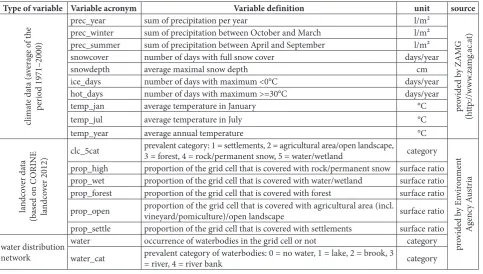
We modeled the probability of presence with Max-Ent version 3.3.3k [30]. Due to the small sample size, we chose a 10-times replication model and kept all other settings default. We first performed a run with all potentially relevant environmental variables (Table 1). As a measure of model performance, MaxEnt generates the mean area under the receiver operating character-istics curve (AUC) [31]. As the RD shows an oppor-tunistic behavior with habitat preferences varying be-tween study regions, we tried to find the best matching model for Austria with the highest AUC by deselecting variables with a low permutation importance.
Predictor variable selection – the realized and fundamental niches of raccoon dogs
Recent ecological studies in other invaded countries in Europe have shown that RDs favor meadows, gardens and open woodlands with tall and abundant under-growth in Finland [32], agricultural areas, wetlands, lower altitudes and shallow slopes in Sweden [33], and dense vegetation cover [34] or grassland and conifer-ous woods [3] in Germany. RDs used all habitat types opportunistically in their study region in Germany [4]. It was assumed that food is a key factor in habitat use [3], but its influence seems to be weaker in winter, when RDs reduce activity and use body-fat reserves. The latter authors furthermore hypothesized that a mixed landscape structure with tree or shrub cover and open habitat patches offers optimal conditions in terms of shelter and food availability for RDs.
and body conditions of RDs [35]. In [36], the authors assumed that an increased snow depth at higher latitudes can outline the border of RD expansion in northern Europe. Although most studies of its ecol-ogy were performed in low-altitude regions, altitude was shown to have an influence on the habitat use of Swedish RDs [33], and furthermore, it is considered to be an important factor influencing their distribution
and abundance (subspecies N. p.viverrinus) in Japan
(Seki Y, personal communication). Thus, both climate and altitude appear to drive RD invasions in Europe. However, since altitude can be considered a surrogate of other predictors (such as precipitation and dura-tion of snow cover) and such indirect predictors might negatively affect transferability of models [22], we did not explicitly incorporate altitude into our modeling procedure and only considered assumed functional driving factors.
As shown by several authors [35,36], climate cues seem to determine the success of RD invasions, with precipitation, the duration of snow cover, snow depth as well as some temperature values and altitude [33] being components of the fundamental niche of this species. Moreover, studies on realized niches
[3,4,32-24] identified preferences for different habitat types (e.g. land cover, vicinity of water bodies) with varia-tions between study regions. Consequently, corre-sponding variables were chosen for the SDM (Table 1). Facing different climate zones, such as the inner-alpine regions with continental climate or pre-inner-alpine regions with more oceanic climate within our study area, we considered potentially meaningful environ-mental drivers of RD distribution for modeling, even in case they were highly correlated over the entire Austrian state territory (e.g. snow depth and mean temperature in January).
Spatial resolution
The environmental variables used for model fitting (Table 1) have been available in or were converted to an ESRI grid file format using the definition of the world geodetic system (WGS 1984). The geographi-cal extension of these files corresponds to the Austrian extension of 46.3175728836 to 49.0460405292 north and 9.40258397741 to 17.2497471234 east. The size of the grid cells is 0.022549319 x 0.022549319. Therewith, every grid cell has a size of about 4 km², and can thus be assumed as a medium sized RD home range [9,33,35].
Table 1. Environmental variables (and their sources), used for modeling the probability of raccoon dog presence in Austria with MaxEnt.
Type of variable Variable acronym Variable definition unit source
clim
at
e d
at
a (a
vera
ge o
f t
he
per
io
d 1971–2000)
prec_year sum of precipitation per year l/m²
pr
ov
ide
d b
y Z
AM
G
(h
ttp://w
w
w.za
m
g.ac.a
t)
prec_winter sum of precipitation between October and March l/m²
prec_summer sum of precipitation between April and September l/m²
snowcover number of days with full snow cover days/year
snowdepth average maximal snow depth cm
ice_days number of days with maximum <0°C days/year
hot_days number of days with maximum >=30°C days/year
temp_jan average temperature in January °C
temp_jul average temperature in July °C
temp_year average annual temperature °C
la
ndco
ver d
at
a
(b
as
ed o
n C
O
RINE
la
ndco
ver 2012)
clc_5cat prevalent category: 1 = settlements, 2 = agricultural area/open landscape, 3 = forest, 4 = rock/permanent snow, 5 = water/wetland category
pr
ov
ide
d b
y En
vir
onm
en
t
A
gen
cy A
us
tr
ia
prop_high proportion of the grid cell that is covered with rock/permanent snow surface ratio
prop_wet proportion of the grid cell that is covered with water/wetland surface ratio
prop_forest proportion of the grid cell that is covered with forest surface ratio
prop_open proportion of the grid cell that is covered with agricultural area (incl. vineyard/pomiculture)/open landscape surface ratio
prop_settle proportion of the grid cell that is covered with settlements surface ratio
water distribution network
water occurrence of waterbodies in the grid cell or not category
We converted all vector data (land cover data and water distribution network) to grid files using ArcGIS 10.1 (©ESRI). Thereby, we divided the land cover data into 5 categories (Table 1) and generated a grid file that provided the prevalent land cover category of each grid cell. Additionally, we generated one grid file for every land cover category showing the proportion of this category in each grid cell. As the representation of water bodies within the land cover data sometimes is not sufficient, we also produced one grid file show-ing the occurrence of water in each cell and another grid file showing the water categories (Table 1). For use in MaxEnt, we finally converted all grid files to ASCII grid format.
RESULTS
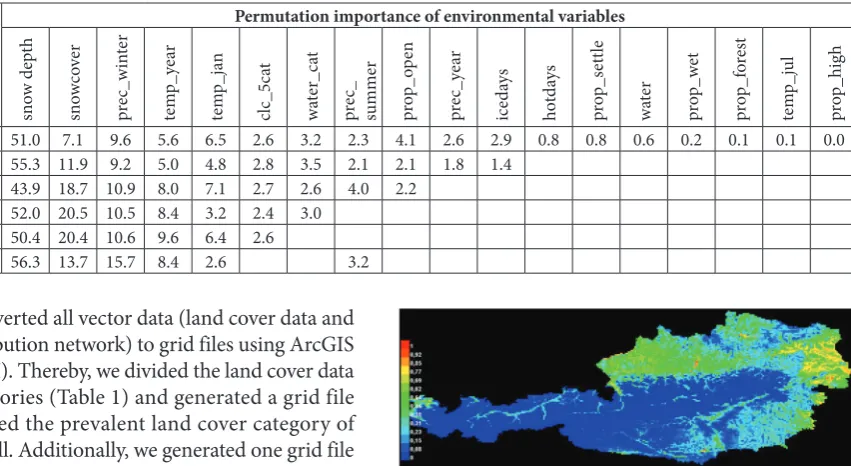
Selecting the best candidate model for Austria based on mean AUC values and permutation importance of predictor variables (Table 2), we finally explained the probability of raccoon dog presence based on seven environmental variables with decreasing values of per-mutation importance: (i) snow depth, (ii) duration of snow cover, (iii) winter precipitation, (iv) mean an-nual temperature, (v) mean January temperature, (vi) prevalent land cover category and (vii) occurrence of water body categories.
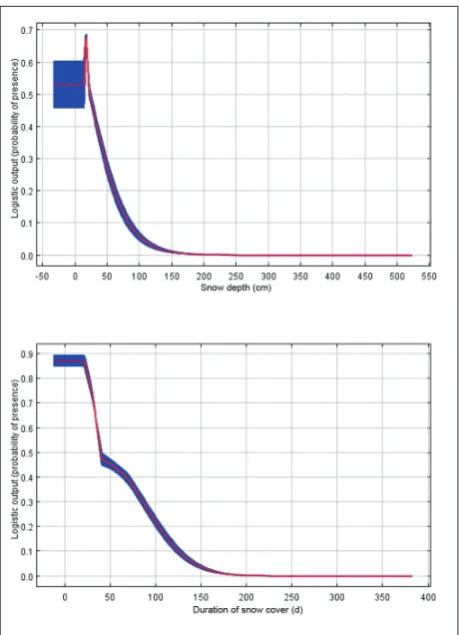
The best candidate MaxEnt model that predicts RD presence in Austria has a mean AUC of 0.854 (±0.059). The resulting map (Fig. 2) shows that the probability of RD presence is comparably high (≥0.5) in the eastern and northern parts of Austria, in par-ticular the Pannonian lowlands (with a probability of RD presence >0.8), the pre-alpine regions and the
Austrian part of the Bohemian Massif. The predicted probability of RD presence is also comparably high in the Klagenfurt Basin (>0.8) in the very south of Aus-tria, and in the northwestern edge of the Rhine valley and the Bregenz Forest (>0.7) in the west of Austria. According to these analyses, RDs are not expected to occur in the higher alpine regions.
Snow depth (permutation importance=52%) and duration of snow cover (permutation impor-tance=20.5%) appear to be the most important en-vironmental predictors of RD distribution in Austria (Table 3). Thus, no RD presence is expected in regions with a maximum annual snow depth of 150 cm and more, or in regions where the snow cover lasts 160 days or longer (Fig. 3).
Our results further indicate that RDs prefer a cli-mate with mean annual temperatures (permutation importance=8.4%) of at least 1°C, and mean tempera-tures in January (permutation importance=3.2%) of at least -5°C, as well as relatively low winter precipitation (permutation importance=10.5%) (Table 3). In Aus-tria, RDs seem to have a slight affinity to habitats close to rivers (probability of presence=0.88; permutation importance=3%), and wetland habitats (probability
Table 2. Model performance (expressed as AUC-value) with different explanatory variables included, and permutation importance of environmental variables; the best candidate model with the highest AUC value is indicated in bold letters.
mean AUC
Permutation importance of environmental variables
sn
ow dep
th
sn
ow
co
ver
pr
ec_w
in
ter
tem
p_y
ea
r
tem
p_j
an
clc_5c
at
wa
ter_c
at
pr
ec_
summ
er
pr
op_o
pen
pr
ec_y
ea
r
ice
da
ys
ho
td
ays
pr
op_s
et
tle
wa
ter
pr
op_w
et
pr
op_f
or
es
t
tem
p_j
ul
pr
op_hig
h
0.84 51.0 7.1 9.6 5.6 6.5 2.6 3.2 2.3 4.1 2.6 2.9 0.8 0.8 0.6 0.2 0.1 0.1 0.0
0.85 55.3 11.9 9.2 5.0 4.8 2.8 3.5 2.1 2.1 1.8 1.4
0.852 43.9 18.7 10.9 8.0 7.1 2.7 2.6 4.0 2.2
0.854 52.0 20.5 10.5 8.4 3.2 2.4 3.0
0.844 50.4 20.4 10.6 9.6 6.4 2.6
0.84 56.3 13.7 15.7 8.4 2.6 3.2
of presence=0.76; permutation importance=2.4%), and they avoid forests as well as high altitude habitats with rocks and glaciers (both have a probability of presence=0.08; permutation importance=2.4%). The latter two habitat types are mainly situated in cen-tral Austria at higher altitude regions. In this regard, climate could be the real driver of habitat choice, as predictors of the realized niche seem to be of minor importance (permutation importance≤3).
DISCUSSION
Realized and fundamental predictors of raccoon dog distribution
As raccoon dogs show high plasticity in their habitat selection [3,32], predictors of the realized niche seem to be of minor importance compared to predictors of the fundamental niche. The RD’s preferences for river and wetland habitats, as noted in our study, can be ex-plained by food abundance. Food is assumed to be a key factor of habitat choice [3], and amphibians, particular-ly aggregations of frogs, offer attractive food sources for RDs [10]. Furthermore, rivers and wetland habitats that favor RD presence are typically more abundant at lower altitudes, thus offering more favorable climatic con-ditions. In contrast, non-preferred rocky habitats and regions with the highest forest cover prevail at higher altitudes. Thus, the choice of land cover categories is probably influenced more by climatic cues.
Examination of the more important fundamental predictors of RD occurrence indicates that our find-ings are comparable to previously presented conclu-sions [7], wherein RDs live in areas where the mean annual temperature is above 0°C, the thickness of snow cover is <80 cm and the snow cover lasts <175 days. Accordingly, alpine regions are hardly affected by the RD invasion. In these regions, increasing alti-tudes are associated with increasing mean snow depth, increasing duration of snow cover and descending mean (annual and winter) temperatures [38]. To adapt to harsh environmental situations, RDs have at their disposal different wintering strategies to preserve en-ergy, e.g. hibernating, denning, basking behavior or shifting of daytime activity [35,36,39]. Nevertheless, as assumed previously [7] and confirmed by our re-sults, the distribution of the RD appears to be limited by climatic parameters that are clearly linked to alti-tude. Yet, the alpine habitats in Austria are evidently unsuitable for the raccoon dog and we consequently
Table 3. Permutation importance and predicted threshold or pref-erence of included variables in the best candidate MaxEnt model for raccoon dogs in Austria.
environmental
variable importance [%] threshold/ preferencepermutation
snowdepth 52 the less the better, max 150cm
snowcover 20.5 the less the better, max 160 days/year
prec_winter 10.5 best at 200 l/m²
temp_year 8.4 the warmer the better, at least 1°C
temp_jan 3.2 the warmer the better, at least -5°C
water_cat 3 preference of rivers
clc_5cat 2.4 preference of wetland, avoidance of forests and rocky habitat
assumed that the Alps represent a barrier to the dis-tribution and natural spread of RD in central Europe. As regards climate change, the ability of RDs to invade alpine regions might change due to predicted warming at higher elevations and large decreases in alpine snow amounts and its persistence below about 1500-2000 m a.s.l. [40].
Assumption and uncertainty articulation
Several factors could have affected our modeling re-sults: first, our presence-only records are biased to-wards random observations rather than the results of a nationwide, continuous systematic sampling effort. Thus, they probably do not entirely reflect actual RD distribution and abundance as the frequency of these reports might be influenced by (i) differences in ob-server density, (ii) regional differences in communi-cation networks, (iii) nonsystematic arrangement of hunters’ traps, camera traps or other recording places due to reachability, and (iv) temporally different in-tensities of public relation activities. Contrasting re-cords of RDs in Austrian provinces against densities of hunters per province (expressed in terms of hunting licenses per province), which were the main observer group with 70% of observations, no simple correlation can be assumed. For example, both terrain features and densities of hunters show a comparable order of magnitude in the provinces Salzburg and Styria [28], while the numbers of proven RD densities differ dis-tinctly (Fig. 1). Thus, a lower number of observations cannot be explained by a lower number of observers, although it could be assumed that the presence of ob-servers in a whole year cycle is lower in high-altitude regions as compared to lower altitudes. A critical as-sumption of presence-only (or presence-background) SDMs is that presence data are not spatially biased [41]. In fact, this is not true in many cases. Rather, the presence of data often merely reflects the pres-ence of observers, which in turn might be affected by distances from human settlements, roads, or nega-tively correlate with altitude. In fact, a true absence of species is rarely recorded systematically. Therefore, such presence data do not reflect the entire range of environmental conditions where a species occurs (its realized niche), with this sampling bias pointing to models with a lower sensitivity (i.e. false negative rates) [42]. One option to adjust for sampling biases
would be to estimate sampling efforts using logistic re-gression and to implement this information in further SDM steps [43]. However, intensifying monitoring efforts at locations of high probability of occurrence, as predicted by our SDM and by the establishment of a systematic surveillance system with camera traps [see 44] or consistent hunting bags, should be a primary goal in Austria in the coming years.
Overall, our raccoon dog observation data par-tially violate basic SDM assumptions, which is typi-cal for many invading species occurrence data [22]. Therefore, (i) we assume that RDs have not reached species-environment equilibrium [45], particularly in the western areas of distribution in Austria; (ii) the information on realized niches in the invaded areas is incomplete [20]; and (iii) the habitat-species rela-tionships and particularly range-limiting factors may differ between native areas and a novel range. The latter point seems to be of minor importance to our study as we only considered the environmental driv-ers of RD distribution within its European range and exclusively used the presence data from Austrian oc-currences. However, evidence of successful reproduc-tion as well as high-quality records of RDs in Austria provide important information for a first examina-tion of the invasion patterns of this species, and for a prediction of its future distributions and the highly probable range-limiting factors.
records from one year were made close together (1.8 km apart), but arose from two different individuals that were shot.
Management challenges and future focal regions
The current management of RD populations in Aus-tria is determined by provincial hunting laws. It is permissible to shoot and trap RDs all year round. In Austria, hunting is a private enterprise as the right to hunt belongs to the landowner or it can be rented. Only a few hunters are specialized in trapping car-nivores, and the shooting of RDs mainly happens by chance (e.g. while waiting for a wild boar at a feeding station). Furthermore, the overall interest in hunting or trapping carnivores is low as the fur can hardly be sold for a reasonable price. The efficiency of this type of management strategy within the context of a pos-sible exponential increase in invasive RD populations is questionable. As a next step, both individual-based (VORTEX) and cohort-based (RAMAS) population models that simulate population growth rates and probabilities of extinction should be run to support management decisions and to prioritize actions at the meta-population level [48,49]. Hitherto, only one population viability analysis (VORTEX) has been run for RDs in Denmark [50], predicting marked expan-sions, with delays of only a few years for attaining carrying capacities when applying culling strategies. As discussed earlier [51], the situation in Europe is often drawn-out regarding the removal of vertebrates, and several eradication projects have been halted by public opposition. Likewise, because of the prevailing public opinion, it is unlikely that Austrian hunters will intensify hunting pressure or even consider an eradi-cation campaign. However, responsible authorities could positively influence the success of IAS regula-tion by providing concrete support (e.g. by offering fur premiums or bounties) [52], and by increasing public awareness of IAS, specifically in the context of prevention and regulation.
Following our predictions, the Pannonian low-lands and palpine areas in the north and east are re-gions with the highest probability of raccoon dog oc-currence in Austria. In these regions, RD populations have already been established, as records are reported regularly and their reproduction has been confirmed.
At present, RD density is low but there is a potential for an exponential increase as has been documented in other European countries [7]. Especially in east-ern Austria, in the floodplain areas along the rivers Danube and Leitha, as well as in the vicinity of Lake Neusiedl, the predicted presence is high, and RDs are likely to establish relatively high densities. Several of these wetland habitats are protected national parks due to the presence of rare amphibians and waterfowl. Thus, future monitoring and management actions for the control of RD populations should mainly focus on these regions to reduce potential impacts.
Implications for alpine neighbors
In contrast to the eastern and northern lowlands, we do not expect significant increases in RD population densities in the alpine regions of Austria. Further-more, our results suggest the Alps are a barrier for RD dispersal because of harsh climate conditions. This is relevant to the monitoring and management of RDs in neighboring countries. Despite the general barrier effect of the Alps, dispersal of RDs along alpine valleys could occur. Again, the barrier effect of the Alps on RD invasion could decrease due to climate change.
Comparability of the IAS status in Europe
con-cern to the EU [54]. Consequently, a transparent and adaptive SDM can also provide essential information for national and EU-wide risk assessments. Certainly, there is a clear need for schematic screenings of inva-sive species [14] in order to quantify and categorize impacts and to improve management priorities [55].
Acknowledgements: We would like to thank everyone who re-ported raccoon dog records or sightings, especially the provincial Hunting Associations, as well as the provincial museums and the Museum of Natural History in Vienna. Furthermore, we thank Markus Immitzer for his valuable modeling advice and likewise Susanne and Friedrich Reimoser and Samuel I. Zeveloff for read-ing and commentread-ing our manuscript.
Conflict of interests disclosure: The authors declare that they have no conflict of interest.
REFERENCES
1. Kearney M, Porter W. Mechanistic niche modelling: com-bining physiological and spatial data to predict species’ ranges. Ecol Lett. 2009;12(4):334-50.
2. Melis C, Nordgaard H, Herfindal I, Kauhala K, Ahlen PA, Strann K-B, Andersen, R. Raccoon dogs in Norway-Potential expansion rate, distribution area and management implica-tions. NTNU Vitenskapsmuseet Rapp. Zool. Ser. 2007;3:1-49 3. Sutor AS, Schwarz S. Seasonal habitat selection of raccoon
dogs (Nyctereutes procyonoides) in Southern Brandenburg, Germany. Folia Zool. 2013;62(3):235-43.
4. Drygala F, Stier N, Zoller H, Boegelsack K, Mix HM, Roth M. Habitat use of the raccoon dog (Nyctereutes procyonoides) in north-eastern Germany. Mamm Biol. 2008;73(5):371-8. 5. Nowak E. Ansiedlung und Ausbreitung des Marderhundes
(Nyctereutes procyonoides Gray) in Europa. Beitr zur
Jagd-Wildforschung. 1974;9:351-84.
6. Sutor A. Dispersal of the alien raccoon dog Nyctereutes
pro-cyonoides in Southern Brandenburg, Germany. Eur J Wildl
Res. 2008;54(2):321-6.
7. Kauhala K, Kowalczyk R. Invasion of the raccoon dog
Nyc-tereutes procyonoides in Europe: history of colonization,
fea-tures behind its success, and threats to native fauna. Curr Zool. 2011;57(5):584-98.
8. Drygala F, Zoller H, Stier N, Roth M. Dispersal of the rac-coon dog Nyctereutes procyonoides into a newly invaded area in Central Europe. Wildl Biol. 2010;16(2):150-61.
9. Kauhala K, Holmala K, Lammers W, Schregel J. Home ranges and densities of medium-sized carnivores in south-east Finland, with special reference to rabies spread. Acta Theriol (Warsz). 2006;51(1):1-13.
10. Sutor A, Kauhala K, Ansorge H. Diet of the raccoon dog
Nyctereutes procyonoides - a canid with an opportunistic
foraging strategy. Acta Theriol (Warsz). 2010;55(2):165-76. 11. Singer A, Kauhala K, Holmala K, Smith GC. Rabies in
north-eastern Europe-the threat from invasive raccoon dogs. J Wildl Dis. 2009;45(4):1121-37.
12. Laurimaa L, Süld K, Moks E, Valdmann H, Umhang G, Knapp J, Saarma, U. First report of the zoonotic tapeworm
Echinococcus multilocularis in raccoon dogs in Estonia, and
comparisons with other countries in Europe. Vet Parasitol. 2015;212(3-4):200-5.
13. Essl F, Rabitsch W. Neobiota in Österreich. Wien: Umwelt-bundesamt; 2002. 432 p.
14. D’hondt B, Vanderhoeven S, Roelandt S, Mayer F, Versteirt V, Adriaens T, . Harmonia+ and Pandora+: risk screening tools for potentially invasive plants, animals and their patho-gens. Biol Invasions. 2015;17(6):1869-83.
15. Mulder JL. The raccoon dog (Nyctereutes procyonoides) in the Netherlands-its present status and a risk assessment. Lutra. 2013;56(1):23-43.
16. Rabitsch W, Nehring S. Naturschutzfachliche Invasivitätsbe-wertung Nyctereutes procyonoides - Marderhund. In: Neh-ring S, Rabitsch W, Kowarik I, Essl F, editors. Naturschutz-fachliche Invasivitätsbewertungen für in Deutschland wild lebende gebietsfremde Wirbeltiere: unter Verwendung von Ergebnissen aus den F+E-Vorhaben FKZ 806 82 330, FKZ 3510 86 0500 und FKZ 3511 86 0300. Bonn: Bundesamt für Naturschutz; 2015. p. 58-9.
17. Genovesi P, Carboneras C, Vilà M, Walton P. EU adopts innovative legislation on invasive species: a step towards a global response to biological invasions? Biol Invasions. 2015;17(5):1307-11.
18. D’Evelyn ST, Tarui N, Burnett K, Roumasset JA. Learning-by-catching: Uncertain invasive-species populations and the value of information. J Env Man. 2007;89(4):284-92. 19. Breiner FT, Guisan A, Bergamini A, Nobis MP. Overcoming
limitations of modelling rare species by using ensembles of small models. Methods Ecol Evol. 2015;6(10):1210-8. 20. Hernandez PA, Graham CH, Master LL, Albert DL. The
effect of sample size and species characteristics on perfor-mance of different species distribution modeling methods. Ecography. 2006;29(5):773-85.
21. Elith J, Graham CH. Do they? How do they? WHY do they differ? On finding reasons for differing performances of spe-cies distribution models. Ecography. 2009;32(1):66-77. 22. Uden DR, Allen CR, Angeler DG, Corral L, Fricke KA.
Adaptive invasive species distribution models: a frame-work for modeling incipient invasions. Biol Invasions. 2015;17(10):2831-50.
23. Huber-Bachmann E. Österreich. Zahlen. Daten. Fakten. 10th ed. Wien: Statistik Austria; 2015. 76 p.
24. Bauer VK. Der Marderhund Nyctereutes proccyonoides (Gray, 1834) in Österreich-erste gesicherte Nachweise (Mammalia austriaca 9). Ann Naturhist Mus Wien. 1986;87:131-6.
25. Aubrecht G. Waschbär (Procyon lotor) und Marderhund
(Nyctereutes proccyonoides) -zwei faunenfremde Tierarten
erobern Österreich. Stapfia. 1995;37:225-36.
26. Sackl P. Marderhund Nyctereutes proccyonoides (Gray, 1834). In: Spitzenberger F, editor. Die Säugetierfauna Österreichs. Bundesministerium für Land- und Forstwirtschaft, Umwelt und Wasserwirtschaft. Grüne Reihe 13. 2001. p. 577-83. 27. Duscher T. The current status of the raccoon (Procyon lotor)
28. Jagd [Internet]. Vienna (A): Statistics Austria. [date unkown] [updated 2016 Nov 11; cited 2017 Jan 21]. Avail-able: http://www.statistik.at/web_de/statistiken/wirtschaft/ land_und_forstwirtschaft/viehbestand_tierische_erzeugung/ jagd/020316.html. German.
29. Elith J, Phillips SJ, Hastie T, Dudík M, Chee YE, Yates CJ. A statistical explanation of MaxEnt for ecologists. Divers Distrib. 2011;17(1):43-57.
30. Phillips SJ, Dudík M. Modeling of species distributions with Maxent: new extensions and a comprehensive evaluation. Ecography. 2008;31(2):161-75.
31. Phillips SJ, Anderson RP, Schapire RE. Maximum entropy modeling of species geographic distributions. Ecol Model. 2006;190(3-4):231-59.
32. Kauhala K, Auttila M. Habitat preferences of the native bad-ger and the invasive raccoon dog in southern Finland. Acta Theriol (Warsz). 2010;55(3):231-40.
33. Melis C, Herfindal I, Dahl F, Åhlén P-A. Individual and Temporal Variation in Habitat Association of an Alien Car-nivore at Its Invasion Front. PLoS One. 2015;10(3):e0122492. 34. Drygala F, Zoller H. Spatial use and interaction of the invasive raccoon dog and the native red fox in Central Europe: com-petition or coexistence? Eur J Wildl Res. 2013;59(5):683-91. 35. Seki Y, Koganezawa M. Factors influencing winter home
ranges and activity patterns of raccoon dogs Nyctereutes
procyonoides in a high-altitude area of Japan. Acta Theriol
(Warsz). 2011;56(2):171-7.
36. Melis C, Herfindal I, Kauhala K, Andersen R, Høgda K-A. Predicting animal performance through climatic and plant phenology variables: The case of an omnivore hibernating species in Finland. Mamm Biol. 2010;75(2):151-9. 37. Kauhala K, Saeki M. Raccoon dog Nyctereutes procyonoides
(Gray, 1834). In: Sillero-Zubiri C, Hoffmann M, Macdonald DW, editors. Canids: Foxes, Wolves, Jackals and Dogs - Sta-tus Survey and Conservation Action Plan. Gland and Cam-bridge: IUCN/SSC Canid Specialist Group; 2004. p. 136-42. 38. Mayer H, Ott E. Gebirgswaldbau, Schutzwaldpflege : ein waldbaulicher Beitrag zur Landschaftsökologie und zum Umweltschutz. 2nd rev. ed. Stuttgart, New York: G. Fischer; 1991. 587 p.
39. Kowalczyk R, Zalewski A. Adaptation to cold and predation-shelter use by invasive raccoon dogs Nyctereutes procyonoi-des in Białowieża Primeval Forest (Poland). Eur J Wildl Res. 2011;57(1):133-42.
40. Gobiet A, Kotlarski S, Beniston M, Heinrich G, Rajczak J, Stoffel M. 21st century climate change in the European Alps-a review. Sci TotAlps-al Environ. 2014;493:1138-51.
41. Peterson A, Soberón J, Pearson RG, Anderson RP, Martínez-Meyer E, Nakamura M, Araújo MB. Ecological niches and geographic distributions. Princeton: Princeton University Press; 2011. 328 p.
42. Hanspach J, Kühn I, Schweiger O, Pompe S, Klotz S. Geo-graphical patterns in prediction errors of species distribution models: Patterns in prediction error. Glob Ecol Biogeogr. 2011;20(5):779-88.
43. Stolar J, Nielsen SE. Accounting for spatially biased sampling effort in presence-only species distribution modelling. Div-ers Distrib. 2015;21(5):595-608.
44. Dahl F, Åhlén P-A, Swartström J, Lindström M, Simmels-gaard Platz ML. Laymans report: Management of the inva-sive Raccoon Dog (Nyctereutes procyonoides) in the north-European countries (LIFE09 NAT/SE/000344). Nyköping, Sweden: Swedish Association for Hunting and Wildlife Management; 2014. 24 p.
45. Elith J, Kearney M, Phillips S. The art of modelling range-shifting species. Methods Ecol Evol. 2010;1(4):330-42. 46. Legendre P. Spatial Autocorrelation: Trouble or New
Para-digm? Ecology. 1993;74(6):1659-73.
47. Guisan A, Zimmermann NE. Predictive habitat distribution models in ecology. Ecol Model. 2000;135(2-3):147-86. 48. Bouzat JL, Strem RI. Population viability analysis of the
blue-throated macaw (Ara glaucogularis) using individual-based and cohort-individual-based PVA programs. Open Conserv Biol J. 2012;6:12-24.
49. Zeoli LF, Sayler RD, Wielgus R. Population viability analy-sis for captive breeding and reintroduction of the endan-gered Columbia basin pygmy rabbit. Anim Conserv. 2008;11(6):504-12.
50. Rømer A, Nørgaard L, Mikkelsen D, Chriél M, Elmeros M, Madsen A, Pertoldi C, Jensen TH. Population viability analysis of feral raccoon dog (Nyctereutes procyonoides) in Denmark. Arch Biol Sci. 2015;67(1):111-7.
51. Genovesi P. Eradications of Invasive Alien Species in Europe: A Review. Biol Inv. 2005;7(1):127-33.
52. Tollington S, Turbé A, Rabitsch W, Groombridge JJ, Scal-era R, Essl F, Shwartz A. Making the EU Legislation on Invasive Species a Conservation Success. Conserv Lett. 2017;10(1):112-20.
53. Secretariat of NOBANIS. Risk-mapping for 100 non-native species in Europe. Copenhagen: NOBANIS-European Net-work in Invasive Alien Species; 2012. 93 p.
54. Roy H, Schonrogge K, Dean H, Peyton J, Branquart E, Van-derhoeven S, Copp G, Stebbing P, Kenis M, Rabitsch W, Essl F, Schindler S, Brunel S, Kettunen M, Mazza L, Nieto A, Kemp J, Genovesi P, Scalera R, Steward A. Invasive alien species − framework for the identification of invasive alien species of EU concern (ENV.B.2/ETU/2013/0026). Brussels, Europe: European Commission; 2014. 298 p.