Available online throug
ISSN 2229 – 5046
DIVISOR DEGREE ENERGY OF GRAPHS
S. P. KANNIGA DEVI
*Department of Mathematics,
Kalasalingam Institute of Technology,
Anand Nagar, Krishnankoil-626 126,
Srivilliputhur(via), Virudhunagar - (Dist), Tamil Nadu, India.
K. NAGARAJAN
Department of Mathematics,
Kalasalingam University, Anand Nagar, Krishnankoil-626 126,
Srivilliputhur(via), Virudhunagar - (Dist), Tamil Nadu, India.
(Received On: 20-08-17; Revised & Accepted On: 23-09-17)
ABSTRACT
I
n this paper, we introduce the concepts of divisor degree matrix DD(G) of a simple graph G and obtain eigenvalues of DD(G). We also introduce divisor degree energy (DDE) of graphs denoted by EDD (G) and find DDE of some standardgraphs and also we establish the relation between energy and DDE of graphs.
Keywords: Energy, Divisor degree matrix, Divisor degree energy, Eigenvalues.
Mathematics Subject Classification: 05C50.
1. INTRODUCTION
In the study of spectral graph theory, we use the spectra of certain matrix associated with the graph, such as the adjacency matrix, the Laplacian matrix and other related matrices. Some useful information about the graph can be obtained from the spectra of these various matrices.
An adjacency matrix of G denoted by 𝐴=𝐴(𝐺) = [𝑎𝑖𝑗] is a square matrix of order of n where
aij=�1, 0, 𝑖𝑓𝑣𝑖𝑖𝑠𝑎𝑑𝑗𝑎𝑐𝑒𝑛𝑡𝑜𝑡ℎ𝑒𝑟𝑤𝑖𝑠𝑒𝑡𝑜𝑣𝑗
The Characteristic polynomial |𝜆𝐼 − 𝐴| of A is called the characteristic polynomial of G and is denoted by
𝑃𝐺(𝜆) or 𝑃(𝐺) =
∑
= − n
i
i n i
a
1
λ
.The eigenvalues of A, which are the zeros of |𝜆𝐼 − 𝐴| are the eigenvalues of G and form spectrum denoted by spec (G). If the distinct eigenvalues of G are 𝜆1,𝜆2, … ,𝜆𝑛 with multiplicities 𝑡1,𝑡2, … ,𝑡𝑛 respectively, then spec (G) is written as �𝜆1𝑡1,𝜆2𝑡2, … ,𝜆𝑛𝑡𝑛�. Since the adjacency matrix is a real symmetric matrix, all its eigenvalues are real and hence the
eigenvalues can be ordered as 𝜆1≥ 𝜆2≥ ⋯ ≥ 𝜆𝑛.
Let G be a graph with 𝑠𝑝𝑒𝑐(𝐺) = {𝜆1,𝜆2, … ,𝜆𝑛}. Then, the energy of G, denoted by E(G) is defined as
E(G) =
∑
= n
i i
1
λ
.Leverrier’s Algorithm: This method allows us to find the characteristic polynomial of any 𝑛×𝑛 matrix A using the trace of the matrix AK, where 𝑘= 1,2, … ,𝑛. Let 𝜎(𝐴) = {𝜆1,𝜆2, … ,𝜆𝑛} be the set of all eigenvalues of A which is also called the spectrum of A. Note that 𝑠𝑘 =𝑡𝑟𝑎𝑐𝑒 (𝐴𝑘) =∑𝑛𝑖=1𝜆𝑘𝑖, for all 𝑘= 1,2, … ,𝑛.
© 2017, IJMA. All Rights Reserved 30 Let 𝐾𝐴(𝜆) = det(𝜆𝐼𝑛− 𝐴) =𝜆𝑛+𝑝1𝜆𝑛−1+⋯+𝑝𝑛−1𝜆+𝑝𝑛 be the characteristic polynomial of the matrix A, then for 𝑘 ≤ 𝑛, the Newton’s identities hold true:
𝑝𝑘 =−1𝑘[𝑠𝑘+𝑝1𝑠𝑘−1+⋯+𝑝𝑘−1𝑠1] (𝑘= 1,2, … ,𝑛)
Various types of energies are studied in the mathematical literature [5]. Motivated by recent works on energy of a graph, in this paper we introduce divisor degree matrix associated with a graph and study its spectrum.
Let G be a simple graph with n vertices 𝑣1,𝑣2,𝑣3, … ,𝑣𝑛 and m edges. Let di be the degree of vi, 𝑖= 1,2, … ,𝑛. Define
𝑎𝑖𝑗 =
⎩ ⎪ ⎨ ⎪ ⎧ �𝑑𝑖
𝑑𝑗�+�
𝑑𝑗
𝑑𝑖�, 𝑖𝑓𝑣𝑖𝑎𝑛𝑑𝑣𝑗𝑎𝑟𝑒𝑎𝑑𝑗𝑎𝑐𝑒𝑛𝑡
1, 𝑖𝑓𝑣𝑖𝑎𝑛𝑑𝑣𝑗𝑎𝑟𝑒𝑎𝑑𝑗𝑎𝑐𝑒𝑛𝑡𝑎𝑛𝑑𝑑𝑖=𝑑𝑗
0, 𝑜𝑡ℎ𝑒𝑟𝑤𝑖𝑠𝑒
where [x] denote integral part of real number x. Then the 𝑛×𝑛 matrix of G has its eigenvalues as 𝜆1,𝜆2, … ,𝜆𝑛.
The divisor degree energy (DDE)of a graph is define as EDD(G) =
∑
= n
i i
1
λ
.Since DD(G)is a symmetric matrix with zero trace, these divisor degree eigenvalues are real with sum equal to zero.
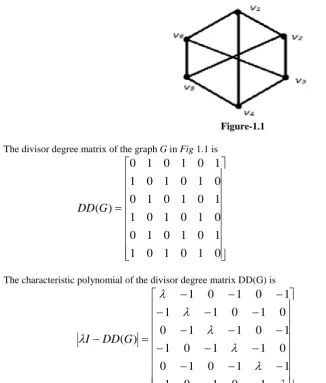
Example 1.1: Consider the graph G
Figure-1.1
The divisor degree matrix of the graph G in Fig 1.1 is
=
0
1
0
1
0
1
1
0
1
0
1
0
0
1
0
1
0
1
1
0
1
0
1
0
0
1
0
1
0
1
1
0
1
0
1
0
)
(
G
DD
The characteristic polynomial of the divisor degree matrix DD(G) is
−
−
−
−
−
−
−
−
−
−
−
−
−
−
−
−
−
−
=
−
λ
λ
λ
λ
λ
λ
λ
1
0
1
0
1
1
1
0
1
0
0
1
1
0
1
1
0
1
1
0
0
1
0
1
1
1
0
1
0
1
)
(
G
DD
I
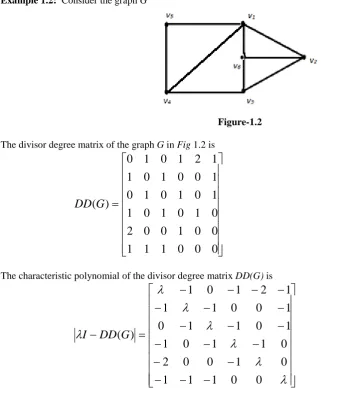
Example 1.2: Consider the graph G
Figure-1.2
The divisor degree matrix of the graph G in Fig 1.2 is
=
0
0
0
1
1
1
0
0
1
0
0
2
0
1
0
1
0
1
1
0
1
0
1
0
1
0
0
1
0
1
1
2
1
0
1
0
)
(
G
DD
The characteristic polynomial of the divisor degree matrix DD(G) is
−
−
−
−
−
−
−
−
−
−
−
−
−
−
−
−
−
−
=
−
λ
λ
λ
λ
λ
λ
λ
0
0
1
1
1
0
1
0
0
2
0
1
1
0
1
1
0
1
1
0
1
0
0
1
1
1
2
1
0
1
)
(
G
DD
I
From the Leverrier’s algorithm [4], it follows that 𝑃(𝐺) =𝜆6−12𝜆4−8𝜆3+ 23𝜆2+ 16𝜆 −4 and the divisor degree eigenvalues of G are 𝜆1≅3.470,𝜆2≅1.442,𝜆3≅0.198,𝜆4≅ −2.498,𝜆5≅ −1.612,𝜆6≅ −1. Thus,𝐸𝐷𝐷(𝐺)≅ 10.22.
We now give the explicit expression for the coefficient 𝑎𝑖 of 𝜆𝑛−𝑖 (𝑖= 0,1,2,3) in the characteristic polynomial of the divisor degree matrix DD(G). It is clear that 𝑎0= 1 and 𝑎1=𝑡𝑟𝑎𝑐𝑒𝐷𝐷(𝐺) = 0.
(i) We have
𝑎2= � �𝑎0 𝑎𝑗𝑘
𝑘𝑗 0�
1≤𝑗<𝑘≤𝑛
But ��0 𝑎𝑗𝑘
𝑎𝑘𝑗 0�=�− �� 𝑑𝑗 𝑑𝑘�+�
𝑑𝑘 𝑑𝑗��
2
, 𝑣𝑗𝑎𝑛𝑑𝑣𝑘𝑎𝑟𝑒𝑎𝑑𝑗𝑎𝑐𝑒𝑛𝑡
0, 𝑜𝑡ℎ𝑒𝑟𝑤𝑖𝑠𝑒
Thus
𝑎2=−12� �� ��𝑑𝑑𝑗 𝑘�+�
𝑑𝑘
𝑑𝑗�� 2
𝑗~𝑘
�
𝑛
𝑗=1
where ∑𝑗~𝑘 indicates summation over all pair of adjacent vertices 𝑣𝑗,𝑣𝑘.
Example 1.3: For the graph G in Fig 1.2 the coefficient 𝑎2 of 𝜆2 in the characteristic polynomial of the divisor degree matrix DD(G) is equal to
−12∑ �∑ ��𝑑𝑗 𝑑 �+�
𝑑𝑘 𝑑��
2
𝑗~𝑘 �
𝑛
𝑗=1 =−12�(1
2+ 22+ 12+ 12) + (12+ 12+ 12) + (12+ 12+ 12)
© 2017, IJMA. All Rights Reserved 32 (ii) We have
𝑎3= (−1)3 � �
𝑎𝑖𝑖 𝑎𝑖𝑗 𝑎𝑖𝑘
𝑎𝑗𝑖 𝑎𝑗𝑗 𝑎𝑗𝑘
𝑎𝑘𝑖 𝑎𝑘𝑗 𝑎𝑘𝑘
�
1≤𝑖<𝑗<𝑘≤𝑛
𝑎3=−2 � 𝑎𝑖𝑗𝑎𝑗𝑘𝑎𝑘𝑖 ∆𝑣𝑖𝑣𝑗𝑣𝑘
where ∑∆𝑣𝑖𝑣𝑗𝑣𝑘 indicates summation over all pair of adjacent vertices𝑣𝑖,𝑣𝑗 and 𝑣𝑘of triangles in a graph.
Remark 1.4:
a) Number of terms in the above sum is equal to the number of triangles in the graph. b) If there is no triangle in the graph G, then 𝑎3= 0.
Example 1.5: For the graph G in Fig 1.2 the coefficient 𝑎3 of 𝜆3 in the characteristic polynomial of the divisor degree matrix DD(G) is equal to
−2 ∑∆𝑣𝑖𝑣𝑗𝑣𝑘𝑎𝑖𝑗𝑎𝑗𝑘𝑎𝑘𝑖=−2�(1 × 1 × 1) + (1 × 1 × 1) + (1 × 1 × 2)�=−8 .
Theorem 1.6: If 𝜆1,𝜆2, … ,𝜆𝑛 are the divisor degree eigenvalues of a graph G, then ∑𝑛𝑖=1𝜆𝑖2=−2𝑎2
Proof: We have
∑𝑛𝑖=1𝜆2𝑖 = 𝑡𝑟𝑎𝑐𝑒�𝐷𝐷(𝐺)�2=∑ �∑𝑖=1𝑛 𝑛𝑗=1𝑎𝑖𝑗𝑎𝑗𝑖� = ∑ �∑ ��𝑑𝑑𝑖𝑗�+�𝑑𝑑𝑗𝑖�� 2
𝑖~𝑗 �
𝑛
𝑖=1
= −2𝑎2.
2. THE DIVISOR DEGREE ENERGY OF SOME STANDARD GRAPHS
We observe that the adjacent matrix of energy and divisor degree matrix of a regular graphs are same. So, DDE is equal to the energy of the regular graphs [8]. Hence, we have the following results.
Result 2.1:
i) 𝐸𝐷𝐷(𝐾𝒏) = 2(𝑛 −1) ii) 𝐸𝐷𝐷�𝐾𝑛,𝑛�= 2𝑛 iii) 𝑠𝑝𝑒𝑐 (𝐶𝑛) = 2 cos�2𝜋𝑗
𝑛 � (𝑗= 0,1, … ,𝑛 −1).
Theorem 2.2: If G is a path Pn of order n, (𝑛 ≥ 𝑘+ 2), then
𝑃(𝑃𝑛) =𝜆𝑘+2−8𝜆𝑘+ 8𝑘 ∑ (−1) 𝑟 𝑟+1 �𝑘2�−1
𝑟=0 �𝑘 − 𝑟 −𝑟 2� 𝜆𝑘−2(𝑟+1)− ∑ (−1)𝑟 �𝑘2�−1
𝑟=0 �𝑘 − 𝑟 −𝑟+ 11� 𝜆𝑘−2𝑟,
𝑛 ≥ 𝑘+ 2,𝑘 ∈ 𝑁 . Proof: For 𝑛= 3,
𝐷𝐷(𝑃3) =�
0 2 0 2 0 2 0 2 0� |𝜆𝐼 − 𝐷𝐷(𝑃3)| =�
𝜆 −2 0 −2 𝜆 −2
0 −2 𝜆 �
From the Leverrier’s algorithm [4], it follows that 𝑃(𝑃3) =𝜆3−8𝜆
Similarly, for 𝑛= 4,𝑃(𝑃4) =𝜆4−9𝜆2+ 16 𝑛= 5,𝑃(𝑃5) =𝜆5−10𝜆3+ 24𝜆 𝑛= 6,𝑃(𝑃6) =𝜆6−11𝜆4+ 33𝜆2−16
𝑛= 7,𝑃(𝑃7) =𝜆7−12𝜆5+ 43𝜆3−40𝜆 and so on.
The numbers in the row can be obtained by the following rule. The first number is 1 each and 16 is the last number in each odd rows except first row. The second number in each row is obtained by adding the previous row’s first number. The third number in each row is obtained by adding the previous second row’s second number and previous row’s third number. Likewise, the fourth number in each row is obtained by adding the previous second row’s third number and previous row’s fourth number and so on. This helps us to generalize the characteristic polynomial of a path Pn of order
n, 𝑛 ≥3,
𝑃(𝜆) =𝜆𝑛−(8 +𝑛 −3)𝜆𝑛−2+�8(𝑛 −2) +(𝑛−4)(𝑛−5)
2 � 𝜆𝑛−4− �
8(𝑛−2)(𝑛−5)
2 +
(𝑛−5)(𝑛−6)(𝑛−7)
3×2×1 � 𝜆𝑛−6
+�8(𝑛−2)(3𝑛−6×2)(𝑛−7)+(𝑛−6)(𝑛−74×)(3×𝑛−82 )(𝑛−9)� 𝜆𝑛−8 − ⋯
=𝜆𝑘+2−8𝜆𝑘+�8𝑘𝜆𝑘−2−8𝑘(𝑘−3)
2 𝜆𝑘−4+
8𝑘(𝑘−4)(𝑘−5)
3×2 𝜆𝑘−6− ⋯ �
− �(𝑘−11 )𝜆𝑘−(𝑘−2)(𝑘−3)
2 𝜆𝑘−2+
(𝑘−3)(𝑘−4)(𝑘−5)
3×2 𝜆𝑘−4− ⋯ �
where 𝑛 ≥ 𝑘+ 2,𝑘 ∈ 𝑁.
𝑃(𝑃𝑛) =𝜆𝑘+2−8𝜆𝑘+ 8𝑘 ∑ (−1) 𝑟 𝑟+1 �𝑘2�−1
𝑟=0 �𝑘 − 𝑟 −𝑟 2� 𝜆𝑘−2(𝑟+1)− ∑ (−1)𝑟 �𝑘2�−1
𝑟=0 �𝑘 − 𝑟 −𝑟+ 11� 𝜆𝑘−2𝑟,
𝑛 ≥ 𝑘+ 2,𝑘 ∈ 𝑁 .
Lemma 2.3 [2]: If M is a non singular square matrix then we have�𝑀 𝑁
𝑃 𝑄�= |𝑀||𝑄 − 𝑃𝑀−1𝑁|.
Theorem 2.4: If G is a complete bipartite graph 𝐾𝑛1,𝑛2, then 𝑃�𝐾𝑛1,𝑛2�=𝜆𝑛1+𝑛2−2(𝜆2− 𝑛1𝑛2𝑘2)where 𝑛2=𝑛1𝑘+𝑟,
(0≤ 𝑟 ≤ 𝑛1−1) and 𝑘=�𝑛𝑛21� is the integral part of real number 𝑛𝑛21, (𝑛1≤ 𝑛2) and 𝐸𝐷𝐷�𝐾𝑛1,𝑛2�= 2𝑘√𝑛1𝑛2 .
Proof: Without loss of generality we partition the vertex set of the complete bipartite graph 𝐾𝑛1,𝑛2 into disjoint sets 𝐴=�𝑢1,𝑢2, … ,𝑢𝑛1� and 𝐵=�𝑣1,𝑣2, … ,𝑣𝑛2� such that no two vertices in either sets are adjacent to each other. Then
the characteristic polynomial of 𝐾𝑛1,𝑛2 is
�𝜆𝐼 − 𝐷𝐷�𝐾𝑛1,𝑛2��
λ
λ
λ
λ
λ
λ
λ
0
0
0
0
0
0
0
0
0
0
0
0
0
0
0
0
0
0
k
k
k
k
k
k
k
k
k
k
k
k
k
k
k
k
k
k
k
k
k
k
k
k
−
−
−
−
−
−
−
−
−
−
−
−
−
−
−
−
−
−
−
−
−
−
−
−
=
T
N
I
λ
© 2017, IJMA. All Rights Reserved 34 where
−
−
−
−
−
−
−
−
−
−
−
−
−
−
−
−
=
k
k
k
k
k
k
k
k
k
k
k
k
k
k
k
k
N
is a matrix of order 𝑛2×𝑛1 and 𝑁𝑇 is the transpose of 𝑁 of order
𝑛1×𝑛2 .
Applying lemma 2.3 to the expression (1), we get �𝜆𝐼 − 𝐷𝐷�𝐾𝑛1,𝑛2��=𝜆𝑛1�𝜆𝐼𝑛2− 𝑁
𝐼𝑛1
𝜆 𝑁𝑇�=𝜆𝑛1−𝑛2�𝜆2𝐼𝑛2− 𝑁𝑁𝑇� (2)
Now,
=
2 1 2 1 2 1 2 1 2 1 2 1 2 1 2 1 2 1 2 1 2 1 2 1 2 1 2 1 2 1 2 1k
n
k
n
k
n
k
n
k
n
k
n
k
n
k
n
k
n
k
n
k
n
k
n
k
n
k
n
k
n
k
n
NN
T
is a square matrix of order 𝑛2.
Substituting
NN
Tin (2), we get�𝜆𝐼 − 𝐷𝐷�𝐾𝑛1,𝑛2��=𝜆𝑛1−𝑛2�
� 𝜆2− 𝑛
1𝑘2 −𝑛1𝑘2 ⋯ −𝑛1𝑘2 −𝑛1𝑘2
−𝑛1𝑘2 𝜆2− 𝑛1𝑘2 ⋯ −𝑛1𝑘2 −𝑛1𝑘2
⋯ ⋯ ⋯ ⋯ ⋯
−𝑛1𝑘2 −𝑛1𝑘2 ⋯ 𝜆2− 𝑛1𝑘2 −𝑛1𝑘2
−𝑛1𝑘2 −𝑛1𝑘2 ⋯ −𝑛1𝑘2 𝜆2− 𝑛1𝑘2
�
� (3)
Subtract row 𝑛2 from the rows 1,2, … ,𝑛2−1 of (3), we get
=𝜆𝑛1−𝑛2
� �
𝜆2 0 ⋯ 0 −𝜆2
0 𝜆2 ⋯ 0 −𝜆2
⋯ ⋯ ⋯ ⋯ ⋯
0 0 ⋯ 𝜆2 −𝜆2
−𝑛1𝑘2 −𝑛1𝑘2 ⋯ −𝑛1𝑘2 𝜆2− 𝑛1𝑘2
� �
=𝜆𝑛1−𝑛2(𝜆2)𝑛2−1
� �
1 0 ⋯ 0 −1
0 1 ⋯ 0 −1
⋯ ⋯ ⋯ ⋯ ⋯
0 0 ⋯ 1 −1
−𝑛1𝑘2 −𝑛1𝑘2 ⋯ −𝑛1𝑘2 𝜆2− 𝑛1𝑘2
� �
Thus, 𝑃�𝐾𝑛1,𝑛2�=𝜆𝑛1+𝑛2−2(𝜆2− 𝑛1𝑛2𝑘2), where 𝑛2=𝑛1𝑘+𝑟, (0≤ 𝑟 ≤ 𝑛1−1) and 𝐸𝐷𝐷�𝐾𝑛
1,𝑛2�= 2𝑘√𝑛1𝑛2.
Corollary 2.5: For a star 𝐾1,𝑛2,𝐸𝐷𝐷�𝐾1,𝑛2�= 2𝑛2√𝑛2.
Theorem 2.6: If 𝐺 is a r-regular graph with triangle free and 𝑛= 2𝑟 then𝐸𝐷𝐷(𝐺) =𝑛.
Proof: We have
|𝜆𝐼 − 𝐷𝐷(𝐺)| = � �
𝜆 −1 0 −1 ⋯ 0 −1 −1 𝜆 −1 0 ⋯ −1 0
0 −1 𝜆 −1 ⋯ 0 −1 −1 0 −1 𝜆 ⋯ −1 0
⋯ ⋯ ⋯ ⋯ ⋯ ⋯ ⋯ 0 −1 0 −1 ⋯ 𝜆 −1 −1 0 −1 0 ⋯ −1 𝜆
� �
|𝜆𝐼 − 𝐷𝐷(𝐺)| =�𝜆 −𝑛2� � �
1 1 1 1 ⋯ 1 1
−1 𝜆 −1 0 ⋯ −1 0 0 −1 𝜆 −1 ⋯ 0 −1 −1 0 −1 𝜆 ⋯ −1 0
⋯ ⋯ ⋯ ⋯ ⋯ ⋯ ⋯ 0 −1 0 −1 ⋯ 𝜆 −1 −1 0 −1 0 ⋯ −1 𝜆
� �
Subtract column 𝑛 from the column 2, 4, 6, … ,𝑛 −2, and column 1 from the column 3, 5, 7, … ,𝑛 −1 respectively, we get
|𝜆𝐼 − 𝐷𝐷(𝐺)| =𝜆𝑛−2�𝜆 −𝑛
2� � �
1 0 0 0 ⋯ 0 1
−1 1 0 0 ⋯ 0 0 0 0 1 0 ⋯ 0 −1 −1 0 0 1 ⋯ 0 0
⋯ ⋯ ⋯ ⋯ ⋯ ⋯ ⋯ 0 0 0 0 ⋯ 1 −1 −1 −1 0 −1 ⋯ 0 𝜆
� �
=𝜆𝑛−2�𝜆 −𝑛
2� �𝜆+ 𝑛 2�
Hence 𝐸𝐷𝐷(𝐺) =𝑛.
REFERENCES
1. Adiga. C and Smitha. M, “On maximum degree energy of a graph”, Int. J. Contemp. Math. Sci., 4(2009), 385 - 396.
2. Cvetkovi'c. D. M, Doob. M and Sachs. H, “Spectra of Graph Theory and Application”, Academic Press, New York, 1980.
3. Ivan Gutman, Sanaz Zare Firoozabadi, Jose Antoniode la Pena and Juan rada, “On the energy of regular Graphs”, MATCH Commun. Math. Comput. Chem. 57(2007).
4. Massoud Malek, “Characteristic polynomial”, California state University, East Bay.
5. Meenakshi. S and Lavanya. S, “A survey on Energy of Graphs”, Annals of Pure and Applied Mathematics, vol. 8, No. 2, 2014, 183 -191.
6. Nenand Trinajstic, “Chemical Graph Theory”, Volume I, CRC Press, Inc. (1983).
7. Norman Bigges, “Algebraic Graph Theory”, London School of Economics, Cambridge University press 1974, second edition 1993, Reprinted 1996.
8. Owen Jones, “Spectra of Simple Graphs”, whitman college, May 13, 2013.
9. Walikar. H. Band Ramane. H. S, “Energy of some Bipartite cluster Graphs”, Kragujevac J. Sci 23 (2001), 63 -74.
Source of support: Nil, Conflict of interest: None Declared.