ISSN-L: 2501 - 1235 Available on-line at: www.oapub.org/edu
Copyright © The Author(s). All Rights Reserved.
doi: 10.5281/zenodo.1318268 Volume 4 │ Issue 7 │ 2018
EFFECT OF 6 WEEKS AEROBIC EXERCISES TRAINING PROGRAM
TO PHYSICAL FITNESS VARIABLES IN MIDDLE AGED WOMEN
Kirani PhD Scholar, Lakshmibai National Institute of Physical Education, Gwalior, Madhya Pradesh, India
Abstract:
Purpose of the study was to see the effect of 6 weeks aerobics training program to physical fitness variables in middle aged women , the study was conducted 20 middle aged women, age ranging between 35 to 50 years from Gwalior, were selected as subjects of this study. To see the effect of 6 weeks aerobics training program to physical fitness variables in middle aged women, collected data was analyzed by using paired t-test at 0.05 level of significance. And significant difference was found between means of pre & post test in flexibility & grip strength but there is no significant difference found between means of pre and post test in cardio vascular endurance of middle aged women.
Keywords: aerobics training, middle aged women, physical fitness variables
1. Introduction
Women in the middle ages occupied a number of different social roles. During the middle ages, women held the positions of wife, mother, peasant, artisan, and nun. The very concept of "woman" changed in a number of ways during the middle Ages and several forces influenced women's roles during their period. Aerobic exercise gives a stronger heart, a leaner body, lower cholesterol, improved sleep. You can strengthen your entire cardiovascular system - heart, lungs and blood vessels - through regular aerobic activities. Aerobic exercise (also known as cardio) is physical exercise of low to high intensity that depends primarily on the aerobic energy-generating process. Aerobic literally means "relating to, involving, or requiring free oxygen", and refers to the use of oxygen to adequately meet energy demands during exercise via aerobic metabolism. Generally, light-to-moderate intensity activities that are sufficiently supported by aerobic metabolism can be performed for extended periods of time. Kenneth Cooper was the first person to introduce the concept of aerobic exercise. In the
1960s, Cooper started research into preventive medicine. He became intrigued by the belief that exercise can preserve one's health. He sparked millions into becoming active and is now known as the "father of aerobics".
2. Objective of the Study
The purpose of the study was to find out the effect of 6 week aerobic training program to physical fitness variables in middle aged women.
3. Methodology
The study was to see the effect of 6 weeks aerobics training program to physical fitness variables in middle aged women. 20 middle aged women, age ranging between 35 to 50 years from Gwalior, were selected as subjects of this study. To see the effect of 6 weeks aerobics training program to physical fitness variables in middle aged women paired t-test were employed. Cardiovascular endurance were measured by the timing of 800 meter run and walk were recorded in minute, Grip strength was measured by the nearest kilogram of Grip strength (right and left) in Grip dynamometer were recorded & Flexibility measured by the sit and reach equipment (Lafayette) was used for the flexibility test, by measuring the nearest centimetre.
3.1Statistical Methods
Paired t-test was applied to see the effect of 6 weeks aerobics training program to physical fitness variables in middle aged women. The hypothesis was tested at 0.05 level of significance.
3.1.1 Descriptive statistics for the data on cardiovascular endurance of middle aged women
Table 1: Descriptive statistics for the data
on cardiovascular endurance of middle aged women
Mean N Std. Deviation Std. Error Mean
Pair 1 CE_PRE 7.109 20 1.623 .36291
CE_POST 6.909 20 1.664 .37196
Table 2: Paired Samples Test Paired Differences
T Df
Sig. (2-tailed) Mean Std. Deviation Std. Error Mean 95% Confidence Interval of the Difference Lower Upper
Pair 1
CE_PRE -
CE_POST .20050 .51980 .11623 -.04277 .44377 1.725 19 .101
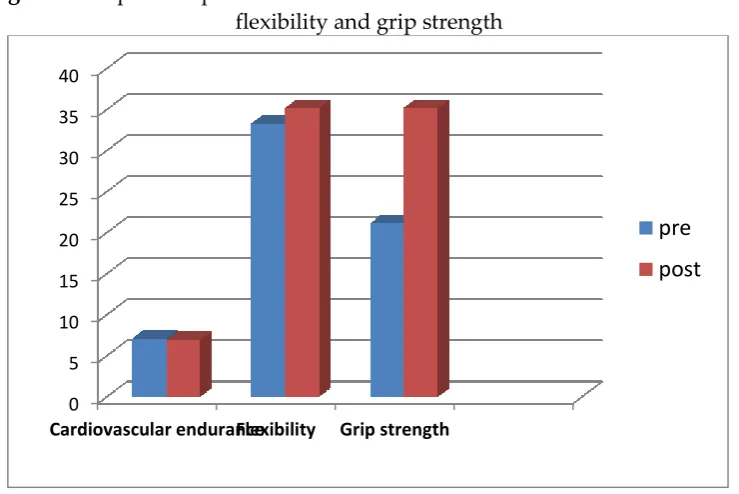
According to analysis of data presented in table 2, the calculated t-value (1.725) was found insignificant as its p-value is more then 0.05. The difference can be seen with the help of graphical representation of mean score. (Figure 1)
3.1.2 Descriptive statistics for the data on flexibility of middle aged women
Table 3: Paired Samples Statistics
Mean N Std. Deviation Std. Error Mean
Pair 1 FLEXIBILITY_PRE 33.2750 20 6.16517 1.37857
FLEXIBILITY_POST 35.1800 20 6.66038 1.48931
Table 3 Shows that the mean score of pre and post test, the mean and SD of Flexibility 33.2750_6.16517 and 35.1800_6.66038 respectively.
Table 4: Paired Samples Test
Paired Differences
t df
Sig. (2-tailed) Mean Std. Deviation Std. Error Mean 95% Confidence Interval of the
Difference Lower Upper
Pair 1 FLEXIBILITY_PRE - FLEXIBILITY_POST
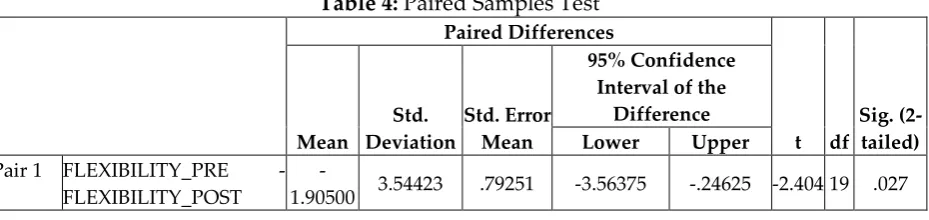
-1.90500 3.54423 .79251 -3.56375 -.24625 -2.404 19 .027
According to analysis of data presented in table 4, the calculated t-value (-2.404) was found significant as its p-value is less than 0.05. The difference can be seen with the help of graphical representation of mean score. (Figure 1)
3.1.3 Descriptive Statistics for the data on grip strength of middle aged women
Table 5: Paired Samples Statistics
Mean N Std. Deviation Std. Error Mean
Pair 1 GS_PRE 21.1450 20 4.27249 .95536
GS_POST 22.6450 20 4.68879 1.04844
Table 6: Paired Samples Test Paired Differences
t df
Sig. (2-tailed) Mean Std. Deviation Std. Error Mean 95% Confidence Interval of the
Difference Lower Upper
Pair 1
GS_PRE -
GS_POST -1.50000 1.65593 .37028 -2.27500 -.72500 -4.051 19 .001
According to analysis of data presented in table 4, the calculated t-value (-4.051) was found significant as its p-value is less than 0.05. The difference can be seen with the help of graphical representation of mean score. (Figure 1)
Figure 1: Graphical representation of mean score of cardiovascular endurance,
flexibility and grip strength
4. Findings and Discussion
In the present study, it is showed that there is a significant difference between pre and post test of 2 variables which is flexibility and grip strength; the development in body fat, hypertension, heart disease that creates interest of women to participate in aerobic dance activities, yoga asana’s. This study has involved aerobic dance, zomba and yoga sessions which may showed the positive result with significant difference in flexibility and grip strength. There is no significant difference between pre and post test of 1 variable which is cardiovascular endurance. It may be attributed due to the age group, while the evidence is limited, it appears that middle-aged and older women have positive attitudes to exercise but seem unable or unwilling to take action. The habit of not being engaged with physical fitness exercise may not be developing in very short period of time as 6 weeks training. The time duration of this study was insufficient to bring significant difference.
0 5 10 15 20 25 30 35 40
Cardiovascular enduranceFlexibility Grip strength
pre
4.1 Discussion of Hypothesis
On the basis of the results of the study, the hypothesis was accepted at 0.05 level of significance in flexibility and grip strength because there was significant difference between pre and post test after six weeks of training program.
The hypothesis was rejected at 0.05 level of significant in cardiovascular endurance.
5. Conclusion
The researcher was able to obtain the following conclusion on the basis of the results obtained after administration of the test.
The result of the statistical application shows that:
1. There was an insignificant difference in cardio vascular endurance after the pre and post test. The reason behind this can be judged because of the age group of the subjects. Another reason for the negative result can be given because of their lack of physical workout during their daily life activities.
2. However, there was a significant difference in flexibility and grip strength of the subjects.
References
1. Blumenthal, J. A., Emery, C. F., Madden, D. J., George, L. K., Coleman, R. E., Riddle, M. W., ... & Williams, R. S. (1989). Cardiovascular and behavioral effects of aerobic exercise training in healthy older men and women. Journal of
gerontology, 44(5), M147-M157.
2. Blumenthal, J. A., Fredrikson, M., Kuhn, C. M., Ulmer, R. L., Walsh-Riddle, M., & Appelbaum, M. (1990). Aerobic exercise reduces levels of cardiovascular and sympathoadrenal responses to mental stress in subjects without prior evidence of myocardial ischemia. The American journal of cardiology, 65(1), 93-98.
3. Bowen, D. J., Fesinmeyer, M. D., Yasui, Y., Tworoger, S., Ulrich, C. M., Irwin, M. L., ... & McTiernan, A. (2006). Randomized trial of exercise in sedentary middle aged women: effects on quality of life. International Journal of Behavioral Nutrition
and Physical Activity, 3(1), 34.
4. Fleg, J. L., O'connor, F., Gerstenblith, G., Becker, L. C., Clulow, J., Schulman, S. P., &Lakatta, E. G. (1995). Impact of age on the cardiovascular response to dynamic upright exercise in healthy men and women. Journal of Applied Physiology, 78(3), 890-900.
5. Gillett, P. A., & Eisenman, P. A. (1987). The effect of intensity controlled aerobic dance exercise on aerobic capacity of middle‐aged, overweight women. Research
6. Gutin, B., Barbeau, P., Owens, S., Lemmon, C. R., Bauman, M., Allison, J., ...& Litaker, M. S. (2002). Effects of exercise intensity on cardiovascular fitness, total body composition, and visceral adiposity of obese adolescents. The American
Creative Commons licensing terms