© 2020 by the Serbian Biological Society How to cite this article: Milanović SD, Popović MM, Dobrosavljević JN, Kostić IM, 63 Lazarević JM. Desperate times call for desperate measures: short-term use of the
common ash tree by gypsy moth larvae (Lepidoptera: Erebidae) under density and starvation stress. Arch Biol Sci. 2020;72(1):63-9.
Desperate times call for desperate measures: short-term use of the common ash tree by
gypsy moth larvae (Lepidoptera: Erebidae) under density and starvation stress
Slobodan D. Milanović1,2, Marija M. Popović1, Jovan N. Dobrosavljević1, Igor M. Kostić3 and Jelica M. Lazarević4,*
1Faculty of Forestry, University of Belgrade, Kneza Višeslava 1, Belgrade 11030, Serbia,
2Faculty of Forestry and Wood Technology, Mendel University in Brno, Zemědělská 3, 61300 Brno, Czech Republic 3Institute for Multidisciplinary Research, University of Belgrade, Kneza Višeslava 1, Belgrade 11030, Serbia
4Department of Insect Physiology and Biochemistry, Institute for Biological Research “Siniša Stanković” – National Institute of
the Republic of Serbia, University of Belgrade, Bulevar Despota Stefana 142, Belgrade 11000, Serbia
*Corresponding author: [email protected]
Received: November 6, 2019; Revised: November 27, 2019; Accepted: December 16, 2019; Published online: December 30, 2019
Abstract: Gypsy moth, Lymantria dispar L. (Lepidoptera: Erebidae) feeds on a large number of tree species, while ash,
Fraxinus spp. (Lamiales: Oleaceae) species are considered resistant and are only sporadically eaten. To assess the conditions under which late instar gypsy moth larvae (GML) can temporarily use non-host common ash (CA) (F. excelsior L.), and to evaluate their ability to recover from ingestion of this toxic food, we determined the relative growth rate, the relative consumption rate and the amount of produced feces in different laboratory feeding trials. Our report is the first to show that under specific circumstances, the resources acquired after short-term consumption of CA leaves can be utilized for larval growth. We varied the intensity of density and starvation stress prior to feeding on CA leaves. We observed that after moderate stress a group of GML was temporarily capable of coping with CA leaves. Although observed growth and con-sumption were much lower on CA than on the optimal host oak, Quercus cerris L. (Fagales: Fagaceae), CA-oak-switched larvae showed the ability to recover from short-term use of a toxic non-host foliage. This suggests that feeding on CA might enable GML to survive under conditions of food shortage.
Keywords: Lymantria dispar; Fraxinus excelsior; non-host use; recovery; Quercus cerris
INTRODUCTION
The gypsy moth, Lymantria dispar L. (Lepidoptera: Erebidae), is a polyphagous pest that feeds on more than 500 plant species [1,2]. Gypsy moth larvae (GML) prefer oaks (Quercus spp.) but can also suc-cessfully develop on some alder (Alnus spp.), birch (Betula spp.), larch (Larix spp.), poplar (Populus spp.), cherry (Prunus spp.) and willow (Salix spp.) species. However, during outbreaks, they can feed on a wider range of hosts and even incorporate into their diet plants that are usually avoided [3,4].
GML select suitable hosts after dispersal from the hatching site. Early larval instars are dispersed passively through the forest by wind [5], while the 4th and later larval instars can be dispersed by active
movement [6]. The movement of later instars is
im-portant in the culmination phase of an insect out-break, when the moth population has exploited all of the resources in one habitat and starts foraging for new food sources. During this quest, GML can travel several kilometers and can experience long periods without food [7]. A less suitable rearing diet and a longer food-deprivation time promote farther move-ment of late instar larvae [8]. This behavior enables the larvae to escape intraspecific competition caused by overpopulation and diminished host leaf quality after defoliation [9,10], which would otherwise lead to cannibalism [11].
masses per hectare). After completely defoliating all oak trees, the later instar larvae defoliated a neighbor-ing Austrian pine (Pinus nigra Arnold) plantation and moved to a beech (Fagus sylvatica L.) forest, which was completely defoliated within a few days. Nearby, we found a group of walnut (Juglans regia L.) and CA trees infested by 5th and 6th instar GML that were
feeding on the leaves. Ash species (Fraxinus spp.) are considered resistant hosts because gypsy moth cannot complete development if larvae continuously feed on their leaves [12]. Although some studies have reported ash to be ‘sporadically eaten’ (reviewed in [2,13,14]) GML never caused visible canopy defoliation. Rejec-tion of ash as a food plant is due to repellency induced by volatile deterrents [15] and feeding inhibition caused by harmful allelochemicals [16].
Our study aimed to explore the conditions under which GML can temporarily use CA leaves in their diet. Preliminary data revealed a complete rejection of CA at low GML densities and short-term starvation that is typical of the latency phase. In this study, we first manipulated the population density and starva-tion time to simulate the natural environment dur-ing the terminal phase of an outbreak. For density/ starvation conditions that promote acceptance and short-term feeding on non-host ash leaves, we ex-plored larval ability to recover from the toxic stress, i.e. to continue development on favorable host oak (Q. cerris L., Fagales: Fagaceae).
MATERIALS AND METHODS Insect rearing
To determine conditions under which GML accept ash leaves, we used a standard New Jersey line obtained from the Center for Plant Health Science and Technol-ogy (USDA APHIS PPQS&T, MA, USA). For evalu-ating the ability of GML to recover from short-term feeding on ash leaves, we used a Serbian population from the Varadin-Županja locality (44°57’28.14”N, 19°15’16.64”E). The first experiment was performed in 2017 and the second in 2019. In both experi-ments, eggs from the middle part of 10 egg masses were cleaned of hairs, mixed, disinfected, transferred to Petri dishes and placed in a climate chamber to initiate hatching. From hatching in May until the 4th
instar stage, the larvae were reared at a density of five individuals per Petri dish (120×15 mm) and fed ad li-bitum on an artificial GM diet (MP Biomedicals, LLC, Santa Ana, CA, USA) under controlled conditions as described in [17].
Experimental groups
The consequences of the last gypsy moth outbreak in Serbia for different tree species are presented in Supplementary Fig. S1A (defoliation of oaks) and Fig. S1C, D (defoliation of Austrian pine), Fig. S1B (defoliation of beech). Also, the use of marginal and non-host plants has been recorded (walnut – Fig. S1E, F; ash – Fig. S2A, B). During insect outbreaks, larval densities are within the range of 5000-20000 [18-20] and can sometimes reach up to 50000 larvae per tree [21]. The high larval density in the Serbian GM pop-ulation is presented in Supplementary Figs. S1E, F and S2A. The density of 10 larvae per liter (larvae/L) in laboratory assays mimics the population density of about 10000 GML per mature tree in the wild, as described by Pavlushin et al. [20]. We also tested the influence of densities of 15 and 20 larvae/L, which corresponded to 15000 and 20000 larvae/L.
In the first experiment, newly molted 4th instar
larvae were starved for 3 days in Petri dishes and transferred to glass cylinders (1 L) at densities of 10, 15 and 20 larvae/L (assigned as D10, D15 and D20). These larvae fed on Turkey oak (Q. cerris) leaves for 2 days. For each density, 4 glass cylinders were used and 2-3 larvae per cylinder were randomly selected to be exposed to the two starvation treatments (5 or 8 days of starvation). Since at each density larvae were given similar amounts of oak leaves (cca. 10 oak leaves about 10 cm in length), D15 and D20 larvae were food-lim-ited and did not survive an 8-day starvation period. Groups starved for 5 and 8 days at density D10 were assigned as D10-S5 and D10-S8. After density/star-vation, the treatment larvae were transferred to Petri dishes and fed individually on CA leaves for 3 days.
Groups of larvae fed on oak or ash leaves for 3 days were assigned as “Oak” and “Ash”, respectively. After 3 days of feeding on ash, the Ash larvae were transferred to oak leaves to monitor the recovery of growth and consumption for 3 days. This experimental group was assigned as “Ash-Oak”.
Growth and consumption indices
The leaves and larvae were weighed at the beginning and end of the 3-day feeding trial. The total amount of produced feces was also weighed. The relative growth rate (RGR) and the relative consumption rate (RCR) were calculated on a fresh weight basis for all experi-mental groups [22,23]. Eight larvae of the D10-S5 in the first experiment and 10 larvae of other experimen-tal groups were analyzed as follows:
RGR (relative growth rate)=(mfin–min)/(t3×min); RCR (relative consumption rate)=mc/(t3 × min), where t3 is the duration of the experiment (3 days), min is the larval weight at the beginning of the experiment, mfin is the larval weight at the end of the experiment and mc is the weight of the food consumed.
Statistical analysis
In the first experiment, the normal distribution of RCR and RGR was recorded only in D10-S5 larvae (Shapiro-Wilk’s test). As variances were highly nonho-mogeneous (Levene’s test), we applied Welch ANOVA and the Games-Howell post hoc test [24] to estimate significant differences among ash larvae from the dif-ferent density/starvation experimental groups. Since in the second experiment the √x+0.5-transformed values of RGR and square root-transformed values of RCR satisfied the assumptions of normality and homoscedacity, we tested the significance of the Oak vs. Ash and Oak vs. Ash-Oak differences by the t-test for independent samples, and the Ash vs. Ash-Oak difference by the t-test for dependent samples. The data on the amount of produced feces in the group fed on ash did not have a normal distribution. The Oak vs. Ash-Oak comparison was performed using the t-test for independent samples; Oak vs. Ash was performed using the Kruskal-Walis test and Ash vs. Ash-Oak by the Wilcoxon matched paired test.
RESULTS
Density and starvation effects on GML growth and consumption on ash leaves
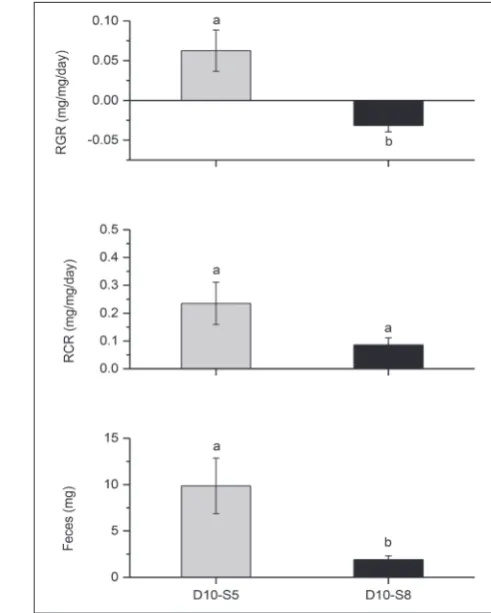
We showed that GML can feed, grow and produce feces on common ash leaves under specific cir-cumstances when the density/starvation stress was not too strong (Figs. 1 and 2). Six out of 8 D10-S5 GML started to feed on CA leaves and gained ~27% of their initial body weight. It can be seen in Fig. 1 that the population density preceding feed-ing on CA significantly affected all examined traits (RGR:F2, 13.82=6.99, P=0.0080; RCR: F1, 7.01=9.21, P=0.0189; feces: F1, 9.03=5.82, P=0.0390). Our results show that densities above 10 larvae/L followed by 5 days of starvation disabled the larvae to cope with non-host food. Namely, none of the D15 and D20 larvae gained weight. We showed that a prolonged starvation time significantly lowered the RGR
(F1, 8.31=11.94, P=0.0082) and feces production
(F1, 7.27=6.95, P=0.0326) while the reduction of RCR
was marginally significant (F1, 8.65=3.46, P=0.0972) (Fig. 2, Supplementary Fig. S2C, D, E and F). Leaf consumption was recorded in 7 out of 10 D10-S8 lar-vae, but only 2 of them gained weight. On average, they lost about 8% of their weight.
Growth and consumption recovery after feeding on ash
Results from assessing the ability of GML to recover from short-term toxic stress are presented in Fig. 3. In comparison to the optimal host Turkey oak, GML sig-nificantly reduced growth (t=15.67, P<0.0001), con-sumption (t=11.57, P<0.0001) and feces production (H=14.29, P=0.0002) on CA. After switching from CA to oak leaves, all indices were significantly increased (RGR: t=9.91, P<0.0001; RCR: t=11.04, P<0.0001; fe-ces: Z=2.80, P=0.0051). After the switch, the RGR did not reach the RGR value on oak (t=2.51, P=0.0220), while consumption and feces production completely recovered and did not differ from the Oak group (RCR: t=0.91, P=0.3726; feces: H=0.09, P=0.7620).
DISCUSSION
lar-vae were clearly below the values obtained on an opti-mal host after the same density/starvation stress. Data from other authors on larvae reared under optimal conditions (suitable hosts, low density, no starvation) have also shown much higher values of nutritional indices [17,25-28].
CA and other Fraxinus species are largely im-mune to attacks by GML because the leaves contain many deterrents, toxins and digestive inhibitors [29]. Besides, compared to suitable oaks, CA is associated with a lower number of other insect pests, indicating the strong antiherbivory effects of its compounds [30]. Extensive work on the relationship between green ash (GA), F. pennsylvanica Marsh. and GML revealed feed-ing inhibitory, repellent, toxic and growth-reducfeed-ing effects of leaf ethyl acetate extracts, which, as the au-thors suggested, contained glucosides, phenolics and terpenoids [15,16,31]. Feeding on GA leaves, starting
from any of the 1st to 4th instars, disabled pupation in
GM [12]. A more than 40-times lower extract con-centration in the diet as compared to fresh leaves was sufficient to provoke such a response [31]. Feeding inhibitory and growth-reducing effects were also re-corded in our experiment. These effects are expected to be expressed more for CA than GA leaves as they emit more of the deterrent volatile α-farnesene [15,32] and contain more diverse, potentially toxic and/or antinu-tritive coumarins, flavonoids and secoiridoids [33-36]. The reduced RGR on CA could be a result both of behavioral (low RCR) and physiological effects (high cost of food processing). Iridoid glucosides are known for their bitter taste and they thus have both deter-rent and growth-reducing effects on GML [37]. The secoiridoid oleuropein that is characteristic of Fraxi-nus species, including CA [34,35], after the activation by β-glucosidase acts as a protein denaturant, which
Fig. 1. Effects of population density on the relative growth rate (RGR), the relative consumption rate (RCR) and feces production in gypsy moth larvae starved for 5 days before feeding on common ash leaves. Densities of 10, 15 and 20 larvae/L were assigned as D10, D15 and D20, respectively. Bars marked by letters a and b are significantly different (P<0.05).
lowers the nutritive value of dietary proteins [38]. CA leaves contain glucosides of the coumarins fraxetin and esculetin as well as glucosides of the flavonoids quercetin and kaempferol [33] that can act as prooxi-dants and enzyme inhibitors. For example, quercetin is known as a prooxidant and a strong trypsin inhibi-tor [39,40]. To cope with dietary protein-crosslinking, the generation of free radicals and impairment of pro-tein digestion, insects activate various physiological mechanisms such as glycine secretion [41], induction of antioxidative defense and detoxification [39], as well as changes in the levels and isozyme patterns of digestive enzymes [42]. Since these processes are en-ergetically costly, to cope with CA leaf chemistry GML should divert part of the assimilated food from growth towards energy metabolism.
Insects have evolved various adaptive responses against plant chemical defenses at the level of feeding
behavior, physiology and metabolism [43]. The effi-cacy of these responses depends on abiotic and biotic contexts [44]. As a species with eruptive population dynamics, GM encounters fluctuations in population density that affect interactions with host and non-host plants. Although GM maintains a high level of po-lyphagy in different phases of population growth, it was reported that the ecological preference for non-host ash species and several unsuitable non-hosts is in-creased during the culmination phase [3]. Densities above 10 larvae/L in our laboratory assays involved food limitation and increased physical contact among larvae, which might further impair feeding, increase larval activity and, together with food limitation, lead to the depletion of energy stores. For instance, changes in the activity of medial neurosecretory neurons in GML suggest intensive carbohydrate metabolism in response to high-density stress [45]. Reduced energy stores might affect resistance to starvation and the ability to detoxify or eliminate harmful allelochemi-cals from ash leaves, and thus may explain the inability of the larvae to gain weight after experiencing high-density or prolonged starvation.
Similarly, starvation also provokes hormonal and metabolic reorganization in insects [46,47]. Depletion of lipids and carbohydrates and a decline in metabolic rate have been recorded in GM after food removal [48]. It is likely that the 8 days of starvation in our experi-ment reduced energy stores that could be allocated to-wards detoxification. Likewise, a significant synergistic interaction between density-dependent starvation and toxin concentration for adult eclosion in Drosophila melanogaster Meigen has been recorded [49], and it was suggested that a “low food supply may reduce (the) metabolic rate of the flies and thus reduce detoxifica-tion rates”. Our preliminary data with starvadetoxifica-tion dura-tion below 5 days revealed that GML were not willing to feed on non-host CA, regardless of larval density. Ac-cordingly, larvae that are not sufficiently starved are too choosy, while larvae that have been starved for longer periods are too exhausted to temporarily use CA leaves.
The composite generalist feeding habit of the gyp-sy moth mirrored in significant variations in fitness, behavior and activities of detoxification enzymes [50-52] might facilitate the temporary use of non-host ash leaves. After about a 90% reduction of RGR and a 75% reduction of RCR in Ash larvae, only 3 days on oak
leaves were sufficient to reach RGR and RCR values that were only 20% and 10%, respectively, lower than in oak larvae. We suggest that despite the metabolic costs of processing inadequate food, individuals capa-ble of metabolizing toxic and antinutritive compounds might avoid starvation and thus have an advantage under extreme conditions. Additionally, our results on the repellent and growth-reducing effects of CA point to a possible application of its leaf extracts as a natural eco-friendly biopesticide for GML management.
Funding: This research was supported by the project “Studying climate change and its influence on the environment: impacts, adaptation and mitigation” (No. 43007), financed by the Ministry of Education and Science of the Republic of Serbia within the framework of integrated and interdisciplinary research for the period 2011-2019.
Acknowledgments: We are grateful to Dr. Hannah Nadel from USDA APHIS PPQS&T (MA, USA) for providing the gypsy moth egg masses.
Author contributions: SM conceived and designed the study. MP and JD conducted all of the experiments. IK statistically analyzed the data. SM and JL wrote the manuscript with assistance from IK, MP, and JD. The final manuscript was read and approved by all authors.
Conflicts of interest disclosure: There are no conflicts of inter-est to declare.
REFERENCES
1. Lance DR. Host-seeking behavior of the gypsy moth: the influence of polyphagy and highly apparent host plants. In: Ahmad S, editor. Herbivorous Insects: Host-seeking Behavior and Mechanisms. New York: Academic Press; 1983. p. 201-24. 2. Liebhold AM, Gottschalk KW, Muzika RM, Montgomery
ME, Young R, O’Day K, Kelly B. Suitability of North Ameri-can tree species to gypsy moth: a summary of field and labo-ratory tests. General Technical Report NE-211. Radnor, PA, U. S. Department of Agriculture, Forest Service, Northeast-ern Forest Experiment Station. Radnor, USA: USDA Forest Service; 1995. 34 p.
3. Lechowicz MJ. Leaf quality and the host preferences of gypsy moth in the northern deciduous forest. In: Talerico RL, Montgomery M, technical coordinators. Proceedings, forest defoliator-host interactions: A comparison between gypsy moth and spruce budworms: Gen. Tech. Rep. NE-85; New Haven, CT; 1986 Apr 5-7. ; 1983 April 5-7, Broomall, PA: U.S. Department of Agriculture, Forest Service, North-eastern Forest Experiment Station; 1983. p. 67-82.
4. Lechowicz MJ, Mauffette Y. Host preferences of the gypsy moth in eastern North American versus European forests. Rev Entomol Que. 1986;31(1):43-51.
5. Mason CJ, McManus ML. Larval dispersal of the gypsy moth. In: Doane CC, McManus ML, editors. The gypsy moth: research toward integrated pest management. Washington, DC: US Department of Agriculture; 1981. p. 161-201. 6. Campbell RW, Hubbard DL, Sloan RJ. Patterns of gypsy
moth occurrence within a sparse and numerically stable population. Environ Entomol. 1975;4(4):535-42.
7. Stojanović I. O gubaru (Liparis dispar). Šumar list. 1889;9-10:424-8.
8. Wittman JT, Aukema BH. Foliage type and deprivation alters the movement behavior of late instar European gypsy moth Lymantria dispar (Lepidoptera: Erebidae). J Insect Behav. 2019;32(1):24-37.
9. Valentine HT, Wallner WE, Wargo PM. Nutritional changes in host foliage during and after defoliation, and their relation to the weight of gypsy moth pupae. Oecologia. 1983;57(3):298-302.
10. Rossiter M, Schultz JC, Baldwin IT. Relationships among defoliation, red oak phenolics, and gypsy moth growth and reproduction. Ecology. 1988;69(1):267-77.
11. Mason CJ, Cannizzo Z, Raffa KF. Influence of diet and density on laboratory cannibalism behaviors in gypsy moth larvae (Lymantria dispar L.). J Insect Behav. 2014;27(6):693-700. 12. Mosher FH. Food plants of the gipsy moth in America.
Washington, DC: US Department of Agriculture ; 1915. 39p. 13. Lechowicz MJ, Jobin L. Estimating the susceptibility of tree
species to attack by the gypsy moth, Lymantria dispar. Ecol Entomol. 1983;8(2):171-83.
14. Žikić V, Stanković SS, Kavallieratos NG, Athanassiou C, Georgiou P, Tschorsnig HP, van Achterberg C. Parasitoids associated with Lymantria dispar (Lepidoptera: Erebidae) and Malacosoma neustria (Lepidoptera: Lasiocampidae) in Greece and comparative analysis of their parasitoid spec-trums in Europe. Zool Anz. 2017;270:166-75.
15. Markovic I, Norris DM, Phillips JK, Webster FX. Vola-tiles involved in the nonhost rejection of Fraxinus penn-sylvanica by Lymantria dispar larvae. J Agr Food Chem. 1996b;44(3):929-35.
16. Markovic I, Norris DM, Cekic M. Some chemical bases for gypsy moth, Lymantria dispar, larval rejection of green ash, Fraxinus pennsylvanica, foliage as food. J Chem Ecol. 1996a;22(12):2283-98.
17. Milanović S, Mihajlović L, Karadžić D, Jankovsky L, Aleksić P, Janković-Tomanić M, Lazarević J. Effects of pedunculate oak tree vitality on gypsy moth preference and performance. Arch Biol Sci. 2014;66(4):1659-72.
18. Thorpe KW, Tatman KM, Sellers P, Webb RE, Ridgway RL. Management of gypsy moths using sticky trunk barriers and larval removal. J Arboric. 1995;21:69-76.
19. Siliņš I, Šmits A. Ozolu mūķenes Lymantria dispar (Lin-naeus, 1758) populācijas reproduktivitātes rādītāju
novērtējums masu savairošanās reģionā. Mežzinātne.
2010;22(55):47-69.
21. Durkin PR, Follansbee MH. Control/eradication agents for the gypsy moth-human health and ecological risk assess-ment for DDVP (Dichlorvos) final report. New York: Syra-cuse Research Corporation; 2004.
22. Waldbauer GP. The consumption and utilization of food by insects. In: Beament JWL, Treherne JE, Wigglesworth VB, editors. Advances in insect physiology. Vol. 5. London, New York: Academic Press; 1968. p. 229-88.
23. Farrar RR Jr, Barbour JD, Kennedy GC. Quantifying food consumption and growth in insects. Ann Entomol Soc Am. 1989;82(5):593-8.
24. McDonald JH. Handbook of Biological Statistics. 3rd ed. Baltimore, Maryland: Sparky House Publishing; 2014. 299 p. 25. Stoyenoff JL, Witter JA, Montgomery ME. Nutritional
indices in the gypsy moth (Lymantria dispar (L.)) under field conditions and host switching situations. Oecologia. 1994;97(2):158-70.
26. Williams RS, Lincoln DE, Norby RJ. Leaf age effects of ele-vated CO2-grown white oak leaves on spring-feeding lepi-dopterans. Glob Change Biol. 1998;4(3):235-46.
27. Couture JJ, Meehan TD, Lindroth RL. Atmospheric change alters foliar quality of host trees and performance of two outbreak insect species. Oecologia. 2012;168(3):863-76. 28. Milanović S, Lazarević J, Popović Z, Miletić Z, Kostić M,
Radulović Z, Karadzić D, Vuleta A. Preference and per-formance of the larvae of Lymantria dispar (Lepidoptera: Lymantriidae) on three species of European oaks. Eur J Entomol. 2014a;111(3):371-8.
29. Kurir A. Die Fraßpflanzen des Schwammspinners (Lymantria dispar L.) Beitrag zur Ernährungsbiologie des Schwammspinners. J Appl Entomol. 1953;34(4):543-86. 30. Southwood TRE. The number of species of insect associated
with various trees. J Anim Ecol. 1961;30(1):1-8.
31. Markovic I, Norris DM, Nordheim EV. Gypsy moth ( Lyman-tria dispar) larval development and survival to pupation on diet plus extractables from green ash foliage. Entomol Exp Appl. 1997;84(3):247-54.
32. Pokorska O, Dewulf J, Amelynck C, Schoon N, Joó É, Šimpraga M, Bloemen J, Steppe K, Van Langenhove H. Emissions of biogenic volatile organic compounds from Fraxinus excelsior and Quercus robur under ambient conditions in Flanders (Belgium). Int J Environ An Ch. 2012;92(15):1729-41.
33. Kostova I, Iossifova T. Chemical components of Fraxinus species. Fitoterapia. 2007;78(2):85-106.
34. Chen Y, Whitehill JG, Bonello P, Poland TM. Differential response in foliar chemistry of three ash species to emerald ash borer adult feeding. J Chem Ecol. 2011;37(1):29-39. 35. Cleary MR, Andersson PF, Broberg A, Elfstrand M, Daniel
G, Stenlid J. Genotypes of Fraxinus excelsior with different susceptibility to the ash dieback pathogen Hymenoscyphus pseudoalbidus and their response to the phytotoxin viridiol – a metabolomic and microscopic study. Phytochemistry. 2014;102:115-25.
36. Qazi S, Lombardo D, Abou-Zaid M. A metabolomic and HPLC-MS/MS analysis of the foliar phenolics, flavonoids and coumarins of the Fraxinus species resistant and suscep-tible to emerald ash borer. Molecules. 2018;23(11):2734. 37. Bowers MD, Puttick GM. Iridoid glycosides and insect
feed-ing preferences: gypsy moths (Lymantria dispar, Lymant-riidae) and buckeyes (Junonia coenia, Nymphalidae). Ecol Entomol.1989;14(3):247-56.
38. Konno K, Hirayama C, Yasui H, Nakamura M. Enzymatic activation of oleuropein: a protein crosslinker used as a chemical defense in the privet tree. Proc Natl Acad Sci USA. 1999;96(16):9159-64.
39. Ahmad S, Pardini RS. Mechanisms for regulating oxygen toxicity in phytophagous insects. Free Radical Bio Med. 1990;8(4):401-13.
40. Jedinák A, Maliar T, Grančai D, Nagy M. Inhibition activi-ties of natural products on serine proteases. Phytother Res. 2006;20(3):214-7.
41. Konno K, Hirayama C, Shinbo H. Glycine in digestive juice: a strategy of herbivorous insects against chemical defense of host plants. J Insect Physiol. 1997;43(3):217-24.
42. Zhu-Salzman K, Zeng R. Insect response to plant defensive protease inhibitors. Annu Rev Entomol. 2015;60:233-52. 43. Pentzold S, Zagrobelny M, Rook F, Bak S. How insects
overcome two-component plant chemical defence: plant β-glucosidases as the main target for herbivore adaptation. Biol Rev. 2014;89(3):531-51.
44. Corcket E, Giffard B, Sforza RFH. Food webs and multiple biotic interactions in plant–herbivore models. In: Sauvion N, Thiéry D, Calatayud P-A, editors. Advances in Botanical Research. Vol. 81, Insect-Plant Interactions in a Crop Protec-tion Perspective. Academic Press; 2017. p. 111-137. 45. Ilijin L, Perić-Mataruga V, Radojičić R, Vlahović M,
Mrdaković M, Mirčić D, Lazarević J. The influence of increased rearing density on medial protocerebral neuro-secretory neurons of Lymantria dispar L. caterpillars. Arch Biol Sci. 2010;62(1):27-37.
46. Gibbs AG, Reynolds LA. Drosophila as a Model for Starva-tion: Evolution, Physiology, and Genetics. In: McCue MD, editor. Comparative Physiology of Fasting, Starvation, and Food Limitation. Berlin, Heidelberg: Springer; 2012. p. 37-51. 47. Price DP, Schilkey FD, Ulanov A, Hansen IA. Small mos-quitoes, large implications: crowding and starvation affects gene expression and nutrient accumulation in Aedes aegypti. Parasit Vector. 2015;8(1):252.
48. Stockhoff BA. Starvation resistance of gypsy moth, Lymant-ria dispar (L.) (Lepidoptera: Lymantriidae): trade offs among growth, body size, and survival. Oecologia. 1991;88(3):422-9. 49. Gui Y, Grant A. Joint effects of density dependence and
toxicant exposure on Drosophila melanogaster populations. Ecotox Environ Safe.2008;70(2):236-43.
50. Rossiter MC. Genetic and phenotypic variation in diet breadth in a generalist herbivore. Evol Ecol. 1987;1(3):272-82. 51. Lindroth RL, Weisbrod AV. Genetic variation in response of
the gypsy moth to aspen phenolic glycosides. Biochem Syst Ecol. 1991;19(2):97-103.
52. Lazarević J, Perić-Mataruga V, Prolić Z, Tucić N. Behavioral response to an unsuitable host plantin the gypsy moth ( Lyman-tria dispar L.). Folia Biol-Krakow. 2003;51(1-2):129-31.
Supplementary Material