ISSN 2307-7743 http://scienceasia.asia
NATURAL CONVECTION FLOW PAST AN IMPERMEABLE VERTICAL PLATE EMBEDDED IN NANOFLUID SATURATED POROUS MEDIUM WITH
TEMPERATURE DEPENDENT VISCOSITY
MAKUNGU JAMES, DR. E.W. MUREITHI AND DMITRY KUZNETSOV
Abstract. The paper investigates a natural convection flow past
an impermeable vertical plate embedded in nanofluid saturated porous medium. The base fluid is assumed to have variable vis-cosity. The self-similar boundary layer equations are solved us-ing standard numerical techniques. The validity of the model is checked against other previous works and is found to be in good a-greement. The results obtained show that the nanoparticle volume fraction and the variable viscosity parameter significantly enhance the heat transfer properties from the wall to the fluid saturated porous medium.
1. Introduction
The study of convective heat transfer in nanofluids flow through porous medium is gaining a lot of attention. Nanofluids are solid-liquid composite materials consisting of solid nanoparticles or nanofibers with sizes typically of 1-100nm suspended in liquid [14]. On the other hand, nanofluids are engineered by suspending nanoparticles in traditional heat transfer fluids such as water, oil and ethylene glycol. The nanopar-ticles used in nanofluids are typically made of metal (Au, Ag, Cu, and Fe), metal oxides (CuO, SiO2, Al2O3, TiO2, ZnO, and Fe3O4), carbides or carbon nanotubes (diamond, graphite, single/multi wall carbon nanotubes) [20]. Nanofluids have attracted great interest re-cently because of reports of greatly enhanced thermal properties. For instance, when less than 1% of the solid particles (copper or carbon nanotubes) are added to the base liquids of lower thermal conductivity eg., ethylene glycol or oil, solid particles improve the heat conductivity
2010Mathematics Subject Classification. 35Q92.
Key words and phrases. Porous medium, Nanofluids, Convection, base fluids, Nanoparticles, variable viscosity.
c
2014 Science Asia
2 JAMES, MUREITHI AND KUZNETSOV
of the liquid by 40% and 150% respectively. Convectional particle-liquid suspensions require high concentrations (>10%) of particles to achieve such enhancement. [18] observed that dispersion of nanoparti-cles in the base fluid increase the thermal conductivity of the fluid and therefore, the presence of porous media enhances the effective thermal conductivity of the base fluid . On the other hand, the effective thermal conductivity produced by a combination of base fluid, nanoparticle and porous medium plays a major role in heat transfer enhancement. Mod-eling of convection of heat by a nanofluid flow through a porous media is a phenomenon of great interest from both theory and application points of view. Nanofluids flow in porous media have numerous ther-mal engineering applications such as electronic cooling, vehicle cooling, transformer cooling and help to improve thermal properties of oil and lubricants [2].
this nature are likely to be used [17]. Since, nanofluid flow and heat transfer in the porous medium has many applications and still a new area with potential for engineering as mentioned above, then, the study has attracted more attention from the research communities to show mathematically what really happen in the system of flow of nanofluid.
Various evidences of nanofluid flow and heat transfer in the porous medium have been reported in the literatures by several researchers. The first work on convection flow and heat transfer of nanofluids inside a 10.66mm-diameter tube by Park and Cho [2] observed a substantial increase in the heat transfer coefficient in the tube regime. The bound-ary layer flows of nanofluids have been analyzed by [11] and [6] solved the non-similar problem of free convection heat transfer from a verti-cal plate embedded in a saturated porous medium with an arbitrary varying surface temperature or heat flux. [15]investigated the mixed convection flow of non-Newtonian fluid from vertical surface saturat-ed in a porous msaturat-edium fillsaturat-ed with a nanofluid. [18] investigatsaturat-ed the natural convection heat transfer of nanofluid along a vertical plate em-bedded in porous medium.
4 JAMES, MUREITHI AND KUZNETSOV
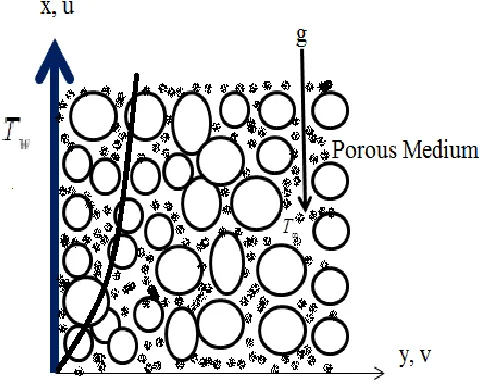
Figure 1. Physical model and coordinate system.
Table 1. Physical properties of base fluid water and copper at 20◦C (293K), (Anjali,2011)
ρ(kg/m3) c
p(J/kgK) k(w/mK) β/K m2/s
water 1000.52 4181.8 0.598 210*10−6 0.143*10−6
copper 8954 383.1 385 51*10−6 1.12*10−4
2. Problem Formulation
satisfy slip condition. Following the modified equations studied by [4] along with the Boussinesq technique and boundary layer approxima-tion, then the modified model becomes;
(1) ∂u
∂x + ∂v ∂y = 0
(2) µnf
K (T)u=− ∂p
∂x + (ρβ)nfg(T −T∞)
(3) 0 = ∂p
∂y
(4) (ρcp)nf
u∂T
∂x +v ∂T
∂y
=kef f
∂2T
∂y2
Noting that v << u in the boundary layer and this shows that there are no body forces (including gravity ) in the y-direction and therefore, the force balance in the y-direction is zero. Apart form that, the pres-sure forces within the boundary layer is established by the hydrostatic condition outside the boundary layer and therefore, the unbalance of pressure and gravitational forces within the boundary layer due to the variation of density of the fluid creates the fluid motion adjacent to the vertical plate. Here, u and v are seepage velocity components a-long x and y axes. Noting that, x and y are the cartesian coordinates measured along the vertical plate and normal to it, respectively. Fur-thermore, T is the temperature of the nanofluid within the boundary layer and µnf(T),(ρcp)nf, kef f and (ρcp)ef f are the dynamic viscosity
of the nanofluid, heat capacitance, effective thermal conductivity and effective heat capacitance of the porous medium, while p is the pres-sure and K is the permeability of the porous medium. The subscript ”nf” defines all the thermophysical quantities of nanofluid in porous medium and these quantities are defined as follows-([18],[9]);
(5)
knf =
kp+2kf−2ϕ(kp−kf)
kp+2kf+ϕ(kp−kf)
,(ρβ)nf =ϕ(ρβ)p+ (1−ϕ) (ρβ)f, kef f =
ksknf
ks+(1−)knf,(ρcp)ef f =(ρcp)nf + (1−) (ρcp)m,
µnf(T) = µf(T)
(1−ϕ)2.5,(ρcp)nf = (1−ϕ) (ρcp)f +ϕ(ρcp)p.
In eqn.(5), ϕ, βp, ρp,(ρcp)p and kp are the nanoparticle volume
6 JAMES, MUREITHI AND KUZNETSOV
heat capacitance and thermal conductivity of the base fluid, respec-tively. In the model, it is assumed that the vertical plate satisfies the power law temperatureTwand the temperature far away from the plate
is at the ambient temperatureT∞. The ambient temperatureT∞is
as-sumed to be less than temperature at any arbitrary reference point in the boundary layer formed along the plate. Therefore, under these situations the boundary conditions associated with this model are as follows:
(6) v = 0, T =T∞+Cxλaty= 0, x≥0
(7) u= 0, T =T∞aty→ ∞, x≥0
Furthermore, the temperatute of the plate is a power function of distance along the plate measured from its leading edge of the plate and is defined as;
(8) Tw =T∞+Cxλ
where, C > 0 for heated vertical plate and C < 0 for cooled vertical plate, whereas λ = 0 for isothermal/constant temperature along the vertical plate. The pressure in Eqns (2), (3) is eliminated using the cross-differentiation approach and therefore the continuity, momentum and heat equations are written as;
(9) ∂u
∂x + ∂v ∂y = 0
(10) ∂
∂y(µnf(T)u) = (ρβ)nfgK ∂T
∂y
(11) u∂T
∂x +v ∂T
∂y = kef f
(ρcp)nf
∂2T ∂y2
For the present base fluid, following ([1]; [16]), the dynamic viscosity of the base fluid is considered in the following form:
(12) µf(T) =
µ∞
1 +γ(T −T∞)
= 1
a(T −Te)
where µ∞ is a dynamic viscosity of the ambient base fluid; γ is a
hand a and Te are constants, given by;
(13) a= γ
µ∞
, Te−T∞ =−
1
γ
We now look for similarity solutions of Equations (10) and (11) with the boundary conditions (6) and (7) of the following form;
(14)
Ψ =αef fRa1/2x f(η), η=
y xRa
1/2
x , θ(η) =
T −T∞
Tw−T∞
, θr =
Te−T∞
Tw−T∞
,
provided thatRax =gβK(Tw−T∞)x/ναef f is the local Rayleigh
num-ber of the porous medium, ν, αef f and θr are the kinetic viscosity,
effective thermal diffusivity of the porous medium with nanofluid and viscosity-variable parameter. Also, Ψ is the stream function which is expressed in terms of derivatives of the seepage velocity asu=∂Ψ/∂y
andv =−∂Ψ/∂x,apart from that, the seepage velocities usually satsi-fy the continuity equation of the flow. Using, similarity solutions, the seepage velocities may be expressed in the following form;
(15) u= gβK(Tw−T∞)
ν f
0
(16) v =−1
2
αef fgβK(Tw −T∞)
νx
1/2
h
(1 +λ)f−(1−λ)ηf0 i
where, primes represent the derivative with respect to η.
Substituting the seepage velocities Egns (15) and (16) in Eqns (10) and (11) together with Eqns (12-14), we get the following system of non-linear ordinary differential equations:
(17) f00+ f
0 θ0 θr−θ
−(1−ϕ)2.5
ϕρpβp ρfβf
+ (1−ϕ)
θ0
1− θ θr
= 0
(18) θ00+ (1 +λ) 2 f θ
0
−λf0θ = 0
Subjected to the boundary conditions:
(19) y= 0, η= 0, f(0) = 0, θ(0) = 1,
y→ ∞, η→ ∞, f0(∞) = 0, θ(∞) = 0
It has showned thatθris determined by the viscosity/temperature
char-acteristics of the base fluid and the operating temperature difference is ∆T =Tw−T∞. It is also shown that, ifθris small then either the base
8 JAMES, MUREITHI AND KUZNETSOV
difference is high. It may be noted that θr is negative for liquids and
positive for gases [1].
The quantity of physical interest is local Nusselt numberN ux, which
is defined as follows:
(20)
N ux=
hx kef f
, h= q
00
w
Tw−T∞
, qw00 =−kef f
∂T ∂y
y=0
q00w =−kef f
∂T
∂y
y=0
=−kef fC3/2θ
0gβK ναef f
1/2
x3λ/2x−1/2
Therefore, using the similarity solutions Egn (14), we get the local Nusselt number equation in dimensionless form;
(21) N ux =−
gβK(Tw−T∞)x
ναef f
1/2
θ0(0) =Ra1/2x h−θ0(0)i
(22) N ux
Ra1/2x
=h−θ0(0)i
where by qw00 and h are the local heat flux and heat transfer coefficient from the vertical plate, respectively. Hence, the effects of the nanopar-ticle volume fraction (ϕ), viscosity-variable parameter (θr) and
param-eter (λ) on the velocity profile, temperature profile and convective heat transfer (local Nusselt number) from a vertical plate to the nanofluid are discussed in the results and discussion part.
3. Numerical technique
fourth order Runge-Kutta method. The accuracy of the assumed ini-tial condition is then checked by comparing the approximated value of the dependent variable at the end point of the domain with its known value at that end point. If it is happen that the difference still exists, then an improvement is done by choosing another initial conditions and this process repeated until the difference become very small between the calculated and the know value at the end point of the domain. Furthermore, the different step sizes were selected to satisfy the con-vergence criterion of 10−6. From the process of numerical computation,
the velocity, temperature profiles and local Nusselt number were ob-served and their numerical values were presented in the graphical and tabular forms.
Table 2. Numerical values of [−θ
0
(0)] for Cu nanopar-ticles when ϕ→0 and θr → −∞
λ [−θ0(0)]- Present results [−θ0(0)]- Nield and Bejan (2006) results
-1/3 0.0247 0
-1/4 0.1755 0.162
0 0.448 0.444
1/4 0.6286 0.630
1/3 0.6793 0.678
1/2 0.7715 0.761
3/4 0.8931 0.892
1 1.0005 1.001
4. Results and Discussion
In our present study, we have computed and analyzed a theoreti-cal solution of the dimensionless equations subject to the boundary conditions. The computations have been done for the vertical plate embedded in saturated porous medium with nanofluid. The tempera-ture of the vertical plate assumed to be a power function of distance along the plate from its leading edge. Also, the values of the physical properties of the base fluid water and copper were taken from ([2]), whereas the nanofluid correlation formulas were taken from [9]. The effects of nanoparticle volume fractionϕ, variable-viscosity parameteθr
10 JAMES, MUREITHI AND KUZNETSOV
they are in good agreement as the variable viscosity parameter goes to infinity and nanoparticles in the base fluid approaches to zero, Table 2 and Fig 9.
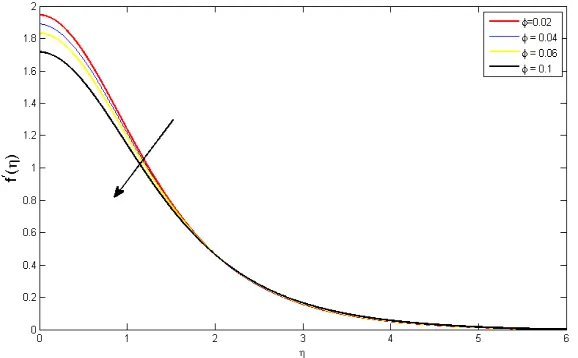
The velocity profile distribution for different values of nanoparticle volume fraction ϕ, with fixed parameter λ = −1/3 and variable vis-cosity parameter θr = −1 is depicted in Fig 2. It is observed that
as the nanoparticle volume fraction increases, dimensionless velocity of the nanofluid along a vertical plate decreases. We suggested that the decline of the dimensionless velocity of the nanofluid is due to the increase of surface drag caused by more addition of nanoparticle in the base fluid water.
In Fig 3, the dimensionless temperature plotted against the simi-larity variable η for different values of nanoparticle volume fraction. From the figure, it is observed that with the increase in nanoparti-cle volume fraction, the dimensionless temperature profile increases in thermal boundary layer. Here, the nanoparticle volume fraction has shown a significant in enhancing heat transfer from the heated plate to the fluid in motion adjacent to the plate.
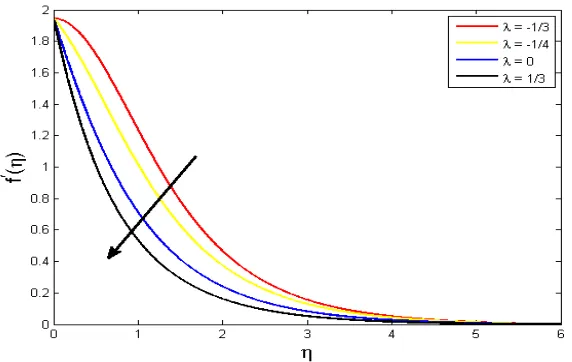
Figures 4-5 show the dimensionless velocity and temperature profiles for different parameter λ with fixed nanoparticle volume fraction and variable viscosity parameter. It is observed that both of them show a common behavior. It means that, as the parameterλ increases, veloc-ity and temperature profiles decrease. Also, through different compu-tations we have observed that the problem becomes realistic when the parameter λ range is−1/3≤λ≤1.
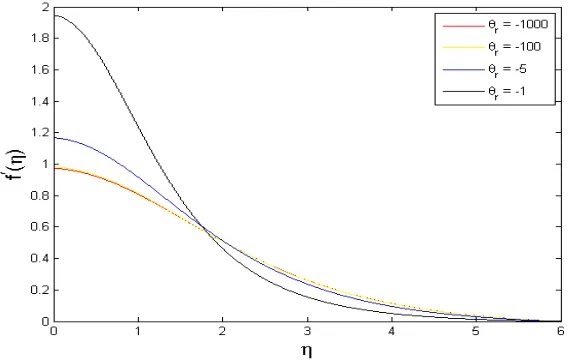
The dimensionless velocity profile plotted against the similarity vari-able η was shown in Fig 6, with fixed nanoparticle volume fraction ϕ
and parameter λ. It is observed that as the variable viscosity parame-ter θr decreases, velocity profile increases. This is due to the fact that,
In Fig 7, the effects of variable viscosity parameter θr on
temper-ature profiles are depicted. It is observed that, as variable viscosity parameter decreases, temperature profiles decrease. The decline of the temperature profile is due to the overhauling of heat in the boundary layer caused by convection of fluid at high velocity adjacent to the heated plate.
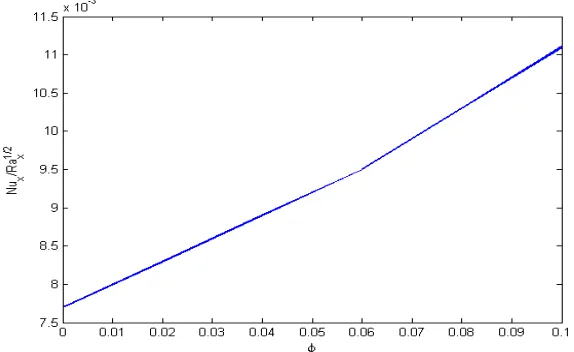
Fig 8 displays the effects of the ratio of local Nusselt number and Rayleigh number on the surface of heated plate for various values of nanoparticle fraction volume with fixed λ and variable viscosity pa-rameter θr. It is observed that, the ratio of local Nusselt number and
Rayleigh number with nanoparticles are linearly relationship. This in-dicates that as nanoparticle increases in the base fluid water, the ratio number increases. This indicates that, more heat is removed from a ver-tical plate and this action proves that nanofluids are efficient coolants than the traditional fluids.
12 JAMES, MUREITHI AND KUZNETSOV
Figure 3. Effects of nanoparticle fraction volume on temperature profilesθ(η) when λ=−1/3, θr =−1.
Figure 5. Effects of parameter λ on temperature pro-files θ(η) whenϕ= 0.02, θr =−1.
14 JAMES, MUREITHI AND KUZNETSOV
Figure 7. Effects of variable -viscosity parameter on temperature profilesθ(η) when λ=−1/3, φ= 0.02.
5. Conclusion
Natural convection flow past an impermeable vertical plate embed-ded in nanofluid saturated porous medium with temperature dependent viscosity is studied numerically using fourth order Runge-Kutta inte-gration with shooting method. The numerical solutions of the model are compared with previous works and found to be in good agreement. The effects of the nanoparticle volume fraction, variable-viscosity pa-rameter and the power papa-rameter of temperature along the plate are discussed and presented in graphical forms. In general a copper-water nanofluid has shown an improvement in heat transfer from a heated vertical plate into convective fluid in porous medium.
Figure 9. Comparison between the present results and Nield and Bejan results on the heat transfer from the heated plate when φ = 0 andθr → −∞.
References
[1] S. M Abdelgaied and M. R Eid. Mixed convection flow of nanoflu-ids over a vertical surface embedded in a porous medium with temperature dependent viscosity. Recent advances in
mathemat-ical methods and computational techniques in modern science,
3,N0.2:300–312, 2013.
16 JAMES, MUREITHI AND KUZNETSOV
[3] V. J Bansod. The darcy model for boundary layer flows in a horizontal porous medium induced by combined buoyancy forces.
Journal of Porous Media, 6(4):273–281, 2003.
[4] A Bejan and A. D Nield. Convection in porous medium; third edition. Springer Science +Business media.inc, 2006.
[5] A Berg and JCT Eijkel. Nanofluids-what is it and what can we except from it? microfluid. Nanofluid, No.1:249–269, 2005.
[6] Rama Subba Reddy Gorla. Nonsimilar solutions for free convection in non-newtonian fluids along a vertical plate in a porous medium.
International Journal of Numerical Methods for Heat Fluid Flow,
Vol. 9 Iss: 8, pp.847 - 859, 6(8):847–859, 1988.
[7] M.A Hossain and M.S Munir. Combined convection from a vertical flate with temperature dependent viscosity and thermal
conductiv-ity. International Journal of Fluid Mechanics Research, 29,No.6,
2002.
[8] R.D Mahdi, H.A Mohammed, and K.M Munisamy. Improvement of convection heat transfer by using porous media and nanoflu-id (review). International journal of science and research IJSR, ISSN, pages 2319–2335, 2013.
[9] O. D Makinde. Analysis of sakiadis flow of nanofluids with viscous dissipation and newtonian heating. Apply. Math. Mech-Engl. Ed, 33, No.22:1545–1554, 2012.
[10] R. K Muhaimin and I Hashim. Variable viscosity and ther-mophoresis effects on darcy mixed convective heat and mass trans-fer past wedge in the presence of chemical reaction. Theoret,
Ap-pl.Mech, 36,No.1, 2009.
[11] A. D Nield and A.V Kuznetsov. The cheng minkowyez problem for natural convective boundary layer flow in a porous medium saturated by a nanofluid. Int. J. heat Mass Transfer, No.52:5792– 5795, 2009.
[12] T. L Olaseni and Olafenwa R.A. Analytical solution of a steady non-reacting laminar fluid flow in a chemical filled with saturat-ed porous msaturat-edia with two distinct horizontal impermeable wall conditions. Journal of Natural Sciences Research, 2, 2006.
[13] I Pop and D.B Ingham. Convective heat transfer-mathematical and computational modeling of viscous fluids and porous media.
Oxford OX5 IGB, UK, 2001.
[15] A.M Rashad and A.J Chamkha. Mixed convection flow of non-newtonian fluid from vertical surface saturated in a porous medi-um filled with a nanofluid. Journal of Applied Fluid Mechanics, 6,No.2:301–309, 2013.
[16] M Sahar and A Gaied. Mixed convection flow of nanofluids over a vertical surface embedded in a porous medium with temperature dependent viscosity. ISBN: 978-1-61804-178-4, 2012.
[17] Khan WA Uddin, MJ and Al Ismail. Mhd free convective layer flow of a nanofluid past a vertical plate with newtonian heating boundary condition. Plos one 7(11); e49499, doi:
10,1371/jour-nal. Pone.0049499, 7,No.11, 2012.
[18] Z Uddin and H Souad. Unsteady natural convection heat trans-fer of nanofluids along a vertical plate embedded in porous
medi-um. Nanoscale Research Letters 2, 8:64 doi:10.1186/1556-276X,
8,No.64:8–64, 2013.
[19] K Vafai. Handbook of porous media, second edition. CRC press
Taylor and Francis Group, New York., 2005.
[20] K.V Wong and O.D Leon. Application of nanofluids, current and future. mechanical and aerospace engineering. Department,
Uni-versity of Miami, USA, 2010.
[21] M. H Yasin and R Arifin. Mixed convection boundary layer flow on a vertical surface in a porous medium saturated by a nanofluid with suction or injection. Journal of Mathematics and Statistics, 2,No.9:119–128, 2013.
Makungu James, School of Computational and Communication Sci-ence and Engineering, The Nelson Mandela African Institution of Science and Technology (NM-AIST), P. O. Box 447, Tengeru, Arusha, Tanzania
E.W. Mureithi, School of Computational and Communication Sci-ence and Engineering, The Nelson Mandela African Institution of Science and Technology (NM-AIST), P. O. Box 447, Tengeru, Arusha, Tanzania