ARTIGO ORIGINAL
SwapINN: Analytic Study about Prescription
Swaps at Pharmacies
DCIsão: Estudo Analítico sobre a Substituição de Prescrições nas
Farmácias
1. Unidade de Saúde Familiar Santiago. Agrupamento de Centros de Saúde Pinhal Litoral. Leiria. Portugal. Recebido: 04 de Julho de 2013 - Aceite: 21 de Outubro de 2013 | Copyright © Ordem dos Médicos 2014
Ana MOUTINHO1, Denise ALEXANDRA1, Renata RODRIGUES1
Acta Med Port 2014 Jan-Feb;27(1):92-98
RESUMO
Introdução: A prescrição obrigatória por DCI foi imposta em 2012, para redução de custos do SNS e motivou discussão entre as partes envolvidas. Estudámos, numa população real, a dinâmica prescrição-dispensa de medicamentos.
Objetivos: Determinar a percentagem de prescrições substituídas; avaliar os fatores associados à substituição; identificar as respeti-vas justificações; quantificar os diferenciais dos custos para utente e Serviço Nacional de Saúde.
Material e Métodos: Estudo analítico. Amostra de conveniência constituída pelos medicamentos prescritos de uma unidade de saúde, de 19 a 23 de Dezembro de 2011. Três dias depois, os utentes foram entrevistados telefonicamente. Software: Excel® e SPSS®. Testes:
Qui-quadrado e Mann-Whitney; n.s. = 0,05.
Resultados: Total de 255 prescrições. A maioria foi efetuada a mulheres (62%), idade média 52 anos, 4 anos de escolaridade (33%) e para situações agudas (53%). Foram substituídas 31% das prescrições, sem relação com idade, sexo ou escolaridade, nem com o médico prescritor ou farmácia. Os medicamentos prescritos para situações crónicas foram menos substituídos (p < 0,001), assim como as prescrições de marca (p < 0,001). Os anti-infeciosos e anti-alérgicos foram os grupos com mais substituições (p = 0,009). Os utentes não se aperceberam da substituição em 72% dos casos. Nos casos de substituição, o utente pagou, em média, mais 79% que o prescrito e o Serviço Nacional de Saúde 5%.
Discussão/Conclusão: Verificou-se substituição de 31% das prescrições, com mais custos para utente e Serviço Nacional de Saúde. Consideramos possível viés de seleção, informação e registo. Sendo agora obrigatória a prescrição por DCI, sugerimos a análise regular, a nível nacional, com base nas aplicações informáticas em uso, da prescrição e respetiva dispensa.
Palavras-chave: Cuidados de Saúde Primários; Custos e Análise de Custo; Prescrições de Medicamentos; Portugal; Substituição de Medicamentos.
ABSTRACT
Introduction: In order to cut spending, compulsory INN prescription was suggested in Portugal during 2012. This instigated discussion among stakeholders in the matter. The authors studied prescription-dispensing dynamics in a real population.
Objectives: To determine the percentage of swapped prescriptions; to assess factors associated with the swap; to analyse justifica-tions for doing so; to quantify the cost difference for patients and the National Health Service.
Material and Methods: Analytic study. Convenience sample consisting of all prescriptions from a Primary Health Care unit, from the 19th to the 23rd December 2011. Third day follow-up, using phone call interviews. Software: Excel and SPSS. Tests: Chi-square and Mann-Whitney, SL = 0.05.
Results: Total of 255 prescriptions. Majority prescribed to women (62%), mean age of 52, four years of school education and for acute situations. A percentage of 31% of prescribed drugs were swapped. The swaps had no statistical relation with age, sex or literacy of the patient, nor with the prescriber or pharmacy. Swapping of prescribed drugs for chronic situations was lower (p < 0.001), as well as for original brand prescriptions (p < 0.001). Anti-infectious and anti-allergic were the most swapped groups (p = 0.009). Seventy-two percent of users were not aware of the swap. Regarding the swapped drugs, users paid on average 79% more than what was originally prescribed, and the National Health Service 5% more.
Discussion/Conclusion: The authors found changes in 31% of the prescriptions, with higher costs for both users and National Health Service. Selection, information and registration bias were considered. With compulsory INN prescriptions, we suggest regular analysis of prescription-dispensing dynamics, based on the available national data.
Keywords: Costs and Cost Analysis; Drug Prescriptions; Drug Substitution; Primary Health Care; Portugal.
INTRODUCTION
International Non-proprietary Name (INN) prescription is still the word of the day, mainly regarding discussion and approval of compulsory INN prescription included in the 2012 State Budget, as a National Health Service (Serviço Nacional de Saúde - SNS) cost reduction measure.1, 2
Portugal is included in the European countries list where INN prescription is compulsory, along with Greece, Romania, Estonia, Latvia and Lithuania since January 2013.3 In most
of the remaining European countries, INN prescription is only indicative and countries may opt for optional or
compulsory swapping for a generic drug.3 In Portugal,
medical prescription is legislated since 2000 and over the following decade, prior to compulsory INN prescription, there has been a quick and significant increase of the generic drug market, reflected in important savings and mainly driven by supply considerations.4 A study about the generic
drug market in Portugal also showed that there is still room for a higher increase in its use with consequent reduction of spending and it is important to reinforce prescription by physicians as a reinforcing measure.5 A study prompted by
35
35 anos a p
rom
ov
er
as
ciê
CA
P
ORT
UGUE
SA
ARTIGO ORIGINAL
the British Government found that the promotion of generic drug use oriented towards savings should include less imposing measures than INN prescription or compulsory swapping, as these obligations may involve risks for user’s safety, raise confusion, lower compliance to therapy and raise doubts regarding cost-effectiveness.6
This issue has raised alarm among physicians and has called for intense discussions between the different parts involved in the prescription process as well as in drug supply, in Portugal, namely between the Portuguese General Medical Council - Ordem dos Médicos (OM) and
the Infarmed (Portuguese National Authority of Medicines
and Health Products).7
In short, Infarmed accepts bioequivalence between
different generic drugs of the same active substance assuming that swapping for generic drugs in the pharmacy may bring financial benefits (swapping for the cheapest) with no impact over drug efficacy.8
This argument is opposed by OM that, although in
favour of generic drugs, sustains that based on current legislation generic drugs are not bioequivalent between them, although each generic drug is bioequivalent to the original product. Legislation allows 20% differences in bioavailability between the generic and original drug. One generic drug with approximately 80% bioavailability would be 40% less bioavailable than one with approximately 120% and both drugs are approved as generic drugs. OM
refers to this major bioavailability difference as the basis for firmly opposing free drug swapping in the pharmacy, claiming it is driven by the financial interests of the players responsible for the circulation of drugs,9,10,11 since there is a
direct proportionality between the pharmacy’s profit margin and the price of drugs supplied.
One of the performance indicators for the assignment of institutional incentives contracted with primary care units is the average medical expense of invoiced drugs per user, expressed as the retail selling price (RSP). However, with the new legislation, the final decision regarding supply is managed by other players who are not prescribing physicians.
In this context, we felt as appropriate to study prescription-drug supply chain dynamic within the user population attending a health centre, Unidade de Saúde Familiar (USF) Santiago, Leiria in order to understand if drug
swapping corresponds to the supply of a less expensive drug and if this is influenced by factors due to the drug, to the user or to the players in this process.
OBJECTIVES
• To determine the percentage of swapped prescriptions in the pharmacy (brand drug for generic and generic drug for another generic);
• To identify the arguments and information given to the user to justify the swapping;
• To assess factors that may be associated to drug swapping at the pharmacy: user’s age, gender and educational background, prescribing physician, acute vs.
chronic medication, therapeutic group, pharmacy;
• To quantify differential cost for the user and for the
SNS between prescribed and supplied medication in the
case of drug swapping at the pharmacy.
MATERIAL AND METHODS
This is an analytical, observational, cross-sectional study, with prospective data collection.
At the time of the study, prescription rules included in the Law nº 14/2000 and in the Decree-Lawnº 271/2002 were in force.
A convenience sample has been created, including all prescribed drugs supplied to the users at the USF Santiago,
as part of a face-to-face medical visit, from 19th to 23rd December 2011. We have chosen to exclude from the study all prescribed drugs as part of medical work in the absence of the user. These correspond to renovation of long-term medication that the user requires and requested prescriptions are collected from the health centre within three working days. This period of time would make the telephone interview impossible within the defined deadline. The USF Santiago covers the civil parish of Marrazes,
Leiria and, at the time of the study, had a five-doctor team, caring for approximately nine thousand patients. There were four pharmacies in this area at the time of this study. The week before data collection, in order to explain the methodology and objectives of the study, a meeting was carried out with the doctors working in this health unit. Everyone agreed participating in the study, following prescribing orientations included in the study protocol, according to the best clinical evidence and the performance indicators for the assignment of institutional incentives contracted with this primary care unit, while preserving user’s will. Beyond these orientations, which refer to the usual practice at this health unit, doctors were asked not to indicate drug swapping prohibition. At the moment of drug prescription, users were not aware of the study, in order to preserve their genuine interaction with the professional at the pharmacy.
We have considered each prescribed drug as one observation unit and we have characterized it with the following variables:
- user’s age, gender and educational background; - prescribing physician;
- prescription type (chronic or acute medication); - active substance of prescribed drug;
- therapeutic group of prescribed drug; - drug type (generic or brand drug);
- whether or not a generic for prescribed drug exists; - marketing authorisation holder of prescribed drug; - cost of prescribed drug for the SNS and the user;
- whether or not the prescribed drug was swapped at the pharmacy;
- marketing authorisation holder of supplied drug; - cost of supplied drug for the SNS and the user;
ARTIGO ORIGINAL
Medication was considered as “chronic” if it had been already included in the user’s long-term medication list.
Data collection
A MS Excel single database used for daily prescription recording was made available online for researchers using a personal login. Data were collected from the clinical records of SAM (Sistema de Apoio ao Médico) software.
Three days after the medical visit, users were interviewed by phone, following an orientation guide, in order to collect data regarding drug supply at the pharmacy, namely the brand that had been supplied and swapping justification when appropriate. The interview guide included a simple explanation of the objectives of the study, data confidentiality guarantee, with a commitment to destroy database within a legal deadline, in order to obtain participant verbal consent.
Data analysis
Data were imported from MS Excel® 2003 to SPSS
Statistics® v17.0 software and subject to statistical analysis
in order to determine the percentage of prescription swapping related to pharmacy supply as well as to determine the presence of a correlation between any of the assessed factors and drug swapping.
A univariate exploratory analysis has been carried out to validate database, to control data quality and to overall characterize the sample. A bivariate analysis was carried out in order to assess the presence of correlations between variables, using chi-square test for qualitative and Mann-Whitney test for quantitative variables, for a significance level of less than 0.05.
In cost analysis, we only considered as valid prescription data in which it was possible to obtain information regarding the price at the date of purchase. Increased cost was considered to be accounted for by the pharmacy swapping when the latter involved an additional total expense over 10 cents, in comparison to what was originally prescribed.
Ethical-legal issues
In order not to influence transaction at the pharmacy,
users were not informed about the study at the moment when drugs were prescribed. This information was provided during the interview and, those who gave their verbal consent gave their contribution to providing data. User’s identification data were omitted from the final database that was used for statistical analysis, preserving confidentiality and anonymity. The study was authorized by USF’s
Coordinator and Technical Council.
RESULTS
During the period of the study, 339 users attended face-to-face medical visits. From these, 177 had not yet been to the pharmacy at the time of the interview. From the remaining 162, four refused to answer and three users could not be reached due to phone error or unavailability. Our final group of users comprised 155 users, corresponding to a total 255 prescribed drugs. Although the civil parish of Marrazes was served by four pharmacies, some users went to other pharmacies outside the parish, with in total 20 different pharmacies.
Only 20 prescriptions from our database had omitted data regarding user’s educational background. All the remaining data were correctly included in database. Most drugs (62%) were prescribed to female users. User’s ages varied between 0 and 94, the mean age was 52, with a standard deviation of 20. Median age was 57 with an interquartile range of 30.
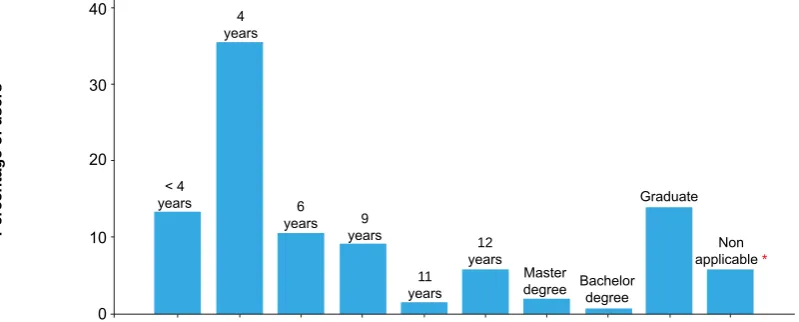
Most users (33%) had four years of educational background (Fig. 1).
From prescribed drugs (n = 255), 48% corresponded to
user’s chronic medication and the remaining (52%) were related with acute clinical situations. There was a generic drug available for 80% of prescribed drugs and in 60% generic drugs were prescribed.
Cardiovascular system (22%) drugs were the most frequently prescribed, followed by musculoskeletal system (17%), central nervous system (16%) and anti-infective drugs (14%).
Overall, 31% (78/255) of prescribed drugs were swapped in the pharmacy. When considering just the cases with an
Figure 1 – Educational background of the users participating in this study
*user aged below 18
< 4 years
4 years
6
years 9
years
11 years
12 years
Master
degree Bachelor degree Graduate
Non applicable *
Percentage of users
ARTIGO ORIGINAL
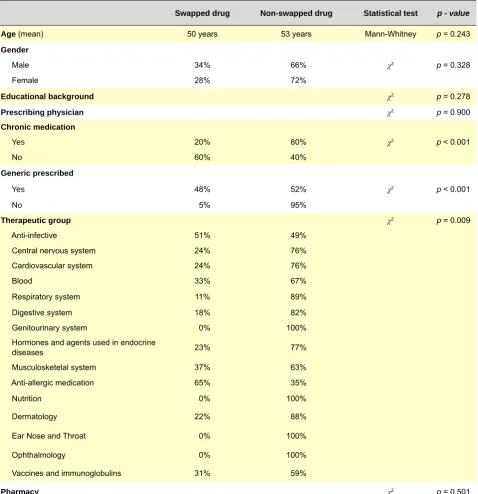
available generic drug, swapping frequency was 38%. Table 1 describes bivariate statistical analysis between the presence of drug swapping at the pharmacy and the different factors assessed. Observation units were the 255 prescriptions from which we obtained information from the users. We should remark that drug swapping did not seem correlated to user’s age, gender or educational background or with prescribing physician or pharmacy. Prescribed drugs for chronic situations were less swapped than drugs for acute situations (p < 0.001). Brand drug prescriptions were
less swapped (p < 0.001). Anti-infective and anti-allergic
drugs were the groups were swapping occurred more frequently (p = 0.009) (Table 1).
The user referred that he was not aware about the swapping in 72% of the cases. In 21% of the cases it was explained to the user that the drug was not available in the pharmacy and in 7% the swapping was decided by the user himself.
It was not possible to obtain information on the prices at that date of purchase in 12 out of 78 prescriptions swapped at the pharmacy, explaining why only 66 prescription data were considered as valid for cost analysis. In 60 of these cases (91%), swapping involved an invoice price increase by the pharmacy, with additional expenses for the user and the SNS.
Table 2 shows the mean cost of prescribed and supplied
Table 1 - Bivariate statistical analysis of the factors related to prescription swapping (n = 255 prescriptions)
Swapped drug Non-swapped drug Statistical test p - value
Age (mean) 50 years 53 years Mann-Whitney p = 0.243
Gender
Male 34% 66% χ2 p = 0.328
Female 28% 72%
Educational background χ2 p = 0.278
Prescribing physician χ2 p = 0.900
Chronic medication
Yes 20% 80% χ2 p < 0.001
No 60% 40%
Generic prescribed
Yes 48% 52% χ2 p < 0.001
No 5% 95%
Therapeutic group χ2 p = 0.009
Anti-infective 51% 49% Central nervous system 24% 76% Cardiovascular system 24% 76% Blood 33% 67% Respiratory system 11% 89% Digestive system 18% 82% Genitourinary system 0% 100% Hormones and agents used in endocrine
diseases 23% 77% Musculosketelal system 37% 63% Anti-allergic medication 65% 35% Nutrition 0% 100% Dermatology 22% 88% Ear Nose and Throat 0% 100% Ophthalmology 0% 100% Vaccines and immunoglobulins 31% 59%
ARTIGO ORIGINAL Table 2
–Mean and differential cost (Euros) of prescribed and supplied drugs for the user, the SNS and in RSP
User SNS RSP
Mean cost of prescribed drug 1.94 3.65 5.58
Mean cost of supplied drug 3.46 3.83 7.29
Mean cost differential
(supplied – prescribed) (+ 79%)+ 1.52 (+ 5%)+ 0.18 (+ 31%)+ 1.71
drugs, for the user, the SNS and the RSP (retail selling
price, which stands for the sum of the cost for the user with the cost for the SNS). The mean cost of supplied was
higher than the cost of prescribed drugs, for both payers (user and SNS). These data allowed us for the calculation
of cost differentials/average deviations between what was prescribed and supplied (Table 2).
When prescription swapping took place, the average cost of supplied drugs was as higher for the users as for the SNS. The average differential cost vs. the average cost
of prescribed drugs was 79% (+1.52€) for the user, 5% (+0.18€) for the SNS and 31% (+1.71€) overall (RSP).
Figure 2 and 3 are continuous interpolations of cost distribution indicating in blue the prescribed and in red the supplied drug costs. In both, the curves related with supplied drugs (in red) present a deviation to the right vs. the curves
related with prescribed drugs (in blue), demonstrating higher supplied drug costs.
Figure 2 – Comparison in patient’s cost distribution (blue – prescribed drugs; red – supplied drugs)
DISCUSSION
We found a 60% generic prescription rate, with 80% generic drugs available. In a study carried out in 2011, in a Portuguese primary health care setting, a lower generic prescription rate of 34% was obtained .8 This high generic
prescription rate probably reflects contracting with the USF
and the current socio-economic context, aimed to reduce drug costs for the users, in an effort to increase therapy compliance.
In our group of users, prescribed drug swapping occurred in 31% of the prescribed drugs over the study period. Medication for acute situations, generic drugs and anti-allergic, anti-infective and musculoskeletal system drugs were the ones that were more often swapped. Chronic medication was less swapped probably due to a higher familiarity of the user with the names and packages of drugs that they take in the long-term, inducing them to only accept the usual drugs.
When drug swapping occurred, the user paid on average
5 10 15 Cost (€)
Frequency
ARTIGO ORIGINAL
area of SAM software, which is subject to frequent price updates, as well as based on user’s responses during the telephone interview. Regarding drug prices, we considered those values included in the general reimbursement scheme, the possibility remaining that those users with a special beneficiary regimen may have paid different values. As this information was not available through the application use, it was not possible to take it in consideration. In order to reduce information bias provided by users, we designed an orientation guide for the telephone interview, in order to standardise the approach.
The possible bias in database record was reduced by creating a single base, available online. In addition, we carried out a descriptive analysis for each variable in order to evaluate the quality of the database and a minimal value of omitted data.
CONCLUSION
This study was carried out before INN compulsory prescription. The ordinance (portarianº 137-A/2012, de 11 de Maio) was published after this study was carried out,
through which active substance INN prescription became compulsory, preserving three exceptions.2 The decision
regarding the supplied drug is virtually no longer a function of the prescribing physician, with these exceptions. This may increase the cost attributed to the health units, compromising the objectives contracted with the administration, as the indicator‘s average expense of invoiced drugs, per user, expressed in RSP’ relies on third parties.
The same ordinance (portaria), in its 14th article,
defines that ‘pharmacies must supply the least expensive drug (except where the user’s option is different).2 However,
Figure 3 – Comparison in SNS’s cost distribution (blue – prescribed drugs; red – supplied drugs)
79% more than what was prescribed and the SNS paid 5%
more. In 91% of swapping cases, there was an increase cost for the pharmacy. Drug swapping did not show any correlation with the prescribing physician, suggesting the presence of impartiality, i.e. in the pharmacy, the name of the prescribing physician did not influence supply. The absence of any correlation with the pharmacy suggests generalized procedures.
The major limitation to the study was the fact that it was only carried out in a single primary health care unit, with a small sample and geographically confined to only one civil parish. Despite these constraints, five medical record sets corresponding to approximately 9,000 users were involved. We are aware of sample biased selection, being a convenience sample and only representing five working days. However, our sample dimension was what we expected for the study period. We specifically chose this period of data collection, before January 2012, to allow the study to take place before INN prescription became compulsory. We are also aware that the exclusion of prescribed drugs in the absence of the patient may represent another bias.
Telephone interviews were carried out three days after the medical visit in order to reduce memory bias. However, this short interval between the medical visit and the interview proved insufficient in 52% of the users who had not yet obtained their medication from the pharmacy. We chose not to repeat the telephone interview in these cases, as it would introduce a bias, considering that on the first phone call users would become aware of the study, influencing their attitude when acquiring the drug at the pharmacy.
We did not exclude information bias, as data was collected based on the records included in the prescription
5 10 15
Cost (€)
Frequency
ARTIGO ORIGINAL in our study, supplied drugs at the pharmacy represented a substantially higher cost for the user. In addition, the
user referred not having noticed the exchange in 72% of the cases, which may raise doubts regarding the degree to which pharmacies fulfil the legal requirements of generic drug supply..
Furthermore, according to the press release published in the OM website on the 19th June 2013, ‘INN – the
big dishonesty’,13 some of the new models of electronic
prescription provide the user with misleading information regarding the price paid for each drug. Therefore, the user will not be adequately protected due to lack of correct Information, becomes easier to manipulate and more vulnerable and overloaded in the decision process. We should emphasize the difficulty in finding national or international literature analysing the impact of this kind of measure on drug prescription-supply chain dynamics. In the future, thanks to the electronic character of
current prescription, the implementation of a national follow-up system (tracking) of drug/prescription will be possible, allowing for an automatic, centralized, reliable way to perform the kind of analysis that we describe in our study. In addition, this system would minimize several of the described biases, probably requiring relatively small scale human and financial resources and allowing for an objective and essential overview about the impact of this legislative measure in terms of costs.
CONFLICTS OF INTEREST
The authors declare that there were no conflicts of interest in writing this manuscript.
FINANCIAL SOURCES
No subsidy or scholarship contributed for writing this manuscript.
REFERENCES
1. Ministério da Saúde (Portugal). Portaria nº 198/2011. Estabelece o re-gime jurídico a que obedecem as regras de prescrição electrónica, bem como o regime transitório da receita manual de medicamentos. Diário da República, 1ª série – Nº 96 – 18 de Maio de 2011.
2. Ministério da Saúde (Portugal). Portaria nº 137-A/2012. Estabelece o re-gime jurídico a que obedecem as regras de prescrição de medicamen-tos, os modelos de receita médica e as condições de dispensa de me-dicamentos, bem como define as obrigações de informação a prestar aos utentes. Diário da República. 1ª série – Nº 92 – 11 de Maio de 2012. 3. World Health Organization. WHO Colaborating Centre for Pharmaceuti-cal Pricing and Reimbursement Policies. 3. PharmaceutiPharmaceuti-cal policy mea-sures, implemented in response to the recession, in Europe 2012/2013. 2013 [consultado 2013 Ago 26]. Disponível em: http://www.epha.org/ IMG/pdf/Christine_Leopold-Pharmaceutical_policy_measures_imple-mented_in_response_to_the_recession_in_Europe_2012-2013.pdf. 4. Medicamentos genéricos: Contexto internacional e potencial de
pou-pança em Portugal. Farmácia Observatório. 2010;26:2-3.
5. Simoens S. The Portuguese generic medicines market: a policy analy-sis. Pharm Pract. 2009;7:74-80.
6. Government of UK, Department of Health. 6. The proposals to imple-ment “Generic Substitution” in primary care, further to the Pharma-ceutical Price Regulation Scheme (PPRS) 2009. 2009 [consultado 2013 Ago 26]. Disponível em: http://webarchive.nationalarchives.gov. uk/20130107105354/http://www.dh.gov.uk/prod_consum_dh/groups/ dh_digitalassets/@dh/@en/documents/digitalasset/dh_120433.pdf. 7. INFARMED, Gabinete de Imprensa do INFARMED. Nota
impren-sa - Prescrição por DCI obrigatória. 2012 [consultado 2013 Ago 26]. Disponível em: http://www.infarmed.pt/portal/page/portal/INFARMED/ MAIS_NOVIDADES/DETALHE_NOVIDADE?itemid=6827570.
8. INFARMED, Gabinete de Imprensa do INFARMED. Gabinete de Im-prensa do INFARMED. Esclarecimento - Ordem dos Médicos / Medi-camentos genéricos. 2011 [consultado 2013 Ago 26]. Disponível em: http://www.infarmed.pt/portal/pls/portal/docs/1/8667462.PDF.
9. Ordem dos Farmacêuticos. Bastonário em defesa da prescrição por DCI (2011/10/28). 2011 [consultado 2011 Dez 02]. Disponível em: http:// www.ordemfarmaceuticos.pt/scid/ofWebInst_09/defaultArticleViewOne. asp?categoryID=1492&articleID=4965.
10. Ordem dos Médicos. Conselho Nacional Executivo. Comunicado do Conselho Nacional executivo (25/05/2012). [consultado 2013 Jun 20]. Disponível em: https://www.ordemdosmedicos.pt/index.php?lop=conte udo&op=ed3d2c21991e3bef5e069713af9fa6ca&id=ee8fe9093fbbb687 bef15a38facc44d2.
11. Ordem dos Médicos, Conselho Nacional Executivo. Comunicado - A nova proposta de Lei de prescrição por Denominação Comum Interna-cional (DCI) (24/10/2011). 2011 [consultado 2011 Dez 02]. Disponível em: https://www.ordemdosmedicos.pt/index.php?lop=conteudo&op=ed 3d2c21991e3bef5e069713af9fa6ca&id=ddd9dda6bfaf0bb1525a8a27c 3ee6131.
12. Ministério da Saúde, Gabinete do Secretário de Estado da Saúde. Moni-torização da Prescrição de Medicamentos de Ambulatório: Indicadores Nacionais e Locais (Fevereiro a Novembro de 2011). Lisboa: MS,GSES; 2012 [consultado em 2013/08/26]. Disponível em: http://www.por- taldasaude.pt/NR/rdonlyres/C1FC69DF-4E63-486C-B726-A6E15A-CF7DAE/0/RelatMonitPrescripMedsIndNacionaisLocaisJAN2012.pdf. 13. Ordem dos Médicos. Prescrição por DCI. A grande desonestidade! 2013