EVALUATION OF ANTIOXIDATIVE, ANTIMICROBIAL AND
CYTOTOXIC ACTIVITY OF THE SYNTHETIZED
ARYLMETHYLENBIS(3-HYDROXY-5,5-DIMETHYL-2-CYCLOHEXEN-1-ONE) DERIVATIVES
A. Džambić,
[a]* S. Muratović,
[b]E. Veljović,
[b]A. Softić,
[a]E. Dautović,
[a]M. Šljivić
Husejnovi
ć,
[a]E. Horozić,
[c]A. Smajlović
[a]Keywords: Tetraketones; cyclohexen-1-one derivatives; synthesis; antioxidants; antimicrobial screening; cytotoxic activity.
Arylmethylenebis(3-hydroxy-5,5-dimethyl-2-cyclohexen-1-one) derivatives (aryl=2-hydroxynaphthyl (1) and 3,4-dihydroxyphenyl (2) have been synthesized and their structures have been elucidated. Both compounds were examined for their antioxidant, antimicrobial and cytotoxic activity. Antioxidative activities of synthesized compounds were evaluated by 2,2-diphenyl-1-picryl-hydrazyl (DPPH) and ferric reducing antioxidant power (FRAP) methods. The microbial screening was performed by diffusion method on bacterial strains
Staphylococcus aureus, Enterococcus faecalis, Bacillus subtilis and Candida albicans. Cytotoxic activity was tested on liver hepatocellular carcinoma cell line (Hep G2) by Neutral red assay. Compared to compound 2, compound 1 showed better antimicrobial and antifungal activity, while compound 2 showed better antioxidant activity with IC50 of 0.0156 mM and FRAP value 50469.44 µmol/l Fe2+. Both
compounds showed cytotoxic activity. Obtained results implicate the importance of arylmethylenebis(3-hydroxy-5,5-dimethyl-2-cyclohexen-1-on) derivatives as a potential antioxidant, antimicrobial and cytotoxic agents.
* Corresponding Authors
E-Mail: [email protected]
[a] Faculty of Pharmacy, University of Tuzla, Urfeta Vejzagića 8, 75 000 Tuzla, Bosnia and Herzegovina
[b] Faculty of Pharmacy, University of Sarajevo, Zmaja od Bosne 8, 71 000 Sarajevo, Bosnia and Herzegovina [c] Faculty of Technology, University of Tuzla, Urfeta Vejzagića 8, 75 000 Tuzla, Bosnia and Herzegovina
INTRODUCTION
Arylmethylenebis(3-hydroxy-5,5-dimethyl-2-cyclohexen-1-one) derivates, generally known as tetraketones, are used as important precursors for organic synthesis of heterocyclic compounds,1 such as acridindiones, thioxanthenes,2 and
xanthenes.3 These compounds have a wide range of
biological activities.4 They have strong antioxidative
potential5 and significant inhibitory effects on enzyme
activities such as lipooxygenase,6 tyrosinase7,8 and protein
kinase activity,9 Lately, derivates of tetraketones, due to
their strong antioxidative activity,10 have received great
attention as therapeutically efficient agents against disorders in which oxidative stress plays a significant role, such as inflammation,11 asthma12 and cancer.13
Antioxidants compounds act to stop or inhibit the oxidation process, in low concentrations, by getting themselves oxidized.14 Therefore, there has been an
increased interest for the use of antioxidants in medical treatments due to their capacity to prevent oxidative stress-induced damage.15 Synthetic antioxidants such as, butylated
hydroxyanisole (BHA) and butylated hydroxytoluene (BHT), most commonly used in the food industry, show significant side effects. Consequently, development of new, safe and more effective antioxidants is of major interest for the pharmaceutical and food industry.16
Antibiotics, as products of secondary metabolites of microorganisms and fungi17, are compounds used to kill or
inhibit the growth of bacteria.18 Frequent and uncontrolled
use of antibiotics results in resistance in bacterial strains, so
there is a real need for the development of new effective and antibacterial agents. Recent studies of tetraketones show that different such derivatives show antibacterial as well as antiviral activity.19
Previous studies of some xanthenes indicate that xanthenes have shown cytotoxic activity against human Colo-205.20 Another study confirmed the antiproliferative
activity of xanten-3-one derivates against different human cell lines including SW620, HepG2, HeLa and A549 tumor cells.21 Thioxantenes and xanthendiones are formed as
products of cyclization of tetraketone by nucleophilic addition of hydroxyl group -OH to the C=C bond,22.23
therefore, their biological activity may be related to the formation of these compounds.24
The aim of this study was to synthesize two new biologically active tetraketones via Knoevenagel condensation and Michael addition of benzaldehydes with dimedone and catalyst, and to evaluate their antioxidative and antimicrobial activities, as well as to assess their cytotoxic effect on human liver hepatocellular carcinoma cell line (HepG2).
EXPERIMENTAL
The chemicals used in the synthesis of arylmethylenebis (3-hydroxy-5,5-dimethyl-2-cyclohexen-1-one) derivatives were obtained from the Merck (Darmstadt, Germany) and Sigma Aldrich (Missouri, SAD). All analyses were performed using analytical grade chemicals, reagents and standards. Neutral red assay kit was obtained from Sigma Aldrich (Missouri, SAD). For all dilutions, only double-distilled deionized water was used.
and 13C nuclear magnetic resonance (NMR) spectra were
recorded at 500 and 150 MHz in deuterated acetone at 25 °C using NMR spectrophotometer Bruker Avance III 500 (500 MHz for 1H, 125 MHz for 13C). Elemental microanalyses of
synthesized compounds were performed by ELEMENTAR (C, H, N, S, O) VARIO EL III. Antioxidant activities were recorded by Spectrophotometer UVmini-1240, Shimadzu Corporation.
General procedure for the synthesis
A mixture of 5,5-dimethylcyclohexyne-1,3-dione (2 mM), substituted benzaldehyde (1 mM) and DABCO (10 mM) in water (20 mL) was refluxed for 30 min. After completion of the reaction, the mixture was cooled to the room temperature. The solid was filtered off, washed with distilled water and recrystallized from 96 % ethanol.
Determination of antioxidant activity
2,2-Diphenyl-1-picryl-hydrazyl (DPPH) method was performed as described earlier by Lee et al. .25 The radical
scavenging effect (%) or percent inhibition of DPPH radical was calculated according to the equation:
% inhibition = (Acontrol-Asample)/Acontrol ×100
where Asample is the absorbance of the solution containing the
sample at 517 nm and Acontrol is the absorbance of the DPPH
solution. The results are expressed as the IC50 value (mM) or
the concentration of the sample that caused 50 % neutralization of DPPH radicals.
The determination of ferric reducing antioxidant power or ferric reducing ability (FRAP assay) was performed by the method of Jiménez-Aspee et al. .26 To prepare the calibration
curve, solutions of FeSO4.7H2O were prepared in the
concentration range from 200 to 1000 μmol L-1 (y= 0.001x +
0.0615; R² = 0.9907). In each tube, 0.1 mL of sample and 3 mL of FRAP reagent were added. The samples were incubated in an aqueous bath for 30 min at 37 °C, and the absorbance was measured at 593 nm.
Determination of antimicrobial activity
Antimicrobial activity was determined using the diffusion the method described by Pirvu et al.,27 on reference bacterial
strains from Gram-positive microorganisms (Staphylococcus
aureus ATCC 25923, Enterococcus faecalis ATCC 51299,
Bacillus subtilis ATCC 23857). Antifungal activity was
examined on Candida albicans (ATCC 90028). From the bacterial strains of overnight cultures, suspensions of 0.5 McFarland turbidity were prepared (density 107-108 CFU
mL-1, depending on soy). The strains were placed then on
the surface of the nutrient substrate-Mueller-Hinton agar (MH), dispersed in sterile Petri dishes. The substrate thickness was 4 mm. In the agar, sterile drill-shaped holes were made ("wells"), into which 50 μL of synthesized compounds (1-2) in concentration of 2 mg mL-1 were added.
After the plates were left at room temperature for 15 min to the substance was diffused into agar, they were incubated at
inhibitory zone was measured and the sensitivity of the microorganisms was expressed as follows. if the zone for inhibition of microorganism growth was greater than 20 mm, it was labeled with three pluses (+++), representing the highest sensitivity of the microorganisms. If the inhibitory zone ranged from 16 to 20 mm, it was marked with two pluses (++). If the inhibitory zone was 10-15 mm in diameter, it was marked with a plus (+). For the inhibitory zone, less than 10 mm or if absent, a minus (-) sign has been used.
In vitro determination of cytotoxic activity
The liver hepatocellular carcinoma cell line was cultured in Minimum Essential Medium Eagle medium (Sigma Aldrich) containing 2 mM glutamine (Sigma Aldrich), 1 % nonessential Amino Acids (Sigma Aldrich), 10 % heat-inactivated (HI) FBS (Sigma Aldrich) and 1 % penicillin/streptomycin antibiotics (Sigma Aldrich), in a humidified atmosphere containing 5 % CO2 at 37 °C. For
each experiment, cells were grown at 80 % confluence in 75 cm2 culture flasks.
Cytotoxic activity (cell viability) was evaluated by Neutral red assay using the method previously described by Repetto
et al. .28 For each experiment, HepG2 cells were seeded (2 x
104 cells well-1) in 96 well plates and grown for 24 h. Test
agents (2.5 µM-100 µM) were then added and cells were incubated for an additional 24 h. Working dilutions were freshly prepared on the day of testing in the growth medium. The solvent (DMSO) concentration never exceeded 0.1 % in the final medium containing cells. Untreated cells were used as negative control and positive control were cells treated with 5-fluorouracil (5-FU). Cells were treated with 10 % compound solutions and 90 % culture medium. Compound stock solutions were prepared in double-distilled deionized water and solutions were sterilized by filtration through 0.2 µm sterile syringe filters.
The Neutral red assay was carried out according to the manufacturer's instructions (Sigma Aldrich). After 24 h treatment cells were incubated with medium containing neutral red dye for 3 h. The cells were subsequently washed, the dye was extracted from cells and absorbance was measured using a microplate reader at a wavelength of 540 nm. The measured absorbance values were converted to percent of cell viability with respect to negative control.
RESULTS AND DISCUSSION
Synthesis of arylmethylenebis(3-hydroxy-5,5-dimethyl-2-cyclohexen-1-one) derivates
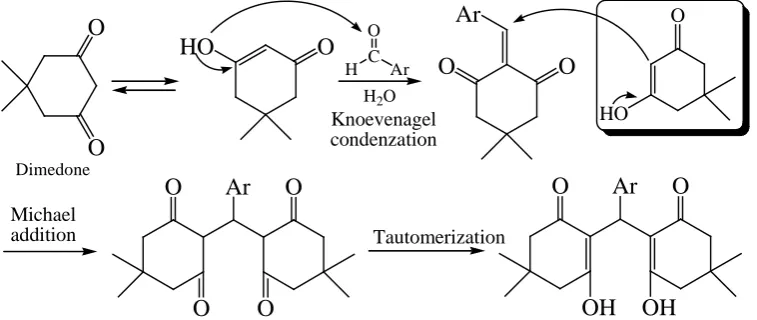
Figure 1. Mechanism of synthesis of 2,2'-arlymethylen-bis(3-hydroxy-5,5-dimethly-2-cyclohexen-1-one) derivatives.
2,2'-(2-Hydroxynaphtyl)methylenebis(3-hydroxy-5,5-dimethyl-2-cyclohexen-1-one) (1)
Yield 98.80 %, m.p. 236-240 °C. IR: 3200 (O-H), 3000 (Ar˗H), 2934 (Aliph. -CH), 1641 (C=O), 1590 and 1465 (C=C), 1369 (C˗O), 1230(˗OH) cm-1. 1H NMR (500 MHz):
δ = 0.52-0.80 (4s 12H, C(CH3)2); 1.70-2.10 (dd, 4H,CH2);
2.02-2.26 (dd, 4H CH2); 5.46 (s1H CH); 7.19-8.02 (6 d, 6H,
Ar-H); 11.09 (s,1H, -OH).13C NMR δ = 26.5-30.0 (CH 3 on
C5 and C5'); 30.07 (C5 and C5'); 32.2 (C7); 41.6, 43.7 (C4 and
C4'); 50.3, 51.3 (C6 and C6'); 111.9 (C2 and C2'); 117.4, 132.2,
149.9 C); 117.5, 123.9, 125.2, 127.4, 129.2, 120.4 (Ar-CH); 195.5, 200.9 (C1 and C1'); Anal. Calcd for C27H30O5: C
74.63, H 6.96. Found C 74.98, H 6.59.
2,2'-(3,4-dihydroxyphenyl)methylenebis(3-hydroxy-5,5-dimethyl-2-cyclohexen-1-one) (2)
Yield 53.50 %, m.p. 196.5-198.5 °C. IR: 3236 (O-H), 3000 (Ar˗H), 2966 (Aliph CH), 1652 (C=O), 1558 and 1467 (C=C), 1369 (C˗O), 1249 (OH) cm -1. 1H NMR: δ = 1.14 (s,
12H, C(CH3)2); 2.12 (s, 4H, CH2); 2.38 (s, 4H CH2); 5.41
(s, 1H, CH); 6.64; 6.69 (dd, 3H Ar-H); 7.67; 7.69 (s, 2H, OH); 12.01 (s, 1H, OH).13C NMR: δ = 28.6 (CH
3 on C5 and
C5'); 32.2 (C5 and C5'); 33.0 (C7); 47.3 (C4, C6 and C4', C6');
115.5, 115.9, 119.2, 131.0 (Ar-CH) 144.0, 145.8 (Ar-C); 116.5 (C2 and C2'); 190,4 (C1,C3 and C1', C3'). Anal. Calcd
for C23H28O6: C 68.98, H 7.05. found C 68.77, H 6.82.
Figure 2. Structure of synthesized compounds, 1 and 2
Structural characterization of compounds
The IR spectrum indicated that both samples show absorption bands for tetraketone structure, stretching vibrations between 3000-2900 cm-1 came from aliphatic CH
group, absorption bands at 1700-1600 cm-1 belong to C=O
groups. Further, all IR spectrum show bands at 1600 and 1446 cm-1, which are characteristic for the aromatic ring
(C=C), there are bands at 1300 cm-1, characteristic for C-O
stretching and deformation vibrations of the OH group at 1200 cm-1. The aromatic hydroxy groups as substituents in
the spectrum of compound 1 with 2-hydroxynaphtyl group show a characteristic band at 3200 cm-1, while the spectrum
of compound 2 with two hydroxy groups on phenyl ring on the positions of 3 and 4, has a characteristic band at 3236 cm-1.
The 1H NMR spectra of synthesized compounds contain
broad singlets in the range of 1.14-1.18 ppm derived from CH3 protons belong to positions C5 and C5'. Both spectra
have 2-2 singlets in the range of 2.03-2.12 ppm and 2.38-2.41 ppm due to CH2 protons on positions of C4, C6, and C4',
C6'. One singlet was observed at 5.41-5.46 ppm from CH
proton, which connects cyclohexene rings (C7).
A singlet at 4.29 ppm (proton of the hydroxy group) and three doublets in the range of 7.19-7.36 ppm and doublets in the range of 7.26-8.02 derived from the protons of the naphthyl group could be observed in the spectrum of compound 1. Two doublets were found at 6.64-7.52 ppm due to phenyl ring protons of compound 2, while the hydroxy group signals had a singlet at 6.97-7.67 ppm
The 13C NMR spectra of synthesized compounds showed
signals at 26.5-29.0 ppm belong to carbon atoms of the methyl groups. The signals from carbons on positions C5 and
C5' are at 30.07-32.8 ppm, while the signal from the methine
group connects the two cyclohexene rings that appeared at 32.2-33.6 ppm. Signals characteristic for cyclohexene ring appeared at 47.6-51.3 (C4, C6 and C4', C6'), 111.9-116.6 (C2
and C2') and 190.4-200.9 ppm (C1, C3 and C1', C3'). In the 13C
NMR spectra, signals for aromatic carbons appeared at 117.4-125.2 and 127.4-132.2 ppm or 112.2-129.0 and 131.0-150 ppm for compound 1 and compound 2, respectively.
O
O
O
HO
H C Ar O
H2O
Knoevenagel condenzation
O
O
Ar
HO O
Michael addition
Ar
O
O
O
O
Tautomerization
Ar
O
O
OH
OH
Dimedone
O O
OH OH
HO
(1) (2)
O O
OH OH
OH
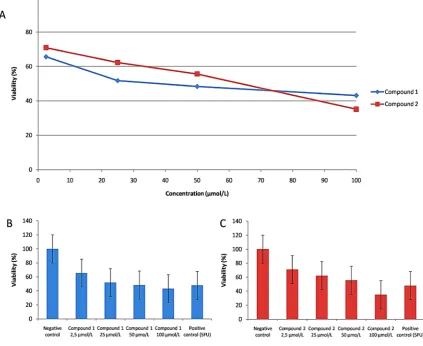
Figure 3. A. Viability of HepG2 cells after 24 hours exposure to increasing concentrations (2.5 µM, 25 µM, 50 µM and 100 µM) of compound 1 and compound 2. B. Effects of compound 1 on cell viability in the treated, negative control, and positive control HepG2 cells. Mean ± SD of triplicates in a representative experiment. C. Effects of compound 1 on cell viability in the treated, negative control, and positive control HepG2 cells. Mean ± SD of triplicates in a representative experiment.
Antioxidant activity
The results of antioxidant activity expressed as IC50 and
FRAP value, are shown in Table 1. Results indicated 2 has the strongest free radical scavenging effect with IC50 of
0.0156 mM and a FRAP value 50469.44 µmol L-1 Fe2+,
which may be due to the formation radical on the hydroxy group (substituted on phenyl ring in positions 3 and 4). Compound 1, substituted with two hydroxynaphtyl groups, has a free radical scavenging effect and IC50 of 1.79 mM and
FRAP value of 290.95 µmol L-1 Fe2+.
Table 1. Summarized results of antioxidant capacity.
Sample IC50 value, FRAP value, µmol L-1 Fe2+
1 1.790 290.95
2 0.015 50469.44
Vitamin C 0.035 14250
In comparison with Vitamin C, compound 2 exhibited higher antioxidant capacity. These results suggest that hydroxy groups have a significant effect on the antioxidant activities of synthetic antioxidant substances. It has been previously reported that reducing power is associated with
findings.30 Further, significant effects of hydroxy group
position on antioxidative activity have been previously reported.3 Also, a good antioxidant activity of other
tetraketones in the literature has been reported, which correlates with our results.31
Antimicrobial activity
Results of the in vitro antimicrobial activity of the synthesized compounds against selected test microorganisms are shown in Table 2. Results indicate that compound 1 has antibacterial activity against all tested Gram-positive bacteria, and has antifungal activity against
Candida albicans. The largest inhibition zone, for
compound 1, was recorded with Staphylococcus aureus (20 mm) and the smallest with Enterococcus faecalis (10 mm). Compound 2 has antimicrobial activity only against
Staphylococcus aureus (11 mm). In comparison to
compound 2, compound 1 showed more potent antimicrobial and antifungal activity. This probably occurs due to the presence of 2-naphthol group in the structure of compound 1. According to the literature the naphthalene ring, as a potent lipophilic part of the structure,32 better
Table 2. Antimicrobial activity of compounds in diameters, in mm, of inhibition zone.
Sample SA EF BS CA
Compound 1 20 (++) 10 (+) 13 (+) 14 (+)
Compound 2 11 (+) - - -
Ciprofloxacin >25 (+++) >25 (+++)
>25 (+++) -
Nystatin - - - 20 (++)
Legend: SA - S. aureus, EF - E. faecalis, BS - B. subtilis, CA - Candida albicans.
Cytotoxic activity
Assessment of the cytotoxic potential of tetraketones on human-derived carcinoma cell line is the subject of many scientific studies.34 Our findings suggest that both of our
samples are potent cytotoxic agents (Figure 3). As expected, compound 1 exhibited higher cytotoxic potential, causing a higher percent of cytotoxicity at the same concentration compared to compound 2. It was interesting that the most pronounced cytotoxic effect was observed at the highest concentrations of compound 2 (100 μmol L-1). It is
noticeable that the increase in concentrations necessarily leads to a proportional decline in cell viability in both cases, respectively. These results are in agreement with previously reported data which suggest that concentrations of cytotoxic substance are in direct relationship with cell viability.21
CONCLUSION
Two arylmethylenebis(3-hydroxy-5,5-dimethyl-2-cyclohexen-1-one) (aryl = 2-hydroxynaphthyl (1) and 3,4-dihydroxy-phenyl (2) derivates were synthesised and tested for antioxidant, antimicrobial and cytotoxic activities. From the results, we can conclude that better antioxidant activity with IC50 of 0.0156 mM and FRAP value 50 469.44 µmol L -1 Fe2+ has been found for compound 2, while better
antimicrobial and antifungal activity could be found for compound 1. Although both compounds showed cytotoxic activity, compound 1 exhibited higher cytotoxic potential in comparison to compound 2. The results obtained showed significant antioxidative, antimicrobial, and cytotoxic activities which support the importance of these compounds as candidates for therapeutically efficient agents against oxidative stress, microorganisms, and tumor cells.
Acknowledgments
This work was supported by the Federal Ministry of Education and Science, Bosnia and Hercegovina, under the grant 05-39-2514-1/18 from 12th November 2018.
REFERENCES
1Khurana, J. M., Vij, K., A highly efficient catalyst for one-pot
synthesis of tetraketones and biscoumarines, J. Chem. Sci., 2012, 124(4), 907-912. https://doi.org/10.1007/s12039-012-0275-8
2Ferreira, M. S., Figueroa-Villar, J. D., Conformational analysis of
2,2'-arylmethylene-bis(3-hydroxy-5,5-dimethyl-2-cyclohex-en-1-one) by NMR and molecular modeling, J. Braz. Chem. Soc., 2014, 25(5), 935-946. http://dx.doi.org/10.5935/0103-5053.20140065
3Zukić, S., Veljović, E., Špirtović-Halilović, S., Muratović, S., Osmanović, A., Trifunović, S., Novaković I., Završnik, D., Antioxidant, antimicrobial and antiproliferative activities of synthesized 2,2,5,5-tetramethyl-9-aryl-3,4,5,6,7,9-hexahydro-1-H-xanthene-1,8(2H)-dione derivatives, Croat. Chem. Acta, 2018, 91(1), 1-9. https://doi.org/10.5562/cca3225
4Sheikhhosseini, E., Faryabi, M., Uncatalyzed synthesis of
arylmethylene[bis(5,5-dimethyl-3-hydroxy-2-cyclohexene-1-ones)] in hot water by domino Knoevenagel/Michael reactions, J. Appl. Chem. Res., 2016, 10(3), 91-98.
5Da Silva, M. L., Teixeira, R. R., Santos, L. A., Martins, F. T.,
Ramalho, T. C., Structural analysis of two tetraketones and theoretical investigation of the reactions involved in their preparation, J. Mol. Str., 2018, 1156(15), 700-711. https://doi.org/10.1016/j.molstruc.2017.11.105
6Khan, K. M., Maharvi, G. M., Nawaz, S. A., Perveen, S.,
Choudhary, M. I., An alternative method for the synthesis of tetraketones and their lipooxygenase inhibiting and antioxidant properties, Lett. Drug. Des. Discov., 2007, 4(4), 272-278. https://doi.org/10.2174/157018007784620004
7Ferreira, M. S., Pires, D. A. T., Figueroa Villar, J. D., Evaluation
of tetraketones and xanthenediones as tyrosinase inhibitors or activators, World J. Pharm. Sci., 2015, 4(4), 1705-1718.
8Khan, K. M., Maharvi, G. M., Khan, M. T. H., Shaikh, A. J.,
Perveen, S., Begum, S., Choudhary, M. I., Tetraketones: A new class of tyrosinase inhibitors, Bioorg. Med. Chem. 2006, 14(2), 344-351. https://doi.org/10.1016/j.bmc.2005.08.029
9Alchab, F., Ettouati, L., Bouaziz, Z., Bollacke, A., Delcros, JG.,
Gerdzen, C. G. W., Gohlke, H., Pinaud, N., Marchivie, M., Guillon, M., Fenet, B., Jose J., Le Borgne, M., Synthesis, biological evaluation and molecular modeling of substituted indeno[1,2-b]indoles as inhibitors of human protein kinase CK2, Pharmaceuticals, 2015, 8(2), 279-302. https://doi.org/10.3390/ph8020279
10Iqbal, L., Lateef, M., Ali, S., Rigaz, N., Maharvi, G. M., Ashraf,
M., Afza, N., Antioxidant activities of tetraketones derived from 5,5-dimethylcyclohexane-1,3-dione,J. Chem. Soc. Pak., 2007, 29(1), 51-54.
11Nie, D., Honn, K. V., Cyclooxygenase, lipoxygenase and tumor
angiogenesis. Cell. Mol. Life. Sci., 2002, 59(5), 799-807. https://doi.org/10.1007/s00018-002-8468-9
12Sneider, I., Bucar, F., Lipoxygenase inhibitors from natural plant
sources. Part 2: medicinal plants with inhibitory activity on arachidonate 12-lipoxygenase, 15-lipoxygenase and leukotriene receptor antagonists, Phytoter. Res., 2005, 19(4), 263-272. https://doi.org/10.1002/ptr.1604
13Nikam, S. S., Kornberg, B. E., AMPA receptor antagonists, Curr.
Med. Chem., 2001, 8(2), 155-170. https://doi.org/10.2174/0929867013373877
14Vaya, J., Aviram, M., Nutritional antioxidants: Mechanism of
action, analyses of activities and medical applications, Curr. Med. Chem. - Imm., Endoc. & Metab. Agents, 2001, 1(1), 99-117. https://doi.org/10.2174/1568013013359168
15Yildirm, A., Oktay, M., Bilaloglu, V., The antioxidant activity of
leaves of Cydonia vulgaris, Turk. J. Med. Sci., 2001, 31, 23-27.
16Fukushima, I. N., Hassegawa, S., Shibata, A., Ogiso, T.,
Carcinogenicity of butylated hydroxyanisole in F344 rats, J. Natl. Cancer. Int., 1983, 70, 343-347.
17Bentley, R., Bennett, J. W., What Is an Antibiotic? Revisited,
18Van Elsas, J. D., Bailey, M. J., The ecology of transfer of mobile
genetic elements, FEMS Microbiol. Ecol., 2002, 42(2), 187-197. https://doi.org/10.1111/j.1574-6941.2002.tb01008.x
19Ferreira, M. S, FigueroaVillar, J. D., Conformational Analysis of
2,2’-arylmethylene bis(3-hydroxy-5,5-dimethyl-2-cyclohe-xene-1-one) by NMR and Molecular Modeling, J. Braz. Chem. Soc., 2014, 25(5), 935-946. https://doi.org/10.5935/0103-5053.20140065
20Bhattacharya, A. K, Rana, K. C, Mujahid, M, Sehar, I, Saxena, A.
K., Synthesis and in vitro study of 14-aryl-14H-dibenzo[a.j]xanthenes as cytotoxic agents. Bioorg. Med. Chem. Lett., 2009, 19(19), 5590-5593. https://doi.org/10.1016/j.bmcl.2009.08.033
21Veljović, E., Špiritović-Halilović, S., Muratović, S., Osmanović,
A., Haverić, S., Haverić, A., Hadžić, M., Salihović, M., Malenica, M., Šapčanin, A., Završnik, D., Antiproliferative and genotoxic potential of xanthen-3-one derivatives, Acta Pharm., 2019, 69(4), 683-694. https://doi.org/10.2478/acph-2019-0044
22Paliwal, P.,Jetti, S. R.,Bhatewara, A., Kadre, T., Jain, S.,
DABCO catalyzed synthesis of xanthene derivatives in aqueous media, Int. Sch. Res. Notices, 2013. https://doi.org/10.1155/2013/526173
23Chen, J., Shi, J., Yan, C. G., Synthesis of spiro dihydrofurans and
1,8-dioxo-xanthenes via DABCO catalyzed tandem reaction of aldehyde with cyclohexane-1,3-dione and dimedone,
Chem. Res. Chin. Univ., 2011, 27(1), 49-53.
24Lambert, R. W, Martin, J. A, Merrett, J. H, Parkes, K. E. B,
Thomas, J. G., PCT Int Appl. WO 9706178 Chem Abstr 1997, 126:212377y
25Benvenuti, S., Pellati, F., Melegari, M., Bertelli, D., Polyphenols,
Anthocyanins, Ascorbic Acid, and Radical Scavenging Activity of Rubus, Ribes, and Aronia, J. Food Sci., 2004, 69(3), 164-169. https://doi.org/10.1111/j.1365-2621.2004.tb13352.x
26Jiménez-Aspee, F., Quispe, C., Soriano, C. M. P., Fuentes,
Gonzalez, J., Hüneke, E., Theoduloz, C., Schmeda-Hirschmann, G., Antioxidant activity and characterization of constituents in copao fruits (Eulychnia acida Phil., Cactaceae) by HPLC–DAD–MS/MSn, Food Res. Int., 2014,
62, 286-298. https://doi.org/10.1016/j.foodres.2014.03.013
27Pirvu, L., Hlevca, C., Nicu, I., Bubueanu, C., Comparative
analytical, antioxidant and antimicrobial activity studies on a series of vegetal extracts prepared from eight plant species growing in Romania, J. Planar. Chromat., 2014, 27(5), 346-356. DOI:10.1556/JPC.27.2014.5.4
28Repetto, G., del Peso, A., Zurita, J. L., Neutral red uptake assay
for the estimation of cell viability/cytotoxicity, Nat. Protoc.,
2008, 3(1), 1125-1131. https://doi.org/10.1038/nprot.2008.75
29Yen, G. C, Chen, H. Y, Lee, C. E., Measurement of antioxidant
activity in metal ion-reduced lipid peroxidation systems, J. Sci. Food Agric., 1999, 79(9), 1213-1217.
30Maharvi, G. M., Ali, S., Riaz, N., Afza, N., Malik, A., Ashraf, M.,
Iqbal, L., Lateef, M., Mild and efficient synthesis of new tetraketones as lipoxygenase inhibitors and antioxidants, J. Enzyme Inhib. Med. Chem., 2008, 23(1), 62-66. https://doi.org/10.1080/14756360701408754
31Azam, F., Singh, S., Kohokhra, S. L., Prakash, O., Synthesis of
Schiff bases of naphtha[1,2-d]thiazol-2-amine and metal complexes of 2-(2'hydroxy)benzylideneaminonaphthothiazole as potential antimicrobial agents, J. Zhejiang Univ. Sci. B., 2007, 8(6), 446-452. https://doi.org/10.1631/jzus.2007.B0446
32Rokade, Y. B, Sayyed, R. Z., Naphthalene derivatives: A new
range of antimicrobials with high therapeutic value, Rasayan J. Chem., 2009, 2(4), 972-980.
33Mohareb, R. M, Al Farouk, F. O., Wardakhan, W. W., Uses of
dimedone for the synthesis of new heterocyclic derivatives with anti-tumor, c-Met, tyrosine, and Pim-1 kinases inhibitions, Med. Chem. Res., 2018, 27(8), 1984-2003. https://doi.org//10.1007/s00044-018-2208-7