Available online throug
ISSN 2229 – 5046
VISCOUS DISSIPATION EFFECTS ON UNSTEADY HYDROMAGNETIC GAS FLOW
ALONG AN INCLINED PLANE WITH INDIRECT NATURAL CONVECTION
IN THE PRESENCE OF THERMAL RADIATION
B. PRABHAKAR REDDY
1*1
Department of Mathematics,
The University of Dodoma, P. Box. No. 259, Dodoma, Tanzania.
*
Department of Mathematics,
Geethanjali College of Engineering and Technology,
Cheeryal (V), Keesara (M), Medchal (Dist)-501301, Telangana State, India.
(Received On: 17-03-17; Revised & Accepted On: 22-04-17)
ABSTRACT
I
n this paper, the viscous dissipation effects on unsteady gravity-driven thermal convection flow of a viscous incompressible, electrically-conducting, absorbing-emitting, optically-thick gray gas along an inclined plane in the presence of thermal radiation has been carried out. The Rossel and diffusion flux model is employed to simulate thermal radiation effects. The governing equations for this investigation are solved numerically by using Ritz FEM. The effects of Prandtl number( ),
P
r Boltzmann-Rosseland radiation parameter(
K
1),
Hartmann number squared(
M
2),
Eckert number
(
E
c),
Grashof number(
G
r)
and plate inclination( )
a
on the dimensionless velocity( )
u
and temperature( )
θ
distributions are studied. Results obtained show that a decrease in the velocity and temperature distributions as the Prandtl number increased. The velocity and temperature are enhanced as Boltzmann-Rosseland radiation parameter and Grashof number are increased.Key words: Eckert number, Boltzmann-Rosseland radiation parameter, free convection, thermal radiation, Ritz FEM.
1. INTRODUCTION
Radiative convection flows are encountered in many areas of industrial and environmental processes. e.g., heating and cooling chambers, fossil fuel combustion energy processes, evaporation for large open water reservoirs, astrophysical flows, solar power technology and space vehicle re-entry. Also, many areas of technology and applied physics including oxide melt materials processing, astrophysical fluid dynamics, plasma flows switch performance, MHD energy pumps operating at very high temperatures and hypersonic aerodynamics. Bestman and Adjepong [1] studied the unsteady hydromagnetic free-convection flow with radiative heat transfer in a rotating fluid. Raptis and Masslas [2] studied unsteady magneto-hydrodynamic convection in a gray, absorbing but non-scattering fluid regime using the Rosseland radiation model. Chamkha [3] investigated unsteady convective heat and mass transfer past a semi-infinite permeable moving plate with heat absorption, where it was found that increase in the solutal Grashof number enhanced the concentration buoyancy effects leading to increase in the velocity. Ganesan and Loganadan [4] presented Radiation and mass transfer effects on flow of an incompressible viscous fluid past a moving cylinder. Azzam [5] studied thermal radiation flux influence on hydromagnetic mixed free-forced convective steady optically-thick laminar boundary layer flow by using Rosseland approximation. Abd-El-nay et al. [6] presented the radiation effects on MHD free convection flow over a vertical plate with variable surface temperature by finite difference solution. Muthucumaraswamy and Janakiraman [7] presented MHD and radiation effects on moving isothermal vertical plate with variable mass diffusion. Gbadeyan and idowu [8] studied the magneto-hydrodynamic heat transfer between two concentric rotating spheres employing the optically thin limit case for thermal radiation. Heat and mass transfer of an unsteady MHD free convection flow of rotating fluid past a vertical porous flat plate in the presence of radiative heat transfer studied by
Mbeledogu and Ogulu [9]. Muthucumaraswamy et al. [10] studied unsteady flow past an accelerated infinite vertical
plate with variable temperature and uniform mass diffusion.
Corresponding Author: B. Prabhakar Reddy
1*© 2017, IJMA. All Rights Reserved 85 Viscous mechanical dissipation effects are important in geophysical flows and also in certain industrial operations and are usually characterized by Eckert number. Gebhart [11] presented the importance of viscous dissipative heat in a free convection flow in the case of isothermal and constant heat flux at the plate. Gebhart and Molledorf [12] presented the effects of viscous dissipation for external natural convection flow over a surface. Viscous dissipation heat on the two dimensional unsteady free convective flow past an infinite vertical porous plate when the temperature oscillates in time and there is constant suction at the plate was studied by Soundalgekar [13]. Gokhale and Samman [14] presented the effects of mass transfer on the transient free convection flow of a dissipative fluid along a semi-infinite vertical plate with constant heat flux. Cookey et al. [15] studied the influence of viscous dissipation and radiation on an unsteady MHD free convection flow past an infinite heated vertical plate in a porous medium with time dependent suction. Zueco Jordan [16] presented the radiation and viscous dissipation effects on MHD unsteady free convection over vertical porous plate by network simulation method. Mohamoud [17] presented temperature dependent viscosity effects in transient dissipative radiation hydrodynamic convection, showing that an increase in Eckert number and decrease in air viscosity accelerate the flow, whereas increasing magnetic field or thermal radiation flux decelerates the flow. Hitesh Kumar [18] studied the boundary layer steady flow and heat transfer of a viscous incompressible fluid due to a stresching plate with viscous dissipation effect in the presence of transverse magnetic field. Recently, Mass transfer effects on an unsteady MHD free convective flow of an incompressible viscous dissipative fluid past an infinite vertical porous plate studied by Reddy [19]. Reddy and Sunzu [20] presented thermal radiation and viscous dissipation effects on MHD heat and mass diffusion flow past a surface embedded in a porous medium with chemical reaction.
The object of the present paper is to analyze the effects of viscous dissipation on unsteady gravity-driven thermal convection flow of a viscous incompressible, electrically-conducting, absorbing-emitting, optically-thick gray gas along an inclined plane in the presence of thermal radiation. The problem is governed by system of non-linear partial differential equations, whose exact solutions are difficult to obtain, whenever possible. Thus, the Ritz FEM is adopted for solution, which is more economical from a computational point of view. The behaviors of the velocitiy, temperature, frictional shearing stress and wall temperature gradient have been discussed for variations in the governing parameters.
2. MATHEMATICAL MODEL
Consider the transient hydro-magnetic flow of a viscous, incompressible, electrically conducting, absorbing-emitting, non-scattering, optically-thick gas along an infinite plate inclined at angle
a
to the horizontal is considered. The plate moving with constant velocityu
0.
Refractive index of the gas medium is constant. A uniform magnetic fieldB
0,
applied normal to the plate. The
x
′
-axis oriented along the plate and they
'
-axis perpendicular to the plate. The Maxwell’s field equations comprise five vector equations - the Ampere’s law, magnetic field continuity, Faraday’s law, Kirchhoff’s law and Ohm’s law. The generalized equations in vector form, for flow of an electrically-conducting gas are the Maxwell equations:B
µ
J
∇× =
Ampere’s law (1)0
B
∇ • =
Magnetic Field Continuity (Maxwell Equation) (2)B
E
t
∂
∇× = −
∂
Faraday’s law (3)0
J
∇ • =
Kirchhoff’s law (4)[
]
J
=
σ
E v B
+ ×
Ohm’s law (5)where
J
is the current density,B
is the magnetic field vector,σ
is the electrical conductivity,E
is the electrical field density vector,ρ
is the density,v
is the velocity vector,µ
is viscosity andt
is time.From an order of magnitude analysis, it can be shown that for two-dimensional
(
xy
)
magneto-hydrodynamic gasdynamic flows, the hydromagnetic retarding force (Lorentz body force) acts only parallel to the flow and has the form:
2
magnetic y
F
≈ −
σ
B u
(6)where
B
y is the component of magnetic field in they
−
direction.In accordance with the Boussinesq approximation, all fluid properties are constant with the exception of the density
variation in the buoyancy term. Unidirectional radiation flux
Q
r is considered and it is assumed that'
'
r r
Q
Q
y
x
∂
>>
∂
∂
∂
. Under these assumptions, the mass, momentum and energy conservation equations for the regime with regard to indirect natural convection may be presented as follows.0
'
'
u
u
x
y
′
′
∂
+
∂
=
∂
∂
(7)(
)
2 2 ' 0 2'
1
'
'
'
sin
'
'
'
'
B u
u
u
u
p
u
u
v
g
T
T
a
t
x
y
x
y
σ
ν
β
ρ
ρ
∞′
′
′
′
∂
+
∂
+
∂
= −
∂
+
∂
−
+
−
′
∂
∂
∂
∂
∂
(8)(
')
1
0
'
cos
'
p
g
T
T
a
x
β
ρ
∞∂
= −
−
−
∂
(9)2 2
2
'
'
1
'
'
'
'
r
p p p
Q
T
k
T
u
t
C
y
C
y
C
y
ν
ρ
ρ
∂
∂
∂
∂
=
−
+
′
∂
∂
∂
∂
(10)Subject to the following initial and boundary conditions:
0 :
t
′ ≤
u
′ =
0, '
T
=
T
∞' for ally
'
≥
0
0 :
t
′ >
u
′ =
u T
0, '
=
T
w fory
'
=
0
'
0, '
u
′ →
T
→
T
∞ asy
'
→ ∞
(11)where
u
'
is the velocity in thex
'
−
direction,v
'
is velocity in they
'
−
direction,g
is acceleration due to gravity,ν
is the kinematic viscosity of the optically-dense gas,
T
'
is temperature of the fluid,T
∞' is free stream temperature ofthe fluid,
T
w' is plate surface temperature,ρ
is the density,C
p is specific heat at constant pressure,k
is thermalconductivity of the optically-dense fluid,
β
is volumetric coefficient of thermal expansion,t
'
is time,B
0 is uniform magnetic field,σ
is electrical conductivity of the gas andQ
r is radiative heat flux.In transient flow, the frictional (viscous) and gravitational forces do not balance exactly and the discrepancy is proportional to the acceleration of the fluid, the deviation between the free surface of the gas and the plate inclination also contributes to this and an instability mechanism arises in the inclined plane flow. There is pressure distribution in the flow with a gradient defined as:
'
p
g
y
ρ
∂
=
∂
(12)From Eq. (3), integration gives:
(
)
(
')
'
'
cos
p
=
ρ β
g
h
−
y
T
−
T
∞a
(13)where
h
denotes free surface elevation. Differentiating Eq. (13) with respect tox
'
yields:(
')
'
cos
'
'
p
h
g
T
T
a
x
ρ β
∞x
∂
=
−
∂
∂
∂
(14)Above the leading edge of the plate
( '
x
=
0),
the density variation with depth is constant i.e., will remains unchangedfor all
.
'
h
x
∂
∂
we therefore prescribe the following condition:1
tan
'
h
cons
t
F
x
∂
=
=
∂
(15)The following non-dimensional quantities introduced to transform equations (7) to (10) under the boundary conditions (11) into dimensionless form:
2 ' 2
0 0 0
' ' 2
0 0
'
'
,
,
,
,
,
,
,
p r wC
u y
u t
T
T
B
u
u
y
t
P
M
u
T
T
k
u
µ
σ ν
θ
µ ρυ
ν
ν
∞∞ρ
′
′
−
=
=
=
=
=
=
=
© 2017, IJMA. All Rights Reserved 87
2 ' '
' ' 3
0
(
)
,
(
)
o w c r p wu
g
T
T
E
G
C T
T
u
βν
∞∞
−
=
=
−
(16)where
u
is dimensionless velocity in thex
−
direction,t
is non-dimensional time,y
is dimensionless transversecoordinate,
θ
is dimensionless temperature,G
r is the Grashof number,P
r is the Prandtl number,E
c is the Eckertnumber and
M
denotes the square root of the Hartmann hydro-magnetic number.Introducing the above non-dimensional variables into Eqs. (8) and (9) using Eq. (15) also, and neglecting convective acceleration terms, we get in due course at the dimensionless form of the momentum equation:
(
)
2 21 2
sin
cos
r
u
u
G
a
F
a
M u
t
θ
y
∂
=
−
+
∂
−
∂
∂
(17)The radiative heat flux vector is addressed using the Rosseland diffusion flux approximation is therefore used leading to a Fourier type gradient function viz:
4
4
'
3
'
rT
Q
k
y
σ
∗∂
= −
∂
(18)where
σ
is the Stefan-Boltzmann constant andk
∗ is the spectral mean absorption coefficient of the medium.Considering the temperature differences within the flow sufficient small,
T
'
4can be expressed as the linear function of temperatureT
'
. This is accomplished by expandingT
'
4 in a Taylor series about a free stream temperatureT
∞'and neglecting the higher-order terms,4 3 4
'
4 '
' 3 '
T
≅
T
∞T
−
T
∞ (19)By using equations (16) and (19), equation (10) reduces to
2 2 1 2
1
c rK
u
E
t
P
y
y
θ
+
θ
∂
=
∂
+
∂
∂
∂
∂
(20)where 3 1
16
'
3
T
K
k k
σ
∞ •=
denotes the Boltzmann-Rosseland radiation conduction number.This parameter
K
1 embodies the relative contribution of heat transfer by thermal radiation to thermal conduction; large1
K
( 1)
>
corresponds to thermal radiation dominance and smallK
1( 1)
<
to the thermal conduction dominance. For1
1
K
=
both conduction and radiative heat transfer modes contributes equally to the regime. Clearly the second term inEq.(20) is an augmented diffusion term i.e., with
K
1=
0,
thermal radiation vanishes and Eq. (20) reduces to the familiar unsteady one-dimensional conduction-convection equation. The boundary conditions Eq.(11) are also transformed using (16) to:0 :
t
≤
u
=
0,
θ
=
0
fory
≥
0
0 :
t
>
u
=
1,
θ
=
1
fory
=
0
0,
0
u
→
θ
→
asy
→ ∞
(21)3. METHOD OF SOLUTION
Equations (17) and (20) are non-linear system of partial differential equations to be solved under the initial and boundary conditions of equation (21) However, whose exact or approximate solutions are not possible. Hence, the Ritz finite element method is applied to solve these equations. The method entails the following steps.
1. Division of the whole domain into smaller elements of finite dimensions called “finite elements”. 2. Generation of the element equations using variational formulations.
3. Assembly of element equations as obtained in step 2.
4. Imposition of boundary conditions to the equations obtained in step 3.
The assembled equations can be solved by any of the numerical technique viz. Gauss-seidal iteration method. An important consideration is that of shape functions which are employed to approximate actual functions. For one dimensional and two dimensional problems, the shape factions can be linear/quadratic and higher order. However, the suitability of the shape functions varies from problem to problem. Due to simple and efficient use in computations
linear shape functions are used in the present problem. Here, the boundary condition
y
→ ∞
is approximated by10,
y
=
which is sufficiently large for the velocity to approach convergence criterion. To prove convergence andstability of the Ritz FEM, the computations are carried out by making small changes in time
t
andy
−
directions. For these slightly changed values, no significant change was observed in the values of velocity( )
u
and temperature( )
θ
.Hence, the Ritz FEM is convergent and stable.
The frictional shearing stress at the plate surface
(
y
=
0)
and the wall temperature gradient are defined as:0
y
du
dy
=
and y 0d
dy
θ
=
4. NUMERICAL RESULTS AND DISCUSSION
The problem of unsteady gravity-driven thermal convection flow of a viscous incompressible, electrically-conducting, absorbing-emitting, optically-thick gray gas along an inclined plane in the presence of thermal radiation taking into account viscous dissipation is addressed in this study. The numerical calculation has been carried out for dimensionless velocity
( ),
u
dimensionless temperature( )
θ
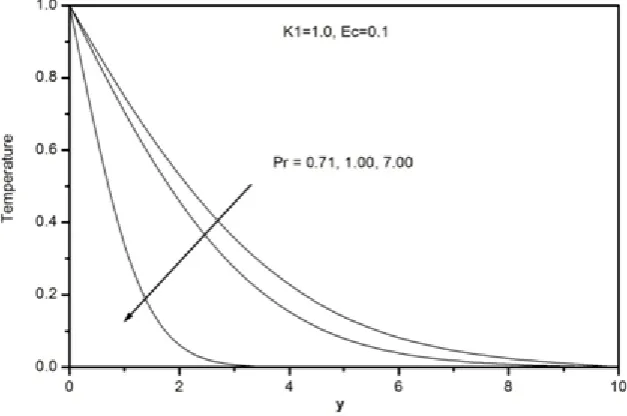
, frictional shearing stress and temperature gradient for various values of the material parameters. Numerical results are presented in figures and tables. These results show the effect of the material parameters on the quantities mentioned.Figure 1 and 2 shows the effects of Prandtle number
P
r on the temperature distribution and velocity with transverse coordinate( )
y
forP
r=
0.71,
which corresponds to air,P
r=
1.00,
which corresponds to electrolytic solution and7.00,
r
P
=
which corresponds to water, respectively. It is observed that an increase in the Prandtl number leads todecrease in both temperature and velocity. This is due to the fact that thermal conductivity of the fluid decreases with increasing Prandtl number results a decrease in the thermal boundary layer thickness. The effects of
Boltzmann-Rosseland radiation convection parameter
(
K
1)
on the temperature distribution and velocity are presented in Fig. 3 and4, respectively. It is seen that an increasing values of
K
1 leads to increase in the temperature and velocity. For0.71
r
P
=
i.e.,P
r<
1,
heat diffuses faster than momentum in the regime.K
1 corresponds to an increase in therelative contribution of thermal radiation heat transfer to thermal conduction heat transfer. As for
K
1<<
1,
thermalconduction heat transfer will dominate and vice versa for
K
1>
1.
Larger values ofK
1 therefore physically correspondto stronger thermal radiation flux and in accordance with this, the maximum temperature is observed for
K
1=
3.
Also, temperature profiles all decay monotonically from the maximum at the plate to the free stream. Fig. 5 and 6 shows theeffects of viscous dissipation parameter i.e., Eckert number
E
c on the temperature distribution and velocityrespectively, with
K
1=
1.0
(i.e., radiation and conduction contributions are equal). It is observed that an increase in the Eckert number leads to increase in the temperature and velocity profiles. This is due to the effect of viscous dissipation on flow field is to increase the energy, yielding a greater fluid temperature and as a consequence greater buoyancy force. The effects of Hartmann number square root(
M
)
on the velocity distribution with distance normal tothe plate
( )
y
are presented in Fig. 7. The hydromaggnetic term in Eq. (17), i.e.,−
M u
2 is a linear drag force term.© 2017, IJMA. All Rights Reserved 89 from the plate to the free stream. Velocity becomes negative further from the plate surface for lower angle of
inclination i.e., back flow arises. Also, we observe that an increase in angle of inclination to
45 , 60
0 0 and to themaximum (vertical) orientation of
a
=
90 ,
0 the flow is strongly accelerated.Table 1 shows the effects of Prandtl number
( ),
P
r Boltzmann-Rosseland radiation-convection parameter(
K
1),
and vicious dissipation parameter i.e., Eckert number(
E
c)
on the frictional shearing stress and plate temperature gradient, respectively. It is observed that an increase in the Prandtl number leads to decrease in the frictional shearing stress and increase in the wall temperature gradient. As increase in the Boltzmann-Rosseland radiation parameter and Eckert number increases in the frictional shearing stress and decrease in the wall temperature gradient. The effects ofHartmann number square root
(
M
),
free convection parameter i.e., Grashof number(
G
r),
and plate inclination( )
a
on the frictional shearing stress are presented in table 2. It can be seen that an increase in the square root of Hartmann number
(
M
)
leads to decrease in the frictional shearing stress whereas an increase in the Grashof number and plate inclination increases the frictional shearing stress. Here, increasing plate inclination serves to accelerate the flow and shearing stress magnitude strongly increased with rise in the Grashof number. Negative values indicate that back flow.Figure-1: Effects of Prandtl number
P
r on the temperature( )
θ
Figure-3: Effects of Boltzmann-Rosseland radiation parameter
K
1 on the temperature( )
θ
Figure-4: Effects of Boltzmann-Rosseland radiation parameter
K
1 on the velocity( )
u
© 2017, IJMA. All Rights Reserved 91
Figure-6: Effects of Eckert number
E
c on the velocity( )
u
Figure-7: Effects of Hartmann number square root
(
M
)
on the velocity( )
u
Figure-9: Effects of plate inclination
( )
a
on the velocity( )
u
Table-1: The numerical values of frictional shearing stress
0
y
du dy =
and wall temperature gradient y 0
d dy
θ
=
for
various values of P Kr, 1 and Eckert number
E
c.
r
P
K
1E
c( )
0
y
du
dy
=( )
d
θ
dy
y=00.71 1.00 0.71 0.71
1.0 1.0 2.0 1.0
0.1 0.1 0.1 0.3
0.044770 -0.013256
0.110220 0.056288
0.257590 0.303190 0.209792 0.244470
Table-2: The numerical values of frictional shearing stress
0
y
du dy =
for various values of M G, r and plate inclination
( ).
a
M
G
ra
(degrees)( )
0
y
du
dy
=1.0 2.0 1.0 1.0
5.0 5.0 7.0 5.0
60 60 60 90
0.044770 -0.833416
0.387422 1.541034
5. CONCLUSIONS
In this paper, the governing equations has been examined for unsteady gravity-driven thermal convection flow of a viscous incompressible, electrically-conducting, absorbing-emitting, optically-thick gray gas along an inclined plane taking into account viscous dissipation in the presence of thermal radiation and a transverse magnetic field effects. The Rosseland diffusion flux model is employed to simulate thermal radiation effects. Employing the Ritz FEM, the leading equations have been solved numerically. We can conclude from these results that an increase in the Prandtl number and the Hartmann number square root leads to decrease in the velocity and temperature. An increase in the Eckert number increases in both velocity and temperature distributions. The velocity and temperature increased as Boltzmann-Rosseland radiation parameter and Grashof number are increased. Also, an increase in the plate inclination values
© 2017, IJMA. All Rights Reserved 93
REFERENCES
1 Bestman A. R and Adjepong S. K., (1998) Unsteady hydromagnetic free-convection flow with radiative heat
transfer in a rotating fluid, Astrophysics Space Sciene, 143, pp.217-224.
2 Raptis A, Masslas C. V., (1998) Magnetohydrodynamic flow past a plate in the presence of radiation, Heat
and Mass Transfer, 34, pp.107-109.
3 Chamkha A. J., (2000) Thermal radiation and buoyancy effects on hydromagnetic flow over an accelerating
permeable surface with heat source or sink, Int. J. Eng. Sci, 38, pp. 1699-1712.
4 Ganesan, P and Loganadan P., (2002) Radiation and mass transfer effects on flow of an incompressible
viscous fluid past a moving cylinder, Int J Heat and Mass Transfer, 45, pp. 4281 – 4288.
5 Azzam G., (2002) Radiation effects on the MHD mixed free-forced convective flow past a semi-infinite
moving vertical plate for high temperature differences, Physica Scripta, 66, pp.71-76.
6 Abd-El-Nay, M. A, Elasayed M. E, Elbarbary, Nadar and Abdelzem., (2003) Finite difference solution of
radiation effects on MHD free convection flow over a vertical plate with variable surface temperature, J. Appl. Maths, 2, pp.65-86.
7 Muthucumaraswamy R and Janakiraman B., (2006) MHD and radiation effects on moving isothermal vertical
plate with variable mass diffusion,Theoret Appl Mech, 33, pp.17 – 29.
8 Gbadeyan, J. A. and idowu A. S., (2006) Radiation effects on magnetohydrodynamic flow of gas between two
concentric spheres, Journal of the Nigerian Association of Mathematical Physics, 10, pp.305-314.
9 Mbeledogu, I. U and Ogulu A., (2007) Heat and mass transfer of an unsteady MHD free convection flow of
rotating fluid past a vertical porous flat plate in the presence of radiative heat transfer, Int. J. heat and Mass Transfer, 50, pp.1902-1908.
10 Muthucumaraswamy, R, Sunder Raj, M, and Subramanian V.S.A., (2009) Unsteady flow past an accelerated
infinite vertical plate with variable temperature and uniform mass diffusion, Int. J. Appl. Math and Mech, 5 (6), pp.51-56.
11 Gebhart B., (1962) Effects of viscous dissipation in natural convection, J. of Fluid Mechanics, 14, pp.225-232. 12 Gebhart, B and Mollendorf J., (1969) Viscous dissipation in external natural flows, J. of Fluid Mechanics, 38,
pp.79-107.
13 Soundalgekar, V. M., (1972) Viscous dissipation effects on unsteady free convective flow past an infinite
vertical porous plate with constant suction, 15, pp. 1253-1261.
14 Gokhale, M. Y. and Samman F. M. A. I., (2003) Effects of mass transfer on the transient free convection flow
of a dissipative fluid along a semi-infinite vertical plate with constant heat flux, Int. J. Heat and Mass Transfer, 46, pp. 999-1011.
15 Cookey C. I. Ogulu, A. and Omubo-pepple V. B., (2003) Influence of viscous dissipation and radiation on
unsteady MHD free convection flow past an infinite heated vertical plate in a porous medium with time dependent suction, Int. J. Heat and Mass Transfer, 46, pp. 3205-3211.
16 Zueco Jordan, J., (2007) Network simulation method applied to radiation and viscous dissipation effects on
MHD unsteady free convection over vertical porous plate, Appl. Mathematical Modeling, 31(20), pp.2019-2033.
17 Mohamoud, M. A. A., (2009) Thermal radiation effect on unsteady MHD free convection flow past a vertical
plate with temperature dependent viscosity, Canadian Journal of Chemical Engineering, 87, pp.441-450.
18 Hitesh Kumar., (2009) Radiative heat transfer with hydro-magnetic flow and viscous dissipation over a
stretching surface in the presence of variable heat flux, Thermal Science, 13(2), pp.163-169.
19 Prabhakar Reddy, B., (2016) Mass transfer effects on an unsteady MHD free convective flow of an
incompressible viscous dissipative fluid past an infinite vertical porous plate, int. J. Appl. Mech. and Engg, 21, pp. 143-155.
20 Prabhakar Reddy, B and Jefta Sunzu., (2016) Thermal radiation and viscous dissipation effects on MHD heat
and mass diffusion flow past a surface embedded in a porous medium with chemical reaction, Int. J. Math and its Appl, 2(B), pp. 91-103.
Source of support: Nil, Conflict of interest: None Declared.