CRYSTALLIZATION FIELDS OF CONDENSED
SCANDIUM-SYLVER AND GALLIUM-SILVER PHOSPHATES
M. Avaliani,
[a]*V. Chagelishvili,
[a]E. Shapakidze,
[b]M. Gvelesiani,
[a]N. Barnovi,
[a]V. Kveselava
[a]and N. Esakia
[c]Keywords: synthesis; condensed phosphates; polyphosphates; cyclotetraphosphate; cyclododecaphosphate; gallium, indium, scandium
We have been able to synthesize a diverse new group of condensed phosphate polymers in the systems MeI
2O–MeIII2O3–P2O5–H2O (where
MeI represents Ag, Na, Cs, and MeIII represents gallium, scandium and indium. The structural arrangement of synthesized condensed
phosphates is ascertained using X-ray spectral analysis, X-ray diffraction and IR spectroscopy. An interesting approach to the synthesis of double compounds containing Ga, In, Sc and monovalent metals, including Ag, resulting in the production of double phosphates is described.
* Corresponding authors
e-mail: [email protected]
[a] I. Javakhishvili Tbilisi State University, R. Agladze Institute of Inorganic Chemistry and Electrochemistry, 11 E. Mindeli Str., Tbilisi, 0186, Georgia
[b] A. Tvalchrelidze Caucasus Institute of Mineral Resources, 11 E. Mindeli Str., Tbilisi, 0186, Georgia
[c] I. Javakhishvili Tbilisi State University, Faculty of Exact and Natural Sciences, Department of Chemistry, 3. I.
Chavchavadze Ave., Tbilisi, 0179, Georgia
Introduction
The development of nanotechnologies for obtaining of
inorganic phosphate polymers, notably – double condensed
phosphates of polyvalent metals – as well as the study of their
crystallization fields is a topical task. There are many research
topics devoted to this subject,
1-11especially those aimed at
determining the conditions for producing some new
condensed phosphates of polyvalent and monovalent cations
including alkaline metals.
8-19The significant advances in the chemistry of inorganic
compounds of phosphorous in the past few years are due to
new application fields of inorganic phosphate oligomers and
polymers.
7,20–27Experimental
We have studied the Me
III2
O
3-Me
I2O-P
2O
5-H
2O and
systems (M
I=Ag, Na, M
III= Sc, In and Ga) at the temperature
range of 100–600 °C. This work contains data concerning the
synthesis and crystallization fields of certain condensed
double phosphates of trivalent and monovalent metals
(including, in particular, Ga, In, Sc and monovalent metals,
notably Ag), resulting in the production of double phosphates
depending on the temperature and molar ratio of the initial
components.
The initial components were oxides of gallium, indium
and/or scandium, silver nitrate (in some cases – sodium
carbonate) and orthophosphoric acid. But when the synthesis
studied system as oxides of suitable elements, such as
Me
III2
O
3, Ag
2O and P
2O
5. The variation of the molar ratio of
initial components
n
=Ag/Me
IIIwas very broad: from 1.5 to
10.0, but constant for each experiment – for each temperature
range. The molar ratio of phosphorus to trivalent metal was
always the same during all synthesis processes and was equal
to
n
1=P/Me
III=15.5.
Trivalent metal oxide, orthophosphoric acid (percentage:
85 %) and monovalent metal salt – silver nitrate - were mixed
in a glassy carbon crucible at different molar ratios and heated
to temperatures between 100 and 600 °C. The duration of the
synthesis process was very variable, from 3-5 days to 15-20
days, depending on the temperature of the experiments. The
crystals formed in the melts were removed by extraction of
15-20 g samples with 500-700 mL of distilled water.
The condensation degree of the synthesized polymeric
phosphates (di-, tri-, tetra-, and/or dodecaphosphates) was
checked by paper chromatography. For the chromatographic
analysis, the obtained crystalline samples were decomposed
with H-form cation type ion-exchanger. In these experiments,
0.1 g of the substance was contacted for ca. 1 h with an
aqueous suspension of 2 g (KU-2) type sulfonated cation
exchanger at ~0 °C. After the decomposition of the main mass
of the substance according to the following scheme:
cationite-H(solid) + M-phosphate(solid)
→
cationite-M(solid)+H-phosphate(liquid) the solution, containing phosphoric acids
was neutralized with sodium bicarbonate and
chromatographed on Filtrak FN-11 paper (Germany) by
acidic
CCl
3COOH-CH
3COOH-CH
3OH
solvent.
Chromatograms were sprayed with ammonium molybdate
(NH
4)
2MoO
45% solution and irradiated with ultraviolet light
(
λ
=400 nm).
Table 1. Dependenceof composition from temperature T and molar ratio n = Ag2O/Sc2O3 = 1.5–2.5, 3.5–5.0, 6.0–7.5, and 8.0–10.0.
T, °C n = 1.5–2.5 n=3.5–5.0 n=6.0–7.5 n=8.0–10.0
130 – 150 Sc(PO3)3–C AgScHP3O10 AgSc(H2P2O7)2 AgSc(H2P2O7)2
180 – 200 Sc(PO3)3–C AgScHP3O10 AgScHP3O10 AgScHP3O10
220 – 240 Sc(PO3)3–C AgScP4O12 AgScP4O12 AgScP4O12
310 – 335 Sc(PO3)3–CI AgScP4O12, AgScHP3O10 AgScP4O12 AgScP4O12
340 – 355 Sc(PO3)3–CI AgScP4O12 AgScP4O12+Ag3Ga3P12O36 AgScP4O12
400 – 450 Sc(PO3)3–CI AgScHP3O10 AgScHP3O10 Ag2ScP3O10
500 – 550 Sc(PO3)3–CI Ag2ScP3O10 AgScHP3O10, Ag2ScP3O10 AgScP2O7
Table 2. XRD data for acid diphosphate AgSc(H2P2O7)2, acid triphosphate AgScHP3O10, tetraphosphates AgGaP4O12 and AgScP4O12,8,10
obtained by us and ASTM–11–642 data for silver triphosphate.
AgScHP3O10 Ag5P3O10 (ASTM–
11–642)
AgSc(H2P2O7)2·2H2O NaSc(H2P2O7)2·2H2O AgScP4O12 AgGaP4O12 NaGaP4O12
dα/n I/I0 dα/n I/I0 dα/n I/I0 dα/n I/I0 dα/n I/I0 dα/n I/I0 dα/n I/I 0
The powder diffraction intensity data collections were
performed on a DRON–
3М diff
ractometer, with anodic Cu–
K
αradiation in the range of 2
θ
= 10–60°, detector’s speed 2°
min
-1, lattice spacing
d
α/
n
in Å, and
I
/
I
0
– is the relative
intensity (used model/standard data – by American Society
for Testing and Materials – ASTM).
The thermal analysis was accomplished by DTA using
Q1500–D derivatograph with heating rate of 10 °C / min. in
air atmosphere and up to maximal temperature of 1100 °C.
10XRD data of some double condensed phosphates prepared by
us, namely acidic diphosphate AgSc(H
2P
2O
7)
2, acidic
triphosphate AgScHP
3O
10, tetraphosphates AgGaP
4O
12,
AgScP
4O
12,
NaGaP
4O
12and standard ASTM–11–642 data
for silver triphosphate are presented in Table 2. Table 3
contains the XRD data for the double condensed
tetraphosphates of silver with gallium and scandium, or
sodium and gallium (molar ratio
n=
Me
I/Me
III=7.5).
The elemental composition of the condensed compounds
was examined by gravimetric analysis. Phosphorus was
determined by precipitation using a molybdate reagent and a
quinoline solution.
25Gallium, indium and scandium were
determined by the hydroxyquinoline precipitation
method.
11,25Silver was determined using argentometry using
titration (Volhard) method.
28Table 3. The XRD data for synthesized gallium-silver, gallium-sodium, indium-silver, scandium-silver tetraphosphates (molar ratio n=MeI/MeIII =7.5).
AgGaP4O12 (at 335 °C) AgScP4O12 (at 335 °C) NaInP4O12 (at 335–345 °C) NaGaP4O12 (at 335–345 °C)
dα/n I/I0 dα/n I/I0 dα/n I/I0 dα/n I/I0
Results and discussion
A series of double condensed phosphate compounds were
prepared and assigned during the investigation of systems
Me
III2
O
3-Ag
2O-P
2O
5-H
2O at the temperature interval of 100–
600 °C. The phase identity was studied by XRD. The
synthesized inorganic polymers containing silver and
scandium are presented in Table 1. There are three stable
double phosphate phases formed at the temperature range of
130-200 °C depending on the Ag/Sc molar ratio: double
acidic diphosphate and triphosphate of scandium and silver,
AgSc(H
2P
2O
7)
2, AgScHP
3O
10,
respectively, and the double
triphosphate, Ag
2ScP
3O
10.
8,19A new
silver scandium
cyclotetraphosphate (AgScP
4O
12)
was synthesized in the
temperature interval
of 240-340 °C. Analogous compounds
could be obtained in similar systems containing Ag-Ga and
Ag-In components.
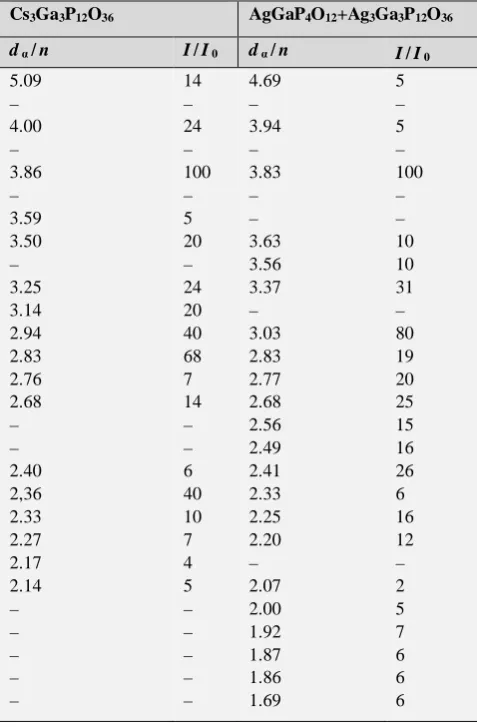
The XRD data of phases obtained at 335–350 °C for the
system containing Ga and Ag (molar ratio
n=
Me
I/Me
III= 7.5)
and their comparison with
the
cesium
gallium
cyclododecaphosphate
25are presented in Table 4.
Table 4. XRD data of phases obtained in the system containing Ag and Ga at 335–350 (molar ratio n=MeI/MeIII = 7.5).
Cs3Ga3P12O36 AgGaP4O12+Ag3Ga3P12O36
dα /n I/I 0 dα /n I/I 0
5.09 – 4.00 – 3.86 – 3.59 3.50 – 3.25 3.14 2.94 2.83 2.76 2.68 – – 2.40 2,36 2.33 2.27 2.17 2.14 – – – – –
14 – 24 – 100 – 5 20 – 24 20 40 68 7 14 – – 6 40 10 7 4 5 – – – – –
4.69 – 3.94 – 3.83 – – 3.63 3.56 3.37 – 3.03 2.83 2.77 2.68 2.56 2.49 2.41 2.33 2.25 2.20 – 2.07 2.00 1.92 1.87 1.86 1.69
5 – 5 – 100 – – 10 10 31 – 80 19 20 25 15 16 26 6 16 12 – 2 5 7 6 6 6
The XRD data of similar compounds formed in the analog
systems containing gallium and silver, indium and silver and
scandium and silver were compared. We ascertain that any of
the initial components - trivalent metal oxides, silver nitrate
and phosphoric acid completely and irreversibly interact with
each other during
the
synthesis.
The XRD data for the Ag-Sc, Ag-In and Ag-Ga di-, tri-
tetra- or cyclododecaphosphates have been compared with
available standard data for analogous double condensed
phosphates of trivalent and monovalent (alkali) metals.
1-9,13,17-20,26The identification of the obtained crystalline phases was
done in accordance with standard ASTM data and based on
the results of chemical analyses. The composition of the
synthesized compounds prepared was found to be the
following: double acidic diphosphates Me
IMe
III(H
2
P
2O
7)
2and their monohydrates Me
IMe
III(H
2
P
2O
7)
2.H
2O, double
acidic triphosphates Me
IMe
IIIHP
3
O
10, double triphosphates
Me
I2
Me
IIIP
3O
10and cyclotetraphosphates Me
IMe
IIIP
4O
12.
Despite the different ionic radius of Ag and Cs (1.13 and
1.67 Å, respectively) an analog Ag-Ga compound,
(Ag
3Sc
3P
12O
36) was formed as that was synthesized in the
Cs-Ga system earlier (Cs
3Ga
3P
12O
36).
25Based on results of paper
chromatography, chemical analysis and XRD analysis, we
can conclude that at 335-340 °C and
n
=Ag/Ga=7.5, a mixed
phase crystallized out with ca. 80 % Ag
3Ga
3P
12O
36and ca.
20 % AgGaP
4O
12content.
The silver scandium cyclotetraphosphate is isostructural
with the appropriate silver gallium, silver indium and sodium
gallium cyclotetraphosphates, in spite of differences between
the ionic radius of sodium and silver (0.98 and 1.13 Å,
respectively).
Figure 1. Electron (SEI) image of AgScHP3O10 (enlargement 1000).
The EDAX results of silver-scandium double phosphates
are presented in Table 5. Figures 1 and 2 illustrate electron
images (on enlargements 1000 and 2700 respectively) for
silver scandium acidic triphosphate (AgScHP
3O
10). The
EDAX spectrum can be seen in Fig. 3. This double compound
was obtained at Ag/Sc = 5.0 at ca. 150 °C. Very small crystals
of lamellar and needle-like shape with a thickness about of
100 nm were observed.
Figures 4 and 5 show photos for double acidic diphosphate
synthesized at the same temperature and molar ratio
Ag/Sc=7.5.
Table 5 and 6 shows the atomic percentage data vs.
spectrum labels for crystals obtained at 335 °C in the system
containing Ag and Ga for initial ratio Me
I/Me
III= 5.0.
Table 5. Atomic percentage data vs. spectrum labels for crystals obtained at 335°C in the system containing Ag-Ga, for initial ratio n=MeI/MeIII= 5.0.
Atom Atomic % Statistics
1 2 3 4 Max Min Average Standard deviation
O 73.88 75.83 75.69 75.70 75.83 73.88 75.27 0.93
P 14.86 12.92 12.98 13.02 14.86 12.92 13.45 0.94
Ga 3.61 3.40 3.42 3.38 3.61 3.38 3.45 0.10
Ag 7.65 7.86 7.90 7.90 7.90 7.65 7.83 0.12
The Figures 4-6 represent SEM pictures of obtained
crystals of in the Me
III2
O
3-Ag
2O-P
2O
5-H
2O systems.
Figure 3. The EDAX spectrum of AgScHP3O10.
Figure 4. Electron (SEI) image of AgSc(H2P2O7)2 (enlargement
1300).
Table 6. Data for spectrum 22, Site 1, molar ratio Ag/Ga = 5.0,
synthesis at 335 °C, approximate formula [AgGa(PO3)4]
Atom Atomic %
O 73.41
P 14.71
Ga 4.07
Figure 5. Electron (SEI) image of AgSc(H2P2O7)2 (enlargement
5500).
Figure 6 shows the SEM picture of silver scandium
cyclotetraphosphate (AgScP
4O
12)
synthesized
at the
temperature of 335 °C at the molar ratio Ag/Sc=5.0.
Figure 7.
Electron (SEI) image of cyclododecaphosphate
Ag
3Ga
3P
12O
36(as primary phase) with the small impurity
phase of the cyclotetraphosphate AgGaP
4O
12(enlargement
2700).
A detailed XRD analysis of the components formed in
the system Ag
2O–Ga
2O
3–P
2O
5–H
2O allows us to conclude
that the product obtained at temperature 335 °C and for
n
=Ag/Ga=7.5 consists of two phases such as silver gallium
cyclododecaphosphate Ag
3Ga
3P
12O
36(as primary phase) and
the and silver gallium cyclotetraphosphate AgGaP
4O
12.
Figure 7 shows the electron image for silver gallium
cyclododecaphosphate with a small mix phase – the minor
quantity of silver gallium tetraphosphate. The synthesis
conditions were as follows: Ag/Ga=7.5 and temperature
335°C.
Conclusions
The formation of Me
IMe
III(H
2P
2O
7)
2,
Me
IMe
III(H
2
P
2O
7)
2.H
2O, Me
IMe
IIIHP
3O
10, and Me
IMe
IIIP
4O
12type crystalline double phosphates could be detected in the
systems Me
I2
O– Me
III2O
3–P
2O
5–H
2O (Me
I=Ag, Me
III=Ga, In
and Sc) in the temperature range of 130–600 °C at Ag/Me
III=1.5-10.0 and P/Me
III=15.5 molar ratio.
The obtainedcrystalline phases were identified with the chemical analysis, XRD and EDAX. The silver scandium, silver gallium and silver indium cyclotetraphosphates are isomorphic with each other and with sodium gallium cyclododecaphosphate.
Acknowledgments
We would like to express our gratitude to our colleague Dr.
Dali Dzanashvili for her advice and support in presented work.
References
1Avaliani, M. A., Tananaev, I. V., Gvelesiani, M. K., Synthesis and
investigation of double condensed phosphates of scandium and alkali metals, in: Phosphorus, Sulfur, Silicon & Related. Elements, 1990, publish. Taylor&Francis online 2009, 51(1-4), 453-453. https://doi.org/10.1080/10426509008040977.
2Averbuch–Pouchot, M.-Th., Durif, A. Topics in Phosphate
Chemistry, Singapore, World Sci.,ISBN-13:978-9810226343, 1996, 174-209.
3Avaliani, M. A., Synthesis and characterization of gallium and
Indium condensed phosphates (PhD Thesis), Moscow, N. Kurnakoff Inst. General & Inorg. Chem., 1982, 5-184.
4Avaliani, M. A., Tananaev, I. V., Gvelesiani, M. K., Gaprindashvili,
V. N., Synthesis and investigation of double condensed phosphates of scandium and alkali metals. ChemInform
Abstract, 1991, 22(2).
https://doi.org/10.1002/chin.199102035
5Grunze, I., Palkina, K. K., Chudinova, N.N., Avaliani, M. A.,
Guzeeva, L.S., Structure and thermal transitions of double Cs– Ca phosphates. Inorg. Mater., 1987, 23(4), 539-544, OSTI ID: 5847982
6Avaliani, M. A., Double sodium–scandium phosphates. Inorg. Mater., 1990, 26(12), INIS 23(15), 2647-2648. https://inis.iaea.org/search/search.aspx?orig_q=RN:23046460
7Avaliani, M., Concerning applications of condensed phosphates of
tri- and polyvalent metals. Proc. Georgian Acad. Sci. (Chem. Ser.), 2004, 30(1/2), 36-39.
8Avaliani, M., Shapakidze, E., Barnovi,N., Gvelesiani, M.,
Dzanashvili, D., About new inorganic polymers-double condensed phosphates of silver and trivalent metals. J. Chem. & Chem. Eng., 2017, 11, 60-64. DOI: 10.17265/1934-7375/2017.02.004
9Murashova, E. V., Chudinova, N. N., Condensed cesium-indium
phosphates, Inorg. Mater., 2001, 37(12), 1298-1301. DOI: 10.1023/A:1012938428228
10Avaliani, M., Investigation and thermal behaviour of double
condensed compounds of gallium, scandium and silver, Nano
Studies, 2018, 17/18, 21-24. DOI:
10.13140/RG.2.2.13040.76807
11Avaliani, M.A., Kveselava, V.M., Esakia N.A. Determination of
trivalent metals: gallium, indium and scandium by oxyquinoline, Georgia Chem. J., 2018, 1(18), 17-26. DOI: 10.13140/RG.2.2.13028.42880
12Bandurkin, G. A., Chudinova, N.N., Palkina, K.K., Balagina, G.
M., Komova, M. G., Cationic (metallic) “memory” in double condensed phosphates: Metals Ln-oxides Ln2O3-phosphates
(MLn(PO)3)4 and MLnP4O12. Russ. J. Inorg. Chem., 2008, 53(7), 1077-1089. DOI: 10.1134/S0036023608070176
13
Durif, A. Crystal Chemistry of Condensed Phosphates.
Cyclooctaphosphates. Ciclododecaphosphates,
Plenum
Press, 2nd edition,
2013,
318-441.
14Oudahmane, A., D. Avignant, D., Zambon.D., Dipotassium
dialuminium cyclo-octa-phosphate.. Acta Crystallogr. E, 2010, 66(7), 49-50. DOI: 10.1107/S1600536810020751.
15Bandurkin, G. A., Chudinova, N. N., Lysanova, G. V. Krut’ko, V.
A., Palkina, K. K., Komova, M. G. Heavy lanthanide phosphates: nanostructuring during their solid-phase synthesis. Russ. J. Inorg. Chem., 2006, 51(9), 1473-1482. DOI: 10.1134/S0036023606090117
16Chudinova, N.N., Murashova, E. V. Yluikhin. A. B., Double
cyclohexaphosphates of cesium and divalent metals. Inorg. Mater., 2003, 39(12), 1298-1302.DOI: 10.1023/B:INMA.0000008917.97768.ab
17Avaliani, M., Barnovi, N., Esakia, N., Sh. Makhatadze. Apropos
of inorganic polymers. Condensed phosphates as inorganic polymers and various domains of their applications, Proc. Georgian Acad. Sci. (Chem. Ser.), 2015, 41(3), 227-231. DOI: 10.13140/RG.2.2.31613.82408/1
18Avaliani, M., Dzanashvili, D., Shapakidze, E., Esakia, N., New
19Avaliani, M., Gvelesiani, M., Areas of crystallization of condensed
scandium and cesium phosphates and regularities of their formation. Proc. Georg. Acad. Sci. (Chem.Ser.), 2006, 32(1-2), 52-58.
20Grunze, I., Palkina, K. K., Chudinova, N. N., Guzeeva, L. S.,
Avaliani, M.A., Maksimova, S. I.. Structure and thermal rearrangements of binary cesium–gallium phosphates. ChemInform Abs., 1987, 18(28), 610-615.
https://doi.org/10.1002/chin.198728010
21Marsh, T. P., Studies into the ion exchange and intercalation
properties of AlH2P3O10·2H2O (Ph.D. Thesis), ed.of Univ. Birmingham, 2011, 6-77.
http://etheses.bham.ac.uk/id/eprint/1599
22Hore, K., The investigation of condensed phosphates of alkaline
earth metals for use as biomaterials, etheses.bham.ac.uk, Univ. Birmingham, 2011, 13-32.
https://pdfs.semanticscholar.org/d3a4/327779e92b8eb3b5875 9a6a5fcaf787d24d9.pdf
23Avaliani, M. A., Chagelishvili, V.A., Gvelesiani, M. K., Barnovi
N. V., Kveselava, V.M. Esakia, N. A., Shapakidze, E. V., Areas of crystallization of condensed scandium and silver phosphates and regularities of their formation, 5th Intern. Conf. Nanothechnologies, « NANO-2018”, 2018, 1, 15-16. DOI: 10.13140/RG.2.2.27447.78241
24Avaliani, M., Shapakidze, E., Areas of crystallization of double
condensed phosphates of Ag and trivalent metals, 5th Int. Conf. Org. & Inorg. Chem. “Strategic Approach & Future Generation Advancements in Organic & Inorganic Chemistry”, Paris, J Chemical Sci, 2018, 9, 63-63. DOI: 10.4172/2150-3494-C4-027
25Avaliani, M., Barnovi, N., Gvelesiani, M. Esakia, N., Double
condensed phosphate’s chemistry of mono- and trivalent metals. Georgia Chem. J., 2017, 17(1), 6-11.
26Vassel, N. P., Vassel, S. S., Pavlova, I. V., Kakliugin, A. V.,
Thermal study of systems involving the metaphosphates of trivalent metals and silver. Proc. Inst. Higher Edu. (Phys.), 2011, 1(2), 121-124.
27Avaliani M., Shapakidze E., Barnovi N., Dzanashvili D., Todradze
G., Kveselava V., Gongadze N. Regio-controlled synthesis of double condensed oligo-, poly- and cyclo- phosphates, their characterization and possibilities of applications, due to their solid-state properties. Nano Studies, 2019, 19 (in press).
28Harris D.Ch. Quantitative Chemical Analysis. Gravimetric
analysis, precipitation titrations and combustion analysis. (8th edition), by W. H. Freeman & Co, 2010, 673-691.
Paper was presented at the 5th International Conference “Nanotechnologies”, November 19–22, 2018, Tbilisi, Georgia (Nano–2018).