Optimal Data Authentication from Directed Transitive Signatures
Philippe Camacho
Dept. of Computer Science, University of Chile, Blanco Encalada 2120, Santiago, Chile.
August 12, 2011
Abstract
An authenticated dictionary of sizeN is said to be optimal when an update operation or proof computation requires at mostO(logN) accesses to the data-structure, and the size of a proof isO(1) with respect toN.
In this note we show that an optimal authenticated dictionary (OAD) can be built using transitive signatures for directed graphs (DTS). As the existence of DTS and OAD are both still open, our result can be interpreted as following: if optimal authenticated dictionaries do not exist then transitive signatures for directed graphs do not exist either.
1
Introduction
In an authenticated dictionary the operations to access and update the data involve some guar-antee that the answers are consistent with the actual state of the data-structure. We consider the following scenario, also called three party model [GTH02]. In this model aSource wants to delegate the access to the data-structure it owns through a Replica which may be corrupted. The finalUser interacts with theReplica to gain access to the data-structure. In order to avoid theUser being fooled by theReplica, theSource publishes some short values that represent the state of the data-structure after each update and extra cryptographic data for theReplica. Then using this value and some proof computed by the Replica, theUser gets the guarantee that the answer of theReplica is authentic.
reach such a goal1. In this note we present an optimal authenticated dictionary (OAD) based on the existence of transitive signatures for directed graphs (DTS). The existence of such schemes was proposed as a challenging open problem in [MR02]. So our result does not solve any of these two open problems, but establishes the following relation between these two primitives.
Theorem 1. DT S→OAD
As a corollary, this result provides a possible path to prove the non-existence of DTS by showing a lower bound ω(logN) on the number of accesses to update the data-structure (or compute the proof) while keeping the size of the proofO(1).
Related Work. Transitive signatures first appeared in [MR02] where the authors proposed an efficient implementation for non-directed graphs based on groups where the discrete logarithm is hard. Other constructions - still for undirected graphs - based on RSA-related assumptions and bilinear maps appeared in [BN05, SSM05]. Hohenberger in [Hoh03] showed that the existence of DTS is a very challenging problem as it would imply the existence of a group for which the internal law can be computed efficiently but where the inversion is hard. Directed transitive signatures for trees have been studied in [Yi07, Nev08]. However these solutions, as noted by Neven, do not fall strictly into the definition of DTS as the size of signature grows with the number of nodes of the tree.
In a similar work to ours [PTT10] it is shown that using multi-linear forms [BS02], an optimal dictionary could be built in the two-party model2. As no concrete implementation for multi-linear forms is known to the date, an impossibility result for an OAD in the two-party model would invalidate the complexity assumption for multi-linear forms which was proposed in [PTT10].
2
Preliminaries
In the following || denotes the concatenation operator. A function f : N → R is said to be negligible if for every polynomial p(.) there exists n0 such that ∀n > n0 :f(n) < 1/p(n). If κ is the security parameter then an algorithm is said to be PPT if it is probabilistic and runs in polynomial time in κ.
G= (V, E) denotes a graphGwith set of verticesV and set of edgesE. If P ∈V is a vertex of G, then P∗ is the transitive closure ofP, that is the set of vertices: {Q ∈V : there exist a path from P to Q }. Similarly the transitive closure of a graph G, denoted G∗
is the union of the transitive closures of every vertex ofG. A path from nodeR to node H is written R→H. In the case thatGis a balanced binary tree we consider the following conventions. The depthd
of a nodeN is the number of edges on a path from the rootR toN. In particular the depth for the rootR is 0. LetRbe the root of the tree. Ifbi ∈ {0,1}, and 0≤i≤l≤d−1, then Rb0b1...bl
denotes the node reachable from R by taking the path b0b1...bl, where 0 means left child and 1 means right child. By R[b0b1...bl] we denote the path from R to Rb0b1...bl formed by the nodes
1Obviously lattices still are a promising path as they seem in some aspect more powerful than bilinear maps
or other more classical primitives after Gentry’s breakthrough [Gen09].
2
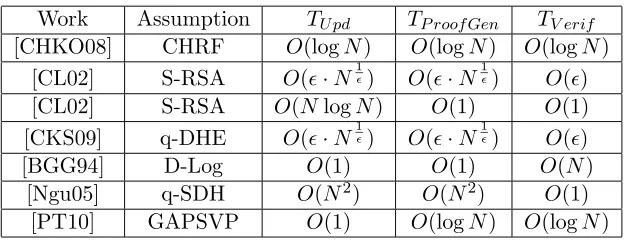
Work Assumption TU pd TP roof Gen TV erif
[CHKO08] CHRF O(logN) O(logN) O(logN) [CL02] S-RSA O(ǫ·N1ǫ) O(ǫ·N
1
ǫ) O(ǫ)
[CL02] S-RSA O(NlogN) O(1) O(1) [CKS09] q-DHE O(ǫ·N1ǫ) O(ǫ·N
1
ǫ) O(ǫ)
[BGG94] D-Log O(1) O(1) O(N) [Ngu05] q-SDH O(N2) O(N2) O(1)
[PT10] GAPSVP O(1) O(logN) O(logN)
Figure 1: Tradeoff for authenticated dictionaries.
Complexities are relatives to the number of accesses to the data-structure. TU pd is the time to update the data-structure, TP roof Gen the time to compute a proof and TV erif is the time to
check the proof. The abbreviationsCHRF, S-RSA, q-DHE, q-SDH, GAPSVPstand respectively for Collision-Resistant Hash Hunction families, Strong RSA Assumption, q-Exponent Diffie-Hellman Assumption,q-Strong Diffie-Hellman Assumption and theGap Version of the Shortest Vector Problem in lattices.
R, Rb0, Rb0b1, ..., Rb0b1...bl−1, Rb0b1...bl. If we index the leaves from left to right starting from 0 until
N−1 = 2d−1 we note thatLi, thei-th leaf of the tree with rootRis such thatLi =Rb0b1...bd−1
wherei= Σdj=0−1bd−1−j2j. In other words, (b0, ..., bd−1) is the binary decomposition ofiwhereb0 is the bit of strongest weight. We considerval, the function that “extracts” the valuevcontained a in message M parsed asM =i||v||r. More precisely, val takes as argument a message of the form i||v||r and returns v.
(Transitive) Signatures. We denote by SSig = (SKG,SSig,SVf) a standard signature scheme. (sk, pk) ← SKG(1κ) is the pair of private/public keys created at the beginning of the
scheme. Then for a message M ∈ {0,1}∗
its associated signature is σM = SSig(sk, M). The validation of a signatureσ onM is done by runningvalid,⊥ ←SVf(pk, M, σ) wherevalidmeans
σ is valid and ⊥ means the opposite. For common digital signatures, we use the standard notion of existential unforgeability under chosen message attack presented in [GMR88]. In the experiment the adversary A is given a public key from the signing oracle. Then A asks the oracle to sign a polynomial number of messages he chose. At the end of the game A outputs a pair (M′, σ) such that M′ has not been signed by the oracle. The scheme is said to be secure if the probability that SVf(pk, M′
σ) = valid is negligible in κ for any PPT Adversary. In a transitive signature scheme, the signer can sign the vertices of some graph but also the edges. Then without the secret, these edge signatures allow to compute the signature for any path that is in the transitive closure of the graph.
Definition 1. (Transitive Signature Scheme, [MR02, Nev08]) A transitive signature scheme (for directed graph) is a tuple DTS= (TSKG,TSign,TSComp,TSVf) where
• TSKG(1κ) : returns a pair of private/public keys (tsk, tpk).
means implicitly that every vertex is also signed. This can be done with a standard signature scheme.
• TSComp((i, j), τ(i,j),(j, k), τ(j,k), tpk): returns the signature τ(i,k) of the edge (i, k). Note that the secret key is not required, neither some description of the current graph.
• TSVf((i, j), τ, tpk) : returns valid if the τ is a valid signature for the edge (i, j) and ⊥
otherwise.
Note that in this definition the time of execution ofTSComp should not depend on previous computations, namely the size of the current graph. So we say that a transitive signature scheme is admissible if there exists a fixed polynomialp(·) such that all the algorithms of DTSrun in time bounded by p(κ).
A transitive signature scheme is said to be secure if there is no adversaryAthat can compute of signature of a path (i, j) that does not lie in the transitive closure of the graph.
Definition 2. (Security for transitive signatures schemes [Nev08]) Let DTS be a transitive signature scheme. Consider the following experiment: the adversary A is given the public pa-rameters of the scheme by runningTSKG. ThenAasks for edge signatures to the signing oracle
TSign(tsk,·.·). After a polynomial number of queriesAfinally outputs(i, j, τ). The set of signed edges form the (directed) graph G= (V, E). The advantage of A is defined by
AdvDTStuf−,cmaA (κ) = Pr [TSVf((i, j), τ, tpk) =valid∧(i, j)∈/ G ∗
]
where the probability is taken over the coins of the adversary and the algorithms of the scheme. DTS is said to be transitively unforgeable under chosen message attack if for any PPT A,
AdvtufDTS−,cmaA (κ) is negligible.
Data authentication. An authenticated dictionary D in the three-party model works as the following. The owner of the dictionary or Source publishes the data-structure with some additional cryptographic information. Moreover the Source also publishes a short value corre-sponding to the current state of the dictionary. With this short value aUser can ask to aReplica for a proof thatD[i] =vfor some indexiand valuev. The security requirement states that the Replica should only be able to compute that proof if indeedD[i] =v, otherwise the verification algorithm run by the User should detect the forgery. When the dictionary is updated, the Source must publish a new state and also the necessary data to allow proof computations by the Replica. Next we define formally the syntax, correctness and security for an authenticated dictionary.
Definition 3. (Authenticated dictionary in the 3-party model)
Let κ∈Nbe the security parameter. An authenticated dictionary scheme AuthDict consists of the following algorithms.
• Setup(1κ, N): this probabilistic algorithm takes κ in unary as input and N, a bound of
that represents the state of m0. Note that the auxiliary information is public3. The m0 data-structure represents a dictionary D which set of keys is {0,1, ..., N −1}.
• Verify(i, v,Π, P K,mˆ): given an index i, a value v, a proof Π, the state mˆ and the public key P K, return valid meaning that D[i] =v, or ⊥otherwise. This algorithm is run by a User .
• ProofGen(i,m, P K): this algorithm returns a proof Π associated to the value v and index
isuch that D[i] =v where D is represented by m. This algorithm is run by the Replica.
• Update(i, v,mbef ore, P K, SK): this algorithm computes the new state of the auxiliary data-structure maf ter where D[i] =v and the rest of the dictionary remains unchanged.
More-over the auxiliary information mbef ore is also updated to maf ter to allow further proof
computations. This algorithm is run by the Source.
An authenticated dictionary is said to be correct if the Replica is always able to compute valid proofs for pairs (i, v) such that D[i] =v.
Definition 4. (Correctness) Letm1,m2, ...,mh be a sequence of updates, then we say the scheme
is correct if for any 0≤i≤N−1 and any 1≤j≤h we have that
Pr [ Π =ProofGen(i,mj, P K)∧Verify(i, v,Π, P K,mˆj) =valid] = 1 where the probability is
taken over the random coins of the algorithms of the scheme.
The authenticated dictionary is said to be secure if the probability for any PPTAto compute a proof Π for a pair (i, v′
) that passes the verification step, and such thatD[i]6=v′
, is negligible.
Definition 5. (Security for authenticated data-structures [CL02])
Let AuthDict be an authenticated dictionary. We consider the notion of security denoted
uf−ad described by the following experiment: on input the security parameter κ, the adversary
Ahas access to an oracle O(·)AD that replies to queries by playing the role of the Source. Using
the oracle, the adversary asks for updates to the dictionary a polynomial number of times. The oracle O(·)AD replies with the new state of the data-structure and also the necessary data to
update the auxiliary information of the data-structure. Recall that, as the auxiliary information is public, the adversary can compute a proof for any index of the table. Finally, the adversary is required to output a tuple (i, v,Π).
The advantage of the adversary A is defined by:
AdvAuthDictuf−ad ,A(κ) = Pr [Verify(i, v,Π,mˆ, P K) =valid∧D[i]6=v]
where P K is the public key generated by Setup, and mis the state of the dictionaryD at the end of the experiment. The scheme AuthDict is said to be secure if for every PPT adversaryA,
AdvufAuthDict−ad ,A(κ) is negligible.
We need now to define what does the expressionoptimal authenticated dictionary mean. The intuition is simply that the time to perform an operation in an optimal authenticated dictio-nary should not be much larger than the time required to run a non-authenticated dictiodictio-nary.
3
However precision is required as the size of an authenticated dictionary is related to the security parameter, that is N =q(κ), where N is the size of the authenticated dictionary and q(·) is a polynomial.
Our definition for authenticated dictionary differs a bit from the one of [PTT10] because it explicitly mentions the security parameterκand allows theSetupalgorithm to run in polynomial time inN. However both definitions are in essence equivalent.
Definition 6. LetN be the size of the dictionary. An authenticated dictionaryAuthDictscheme is optimal if and only if:
• It is correct and secure under definitions 4 and 5 respectively.
• There exist two polynomials m(·), l(·) such that:
– Setup runs inO(m(κ)·l(N))time.
– Verify runs inO(m(κ)) time and the proof Π has size O(κ) =O(1)w.r.t N.
– ProofGen runs in O(m(κ)·log(N)) time, and involves at most O(logN) accesses to the dictionary.
– Update runs in O(m(κ) ·log(N)), and involves at most O(logN) accesses to the dictionary.
Let us comment and justify the definition. As N =q(κ) for some polynomial q(·), then an authenticated data-structure will be slower than the un-authenticated data-structure only by a factor ofm(κ) which is fixed and does not depend onN. Moreover the number of accesses to the dictionary will remain the same. In practice m(κ) is the time to perform some cryptographic operation (hash, signature,...), so it is reasonable to consider thatm(κ)≪N =q(κ). Note that the trivial construction like the Merkle trie [?], does not fit this definition. The reason is that although the algorithms Verify,ProofGen,Update require O(m(κ)) time where m(κ) = κ2, the size of the proof is O(κ2) =ω(κ) and the number of accesses to the data-structure to compute a proof is O(κ) =ω(log(N)).
3
Our construction
The idea of our construction is to build a balanced binary tree of N = 2d leaves, where each
leaf Li : 0≤i≤N −1 will store the value D[i] of the dictionary. The edges will be signed by the DTS scheme and the root Rh will “represent” D at some point of time h. To perform an
update for the indexj, which corresponds to the leafLh
j (that is the leaf at position jreachable
from root Rh) a new root Rh+1 is created. Along with this new root, a parallel path from
Ph =Rh
[b0b1...bd−1] the old rootR
h to the leaf Lh
i is created. That isPh+1 =R[hc+10c1...cd−1] where ∀i : 0 ≤ i ≤ d−1 : ci = bi. Each internal node in Ph+1 is assigned a random label and the leaf Rh+1
c0c1...cd =L
h+1
j will contain the new value v such that D[j] =v. Then this new path will
be linked to the other nodes of the previous tree to maintain consistency of the dictionary, in the sense that except for the index k = j, all the leaves Lh
k must remain reachable from the
corresponding sibling of the node belonging to the old path. Again, every new edge is signed using a transitive signature scheme. So now, proving that D[i] = v is equivalent to exhibit a signature for the path from the current rootRh to a leafLh
i such that val(L) =v. We can then
note that the time to update the balanced binary tree requiresO(logN) signature computations and the proof consists only in a single signature of a path. The security of the construction is based on the fact that the only directed path from a root Rh to a given leaf Lh
i will always
correspond to the current value of the dictionary at time hand indexi.
Definition 7. (Authenticated Dictionary from DTS)
Let AuthDictDT S be the authenticated dictionary defined by the following algorithms.
• Setup(1κ, N): generates the parameters (tsk, tpk) for the a directed transitive signature
scheme DTS. Then we set SK=tsk and P K=tpk. LetN be the size of the dictionary
D, and assume w.l.o.g. that N is a power of 2. Build a balanced binary tree m0 where each leaf at position 0≤i≤N−1 has got the value M =i||v||r withr a random value4. Every internal node is filled with a random value. Then sign the tree with DTS scheme. Publish the root node mˆ0 as the state of the dictionary.
• Verify(i, v,Π, P K,mˆ): parse Π as (σl, σp), then extract from mˆ the root node R and verify
that σl is the signature of message M = i||v||r for some (random) value r. Then check that σp is a valid signature for the path R→M.
• ProofGen(i,m, P K): using mcompute the digital signature σp for the path R→M where
R is the root of the tree and M is the value at the ith leaf, i.e. M = i||v||r where r is
random. Return (σp, σl) with σl =TSign(M).
• Update(i, v,m, P K, SK):
– Create a new leafLhi+1 with valueM =i||v||r for a randomr. Compute the signature
σLh+1
i =SSig(tsk, M).
– Let R[b1b2...bd]be the path from the root Rh∈G, the graph corresponding to m, to leaf
Lh
i. Create a new root nodeRh+1and new intermediate nodesRhb0+1, R
h+1
b0b1, ..., R
h+1
b0...bd−1 =
Lhi+1. All these new nodes contain random values and are signed. The edges(Rh+1, Rh+1
b0 ),
(Rhb0+1, Rbh0+1b1), (Rhb0+1b1, Rhb0+1b1b2), ..., (Rbh0+1b1...bd −2, R
h+1
b0b1b2...bd−1) are signed too using the
algorithm TSign.
– Then the nodes of this path are connected (by signing edges) to the siblings of the old path that has been replaced. That is for every0≤i≤d−1sign edges(Rhb0+1...bi, Rh
b0...bib1−bi+1)
and also (Rh+1, Rh
1−b0).
– Publish the new valuemaf terˆ =Rh+1 as the new state of the dictionary.
4
Indeed it would be sufficient to handle vertices labels of the formi||v||cwherecis a counter as to guarantee
To prove correctness and the security of our construction we need the following lemma.
Lemma 1. Let {Rh :h ∈N} denotes the sequence of root nodes generated by the consecutive
executions of the Update algorithm. Then with probability at least P(q) = 1− 2κq+12 , the two
following properties hold:
1. ∀h∈N, (Rh)∗ is a directed balanced binary tree withN leaves (Lh
0, Lh1, ..., LhN−1).
2. if Dh denotes the state the dictionary after the same sequence of updates, then ∀i : 0 ≤
i≤N −1 :Dh[i] =val(Lh i).
where q′ is the number of graph nodes created during the successive updates.
Proof. We assume first that every node is filled with different values.
By induction on h. For h = 0 the claim is verified. Assume that for any h ∈ N, R∗
h is a
directed balanced binary tree with N leaves and that ∀0≤i≤N −1 :Dh[i] = val(Lh
i). After
the update (Rh+1)∗ is also a directed binary tree because it is formed by the new nodes of the pathRh[b′+1
1...bd] that are connected to the nodes of (R
h)∗
which are by induction root of balanced directed binary trees of depthd−1, d−2, ...,0 respectively. Let ibe the index of the dictionary that is updated. Then we can also see that ∀0 ≤ j ≤ N −1∧j =6 i : Dh[j] = val(Lh+1
j )
as the only new nodes that are reachable from Rh+1 are those on the new path Rh+1
b1...bd where
i = Σdj−=01bd−j2j. The other nodes, including the leaves (except Lhi+1) are still reachable from Rh. So we have that the set of leaves that are reachable from Rh+1 is formed by the leaves reachable fromRh except for Lhi that is replaced by the new leafLih+1. Thus, if (Rh)∗ was the tree such that ∀i,0 ≤i ≤ N −1 :Dh[i] = val(Lh
i), we can deduce that the leaves of (Rh+1)
∗
represent Dh+1.
These two properties hold as long as all values in each node of the graph G = G1 ∪G2∪
· · · ∪Gh+1 are different. As by construction these values are chosen randomly in a universe of size 2κ, we have that P(q) the probability that every two values are different after q nodes
creation is such that 1−P(q)≤Pqi=121κ ≤ q
2
2κ+1. Thus both properties are true with probability
P(q)≥1−2κq+12 .
Note finally that the fact that the graph G= G1∪G2∪ · · ·Gh+1 is directed is essential as otherwise every node would be reachable from any root Rj, thus invalidating the lemma.
From the lemma we can directly deduce that,
Proposition 1. The authenticated dictionary AuthDictDT S is correct.
Proposition 2. Let ǫbe the advantage of an adversary Afor theAuthDict, andqAD the number of queries made to the oracle OAD by A. Then we can build an adversary B such that
AdvtufDTS−,cmaA (κ)≥ǫ(1−
qAD2
Proof. Assume that there exist a PPT adversary A that breaks our scheme, then we build the the following adversary Bthat breaks the security of the transitive signature scheme DTS.
B obtains the public parameters of the DTS scheme. With these parameters its computes the parameters of theAuthDictscheme and sends them toA. Then for each query ofA,Breplies using the signing oracle ofTSign(sk,·,·), theUpdateand ProofGenalgorithm. At the end of the challenge forAuthDict, the adversaryAsends a tuple (i, v,Π) such thatVerify(i, v,Π,mh, P K) =
valid∧Dh[i]6=v. As Dh[i]6=v, from the lemma we can deduce that, with probability at least
1−q2AD
2κ , there is no leafLreachable fromRh such that val(L) =v and Lis in position i. This
means that the adversaryB has been able forge a signatureσ forDTS.
With respect to the complexity we can observe that the update algorithm requiresO(logN) signature computations of the DTS scheme, the proof computation consists in combiningO(logN) DTS signatures and verifying the value of a dictionary at some index requires a DTS signature verification. Thus, if DTS is an admissible transitive signature scheme for directed graphs, the authenticated dictionary is optimal and theorem 1 is proved.
References
[BGG94] Mihir Bellare, Oded Goldreich, and Shafi Goldwasser. Incremental Cryptography: The Case of Hashing and Signing. In Yvo G. Desmedt, editor, CRYPTO 1994, volume 839 of LNCS, pages 216–233–233. Springer-Verlag, July 1994.
[BN05] Mihir Bellare and Gregory Neven. Transitive Signatures: New Schemes and Proofs. IEEE Transactions on Information Theory, 51(6):2133–2151, June 2005.
[BS02] Dan Boneh and Alice Silverberg. Applications of Multilinear Forms to Cryptography. http://eprint.iacr.org/2002/080, 2002.
[CHKO08] Philippe Camacho, Alejandro Hevia, Marcos Kiwi, and Roberto Opazo. Strong Accumulators from Collision-Resistant Hashing. 2008.
[CKS09] Jan Camenisch, Markulf Kohlweiss, and Claudio Soriente. An Accumulator Based on Bilinear Maps and Efficient Revocation for Anonymous Credentials. In Stanisaw Jarecki and Gene Tsudik, editors,PKC 2009, volume 5443 ofIrvine, pages 481–500. Springer Berlin / Heidelberg, 2009.
[CL02] Jan Camenisch and Anna Lysyanskaya. Dynamic Accumulators and Application to Efficient Revocation of Anonymous Credentials. In Moti Yung, editor, CRYPTO 2002, volume 2442 ofLNCS, pages 61–76. Springer-Verlag, 2002.
[Gen09] Craig Gentry. Fully homomorphic encryption using ideal lattices. ACM Press, New York, New York, USA, May 2009.
[GTH02] Michael T. Goodrich, Roberto Tamassia, and Jasminka Hasic. An Efficient Dynamic and Distributed Cryptographic Accumulator. In ISC ’02 Proceedings of the 5th International Conference on Information Security, pages 372–388, September 2002.
[Hoh03] Susan Hohenberger. The Cryptographic Impact of Groups with Infeasible Inversion. http://groups.csail.mit.edu/cis/theses/hohenberger-masters.ps, 2003.
[MR02] Silvio Micali and Ronald Rivest. Transitive Signature Schemes. In Bart Preneel, editor,CT-RSA 2002, volume 2271 of LNCS, pages 236–243. Springer / Berlin Hei-delberg, February 2002.
[Nev08] Gregory Neven. A simple transitive signature scheme for directed trees. Theoretical Computer Science, 396(1-3):277–282, May 2008.
[Ngu05] Lan Nguyen. Accumulators from Bilinear Pairings and Applications. In Alfred Menezes, editor,Topics in Cryptology CT-RSA 2005, volume 3376 ofLecture Notes in Computer Science, pages 275–292–292, Berlin, Heidelberg, 2005. Springer Berlin Heidelberg.
[PT10] Charalampos Papamanthou and Roberto Tamassia. Update-Optimal Authenticated Structures Based on Lattices. http://eprint.iacr.org/2010/128, 2010.
[PTT10] Charalampos Papamanthou, Roberto Tamassia, and Nikos Triandopoulos. Opti-mal Authenticated Data Structures with Multilinear Forms, volume 6487 of Lecture Notes in Computer Science, pages 246–264–264. Springer Berlin Heidelberg, Berlin, Heidelberg, 2010.
[SSM05] Siamak Fayyaz Shahandashti, Mahmoud Salmasizadeh, and Javad Mohajeri. A Prov-ably Secure Short Transitive Signature Scheme from Bilinear Group Pairs. In Carlo Blundo and Stelvio Cimato, editors, Security in Communication Networks, volume 3352 of LNCS, pages 60–76. Springer / Berlin Heidelberg, 2005.