ISSN-L: 2501 - 1235 Available on-line at: www.oapub.org/edu
Copyright © The Author(s). All Rights Reserved.
doi: 10.5281/zenodo.2530907 Volume 5 │ Issue 3 │ 2019
THE DIFFERENCES OF KINEMATIC PARAMETERS POLE VAULT
BETWEEN MALE AND FEMALE FINALISTS WORLD
CHAMPIONSHIP IN DAEGU, 2011
Ratko Pavlović¹i,
Mensur Vrcić², Vladan Savić¹, Irina Skrypchenko³,
Zsolt Németh4,
Ahmed Khafagy5
¹Faculty of Physical Education and Sport, University of East Sarajevo,
Bosnia and Herzegovina ²Faculty of Physical Education and Sport, University of Sarajevo, Bosnia and Herzegovina ³Prydniprovska State Academy of Physical Culture and Sports,
Dnipro, Ukraine 4 Faculty of Sciences, Institute of Sport Science and
Physical Education, University of Pécs, Hungary 5Faculty of Physical Education,
University of Sadat City, Egypt
Abstract:
Kinematic parameters often crucially influence the performance in athletic disciplines. This is especially evident for top athletes who have almost identical morphological, motor and functional parameters. The differences that affect the sporting result are generally attributed to a better performance technique that is often the consequence of the different values of the individual's kinematic parameters. This study analyzes the differences between the defined kinematic parameters in the discipline Pole vault. The sample included 16 men and women athletes who competed in the finals of the World Championships (Daegu, 2011) and a total of 9 kinematic parameters were selected. The results were obtained by applying the T-test module for small independent samples, confirming the differences between men and women's finalists in Daegu, 2011. Statistically significant differences were recorded eight of nine kinematic parameters
(about 89%). Significant differences were recorded in the following kinematic parameters: total run-up distance (T=5,312; p<0,01), number of steps (T=2,712; p<0,05), average step length (T=6,725; p<0,01), VA (T=18,430; p<0,01), AP (T=8,326; p<0,01); ¹average step length last (T=2,662; p<0,01); ²average step length last (T=8,303; p<0,01), ³average step length last (T=8,362; p<0,01).
Keywords: pole vault, kinematic parameters, differences
1. Introduction
Pole vault is one of the most attractive athletic disciplines, where part of the equipment is used to move a vaulter from one place to another, instead of moving or throwing certain equipment (disc, hammer, spear and bowl). Pole vault has always paid attention but especially since 1961 when World Athletic Federation introduced the use of flexible pole. Ever since then, the men’s world record has increased up to 6,15m. Pole vault is technically demanding motoric activity, and there has been much practical and theoretical information about it gathered by both trainers and biomechanists (Zagorac, Retelj, & Katić, 2008).
Pole vault is probably the most complex individual discipline which integrates the skill of a sprinter, a jumper, a thrower, and it represents a vertical high jump over the pole, done with the help of a special pole, during which the pole cannot be knocked down. It is one of the most attractive and by the structure of the movements the most complex technical disciplines (Mihajlović, 2010; Stanković, & Raković, 2010; Stefanović, & Bošnjak, 2011). This discipline requires a great dose of strength, speed, flexibility, balance, coordination, preciseness and moreover the synchronisation of the named motor components from the athlete (Pavlović, 2016). Considering the trajectory of the body centre of gravity (BG) it can be sorted into the category of high jumps. Sports result depends on the speed of the take-off of the body gravity centre and efficient transformation of movement energy during the bending and stretching of the pole, as well as rational transfer over the pole (Tončev, 2001). All these components require a great dose of speed, arm and shoulder belt strength, flexibility, balance and more importantly good technique and very high level of coordination for which several years of practice are required. Pole vault athletes are known as sportsmen with good speed, superior coordination and decisiveness (Bowerman, Freeman, & Vern Gambeta, 1999).
jumping and throwing character. Also, this discipline requires distinctively fast corrections of nerve-muscle body coordination, when a jumper and a pole are one unity and they have common body gravity centre which is observed. In terms of performance structure, this discipline is composed of five phases or parts, where there is a rule that every subsequent phase depends on the previously performed phase. However, every phase depends on individual motor skills, morphological characteristics and technical skills of the competitors, which can be observed through good synchronisation of the athlete's body and the pole as a prop. What is characteristic for pole vault jumpers is the fact that they are not required to be tall or to have a specific weight; therefore their morphological dimensions are on the level of weaker jumpers and runners (Pavlović, 2012; 2013). Motor skills which are significant are speed, explosive strength, preciseness, balance, coordination, flexibility, or good synergy of muscle kinetic chains. Exactly good technique, with the addition of speed, coordination, balance, strength and preciseness comes to the fore in one synchronised action of all skills from the beginning of the run-up until the landing on the mat. One more important factor, the ability to use the pole i.e. its elasticity properties to a great extent defines result success, as well as transferring of the acquired kinetic energy into potential energy (Arampatzis, Schade, & Brüggemann, 2004; Schade, Arampatzis, & Brüggemann, 2006).
In order to achieve good potential energy, the speed of the run must be large and the last steps of the run, the elite jumpers reach a speed of about 9,5 m/s and women about 8,2 m/s (Idrizović, 2010).It should be mentioned that sprinting speed is higher without the pole, the maximum horizontal speed with pole is approximately lower up to 0,8–1,2m/s. The acceleration as an element of the pole vault has its own parts, which determine vaulter’s activity during the approach. Any source of disruption or change violates the speed and acceleration efficiency. Analyses show that average approach of today’ stop vaulters is from 42m–46m, and average number of steps is 18–20 (Zagorac, et al. 2008)
According to the author (Idrizović, 2010; Pavlović, 2016) the first-ranked Bloom on World Championship in Helsinki in 2005 with the result 5,80m had a height of the grip of 4,81m, distance of the jump-off 3,75m, maximum height of body gravity centre 5,91m, speed from 16-11m (9,01m/s) and from 11-6m (9,04m/s). On the same competition the first-ranked Isinbayeva jumped over 5,01m with the height of the grip 4,37m, distance of the jump-off 3,41m, maximum height of body gravity centre 5,19m, by running with the speed of 8,1m/s from 16-11m and from 11-6m (8,31m/s).
The pole vault is a technically highly demanding motor activity, and a great deal of practical and theoretical information has been gathered by the coaches and biomechanics experts. Finding the pole vault determining and influential factors was the object of many biomechanical researches. The application of the kinematic measure system is an infallible method of determining the training condition, as well as the attainment of the vaulting technique in a pole vaulter. A detailed insight into the movement structure can be attained by the calculation of different kinematic parameters (Zagorac, 2013). The aim of research (Schade, Arampatzis, Brüggeman, &Komi, 2004) was to identify differences between elite male and female pole vaulters in terms of their mechanical energy and angular momentum. The vaulter's total mechanical energy and angular momentum were calculated from the three-dimensional kinematic data of the pole vault finals at the Sydney 2000 Olympic Games. The development of total, kinetic and potential energy showed similar characteristics for men and women. The initial energy of the vault, the energy at maximum pole bend position and the final energy were significantly higher for male athletes (p<0,05), while the energy gain produced by the athletes during the vault showed no significant differences (male vaulters 5,88 +/- 1,02 J.kg(-1), female vaulters 5,74 +/- 1,63 J.kg(-1)). Time-related parameters relating to pole bending and recoiling also showed no significant differences (p<0,05). In contrast to the male vaulters, the female vaulters did not show a free upward flight phase. The angular momentum was significantly higher for the female vaulters during the initial pole bend and during the bar clearance (p<0,05). We conclude that the pole vaulting technique of female elite athletes is not a projection of the technique of male elite vaulters at a lower jump height, but rather a different way of jumping and interacting with the elastic pole.
parameters than movements apart from the main plane of movement. For analysing the energy exchange between the athlete and the elastic implement pole only the differences among the secondary parameters (initial energy minus energy at maximum pole bend, final energy minus energy at maximum pole bend). The research Zagorac (2013) was to ascertain the level of correlation between some kinematic parameters and the result success in the pole vault, using the sample of the best European female junior athletes. A set of 11 kinematic parameters has been applied, according to the McGinnis1 model, representing a predictor assemblage of variables. The maximum height vaulted presented a criterion variable. A general hypothesis of achieving a positive correlation between the system of predictor variables and the criteria had been set, and later confirmed. The results of the pole vault regression analysis confirmed the multiple correlations between the two groups of variables. The greatest influences on the prediction of pole vault success, regarding all the analyzed kinematic parameters, were the following variables: maximum pole bend, last stride speed and time of pole bend. The results were as expected, and can be used in kinesiology practice, especially during the technique learning process in young pole vaulters, but also in development of motor abilities relevant for success in this track and field discipline.
The purposes of study Arampatzis, Schade, & Brüggemann, (2004) were: (a) to examine the interactions between the athlete and the pole and the possibility for the athlete to take advantage of the pole's elasticity by means of muscular work and (b) to develop performance criteria during the interaction between the athlete and the pole in pole vaulting. Six athletes performed 4-11 trials each, at 90% of their respective personal best performance. All trials were recorded using four synchronized, genlocked video cameras operating at 50 Hz. The ground reaction forces exerted on the bottom of the pole were measured using a planting box fixed on a force plate (1000 Hz). The interaction between athlete and pole may be split into two parts. During the first part, energy is transferred into the pole and the total energy of the athlete decreases. The difference between the energy decrease of the athlete and the pole energy is an indicator of the energy produced by the athletes by means of muscular work (criterion 1). During the second part of the interaction, energy is transferred back to the athlete and the total energy of the athlete increases. The difference between the returned pole energy and the amount of energy increase of the athlete defines criterion 2. In general, the function of the pole during the interaction is: (a) store part of the kinetic energy that the athlete achieved during the run up as strain energy and convert this strain energy into potential energy of the athlete, (b) allow the active system (athlete) to produce muscular work to increase the total energy potential.
angular momentum serve as good indicators of a jumper's performance. An early positioning of the hips parallel to the bar can be very beneficial, as can a close placement of the CM to the bar at the time of pole release.
According to Zagorac, et al. (2008) the application of the kinematics’ metrical systems is common method of establishing the training condition as well as vaulter’s technique. It is possible to get detailed insight into the moving structure by taking results of different kinematics parameters. In general, the biomechanical analysis of pole vault is occasionally conducted in the projects related to great athletic manifestations where the characteristics of the best pole vaulters are ascertained. These researches can be categorized as following: 1) mathematical models and computer simulation and 2) kinematic and/or kinetic analysis of the observed pole vaulters. The aim of the first method is pole vault shaping and predicting. The advantage of second method is in measuring the real vault data, but on the other hand it is limited by the invasive nature of the materials used in research and evaluation of the competitive vault performance. Generally, biomechanical analysis of the jumps with poles is occasionally done in projects which are related to big athletic competitions where the characteristics of the best pole vault jumpers are determined. This research can be categorised as: 1) mathematical models and computer simulation and 2) kinematics and/or kinetic analysis of the observed jumpers. The aim of the first method is shaping and predictions of the poles. The advantage of the second method is in the measurement of real vault data, but on the other hand it is limited by the invasive nature of the materials which are used in the research and the assessment of the performances of the competitive vault. (Zagorac, 2013).
It is obvious that besides morphological dimensions, kinematic parameters have influence on technical performance and results in high jumps (Dapena, & Chung, 1988; Angulo-Kinzler, et al.1994) as well as stability of the realisation technique, i.e. its adaptation based on a bigger number of repetitions of one jumper, tracking of the quality of performing of the technique of the same jump in function of the time and it is connected to the development of the base and specific motor skills (Zagorac, et al. 2008). Based on previous research, the differences between male and female jumpers are evident in specific biomechanical parameters. However, they are never statistically significant.
Therefore, the aim of this study is to analyse and determine possible differences between some kinematic parameters of male and female pole vault jumpers who won medals on World Championship in Daegu in 2011.
2. Method
1. Total Run-up Distance (m);
2. Number of steps;
3. Average Step Length (m);
4. Ratio (%)-step length / height ratio;
5. VA (m/s)-the velocity in the run-up section between 11-6 m from the pole box;
6. AP (m)-the distance between cut-in box and the last heel strike;
7. Average step length-Last 15-10 step mаlе and 12-9 step female(m);
8. Average step length-Last 10-6 step male and 8-5 step female (m);
9. Average step length-Last 5-1 step male and 4-1 step female(m).
Data obtained in the survey were analyzed by standard descriptive methods,
and the differences between groups of respondents-finalists were tested using Student's t-test for independent samples. Statistical analysis was done using the statistical program Statistica 8.0
Table 1: Biomechanical parameters of male finalists- SP Daeegu, 2011. (Kim, Kang, Kim, 2011)
Male finalists He ight ( cm ) T ota l R u n -up Di st an ce ( m ) Num b er of S te p s (st ep ) A ve ra ge S te p L en gth ( m) R at io ( %) V A (m/ s) AP ( m)
Average step length (m)
Last 15 - 10 step
Last 10 - 6 step
Last 5 - 1 step
P. Wojciechowski
(POL) 185 33,34 16 1,96 106,0 9,05 4,50 1,88 2,21 2,04 L. Borges (CUB) 178 34,04 20 2,27 127,5 9,48 4,55 2,42 2,24 2,15 R. Lavillenie (FRA) 176 33,59 18 2,10 119,3 963 4,79 2,05 2,17 2,09 L. Michalski (POL) 189 34,20 18 2,14 113,2 9,09 4,51 2,09 2,20 2,20 M. Morh (GER) 192 35,62 16 2,23 116,2 9,05 4,47 2,25 2,31 2,19 K. Filippidis (GRE) 188 37,35 18 2,08 110,6 9,34 3,80 2,00 2,26 2,21 M. Didenkov (POL) 180 33,42 16 1,97 109,4 9,09 4,48 1,90 2,20 2,07 F. Silva (BRA) 178 30,43 18 2.03 114,0 9,31 4,45 1,94 2,11 2,04
Mean 183,25 34,00 17,5 2,10 114,5 9,26 4,44 2,07 2,21 2,12
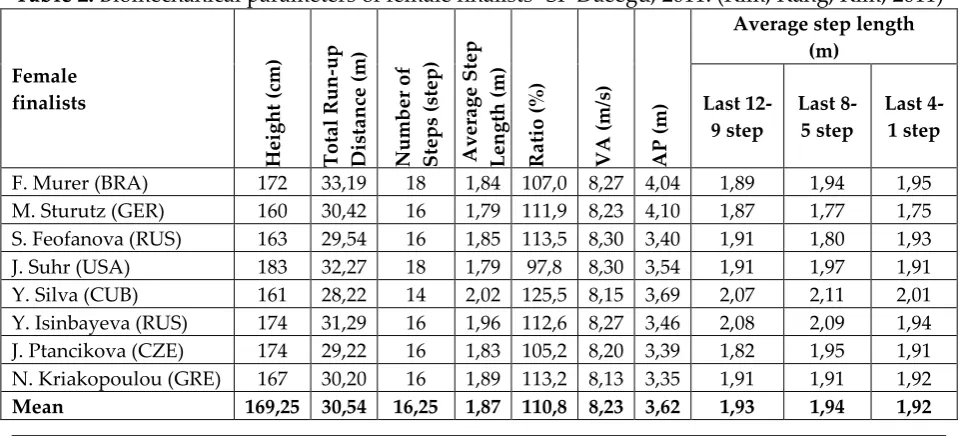
Table 2: Biomechanical parameters of female finalists- SP Daeegu, 2011. (Kim, Kang, Kim, 2011)
Female finalists He ight ( cm ) T ota l R u n -up Di st an ce ( m ) Num b er of S te p s (st ep ) A ve ra ge S te p L en gth ( m) R at io ( %) V A ( m/ s) AP ( m)
Average step length (m) Last 12-9 step Last 8-5 step Last 4-1 step
F. Murer (BRA) 172 33,19 18 1,84 107,0 8,27 4,04 1,89 1,94 1,95 M. Sturutz (GER) 160 30,42 16 1,79 111,9 8,23 4,10 1,87 1,77 1,75 S. Feofanova (RUS) 163 29,54 16 1,85 113,5 8,30 3,40 1,91 1,80 1,93 J. Suhr (USA) 183 32,27 18 1,79 97,8 8,30 3,54 1,91 1,97 1,91 Y. Silva (CUB) 161 28,22 14 2,02 125,5 8,15 3,69 2,07 2,11 2,01 Y. Isinbayeva (RUS) 174 31,29 16 1,96 112,6 8,27 3,46 2,08 2,09 1,94 J. Ptancikova (CZE) 174 29,22 16 1,83 105,2 8,20 3,39 1,82 1,95 1,91 N. Kriakopoulou (GRE) 167 30,20 16 1,89 113,2 8,13 3,35 1,91 1,91 1,92
3. Results and Discussion
Pole vault is technically demanding motoric activity, and there has been much practical and theoretical information about it gathered by both trainers and bio mechanists. Search of the factors that determine and influence the successful pole vault has been an object of many researches in biomechanics (Angulo-Kinzler, et al. 1994; Tončev, 2001; Arampatzis, et al. 2004; Schade, et al. 2006; Idrizović, 2010; Zagorac, 2013). These kinds of researches belong to following categories: 1) mathematic model and computer simulation and 2) kinematics and/or kinetic analysis of observed vaulters (Zagorac, et al. 2008).
Pole vault is a very complex athletic discipline which requires a great dose of strength from athletes, as well as speed, flexibility, balance, preciseness and in the greatest scale the synchronisation of the named motor components (Pavlović, 2016). Besides the mentioned motor skills, biomechanical parameters which are changing depending on the gender have a big role in result successfulness, as well as the technique, specific motor abilities of the jumpers (Tables 1 and 2). Average longevity of the run-up of male finalists on World Championship in Daegu in 2011 was 34m (min.30, 43m-F.Silva and max.37,35m-Filippidisa) done with 17,5 steps (min.16 steps-Wojciechowski, Morh, Didenkov and max.20 steps-Borges) and average length of 2,10m (min.1,96-Wojciechowski and max.2,27m-Borges). An indisputable fact is that the first-ranked Polish Wojciechowski had the smallest average step length (1,96m) and the smallest number of steps in the run-up (16 steps). What is also visible are smaller changes during the run-up on the parts which are measured by step length, where the last 5 steps before the pole touchdown are slightly shorter in comparison with the length from 10-6 steps (Table 1).
Step analysis was divided into three sections: early (the final 15th-11th steps),
middle (the final 10th-6th steps), and final (the last 5 to the final step). Early average step
length was 2.07 m (step length / height ratio: 112,8%), increasing during middle average step length to 2,21 m (120,8% ratio), and decreasing during final average step length to 2,12 m (115,9% ratio). By inspection of Table 2 it is evident that average length of female finalists on the World Championship in Daegu in 2011 was around 31m (Min.28,22m-Silva and Max.33,19m-Murer) with conducted 16,25 steps (Min.14-(Min.28,22m-Silva and Max.18-Murer, Suhr) of average length 1,87m (Min.1,79-Sturutz, Suhrand Max.2,02m-Silva). First-ranked Brazilian F. Murerhad the longest run-up of 33,19m and 18 steps in the run-up. Insignificant average changes are also evident during the run-up on parts which are measured by the length of the steps, from 12th to 1st step.
Total run up distance averaged 30.54 m. The total number of steps averaged 16,25. These numbers was slightly higher than the 2009 Berlin results (15,88). Average step length was 1.87 m, while the ratio of average step length to height was 110.8%.Step analysis was divided into three sections: early (the final 12th-9th steps), middle (the final
8th-5th steps), and final (the last 4 to the final step) (Table 3). Since the average number of
the least amount of steps for competitor (Y. Silva) was 14, the analytic phases for women's steps were divided into three stages, with four steps for each stage. Early average step length was 1,93 m (step length / height ratio: 114,4%), increasing during middle average step length to 1,94 m (114.9% ratio), and decreasing during final average step length to 1,92 m (113,3% ratio). Figure 3 shows the average step length according to all three stages for Brazil's F. Murer, the first place vaulter in Daegu.
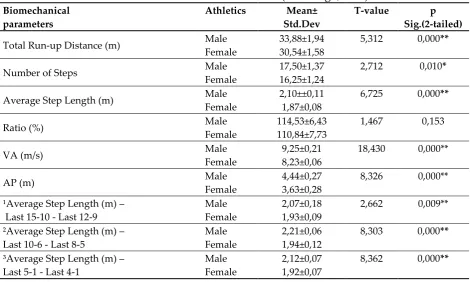
Table 3: Differences of kinematic parameters Pole vault male and female athletics (SP Daeegu, 2011)
Biomechanical parameters
Athletics Mean± Std.Dev
T-value p Sig.(2-tailed)
Total Run-up Distance (m) Male 33,88±1,94 5,312 0,000** Female 30,54±1,58
Number of Steps Male 17,50±1,37 2,712 0,010*
Female 16,25±1,24
Average Step Length (m) Male 2,10±±0,11 6,725 0,000** Female 1,87±0,08
Ratio (%) Male 114,53±6,43 1,467 0,153
Female 110,84±7,73
VA (m/s) Male 9,25±0,21 18,430 0,000**
Female 8,23±0,06
AP (m) Male 4,44±0,27 8,326 0,000**
Female 3,63±0,28 ¹Average Step Length (m) –
Last 15-10 - Last 12-9
Male 2,07±0,18 2,662 0,009** Female 1,93±0,09
²Average Step Length (m) – Last 10-6 - Last 8-5
Male 2,21±0,06 8,303 0,000**
Female 1,94±0,12 ³Average Step Length (m) –
Last 5-1 - Last 4-1
Male 2,12±0,07 8,362 0,000**
Female 1,92±0,07 Sig.**p<0,01; Sig.*p<0,05
In that moment the jumper has to transform horizontal component acquired in the run-up (it ranged between 8,23m/s- 9,25m/s) in the best way into vertical component of the body gravity centre take-off into the direction of the movement from 16º-20º, in comparison to the horizontal line, as well as transferring of the kinetic energy gained during the run-up into a potential energy in the system athlete-pole, during the starting horizontal speed of around 9,50m/s and vertical more than 5m/s. According to the authors (Jovović, 2006; Mihajlović, 2010; Idrizović, 2010) top male jumpers in the run-up gain the speed of 9,6-9,8m/s, and females from 8-8,5m/s. For example (Petrov, 2004), Sergey Bubka had the speed of (9,5m/s) four steps before the jump-off, the speed of (9,7m/s) two steps before, and in the take-off moment (9,9 m/s). The angle of the take-off is between 17º-20º, and the angle which the pole closes with the surface is slightly bigger, 30º, with the force of the pressure to the surface in the moment of the take-off from 290 and 390kg (Stefanović, & Bošnjak, 2011). Afterthat the faze of pendulous momentum starts in the time interval from 1,20-2,50sec and jump-off speed from 8-8,5m/s (Pavlović, 2016). Exactly in the pendulous momentum the jumper makes a certain move in synchronisation with the pole by trying to show technical and motor skills in order to transform kinetic energy into potential energy in the best way. Exactly this phase, even though it does not last for a long time, is of great importance for a good result and jumpers pay special attention to it. After the pendulous momentum comes the resistance of the pole and the crossover over the pole with an arched body position. The height of the pole resistance has different values in male and female contestants and it is in the range of (3,30-4,90m) which justifies the research of Yagodin and Papanov, 1987. In Daegu it amounted to 4,44m in male and 3,62m in female finalists, which is statistically significant, as well (p<0,001).
box, without the alteration of speed or body position. During the next two steps, the vaulter is focused on pushing his hips forward without losing the upper torso control and keeping its main role in the approach. During the last three steps, the vaulter must keep his abdomen tight, which will help him move his torso to the back even before leaving the pole. The most important moment is when the vaulter raise the pole up above his head, before he reach the vertical position with his left leg. The most dangerous moment during the plant is untimely reaching the box during transition from left to right leg. Continued acceleration during the last four steps is indicator of demanding skill in this part of pole vault (Petrov, 2004).
speed of sprinters and the control of a gymnast. They have to obtain very strong arms and shoulders, high level of confidence and tendency to risk. In all categories of the pole vault, male and female, the speed of the run-up is an important factor of result improvement. Certain authors (Steinacker, 1989) say that anthropometric characteristics and neuromusculature coordination of the athlete give a personal style. The way of carrying the pole and running rhythm are representing the individuality of the jumper. The speed of the run-up of top jumpers during the years constantly increased. For example in 1940 it was 8,8m/s, in 1964 it was 9,34m/s., 1973. 9,62m/s, and in 1988 it was 9,90m/s.
Steinacker (1989) gives values of individual kinematic, technical and motor parameters for the result between 5,80m and 6,00m. He divides the run-up into three phases: Phase 1–initial acceleration in the first 5 to 10m, the frequency and the length of the step is developed; Phase 2 – stabilisation of the speed between 20 and 25m (submaksimum level 95%); Pole positioning complex-reflection in the last 5m, with minimal loss of the speed. According to the research of Schade 2005, retrieved from Idrizović, 2010) the height of the grip of the first-ranked on World Championship in Helsinki in 2005 was 4,81m, reflection distance was 3,75m, max. height of body gravity centre was 5,91m,the speed of 16-11m 9,01m/s and the speed of 11-6m 9,04m/s (rez.5,80m). Isinbayeva jumped over 5,01m and had the height of the grip of 4,37m, reflection distance of 3,41m, max. height of body gravity centre of 5,19m, running speed of 16-11m (8,10m/s) and of 11-6m (8,31m/s). Bloom’s reflection distance in Helsinki in comparison to the first-ranked Polish Wojciechowski from Daegu in 2011 was shorter for almost 80cm (4,50m) with almost identical running speed in the part from 11-6m of the run-up (9,05m/s). In comparison with Isinbayeva, the first-ranked Murer had greater distance of the jump-off (4,04), but also smaller speed of the run-up (8,27m/s).
4,75m). The Brazillian also conducted 18 steps during the run-up, which is two more than Rogowska in Berlin, and she pushed the pole from a greater height (4,04m). First-ranked in Berlin, Rogowska only had a greater speed on the track part of 11-6m (8,68m/s), in comparison to Murer (8,27m/s). These parameters show often inversion relation between the number of steps, the length of the steps, run-up speed, distance of the jump-off and results.
Based on all of the above for both male and female jumpers we can conclude that the rule is that the success in pole vault jump depends on the morphological dimensions, technique of the element itself, but also it depends on the biomechanical parameters, which are unavoidable in athletics. Moreover, what is very important is the unity of motor components which should successively and synchronically be manifested, and transitions of kinetic into potential energy are important as well (Idrizović, 2010, Stanković, & Raković, 2010; Mihajlović, 2010). A good example for that is current record-holder, the French jumper Renaud Lavillenie, who, after 20 years, broke the record of Sergey Bubke from 1994 when he jumped over 6,16m. It can be concluded that he managed to “fit all the pieces together”. It can be assumed that in the future the same jumper or maybe some others could break this record for a few centimetres. Baring in mind that training technology has developed greatly, this can be expected (Pavlović, 2016).
4. Conclusion
The research had the aim to determine statistically significant differences in kinematic parameters between male and female pole vault finalists on World Championship in Daegu in 2011. Based on the obtained results of measured kinematic parameters and applying T-test, statistically significant difference has been recorded in 89% parameters: total run-up distance (T=5,312**), number of steps (T=2,712*), average step length
(T=6,725**), VA (T=18,430**), AP (T=8,326**), 1average last step length (T=2,662**),
2average last step length (T=8,303**), 3average last step length (T=8,362**).
Statistically significant differences between the finalists were not recorded in terms of the relation between the height and length of the step (Ratio%).Based on the obtained results, for male and female jumpers the rule is that success in pole vault jumping depends on the morphological dimensions, specific motor skills, pole characteristics, jumpers’ technique, but also on the biomechanical parameters.
References
Angulo-Kinzler, R., Kinzler, S., Balius, X., Turro, C., Caubet, J., Escoda, J. & Prat, A.
(1994). Biomechanical analysis of the pole vault event. Journal of Applied
Arampatzis, A., Schade, F. & Brüggemann, G.P. (2004). Effect of the pole - human body interaction on pole vaulting performance. Journal of Biomechanics 37 (9), 1353-1360.
Bowerman, W.J., Freeman, W, H. & Vern Gambetta T.A.C. (1998). Athletics. Zagreb-Gopal.
Dapena, J. & Chung, S.C. (1988). Vertical and radial motions of the body during the take-off phase of high jumping. Medicine & Science in Sports & Exercise 20 (3), 290-302.
Idrizović, K. (2010). Atletika I i II. [Athletics I, II. In Serbian]. Univerzitet Crne Gore. Biblioteka bio - medicinskih nauka.
Jovović, V. (2006). Atletika - biomehanika, tehnika i metodika [Athletics - biomechanics-tehnics and metodius. In Serbian] Filozofski fakultet Nikšić - studijski program fizičke kulture.
Kim, N.H., Kang, J.E. & Kim, H.L. (2011). Biomechanical Analysis of the Pole Vault Men and Women Final. Scientific Research Project Biomechanical Analyses at the 13 IAAF World Championship, Daeegu, 2011 Final Report Pole Vault. Korean Society of Sport biomechanics
Mihajlović, I. (2010). Atletika [Athletics. In Serbian]. Novi Sad: Fakultet sporta i fizičkog vaspitanja.
Mendoza, L., Nixdorf, E., Isele, R. & Gűnther, C. (2009). Biomechanical Analysis of the
Pole Vault Men and Women Final. Scientific Research Project Biomechanical
Analyses at the 12 IAAF World Championship, Berlin, 2009 Final Report Pole Vault. Petrov, V. (2004). New Studies in Athletics, 12, 23.
Pavlović, R. (2012). The morphological status of the finalist in jumping disciplines at the Beijing Olympics. SPORT SCIENCE- International Scientific Journal on Kinesiology, 5 (2), 43-48.
Pavlović, R., (2013). The morphological status of female the finalist in jumping disciplines at the Beijing Olympics. Sport Mont, 11 (37-39), 116-125.
Pavlović, R. (2016). Atletika 2 *Athletics 2. In Serbian]. Niš: udruženje književnika, Branko Miljković’’
Schade, F., Arampatzis, A. & Brüggemann, G.P. (2000). Influence of different approaches for calculating the athlete’s mechanical energy on energetic parameters in the pole vault. Journal of Biomechanics 33 (10), 1263-1268.
Schade, F., Arampatzis, A. & Brüggeman, & Komi, P. (2004). Comparison of the men’s and the women’s pole vault at the 2000 Sydney Olympic Games. Journal of Sport Sciences 22 (9), 835-842.
Schade, F., Arampatzis, A. & Brüggemann, G.P. (2006). Reproducibility of energy parameters in the pole vault. Journal of Biomechanics 39 (8), 1464-1471.
Stefanović, Đ. & Bošnjak, G. (2011). Atletika, filosofsko – naučne osnove primena u praksi [Athletics, philosophical - scientific basics and application in practice. In
Stanković, D. & Raković, A. (2010). Atletika [Athletics. In Serbian] Univerzitet u Nišu: Fakultet fizičke kulture.
Tončev, I. (2001). Atletika – tehnika i obučavanje *Athletics - technics and training. In Serbian]. Univerzitet u Novom Sadu.
Zagorac, N., Retelj, E. & Katić, R. (2008). Successful pole vault influenced by certain kinematical parameters. Coll Antropol. 32 (4), 1133-1139.
Zagorac, N. (2013). Influence of Kinematic Parameters on Pole Vault Result in Top Junior Athletes. Coll Antropol.37 (suppl.2), 19-24.
Creative Commons licensing terms