A new species in the tree genus
Polyceratocarpus
(Annonaceae) from the Udzungwa Mountains
of Tanzania
Andrew R. Marshall1,2, Thomas L.P. Couvreur4,5,6, Abigail L. Summers1,2,3, Nicolas J. Deere1,7, W.R. Quentin Luke8, Henry J. Ndangalasi9,
Sue Sparrow3, David M. Johnson10
1 CIRCLE, Environment Department, University of York, York, UK 2 Flamingo Land Ltd., Kirby Misperton, North Yorkshire, UK 3 Biology Department, University of York, York, UK 4 Institut de Recherche pour le Déve-loppement, UMR-DIADE, BP 64501, F-34394 Montpellier cedex 5, France 5 Université de Yaoundé I, Ecole Normale Supérieure, Département des Sciences Biologiques, Laboratoire de Botanique systématique et d’Ecolo-gie, B.P. 047, Yaoundé, Cameroon 6 Netherlands Centre for Biodiversity Naturalis (section NHN), Biosyste-matics Group, Wageningen University, the Netherlands 7 Durrell Institute of Conservation and Ecology, School of Anthropology and Conservation, University of Kent, Canterbury, UK 8 East African Herbarium, National Museums of Kenya, Nairobi, Kenya 9 Department of Botany, University of Dar es Salaam, Dar es Salaam, Tanzania 10 Department of Botany & Microbiology, Ohio Wesleyan University, Delaware, Ohio 43015 USA
Corresponding author:Andrew R. Marshall ([email protected])
Academic editor:M.A. Jaramillo | Received 30 October 2014 | Accepted 14 May 2015 | Published 1 June 2016
Citation: Marshall AR, Couvreur TLP, Summers AL, Deere NJ, Luke WRQ, Ndangalasi HJ, Sparrow S, Johnson DM (2016) A new species in the tree genus Polyceratocarpus (Annonaceae) from the Udzungwa Mountains of Tanzania. PhytoKeys 63: 63–76. doi: 10.3897/phytokeys.63.6262
Abstract
Polyceratocarpus askhambryan-iringae, an endemic tree species of Annonaceae from the Udzungwa Moun-tains of Tanzania, is described and illustrated. The new species is identified as a member of the genus
Polyceratocarpus by the combination of staminate and bisexual flowers, axillary inflorescences, subequal outer and inner petals, and multi-seeded monocarps with pitted seeds. From P. scheffleri, with which it has previously been confused, it differs in the longer pedicels, smaller and thinner petals, shorter bracts, and by generally smaller, less curved monocarps that have a clear stipe and usually have fewer seeds. Because P. askhambryan-iringae has a restricted extent of occurrence, area of occupancy, and ongoing degradation of its forest habitat, we recommend classification of it as Endangered (EN) on the IUCN Red List.
Keywords
East Africa, Eastern Arc, endemism, Ndundulu, Polyceratocarpus http://phytokeys.pensoft.net
Copyright Andrew R. Marshall et al. This is an open access article distributed under the terms of the Creative Commons Attribution License (CC BY 4.0), which permits unrestricted use, distribution, and reproduction in any medium, provided the original author and source are credited.
Andrew R. Marshall et al. / PhytoKeys 63: 63–76 (2016)
64
Introduction
The Eastern Arc Mountains of Kenya and Tanzania are well known for their high levels of biodiversity and endemism across many plant and animal groups (Lovett and Wasser 1993, Myers et al. 2000, Newmark 2002, Burgess et al. 2007, Dawson and Gereau 2010). The 13 mountain blocs making up the chain are somewhat isolated from one another, and each block exhibits its own unique suite of species. Many of the forests occupying these mountains are under threat from expanding agriculture and human population increase: an estimated 2.79 Mha of forest was lost between 1908 and 2000 (Willcock et al. 2016), with just 10% of the Eastern Arc Mountains still forested (Platts et al. 2011). These development pressures have added urgency to the inventory of the unique biota of this region.
Within the Eastern Arc chain, the 19,375 km2 Udzungwa Mountains form the
largest mountain bloc (Platts et al. 2011) and comprise the largest area of forest in the Eastern Arc Mountains, totaling around 1,600 km2 (Marshall et al. 2010). The
Udzungwa Mountains have enormous biodiversity value, with the highest plant spe-cies richness, the highest endemic vertebrate spespe-cies richness, and the second highest endemic plant species richness of all mountain blocs in the region (Platts et al. 2010; Rovero et al. 2014). The distinctive character of Udzungwa biodiversity has been re-cently highlighted by high-profile mammal species discoveries including the kipunji monkey (Rungwecebus kipunji; Davenport et al. 2006) and Udzungwa elephant shrew (Rhynchocyon udzungwensis; Rovero et al. 2008).
Species of the flowering plant family Annonaceae are prominent among the un-derstory trees and woody climbers of the Eastern Arc Mountains. In these mountains, there are 50 known Annonaceae species, 16 of which are endemic, including 12 out of 127 reported endemic tree species (R.E. Gereau, unpubl. data).
The genus Polyceratocarpus Engl. & Diels (Annonaceae subfamily Malmeoideae, tribe Piptostigmateae, Chatrou et al. 2012) is distinguishable from other African gen-era of the family by the combination of a tree habit, percurrent tertiary veins of the leaves, axillary (sometimes cauliflorous) inflorescences, occurrence of both staminate and bisexual flowers, petals of the outer and inner whorls roughly equal in size and shape, numerous monocarps with multiple seeds arranged in a single row, and pitted seeds with spiniform ruminations (Couvreur et al. 2009, Couvreur et al. 2012). Engler and Diels (1900) published the genus based on P. scheffleri Engler & Diels, collected in the Usambara Mountains. Since that time seven additional species have been added to the genus, all from western and central Africa.
Taxonomic treatment
Polyceratocarpus askhambryan-iringae A.R. Marshall & D.M. Johnson, sp. nov.
urn:lsid:ipni.org:names:77155232-1
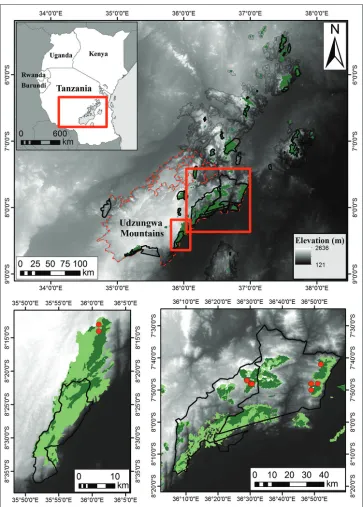
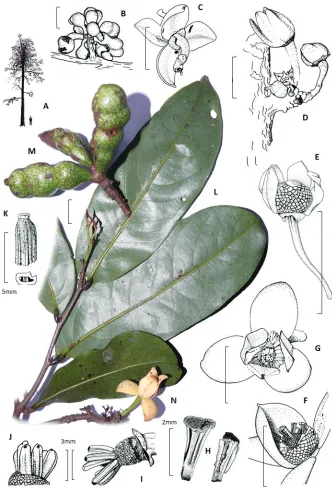
Figs 1–3
Diagnosis. This species may be distinguished from other species of Polyceratocarpus by the combination of glabrous non-glaucous leaves with finely reticulate to weakly scalari-form tertiary venation, pedicels 15–22 mm long, broadly ovoid buds, chartaceous petals 10–17 mm long, 5 to 18 carpels/monocarps, and relatively large torulose monocarps.
Type. Marshall 2117 (holotype K; isotypes DSM, MO, NHT), Tanzania, Ir-inga Region: Ndundulu Forest, Kilombero Nature Reserve, Udzungwa Mountains, 07°48'S, 36°31'E (WGS84), 1490 m, 30 May 2011.
Andrew R. Marshall et al. / PhytoKeys 63: 63–76 (2016)
66
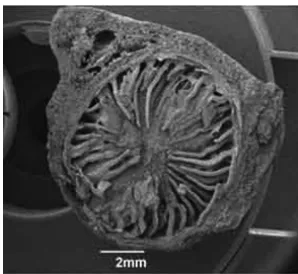
trichomes densest along ridge and at apex abaxially, verrucose on both surfaces, apex acute; stamens ca. 200, 2.0–2.8 mm long, clavate, apex of connective obliquely trun-cate, pale brown with orange apex, glabrous?; carpels 5 to 18, oblong, 2.9–4.0(-6.0) mm long by 0.9–1.1(-2.3) mm wide, densely pale brown/ferruginous-puberulous; stigma bilobed, capitate, 1 mm in diam., glabrous, ovules ca. 10, uniseriate; torus subglobose to broadly pyriform to oblate, 4.4–4.9 mm long by 2.6–5.4 mm diam., 3–8 mm diam. at base. Pedicel of fruit 20–44 mm long by 3–7 mm diam., weakly longitudinally rugulose, glabrate; torus of fruit ellipsoid to broadly pyriform, 7–15 mm diam. × 8–12 mm long, grey-brown. Monocarps up to 18 per fruit, green (rarely with orange or vinaceous tinge) in vivo, dark brown when dried, weakly (to strongly) recurved-falciform, (1.9) 6.0–8.6 cm by 0.7–2.2 cm, torulose, minutely verrucose, glabrate or with a few scattered hairs, base sub-sessile or short-stipitate, stipe 1–11 mm long, 2–6 mm thick, apex rounded or sometimes short-beaked. Seeds 1–15 per monocarp, 15 mm long by 13 mm wide by 10 mm thick, arranged in a single [or two irregular?] rows, flattened-ellipsoid, pitted, with spiniform ruminations (fig. 3) and raphe/antiraphe sunken in a circumferential groove.
Distribution. Polyceratocarpus askhambryan-iringae is endemic to the Udzung-wa Mountains of Tanzania. It is known from MUdzung-wanihana Forest in the UdzungUdzung-wa Mountains National Park, Ndundulu Forest in the Kilombero Nature Reserve, and the Uzungwa Scarp Forest Reserve (Fig. 1).
Habitat and ecology. Inhabits montane forest on brown sandy loam soils (pH range 4–5 measured in Ndundulu Forest). Mean annual rainfall of collection localities approximately 1500–2000 mm/yr (Marshall, Ndangalasi, unpubl. data). Thirty-eight mature individuals were found mostly on slopes or ridge-tops at elevations 1090– 1540m. Mature flowers were collected in May, November, and December, fruits in February and May-October.
Associated taxa recorded with Polyceratocarpus askhambryan-iringae include the following: (1) Ndundulu Forest: Allanblackia ulugurensis Engl., Alsodeiopsis schu-mannii Engl.; Anisotes pubinervius (T.Anderson) Heine, Anthocleista grandiflora Gilg,
Beilschmiedia kweo (Mildbr.) Robyns & Wilczek, Bertiera pauloi Verdc., Cassipourea
gummiflua Tul.; Cassipourea malosana Alston; Chlorophytum brachystachyum Baker,
Cleistanthus polystachyus Hook.f. ex Planch., Clerodendrum cephalanthum Oliv., Cof-fea sp., Cola greenwayi Brenan, Cola stelechantha Brenan; Craterispermum longipe-dunculatum Verdc.; Diospyros abyssinica (Hiern) F.White, Drypetes gerrardii Hutch.;
Englerina sp. nov.; Garcinia buchananii Baker; Garcinia volkensii Engl.; Grewia mild-braedii Burret; Justicia rodgersii Vollesen; Lasiodiscus usambarensis Engl.; Maytenus
undata (Thunb.) Blakelock; Monodora globiflora Couvreur; Monanthotaxis
Andrew R. Marshall et al. / PhytoKeys 63: 63–76 (2016)
68
Figure 2.Polyceratocarpus askhambryan-iringae drawings of A tree architecture B fresh fruits C fresh flower below D fresh ramiflorous flower buds E–F dry and fresh bisexual flower (one petal removed)
(Mattf.) C.Jeffrey; Strombosia scheffleri Engl.; Strychnos mellodora S.Moore; Strychnos mitis S.Moore; Strychnos sp. nov; Syzygium guineense DC.; Tabernaemontana stapfiana
Britten; Tarenna pavettoides (Harv.) Sim; Thalictrum rhynchocarpum Quart.-Dill. & A.Rich.; Uvariopsis lovettiana Couvreur & Q.Luke; Vepris stolzii I.Verd.; Vernonia calvoana Engl. subsp. leucocalyx (O.Hoffm.) C.Jeffrey; Vernonia luhomeroensis Q.Luke & Beentje; Vernonia sp. nr. pteropoda Oliv. & Hiern; Warneckea sp. nov.; Xymalos monospora Baill.; Zanthoxylum paracanthum (Mildbr.) Kokwaro; Zehneria sp. nr.
oli-gosperma C.Jeffrey. (2) Uzungwa Scarp Forest Reserve:Cassipourea gummiflua Tul;
Cleistanthus polystachyus Hook.f. ex Planch.; Craterispermum longipedunculatum Ver-dc.; Diospyros uzungwaensis Frim.-Møll. & H.J.Ndangalasi; Drypetes gerrardii Hutch.;
Lasiodiscus usambarensis Engl.; Psychotria megalopus Verdc.; Tabernaemontana stapfi-ana Britten; Tarenna uzungwaensis Bridson. (3) Mwanihana: Acalypha psilostachya
Hochst. ex A.Rich. var. psilostachya; Anisotes pubinervius (T.Anderson) Heine; Calon-coba welwitschii Gilg; Chrysophyllum gorungosanum Engl.; Coffea mufindiensis Hutch. ex Bridson subsp. mufindiensis; Dorstenia sp. aff tenuiradiata Mildbr.; Isoglossa lactea
Lindau ex Engl. subsp. lactea; Isolona linearis Couvreur; Newtonia buchananii (Baker) G.C.C.Gilbert & Boutique; Ochna holstii Engl.; Parinari excelsa Sabine; Phyllopentas ulugurica (Verdc.) Kårehed & B. Bremer; Kedrostis sp.; Polystachya sp aff. canaliculata
Summerh.; Raphidiocystis chrysocoma (Schumach.) C.Jeffrey; Selaginella kraussiana
(Kunze) A.Braun; Stellaria mannii Hook.f.; Tricalysia aciculiflora Robbr.; Uvariopsis lovettiana Couvreur & Q.Luke; Vepris nobilis (Delile) Mziray; Zanthoxylum paracan-thum (Mildbr.) Kokwaro.
Additional specimens examined. TANZANIA. Iringa Region, Kilolo District: east Udzungwa National Park, forest south of Mwanihana hill c. 2 km S of last camp-ing site of Mwanihana trail, 1400 m, 07°48'S, 36°49'E, Couvreur 101 (DSM, OWU, WAG); Mwanihana Forest above Sanje village, 1220 m, no grid reference, Lovett 222 (K); Udzungwa Mountains National Park, 1200 m, 07°48'S, 36°49'E, Luke 7738 (EA, K); Udzungwa Mountains National Park, 1440 m, 07°42'S, 36°52'E, Luke 11279 (EA, NHT, MO, K); Ndundulu FR, Camp 589-Camp 590, 07°47'S, 36°29'E, 1440 m, Luke et al. 10366 (MO); Kilombero Nature Reserve, Ndundulu Forest, 1540 m, 07°48'S, 36°31'E (WGS84), Marshall 2036, 2070, (NHT, MO, K); Uzungwa Scarp Forest Reserve, Uluti, 1534 m, 08°14'S, 36°01'E, Ndangalasi HJN 392 (DSM, OWU); Uzungwa Scarp Forest Reserve, Ilutila, 1709 m, 08°13'S, 36°01'E, Ndangalasi 393 (DSM, OWU); Udzungwa, Kilombero FR, W of Ruaha River, 1700 m, Rogers & Hall 2300 (K); Mwanihana Forest above Sanje village, 1400 m, 07°50'S, 36°49'E, Thomas 3656 (MO); Mwanihana Forest above Sanje village, 1400 m, 07°50'S, 36°49'E, Thomas 3698 (MO, WAG). Morogoro Region, Kilombero District: Sonjo-Mwanihana trail, 1090 m, 07°48'S, 36°51'E, Luke 5051 (EA, K).
Andrew R. Marshall et al. / PhytoKeys 63: 63–76 (2016)
70
Figure 3. SEM photograph of Polyceratocarpus askhambryan-iringae dried seed cross-section, showing spiniform ruminations.
from Morogoro Region was not considered to be from this genus at all (Kimboza For-est Reserve: Parry 1816, TFD; cited Verdcourt 1971).
Additional field notes.Slash dry, slightly stringy, pale yellow (to pale peach), oc-casionally streaked yellow-brown, dark brown at outer edge formed by the colour of the inner bark, potpourri aroma. Leaf lamina dark green above, mid-green with greyish tinge below, turning greenish-grey when dried, new flush pinkish; petiole initially pale green in vivo, becoming roughened grey-brown with age; midrib yellow-green above and below in vivo. Flower buds broadly ovoid, green or pale brown-yellow with oc-casional pink tinge at apex in vivo; sepals yellowish-green in vivo.
Etymology. This new species of Polyceratocarpus was named by Askham Bryan College and Iringa International School as part of a rainforest education program.
Conservation status. Our IUCN Red List assessment for P. askhambryan-iringae
not extrapolated far beyond the expected habitat tolerance of the species. We estimated an AOO of 300 km2 and an EOO of 1,410 km2, with EOO, AOO, habitat quality and
the number of mature individuals, all presumed declining as a result of timber-felling in USFR. Given this continuing decline, plus an EOO of less than 5,000 km2, an
AOO of less than 500 km2, and a population at no more than five locations, the
spe-cies qualified firmly as endangered on the IUCN Red List (IUCN 2012), EN B1ab(i, ii,iii,v)+2ab(i,ii,iii,v). Within the Udzungwa Mountains, closed-canopy forest was not extensive at elevations suitable for P. askhambryan-iringae, and hence we expect that future expeditions will not expand the AOO or EOO of P. askhambryan-iringae above the IUCN endangered threshold. However, the Rubeho and Mahenge mountain blocs adjacent to Udzungwa were more poorly known, and may contain suitable habitat in which this species might also be found.
Discussion
A) Systematics
Polyceratocarpus askhambryan-iringae is similar to P. scheffleri and has previously been confused with it. As far as is known, however, P. scheffleri is confined to the Usambara Mountains and P. askhambryan-iringae to the Udzungwa Mountains; previous reports of P. scheffleri from the Udzungwa Mountains (e. g. Lovett et al. 1988, Couvreur et al. 2006, Eastern Arc Mountains & Coastal Forests CEPF Plant Assessment Project 2009) have been based on misidentifications of P. askhambryan-iringae. To facilitate separation of the two East African species, their differences are contrasted in the fol-lowing key:
1 Lamina rounded and minutely subcordate at base, with tertiary veins reticu-late to weakly scalariform; pedicel 15–29 mm long, bearing a bract 0.8–1 mm long; sepals connate only at base, distinct, crescent-shaped; petals 10–17 mm long; monocarps up to 18 per fruit, (1.9–) 6–8.6 cm long, weakly recurved-falciform, short-stipitate (1–11 × 2–6 mm); seeds per monocarp up to 15 .... ...Polyceratocarpus askhambryan-iringae – Lamina cuneate to broadly cuneate at base, with tertiary veins distinctly sca-lariform; pedicel 10–16 mm long, bearing a bract 7–9 mm long; sepals con-nate into a disc with indistinguishable sepal lobes; petals 18–32 mm long; monocarps 5 to 33, 6–20 cm long, strongly curved, sessile; seeds per mono-carp up to ca. 25 ...Polyceratocarpus scheffleri
Andrew R. Marshall et al. / PhytoKeys 63: 63–76 (2016)
72
carpels and large strongly torulose monocarps. The only other species with such a high number of carpels (18 to 20) is Polyceratocarpus laurifolius Paiva from northern Angola, but that species differs from P. askhambryan-iringae in having densely pubescent twigs, a distinctly cuneate base to the leaf, a larger bract on the pedicel, and larger sepals.
Polyceratocarpus laurifolius also differs from P. askhambryan-iringae in having larger petals of the staminate flowers than of the bisexual ones (Paiva 1966); in P.
askham-bryan-iringae no petal dimorphism between staminate and bisexual flowers was seen.
Polyceratocarpus askhambryan-iringae (as “Polyceratocarpus sp.”) was one of four
Polyceratocarpus species included in the phylogenetic analysis of Couvreur et al. (2009) focused on the phylogeny of several closely related African genera of Annonaceae. In this analysis P. askhambryan-iringae appeared as sister to the other three species of Polyceratocarpus sampled (P. microtrichus (Engl. & Diels) Ghesq. & Pellegr., P. parviflorus (Baker f.) Ghesq., and P. pellegrinii Le Thomas) forming a monophyletic group with strong bootstrap and posterior probability support. The other five species remain to be sampled. The genus itself, however, was nested within the western and central African genus Piptostigma Oliv., to which it is morphologically dissimilar, so additional sampling is needed.
B) Regional endemism and biodiversity
East Africa is an area of both high endemism and high diversity for Annonaceae, with 28 genera and 85 species known from Tanzania alone (Couvreur et al. 2006). In particular, the Eastern Arc Mountains form an area of high species endemism for East African An-nonaceae. Furthermore, many Annonaceae genera represented in these mountains have main areas of diversity in the Guineo-Congolean region and are represented in the East-ern Arc Mountains by endemic taxa. In addition to Polyceratocarpus, the genera Annickia
Setten & Maas, Greenwayodendron Verdc., Isolona Engl., Monodora Dunal, Uvarioden-dron (Engl. & Diels) R.E. FR., and Uvariopsis Engl. all follow this pattern (Verdcourt 1971, 1986, Couvreur et al. 2006, Couvreur 2009, Couvreur and Luke 2010).
are known from the Udzungwa Mountains than other Eastern Arc Mountain blocs, and while this is partly due to increased survey effort over other blocs, recent projections by distribution models estimate that the number of endemic/threatened plant taxa will not be superseded following increased exploration of other blocs (Platts et al. 2010).
The four P. askhambryan-iringae localities are coextensive with other recent dis-coveries of rare and endemic Eastern Arc animals, e.g. the Critically Endangered endemic Sanje mangabey (Cercocebus sanjei; Mwanihana and Uzungwa Scarp), the Critically Endangered kipunji monkey (Rungwecebus kipunji; Ndundulu; also found on Rungwe Mountain), the endemic Udzungwa forest partridge (Xenoperdix
ud-zungwensis; Ndundulu), the endemic rufous-winged sunbird (Nectarinia rufipennis;
Mwanihana, Ndundulu and Uzungwa Scarp), the endemic Udzungwa elephant shrew
(Rhynchocyon udzungwensis; Ndundulu and Mwanihana), further emphasizing the
ex-ceptional local biodiversity value. The exex-ceptional biodiversity of these areas led to the incorporation of Mwanihana forest into the Udzungwa Mountains National Park in 1991, and later incorporation of Ndundulu forest into the Kilombero Nature Reserve in 2007 (Marshall et al. 2007).
The discovery of P. askhambryan-iringae further highlights the need for improved conservation of Uzungwa Scarp Forest Reserve, one of the most important forests in the region for primates and birds (Dinesen et al. 2001), where herpetofauna endemism has been estimated at eight times that of the Eastern Arc as a whole (Menegon, unpub-lished data). Uzungwa Scarp FR is home to the Kihansi spray toad (Nectophrynoides asperginis), which was extinct in the wild, but was successfully reintroduced in October 2012 following zoo conservation breeding (Channing et al. 2009; Gereau et al. 2014). We hope that our discovery of yet another new endemic will add weight to ongoing proposals for gazettement of Uzungwa Scarp Forest Reserve as a Nature Reserve, the highest designation of protected area possible under the Tanzania Forestry Service.
Acknowledgements
Andrew R. Marshall et al. / PhytoKeys 63: 63–76 (2016)
74
logistics, especially Richard Mgata from Udekwa village, who climbed tall trees in pur-suit of vital material for this description. TLPC thanks the Netherlands Organization for Scientific Research (NWO), Hugo de Vries Fonds and Air France-KLM for financial help in Tanzania in 2006. Frank Mbago is thanked for assistance while in the field with TLPC. We also thank the United Bank of Carbon for funding to develop a schools’ rainforest education program around this species, which led to the chosen species name. And last but not least we thank all the participating schools, colleges, youth groups and people who helped the success of this program, particularly Katie Boswell, Amber Hall, Joshua Sammy, Sharon Sheppard and the First Sherburn Rainbows and Brownies.
References
Burgess ND, Butynski TM, Cordeiro NJ, Doggart NH, Fjeldså J, Howell KM, Kilahama FB, Loader SP, Lovett JC, Mbilinyi B, Menegon M, Moyer DC, Nashanda E, Perkin A, Rovero F, Stanley WT, Stuart SN (2007) The biological importance of the Eastern Arc Mountains of Tanzania and Kenya. Biological Conservation 134: 209–231.
Channing A, Howell K, Loader S, Menegon M, Poynton J (2009) Nectophrynoides asperginis. The IUCN Red List of Threatened Species. Version 2014.2. http://www.iucnredlist.org [Downloaded on 10 October 2014]
Chatrou LW, Pirie MD, Erkens RHJ, Couvreur TLP, Neubig KM, Abbott JR, Mols JB, Maas JW, Saunders RMK, Chase MW (2012) A new subfamilial and tribal classification of the pantropical flowering plant family Annonaceae informed by molecular phylogenetics. Botan-ical Journal of the Linnean Society 169(1): 5–40. doi: 10.1111/j.1095-8339.2012.01235.x Couvreur TLP, Gereau RE, Wieringa JJ, Richardson JE (2006) Description of four new spe-cies of Monodora and Isolona (Annonaceae) from Tanzania and an overview of Tanzanian Annonaceae diversity. Adansonia sér 3 28(2): 242–266.
Couvreur TLP (2009) Monograph of the syncarpous African genera Isolona and Monodora (Annonaceae). Systematic Botany Monographs 87: 1–150.
Couvreur TLP, van der Ham RWJM, Mbele YM, Mbago FM, Johnson DM (2009) Molecular and morphological characterization of a new monotypic genus of An-nonaceae, Mwasumbia, from Tanzania. Systematic Botany 34(2): 266–276. doi: 10.1600/036364409788606398
Couvreur TLP, Luke WRQ (2010) A new species of Uvariopsis (Annonaceae), endemic to the Eastern Arc Mountains of Tanzania. Blumea 55(1): 68–72.
Couvreur TLP, Mass PJM, Meinke S, Johnson DM, KeßLer PJA (2012) Keys to the genera of Annonaceae. Botanical Journal of the Linnean Society 169(1): 74–83. doi: 10.1111/j.1095-8339.2012.01230.x
Davenport TRB, Stanley WT, Sargis EJ, De Luca DW, Mpunga NE, Machaga SJ, Olson LE (2006) A new genus of African monkey, Rungwecebus: morphology, ecology, and molecu-lar phylogenetics. Science 312: 1378–1381. doi: 10.1126/science.1125631
Deroin T, Luke WRQ (2005) A new Toussaintia (Annonaceae) from Tanzania. Journal of East African Natural History 94: 165–174. doi: 10.2982/0012-8317(2005)94[165:ANTAFT ]2.0.CO;2
Dinesen L, Lehmberg T, Rahner MC, Fjeldså J (2001) Conservation priorities for the forests of the Udzungwa Mountains, Tanzania, based on primates, duikers and birds. Biological Conservation 99: 223–236. doi: 10.1016/S0006-3207(00)00218-4
Dudley N (2008) Guidelines for Applying Protected Area Management Categories. IUCN, Gland. doi: 10.2305/IUCN.CH.2008.PAPS.2.en
Eastern Arc Mountains & Coastal Forests CEPF Plant Assessment Project (2009) Polyceratocar-pus scheffleri. The IUCN Red List of Threatened Species. http://www.iucnredlist.org Engler A, Diels L (1900) Übersicht über die bekannten Gattungen der Anonaceen und
Be-schreibung einiger neuen Gattungen dieser Familie aus dem tropischen Afrika. Notiz-blatt des Königlichen botanischen Gartens und Museums zu Berlin 23: 45–59. doi: 10.2307/3993968
Harvey YB, Lovett JC (1998) A new species of Omphalocarpum (Sapotaceae) from eastern Tanzania. Kew Bulletin 54(1): 197–202. doi: 10.2307/4111038
Gereau RE, Kariuki M, Ndang’ang’a PK, Werema C, Muoria P (2014) Biodiversity Status and Trends in the Eastern Arc Mountains and Coastal Forests of Kenya and Tanzania Region, 2008–2013. BirdLife International – Africa Partnership Secretariat, Nairobi, 80 pp. doi: 10.5962/bhl.title.96053
IUCN (2012) IUCN Red List Categories and Criteria: Version 3.1 (Second edition). IUCN, Gland, Switzerland and Cambridge.
Knox EB, Luke WRQ, Thulin M (2004) A new giant Lobelia from the Eastern Arc Mountains, Tanzania. Kew Bulletin 59: 189–194. doi: 10.2307/4115849
Lovett JC, Bridson DM, Thomas DW (1988) A preliminary list of the Moist Forest Angiosperm Flora of Mwanihana Forest. Annals of the Missouri Botanical Garden 75(3): 874–885. doi: 10.2307/2399376
Lovett JC, Wasser SK (1993) Biogeography and ecology of the rain forests of Eastern Africa. Cambridge University Press, Cambridge. doi: 10.1017/CBO9780511895692
Luke WRQ, Beentje HJ (2003) A New Vernonia (Compositae: Vernonieae) from the Udzungwa Mountains, Tanzania. Kew Bulletin 58: 977–980. doi: 10.2307/4111212
Marshall AR, Aloyce Z, Mariki S, Jones T, Burgess N, Kilihama F, Massao J, Nashanda E, Sawe C, Rovero F, Watkin J (2007) Tanzania’s second Nature Reserve: improving the conservation status of the Udzungwa Mountains? Oryx 41(4): 429–430.
Marshall AR, Jørgensbye HIO, Rovero F, Platts PJ, White PCL, Lovett JC (2010) The species-area relationship and confounding variables in a threatened monkey community. American Journal of Primatology 72: 325–336.
Marshall AR, Willcock S, Platts PJ, Lovett JC, Balmford A, Burgess ND, Latham JE, Munishi PKT, Salter R, Shirima DD, Lewis SL (2012) Measuring and modelling above-ground carbon and tree allometry along a tropical elevation gradient. Biological Conservation 154: 20–33. doi: 10.1016/j.biocon.2012.03.017
Andrew R. Marshall et al. / PhytoKeys 63: 63–76 (2016)
76
Newmark WD (2002) Conserving biodiversity in East African forests: a study of the Eastern Arc Mountains. Springer, 1–205. doi: 10.1007/978-3-662-04872-6
Paiva JAR (1966) Revisão das Annonaceae de Angola. Memórias da Sociedade Broteriana 19: 5–128.
Platts PJ, Ahrends A, Gereau RE, McClean CJ, Lovett JC, Marshall AR, Pellikka PKE, Mulligan M, Fanning E, Marchant R (2010) Can distribution models help refine inventory-based estimates of conservation priority? A case study in the Eastern Arc forests of Tanzania and Kenya. Diversity & Distributions 16: 628–642. doi: 10.1111/j.1472-4642.2010.00668.x Platts PJ, Burgess ND, Gereau RE, Lovett JC, Marshall AR, McClean CJ, Pellikka PKE, Swet-nam RD, Marchant R (2011) Delimiting tropical mountain ecoregions for conservation. Environmental Conservation 38(3): 312–324. doi: 10.1017/S0376892911000191 Rovero F, Rathburn GB, Perkin A, Jones T, Ribble DO, Leonard C, Mwakisoma RR, Doggart
N (2008) A new species of giant sengi or elephant-shrew (genus Rhynchocyon) highlights the exceptional biodiversity of the Udzungwa Mountains of Tanzania. Journal of Zoology 274: 126–133. doi: 10.1111/j.1469-7998.2007.00363.x
Rovero F, Menegon M, Fjeldså, Collett L, Doggart N, Leonard C, Norton G, Owen N, Perkin A, Spitale D, Ahrends A, Burgess ND (2014) Targeted vertebrate surveys enhance the faunal importance and improve explanatory models within the Eastern Arc Mountains of Kenya and Tanzania. Diversity and Distributions. doi: 10.1111/ddi.12246
Verdcourt B (1971) Annonaceae. In: Milne-Redhead E, Polhill RM (Eds) Flora of Tropical East Africa. Whitefriars Press, 1–132.
Verdcourt B (1986) New taxa of East African Annonaceae. Kew Bulletin 41(2): 287–297. doi: 10.2307/4102932