PLEASE CITE AS: Van Nieuwenhuyse, K., Roose, H., Wils, K., Depaepe, F., & Verschaffel, L. (2017). Reasoning with and/or
about sources? The use of primary sources in Flemish secondary school History education. Historical Encounters: A journal of historical consciousness, historical cultures, and history education, 4(2), 48-70.
ISSN 2203 7543 | © Author | This work is licensed under a Creative Commons Attribution 3.0 Unported License
Publication Date: 28 May 2017 | Available Online: http://hej.hermes-history.net
Reasoning with and/or about sources? The use
of primary sources in Flemish secondary
school history education
Karel Van Nieuwenhuyse
University of Leuven, Belgium
Hanne Roose
University of Leuven, Belgium
Kaat Wils
University of Leuven, Belgium
Fien Depaepe
University of Leuven, Belgium
Lieven Verschaffel
University of Leuven, Belgium
ABSTRACT: Working with sources in secondary school history education has become a common practice over the last few decades. However, researchers have concluded that teaching practices relating to the educational use of sources cause difficulties. Teachers often only examine sources for/in relation to their content, and tend to ignore author and context information in the analysis of the source. This paper reports on an empirical study focusing on how primary sources are dealt with in Flemish secondary school history education, in which the standards only make general reference to the use of sources. It focuses on whether primary sources are used to prompt reasoning with and/or about sources, and includes an examination of both the kind of primary sources that are used, and the provided source and context information. 88 classroom history lessons in the three stages of secondary education, involving 51 teachers, were observed and analyzed. Analysis shows that primary sources play an important part in the lessons. Overall, 21% of all primary sources were used for illustration, 55% to reason with sources and thus to foster students’ substantive knowledge, and 24% to reason about and thus foster students’ strategic knowledge. Important differences and similarities regarding the educational use of primary sources between the three stages of secondary education are also found, and further explained and discussed.
KEYWORDS: Source Analysis; Primary Sources; Secondary School Education; History Teaching.
Introduction
Boxtel, 2008). Students, it was argued, should gain an understanding of how the past is examined and interpreted, and how history is constructed through the critical analysis and interpretation of sources. Thus history education should not only provide an understanding of the past, but also focus on giving training in the skills needed to understand and examine how representations of the past are based on the interpretation of sources (Havekes et al., 2012; Wineburg et al., 2013). History education should not only be about the transfer of substantive knowledge (Lee, 1983), but should also develop students’ strategic knowledge (VanSledright & Limón, 2006). According to Rouet (et al., 1996), students should be able to reason both with and about sources. Reasoning ‘with’ sources refers to the skills involved in selecting information from sources and using this information to support a claim about the past. Reasoning ‘about’ sources concerns students’ skills at critically assessing the value of information, whether or not in corroboration with other sources, and the usefulness and limits of the source, recognizing the author’s perspective, and analyzing what sources do, while taking into account the context in which the source was produced. Reasoning about sources contributes to students’ understanding of history as an interpretative construction, in short to their strategic knowledge. To include reasoning about sources while reasoning with sources is important, since if the use of sources is limited solely to reasoning with sources, students might consider them to be mirrors of the past (Maggioni et al., 2009; Maggioni, 2010). Scholars in the field of history education therefore conclude that direct contact with sources is important in history education, but needs to be thoughtful, and to include reasoning about sources (Seixas, 1993; Yilmaz, 2008).
In this respect, Sam Wineburg (1991; 2001) suggests three strategies to apply when analyzing sources in the history classroom: sourcing, contextualization and corroboration. Students engage in sourcing when they take into account the author of the source, when, where, why and for whom it was produced, and the text’s genre, while assessing and evaluating the source content and its potential value in answering a research question. Contextualization is an activity in which students assess sources within their broader historical and societal context. Corroboration is employed to compare multiple texts on the same event, to look for similarities and contradictions, and so to determine the reliability of texts, and to construct historical interpretations.
Starting from this theoretical framework, this paper reports on an empirical study of how sources are dealt with in secondary school history education in Flanders, the Dutch-speaking part of Belgium. We analyze to what extent students have to reason with and/or about sources. For practical reasons, the research is limited to the analysis of the use of primary sources. Primary sources are, contrary to secondary ones, sources stemming from the time period under study in the history classroom. The paper starts with a short introduction on how history is approached and what use of sources is prescribed in history education in Flanders. The second section consists of a presentation of existing international research on the use of sources in secondary school history education. This section is followed by a brief sketch of the data collection and research methodology, including a presentation of the analysis instrument that was used in this study. In the following sections, the results of the empirical study are presented and discussed.
Secondary school history education in Flanders
simultaneously decided that standards for each subject needed to be drawn up, setting the minimum targets to be achieved for the subject by every student. Standards were developed per stage (7th-8th grade = 1st stage, 9th-10th grade = 2nd stage, 11th-12th grade = 3rd stage). These
consist of specific attainment targets and an explanatory text, called ‘basic principles’, which is more or less the same for all stages (Flemish Ministry of Education and Training, 2000a; 2000b)1. In general, the curricular requirements between the types of secondary education do not vary much, and regarding the use of sources, they are not different at all. Therefore, in what follows, we will not distinguish between the variety of types of secondary education.
The history standards are less focused on a strict demarcation of curriculum contents than on the acquisition of skills and attitudes. Concerning the content, the standards do not prescribe any specific content matter. They prescribe that the period of Prehistory, Ancient History and Classical Antiquity (until ca 500) should be treated in the 1st stage, the Ancien Régime (ca 500-ca 1800) in the 2nd stage, while the 3rd stage should be devoted to the period from ca 1750 to the present. In each stage, aspects of political, economic, social and cultural history should be touched upon. The focus is on Western history, with some specific attention to the national past and the requirement to study at least one non-Western society in depth in each grade. In relation to the skills, the main aim is to make students proficient in the use of subject-specific (problem solving) methods. A fundamental part of this is the critical examination of sources (Flemish Ministry of Education and Training, 2000a).
In general, the standards attribute great importance to the use of sources, and address both reasoning with and reasoning about sources, without elaborating on them in detail. The standards distinguish four steps in dealing with sources: (1) collecting historical information material, (2) questioning historical information material, (3) historical reasoning, and (4) historical reporting. They address reasoning with sources, stating that students should be able to select information from various sources in an effective manner, in order to answer a historical research question. Reasoning about sources comes to the fore when they state that students must also be capable of approaching this information in a critical manner that also shows awareness of multiple viewpoints. In the 1st stage, students must “analyze simple historical information in a critical way, via specific questions” (Flemish Ministry of Education and Training, 2000c). In the 2nd stage, students must deduce, compare, structure, synthesize and communicate information, via questions and assignments. In the 3rd stage, students should operate on self-reliant bases. The guidelines regarding the strategic use of sources are rather vague, and do not go beyond the above-mentioned general terms. Reasoning about sources is not made concrete. The need to apply strategies such as sourcing and contextualization is not made explicit, for instance; nor are specific approaches to reasoning about sources provided. It hence seems as if the standards consider the acquisition of skills, which include the use of sources, mainly in terms of instigating student-centered and student-activating teaching methods. They encourage these methods rather than instilling the fostering of epistemological reflection about the nature of historical knowledge.
Even though no systematic research has been conducted into the way Flemish secondary school history textbooks deal with primary sources, our firm impression is that those textbooks mainly lead teachers towards an educational use in terms of reasoning with sources. Firstly, the textbooks support teachers in activating their students, by providing many sources accompanied by questions. A large majority of these questions are, however, purely content-related. Suggestions involving reasoning about sources, and hence instigating epistemological reflection, seem to be far less common. The context in which primary sources were produced is for instance rarely discussed; the name of the author and the date of the source are mentioned, without any further explanation. Furthermore, this context is almost never included in the questioning. Secondly, the strategy of corroboration is only very rarely applied. Reasoning about sources mostly comes to the fore in questions related to the application of what is called ‘the historical method’. The latter, corresponding to the standards’ requirement of critical analysis of historical information, concerns a fixed set of questions such as who produced the source, where and when, on which information did the author lean in making the sources, why did the author produce the source, and did the author have reasons to construct a subjective account? These questions relate to the strategy of sourcing. Their aim is to determine the reliability and impartiality of a source, or, in the words of a Flemish textbook, to determine to what extent a historical source is "reliable, impartial, complete and thus useful" (Van de Voorde, 2008, 197). In limiting the examination of sources to the above-mentioned questions, textbooks fail to encourage reflection on the concept of reliability, by showing, for instance, that subjectivity and untrustworthiness are not synonyms. Every source is to a certain extent subjective. Moreover, the reliability of a source is not inherent to the source itself, but is related to the questions one asks (Ashby, 2011; Counsell, 2011). The textbooks do not seem to touch upon the fact that the usefulness of a source depends on the research question in respect of which it is analyzed. In short, when paying explicit attention to disciplinary methodology, Flemish textbooks tend to cling to rather straightforward, so-called ‘realist’ approaches of historical practice rather than instilling nuanced reasoning about sources and reflection on the constructed character of history.
significant changes since then. They now pay a lot of attention to strategic knowledge (Van Nieuwenhuyse, 2016).
Previous research on the use of sources in secondary school history education
History textbooks have not been the only subject of research into the use of sources in secondary school history education. Several researchers have examined the way in which students as well as teachers deal with sources. Wineburg (1991; 2001) and Nokes (2010) for instance find that students do not spontaneously approach sources as evidence – accounts of authors that need to be interpreted – but rather treat them as authorless collections of historical facts. They consider and read sources as pure bearers of information, which they accept uncritically. Students do not contextualize sources, hardly critique what they read, and only spontaneously reason with sources. These findings are confirmed in many other studies (Britt & Aglinskas, 2002; Hynd, 1999; Nokes et al., 2007; Nokes, 2010; Paxton, 1999; Perfetti et al., 1995; Stahl et al., 1996). While Nokes (2011) also connects the difficulty students encounter when reading primary sources to the complex language used in them and their lack of background contextual knowledge, Wineburg (1991; 2001) points to students’ epistemological beliefs as the main explanation. Before students can discern the influence of an author’s opinions and perspective in a source, for example, they must first realize that sources are not authorless collections of historical facts. As long as students do this, they simply overlook the fact that sources are interpretations of the past made by authors, and that these sources therefore need to be interpreted.
Maggioni (et al., 2009; 2010) further elaborates the epistemic stances of students. They spontaneously adhere to a realist or objectivist stance, in which sources are considered to be authorless mirrors of the past. Only students trained to adopt a ‘criterialist stance’ are aware that history is an evidence-based interpretation and construction, and that not all interpretations of sources are equally valuable. For example, multiple text activities and corroboration can help students to develop such a criterialist stance (Britt & Aglinskas, 2002; De La Paz, 2005; Nokes at al., 2007; Nokes, 2013; Reisman, 2012; Van Boxtel & Van Drie, 2012). Overall, these studies strongly suggest that textbooks and/or history teachers can play an important role in promoting students’ understanding of sources, and in fostering their strategic knowledge and ability to reason about sources.
research, illustrative or content-related use of sources goes hand in hand with a minimal sourcing and contextualization of sources.
Another question related to the use of sources concerns the kind of sources history teachers and textbooks select for history educational practice. Research concludes that they use a mix of primary and secondary sources, although Grant and Gradwell (2005) have found in their research in two New York State middle schools that primary source texts are heavily favored. According to Magalhães (2005), Portuguese teachers use both iconographic and written sources. Kleppe (2010), in his research on Dutch history textbooks over a 30-year period (1970-2000), concludes that over the years, more photos have been included in the textbooks. Of all the photos appearing in Dutch history textbooks, half of them are examined, while the other half seem to serve as illustrations. During the 1990s, photos being accompanied by questions increased in number.
Overall, it can be concluded that teaching (and textbook) practice related to the educational use of sources causes difficulties (Barton, 2005; Nokes et al., 2007; Van Boxtel & Van Drie, 2012; VanSledright & Limon, 2006; Wineburg, 2001). Teachers often only use and examine sources in relation to their contents, ignore the interpretative and constructed nature of historical knowledge, and tend to ignore author and context information in the analysis of the source. They tend to cling to rather straightforward, realist approaches to historical practice rather than instilling historical thinking.
Research questions and method
This paper reports on an empirical study focusing on how primary sources are used in real classroom practice. (1) Are primary sources used to encourage reasoning with and/or about sources? (2) Which primary sources - visual versus textual - are used? (3) To what extent are the primary sources accompanied by source and context information? (4) Are primary sources corroborated, as an important source analysis strategy and an element contributing to reasoning both with and about sources? The innovative character of this research lies firstly in the large volume of data gathered. In other research, history assessment tasks have been analyzed (Bertram, 2008), questionnaires and interviews held (Magalhães, 2005), or observations performed on a few teachers (Grant & Gradwell, 2005). This research, however, is based on no fewer than 88 classroom observations (of full lessons of about 50 minutes) with 51 teachers. The observations were, moreover, situated in the three stages of secondary education. This constitutes a second innovative aspect of the research: it offers a broad view of practices across all three stages of secondary education.
Data collection
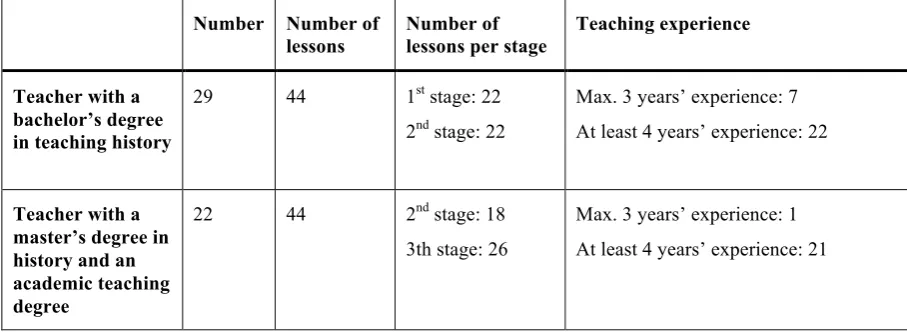
combined history with one or two other subjects. In principle, holders of bachelor’s degrees can only teach history in the first and second stage of secondary education; holders of master’s degrees can only teach in the second and third stage of secondary education. Of the 51 teachers, eight had one to three years of teaching experience, and the rest had more than three years. Eighty lessons were taught by teachers with more than three years of experience.
Table 1: Overview of the teachers participating in the research
Analysis method
This research focuses on the use of primary sources in real classroom practice in the three stages of secondary school history education. As mentioned earlier, primary sources are defined as sources stemming from the period of historical study. Therefore, for example, if a textbook chapter is about the Roman Republic from 509 BC onwards, then a text from the Roman historian Livy from the first century BC is considered a primary source. In a history lesson on the Holocaust, a quotation from a book by Saul Friedländer from 1997 entitled Nazi Germany and the Jews: The Years of Persecution, 1933-1939 (New York: HarperCollins) cannot be considered a primary source. However, if the lesson were about Holocaust memories and historiography in the post-war period, it would be a primary source.
The unit of analysis is the individual primary source used in the classroom. Based on existing literature (Nokes, 2013; Rouet et al., 1996; Van Boxtel & Van Drie, 2012; Van Nieuwenhuyse et al., 2015a; 2015b; Wineburg, 2001) on the use of sources in written history exams, in classroom practice and in history textbooks, an analytical research tool has been built. All the factors involved when dealing with primary sources are framed as categories, and codes for each category are designed. Categories were, among others, the type of sources, the kinds of contextual information provided, the educational use of the sources (in which a distinction was made between illustrative, content-related and strategic knowledge-related use), the presence of corroboration of sources, and the number of questions accompanying the source. For some examples of categories of the analytical research tool, see Appendix 1. The validity of the tool has been tested for this study by two independent raters, resulting in a strong interrater reliability (categories concerning type of source: ƙ=.95; regarding presentation (sourcing and source genesis): ƙ=.84; regarding use/questioning: ƙ=.94). The coding of all primary sources was done in MS Excel, which allows a descriptive quantitative view to be obtained of all categories, and connections between different aspects to be identified. This does not mean, however, that our research takes an exclusively quantitative approach. Rather, a mixed method approach is applied. The categorization helps to assess the quantity of certain uses of sources, and to distinguish different types of presentation and examination of primary sources. Afterwards, the
Number Number of lessons
Number of lessons per stage
Teaching experience
Teacher with a bachelor’s degree in teaching history
29 44 1st stage: 22
2nd stage: 22
Max. 3 years’ experience: 7 At least 4 years’ experience: 22
Teacher with a master’s degree in history and an academic teaching degree
22 44 2nd stage: 18 3th stage: 26
contextualization and use of sources are further analyzed in a qualitative way. Within each category, a more detailed qualitative analysis is done, allowing to distinguish subcategories, for instance regarding the specific ways in which reasoning about sources is stimulated.
Research results
In what follows, we firstly present the number of primary sources (as well as their nature) occurring in the lessons. Afterwards, and most importantly, the results concerning the educational use of sources, including the attention paid to sourcing, contextualization and corroboration, are addressed.
Presence and nature of primary sources
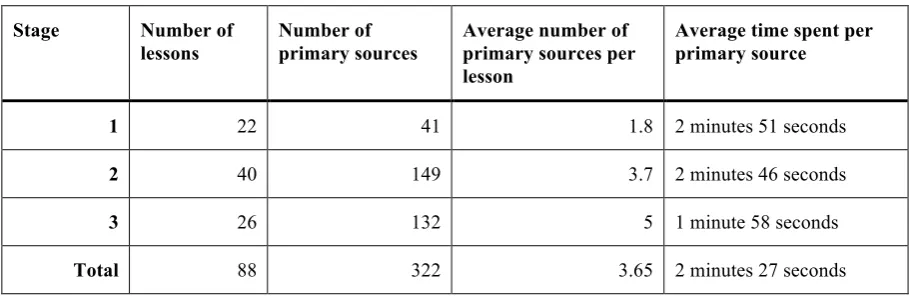
Judging from the classroom observations examined in this research, working with sources is a common practice in Flemish history classes. 322 primary sources were present in the 88 classroom observations. The number of primary sources found in the lessons varied. In 22 lessons, no primary sources occurred. In 17 lessons, one primary source was found. In one lesson, no fewer than 22 primary sources were included (for an overview, see Appendix 2). The average number of primary sources present in the 88 classroom observations was 3.65. It is noticeable that the average per stage increases. At the same time, the average time spent on dealing with each source decreases, especially in the third stage.
Stage Number of lessons
Number of primary sources
Average number of primary sources per lesson
Average time spent per primary source
1 22 41 1.8 2 minutes 51 seconds
2 40 149 3.7 2 minutes 46 seconds
3 26 132 5 1 minute 58 seconds
Total 88 322 3.65 2 minutes 27 seconds
Table 2: Number of primary sources and time spent on them, per stage
A difference was also found according to the level of education of the teachers. Teachers with a bachelor’s degree used an average of 2.8 primary sources per lesson; teachers with a master’s degree used an average of 4.4 primary sources per lesson.
Looking at the kind of primary sources that are used, the preponderance of visual sources is striking. No less than 71% of all primary sources (230 out of 322) were visual sources, such as photographs, paintings, drawings, (photographs of) statues, sculptures, pieces of art, and artifacts; 24% (78 out of 322) were textual sources, including excerpts from treaties, speeches, diaries, chronicles, and newspaper articles; and 5% (14 out of 322) consisted of a combination of textual and visual aspects, such as cartoons and (propaganda) posters.
sources. This difference is partly explained by the fact that the first year of the first stage (7th grade) deals with prehistory, a period in which textual sources did not exist.
Educational use of primary sources
Primary sources were used in different ways. Before addressing the details of how they were used, it is worth examining who engaged with the sources in an active manner: the students or the teachers. Of all 322 primary sources analyzed in this research, 206 (64%) were accompanied by questions for the students, while 116 (36%) were not. This means that students were actively engaged in working with approximately two-thirds of all primary sources. In the other third, it was the teacher who explained about the primary source her/himself. This overall number hides important differences per stage. The number of primary sources accompanied by questions decreases considerably from 83% in the first stage to 66% in the second stage and 56% in the third stage.
In general, teachers tended to use a Socratic dialogue technique when examining sources, sometimes combined with an element of group or individual work. Primary sources were almost never corroborated. Only 10 of the 322 primary sources (3%) present in this research, were corroborated. An example of corroboration concerns the comparison of three medieval chronicles, providing different explanations for why the Frankish army under the guidance of Charles Martel defeated the Arab army at Poitiers in 732. Students were asked to critically compare the sources, to look for differences, and to explain them, taking into account the author of the source and when it was produced (the distance in time between the historical event, and the written account). Sometimes, sources were examined in combination with others, but without corroborating them. One example is when students were asked to deduce several consequences of the industrialization in the 19th century for the working class, from a set of different sources such as newspaper articles and photographs. The sources were examined together, but students were not asked to critically compare the sources with each other, and hence to corroborate them.
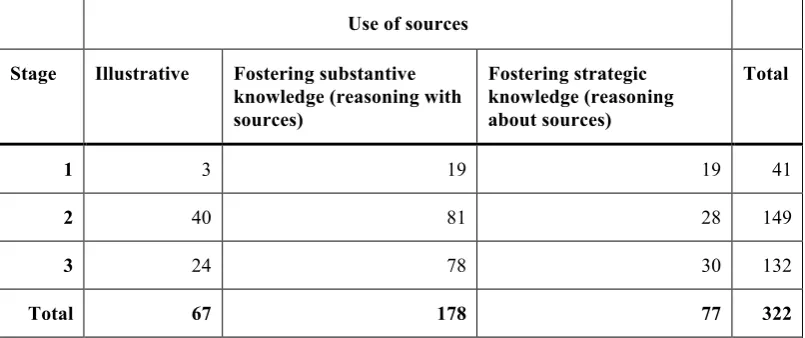
Regarding the educational use of primary sources, three main categories were distinguished during the research. Each of these will be further analyzed.
Table 3: The use of primary sources, per stage Use of sources
Stage Illustrative Fostering substantive knowledge (reasoning with sources)
Fostering strategic knowledge (reasoning about sources)
Total
1 3 19 19 41
2 40 81 28 149
3 24 78 30 132
Illustrative use of primary sources
Overall, 67 out of 322 primary sources (21%) were used as an illustration. Unsurprisingly, perhaps, of these 67 sources, 61 were visual, such as a picture of a Linear B clay tablet, a prehistoric battle axe, a statue of Confucius, a painting of Francisco Pizarro, a statue of Leopold I, the first king of Belgium, a photograph of a British Spitfire fighter aircraft during the Second World War, etc. These sources merely served as an illustration accompanying an explanation of the teacher. They were not accompanied by questions, or explained or analyzed by the teacher.
About two-thirds of the primary sources belonging to this category were not accompanied by any sourcing or contextualization information. In a number of sources, this was due to the fact that the author, the date and the place where the source was produced were not known, for instance in the case of a prehistoric artefact. For other sources, this information was known, but was not mentioned. This especially applied to photographs. It is striking that the name of the photographer was almost never mentioned; the date was sometimes mentioned. This might lead students to the idea that photos neatly and objectively reflect a past reality, rather than considering them as a subjective representation of an author, taking a picture from a specific viewpoint, at a certain time, with a specific intention, and to be published in a specific medium.
In the first stage, only 3 of the 41 (7%) primary sources were purely used as illustrations. Along with the increasing average number of primary sources per lesson throughout the stages, the number of sources, in terms of percentages, used as illustrations also increased. In the second stage, it increased to 27%, while in the third stage it was 18%.
Fostering substantive knowledge
In general, just over half of all primary sources (55%) were used solely to foster students’ substantive historical knowledge, i.e. to reason with sources. Substantive questioning of sources was heavily geared towards an understanding of the event itself. An excerpt from the decrees of the Council of Trent (1545-1563) was mainly examined for its content: ‘What were the conclusions of the Council?’ A cartoon picturing the countries taking part in the London Conference of November 1830 discussing Belgian independence was accompanied by questions such as: ‘Who is making the decisions during the conference? Why are Belgium and the Netherlands in chains? How can you explain each country’s viewpoint on Belgian independence?’ Sometimes, the questions accompanying sources also addressed aspects of continuity and change, or cause and consequence, described by Seixas and Peck (2004) as two key aspects of historical thinking. Examples here included the analysis of a print of a turnplow (asking about the changes it caused in agriculture), or a cartoon of Lenin sweeping the world clean and removing the nobility and bourgeoisie (asking about the causes of Lenin’s actions, and their consequences).
the print who the author could have been, or what views he might have held. This would have been very interesting, since Arthur Szyk was a Polish Jew who worked as a graphic artist, book illustrator, stage designer and caricaturist in Poland and France, and then moved to England in 1937 and to the United States in 1940. His work was characterized by strong social and political engagement. Another example was found in questions related to the headline of the American newspaper Chicago American of February 25, 1935, which ran as follows: ‘Six million perish in Soviet famine’. The questions focused on the famine (in the Ukraine). The source of this article, the Chicago American, was not analyzed. This can be considered a missed opportunity, since this newspaper was an American one, and moreover, was known for its aggressive reporting. Both factors undoubtedly influenced the representation of contemporary conditions in (parts of) the Soviet Union, but this was ignored by the teacher. Such practice entails the risk, similar to what was mentioned earlier in relation to the illustrative use of photos and similar material, that students might start to consider sources as exact mirrors of the past, instead of as subjective representations that need to be critically assessed.
The lack of context information and information about the genesis of a source also hinders in-depth examination. By genesis information is meant information about the specific circumstances in which the source was shaped, for instance the concrete event as a result of which a cartoon was drawn, or the particular political and economic circumstances in which a letter was written or a speech prepared. A characteristic example is that of the Truman Doctrine, as disclosed in a speech to Congress by American President Truman on March 12, 1947. The 12th grade teacher discussing an excerpt from this speech limited his source information to the above-mentioned facts. The specific context in which Truman gave his speech was neglected, although it is important in order to fully understand and accurately analyze the speech. In February 1947, the British government had ceased helping Greece and Turkey, due to a financial crisis. Military and economic help, however, was considered necessary in the West, since communism was gaining strength in Greece, and Turkey was exposed to Soviet Russian pressure. American Secretary of State for Foreign Affairs Dean Acheson feared that, if Greece and/or Turkey chose communism, more countries would follow. The American government therefore planned to take over the British role. President Truman asked Congress to approve a budget of 400 million dollars for military and economic aid to both countries. This context makes it clear that Truman’s speech was not just a speech, but included an important request, which Congress had to approve. He therefore needed to convince them, and used rhetorical strategies to do so. Without this context, however, it is difficult for a teacher to examine those strategies, for example. In the actual lesson in which the Truman speech was used, and no genesis context was provided, the examination of the source was indeed limited to its content: for example, the teacher asked which two ways of life Truman described in his speech, and which task he reserved for the United States of America.
One-fifth (21%) of the primary sources that are solely used to foster students’ substantive historical knowledge were accompanied with genesis information. In the use and examination of those sources, however, nothing was done with this information. For example, one teacher dealt with propaganda in the early years of the Soviet Union under Lenin at great length. Afterwards the teacher showed a propaganda poster from 1922, yet only asked the students what they saw. The teacher did not encourage any reasoning about the specific propaganda character of the poster.
In the third stage, 70% of all primary sources were accompanied with some source and context information. As mentioned earlier, in many cases, the information was very basic. This seemed to hinder not only in-depth examination of the source, but also reasoning about the source.
Fostering strategic knowledge (including substantive knowledge)
In our analysis, three different ways of stimulating students’ reasoning about sources come to the fore: (1) teachers draw attention to the reliability and impartiality of primary sources; (2) they pay attention to the analysis of the author’s perspective; and (3) they instill reflection on the significance and effects of a primary source. Below, these three subcategories are analyzed in more detail.
Table 4: Subcategories in the strategic use of primary sources, per stage
Thirty of the 322 sources (9%) were examined using the fixed set of questions relating to the historical method as presented in history textbooks, aimed at determining whether a primary source is reliable and impartial. A good example of the application of this set of questions was found in a lesson on Charlemagne, in which excerpts were analyzed from Einhard’s Vita Karoli Magni and from the Chronicles of the Abbey of Lorsch, by an anonymous author. Both excerpts addressed the coronation of Charlemagne, and were accompanied by some source and context information, which served as a basis for further analysis. Questions are asked about whether the author was an eye-witness of the events he described, whether he was objective or subjective, and hence whether the information was reliable or not. The conclusions were that Einhard was an eye-witness, but since he was Charlemagne’s counsellor, he was subjective, so this source was not to be fully trusted. The anonymous author of the other source was not an eye-witness. He was probably a monk, but since no other information was available, the objectivity and trustworthiness of the source could not be fully judged. While the questions and the conclusions were of course legitimate and very interesting, they should, however, not have been treated as the end point of the analysis, but only as the beginning. Questions could and should have also been asked about what one could learn from the sources, what their significance was in building an account of the life of Charlemagne, and how to explain the different accounts of the authors. Furthermore, it should always be taken into account that the reliability of a source is related to the specific questions one asks.
attention to the fact that sources have an author who gave shape to the source with a certain intention, and/or an audience for whom the source was meant. This encouraged students to analyze and interpret the source from this perspective, instead of treating it as an objective account and a mere mirror of a past event, or limiting the analysis to the conclusion of subjectivity. Most of the primary sources used in this respect were accompanied with some source and context information. The amount of information varied. Several sources came with extensive source and context information. At other times, only a small amount of information was provided, because students were being asked to think about it themselves. An example was the group of questions accompanying a set of three primary sources about Charles Martel and the Battle of Poitiers (732), which was mentioned earlier as an example of corroboration. All sources were accompanied by some source and context information, involved in the further examination. For each of the corroborated sources – two Christian chronicles and one Arabic source – students were asked who the author was, and how and why this influenced the representation of Charles Martel and the Arabs. The same applied to a series of questions accompanying a print of the Catholic Inquisition torturing people accused of heresy. The teacher drew students’ attention to the author of the print, a Protestant, and asked the students to reflect on the implications of this finding. Why would he have made this print, with what intention, and how would this have influenced the representation of the Inquisition? In this example, the source information was built upon to elaborate on the author’s perspective and its influence on the specific representation. Similar questions guided an excerpt from a report by Willem Bosman, a slave trader and leading figure in the Dutch West Indian Company in the 17th century. In his report, he pictured black people as ‘sly, villainous, deceptive, and only rarely trustworthy’. According to Bosman, they were ‘villains, born and bred, slow, lazy and work-shy’; he also characterized them as ‘very carefree and dumb’. The teacher asked students to analyze this excerpt, keeping the author’s position and intentions in mind (justifying the slave trade), hence at the same time fostering students’ contextual historical empathy (Ashby & Lee, 1987). The teacher asked students to explain why Bosman described black people in this way, taking the specific historical context into account (the lucrative slave trade).
While analyzing the author’s perspective, teachers sometimes also drew specific attention to the language an author used in the source. In the analysis of an excerpt from speeches by the fascist leaders Mussolini in Italy and Hitler in Germany, a teacher referred to the theories of the Jewish-German professor of linguistics Victor Klemperer, drawing students’ attention to the fact that fascists attributed a negative connotation to democracy and a positive one to authoritarian regimes through their use of words. This teacher also analyzed the word ‘fanatical’ with his students, and showed them how the Nazis attributed positive significance to it. Such questions or observations, however, were exceptional. The language and rhetoric used in a text (whether a speech or another kind of textual source) were almost never the object of examination.
Looking in general at the sources through which students’ strategic knowledge was fostered, it can be noted that seventeen out of the 51 teachers used primary sources to reason about sources. Ten of these had a bachelor’s degree and seven had a master’s degree. All of them had at least three years of teaching experience. Taking into account the balance between teachers with a bachelor’s and a master’s degree (29 to 22), it seems as if the level of training did not generate a clear effect. Furthermore, differences throughout the stages occurred. It was notable that the analysis of the reliability and impartiality of sources through the application of the fixed set of questions of the historical method especially occurred in the first and second stages. In the first stage, 29% of all primary sources were used in this way. This seems logical, as it is in the first stage that the historical method needs to be taught to students, and is required by the standards. While in the second stage, some attention is still paid to this method (11% of all sources were used in this way), in the third stage, this disappears almost completely (1.5%), yet it is not really replaced by other questions oriented towards reasoning about sources.
Conclusion and discussion
This research investigated, for the three stages of secondary school history education in Flanders, the educational use of primary sources. More specifically, it examined whether they are used to encourage reasoning with or about sources. It included the examination of the kind of primary sources that are used (visual versus textual), the source and context information accompanying sources, and the extent of corroboration. Eighty-eight classroom observations, involving 51 teachers and including 322 primary sources, were analyzed. A first finding is that primary sources played an important part in the 88 classroom observations. This clearly reflects the importance the Flemish history standards attribute to the use of sources and the prominence of sources in history textbooks, and also reflects developments in history education in other countries. The vast majority of primary sources present in the 88 lessons were visual, which confirms Kleppe’s finding (2010) for Dutch history textbooks. Looking at the differences between stages, it is notable that in the first stage, significantly fewer primary sources were included in the lessons, on average, than the second and third stage. On the other hand, this stage involved comparatively more visual sources, which can be related to the fact that in the 7th grade prehistory is addressed, a period in which textual sources did not exist. Another
explanation might perhaps be found in the perception by teachers of young students’ learning capacities. Teachers might consider visual sources to be easier to deal with for younger students than textual sources. The standards do not give any indication about this, however.
hence still in the early stages of teaching, did not engage with the constructed nature of history and with reasoning about sources. They used primary sources especially to impart content-related substantive knowledge to students.
How can we explain the comparatively significant amount of attention given by Flemish history teachers to reasoning about sources, and hence to revealing the constructed nature of historical knowledge? The Flemish history standards do encourage the use of sources, albeit not in a very disciplinary way. In the first stage, for instance, they encourage the application of the historical method, without elaborating on that very much, while in the second and third stage, students are supposed to build upon this, while dealing with sources in a more self-reliant way. The rather vague character of the standards’ guidelines is also reflected with respect to the notion of corroboration, for instance. The standards only mention this in terms of ‘students should be able to compare information’, but do not further elaborate on this notion. This coincides with our finding that corroboration of sources was almost completely absent from our data set. A similar observation can be made about the strategies of sourcing and contextualization, which are not explicitly mentioned in the standards. We found that two-thirds of all primary sources were provided with some source information. Most of this ‘sourcing’ information, however, appeared to be very basic, and lacked sufficient explanation. Information about the genesis of sources was provided in around 20% of all primary sources in each stage. The standards’ failure to make an explicit connection between source and context information on the one hand and educational use on the other hand is clearly reflected in our research. In the analysis of sources, the source and context information is in many cases not related to the critical analysis of the source. This often results in a use of the source, merely as an illustration, or limited to reason with. On the other hand, the finding remains that a significant amount of attention is given by Flemish history teachers to reasoning about sources. This shows that several history teachers in Flanders are acquainted with the constructed nature of historical knowledge, and apparently consider it important to at least occasionally touch upon it in their classroom practice. They might be encouraged, in doing so, by history teachers’ continuing professional development initiatives in Flanders. For during the last decade, many of these initiatives have paid a lot of attention to concrete teaching strategies oriented towards fostering students’ strategic knowledge.
The above-mentioned practices relating to sourcing, contextualization and educational use of sources do not just reflect the standards. The influence of history textbooks can be discerned here as well. For, as mentioned earlier, Flemish textbooks offer many sources and accompanying questions, yet they often only provide some basic source information (mostly author and date), and do not further contextualize them. Most of the questions are purely content-related and hence oriented towards reasoning with sources. Such questions are certainly legitimate, but, as scholars in the field of history education emphasize, it is also important to pay attention to the source itself, and what it does or does not do – in short to also reason about sources (VanSledright & Limón, 2006). In order to develop a criterialist stance (Maggioni et al., 2009; Maggioni, 2010), students need to understand that sources are never a mirror of the past, are always biased, are not a collection of facts, and never provide a complete and objective account of a past event. In this respect, it is absolutely necessary to include the source and context information in the analysis and examination of the source, either by providing this information in advance or by including it in reflective questions addressing its influence on the representation of the source. For the most part, however, Flemish history textbooks tend to cling to realist approaches of historical practice rather than perspectivist ones.
sources are more accompanied by questions, in the first stage; fourthly, compared with each other in terms of percentages, sources are used more to foster students’ strategic knowledge in the first stage. The examination of the reliability and impartiality of primary sources especially occurs in the first stage, in line with the Flemish history standards, requiring that teachers teach the students to apply the historical method, via a set of specific questions. In this respect, it needs to be noted that history is not treated as a separate subject until secondary education in Flanders. In primary education, it is part of a larger subject called ‘world orientation’, to which other disciplines such as geography and biology belong too. The use of sources is hence only addressed in general terms here: pupils must be able to consult sources according to their level. They should also be able to distinguish fact from opinion. As a result, only from the first stage of secondary education on can a profound instructional process of learning how to deal with primary sources in history be developed. In order to do this, teachers select a small number of primary sources, which they subsequently explore and investigate extensively, together with their students. The focus in the first stage really is on whether a primary source is reliable and impartial. Questions seldom go beyond those notions.
One might perhaps have expected that reasoning about sources would have been elaborated on and taught more extensively in the subsequent second and third stages, especially since from the second stage onwards, teachers might have (second stage) and certainly have (third stage) a master’s degree in history. A master’s degree is of course not conclusive evidence of superior competence, but on the other hand it signifies teachers who are more likely to be acquainted with historical research and the use of sources. However, such further elaboration of and attention to reasoning about sources occurs only rarely. The analysis shows an increase in the number of primary sources present in the lessons, but a decrease in reasoning about sources: from 46% of all sources in the first stage, to 19% in the second and 23% in the third stage. Given the finding that in the second, and certainly in the third stage, more sources are used, but less time is spent on them, and less questions are asked about them, it seems as if, contrary to the standards’ requirements, history education becomes more teacher-centered instead of student-centered (and stimulating self-reliance). This can be connected to the intention of many Flemish history teachers, especially of those holding a master’s degree and hence teaching in the second and third stage, to pursue a 'complete' overview of history in terms of historical content. Although the standards do not prescribe this, Flemish history teachers indeed nevertheless tend to give priority to providing such a 'complete' historical overview as it is presented in most textbooks. For, even though the time periods to be treated grow shorter from the first to the third stage, the textbooks become significantly more extensive. Teachers aiming to treat the complete textbook and fostering students’ substantive knowledge, hence lack time to reason intensively about sources and foster students’ strategic knowledge.
hand, research shows that such perseverance can indeed bring students to a criterialist stance (Britt & Aglinskas, 2002; De La Paz, 2005; Nokes at al., 2007; Nokes, 2013; Reisman, 2012; Van Boxtel & Van Drie, 2012). It is not an easy job, yet it is certainly not an impossible one either.
References
Ashby, R. (2011). Understanding historical evidence: teaching and learning challenges. In I. Davies (Ed.), Debates in history teaching (pp. 137-147). London: Routledge.
Ashby, R., & P. Lee (1987). Children's concepts of empathy and understanding in History. In C. Portal (Ed.), The History Curriculum for Teachers (pp. 62-88). London: Falmer.
Barton, K. C. (2005). Primary sources in history: breaking through the myths. Teaching History, 86(10), 745-753.
Barton, K. C., & Levstik, L. S. (2004). Teaching history for the common good. Mahwah, N.J.: Lawrence Erlbaum Associates.
Bertram, C. (2008). ‘Doing history?’: Assessment in history classrooms at a time of curriculum reform. Journal of Education, 45, 155-177.
Boutonnet, V. (2013). Les ressources didactiques: typologie d’usages en lien avec la méthode historique et l’intervention éducative d’enseignants d’histoire au secondaire [Didactic resources: typology of uses of teaching materials in relation to the historical method and the educational intervention of secondary school history teachers] (Unpublished doctoral thesis). University of Montreal, Montreal, Canada.
Britt, M. A., & Aglinskas, C. (2002). Improving students’ ability to identify and use source information. Cognition and Instruction, 20(4),485-522.
Chapman, A. (2011). Historical interpretations. In I. Davies (Ed.), Debates in history teaching
(pp. 96-108). Abingdon (UK)/New York (NY): Routledge.
Counsell, C. (2011). Disciplinary knowledge for all. The secondary history curriculum and history teachers' achievement. Curriculum Journal, 22(2), 201-225.
Crismore, A. (1984). The rhetoric of textbooks: Metadiscourse. Journal of Curriculum Studies, 16(3), 279-296.
De La Paz, S. (2005). Effects of historical reasoning instruction and writing strategy mastery in culturally and academically diverse middle school classrooms. Journal of Educational Psychology, 97, 139-156.
Flemish Ministry of Education and Training (2000 a). Secundair onderwijs, derde graad ASO: uitgangspunten bij de vakgebonden eindtermen geschiedenis [Secondary education, third stage of general education: basic principles of the history standards]. Retrieved February 26, 2016, from http://www.ond.vlaanderen.be/curriculum/secundair-onderwijs/derde-graad/aso/vakgebonden/geschiedenis/algemeen.htm.
Flemish Ministry of Education and Training (2000 b). Secundair onderwijs, derde graad ASO: vakgebonden eindtermen geschiedenis [Secondary education, third stage of general
Flemish Ministry of Education and Training (2000 c). Secundair onderwijs, eerste graad ASO: vakgebonden eindtermen geschiedenis [Secondary education, first stage of general education: history standards]. Retrieved February 26, 2016, from
http://www.ond.vlaanderen.be/curriculum/secundair-onderwijs/eerste-graad/aso/vakgebonden/geschiedenis/algemeen.htm.
Grant S. G., & Gradwell, J. M. (2005). The sources are many: exploring history teachers’ selection of classroom texts. Theory & Research in Social Education, 33(2), 244-265. Havekes, H., Arno-Coppen, P., Luttenberg, J., & Van Boxtel, C. (2012). Knowing and doing
history: a conceptual framework and pedagogy for teaching historical contextualization.
International Journal of Historical Learning, Teaching and Research, 11(1), 72-93. Haydn, T. (2011). The Changing Form and Use of Textbooks in the History Classroom. In S.
Popp, J. Schumman, & M. Schmitz (Eds.), International Society for History Didactics. Analyzing Textbooks: Methodological Issues (pp. 67-88). Schwalbach: Wochenschau Verlag.
Hynd, C. R. (1999). Teaching students to think critically using multiple texts in history.
Journal of Adolescent and Adult Literacy, 42,428-436.
Kleppe, M. (2010). Photographs in Dutch History Textbooks: Quantity, type and educational use. In C. Heinze, & E. Matthes (Eds.), Das Bild im Schulbuch (pp. 261-272). Bad
Heilbrunn: Verlag Julius Klinkhardt.
Lee, P. (1983). History Teaching and Philosophy of History. History and Theory,22(4), 19-49.
Le Marec, Y. (2011). Pour un usage pragmatique des manuels d’histoire [Towards a
pragmatic use of history textbooks]. In M.-A. Ethier, D. Lefrançois, & J.-F. Cardin (Eds.),
Enseigner et apprendre l’histoire. Manuels, enseignants et élèves [Teaching and learning history. Textbooks, teachers and learners] (pp. 139-158). Quebec: Presses de l’Université de Laval.
Magalhães, O. (2005). Portuguese history teachers’ ideas about history. In R. Ashby, P. Gordon, & P. Lee (Eds.), Understanding history: international review of history education
(Vol. 4, pp. 136-147). London/New York: Routledge.
Maggioni, L. (2010). Between facts and opinions: an exploration of adolescents’ ideas about the nature of historical knowledge. Paper presented at the 21st International Congress of Historical Sciences, Amsterdam.
Maggioni, L., VanSledright, B., & Alexander, P. (2009). Walking on the borders: a measure of epistemic cognition in history. The Journal of Experimental Education, 77(3), 187-213. McCrum, E. (2013). History teachers’ thinking about the nature of their subject. Teaching and
Teacher Education, 35, 73-80.
Moisan, S. (2010). Fondements épistémologiques et représentations sociales d’enseignants d’histoire du secondaire à l’égard de l’enseignement de l’histoire et de la formation citoyenne [Epistemological foundations and social representations of secondary school history teachers regarding history teaching and citizenship education] (Unpublished doctoral thesis). University of Montreal, Montreal, Canada.
Nokes, J. D. (2010). Observing literacy practices in history classrooms. Theory & Research in Social Education, 38(4), 515-544.
Nokes, J. D. (2011). Recognizing and addressing the barriers to adolescents’ “reading like historians”. The History Teacher, 44(3), 379-404.
Nokes, J. D., Dole, J. A., & Hacker, D. J. (2007). Teaching high school students to use heuristics while reading historical texts. Journal of Educational Psychology, 99, 492-504. Pagès, J., & Santisteban, A. (2011). Enseigner et apprendre l’histoire en Catalogne [Teaching
and learning history in Catalonia]. In M.-A. Ethier, D. Lefrançois, & J.-F. Cardin (Eds.),
Enseigner et apprendre l’histoire. Manuels, enseignants et élèves [Teaching and learning history. Textbooks, teachers and learners] (pp. 359-376). Québec: Presses de l’Université de Laval.
Paxton, R. J. (1999). A deafening silence: history textbooks and the students who read them.
Review of Educational Research, 69(3),315–337.
Perfetti, C. A., Britt, M.A., & Georgi, M. C. (1995). Text-based learning and reasoning: Studies in history. Hillsdale, NJ: Erlbaum.
Reisman, A. (2012). Reading like a historian: a document-based history curriculum intervention in urban high schools. Cognition and Instruction, 30(1), 86-112.
Rouet, J. F., Britt, M. A., Mason, R. A., & Perfetti, C. A. (1996). Using multiple sources of evidence to reason about history. Journal of Educational Psychology, 88(3), 478-493. Seixas, P. (2000). 'Schweigen! Die Kinder! Or, does postmodern history have a place in the
schools? In P.N. Stearns, P. Seixas, & S. Wineburg (Eds.), Knowing, Teaching and
Learning History. National and International Perspectives (pp. 19-37). New York/London: New York University Press.
Seixas, P. (1998). Student teachers thinking historically. Theory & Research in Social Education, 26(3), 310-341.
Seixas, P. (1993). The community of inquiry as a basis for knowledge and learning: the case of history. American Educational Research Journal, 30(2), 305-324.
Seixas, P., & Peck, C. (2004). Teaching historical thinking. In A. Sears, & I. Wright (Eds.),
Challenges and Prospects for Canadian Social Studies (pp. 109-117). Vancouver: Pacific Educational Press.
Stahl, S. A., Hynd, C. R., Britton, B. K., McNish, M. M., & Bosquet, D. (1996). What happens when students read multiple source documents in history? Reading Research Quarterly, 31(4),430-456.
Tutiaux-Guillon, N. (2006). L’enseignement de l’histoire en France: les pratiques de classe [History education in France: classroom practices]. In E. Erdmann, R. Maier, & S. Popp (Eds.), Geschichtsunterricht international / Worldwide Teaching of History /
L’enseignement de l’histoire dans le monde (pp. 301-322). Hannover: Verlag Hahnsche Buchhandlung.
VanSledright, B., & Limón, M. (2006). Learning and teaching social studies: a review of cognitive research in history and geography. In P. A. Alexander, & P. H. Winne (Eds.),
Handbook of educational psychology (pp. 545-570). Hillsdale NJ: Erlbaum.
Van de Voorde, H. (Red.) (2008). Historia 5. Kapellen: Pelckmans.
Van Drie, J., & Van Boxtel, C. (2008). Historical reasoning: towards a framework for analyzing students’ reasoning about the past. Educational Psychology Review, 20(2), 87-110.
van Hover, S., & Yeager, E. (2003a). Challenges facing beginning history teachers: an exploratory study. International Journal of Social Education, 19(1), 8-21.
van Hover, S., & Yeager, E. (2003b). Making students better people? A case study of a beginning history teacher. International Social Studies Forum, 3(1), 219-232. van Hover, S., & Yeager, E. (2007). ‘I want to use my subject matter to …’: the role of
purpose in one U.S. secondary history teacher’s instructional decision making. Canadian Journal of Education, 30(3), 670-690.
Van Nieuwenhuyse, K., Wils, K., Clarebout, G., Draye, G., & Verschaffel, L. (2015a). Making the constructed nature of history visible. Flemish secondary history education through the lens of written exams. In A. Chapman & A. Wilschut (Eds.), International Review of History Education. Joined-up history: New directions in history education research (pp. 311-333), Charlotte, NC: Information Age Publishing.
Van Nieuwenhuyse, K., Wils, K., Clarebout, G., Draye, G., & Verschaffel, L. (2015b). The present in Flemish secondary history education, through the lens of written history exams.
McGill Journal of Education, 50 (1), 1-19.
Van Nieuwenhuyse, K. (2016). Reasoning with and/or about sources on the Cold War? The use of primary sources in English and French history textbooks for upper secondary education. International Journal for History and Social Sciences Education, 1 (1), 19-52. Wineburg, S. (2001). Historical Thinking and Other Unnatural Acts: Charting the Future of
Teaching the Past. Philadelphia: Temple University Press.
Wineburg, S. (1991). On the reading of historical texts: Notes on the Breach between School and Academy. American Educational Research Journal, 28(3), 495–519.
Wineburg, S., Martin, D., & Monte-Sano C. (2013). Reading like a historian. Teaching literacy in Middle and High School History Classrooms. New York-London: Teachers College Press.
Yilmaz, K. (2008). Social studies teachers' conceptions of history: Calling on Historiography.
Appendix 1: Extracts from some categories of the analytical research tool used during this research
CATEGORY 1: TYPE OF SOURCE 1. Textual source
2. Visual source 3. Combination 4. Other
CATEGORY 2: CONTEXT INFORMATION ACCOMPANYING THE SOURCE 1. None
2. Context information is provided
3. Context information is included in the source itself
4. Context information is not provided, because it is asked for in the questions 5. Context information is partly provided, and partly asked for
6. Context information is partly provided, and partly included in the source itself 7. Context information is partly included in the source itself, and partly asked for
8. Context information is partly provided, partly asked for, and partly included in the source itself CATEGORY 3: TYPE OF CONTEXT INFORMATION PROVIDED
1. Sourcing (author and/or date and/or place) 2. Genesis
3. Sourcing and genesis
CATEGORY 4: USE OF THE SOURCE 1. Purely illustrative
2. Content-related (reasoning with sources)
3. Strategic knowledge-related (reasoning about sources) … (combinations)
CATEGORY 5: CORROBORATION OF SOURCES 1. Yes, with another primary source
2. Yes, with a secondary source 3. No
CATEGORY 6: NUMBER OF QUESTIONS ACCOMPANYING THE SOURCE 0 = 0
1 = 1 2 = 2 …
Appendix 2: Number of primary sources appearing in the 88 classroom observations, per lesson
Number of primary sources used in one lesson
Number of lessons in which X primary sources appear
0 22
1 17
2 8
3 4
4 4
5 4
6 10
7 4
8 4
9 2
10 4
11 2
12 2
22 1
Total 88
About the Authors
Karel Van Nieuwenhuyse* is since 2013 assistant professor in History Didactics, in the Faculty of Arts, University of Leuven, Belgium. His main research interests related to history education are the position of the present, the use of sources, students’ historical narratives and the connection with their identification, and historical representations of the colonial past. Hanne Roose was research assistant in History Didactics, in the Faculty of Arts, University of Leuven, Belgium. She currently teaches history in secondary school education, and is teaching assistant in the history department, University of Brussels, Belgium.
Kaat Wils is is professor in European cultural history and head of the Research Group Cultural History since 1750 at the University of Leuven, Belgium. Her research fields include contemporary historical culture, the history of history education and the history of 19th and 20th century scientific and intellectual culture.
Fien Depaepe is since 2013 assistant professor in educational sciences at the KU Leuven, Center for Instructional Psychology and Technology. Her research deals with cognitive (e.g. content knowledge, pedagogical content knowledge, general pedagogical knowledge) and affective factors (e.g. beliefs, attitudes) that influence teaching and learning different disciplines.
Lieven Verschaffel obtained in 1984 the degree of Doctor in Educational Sciences at the University of Leuven, Belgium. Since 2000 he is a full professor in educational sciences of that same university, with a main interest educational psychology and more particularly learning and teaching in specific domains such as mathematics, languages, history, and music.
Endnotes
1Based on the official attainment targets, the differenteducational networks in Flanders further design theirown
curriculum. Because this would take us into too much detail, we pay no further attention to the different curricula in this article, even though we included this distinction in our research.