
A POLYMER-ORGANOCLAY NANOCOMPOSITE FOR
SIMULTANEOUS REMOVAL OF CHROMIUM(VI) AND
ORGANIC DYES
Adel A. El-Zahhar
[a,b]Keywords: Polymer; organoclay; composite; chromium(VI); dyes; poly(acrylonitrile); kaolinite; methylene blue; adsorption
Synthesis of polyacrylonitrile (PAN)-organoclay nanocomposite was studied through grafting of PAN onto organophilic kaolinite. The organophilic kaolinite was prepared by treatment of kaolinite with different ratios of hexadecylethyldimethylammonium (HDEDMA) to kaolinite. The chemical grafting polymerization of acrylonitrile (AN) onto organophilic kaolinite was performed. The synthesized polymer-organoclay nanocomposite was studied for simultaneous adsorption of Cr(VI) and methylene blue dye (MB) from aqueous solutions. The results of Cr(VI) or the dye adsorption revealed that the adsorbed amounts increased with increasing HDETMA concentration. The removal percentage of Cr(VI) reached more than 98 % if individually studied, while 96 % was obtained when competing with dye. Also the adsorption of Cr(VI) was potentially influenced by its concentration in solution. The isothermal studies were performed using Langmuir and Freundlich models. The maximum calculated adsorption capacity was found to be 127 mg g-1 and 68 mg g-1 for Cr(VI) and methylene
blue, respectively for individual adsorption, while in simultaneous adsorption their adsorption capacity was not affected by the other.
Corresponding Authors Tel: +966583186281
E-Mail: [email protected]
[a] Chemistry Department, College of Science, KKU, P.O. 9004, Abha 61321, KSA
[b] Nucl. Chem. Dept., Atomic Energy Authority, P.C.13759,Cairo,Egypt
Introduction
Clays are used in many scientific applications and technological fields, due to their natural availability and the capacity for the chemical and physical modifications. Clays are characterized by their high platelet aspect ratio, swelling ability and some features that make clays very desirable in the industrial and scientific applications.1 Clays contain
inorganic cations in their basal spacing, which make them hydrophilic in nature. This nature renders clays ineffective adsorbents for hydrophobic and aliphatic compounds.2 The
inorganic ions present in the clay can be effectively replaced by organic cationic surfactant molecules through cation-exchange reactions. This replacement leads to expansion of the interlayer spacing which leads to an increase in the basal spacing. As a result, the swelling percentage and the potential thermodynamical interactions increase significantly with increasing basal spacing. The unique properties of unmodified and modified clay, renders these materials finding industrial applications, additives, as thickeners in coating products, glues, plastisols, drilling fluids3 and for wastewater treatment,4 and other
technological applications.5-8 In recent years, clays have find
use in the field of materials science such as solid phase polymeric nanocomposites.9 Polymer clay composites have
been accepted major importance due to their major criteria for utilization in some advanced technology. The high surface area of polymer clay composites (reached 750-800 m2 g-1), due to exfoliation degree of polymer composite
enhance the physicochemical properties of the produced composites.10 The low coast and characteristics of
unmodified and modified clay minerals also lead to unique
superior applications for the produced composite.11 Clay
minerals of layered structure, e.g. montmorillonite, bentonite and etc. have exchangeable hydrated cations (Na+
and Ca2+), these ions are responsible for the advanced
adsorption properties of these materials.12 In this connection,
the use of organically modified clays for polymer clays nanocomposite preparation has started in the early 1990’s.13,14 The modification of clay includes the exchange
of amine salts with the exchangeable cations in the clay with varied amine structure and concentration.15 Different
research papers were published dealing with organically modified clay polymer composites for different applications.16,17 The organic modification is essential for
the compatibility of polymer with clay, which leads to a decrease in the surface energy and increase the surface compatibility.
Experimental
Materials
All chemicals were used as received without purification. Kaolinite was purchased from Sigma-Aldrich, acrylonitrile (AN) was obtained from Merck Co., hexadecylethyldimethyl ammonium bromide (HDEDMA) was obtained from Aldrich Chemical Company Inc. and potassium peroxysulphate was provided by Merck. All other chemicals were of reagent grade and were used without further purification.
Preparation of polymer organo-clay composite
yield different concentrations of amines, from 0 % to 100 % of the cation exchange capacity The mixtures were agitated for 24 h, centrifuged washed, dried at 80 oC, activated for 1
h at 105 °C in oven, and mechanically ground
.
The polymer clay composite was prepared as: in a three-neck round bottomed flask equipped with a magnetic stirrer and a reflux condenser, HDEDMA–kaolinite, acrylonitrile, and initiator potassium peroxysulphate were placed in DMF. The flask was purged by nitrogen for 20 min, heated and magnetically stirred at 90–95 °C for 8 h. Then the reaction mixture was transferred into another flask and extracted with CH2Cl2 for 72 h. The produced polyacrylonitrile –
organokaolinite (PAN-OK) composite was then dried at 40 °C for 24 h.
Sorption studies of Cr(VI) and MB using PAN-OK
The adsorption of Cr(VI) was studied using PAN-OK through mixing 0.05 g of the dry composite with 25 ml of chromium solution of different concentration with agitation for the appropriate time. The concentration of Cr(VI) was measured before and after equilibrium using a UV-spectrometer and 1,5-diphenylcarbazide at λmax = 540 nm.
The adsorption of methylene blue (MB) dye was performed by immersing the 0.05 g of composite adsorbent into 25 mL of dye solution with varied concentration. All adsorption experiments were examined through a batch method on a stirrer with a constant speed at 120 rpm. The amount of adsorbed MB was evaluated using a UV spectrometer at λmax = 590 nm.
The amount adsorbed Cr(VI) or MB at equilibrium (qt, mg
g-1) was calculated using following as:
(1)
where,
C0is the initial concentration (mg L-1),
Ct is the equilibrium concentration in the solution at
time t, (mg L-1),
V is the volume of solution used (L), and
m is the weight of composite (g).
Results and Discussions
Characterization of PAN-OK composite material:
The IR spectrum reveled that, absorption bands appeared at 2980 cm−1 and 1450 cm−1 that can be attributed to the stretching of the aliphatic C–H bonds, 3632 cm -1 for OH
groups, 2927 cm-1 and 2855 cm-1 for the amine group of
surfactant, 2246 cm-1 for C≡N groups of the polymer moiety,
the band at 1040 cm−1 for Si–O of clay moiety and the strong band at 1000–1160 cm−1 is likely due to siloxane (Si–
O–Si) bond. X-ray diffraction patterns of PAN grafted organoclay showed a strong peak at 2θ = 3.43° and 5.14o
indicating that the interlayer d-spacing of the clay was slightly decreased due to grafting of polymer onto the clay surface.
Sorption of MB and Cr(VI) on PAN-OK composite:
The adsorption of both MB and Cr(VI) was studied individually and in presence of each other using the prepared PAN-OK composite.
Effect of pH on the adsorption of MB and Cr(VI) using PAN-OK composite:
The removal of Cr(VI) and MB from aqueous solutions was studied individually using PAN-OK at different pH and the results are given in Figure 1. The results show that the amount adsorbed of Cr(VI) increases greatly with increasing pH and reached its maximum value (23mg/g) at pH 6-7. At pH 7 the more stable species of Cr(VI) is CrO42-, while pH
lower than 7 a larger dichromate (Cr2O72-) ion is formed, the
smaller CrO42- is more easy to be adsorbed at pH 7 than
Cr2O72-.18 At pH higher than 7 the hydrolyzed species of
Cr(VI) are formed and the adsorption of Cr(VI) is decreased.
(a)
(b)
Figure 1. Effect of pH on the adsorption of Cr(VI) and MB on PAN-OK (0.05 g of composite, 25 mL of solution, 1 h, [Cr]=50 (a) or 250 (b) mg L-1, respectively.
0 t
t
( )
V C C q
m
2 4 6 8 10 12 14
5 10 15 20 25 30
A
m
o
u
n
t
a
d
s
o
rb
e
d
o
f
C
r(VI
),
q
(m
g
/g
)
2 4 6 8 10 12 14
40 50 60 70 80 90 100 110 120 130
A
m
o
u
n
t
a
d
s
o
rb
e
d
o
f
MB
,
q
(m
g
/g
Concerning the effect of pH on the adsorption of MB using OK, the amount adsorbed of MB on the PAN-OK increased with increasing pH within the range 2-7. At pH higher than 7 the amount adsorbed of MB on PAN-OK is decreased. This finding could be explained on the bases of protonation of adsorbent active sites at low pH. The dependence of adsorption on pH reflects the participation of ion exchange in the adsorption process.18
Effect of HDEDMA concentration on adsorption of MB and Cr(VI)
The adsorption of both MB and Cr(VI) individually on PAN-OK was studied as a function of HDEDMA concentration adsorbed onto kaolinite. The results in Figure 2 and Figure 3 show that the adsorbed amount of Cr(VI) and MB increased with increasing the concentration of HDEDMA in the clay. This observation could be due to increasing the surface active sites on the composite adsorbent with increasing HDEDMA concentration.
Figure 2. Effect of HEDMA concentration on the adsorption of Cr(VI) onto PAN-OK composite; wt-0.05 g, vol-25 mL, pH-6.8 [Cr]-50 mg L-1
Figure 3. Effect of HEDMA concentration on the adsorption of MB onto PAN-organoclay composite; wt-0.05 g, vol-25 mL, pH-6.8 [MB]-250 mg L-1
Effect of initial concentration of Cr(VI) or MB
The equilibrium sorption capacity for both Cr(VI) and MB individually was studied as a function of their initial concentration in the aqueous solution with measuring their equilibrium concentration. The results in Figure 4 and Figure 5 show the sorption isotherm curves for adsorption of both Cr(VI) and MB, respectively. The shapes of these figures show slight deviation from linearity, with increasing the curvature at higher concentrations. This observation indicates ‘‘non-cooperative sorption’’. This type of sorption occurs when the sorbate–sorbent interaction is more powerful than sorbate–sorbate interaction. The Cr(VI) or MB molecules have high affinity to interact with the sorbent surface groups than to each other (forming cluster).
Figure 4. Adsorption isotherm of Cr(VI) onto PAN-organoclay composite; wt, 0.05 g, vol. 25 pH 6.8, time 60 min, temp. 25 °C.
Figure 5. Adsorption isotherms of MB dye onto PAN-organoclay composite; wt, 0.05 g, vol. 25 pH 6.8, time 60 min, temp. 25 °C
Adsorption Isotherms
The results in Figures 4 and 5 show the measured adsorption capacity with the equilibrium concentration of Cr(VI) and MB on PAN-OK. These results reflect that the adsorption capacity of MB is significantly higher than that of Cr(VI), indicating the potential removal of MB using PAN-OK and the higher affinity of MB to PAN-OK than Cr(VI). This finding could be explained on the basis of the strong interaction of MB with the surface groups as it usually coordinated to the surface hydroxyl groups.19,20
0 100 200 300 400 500 600 0
5 10 15 20 25 30
A
m
o
u
n
t
a
d
s
o
rb
e
d
o
f
C
r(VI
)
(m
g
/g
)
Time (min)
100% CEC 80% CEC 40% CEC 20% CEC
0 100 200 300 400 500 600 0
20 40 60 80 100 120 140
A
m
o
u
n
t
a
d
s
o
rb
e
d
o
f
MB
,
q
(m
g
/L
)
Time, min 100% CEC 80% CEC 40% CEC 20% CEC
10 20 30
0 5 10 15 20 25 30
A
d
s
o
rb
e
d
a
m
o
u
n
t
o
f
C
r(VI
)
(m
g
/g
)
Equilibrium concentration of Cr(VI) (mg/L)
0 10 20 30 40 50
0 20 40 60 80 100 120 140
A
m
o
u
n
t
a
d
s
o
rb
e
d
o
f
MB
,
qe
(m
g
/g
)
Langmuir and Freundlich models were used to fit the adsorption data to correlate the adsorption models and the experimental adsorption equilibrium data. In this concern the experimental data for adsorption of both Cr(VI) and MB on PAN-OK were fitted to Langmuir and Freundlich isotherms equations. Langmuir isotherm model could be applied to homogeneous adsorption system, while Freundlich isotherm model could describe the heterogeneous systems, which is an empirical equation and is not limited to the creation of the monolayer.
Langmuir isotherm model equation is represented as:
(2)
where
Qe is the equilibrium concentration of Cr(VI) or MB on
the adsorbent (mg g-1),
Ce is the equilibrium concentration of Cr(VI) or MB in
solution (mg L-1),
Qmax is the maximum monolayer adsorption capacity of
adsorbent material (mg g-1),
and KL is the Langmuir adsorption constant (L mg-1).
The value of Langmuir constant KL is an indication to the affinity between adsorbate and adsorbent, while the reciprocal of the KL value describe the concentration when the adsorption capacity reached to half its maximum value. When Ce/Qe plotted vs. Ce it gives a straight line with slope equal to 1/Qmax and intercept equal to 1/QmaxKL.21 The
values of Langmuir constants were calculated from the plot of Ce/Qe vs Ce, and are presented in Table 1.
Freundlich isotherm model equation is represented as:
(3)
where
KF (L g-1) is the Freundlich constants, indicating the
adsorption capacity and
1/n is a constant indicating the adsorption intensity.22
When the value of 1/n is smaller than 1, it reflects a favorable adsorption and high sorption capacity. While if 1/n is higher than 1, it reflects unfavorable adsorption with lower adsorption capacity. The values of Freundlich constants were obtained from the plot of ln Qe vs ln Ce, where KF was calculated from the intercept and 1/n was calculated from the slope of the linear plot. The calculated values were given in Table 1.
The values listed in Table 1 reflect that the correlation coefficients with respect to Langmuir isotherm model is higher than that with respect to Freundlich for Cr(VI)-PAN-OK and MB-PAN-Cr(VI)-PAN-OK systems. Also the KL values reflects the higher affinity Cr(VI). The values of Qmax are comparable with the experimental values. The values of 1/n reflect a favourable adsorption with respect to Cr(VI) and MB with PAN-OK.
Table 1. Langmuir and Freundlich isotherm constants for the adsorption system of Cr(VI)-PAN-OK and MB-PAN-OK
Langmuir Freundlich
Qmax,
mg g-1
KL,
L mg-1
R2 1/n KF R2
Cr(VI) 33.56 0.1368 0.993 0.930 1.90 0.960 MB 133.15 0.196 0.977 0.408 28.10 0.996
Effect of temperature
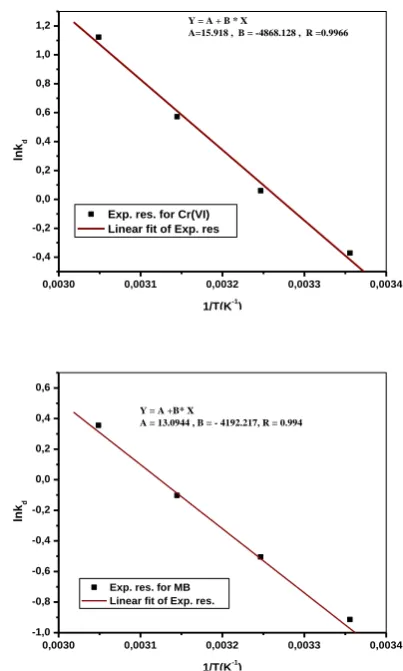
The adsorption of Cr(VI) and MB on the PAN-OK was studied at different temperature (25-55 °C) using the optimized conditions. The obtained results revealed that the amount adsorbed of Cr(VI) on PAN-OK increases with increasing temperature reflecting enhanced adsorption of Cr(VI) with temperature.
Figure 6. Van't Hoff plots for adsorption of Cr(VI) and MB on PAN-OK
Table 2. Thermodynamic parameters for the adsorption systems of Cr(VI)-PAN-OK and MB-PAN-OK
Adsorption system
ΔH kJ mol-1
ΔS J mol-1 K-1
ΔG kJ mol-1
R2
Cr(VI)-PAN-OK 40.47 132.34 1.033 0.996
MB-PAN-OK 34.85 108.86 2.41 0.994
e e
e max L max
1
C C
Q Q K Q
n
e F e
Q K C
0,0030 0,0031 0,0032 0,0033 0,0034 -0,4
-0,2 0,0 0,2 0,4 0,6 0,8 1,0
1,2 Y = A + B * X
A=15.918 , B = -4868.128 , R =0.9966
lnk
d
1/T(K-1
) Exp. res. for Cr(VI) Linear fit of Exp. res
0,0030 0,0031 0,0032 0,0033 0,0034 -1,0
-0,8 -0,6 -0,4 -0,2 0,0 0,2 0,4 0,6
Y = A +B* X
A = 13.0944 , B = - 4192.217, R = 0.994
lnk
d
1/T(K-1
)
The similar results were observed with respect to MB, reflecting better sorption at higher temperature. This observation could be due to creation of some new active sites on the sorbent surface. The thermodynamic parameters for adsorption of Cr(VI) and MB on PAN-OK were calculated by applying van't Hoff equation (4) and plotting of ln Kd vs. 1/T (Figure 6).
(4)
(5)
Competitive adsorption
The sorption results in Figures 7 and 8 show the simultaneous sorption of Cr(VI) and MB onto PAN-organo-kaolinite. It is clear that the sorption of Cr(VI) is not affected by the presence of MB, and also the sorption of MB not affected by the presence of Cr(VI).
Figure 7. Competitive adsorption of MB in presence of different concentrations of Cr(VI); wt-0.05 g, vol-25 mL, pH-6.8, time 60 min, temp.-25 °C, [MB]-250 mg L-1
Figure 8. Competitive adsorption of Cr(VI) in presence of different concentrations of MB; wt-0.05 g, vol-25 mL, pH-6.8, time 60 min, temp.-25 °C, [Cr]-50 mg L-1
References
1Xi, Y., Frost, R. L., He, H., Kloprogge,T. and Bostrom, T.,
Langmuir, 2005, 21, 8675-8680.
2Giannelis, E. P., Adv. Mater., 1996, 8, 29-35.
3Lan, T., Kaviratna,P.D. and Pinnavaia,T.J., Chem. Mater., 1995, 7,
2144-2150.
4Beall, G.W., Applied Clay Sci.,2003, 24, 11-20.
5Zadaka, D., Mishael, Y. G., Polubesova, T., Serban, C. and Nir, S.,
Applied Clay Sci., 2007, 36, 174-181.
6Lagaly, G., Solid State Ion., 1986, 22, 43-51.
7Konta, J., Appl. Clay Sci., 1995, 10, 275-335.
8Murray, H. H., Appl. Clay Sci., 2000, 17, 207-221.
9Ruiz-Hitzky, E. and Van, A. M., Clay Mineral and
Organoclay-Polymer Nanocomposites. In: Handbook of Clay Science, F.
Bergaya, B. K. G. Theng and G. Lagaly (Eds.) (2006), Vol. 1, Elsevier, Amsterdam, ISBN: 0080441831, pp: 583-621.
10Pavlidou, S. and Papaspyrides, C. D., Prog. Polym. Sci., 2008, 32,
1119-1198.
11Phang, I. Y., Liu, T., Mohamed, A., Pramoda, K. P., Chen, L.,
Shen, L., Chow, S. Y., He, C., Lu, X. and Hu, X., Polym. Int., 2005, 54, 456-464.
12Olad, A., Polymer/Clay Nanocomposites, Advances in Diverse
Industrial Applications of Nanocomposites, Dr. Boreddy
Reddy (Ed.), (2011) InTech, ISBN: 978-953-307-202-9.
13Kojima, Y., Usuki, A., Kawasumi, M., Okada, A., Kurauchi, T.
And Kamigaito, O., J. Polymer Sci.,Part A: Polymer Chem., 1993, 31, 1755-1758.
14Alexandre, M. and Dubois, P., Mater. Sci. Eng., 2000, 28, 1-63.
15Fornes, T. D., Yoon, P.J., Hunter, D.L., Keskkula, H. and Paul,
D.R., Polymer, 2002,43, 5915-5933.
16Stretz, H. A., Paul, D. R., Li, R., Keskkula, H. and Cassidy, P. E.,
Polymer, 2005, 46, 2621-2637.
17Shah, R. K., Kim, D. H. and Paul, D. R., Polymer, 2007, 48,
1047-1057.
18Swarnakar, V., Agrawal, N. and Tomar, R., Int. J. Sci. Eng. Res.,
2011, 2(5), 1-9.
19Wang, C. C., Juang, L. C., Hsu, T. C., Lee, C. K., Lee, J. F. and
Huang, F. C., J. Colloid Interf. Sci., 2004, 273(1), 80-86.
20Li, D., Zhao, W., Sun, X., Zhang, J., Anpo, M. and Zhao, J., Dyes
Pigments, 2006, 68(1), 33-37.
21Kaewprasit, C., Hequet, E., Abidi, N. and Gourlot, J. P., J. Cotton.
Sci., 1998, 2(4), 164-173.
22Özcan, A. S. and Özcan, A., J. Colloid Interf. Sci., 2004, 276(1),
39-46.
Received: 27.10.2015. Accepted: 04.12.2015.
d
lnK S H R RT
G H T S
0 10 20 30 40 50 60 70 80
20 40 60 80 100 120 140
A
d
so
rb
ed
a
m
o
u
n
t
o
f
MB
d
ye
(m
g
/g
)
Initial concentration of Cr(VI) (mg/L)
0 50 100 150 200
0 5 10 15 20 25 30
A
d
so
rb
ed
a
m
o
u
n
t
o
f
C
r(VI
)
(m
g
/g
)
![Figure 1. Effect of pH on the adsorption of Cr(VI) and MB on PAN-OK (0.05 g of composite, 25 mL of solution, 1 h, [Cr]=50 (a) or 250 (b) mg L-1, respectively](https://thumb-us.123doks.com/thumbv2/123dok_us/7829863.2088970/2.595.315.514.382.734/figure-effect-adsorption-mb-pan-composite-solution-respectively.webp)

![Figure 7. Competitive adsorption of MB in presence of different concentrations of Cr(VI); wt-0.05 g, vol-25 mL, pH-6.8, time 60 min, temp.-25 °C, [MB]-250 mg L-1](https://thumb-us.123doks.com/thumbv2/123dok_us/7829863.2088970/5.595.69.261.486.616/figure-competitive-adsorption-presence-different-concentrations-time-temp.webp)
