OLIGOMERIZATION OF THE ETHYLENE IN THE PRESENCE
OF NEW HETEROGENIZED Zr-CONTAINING COMPLEX
CATALYTIC SYSTEMS
A. H. Azizov,
[a],[b]*M. J. Khamiyev,
[a]A. A. Khanmetov,
[a]R. V. Alieva,
[a]B. M.
Aliyev
[a]and S. F. Ahmedbekova
[a]Keywords: ethylene, oliqomerization, ionic-liquid, zirconium precursor, synthetic oil.
The new heterogenized zirconium phenolate complexes containing different bulky ionic liquid type amine hydrochloride substituents in ortho-position have been synthesized and characterized. The oligomerization of the ethylene was carried out with use of these complexes activated by aluminium organic compounds in heptane, toluene and chlorobenzene. In the presence of diethyl aluminium chloride these complexes show higher activity than in the presence of ethylaluminium dichloride. The distributions and composition of the obtained oligomer products depend on the nature of aluminium organic compound used. The oligomerization products consist of C4 - C18 oligomers when diethyl aluminium chloride is used as a cocatalyst. In the presence of ethylaluminium dichloride the higher branched structured oligomers (oil fraction with boiling point > 350 °C) is obtained with >75 % yield. The products are easily separated from the catalysts by simple decantation and zirconium complexes may be repeatedly reused in successive ethylene oligomerization.
* Corresponding Authors Fax: (+99418) 642-04-00 E-mail: [email protected]
[a] Institute of Petrochemical Processes, Azerbaijan National Academy of Sciences, 30, Khojaly Ave., AZ1025, Baku, Azerbaijan
[b] Institute of Polymer Materials, Azerbaijan National Academy of Sciences, 124, S.Vurgun str., Az5004, Sumgait,
Azerbaijan
Introduction
Oligomerization of ethylene is a process in which higher olefins and end vinyl caped macromonomers are produced. These olefins are used for the production of fuels, detergents, plasticizers, comonomers for linear low density and long-chain branched polyethylenes, blend compatibilizers, synthetic oils, corrosion inhibitor etc.1-4
Oligomerization of ethylene in the presence of the homogeneous catalyst systems based on transition metal complexes has been widely studied.5,6 In spite of high catalytic activity and selectivity of these catalysts in oligomerization of ethylene, they have essential disadvantages such as difficulties assosiated with separation of the catalyst from olgomerization products and impossibility of their recycling.
To avoid these disadvantages in recent years the intensive researches aimed at development of olefins oligomerization processes with participation of ionic liquids are being conducted.7-9 In particular, the use of ionic liquids for "heterogenizing" homogenous catalysts has received increasing attention.
Three main methodologies have been developed for applications of ionic liquids in catalytic oligomerization reactions of olefins. In the first method, the ionic liquids were used both as the solvents and the catalysts for oligomerization reactions.10-12 The chloroaluminate type ionic liquid systems have been studied most under this category.13-15 The main advantages of using ionic liquids as
the solvents include carrying out the process in a biphasic system, which eases separation of reaction products from reaction medium and reuse of the catalyst in a cyclic process.16-19
In the second approach, the catalyst (in general a transition metal complex) is immobilized in the ionic liquid phase and the reaction products are formed in the upper organic phase.20 For implementing such an approach in the continuous process, the key point is the stable immobilization of the catalyst (or catalytic system) in the ionic liquid phase. This approach was used successfully in the oligomerization and polymerization processes of olefins.21-24 A distinctive feature of immobilization of metal-complexes in such a manner is that they are compatible with many ionic liquids, which opens up many possibilities for their applications in biphasic processes. Besides, increased effectiveness of metal-complex catalysts in the oligomerization and polymerization of ethylene, propylene and other α-olefins in the presence of ionic liquids was observed, which causes additional interest for development of recyclable ionic-liquid based highly active metal-complex catalytic systems for these processes. Studies devoted to oligomerization of ethylene in the presence of complex catalytic systems immobilized in ionic liquids taken as the solventshave demonstrated the possibility of conducting the process in a more efficiently and environmentally friendly manner.
The third approach, suggested by us, is based on the use of transition metal (Ti, Zr) precursor complexes containing ionic liquid type ligands in their coordination sphere. These complexes, combined with aluminium-organic activators, act as a recyclable heterogenous oligomerization catalysts both in the molecular organic and ionic liquid solvents.25-28
alkyl chlorides have been overviewed. Influence of corresponding ligands of the substituted phenolate type precursor compounds of zirconium, the nature and molar ratio of the catalyst components, a modifier compound and process temperature on the activity of the catalyst, distribution and structure of the oligomerization products have been studied.
Experimental
General Procedures
All solvents were purified and dried by standard procedures and distilled under inert atmosphere. All aluminium organic compounds and ZrCl4 were purchased from Aldrich Chemical Co. and used without additional purification. The corresponding phenol derivatives were synthesized according to the reported procedures.29,30 The catalysts precursors were synthesized by an interaction of ZrCl4 with phenol derivatives in THF solution at 50-55 °C.31
Oligomerization
Oligomerization of ethylene was carried out in the jacketed autoclave equipped with a magnetic stirrer, thermometer and heated with thermostated water or glycerine. Before charging with reaction mixture and catalyst components, the autoclave was washed with dry toluene and acetone, checked for leak tightness under nitrogen pressure, dried in vacuum under heating by connecting the reactor connected to the vacuum line and heating for 1-1.5 h at 90 °C. The catalyst and solvent were placed into reactor under an inert gas atmosphere. The reactor was heated to reaction temperature and then ethylene was pressurized into it with intensively mixing the reaction mixture by magnetic stirrer. The pressure of ethylene in the reactor was controlled by a manometer. The oligomerization product solution was removed from the reactor by simple decantation. The Zr-component of catalyst, remaining in the reactor, was repeatedly used in the oligomerization prosess by addition of new portions of solvent and aluminium organic compound. The obtained oligomerization products were washed with aqueous solution of sodium hydroxide for removing aluminium organic compound residues, dried over aluminium oxide and fractionated.
Analytical procedures
Oligomerization products and metal complexes (MC) were analyzed by gas-liquid and exclusion chromatography, DSC, IR- and 1H NMR-spectroscopy, element analysis and scanning electron microscope (SEM).
Oligomers of ethylene, boiling up to 350 °C were analyzed by gas-liquid chromatography on “Focus GS”, with a 100 m long column and 100 % dimethyl silicone as the liquid phase. The analyses were performed in the following programming mode: temperature from 50 °C to 320 °C rising at a rate of 6 °C min-1. The rate of flow of carrier gas (helium) was 30 ml min-1. The temperature of evaporator was 320-350 °C.
1H NMR spectra were recorded on a Bruker pulsing Fourier spectrometer (Germany) operating at the frequency of 300 MHz. Deuterated benzene and dimethyl sulfoxide were used as a solvent.
IR-spectra were recorded on the "BRUKER" Fourier spectrometer in the range of 50-4000 cm-1.
DSC analysis was carried out on a Thermoelectron Q-20 Differential Scanning Calorimeter at a heating rate of 10 ˚C min-1 in an air or nitrogen atmosphere.
Element analysis of the catalyst precursor components was performed on TruSpec Micro analyzer of Horiba company.
Molecular-weight distribution (MWD) of the obtained products was studied by size exclusion chromatography method using high performance “Kovo” (Czech Republic) liquid chromatograph with a refractive index detector. Two 3.3 mm-150 mm columns packed with the “Separon-SGX” stationary phase with a particle size of 7 mm and a porosity of 100 Å were used. DMF was used as an eluent (flow rate 0.3 ml min-1, temperature 20-25 °C). A calibration plot of log M versus VR in the range M = 2-100 x 102 was obtained using polyethylene glycol standards and transformed to the common dependence of fraction (%) of chains from their molecular weights. Calculations of the average molecular weights and MWD characteristics were made using the data of size exclusion chromatographic analysis in accordance with the described procedure.32 Average molecular weights (Mw and Mn) were calculated using the following formulas:
Mw = Mi i, Mn = 1/i / Mi
(1)
where Mi is the molecular weight, corresponding to the ith slice of the chromatogram; ωi is the area fraction of the ith slice.
The degree of branching in the oligomer chains of oil fractions were determined by the method presented in the literature33and the ratios of CH
3 group to 1000 CH2 and of vinyl group (СН2=СН-) to 1000 СН3 were calculated according to the following formulas
3 1380 2 910
2 720 2 1380
CH CH = CH –
= 188 and = 98 , respectively
1000CH 1000CH
D D
D D
Average structural parameters of oligomers were calculated from NMR spectra according to the method reported in the literature,34 adapted to hydrocarbons. For calculations the following initial data were used.
1. Quantity of C and H atoms, determined on the basis of data obtained from elemental analysis and values of average molecular weights (M).
3. Proton-deficiency of an average molecule (Z), determined according to equation Z = 2C - H on the basis of above-mentioned input data the following average structural parameters of the synthesized oligomers were calculated.
a) quantity of saturated cycles in the molecule: Kn= 0.5Z+1; b) quantity of C atoms in naphthenic cycles: Cn= 3.85Kn+2; c) quantity of C atoms in paraffinic structures: Cp=C – CH; d) quantity of terminal methyl groups:Cγ= 1/3Hγ;
e) total quantity of secondary, tertiary and quaternary C atoms in paraffinic chains: Cβp = Cp – Cγ;
(f) number of carbon atoms in the alkyl and naphthenic fragments in the amount: Cβ=C – Cγ.
Synthesis and characterization of phenol derivatives and precursor metal complexes
The phenol derivatives, required for the syntheses of corresponding precursor Zr-complexes, were prepared, by Ch. Rasulov and collaborators of the Institute of Petrochemical Processes of Azerbaijan National Academy of Sciences, according to the reported methods.29,30 The precursor Zr-phenolate complexes were synthesized by us according to the literature method31 by interaction of ZrCl
4 with four phenol derivatives viz., 2–piperidinylmethyl-4-methylphenol (L1), 2-morfolylmethyl-4-methylphenol(L2), 2-diethylaminomethyl-4-methylphenol(L3) and 2-[(2,6-di(isopropyl)phenyl)imino]phenol(L4). The syntheses were carried out by heating the reactants to 50-55 °C for 2 h, in a three-necked flask under an inert atmosphere in THF solution with different ZrCl4 / phenol molar ratios. The complexes were obtained as their hydrochloride salts. The obtained complexes were separated from the solvent by simple decantation, washed with dry solvent and dried under vacuum for 2 h. These complexes are not soluble in hydrocarbon solvents (aromatic, aliphatic, haloid aromatics) but dissolve in DMSO and ionic liquids. They are unstable in air Scheme 1 illustrates the general synthesis schemes taking an example of MC1 (ZrCl4 : Ligand = 1 : 2 molar ratio).
Scheme 1. Synthesis of zirconium complexes.
Synthesis of MC1 and MC2
MC1 and MC2 were synthesized by interaction of ZrCl4 with ligand L1 at molar ratio of 1:2 and 1:3 respectively in THF at 50-55 °C for 2 h with mechanically stirring. The precipitated products were separated from THF and dried for 2 h in vacuum. The products obtained as white powders were characterized by spectral and elemental analysis data. MC1: 1H NMR (300 MHz, DMSO-d
6), δ (ppm): 2.19 (6H, s, Ph-CH3), 6.90-7.29 (6H, m, Ph-H), 4.10 (4H, s, CNH), 3.46 (8H, t, NCH2 of piperidinyl), 2.84-3.72 (8H, m, -CH2- of piperidinyl), 1.36-1.62 (4H, m, >CH2 of piperidinyl), 1.74 (4H, m, CH2 of THF) 3.46 (4H, t, OCH2 of THF), 10.0 (2H, s, N+H). 13C NMR (300 MHz, DMSO-d
6): 154.9, 134.0, 131.7, 128.1, 116.1, 115.8, 67.5, 54.1, 52.0, 25.6, 22.6, 21.7, 20.5. Calc. C26H38N2O2ZrCl4 THF C 50.31, H 6.43, N 3.91%; found C 49.78, H 6.70, N 4.01 %. MC2: 1H NMR (300 MHz, DMSO-d6), δ (ppm): 2.23 (9H, s, Ph-CH3), 6.65-7.28 (9H, m, Ph-H), 4.04 (6 H, s, CNH), 3.44 (12H, s, N(CH2)2 of piperidinyl), 2.99 (12 H, m, -CH2- of piperidinyl), 1.71 (6H, m, >CH2 of piperidinyl), 10.0 (3H, s, N+H). Calc. for C
39H57N3O3ZrCl4 C 55.18, H 6.72, N 4.95 %; found C 54.81, H 6.90, N 4.65 %.
Synthesis of MC3
MC3 was synthesized by interaction of ZrCl4 with phenolic derivative L2 at molar ratio 1:2 in THF. The reaction was carried on for 2 h with mechanically stirring. The product, obtained as a white powder, was characterized by 1H NMR (300 MHz, DMSO-d
6), δ (ppm): 2.23 (6H, s, Ph-CH3), 6.69-7.33 (6H, m, Ph-H), 3.52 (4H, s, CNH), 3.12 (8H, s, N(CH2)2 of morpholyl), 3.84 (8H, s, (CH2)2O of morpholyl), 1.74 (4H, m, CH2 of THF) 3.59 (4H, t, OCH2 of THF), 10.0 (2H, s, N+H). Calc. for C
24H34N2O4ZrCl4THF C 44.51, H 5.25, N 4.32 %; found: C 44.49, H 5.18, N 4.20 %.
This complex is also unstable in air, rapidly soluble in water and hardly soluble in DMSO and ionic liquids.
Synthesis of MC4
MC4 was synthesized by interaction of ZrCl4 dissolved in THF with phenol derivative L3 at molar ratio 1:2 in the similar manner. The product was obtained as white powder. Calc. for C39H57N3O3ZrCl4 C 44.51, H 5.87, N 4.32 %; found C 45.28, H 5.18, N 2.99 %.
Synthesis of MC5
MC5 was synthesized by interaction of ZrCl4 dissolved in THF with phenolic compound L4 at molar ratio 1:2 in a similar manner. The product, obtained as a yellow powder, was characterized by 1H NMR (300 MHz, DMSO-d
6), δ (ppm): 2.23 (6H, s, Ph-CH3), 6.93-7.66 (614H, m, Ph-H), 8.57 (2H, s, CNH), 1.10-1.23 (24H, d, CH3), 2.87 (4H, m, CH(CH3)2), 10.25 (2H, s, N+H), 3.25 (4H, t, of OCH2 of THF) 1.74 (4H, m, CH2 of THF). 13C NMR (300 MHz, DMSO-d6): 23.7, 24.0, 27.8, 28.2, 117.1, 119.7, 123.6, 124.1, 125.8, 132.3, 134.1, 138.4, 160.6, 168.2. Calc. for C38H46N2O2ZrCl4THF C 57.35, H 5.78, N 3.52 %; found C 57.29, H 7.69, N 3.49 %.
OH
Me N
2 + ZrCl4
THF 50-55 C
O Zr Cl
Cl
O Me
Me
NH
H
N
Cl
Cl L1
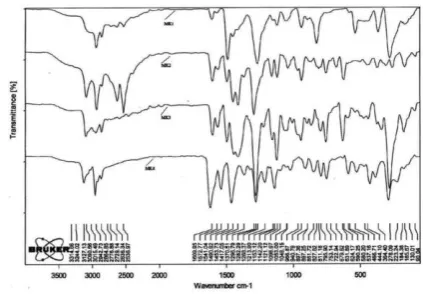
In the IR spectrum of the synthesized complexes, absorption bands are observed at 2547 cm-1, 2573 cm-1 and 2633 cm-1 corresponding to N+R
3H ammonium group, 1614 cm-1 corresponding to the stretching deformation vibrations of the N-H bonds in ammonium salts. Bands in the absorption area of 530-600 cm-1, characteristic for stretching vibrations of Zr-O bond and 280 cm-1 absorption band characteristic for stretching vibrations of Zr – Cl bond were also observed (Fig..1).
Figure 1. IR spectra of MC1, MC2, MC3 and MC5.
The surface structures of the MC1 and of the complex catalyst system obtained by its interaction with ethyl aluminium dichloride were investigated by the scanning electron microscope. The images are presented in Figure 2a and 2b, respectively.
Figure 2. Scanning electron microscope images of MC1 and complex catalyst system (x 500F).
As is seen, the freshly prepared complex MC1 (prior to reaction with aluminium organic compound) has a well-developed structure. After the reaction, the surface remains sufficiently well developed. But the separate fragments of the complex are closely interconnected forming a single mass. The system is very porous and it has lots of pores and channels where the reacting components can be placed, which favours its reuse as heterogeneous catalyst in the oligomerization process of ethylene in heptane.
Results and Discussion
Dependence of ethylene oligomerization products distribution and catalyst activity on the reaction conditions
The results obtained during the reaction of ethylene oligomerization in the presence of complex catalytic systems consisting of different synthesized zirconium
precursors and aluminium organic compounds are given in the Table 1. The reaction products are oligomers of ethylene with a carbon atom number from C4 to C20+ and higher. The distribution of the oligomerization products depends on the composition of zirconium compound containing ammonium hydrochloride substituents (Table 1). In the presence of MC1 and ethylaluminium dichloride the yields of C4 - C6, C8 - C18 and C20+ oligomer fractions are 13.3 %, 26.7 % and 60 %, respectively. Use of more polar solvent chlorobenzene increases the reactivity of the catalyst system and the yields of low oligomer products C4-C6 increase to 31.5 %. The yields of higher molecular weight oligomer fractions C8 - C18 and C20+ decrease and reach 18.5 % and 50 % respectively. When ethylaluminium sesquichloride is used as an aluminium organic compound the yield of dimer product increases and amounts to 41.3 %. In this case the yields of C8 - C18 and C20+ fractions are 10.6 % and 7.1 % of the converted ethylene. Using diethylaluminium chloride as the co-catalyst in toluene increases the catalyst activity nearly threefold. In this case, the reaction product consists mainly of the dimers (2.7 %), trimers (63.2 %) and C8-C18 oligomers (34.1 %).
While using ethyl aluminium dichloride as an activator, replacement of MC1 by MC3 and MC5 increases the yields of dimers, trimers and C8 - C18, and decreases the yield of C20+ fraction. In the presence of MC5 as zirconium compound the oligomerization product consists mainly of C6-C8 fraction. In this case the yields of C4 and C6 fractions are 5.6 %, 62.9%, while the yields of the C8 – C18 and oil fractions are 25.5 % and 6 %, respectively. In the presence of MC3 and ethylaluminium dichloride the yields of dimer and trimer fractions are 15.2 %, 40% and of the oil fraction is 46 % respectively.
As is seen from Table 1, the catalytic activity also depends on the compositions of the different zirconium precursors and aluminium organic compounds as well as on the solvents used. In particular, when ethylaluminium dichloride is used as an aluminium organic compound and MC1 as Zr-precursor the activity of the system in heptane is 156 g oligomer/g Zr h-1. Replacement of ethylaluminium dichloride by diethylaluminium chloride and heptane by toluene leads to the increase of catalytic activity up to 1210 g oligomer/g Zr h-1. In heptane MC3 + ethylaluminium dichloride and MC5 + ethylaluminium dichloride systems show the highest activity (1100 -1150 g oligomer/g Zr h-1).
The nature of solvent and modifier influences also on the properties and the yield of the oil fraction of oligomerization products. The results obtained in the presence of MC1, MC4, ethylaluminium dichloride and different modifiers in the medium of chlorobenzene and heptane are given in the Table 2. In heptane medium without modifier the yield of the obtained oil fraction is 61.8 %, kinematic viscosity 83 .6 cSt at 40 °C, 8.70 cSt at 100 °C and index viscosity is 68. Addition of modifier (durene, mesitylene, etc) to the catalytic system increases the yield of oil fraction up to 5 – 10 % and index viscosity 12-18 units.
The molecular mass distribution of oligomer molecules in the oil fractions are given in the Table 3. The oligomerization products obtained in the presence of MC1, MC2 and MC4 have the molecular masses within the limits,
Table 1. Influence of the catalyst composition and solvents nature on the ethylene oligomerization product distribution and catalyst activity.
No. Aluminium
organic compound
Al:Zr, molar ratio,
Solvent Activity of the catalyst g oligomer/g Zr ·h-1
Product distribution (%)
С4 С6 С8 –
С18
С20+
MC1 С2H5AlCl2 25 : 1 Heptane 156 3.5 9.8 26.7 60.0
С2H5AlCl2 25 : 1 chloro-benzene
273 5.0 26.5 18.5 50.0
(С2H5)3Al2Cl3 25 : 1 Toluene 420 41.3 15.8 10.6 7.1 (С2H5)2AlCl 30 : 1 Toluene 1210 2.7 63.2 34.1 traces
MC2 С2H5AlCl2 30 : 1 Heptane 428 4.2 10.9 32.3 52.6
MC3 С2H5AlCl2 25 : 1 Heptane 1150 15.2 40.0 30.8 14.0
MC4 С2H5AlCl2 25 : 1 Heptane 185 18.2 15.3 20.5 46
MC5 С2H5AlCl2 28 : 1 Heptane 1100 5.6 62.9 25.5 6.0 Reaction Conditions: Temperature 90 °C, solvent 50 mL, time 5 h, pressure 2.5 MPa.
Table 2. Influence of modifier and solvent on the properties and the yield of oil fraction.
MC Solvent Modifier (M)
Molar ratio of Al:Zr:M
Activity of catalyst g oligomer/g Zr ·h-1
Composition of product %
Kinematic vis-cosity, mm s-1
IV F. P. °С
Flash point °С
Tqay
<350 °С
Tqay
>350°С
40°С 100 °С
MC1
Heptane - 25:1 156 38.2 61.8 83.36 8.70 68 -20 205
PhCl - 25:1 250 50.0 50.0 91.93 8.20 57
Heptane Durene 25 :1:3 159 33.0 67.0 278.1 19.8 80 -12 Heptane Mesitylene 25:1:5 125 32.0 68.0 214.2 16.7 79 -20 Heptane Durene 25:1:5 140 24.4 75.6 754.2 38.5 86 -10 PhCl Ph2O 25:1:1.5 130 40.3 59.7 315.2 20.3 70 -12 210 Toluene - 25:1 220 62.0 38.0 122.0 10.0 51
MC4
Heptane - 1:30:0 168 63.0 57.0 116.3 10.23 58
Heptane Durene 1:30:5 132 27.7 72.3 168.8 13.2 62
Reaction condition: temperature 90 °C, time 5 h, pressure of ethylene 2.5 MPa.
Figure 3. The IR spectrum of C8 - C18 olefin fraction.
Structures and properties of oligomerization products
The structures of the obtained oligomers were examined by IR and 1H NMR-spectroscopic methods and thermal properties by DSC method. The IR-spectrum of C8 - C18 olefin fraction is given in the Figure 3. As can be seen the intensive absorption bands are observed at 909 cm-1, 997 cm-1 and 1638 cm-1 which is referred to the deformation and valence vibrations of olefin double bonds respectively.
Furthermore, there is deformation vibration at 966 cm-1 with low intensity, which is characteristic of olefins with internal double bonds.
Таble 3. The molecular-mass characteristics and physical-chemical properties of the oil fractions.
MC Мw Мn Мw/
Мn
Density g cm-3
Refractive index, nD20
МC1 330 217 1.52 0.8395 1.4637 МC1а 379 296 1.28 0.8340 1.4628 МC2 345 280 1.32 0.8369 1.4643 МC4 323 236 1.37 0.8389 1.4651 МC4а 384 272 1.4 0.8529 1.4615 a = modified catalysts
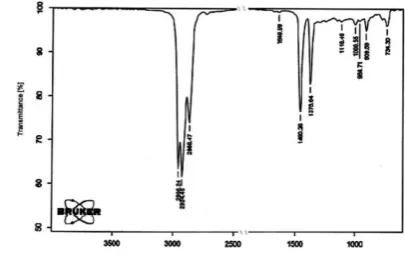
The IR-spectrum of the oil fraction obtained in the presence of catalytic system based on MC1 and ethylaluminium dichloride is shown in the Figure 4. In the IR-spectrum (Figure 4) the absorption bands of pendulum oscillation (734 cm-1) of C-H bonds of the CH
Table 4. IR spectroscopic data of the oil fractions obtained by oligomerization of ethylene.
Таble 5. Average structural parameters of the oil fractions of ethylene oligomerization products.
MC Average
mol. wt.
Empirical formula
No. of carbon atoms No. of cycles, Кn
Share of carbon atoms,%
No. of carbon atoms in the fragments
Сn Сp Сn Сp Сγ Сβ Cp
МC1 217 С15,6Н31,2 5.9 9.7 1.0 37.8 62.2 4.8 10.8 4.9 МC1а 296 С21,0Н42,7 4.5 16.5 0.65 21.4 78.6 6.3 14.7 10.2 МC2 280 С19,9Н40,3 4.9 15.0 0.75 24.6 75.4 6.1 13.8 8.9 МC4 236 С16,8Н34,2 4.7 12.1 0.70 28.0 72.0 4.9 11.9 7.2 МC4а 272 С19,3Н39,4 4.3 15.0 0.60 22.3 77.7 6.0 13.3 9.0
Cn, Cp – carbon atoms in naphthenic and paraffinic fragments, respectively; Kn– quantity of naphthenic cycles in an average molecule; Cγ –
number of terminal methyl groups; C– an average number of secondary, tertiary and quaternary carbon atoms in a paraffinic chain;
number of carbon atoms in the alkyl and naphthenic fragments amount Cβ = C – Cγ.
The absorption bands at 1375 cm-1 and 1460 cm-1 refer to the symmetrical deformation vibrations of the CH3 and deformation vibrations of the CH2 groups respectively. Presence of the intensive bands at 2924 cm-1 and 2956 cm-1 refers to valence vibrations of C–H bond of the methylene groups in (CH2)n chain. The absorption bands at 1000 cm-1 and 964 cm-1 may be considered as an evidence for the deformation vibrations of C - H bond of CH2 groups in the naphthenic ring.
IR spectroscopic analysis data are given also in Table 4. As is seen, the degree of branching of the oligomer chain of oil fractions obtained by oligomerization of ethylene in the presence of the unmodified catalytic systems MC1, and MC4 are characterized by the values of the ratio CH3 / 1000 CH2, equalled 963 and 884, respectively (the degree of branching of the oligomer chain was calculated from IR data). The branching degrees of oligomer molecules obtained in the presence of catalyst systems with π - electron donor modifier compound (MC1a MC4a in Table 3)are 906 and 856, respectively. Hence, adding π-electron donor modifier to the catalyst system reduces the branching degree of the oligomer chain, increases the yield and improves the viscosity - temperature properties of the oil fraction. The main physical - chemical characteristics of these oil fractions are given in Table 3
1H NMR-spectrum of the oil fractions obtained at using unmodified and modified catalyst systems are given in the Figure 5(a-e). As can be seen, in the all spectra it is identified four analytical areas corresponding to resonance absorptions of 1H atoms bound to carbon atoms of different structural elements. The most intense peaks are observed in the strong field with chemical shifts 0.7 - 1.0 ppm and 1.0 - 1.5 ppm. The first resonance band refers to the hydrogen atoms in the terminal methyl groups (Hγ), and the second to a CH2 - groups of the alkyl chain. The resonance signals in the region 1.5 - 1.8 ppm refer to naphthenic protons. The resonance signals in the region of 2.05 ppm is related to the
first -CH2- group which directly attached double bonds. However, the intensity of this band is very weak that indicates to the low content of these groups in the structure of the oligomer molecule. A weak resonance signal in the 5.5 - 6.0 ppm also indicates to the small amounts of double bonds - CH = CH - or >C=CH2.
In Table 5 the average structural parameters of ethylene oligomerization products obtained in the presence of the investigated catalytic systems with ethyl aluminium dichloride as an activator are presented. The calculations were performed according to the method34 on the basis of average molecular weights values, 1 H NMR and element analysis data. The molecules of the oil fractions contain naphthenic fragments with average 4.3-5.9 carbon atoms in the ring.
The average number of carbon atoms in paraffinic chains changes within 9.7-16.5. The percentage of naphthenic and paraffinic carbon atoms in the molecules of the oil fractions amounts to 22.3 - 37.8 % and 62.2 - 78.6 %, respectively. The content of terminal methyl groups changes within 4.8 - 6.3 depending on the composition of the catalyst systems.
Figure 4. IR-spectrum of the oil fraction of ethylene oligomerization product.
МC Zr:Al:M D735 D909 D990 D1380 D1460 CH3/
1000СН2
CН2=СН/
1000СН3
Figure 5.1H NMR spectrum of the oil fractions obtained in the presence of MC1 (a) MC1a (b), MC2 (c), MC4 (d) and MC4a (e).
The group distribution of hydrogen atoms in the oil fractions structures are given in the Table 6. As can be seen, the content of hydrogen atoms in the oligomer molecules terminal methyl groups is 43.1 - 46.6 % that indicates to a highly branched structure of the molecule. The percent content of hydrogen atoms in the alkyl - CH2 - groups and naphthenic CH and CH2 fragments (Hβ) is 42.3 - 46.3 % and 6.5 - 11.0 %, respectively.
The thermal properties of the oil fractions obtained in the presence of unmodified (MC1) and modified (MC1a) complex catalytic systems and ethyl aluminium dichloride were determined by DSC analysis and are given in the Figure 6.
Таble 6. Distribution of hydrogen atoms in the oil fractions structures
MC Distribution of H-atoms in fragments, %
Нγ Нβ* Нα Ноl. Нs.
МC1 46.6 37.6 (11.0) 3.9 0.9 99.1 МC1а 44.6 42.3 (8.7) 3.3 1.1 98.9 МC2 46.5 40.4 (7.9) 3.9 1.3 98.7 МC4 45.5 43.0 (7.4) 3.0 1.1 98.9 МC4а 43.1 46.3 (6.5) 3.0 1.1 98.9
Figure 6. DSC curves of oil fraction obtained in the presence of MC1 and MC1a
As can be seen from the pictures, prior to starting oxidation temperatures 182.42 °C and 200.19 °C, the oils fractions do not expose to any thermal process. Addition of electron donor type modifier as durene to the catalytic system increases starting oxidation temperature of the oil fraction, presumably due to increased linearity of the oligomer molecules chains.
Conclusions
The ethylene oligomerization process was studied using the synthesized zirconium precursor complexes containing ionic liquids type amino and imino hydrochloride ligands and ethylaluminium chlorides as the activators. The structures of the synthesized complexes and oligomer products obtained have been examined by means of IR, 1H NMR spectroscopy, element analysis, SEM, size exclusion chromatography and the DSC. It was shown that the compositions of the ethylene oligomerization products change depending on the aluminium organic and Zr-precursor compounds. The oil fractions obtained in the presence of zirconium complexes and ethyl aluminium dichloride have highly branched molecules, contain naphthenic rings in the molecule structures and are oligoalkylnaphtenic oil character with low viscosity indexes. Adding π-electron donor modifiers to the catalysts systems decreases the branching degree of oligomer chain, improves the viscosity - thermal properties of oil fractions by increasing their viscosity index values.
References
1Plaksupov, T. K., Belov, G. P., Potanov, S. S., Vysshiye lineynye
α-olefiny i sopolimery etilena na ikh osnove. Proizvodstvo i primeneniya, 2008.
2Azizov, A. H., Asadov, Z. G., Akhmedov, G. A., Makromonomery,
Baku, Elm, 2009.
3Khanmetov A. A., Processy neftekhimii i neftepererabotki, 2007,
4(31), 40.
4Kotov, S. V., Moiseev, I. K., Shabanova, A. V., Neftekhimiya,
2003, 43, 5, 323.
5Forestière, H., Olivier-Bourbigou and Saussine, L., Oil Gas Sci.
6Belov, G. P., Neftekhimiya, 2012, 52, 3, 163.
7Lecocq, V., Olivier-Bourbigon, H., Oil Gas Sci. Technol., 2007,
62, 761.
8Thiele, D., de Souza, R. F., Catal. Lett., 2010, 138, 50.
9Fehér, Cs., Kriván, E., Eller, Z., Hancsók, J. and Skoda-Földes, R.,
The Use of Ionic Liquids in the Oligomerization of Alkenes in: Oligomerization of chemical and biological compounds,
Ed. by Lesieur, C., ISBN 978-953-51-1617-2, INTECH, 2014; DOI: 10.5772/57478
10Olivier-Bourbigou, H., Magna L., Morvan D., Appl.Catal., 2010,
A:General, 373, 1–2, 1.
11Welton, T., Coord. Chem. Rev., 2004, 248, 2459.
12Wasserscheid, P., Welton, T., Ionic liquids in synthesis, 2nd
Edition, Wiley-VCH, 2008.
13Stenzel, O., Brüll, R., Wahner, U. M., Sanderson, R. D. and Raubenheimer, H. R., J. Mol. Catal., 2002A, 3770, 1. 14Azizov, A. H., Aliyeva R. V., Am. J. Chem. Appl., 2015, 2(3), 21. 15Matthias, D. and Helmut G., Chem. Cat. Chem., 2011, 11(3),
1799.
16Earle, Martyn J. and Seddon Kenneth R., Pure Appl. Chem.,
2000, 72(7), 1391.
17Wasserscheid, P., Gordon, C. M., Hilgers, C., Muldoon, M. J., Dunkin, I. R., Chem. Comm., 2001, 13, 1186.
18Einloft, S., Dietrich, F. K., de Souza R. F., Dupont, J.,
Polyhedron, 1996, 19, 3257.
19Khanmetov, A. A., Askerova, Kh. G., Aliyeva, R. V., Azizov, A. H., Process. Neftekhim. Neftepererab., 2010, II. 4(44), 309.
20Thiele, Daniel, de Souza, Roberto Fernando, J. Mol. Catal., A.
Chem., 2011, 340(1), 83.
21Pei, L- X., Liu, X. M., Gao, H. Y, Wu, Q., Appl. Organomet.
Chem., 2009, 23, 455.
22Ke, M. S., Hai, Y. Q., Feng, S. L., Jin, P. Li, H. G., Shao, B. Z., Qing, W,, J. Catal.Lett.,2009, 131(3-4), 566.
23Ochędzan-Siodłak, W., Dziubek, K., Czaja, K., Polym. Bull.,
2013, 70(1), 1.
24Christian, P., Mehnert, D., Chem. – Eur. J., 2005, 50.
25Azizov, A. G., Alieva, R. V., Martynova, G. S., Bagirova, Sh. R., Kalbalieva, E. S., Polym. Sci., 2009, B51(11-12), 444. 26Azizov, A. G., Aliyeva, R. V., Kalbalieva, E. S., Ibragimova,
M. C., Appl. Catal., A: General,2010 375, 70. 27Azizov, A. H., Izbrannye trudy, Baku, ELM, 2010.
29Rasulov, Ch. K., Nabiyev, F. A., Babayeva, R. K., Process.
Neftekhim. Neftepererab.,2001, 2, 37.
30Rustəmov, S. T., Nabiyev, F. A., Azizov, A. H., Rasulov, Ç. Q.,
Azərbaycan Kim. J. (in Azeri), 2014, 2, 36.
31Azizov, A. H., Aliyeva, R. V., Bagirova, Sh. R., Mamedova, R. Z., Kalbaliyeva, E. S., Azizbeili, G. R., Khanmetov, A. A., Guliyev, B. V., Azerbaijan Pat. I 2008 0048 (2008).
32Bektashi, N. R., Jafarov, V. A., Polym. Chem., 2004, A, 46, 10, 1769.
33Gryunevedzh, M. P., Shuyer, Dzh., Schmidt, Dzh., Gyudman, K. A. F., Absorbcionnye i relaksacionnye spektry poliolefinov. V sb. Kristallicheskie poliolefiny, M. Khimiya,
1970, 2, 279.
34Kamyanov, V.F., Bolshakov, G. F., Pet. Chem., 1984, 24(4), 450.