International Journal Advances in Social Science and Humanities
Available Online at: www.ijassh.com
RESEARCH ARTICLE
Career Readiness and Decision Making among the B.Tech
Students of IT and Non IT Courses in the Colleges of Kolkata
Arindam Bhattacharjee
1*, Dr. Anjali Ray
21Research Student, Department of Applied Psychology, Calcutta University, Calcutta, India.
2Professor, Department of Applied Psychology, Department of Applied Psychology, Calcutta University,
Calcutta, India.
*Corresponding Author:Arindam Bhattacharjee
Abstract
Career readiness is viewed as career maturity, college readiness, career aspiration and many more. This present article focused on searching dimensions of career readiness in new way. The selected dimensions are mastery over the task, persistency in goal, skill development, adjustment ability and development of civic sense. Decision making also included as individual component of career readiness. Engineering students were selected as sample dividing two groups, namely student studied in Information Technology or software developer, and another were as core group of Engineering. Career readiness viewed as multidimensional construct and with various components. Result was found that students differentiated according to the levels and components of career readiness.
Keywords: Career readiness, components of Career Readiness, Core Engineering and Information Technology.
Introduction
Science and Technology education has been considered as one of the most significant component of human resource development spectrum with great potential for adding value to product and services to the national economy and improving the quality of life of the students. In recognition of the importance of this sector the students of technical and engineering colleges are striving hard to develop their knowledge and skills for appropriate placement and successful progress in specialized and advanced training in science and technical education.
In the face of new socio-economic challenges and competitive career markets of courses and jobs, the current enrollment and recruitment in the technical and engineering Colleges are influenced by the institutional future career and job placement strategies and counseling programme of institutes. In this context, owing to age specific sensitivity, needs for growth and exposures, career
decision and acquisition of knowledge and skill for future career/ job are one of the most important and critical task for young students studying in post-secondary institution of science, technology engineering colleges. The current recruitment strategies of these institutes appear to be attracting the students who value career preparation and development more than the average. Realizing the importance and significance career of the students all the post-secondary institution of science, technology and engineering are giving more emphasize on assisting students in acquisition of skills and knowledge intended to their ‘career readiness’.
Career readiness is defined as the level of maturity of the students to acquire specific information on career options, to identify interests, values and aptitudes [1] and to use this information in their career planning. Career readiness/ maturity is thought of as the interaction between an individual’s resources (what he brings to his encounter with the reality) and reality demands [2].
Winecoff and Lyday [3] proposed that reasonable career readiness for adolescents and young students should involve the understanding of the basic work values and attitudes including: an understanding of consumer economics; an awareness of knowledge about and some initial experience of work, personal interests and abilities, higher levels of achievement in basic academic skills, a tentative selection of preferred job clusters; and a sense of civic responsibility.
Career readiness in the late adolescence is more related to the course readiness and job readiness [4]. In this stage, career readiness means the act of seeking and obtaining employment, preparation to seek or obtain employment, including life skills training and substance abuse treatment and mental health treatment or rehabilitation activities for those who are otherwise employable.
Generally career readiness measures are the indicator of workplace literacy and represent a widely accepted common language for skills definition among employers, educators/ trainers, and potential/ incumbent employees etc. Generally, this career readiness or workplace readiness are related with the personality variables like personality type, aptitude, interest as well as situational variables like training, socioeconomic condition, parental acceptances [5] care structure, job market etc. [6],[7].
Research has been continuously shown that cognitive measures of academic performance, such as high school grade are highly predictive of entry in college level, but less predictive on retention and graduation. [8]. Robbins et al., found that correlation between cognitive measure and first year academic grade is much more significant than retention rate of the student. Burton
and Ramits [9] reported that combination of academic records admission test scores offers the best prediction of graduation, but it is poorly related to college grades score. Grades on the advanced placement examinations have been shows to be a superior predictor of graduation then the admission scores; even it is less related with school grades both considering the quality of the school and student background. [10]
The non-cognitive factors like academic discipline, commitment and persistence are related with success in graduation [11].
Conley [12,13] defined the level of preparation a student needs in order to enroll and succeed -without remediation- in a credit bearing course at a post-secondary institution that offers a baccalaureate degree or transfer of baccalaureate programme, or in a high quality certificate programme that enable students to enter a career path way with potential future advancement.
In addition the students need learn to process of decision making including choosing between different alternatives, examining the consequences of specific choices, learning the value of compromise and implementing a decision. At this point students must aware and recognize the impact of current planning and decision making on their future life [14].
According to Heinz Weihrich and Harold Koontz, decision as the selection of a course of action among alternatives; it is the care of planning. [15]
Characteristics of Decision Making
The definition of decision involves
following characteristics:
Decision is the choice of the best course among alternatives.
Decision is the end process preceded by deliberation and reasoning.
Decision-making is a mental process
because the final selection is made after thoughtful consideration.
Decision involves rationality because
Decision is aimed at achieving the objectives of the organization.
It also involves the evaluation of the available alternatives because only through critical appraisal one can know the best alternative.
It may also be negative and may just be a decision not to decide.
Decision making involves a certain
commitment. This commitment may be for short run or long run depending upon the type of decision.
Decision relates the means to the end Realizing the important of person related variables and situational variables for appropriate career readiness programme, the psychologists, counseller interested to identify the nature and attribute of career readiness among the engineering students in this context. As a step in this direction a research proposal has been framed with the following objective.
Objectives
To identify the attributes of career readiness among the B.Tech (Bachelor of Technology) students of Colleges in Kolkata and to develop a ‘Career Readiness Inventory’ for the B.Tech students.
To ascertain the nature of career readiness with respect to the courses of study (IT and Non IT.) of the B.Tech students in Engineering Colleges of Kolkata.
To ascertain the nature of career readiness with respect of gender of the B.Tech students in Engineering Colleges of Kolkata
To ascertain the nature of person related variables (decision making style) of B.Tech students in Engineering Colleges of Kolkata with respect to student’s level of career readiness.
To identify the patterns of relationship among sets of variables- the level of career readiness and the selected person related variable person related variables (decision making style) of B.Tech students of IT and Non IT courses.
Methodology
Definition of Career Readiness
ACT define [16] the level of achievement a student needs to be ready to enroll and successes -without remediation -in credit bearing first year post-secondary course. (Post-secondary course means primarily two year or four year institutions, trade school and technical schools. Today, however workshop readiness demands the same level of knowledge and skills as college readiness. Definition of Decision Making
Rainey [17] summarizes variations on four major approaches to decision making, the rational decision making, the contingency decision making approach, incremental decision making and common form of observation and decision making.
Hypotheses
The nature of career readiness test score of B.Tech students in Colleges of Kolkata varies in terms of their gender(male and female)
Irrespective of gender the nature of the test score of career readiness of B.Tech students in Colleges of Kolkata varies in terms of their course of studies (IT and Non IT)
The nature of the test score of the decision making style of the B.Tech students in Colleges of Kolkata varies intems of their level of career readiness (high, and low).
The nature of relationship among sets of variables (test scores) for Career readiness in terms of their levels of career readiness (high and low)
Tools Used
General Information
Career Readiness Inventory (Based on the
concept of Adam [1], Crities [2], Winecoff and Lyday [3]
Decision Making Style (Based on the
concept of Hirsch, A., & Läge, D. et al, )[17] Description of the Tools
Conley, ACT considering Indian students. This scale consisted of 60 items covering 5 domains namely mastery over the task, persistency, skill development, adjustment, and civic sense. Item component correlation values (above 0.90) and the split half r of this scale was 0.87.
Decision Making Style Inventory was also a self-instructed inventory based on the concepts of several psychologists namely of, Hirschi A, Läge, D. Guindon, MH and Richmond, L. J. [18].
It was 5 point rating scale .Total number of items were 70. The covering dimensions are objectivity, thinking style, observation, goal orientation, reasoning intuition, computation, communication and interaction. The split half reliability of the questionnaire was .81.
Sample: The study confined to first year B. Tech Students (including first semester and second semester) of the Engineering Colleges of Kolkata and including surrounding extended Kolkata. The study covered first year B. Tech Students (male and female) aged between 17-24 years. A list of Engineering Colleges in Kolkata and including surrounding extended Kolkata will be prepared.
From the said list, Colleges are selected following the random selection technique. 500 (male: 347 and female: 153) students were utilized for verification of hypotheses.
Those 500 students are divided in two groups according to their special fields of study, IT namely,
Information Technology (IT),
CSE: (Computer Science and Engineering),
ECE:(Electronics and Communication Engineering) and Non IT (Core group) namely 1.EE (Electrical Engineering)
CIVIL Engineering,3.BME( Bio Medical
Engineering)
Statistical Analysis
Measure of central tendencies and depression to verify the nature of sample and score distribution of measure variables.
‘t’ test as per requirement for verification of hypotheses
Co-efficient of correlation difference of verification of hypotheses.
Two way ANOVA.
Results
Table 1: Group Statistics of Career Readiness Score
Male, female Core, IT Mean Std. Deviation N
Male core 235.3161 39.25238 174
IT 246.4277 38.23279 173
Total 240.8559 39.08937 347
Female core 232.2237 39.52808 76
IT 248.8961 40.77589 77
Total 240.6144 40.89301 153
Total core 234.3760 39.28276 250
IT 247.1880 38.96802 250
Total 240.7820 39.60899 500
Table 2:Group statistics for decision making (DM):Score Male,
female Core, IT Mean Std. Deviation N
Male core 411.3851 73.05826 174
IT 210.9191 18.76583 173
Total 311.4409 113.66363 347
Female core 405.7500 78.29706 76
IT 213.4935 18.45380 77
Total 308.9935 111.78636 153
Total core 409.6720 74.57648 250
IT 211.7120 18.67125 250
Table 3: t value of career readiness components and course of study (IT and Non IT/ Core Group)
Dimension of career readiness t Sig.
Mastery -3.178 0.008
Persistence -4.751 0.103
Skill -5.065 0
Adjustment 0.276 0.003
civic sense 0.317 0
totalCR -3.661 0.961
In table 3, t-value of the career readiness score and its components were revealed among the students of IT (M=247.188) and Non IT (M=234.376) courses. From the statistical analysis, it was seen that there is non-significant difference come among the two groups of students on overall career readiness score (t=3.661).
The differences is come on the various components of the career readiness, such as mastery over the task (t= 3.178, IT M = 49.2 and non IT M=45.716) , skill (t=5.065, IT M=50.528 and nonIT M=45.456), adjustment (t=0.276, IT =46.952 non IT M=47.228), civic Sense (.317 IT M=48.284, nonIT M=48.500).
Table 4: t value of career readiness components and gender (male and female)
Dimension of career readiness t Sig.
Mastery 1.691 0.673
Persistence 0.877 0.288
Skill -0.755 0.89
Adjustment -0.643 0.289
civic sense -1.301 0.423
totalCR 0.063 0.461
In table 4, t-value of the career readiness
score and its components were not revealed any significant differences among the male (M=240.85) and female (M= 240.61) students.
Table 5: t value of decision making components with high and low levels of career readiness
Dimension of decision making t Sig.
objectivity 0.588 0
thinking style 0.078 0
observation 9.173 0
goal orientation 7.82 0.001
reasoning 7.162 0.001
intuition 5.738 0
computation 5.885 0.141
communication 3.893 0.041
interaction 3.733 0.077
totaldm 1.745 0
As shown in this table 5 that, there exist a significant difference between the higher and lower career readiness students with different component of decision making scale.
The students with higher career readiness score show significant difference in decision making components namely objectivity (t=.588), thinking style (t=0.078), observation (t=9.173), goal orientation (t=7.82), reasoning (t= 7.162) intuition (t=
5.738), communication (t=3.893) and interaction (t=3.733).
Table 6 indicated that there is significant effect of group (that is, course of study namely IT and Non IT) on the total career readiness.
Table 6: Mean, Mean Difference and F values for career readiness, course of study (IT and NON IT) and sex differences
Source Type III Sum of Squares Df Mean Square F Sig.
Corrected Model 21348.910 3 7116.303 4.635 .003
Intercept 24609709.755 1 24609709.755 16029.051 .000
Sex 10.337 1 10.337 .007 .935
Group 20491.265 1 20491.265 13.347 .000*
sex * group 820.817 1 820.817 .535 .465
Error 761518.328 496 1535.319
Total 29770853.000 500
Corrected Total 782867.238 499
*F value significant at 0.05 level
Table 7: Mean, Mean Difference and F values for decision making, course of study (IT and NON IT) and sex differences
Source
Type III Sum of
Squares Df Mean Square F Sig.
Corrected Model 4900553.003a 3 1633517.668 551.314 .000
Intercept 40916992.768 1 40916992.768 13809.542 .000
Sex 248.655 1 248.655 .084 .772
Group 4094005.715 1 4094005.715 1381.733 .000*
sex * group 1788.995 1 1788.995 .604 .438
Error 1469623.565 496 2962.951
Total 54634936.000 500
Corrected Total 6370176.568 499
*F value significant at 0.05 levels
Table 7 indicated that there is significant effect of group (that is, course of study namely IT and NonIT) on the total decision making. There is also an interaction effect on group and gender in total decision making score. But no such effect of gender consider significant for decision making.
Table 8: represents inter-correlation among the components of High Career Readiness (HCR) score with decision making
Mastery Persistency Skill adjustment civic sense Total CR
Mastery Pearson Correlation 1
Sig. (2-tailed)
N 250
Persistency Pearson Correlation .701**
Sig. (2-tailed) .000
N 250
Skill Pearson Correlation -.005 .003
Sig. (2-tailed) .943 .962
N 250 250
adjustment Pearson Correlation -.156* -.149* .338**
Sig. (2-tailed) .014 .019 .000
N 250 250 250
civic sense Pearson Correlation -.234** -.323** .366** .506**
Sig. (2-tailed) .000 .000 .000 .000
N 250 250 250 250
totalCR Pearson Correlation .598** .561** .557** .530** .388**
Sig. (2-tailed) .000 .000 .000 .000 .000
N 250 250 250 250 250 250
**. Correlation is significant at the 0.01 level (2-tailed). *. Correlation is significant at the 0.05 level (2-tailed).
This table 8 represents the correlational matrix, which indicated the correlational value among decision making score with component of high career readiness score. As seen in the matrix significant correlations exist among them.
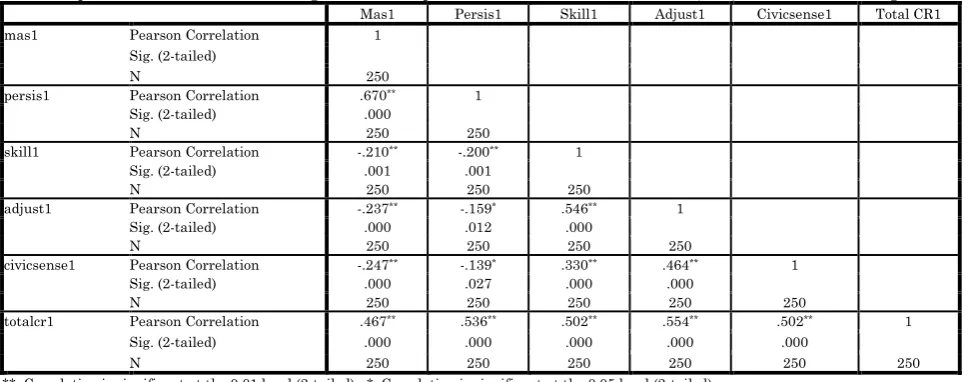
Table 9: represents inter-correlation among the score components Low Career Readiness score (LCR) with decision making
Mas1 Persis1 Skill1 Adjust1 Civicsense1 Total CR1
mas1 Pearson Correlation 1
Sig. (2-tailed)
N 250
persis1 Pearson Correlation .670** 1
Sig. (2-tailed) .000
N 250 250
skill1 Pearson Correlation -.210** -.200** 1
Sig. (2-tailed) .001 .001
N 250 250 250
adjust1 Pearson Correlation -.237** -.159* .546** 1
Sig. (2-tailed) .000 .012 .000
N 250 250 250 250
civicsense1 Pearson Correlation -.247** -.139* .330** .464** 1
Sig. (2-tailed) .000 .027 .000 .000
N 250 250 250 250 250
totalcr1 Pearson Correlation .467** .536** .502** .554** .502** 1
Sig. (2-tailed) .000 .000 .000 .000 .000
N 250 250 250 250 250 250
**. Correlation is significant at the 0.01 level (2-tailed). *. Correlation is significant at the 0.05 level (2-tailed).
Discussion
Career readiness among the B.Tech students of IT and non IT courses was assess by using career readiness questionnaire developed by the concept of different psychologists. From the mean value and t value it is said that the selection of the study courses of has significant impact on career readiness among the students from same engineering degree. Career readiness is composed by different components.
The components mastery over the subject matter, persistency in career field and skill development are shown significant differences in among the students of IT and NON IT courses of Engineering. But no mark difference was also found in total career readiness score. Thus, the hypothesis that irrespective of gender the nature of the test score of career readiness of B.Tech students in Colleges of Kolkata significantly varies in terms of their course of studies (IT and Non IT) was rejected. Although, components of career readiness varied among the students with high career readiness and low career readiness.
From the t table 4, it is shown that there is no significant difference in career readiness among the male and female students of B.Tech courses. Even there was no significant difference in different components of career readiness among the male and female students of B. Tech courses. Thus, the hypothetical assumption that the nature of career readiness test score of B.Tech students in Colleges of Kolkata varied in terms of their gender (male and female) was rejected.
Mean values and ANOVA results (Table: 7) indicated that there was a significant difference in components of career readiness for the course of studies namely IT and NON IT. Study conducted by Vyasarajan J., et al., [19] found that career development influenced by career preparation and readiness to make career choices. Individual selection of courses thus predicts the students prolonged planning for future career [20].
Career readiness; factor comes from both cognitive and sociological background. From knowledge dimension which is cognitive
also, mastery over the subject shows significant difference in both IT and NONIT group. Though out development of skill is also helpful to reach students’ goal.
According to Super [21], concept of career readiness or maturity is a continuous development process that can be segmented into a series of stages and tasks namely orientation toward work (attitudinal), planning (competency), consistency of vocational preferences (consistency), and wisdom of vocational preferences (realistic).
This is also revealed from the study that continuous development of skills requires persistency which helps students to gain knowledge which reflects make differences in career readiness field. The ANOVA test also revealed no significant difference in career readiness is due to gender. Although career readiness may not be different in male and female but there must be possibilities of different in components of career readiness.
In a study by Wendy Patton, Dee A. Bartrum, and Peter A Creed [22] found that in male optimism and self-esteem influenced career expectations. A different pathway was identified for females, with optimism directly influencing career goals, which subsequently predicted career planning and career exploration.
As shown in this table 4 that, there exist a significant difference between the higher and lower career readiness students with different component of decision making scale. The students with higher career readiness score show significant difference in decision making components like reasoning (t= 7.162) intuition (t= 5.738), computation (t=5.885), communication (t=3.893) and interaction (t=3.733). In a study Tan, Hannah Irene Ai Ling (2004) conducted a study to find out types of problem students’ faces during decision making.
The correlational matrix represents correlational value among decision making score with component of career readiness score. As seen in the matrix few significant correlations exist among them.
Conclusion
The study identify the relevant the situational and personal factors in early stage of career planning of the students and development and to develop the resource materials for management of career readiness programme at the colleges.
References
1. Adams TP (1997) From Childhood to Adolescence: A Transitional Period (Pp205-239) Newbury Park, CA: SAGE Publications.
2. Crites JO (1961) A Model for Measurement of vocational maturity. Journal of Counseling Psychology, 8:255-259.
3. Winecoff and Lyday (1978) Career Counseling and Colleges, Hand Book of Guidance and Counselling, New York.
4. Mau WC (1995) Educational Planning And Academic Acievemet of Middle School Students: A Racial and Cultural Camparison. Journal Of Counseling And Develpoment,73:518-526.
5. Lynch JH (1994) Representation Of Relationship To Teachers, Parents And Friends As Predictor Of Academic Motivation And Self Esteem, Journal Of Early Adolescence,14(2):226-249.
6. Seta CE, Paulus PB, Baron RA (2000) Effective Human Relation: A Guide To People At Work: Boston: Allyn And Bacon.
7. Quenk NL (1999) Essential Of Mayers – Brigger Type Indicator Assesment.New York, John Wiley.
8. Robbins SB, Allen J, Casillas A, Peterson CH, Le H (2006) Unraveling the differential effects of motivational and skills, social, and self-management measures from traditional predictors of college outcomes. Journal of educational psychology, 98(3):598.
9. Burton NW, Ramist L (2001) Predicting success in college: SAT studies of classes graduating since 1980.
10. Bowen WG, Chingos MM, Mc Pherson MS (2009) Crossing the Finish Line: Completing College at America’s Public Universities. Princeton, N.J.: Princeton
University Press.
www.avid.org/dl/res_research/research_crossingthefinish line.pdf
11. Mattern K, Burrus J, Camara W, O’Connor R, Hanson MA, Gambrell J, Bobek B (2014) Broadening the definition of college and career readiness: A holistic approach. ACT Research Report 2014-5). Iowa City, IA: ACT.
12. Conley DT (2007) Redefining College Readiness. Educational Policy Improvement Center (NJ1).
13. Conley DT (2012) A Complete Definition of College and Career Readiness. Educational Policy Improvement Center (NJ1).
14. Gibson RL, Mitchell MH (2006) Introduction to career counseling for the 21st century. Columbus, OH: Pearson.
15. Weihrich H, Koontz H (2005) Management: A global perspective. Tata Mc Graw-Hill.
16. https://www.act.org/content/dam/act/unsecured/docume nts/ACT_Technical_Manual.pdf
17. Rainey HG, Backoff RW, Levine CH (1976) Comparing public and private organizations. Public administration review, 36(2):233-244.
18. Hirschi A, Läge D (2007) The relation of secondary student’s career choice readiness to a six-phase model of career decision-making. Journal of Career Development, 34(2),164-191.http://works.bepress.com/dee_bartrum/3/ date 3.6.2014
19. Guindon, M. H. and Richmond, L. J. (2005), Practice and Research in Career Counseling and Development—2004. The Career Development Quarterly, 54: 90–137.
20. Vyasarajan J, Arulmani G (2010) Indian adolescents’ readiness to make career choices: Findings from a career counselling intervention http://www.jivacareer.org/jiva/conference/docs/Jayashree -V&Gideon-A.pdf 2.01.2014
21. Sampson JP, Peterson GW, Reardon RC, Lenz JG (2003) Key elements of the CIP approach to designing career services. Center for the Study of Technology in Counseling and Career Development, Tallahassee, FL: Florida State University.
22. Super DE (1980) A life-span, life-space approach to career development. Journal of vocational behavior, 16(3):282-298.