Available online throug
ISSN 2229 – 5046
BIANCHI TYPE VIII COSMOLOGICAL MODEL
WITH PERFECT FLUID IN
f
(
R
,
T
)
THEORY OF GRAVITATION
M. M. Sancheti & S. P. Hatkar*
Department of Mathematics, R. A. Science College, Washim-444505, India.
*Department of Mathematics, Adarsh Education Society’s Arts, Commerce & Science College,
Hingoli-431513, India.
(Received on: 24-10-13; Revised & Accepted on: 19-11-13)
ABSTRACT
I
n the present paper Bianchi type VIII space time with perfect fluid in f(R,T) theory of gravitation (Harko et al, Phys. Rev. D.84, 024020, 2011) is presented. Exact solution of the field equations is obtained. It is observed that the universe is anisotropic with early acceleration and late deceleration.Keywords: Bianchi type VIII cosmological model, Perfect fluid, f(R,T)gravity.
1. INTRODUCTION
Cosmological observations such as cosmic microwave background radiation, type Ia supernova [1, 2] shows that the universe is accelerating. There are various interesting possibilities invoked in order to explain acceleration of the
universe. Among these f(R)modified gravity models have attracted a lot of attentions [3-10]. In Einstein field
equations of general relativity, which are derived from an action principle by Hilbert, by adopting a linear function of
the scalar curvatureR, in the gravitational lagrangian density. There is no reason why the gravitational action should
be linear in the Ricci scalarR. It has been suggested that cosmic acceleration can be achieved by replacing
Einstein-Hilbert action of general relativity with a general function f(R). Harko et al [11] proposed another extension of
standard general relativity f(R,T). This theory of gravitation is generalizes f(R)in which an arbitrary function of
Ricci scalar is coupled with the stress energy tensor T.
Very recently Adhav [12] obtained exact solution of the field equations in respect of LRS Bianchi type I space time
filled with perfect fluid in the frame work of f(R,T). D.R.K. Reddy and R.Santhi Kumar [13] explores LRS Bianchi
type II universe in f(R,T)theory of gravity. FRW viscous fluid cosmological model in f(R,T)gravity studied by
Naidu et al [14].
Motivated by the above investigations we have investigated Bianchi type VIII cosmological model in f(R,T)gravity.
2. METRIC AND FIELD EQUATIONS.
The action for the modified theory of gravity is
∫ + −
= f RT L gd x s ( ( , ) m) 4
16 1
π (1)
where f(R,T) is an arbitrary function of the Ricci scalarR and Tis the trace energy momentum tensor of matter
T
ij,m
L
is the matter lagrangian density. The field equations of f(R,T)gravity model as (Harko et al 2011)(
j i j)
R ij T ij T iji ij ij ij
R RT R f RT g g f RT T f R T T f RT
f ( , ) ( , ) 8π ( , ) ( , )θ 2
1 ) ,
( = + ∇∇ −∇∇ = − − (2)
IJMA- 4(11), Nov.-2013.
where ij ij Lm ij Tij pgij
g g g
T =− −
∂ − ∂ − −
= 2 ,θ 2 (3)
Here R T j
T T R f f R T R f f ∇ ∂ ∂ = ∂ ∂
= ( , ) , ( , ) , is covariant derivative.
Assume the function f(R,T) given Harko et al
) ( 2 ) ,
(RT R f T
f = + (4)
where f(T) is an arbitrary function of trace of the stress energy tensor of matter. The matter lagrangian can be taken as
p
Lm =− . Also we choose
T T
f( )=µ (5)
Therefore using equation (2), (3), (4) we obtain
(
)
ijij ij
ij
ij Rg T f T T pf T f T g
R 8 2 ( ) 2 ( ) ( ) 2
1 = + ′ + ′ +
− π (6)
where the prime indicate the differentiation with respect to argument. We consider a spatially homogeneous Bianchi type VIII metric of the form
2 2 2 2 2 2 2 2 ] ) sinh( [ ] ) ( cosh
[d
θ
θ
dφ
S dψ
θ
dφ
Rdt
ds =− + + + + (7)
where(θ,φ,ψ) are the Eulerian angles. R & S are functions of t only.
The energy momentum tensor for perfect fluid distribution is given by
(
)
i j ij ij puu pgT = ρ+ + (8)
where
ρ
is the energy density, p is pressure. Here we consider the case when the perfect fluid obeys the followingequation of the state
1 0
, ≤ ≤
=γρ γ
p (9)
In commoving coordinate system we have
ρ = = = = 4 4 3 3 2 2 1
1 T T p,T
T (10)
ρ − = + + +
=T T T T p
T 11 22 33 44 3 (11)
The field equation for the metric (7) takes the form
µρ
µ
π
+ −= + +
+ p p
R S RS S R S S R R 7 8 4 4 2 4 4 44
44 (12)
µρ
µ
π
+ −= − −
+ p p
R S R R R R R 7 8 4 3 1 2 4 2 2 2 2 4
44 (13)
µρ
µ
πρ
5 38 4 1 2 4 2 2 2 2 4 4
4 + − − =− + p−
R S R R R RS S R (14)
IJMA- 4(11), Nov.-2013.
(
)
α ββ
π
µ
µρ
β
α
α
β
α
. . 4 4 22 . .. .. 7 8 4 1
2 + = + − +
− −
+ e p p e (15)
(
)
α ββ β
α
π
µ
µρ
β
α
α
α
. . 2 2 4 4 22 . .. 7 8 4 3 2
2 − − −e + − e = p+ p− e + (16)
(
)
α ββ β
α πρ µ µρ
β
α. . 2 2 4 4 2
3 5 8 4
1
2 −e + − e = − + p− e + (17)
where overhead dot indicate differentiation with respect to
τ
.Using equations (15) & (16) we get
0 4 .. 2 2 .. = − −
− α+ β β β
α e e (18)
Assuming the relation between the metric potentials
β
α=n (19)
where
n
is arbitrary constant. We obtainβ β
β 2( 1) 4
1 1 1 1 e n e n n − + −
= + (20)
Taking
β
=
log(
u
)
&
n
=
0
equation (20) reduces to2 1 2 4 2 3 2 1 1 − − = u u c u d du
τ (21)
where c is integration constant.
On further integration equation (21) leads to
1 =
R (22)
2 1 ) 2 cosh( 4 3 2 1 − + = τ
S (23)
3. PHYSICAL AND GEOMETRICAL PARAMETER
Density and Pressure are obtained as
(
)
+ + + − + − − = ) 2 cosh( 2 3 2 1 )] 7 8 )( 3 8 ( 5 [ ) 2 cosh( 3 4 1 62 π µ π µ τ
µ
τ π
π µ
ρ (24)
+ + + − + = ) 2 cosh( 2 3 2 1 ) 7 8 ( ) 2 cosh( 2 3 25 . 1 7 8 τ µ π τ ρ µ π µ
p (25)
Volume 2 1 ) 2 cosh( 2 3 2 1 − + = τ
IJMA- 4(11), Nov.-2013.
Expansion scalar
) 2 cosh( 3 3 3
) 2 sinh( 3
τ τ θ
+ −
= (27)
Shear scalar
(
)
22 2
) 2 cosh( 3 3 3
) 2 ( sinh 3
τ τ σ
+
= (28)
Deceleration parameter
) 2 cosh( ) 2 sinh( 3
) 2 ( cos 6
τ
τ
τ
−
= ech
q (29)
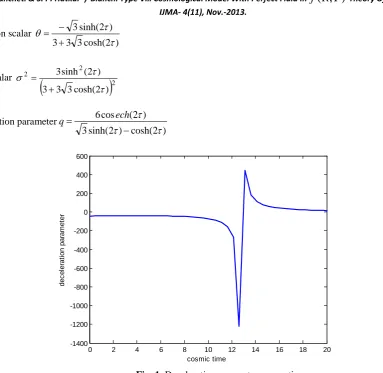
Fig. 1. Deceleration parameter versus time
It is from equations (27) and (28) observed that the ratio of shear scalar to expansion scalar is not zero. The value of expansion scalar tends to constant at large time. This means that the universe is anisotropic. The deceleration parameter at early epoch is negative and at late time positive i.e. early acceleration and late deceleration.
4. CONCLUSION
We have presented Bianchi type VIII universe in the framework of modified f(R,T) theory of gravitation in the
presence of perfect fluid. We found that the universe is anisotropic. Early acceleration and late time deceleration nature of the universe is also observed.
5. REFERENCES.
[1] Riess et.al: Astron J.116 (1998), 100.
[2] Perlmutter et.al: Astrophys.J.517, (1999), 565.
[3] Nojiri S., Odintsov S.D.: Phys.Rev.D.74, (2006), 086005.
[4] Carroll S.M., Duvvuri V., Trodden M., Turner M.S.: Phys.Rev.D.70, (2004), 043528.
[5] Capozziello S., Cardone V.F., Corloni S., Troisi A.: Int.J.Mod.Phs.D.12, (2003), 1969.
[6] Multamaki T., Vilja I.: Phys.Rev.D.73, (2006), 024018.
[7] Starobinski A.A.: JETP Lett. 86, (2007), 157.
[8] Bertoami O., Boehamer C.G., Harko T., Lobo F.S.N.: Phys.Rev.D.75, (2007), 104016.
[9].Nozari K., Azizi T.:Phys. Lett.B.680, (2009), 205.
0 2 4 6 8 10 12 14 16 18 20
-1400 -1200 -1000 -800 -600 -400 -200 0 200 400 600
cosmic time
dec
el
er
at
ion par
am
et
IJMA- 4(11), Nov.-2013.
[10] Sotiriou T.P., Farooni V.: Rev.Mod.Phys.82, (2010), 457.
[11] Harko T., Lobo F.S.N., Nojiri S.,Odintsov S.D:arXiv.1104.2669v2 [gr-qc] (2011).
[12] Adhav K.S.: Astrophys Space.Sci., 339, (2012), 365.
[13] DRK Reddy, R.Santhikumar: Global Journal of Science frontier research physics and space science Vol.13, issue2 ver.1.0, (2013).
[14] R.L.Naidu, K.Dasu Naidu, T. Ramprasad, DRK Reddy: Journal of Science frontier research physics and space science Vol.13, issue 3 ver.1.0, (2013).