European Journal of Physical Education and Sport Science
ISSN: 2501 - 1235 ISSN-L: 2501 - 1235 Available on-line at: www.oapub.org/edu
Copyright © The Author(s). All Rights Reserved.
doi: 10.5281/zenodo.2694720 Volume 5 │ Issue 8 │ 2019
LEVEL OF PHYSICAL FITNESS & ACTIVITY
IN THE SCHOOL CHILDREN: A REVIEW
Poorva Rastogi,
Kalpana Sharmai
1Research Scholar, Amity School of Physical Education & Sports Sciences,
Amity University, Noida, India 2Prof., Dr., Supervisor & Director, Amity School of Physical Education & Sports Sciences, Amity University, Noida, India
Abstract:
The aim of this study was to determine the level of physical activity of children during the period of stay in schools. A literature search was conducted in databases Web of Science, Sport Discus, Science Direct, PubMed and Scopus. Inclusion criteria were: articles concerning physical activity of children aged 2-6 years in preschools. Seven original articles were included. The methods of evaluation were: accelerometers, pedometers and direct observation. In total, it was analysed 1485 children aged 2-6 years. Findings indicated on average 7.51 h/day and 7.22 h/day of stay of children in preschool, with the highest percentage of sedentary physical activity which conclusion that children attending preschools spend most of the day in sedentary behaviour. Activities initiated by adults tend to result in lower levels of physical activity among children. The space inside for games, outdoor games, markings on the floor to play, jumping and climbing equipment are some actions that increase the level of daily physical activity of children in such places.
Keywords: child care; environment; epidemiology; movement education; sports
1. Introduction
Children in educational institution age ought to be inspired to apply fun activities, games, exploring varied physical and emotional experiences and environments, like play and activities, as well as many actions, including; run, gallop, leap, hop, play, think, draw up plans, in insurance and supervised environments. In this context, we can embody physical activity, at early ages, being related to positive effects on health, even in age from 2 to 6 years. A review with kids from 1 month to 4.9 years, found the
positive relationship between enhanced physical activity with favourable measures of fattiness, bone density and factors cardiometabolic (Timmons BW, 2012).
The pattern of physical activity of kids of 4 and 6- year old is characterised by an intermittent pattern of long periods of low activity intensity mixed with very short shots of vigorous activity, and jump or run, recommended as very vital for the bone mineralization. Mean MVPA (moderate to vigorous physical activity) in educational institution kids are concerning 16minutes per day. It looks that it takes a minimum of double that quantity to the positive effects higher than bone mineralization.
In addition to those factors, the daily physical activity recommendations for educational institution kids are 60 minutes/day MVPA. Thus, the possibilities of those recommendations for educational institution kids would be rare, even extrapolating for an all-day (Raustorp A, Accelerometer measured level of physical activity indoors and outdoors during preschool time in Sweden and the United States, 2012). an intensifying issue is that parents suppose that kids are extremely active in educational institution, then provide fewer opportunities for active behaviour in alternative environments, reducing the amount of physical activity of kids over day (Pate RR, Directly observed physical activity levels in preschool children, 2008).
2. Literature Review
In 2008, was revealed a scientific review of the physical activity of kids of 2-6 years old, still as meeting the guidelines for physical activity NASPE, 60 min/day MVPA. This review showed a mirrored image of the participation of kids in physical activities, and the importance of early intervention. The review concerned thirty-nine studies published between 1986 and 2007, representing 10,316 kids in seven countries. The results of this review reportable kids MVPA for a minimum of 60 min/day in 21 (54%) studies. Therefore, 18 studies (46%) kids failed to meet the daily recommendation of PA. The author points out that whereas a bit over half the studies meet the recommendations of 60 min/day physical activity, the educational institution setting should offer structured and unstructured activities (60 min/day each). Thus, if the standards of the review studies would use 120 min/day of physical activity, solely 23rd of the studies would be valid.
Another newer systematic review study aimed to analyse offer an important outline of proof on the Low Physical Activity by objective strategies, inside the educational institution. The review solely enclosed studies with objective measures of physical activity in kids 3-6 years recent, preschools, within the period 2000-2008. The results found twelve articles, with ninety-six preschools and 1,900 kids. The author concludes that the Low Physical Ability, measured by objective strategies, within the preschools were low, with high performance inactive.
Thus, there was the requirement for brand new studies to explain the present knowledge on physical activity in kids, specifically in educational institution atmosphere, moreover as potent factors in these surroundings. This review was the proposal to supply knowledge on the amount of physical activity of kids throughout the amount of stay in preschools, moreover because the factors which will influence, to mirror on the contribution of educational institution surroundings in daily physical activity of kids.
3. Methodological Procedures
Were conducted searches within the databases internet of Science, Sport Discus, Science Direct, PubMed, Scopus, in December 2018. Consistent with the planned objectives were elite in January 2008 articles to December 2016, concerning the physical activity of kids aged 2-6 years throughout the amount of possess in preschools. The descriptors used were: (preschool kid or kid day care centres) AND (physical activity) AND (OR accelerometer direct observation OR pedometers OR 60 minutes monitoring). Throughout the searches, filters for the year of publication (2008-2016) were used, sort of publication (scientific papers), language (English), totalling 893 articles found.
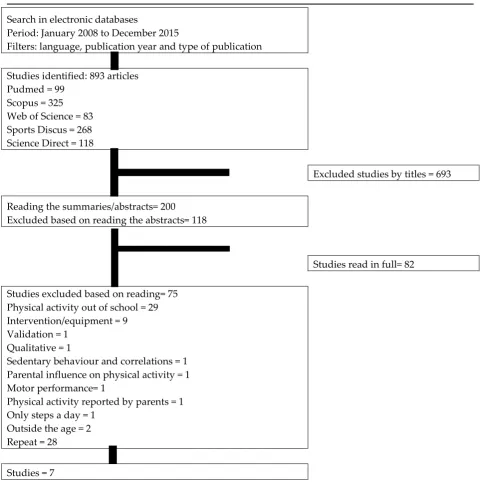
The first search yielded 893 articles known within the said info. Later, the reading of all the titles of the articles that resulted within the exclusion of 693 was control, and among these, twenty-five were recurrent articles. Then proceeded to browse the outline of the two hundred eligible articles of that 118 were excluded. in order that they were scan fully eighty-two articles wherever seventy-five were excluded.
Search in electronic databases
Period: January 2008 to December 2015
Filters: language, publication year and type of publication
Studies identified: 893 articles Pudmed = 99
Scopus = 325 Web of Science = 83 Sports Discus = 268 Science Direct = 118
Excluded studies by titles = 693
Reading the summaries/abstracts= 200 Excluded based on reading the abstracts= 118
Studies read in full= 82
Studies excluded based on reading= 75 Physical activity out of school = 29 Intervention/equipment = 9 Validation = 1
Qualitative = 1
Sedentary behaviour and correlations = 1 Parental influence on physical activity = 1 Motor performance= 1
Physical activity reported by parents = 1 Only steps a day = 1
Outside the age = 2 Repeat = 28
Studies = 7
Figure 1: Organizational chart of the steps elapsed to perform the review
4. Results
The first stage of the search resulted in 893 articles found. once reading the titles, abstracts and full reading of the studies, it amounted to six articles used for review (Figure 1). The six original articles enclosed within the review analysed the physical activity of kids of 2-6 years recent, solely throughout the amount of keep in preschools, and used accelerometers, pedometers and direct observation and activity strategies of physical activity.
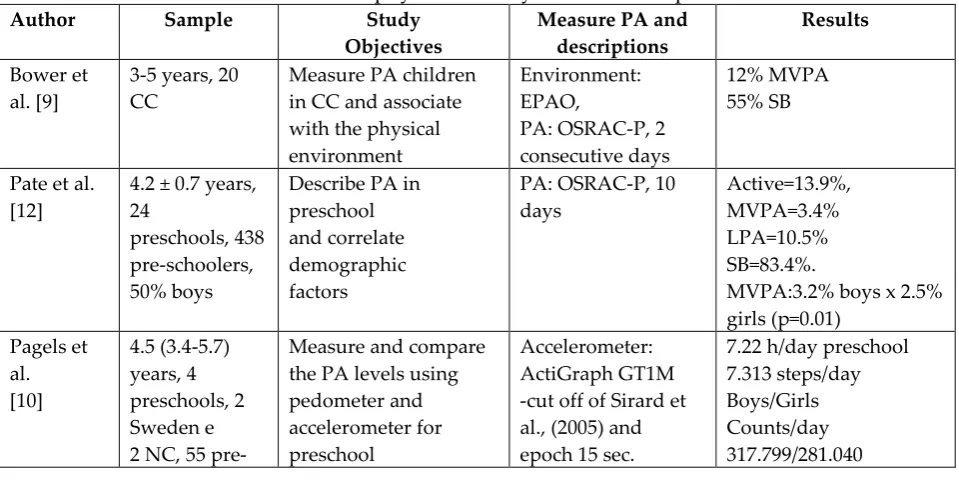
average. Most of the time the kids are inactive, predominantly SB, altogether studies, with an MVPA around Week for 1 hour [12]. The time determined among the preschool was 87, with a predominance of SB, 100% of the time was determined outside the room and also the transition from outdoors to internal it had been 3-dimensional (Brown WH, social and environmental factors associated with pre-schoolers’ nonsedentary physical activity, 2009). The proportion of MVPA was four-dimensional for kids of 3 years old and 3.3% between 4-5 years old. The average time spent on light to vigorous physical activity (i.e.: not inactive activity) was fifty (± 17) minutes throughout the amount of educational institution. Boys had a better proportion of MVPA, and 3.2% against 2.5% in girls, p=0.01[5].
As for the selection of the sample, 2 selected by convenience [10,3]. In total, ninety-one preschools were analysed, totalling 1485 kids aged 2-6 years old. The physical activity of educational institution kids was a part of the aim of all studies. However, the connection between physical space and the social atmosphere among the preschools and predictors conditions of physical activity, comparison of steps per day with counts per minute, biological and demographic characteristics and comparisons between physical activities inside and outside were several the other objectives analysed within the studies.
To measure the physical activity of educational institution kids, 5 studies used the OSRAC-P (Observational System for Recording Physical Activity in Children-Preschool) as direct observation instrument [9,5,13-15]. The accelerometer of ActiGraph mark GT1M was utilized in a study because the single instrument [3], and in 2 alternative studies combined with the utilization of pedometers Yamax SW-200 [10] and direct observation [14,15]. The cut-offs of Sirard et al. [16] and 15 second epoch were utilized in 3 studies with accelerometers. For direct observation methodology was used 1 to 2 days of observation and studies given accelerometers 5 days of use.
Table 1: Description and characteristics of the six studies included in this review of the physical activity of children in preschools
Author Sample Study
Objectives
Measure PA and descriptions
Results
Bower et al. [9]
3-5 years, 20 CC
Measure PA children in CC and associate with the physical environment
Environment: EPAO,
PA: OSRAC-P, 2 consecutive days
12% MVPA 55% SB
Pate et al. [12]
4.2 ± 0.7 years, 24
preschools, 438 pre-schoolers, 50% boys
Describe PA in preschool and correlate demographic factors
PA: OSRAC-P, 10 days
Active=13.9%, MVPA=3.4% LPA=10.5% SB=83.4%.
MVPA:3.2% boys x 2.5% girls (p=0.01) Pagels et al. [10] 4.5 (3.4-5.7) years, 4 preschools, 2 Sweden e 2 NC, 55
pre-Measure and compare the PA levels using pedometer and accelerometer for preschool
Accelerometer: ActiGraph GT1M -cut off of Sirard et al., (2005) and epoch 15 sec.
schoolers, 28 boys
Pedometer: Yamax SW-200. 5 days
Steps/day 8.385/6.202 MVPA min/day 16.6/17.4 LVPA min/day 50/46 Sedentary min/day 396/397
r= 0.67-counts and steps/day r=0.76-LVPA and steps/day Alhassan et al. [14]
4.1( ± 0.8) years,10 preschools, 34 classrooms, 315
pre-schoolers
Describe PA in the baseline of CG and IG of STEP and
the biological characteristics and demographic of the participants
Accelerometer: ActiGraph-GT1M - cut off of Sirard et al., (2005), epoch 15 sec., 5 days, 7:00a.m.-16:30p.m., during the preschool Direct observation: OSRAC-P, 1 day
Accelerometer MVPA (average/day) 6.40% LPA (average/day) 18.60% SB (average/day) 74.20% Direct observation: MVPA (average/day) 33.60% LPA (average/day) 40%
SB (average/day) 24.50%
Raustorp et al. [11] 4.3 (3.33-5.58) years, 4 preschool, 2 Sweden e 2 NC, 50 pre-schoolers, 26 boys
Evaluate and compare LPA indoor and outdoor, and compare PA among preschool Swedes and
Americans, and between boys and girls
Accelerometer: ActiGraph GT1M – cut off of Sirard et al., (2005), epoch 15 sec.
5 days, morning and afternoon
471 min/day in the preschool
Indoor * ƚƖ/Outdoor * ƚ
323min/149min Counts-indoor*/Count-outdoor 493min/1098min MVPA indoor/outdoor 2.3 %/7.3% LPA indoor*/outdoor 8.5 %/17.6% SB indoor*/outdoor 89.1 %/75.2 %
Increased PA outdoor: SWE:47% x USA:18% Gubbels et
al. [15]
2.6 years, 9 preschools, 175
pre-schoolers, 50.9% boys
Describe PA in pre-schoolers of 2-3 years in the preschools, and associate with
environment and facilities
Environment: EPAO,
PA: OSRAC-P, 2 days 1 day morning, another afternoon MVPA Indoor: 5.5% Outdoor: 21.3% SB Indoor: 59.4% Outdoor: 31.2%
group; IG: intervention group; *significant differences between USA and SWE (p<0.001); ƚ significant differences between USA and SWE (p<0.001) for boys and Ɩ significant differences between USA and SWE (p<0.001) for girls.
5. Discussion
The survey covers the diverse dimensions of physical action of kids in preschool gave pre-schoolers higher SB esteems that all out physical action (TPA). For action in explicit situations kids invest more energy inside, averaging 323 ± 114 min/day versus 149 ± 115 min/day outside. Conversely, are progressively dynamic in outside [13,15].
Physical action levels indicated changes between ages. The rate invested in MVPA and inactive energy in, would in general lessening while the time LMPA would in general increment in more established kids [9,10,5,13].
One factor to consider for more established kids have lower MVPA values is the best time in the study hall, in instructive exercises that more youthful [5]. The accompanying outcomes will be talked about by point: Estimating instruments and physical movement; interior condition, physical action and affecting variables and outer condition, physical action and impacting factors.
5.1 Assessing instrument and Physical movement
Of the six examinations incorporated into the audit, three utilized accelerometers [10,3,14] as a proportion of physical movement instrument, and in two utilized pedometer and direct perception together [10,14]. Different examinations utilized direct perception as an instrument both for assessment of physical action of kids and for the earth [9,5,13,15]. As to instrument to quantify physical movement, considers utilizing direct perception [9,5,13,15] report higher MVPA values when contrasted with studies utilizing accelerometer [10,3,14], and the variety of 1% values 33.6%. For SB, thinks about that utilized direct perception [9,5,13,15] detailed lower esteems contrasted with accelerometer [10,3,14], running from 31.2% to 94%.
Applicable factors on the inconsistency of qualities found for the force of physical movement, notwithstanding the diverse instruments are criteria for the utilization of the instruments. Inside the examinations utilizing direct perception [9,5,13,15] as a strategy for assessment of physical action, time of perception of youngsters ran from hours to days, or just amid explicit exercises. The discoveries show the absence of basic criteria for estimating and assessing physical action and comprise a confinement with respect to the techniques and proportions of physical action appraisal. We ought to be careful when looking at concentrates that survey physical action, notwithstanding when utilizing a similar assessment technique.
5.2 Inward condition, Physical movement and Impacting factors
the components that can impact the conduct of kids dynamic in the inside condition of preschools, the standard emerges the utilization of some gear and size of the region accessible for play as influents [3,15].
At the point when looked at preschools in two unique urban areas, altogether higher level of MVPA were seen in Malmo, 2.9% against 1.8% in Raleigh with p<0.001. This contrast between preschools was clarified through the everyday practice of kids. In Raleigh, the exercises were identified with guidelines and schedules, driven by grown-ups, so the kids were ceased or restrained in certain exercises or practices. Also, offspring of preschool Raleigh rested or kept in a stationary action, between 1-3 pm, often as for the focal point of Malmo (Raustorp A, 2012).
Another compelling component in the conduct of kids in the indoor were the gear. The kids were altogether increasingly dynamic in the local condition when gear was bouncing, throwing, pushing, pulling and versatile slides. What's more, were altogether less dynamic within the sight of sand and water toys, and development toys as meagre steeds [15]. The extent of the indoor play territory is additionally a factor that affected the preschool action and was decidedly connected with the physical movement dimensions of kids (r=0:17, p<0.001), being progressively dynamic when the inward play zone it was bigger [15].
5.3 Outside condition, Physical action and Impacting factors
The exercises completed outwardly of the preschools, just 10% of the time are described dynamic practices [3], and the most well-known exercises were [13]: walk (7% MVPA), race (100% MVPA), slither (4% MVPA), hop or hop (56% MVPA) and scale (29% MVPA) [13].
Concerning the conceivable powerful factors in the dynamic conduct of preschool kids in the open air of preschools, we can feature, just as to the indoor, the utilization of some equipment and size of the territory accessible for play, settings and initiators of exercises were accounted for as components impacting the dynamic practices in that condition [3,13,15]. Kids were fundamentally progressively dynamic within the sight of fixed hardware, bouncing, markings on the floor to play, climbing casings, passages and sandbox [15] boxes. Conversely, convenient waterslides and open-air shaking hardware were adversely connected with the dimension of physical action of kids [15].
The span of the zone accessible for play is another compelling element in the dynamic conduct of pre-schoolers. The extent of the open-air park was altogether and emphatically related with the dimension of physical movement of kids [15]. The most well-known settings related with LVPA in the outside were space utilizing balls and items (26% MVPA), open spaces (23% MVPA), toy run (14% MVPA), fixed equipment (13% MVPA) and exercises sociodramatic (10% MVPA).
the appraisals of the physical space of preschools by direct perception, higher all out scores sequentially detailed higher estimations of MVPA in connection to low scores (Bower JK, 2008). This reality shows the positive impact of nature helpful for the act of physical movement in preschools.
6. Conclusion
In conclusion of this review study, kids who go to preschools, go through most of the day in stationary conduct. Exercises started by kids will in general outcome in larger amounts of physical movement. The space inside for diversions, open air recreations, markings on the floor to play, bounce from climbing equipment are some conceivable moves to be made for expanding physical action these spots.
Ought to abstain from riding toys/wheelies in little spaces, among other static toys. The utilization of slides swings and sandboxes that must be inspected with alert as they may restrain the dimension of physical movement of kids (Gubbels JS, 2012). Subjects identified with physical movement, just as instructor preparing, and inner arrangements for physical action, merit more prominent consideration regarding the best occupation and best stocks in preschools (Brown WH, Social and environmental factors associated with preschoolers’ nonsedentary physical activity, 2009).
One of the restrictions of this survey was constrained was the incorporation of concentrates with various techniques for estimation of physical action. In any case, this reality is normal as to analyse aftereffects of physical movement not just among preschool kids, as in concentrates that measure constant physical action, which uncovered the requirement for elucidation in connection to the investigation goals with the criteria and techniques to be utilized.
Intervention thinks about directed to assess conceivable techniques increment the physical action of preschool kids, exhibit the requirement for more research to confirm the possible physical, biological and political influents [15,16]. One should consider the way that the more prominent amassing of MVPA amid play of gross engine abilities often happen amid the main portion of play and speaks to a little division of the measure of time that preschool kids take part in MVPA. Based on this proof, the activities for higher execution resources of these preschool ought to research the likelihood of presenting them to all the shorter episodes of physical action organized along the preschool day (Alhassan S, 2012).
References
2 (Ed.). (2009). Active Start: A Statement of Physical Activity Guidelines for Children
from Birth to Age 5. Shape America-Society of Health and Physical Educators.
Alhassan S, N. O.-G. (2012). Design and baseline characteristics of the Short bouTs of
Bower JK, H. D. (2008). The Childcare Environment and Children’s Physical Activity.
Am J Prev Med(34), 23-29.
Brown W. H., P. K. (2009). Social and environmental factors associated with
preschoolers’ non sedentary physical activity. Child Development(80), 45-58.
Brown W. H., P. K. (2009). social and environmental factors associated with
preschoolers’ nonsedentary physical activity. 80. Retrieved from Child Dev.
Coe, D. P., Pivarnik, J. M., Womack, C. J., Reeves, M. J., & Malina, R. M. (2006, August). Effects of physical education and activity levels on academic achievement in
children. Medicine and Science in Sports and Exercise(8), 38. Retrieved from
https://doi.org/10.1249/01.mss.0000227537.13175.1b
Gubbels J. S., V.-K. D. (2012). Play equipment, physical activity opportunities, and children’s activity levels at childcare. Journal of Environmental and Public Health 2012.
Hillman, C. H., Castelli, D. M., & Buck, S. M. (2005). Aerobic fitness and neurocognitive function in healthy preadolescent children. Medicine & Science in Sports &
Exercise, 37, 1967-1974. Retrieved from
https://doi.org/10.1249/01.mss.0000176680.79702.ce
Pagels P, B. C. (2011). Comparison of pedometer and accelerometer measures of
physical activity during preschool time on 3 to5-year-old children. Acta Paediatr ,
116-120.
Pate R. R., M. K. (2008). Directly observed physical activity levels in preschool children.
J Sch Health, 78, 438-444.
Raustorp A, P. P. (2012). Accelerometer measured level of physical activity indoors and
outdoors during preschool time in Sweden and the United States. J Phy Act
Health 9:801-808.(9), 801-808.
Timmons B. W., L. G. (2012). Systematic review of physical activity and health in the
Creative Commons licensing terms
Authors will retain the copyright of their published articles agreeing that a Creative Commons Attribution 4.0 International License (CC BY 4.0) terms will be applied to their work. Under the terms of this license, no permission is required from the author(s) or publisher for members of the community to copy, distribute, transmit or adapt the article content, providing a proper, prominent and unambiguous attribution to the authors in a manner that makes clear that the materials are being reused under permission of a Creative Commons License. Views, opinions and conclusions expressed in this research article are views, opinions and conclusions of the author(s). Open Access Publishing Group and European Journal of Physical Education and Sport Science shall not be responsible or answerable for any loss, damage or liability caused in relation to/arising out of conflict of interests, copyright violations and inappropriate or inaccurate use of any kind content related or integrated on the research work. All the published works are meeting the Open Access Publishing requirements and can be freely accessed, shared, modified, distributed and used in educational, commercial and