ISSN-L: 2501 - 1235 Available on-line at: www.oapub.org/edu
Copyright © The Author(s). All Rights Reserved.
doi: 10.5281/zenodo.3348326 Volume 5 │ Issue 10 │ 2019
COMPARISON OF EFFECT OF BALANCE DISC AND
BOSU BALL ON ANKLE DORSIFLEXOR AND
PLANTARFLEXOR MUSCLE STRENGTH
Abdurrahman Demiri Artvin Coruh University, Department of Sports Management,
Artvin, Turkey
Abstract:
Purpose of this study is to compare effect of balance disc (duradisk, dynadisk, balance ball, inflatable disc, etc.) and bosu ball on the strength development of ankle dorsiflexor and plantarflexor muscles of sedentary children. 74 sedentary children with a mean age of 9.71 years (sd =0,370) were granted permission from their parents in accordance with the Helsinki Declaration. In the study, a balance disk group and a bosu group were formed by random sampling. Balance disk group with the balance disk to the bosu group with bosu balls, three days a week, the same training program was applied for 8 weeks. The pre and post test ankle strength measurements of all groups were measured using the ’Lafayette’ digital hand dynamometer and the differences between the groups were examined. The participants were asked to perform a right-left foot dorsiflexion, and right-left foot plantarflexion force measurements were performed for 5 seconds. Each measurement is repeated twice and the best result was recorded. Two-way analysis of variance was used for parametric results and Kruskall Wallis test for non-parametric results. Before the study, it was seen that there was no significant difference between the groups in the measurements (p>.05). Therefore, gender difference is not considered. After the research, both groups showed improvement according to the pre-tests. There was a significant difference between the balance disk group and the bosu group in favor of the balance disk group (p <.05). In our study, it was found that the training performed with balance disk and bosu ball significantly improved the strength of both ankle dorsiflexor muscle groups and ankle plantarflexor muscle groups. This result shows that the exercises with balance disc and bosu can increase the strength development of dorsiflexor and plantarflexor muscle groups in sedentary children. Therefore, it may be suggested that training with balance disc and bosu can be used as an alternative method for strength development for these muscle groups.
Keywords: balance disc, bosu ball, strength
1. Introduction
Ankle muscle groups are one of the most important muscle groups in dynamic movement, static movement, providing support to whole body and most of sports activities (Weineck, 2011). Ankle dorsiflexor muscles consist of musculus tibialis anterior, musculus extensor digitorum longus, musculus peroneus tertius and musculus extensor hallucis longus muscles (Taner & Sancak, 1996) and plays a major role in maintaining balance of the body (Şeker, Talmaç and Sarıkaya, 2014). In addition, while walking and running, dorsiflexors are effective in keeping the swinging leg in a certain position (Jerosch & Schoppe, 2000). Ankle plantarflexor muscles consist of musculus gastrocnemius, musculus soleus, musculus peroneus longus and brevis, musculus flexor digitorum longus, musculus flexor hallucis longus, musculus tibialis posteriordur (Dere & Yücel, 1994).
Plantar flexion movement is more powerful than dorsi flexion movement due to calf muscles (Oatis, 1988). Plantar flexors and dorsiflexors are important muscle groups that may affect the performance of athletes in some branches. Bounce ability is associated with a strong foot and ankle muscle strength. In particular, problems in ankle muscle groups can prevent normal load distribution and displacement of the foot (Jerosch & Schoppe, 2000). Shortness and contractures of plantarflexor muscles may lead to limitations in the range of motion that restricts normal movement of muscle over time. Therefore, various training for these muscle groups and functional activities can affect the daily life positively (Knight, Rutledge, Cox, Acosta & Hall, 2001). Force, is an important biomotor ability for most sports, forms the basis for maximal power generation and muscular endurance (Bompa, 2015). So methods for increasing muscle strength are expected to be standard. But there is no clear method. Therefore, various training methods for strength development are being investigated (Murray & Kenney, 2016). It is stated that the muscle strength increase occurs in pre-puberty children as well as in adults by proper training method. However, there is no certain and clear view for development of muscle strength in pre-puberty children (Acikada, 2004). This may lead to the investigation of different methods for the development of muscle strength, especially in children.
Anderson & Curnew, 2002). Inflated balls, such as bosu and balance discs, can be useful because they provide a moving and variable surface.
In light of this information, bosu ball which is used for strengthening muscles and improving condition in daily life with applying balance disc may lead to improve the strength of the ankle plantar and dorsi flexors on the children (Durmus, 2014; Physioadvisor, 2017). Therefore purpose of this study is to compare effects of training with balance disc and bosu ball (only dome part) on the development of ankle dorsiflexor and plantarflexor muscle strength of sedentary children.
2. Material and Methods
In the study, pre-test and post-test experimental unbiased sampling model was used. Participants voluntarily participated with informed consent form of their parents according to Helsinki criteria.
2.1. Samples
In the study, age, body weight and height were 9,71 (Sd =, 370), 31.28 kg (Sd = 4,29), 138,93 cm respectively. Seventy-four children (Sd = 4.99). A balance disc of 39 people and a vacancy group of 35 people were formed.
2.2. Data Collection
Participants’ heights were measured in anatomical posture, barefoot and in centimeters form using a stadiometer (Holtain, UK). Body weights of children with anatomical posture, without shoes and sportswear with sensitivity ± 0.1 kg. using electronic scales. ‘Lafayette Digital Hand Dynamometer’ was used to measure ankle strength. All groups were pre-tested and post-tested. Points to be considered about how to make the measurement are explained to participants in a simple and clear way. Eight weeks later, same measurements were applied as a post-test and development levels between two groups were examined. Age, body weight and height of the participants are given in Table 1.
Table 1: Age, Body Weight and Height of the Groups
n Decimal Age Body Weight (kg) Height (cm)
Balance Disc 39 9,70 ±,386 31,25±,5,01 138,97±,4,55
Bosu Ball 35 9,72 ±,356 31,32±,4,29 138,88±,5,51
Total 74 9,71 ±,370 31,28±,4,65 138,93±,4,99
When the table is examined, it is seen that the age and physical characteristics of balance disc and bosu group are close to each other. Therefore, it can be said that the groups are distributed homogeneously.
LCD display with digital display. The device is capable of delivering data such as peak power, peak power time, total test time, and average force in kg, newtons and pounds, and provides 150 data storage options, and also selectable measuring time between 1-10 seconds (Lafayette, 2017). Nowadays, digital display instruments such as Lafayette have been developed as an alternative to manual muscle testing. Measuring methods are reliable and objective to determine muscle strength values (Li et al., 2006).
Figure 1: Lafayette Digital Hand Dynamometer and Measurement
2.4. Training Program
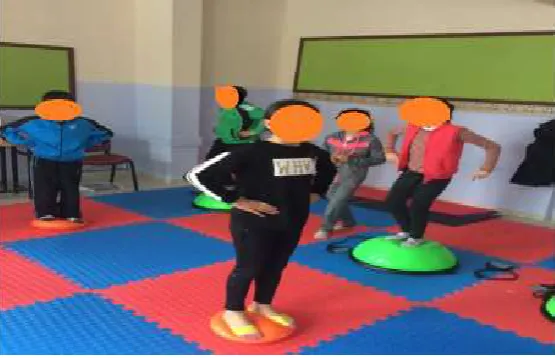
Balance disc and bosu group received same training programs for 40 minutes and three days a week total 8 weeks long. Trainings have implemented on the balance board by Verhagen’s (2004) program. Each training program consists of 4 stages. 1-Applications on the ground, 2- Applications on balance disc and bosu balls, 3- Ball exercises on balance disc and bosu ball 4- Exercises on both on ground and materials. Training level was determined by researcher according to condition of the children.
2.5. Bosu Ball
It was designed by David Weck (Joshi, Mahishale & Motimath, 2015) in 1999 as an alternative to traditional balance ball. It means “bilateral”. It has a flat side and a curved side in form of a half ball. It uses those who want to exercise cardio with the domed portion or to run lower extremities and center muscles. It can train upper extremity with flat side exercises like crunch spin. Bosu ball is an apparatus designed for balance training. Inflatable rubber is designed in a similar way to a Swiss ball with a solid plastic base integrated with an inner tube. It has property of providing an unstable surface on a fixed ground (Yaggie & Campbell, 2006).
2.6. Balance Disc
Balance disc is a rehabilitation apparatus designed to improve balance, strength and lower extremity control skills. It is especially useful for plates exercises and for the treatment of lower extremity injuries. It can help reducing possibility of re-injury after starting activity or sports. These discs are commonly used for proprioceptive exercises in physiotherapy clinical applications, especially after lower extremity injuries and following surgical procedures, in the later stages of rehabilitation. In addition, balance disc improves balance with standard balance exercises on balanced surfaces such as flat ground (Physioadvisor, 2017).
2.7. Data Analysis
Shapiro wilk test was used for parametric distributions (p> 0.05). Independent sample t test was used for pretest in groups with parametric distribution and mann withney u test was used in groups with parametric distribution. Two-way ANOVA was used in parametric distributions to look at the difference between pre-test and post-test results.
3. Results
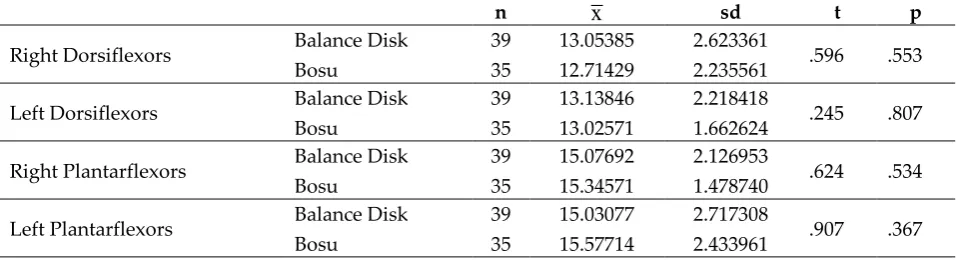
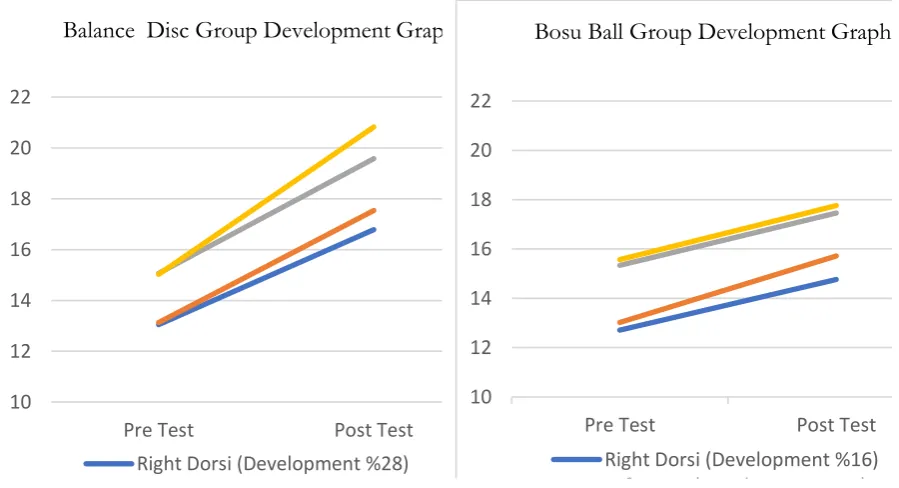
Independent sample t test analysis of the pre-test right-left ankle of the participants is given in Table 2, pre-test post-test two-way ANOVA results are shown in Table 3 and pre-test post-test average development graph is given in Graphic 1.
Table 2: Pre-Test Analysis of the Dorsiflexors and Plantarflexors Right-Left Foot of Groups
n x sd t p
Right Dorsiflexors Balance Disk 39 13.05385 2.623361 .596 .553
Bosu 35 12.71429 2.235561
Left Dorsiflexors Balance Disk 39 13.13846 2.218418 .245 .807
Bosu 35 13.02571 1.662624
Right Plantarflexors Balance Disk 39 15.07692 2.126953 .624 .534
Bosu 35 15.34571 1.478740
Left Plantarflexors Balance Disk 39 15.03077 2.717308 .907 .367
According to the table, there was no significant difference between group of preliminary tests left-right plantarflexors and right-left dorsiflexors strength at comparison of active video game duradisk group (p> .05).
Table 3: Two-way ANOVA Results of Groups Pre-Test Post-Test Results
Balance Disk Group Bosu Group
n x Pre Test xPost Test n xPre Test xPost Test p Right Dorsiflexors 39 13,05 16,79 35 12,71 14,76 ,027* Left Dorsiflexors 39 13,13 17,54 35 13,02 15,72 ,014* Right Plantarflexors 39 15,07 19,58 35 15,34 17,46 ,026* Left Plantarflexors 39 15,03 20,83 35 15,57 17,76 ,033* *p<0.05
There was a significant difference between the right-left foot plantarflexors and right left foot dorsiflexors pre-test and post-test scores (p <.05). Both groups showed improvement according to the pre-test but duradisk group showed more development than the bosu group.
Graphic 1: Groups Pre-Test Post-Test Development Graphs
10 12 14 16 18 20 22
Pre Test Post Test
Balance Disc Group Development Graph
Right Dorsi (Development %28) Left Dorsi (Development %33) Right Plantar (Development %29) Left Plantar (Development %38)
10 12 14 16 18 20 22
Pre Test Post Test
Bosu Ball Group Development Graph
Right Dorsi (Development %16) Left Dorsi (Development %20) Right Plantar (Development %14) Left Plantar (Development %14)
The graph shows pre-test and post-test development percentages of groups. When graph is examined, it is seen that the balance disc group has a slightly higher development percentage between pre-test and post-test compared to the bosu group.
4. Discussion
sedentary children. The findings of the study show that exercises with balance disc and bosu ball improve strength of ankle dorfislexor and plantarflexor muscle groups in sedentary children (p <.05). In the study, a significant difference was found between pre-test and post-test scores of the groups training with both balance disc and bosu ball (p <.05). In addition, a significant difference was found between two test groups in favor of the balance disc (p <.05). It can be said that training with balance disc and bosu ball significantly improves the ankle muscle strength of children. 8-week training with balance disc improved right foot dorsiflexor strength by 28%, left foot dorsiflexor strength by 33%, right foot dorsiflexor strength by 29% and left foot plantarflexor strength by 38%, 8-week training with bosu ball, right foot dorsiflexor 16%, left foot dorsiflexor force 20%, right foot dorsiflexor force 14% and left foot plantarflexor strength 14%.
When it is focused at bosu ball studies, it was found that rectus abdominis activities improve muscle strength for these muscle groups (Saeterbakken, 2014). In addition, a study on sprinters showed that the exercises with bosu ball had a positive effect on jump strength (Romero-Franco et al. 2012). In a study conducted on athletic children, it was found that force exercises with bosu balls improved vertical leap, standing long jump and 30 meters speed (Aysan, 2019). In addition, the aim of the study was to determine the electromyographic activity on tibialis anterior and tibialis posterior of trampoline, balance disc which provides a mobile surface with eyes open and closed, and showed a significant increase in muscle activity (Ferreira, Pereira, Rossi). Kerpers, Paula & Oliveira, 2011).
In another study, it was found that training with the 10-week ankle disc improves isokinetic pronator muscle strength (Tropp & Askling, 1988). In a study examining the effect of plyometric training on leg strength on unstable ground (bosu, tambolin) by wrestler athletes, it was reported that bosu ball and trampoline training had an effect on leg strength and vertical jump (Çağlayan, Kayhan, Kurt & Yüce, 2018). Granacher et al. (2014) in their research on adolescent children found that the physical training data on core (dyna disk) and immobile surface causes a significant increase in physical fitness data and compared with each other, mobile surface training showed a slight improvement compared to fixed surface. In another study, it was reported that trunk muscle activation increased by 47.3% when exercising on a mobile surface (Behm & Colado, 2012). When all these studies are examined, it is seen that the training on a moving surface improves muscle strength. Our findings are supported by these studies findings.
5. Conclusion and Suggestions
This result shows that exercises with balance disc and bosu ball increase development of dorsiflexor and plantarflexor muscle strength in sedentary children and that balance disc is more effective than bosu ball. The reason for this is that the balance disc is smaller than the bosu ball and causes more tension in the ankle, leaving these muscle groups under more stress. It may also be effective that the surface portion of the bosu ball is wider than the balance disc and moves relatively less.
Instead of a monotonous training method, diversified training should be performed using moving surfaces such as bosu ball and balance disc. In this context, training with both balance disc and bosu ball can be used as an alternative method to improve ankle dorsiflexor and plantarflexor muscle strength.
References
Acikada, C. (2004). Children and training. Acta Orthop Traumatol Turc, 38 (1), 16-26. Aysan, H. A. (2019). Investigation of the effect of bosuball strength training on some
parameters in 14 year old football playing children. Cross Section Academy Journal, 5 (18), 174-182.
Behm, D. G., Anderson, K., & Curnew, R. S. (2002). Muscle force and activation under stable and unstable conditions. The Journal of Strength & Conditioning Research, 16(3), 416-422.
Behm, D., & Colado, J. C. (2012). The effectiveness of resistance training using unstable surfaces and devices for rehabilitation. International journal of sports physical therapy, 7(2), 226.
Bompa, Tudor O., Haff, Gregory G. (2015). Training Theory and Method (T. Bağıran, Trans.). Ankara: Sports Publishing and Bookstore
Caglayan, A., Kayhan, R. F., Kurt, A., & Yuce, M. (2018). The effect of pliometric studies on unstable soils on bilateral leg balance and strength of wrestlers. Journal of International Social Research, 11 (59).
Dere, F., & Yucel, B. D. (1994). Functional anatomy for sports training. Schools Market Bookstores, 16-20.
Durmus, A. (2014). The Effect of Kangoo Jumps on Training Balance, Leg Strength and Shot Rate in Female Basketball Players. Master Thesis. Mersin University. Institute of Educational Sciences. Mersin.
Ferreira, L. A. B., Pereira, W. M., Rossi, L. P., Kerpers, I. I., de Paula Jr, A. R., & Oliveira, C. S. (2011). Analysis of electromyographic activity of ankle muscles on stable and unstable surfaces with eyes open and closed. Journal of bodywork and movement therapies, 15(4), 496-501.
physical fitness in adolescents: a randomized controlled trial. BMC sports science, medicine and rehabilitation, 6(1), 40.
Hekim, M., & Hekim, H. (2015). Strength Development in Children and Overview of Strength Training. Journal of Current Pediatrics, 13 (2).
Jerosch, J., & Schoppe, R. (2000). Midterm effects of ankle joint supports on sensomotor and sport-specific capabilities. Knee Surgery, Sports Traumatology, Arthroscopy, 8(4), 252-259
Joshi, N., Mahishale, A., & Motimath, B. (2015). Comparative study of 4 weeks of dynamic balance training program in collegiate football players: randomized clinical trial. Journal of evidence based medicine and health care, 2(10).
Kibele, A., & Behm, D. G. (2009). Seven weeks of instability and traditional resistance training effects on strength, balance and functional performance. The Journal of Strength & Conditioning Research, 23(9), 2443-2450.
Knight, C. A., Rutledge, C. R., Cox, M. E., Acosta, M., & Hall, S. J. (2001). Effect of superficial heat, deep heat, and active exercise warm-up on the extensibility of the plantar flexors. Physical Therapy, 81(6), 1206-1214.
Lafayette Manuel Muscle Test System: Accessed on 22 September 2017 at
http://lafayetteevaluation.com
Li, R. C., Jasiewicz, J. M., Middleton, J., Condie, P., Barriskill, A., Hebnes, H., & Purcell, B. (2006). The development, validity, and reliability of a manual muscle testing device with integrated limb position sensors. Archives of physical medicine and rehabilitation, 87(3), 411-417.
Murray, B., & Kenney, W. L. (2016). Practical guide to exercise physiology. Human Kinetics.
Oatis, C. A. (1988). Biomechanics of the foot and ankle under static conditions. Physical therapy, 68(12), 1815-1821.
Physioadvisor (2017). Dura Disc. Access address: Accessed on December 31, 2017 at
https://www.physioadvisor.com.au/shop/fitness-supplies/dura-disc-green/. Romero-Franco, N., Martínez-López, E., Lomas-Vega, R., Hita-Contreras, F., &
Martínez-Amat, A. (2012). Effects of proprioceptive training program on core stability and center of gravity control in sprinters. The Journal of Strength & Conditioning Research, 26(8), 2071-2077.
Saeterbakken, A. H., Andersen, V., Jansson, J., Kvellestad, A. C., & Fimland, M. S. (2014). Effects of BOSU ball (s) during sit-ups with body weight and added resistance on core muscle activation. The Journal of Strength & Conditioning Research, 28(12), 3515-3522.
Şeker, A., Talmaç, M. A., & Sarıkaya. (2014). Gait biomechanics. TOTBID Journal (13), 314-324
Taner, D., & Sancak, B. (1996). Functional anatomy extremities and back. Medical Association of Physicians. Ankara. s, 129-134.
Vera-Garcia, F. J., Grenier, S. G., & McGill, S. M. (2000). Abdominal muscle response during curl-ups on both stable and labile surfaces. Physical therapy, 80(6), 564-569. Verhagen, E., Van der Beek, A., Twisk, J., Bouter, L., Bahr, R., & Van Mechelen, W. (2004). The effect of a proprioceptive balance board training program for the prevention of ankle sprains: a prospective controlled trial. The American journal of sports medicine, 32(6), 1385-1393.
Weineck, J. (2007). Optimales Training. 15. Aufl., Balingen: Spitta.
Weineck, J. (2011). Sports Anatomy (S. Elmaci, Trans.). Ankara: Sports Publishing and Bookstore.
Creative Commons licensing terms