JPRHC
Research Article
FORMULATION DEVELOPMENT AND IN-VITRO EVALUATION OF SUSTAINED RELEASE MATRIX TABLETS OF SALBUTAMOL SULPHATE.
AMITAVA GHOSH*, KOUSHIK SEN GUPTA
For author affiliations, see end of text
This paper is available online at www.jprhc.in
ABSTRACT:
The objective of the present study was to develop salbutamol sulphate matrix tablets, sustained release dosage form, for the treatment of Chronic Obstructive Pulmonary Disease (COPD). Simultaneous equations were formed to calculate the concentration values of Salbutamol sulphate and drug compatibility study was performed through Infrared spectroscopy. The matrix tablets were prepared by wet granulation method using two hydrophobic polymers such as Ethyl cellulose and Acrycoat S-100 in varying ratios. The granules exhibited satisfactory rheological demeanor. All the seven tablet formulations showed acceptable pharmacotechnical properties and complied with the in-house specifications for tested parameters.
The results of formulation F-4 (Ethyl cellulose and Acrycoat in 2:1 ratio) could extend the release of Salbutamol sulphate up to 12 hr and was found comparable to marketed sustained release products. Model fitting analysis (Zero order, Higuchi and Korsmeyer-Peppas model) for all the formulations were performed and it was seen that all the formulations predominantly follow the Higuchi model. While comparing with the ‘n’ values of all the formulations of Korsmeyer-Peppas model, Fickian/Diffusion controlled release was observed in case of F-4 and F-5, whereas for the other formulations non-Fickian transport was observed.
KEYWORDS: Salbutamol sulphate, matrix tablet,
Ethyl cellulose, Acrycoat, Higuchi model, Fickian/Diffusion, Korsmeyer-Peppas model.
INTRODUCTION:
The objective in dosage form design is to optimize the delivery of medication so as to achieve a measure of control of therapeutic effect in the face of uncertain fluctuations in-vivo environment in which drug release takes place (1).
Sustained release dosage forms are designed to complement the pharmaceutical activity of the medicament in order to achieve better selectivity and longer duration of action. Sustained release preparations are helpful to reduce the dosage frequency and side effects of drugs and improve patient’s convenience (2)
.
The drug release time can be prolonged according to one of the following mechanisms-
1. Changing the physical properties such as- solubility and stability of the drug molecules,
2. Forming a complex of drug molecules with ion exchange resins,
3. Incorporating drug molecules in slowly disintegrating or inert porous matrices, 4. Coating drug molecules with pharmaceutical
polymers that have a barrier function for the diffusion of drug molecules,
5. Use of osmotic pumps (3).
Sustained release matrix tablet is relatively easy to fabricate by incorporating drug molecules in slowly disintegrating or inert porous materials (2). Drug release occurs either by diffusion through the matrix
or by erosion of the matrix or by a combination of both diffusion and erosion (4).
Salbutamol sulphate (SS), a short acting highly selective beta 2 adrenoceptor agonist with bronchodilating property is widely used for the management of Chronic Obstructive Pulmonary Disease (COPD) which includes bronchial asthma, chronic bronchitis and emphysema (5). SS is almost completely absorbed from the gastrointestinal tract after oral administration. The reported plasma half-life of SS is 2.85±0.85 and the peak plasma concentration occurs about 30 minutes after an oral dose. The protein binding affinity of SS 7±1% and undergoes considerable first pass metabolism. The drug as sulphate is soluble in 1 to 4 of water, due to the
hydrophilic nature it is readily excreted through urine
(6-9)
. These bio-pharmaceutical and physicochemical properties provide the rationality behind the fabrication of SS as a controlled release dosage form.
SS being basic in nature shows maximum absorption in the intestine. The main objective of this
INGREDIENTS (mg/tablet)
F-1 (1:1)
F-2 (1:2)
F-3 (1:3)
F-4 (2:1)
F-5 (2:3)
F-6 (3:1)
F-7 (3:2)
Salbutamol Sulphate EC Acrycoat S-100
Lactose Talc Magnesium Stearate
12 25 25 35 2 1
12 17 33 35 2 1
12 13 37 35 2 1
12 33 17 35 2 1
12 20 30 35 2 1
12 37 13 35 2 1
JPRHC
Research Article
work is to deliver the drug as much as possible in intact form into the intestine as SS is highly susceptible to first pass degradation. Keeping in view the hydrophilic character of SS, two hydrophobic polymers (Ethyl cellulose and Acrycoat S-100) in different ratios are used in this present work as matrix forming agent to protect the drug from hepatic metabolism.
Present study concerns with the preparation of SS matrix tablet for prolong drug release leading to minimization of incidences of nocturnal and early morning asthmatic attacks, better patient convenience and a pharmacoeconomic novel drug delivery system, for effective treatment for of COPD.
Aim:
Salbutamol sulphate conventional release tablets are administered 2 to 4 mg three to four times daily and their duration of action are last for 4 to 6 hours (9). So the aim of this work was to design, formulate and develop a novel oral monolithic controlled release tablet dosage form that may be toiled to provide quasi steady state drug release over an extended period of time (10).
Materials & Methods:
Materials:
Salbutamol sulphate was obtained as a gift sample from INGA Laboratories P. Ltd., Mumbai. Acrycoat S-100 and Ethyl cellulose (EC) were gift samples received from COREL PHARMA-CHEM, Gujrat. And S.D. Fine- Chem. Limited, Mumbai, respectively. All other chemicals and reagents used were obtained from commercial sources and were of analytical grade.
Methods (2):
Compatibility study:
IR spectra of pure drug, drug and polymers and the formulations were obtained using IR spectrophotometer (FTIR – 8400S, SHIMADZU) to establish the compatibility of ingredients.
Preparation of Matrix Tablet of Salbutamol Sulphate:
Different tablet formulations were prepared by wet granulation technique. The compositions of each batch of tablet formulation were shown in the following Table.
All the powders were passed through USP 100 mesh sieve. Required quantity of drugs, polymers and diluents were mixed thoroughly and a sufficient quantity of binding agent (0.1% w/v of respective polymers in Isopropyl alcohol) was added slowly to
20/35 mesh and dried at 600C for 1hr. the dried granules retained on 35 mesh were mixed with 10% fines, 2% Talc and 1% Magnesium Stearate. Tablets were compressed using 6 mm round concave punches to get the tablets having the hardness between 5 to 7 kg/ cm2.
EVALUATION OF GRANULES (11):
1. Measurement of Angle of Repose:
Angle of repose was determined by funnel method. The blend was poured through a funnel that can be raised vertically until a maximum cone height (h) was obtained. Radius of the heap (r) was measured and the angle of repose (θ) was calculated by using the formula:
θ= tan -1 (h / r)
This was done thrice, from that average angle of repose and standard deviation was calculated.
2. Bulk Density:
Apparent bulk density (ρb) was measured by
pouring the pre-weighed (M) blend into a graduated cylinder. The bulk volume (Vb) of the blend was
determined. Then the bulk density was calculated by using the formula:
ρb = M / Vb
This was done thrice, from that average bulk density and standard deviation was calculated.
3. Tapped Density:
The measuring cylinder containing a known mass (M) of blend was tapped for a fixed time, and the minimum volume (Vt) occupied in the cylinder was measured. The tapped density ρt was calculated by using the following formula:
ρt = M / Vt
This was done thrice, from that average tapped density and standard deviation was calculated.
EVALUATION OF THE FORMULATIONS (1,12) :
The tablets were evaluated for Appearance, Weight variation, Thickness, Diameter, Hardness, and Friability to meet the Pharmacopoeial standards.
1. Determination of Weight Variation of the tablets:
Twenty tablets were selected at random from each batch and were weighed accurately and average weights were calculated. Then the deviations of individual weights from the average weight and the standard deviation were calculated.
2. Determination of Thickness and Diameter of
the tablets:
JPRHC
Research Article
3. Determination of Hardness of the tablets:
Five tablets were sampled randomly from each batch and the hardness was determined by using Monsanto Hardness Tester. Then average hardness and standard deviation was calculated.
4. Determination of Friability of the tablets:
Twenty tablets were sampled randomly from each batch and the friability was determined using Roche type Friabilator. A pre-weighed tablet sample was placed in Friabilator which was then operated for 100 revolutions (25 rpm). The tablets were then dusted and reweighed. Then percentage friability was calculated.
5. Determination of Drug Content Uniformity:
Three tablets were selected randomly from each batch and taken separately into three 100 ml volumetric flasks. In each flask 100 ml of Phosphate buffer pH 6.8 was poured and kept for 24 hrs. After filtering the solutions, the absorbance of the filtrate was measured at 225 nm. From these absorbances, drug content was determined and average and standard deviation was calculated.
6. Determination of Mass Degree of Swelling (2) :
Each tablet from all formulations were pre-weighed and allowed to equilibrate with 100 ml of
water for 5 hrs. Then the tablet was removed, blotted using tissue paper and weighed. The Mass Degree of Swelling was then calculated by using the following formula-
Q = Mass of swelling gel / Mass of dry the powder
Where,
Q = Mass Degree of Swelling
7.In-vitro Dissolution Studies of the tablets:
In-vitro drug release studies were carried out using tablet dissolution test apparatus USP Type-I (Paddle Type) at 100 rpm. The dissolution medium consisted of 900 ml of Phosphate buffer pH 6.8 and dissolution carried out for 12 hrs. maintaining the temperature at 370C ± 10C. Aliquots of 5 ml were withdrawn at 30 minutes intervals and an equivalent amount of fresh dissolution media equilibrated at the same temperature was replaced. These aliquots were filtered and the absorbance of the filtrate was measured in each case at about 275 nm against fresh pH 6.8 Phosphate buffer solutions as blank. Finally the Cumulative percentage of drug release was calculated.
In-vitro dissolution studies were also carried out with the marketed sustained release products (ASTHALIN SA-8mg and VENTORLIN 8mg).
RESULTS:
TABLE - I. Evaluation of Granules:
Batch Code
Angle of Repose (θ) Bulk Density (ρb)
(g/cm3) Tapped Density (ρt
) (g/cm3)
F – 1 F – 2 F – 3 F – 4 F – 5 F – 6 F – 7
28.2761 ± 0.6635 26.8946 ± 1.4113 27.3089 ± 1.4164 25.1293 ± 1.6721 27.8269 ± 1.6296 26.3839 ± 1.3576 26.2352 ± 0.9686
0.3282 ± 0.0318 0.3002 ± 0.0106 0.3158 ± 0.0398 0.3264 ± 0.0120 0.2845 ± 0.0253 0.3072 ± 0.0226 0.3009 ± 0.0200
0.4524 ± 0.0825 0.3861 ± 0.0298 0.4139 ± 0.0758 0.4186 ± 0.0349 0.3690 ± 0.0429 0.3987 ± 0.0502 0.3861 ± 0.0298
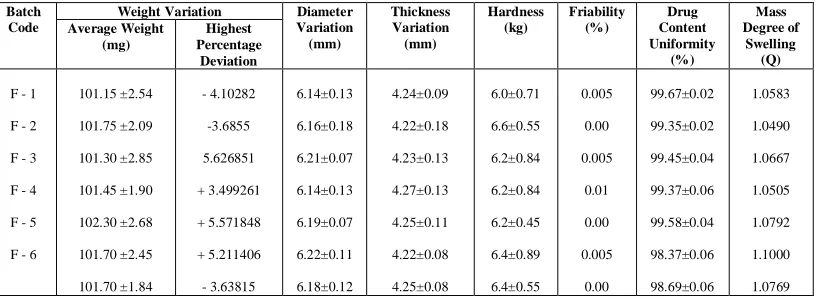
TABLE - II. PHYSICO-CHEMICAL CHARACTERISTICS OF PREPARED TABLETS
Batch Code
Weight Variation Diameter
Variation (mm)
Thickness Variation (mm)
Hardness (kg)
Friability (%)
Drug Content Uniformity
(%)
Mass Degree of
Swelling (Q) Average Weight
(mg)
Highest Percentage
Deviation
F - 1 F - 2 F - 3 F - 4 F - 5 F - 6
101.15 ±2.54 101.75 ±2.09 101.30 ±2.85 101.45 ±1.90 102.30 ±2.68 101.70 ±2.45 101.70 ±1.84
- 4.10282 -3.6855 5.626851 + 3.499261 + 5.571848 + 5.211406 - 3.63815
6.14±0.13 6.16±0.18 6.21±0.07 6.14±0.13 6.19±0.07 6.22±0.11 6.18±0.12
4.24±0.09 4.22±0.18 4.23±0.13 4.27±0.13 4.25±0.11 4.22±0.08 4.25±0.08
6.0±0.71 6.6±0.55 6.2±0.84 6.2±0.84 6.2±0.45 6.4±0.89 6.4±0.55
0.005 0.00 0.005 0.01 0.00 0.005 0.00
99.67±0.02 99.35±0.02 99.45±0.04 99.37±0.06 99.58±0.04 98.37±0.06 98.69±0.06
JPRHC
Research Article
TABLE-III. In-vitro Dissolution Profile of Formulations (1-7) and Marketed Brands:
Batch Code
Zero Order Higuchi Korsmeyer-Peppas t50
(hr) t77 (hr)
X60 (mg)
R2 K
0 R2 KH n K R2
F – 1 F – 2 F – 3 F – 4 F – 5 F – 6 F – 7 ASTHAL IN-SA VENTOR LIN 0.8548 0.8642 0.8519 0.8724 0.8479 0.8548 0.8683 0.9507 0.9373 7.0681 7.1888 6.7017 7.3681 7.2591 6.9925 7.1372 7.5532 7.4393 0.9693 0.9739 0.9647 0.9783 0.9714 0.9699 0.9713 0.9771 0.9725 30.0865 30.2940 28.1130 31.8546 30.6192 29.5619 30.0583 30.5910 30.2510 0.6643 0.6572 0.5758 0.5021 0.4503 0.6634 0.6240 0.4978 0.4669 1.2535 1.5713 1.9449 1.5196 4.4182 1.2469 1.2932 1.4643 1.500 0.9904 0.9932 0.9842 0.9948 0.9932 0.9860 0.9901 0.9956 0.9945 2.5 3.0 2.5 2.5 3.0 2.5 3.0 4.0 3.5 5.5 5.5 5.5 6.0 5.0 5.5 5.5 7.0 6.5 32.5149 32.0090 32.4507 32.8142 31.9739 32.3314 32.4315 30.1446 32.9453 0 20 40 60 80 100 120
0 2 4 6 8 10 12 14
Time (hr) C u m u la ti v e Pe r c e n t D r u g R e le a s e
F - 1 F - 2 F - 3 F - 4 F - 5 F - 6 F - 7
Figure II.Release Profile of Salbutamol Sulphate
from Formulation F-1 to F-7.
0 20 40 60 80 100 120
0 0.5 1 1.5 2 2.5 3 3.5 4
Square Root Time (hr)
A m o u n t o f D r u g R e le a s e
F - 1 F - 2 F - 3 F - 4 F - 5 F - 6 F- 7
Figure III. Release Profile of Salbutamol
Sulphate from Formulation F-1 to F-7
. 0 20 40 60 80 100 120
0 2 4 6 8 10 12 14
Time (hr) C um ul a ti v e P e r c e nt D r ug R e le a s e
F - 4 ASTHALIN-SA 8mg VENTORLIN 8mg
Figure IV.Release Profile of Formulation F-4 and Two Marketed Brand.
0 20 40 60 80 100 120
0 0.5 1 1.5 2 2.5 3 3.5 4
Square Root of Time (hr)
A m ou nt of D r ug R e le a s e
F - 4 ASTHALIN-SA 8mg VENTORLIN 8mg
Figure V. Release Profile of Formulation
F-4 and Two Marketed Brand.
DISCUSSION:
The present investigation was undertaken to design, formulate and evaluate Salbutamol sulphate
JPRHC
Research Article
evaluated for Angle of repose, Bulk density and Tapped density. The granules indicated good flowability with an angle of repose values ranging from 25-280. The result of bulk density and tapped density are mentioned in Table-I and the results were within the limit.
All tablet formulations were subjected to various evaluation parameters and the results obtained were within the range. The weight variation test indicates that all the tablets were uniform with low standard deviation values. The tablet mean diameter and mean thickness values ranged from 6.14±0.13 to 6.21±0.07 mm and 4.22±0.08 to 4.27±0.13 mm, respectively. The hardness of all the tablets was within a range of 6.0±0.71 to 6.6±0.55 kg/cm2. The loss in total weight in friability test was in a range of 0.00 to 0.01%. The percentage drug content for different tablet formulations varied from 98.37±0.06 to 99.67±0.02% was found to be within the limit. The mass degree of swelling was found to be the
maximum for F–6, indicating high swelling which helps in retarding the drug release from the formulation.F–4 containing EC and Acrycoat S-100 (2:1 ratio) was selected as the optimum formulation on the basis of the results of in-vitro dissolution studies. It is seen that at the end of 12 hr, 98.62% drug was released from the formulation, whereas the two marketed sustained release products (ASTHALIN-SA 8mg and VENTORLIN 8mg) released 99.23% and 99.44% respectively at the end of 12 hr, which is comparable to the fabricated formulation F-4.
Upon model fitting analysis (Zero order, Higuchi and Korsmeyer-Peppas model), it is seen that all the formulations predominantly follow Higuchi model as the R2 values are near to unity.As compared to the ‘n’ value, obtained from the Korsmeyer-Peppas model, Fickian/Diffusion controlled drug release is observed from F-4 and F-5 whereas for the other formulations non-Fickian transport are observed.
CONCLUSION:
From the above results it can be concluded that formulation F-4 has achieved the objectives of prolonged drug release, patient convenience and cost
effectiveness as a sustained release dosage form and appears to be assessed further by conducting bioavailability studies in human volunteers and long term stability testing.
REFERENCES:
1) Banker GS, Anderson NR. Tablets. In: Lachman L, Lieberman HA, Kanig JL, editors. The Theory and Practice of Industrial Pharmacy. 3rd ed. Bombay: Varghese Publishing House; 1991. p. 295-303.
2) Dandagi PM, Mastiholimath VS, Patil MB, Manvi FV, Gadad AP, Sharma R. Development and Evaluation of Theophylline and Salbutamol Sulphate Sustained Release Matrix Tablets. Indian J Pharm Sci 2005;67(5) :598-602.
3) Takada K, Yoshikawa H. Oral Drug Delivery, Traditional. In: Mathiowitz E, editor. Encyclopedia of Controlled Drug Delivery. New York: John Wiley & Sons, Inc; 1952. p. 428-442.
4) Kondaiah A, Prakash K. Design of Controlled Release Non-erodible Polymeric Matrix Tablets of Theophylline Using Sintering Technique. Indian J Pharm Sci 2002;64(3) :239-243.
5) Barar FSK. In: Essentials of Pharmacotherapeutics. 3rd ed. New Delhi: S. Chand & Company Ltd; 2000. p. 544-559.
6) Torphy TJ, Hay DWP. Drugs Used in Asthma. In: Craig CR, Stitzel RE, editors. Modern Pharmacology with Clinical Applications. 5th ed. New York: Little, Brown and Company; 1997. p. 491-501.
7) Undem BJ, Lichtenstein LM. Drugs used in the Treatment of Asthma. In: Hardman JG, Limbird LE, Gilman AG, editors. Goodman & Gilman’s The Pharmacological Basis of Therapeutics. 10th ed. New York: McGraw-Hill Medical Publishing Division; 2001. p. 733-754.
8) Flanagan RJ. Some Drug/Poison Concentrations and Mass/Amount Concentration Factors. In: Dart RC, editor. Medical Toxicology. 3rd ed. Philadelphia: Lippincott Williams and Wilkins; 2004. p. 1796-1814.
JPRHC
Research Article
10) Pillay V and Fassihi R. Monolithic tablet for controlled drug release. U.S. Patent Apple; 09/037, 1998, 096.
11) Indian Pharmacopoeia, vol. II, Government of India, The Controller of Publication; New Delhi, 1996. p. 734-736.
12) Wells J. Pharmaceutical Preformulation: The Physicochemical Properties of Drug Substances. In: Aulton ME, editor.
Pharmaceutics The Science of Dosage Form Design. 2nd ed. Edinburgh: Churchill Livingstone; 2003. p. 113-138.
FOR AUTHORS AFFILIATIONS AND ADDRESS FOR CORRESPONDENCE:
Department of Pharmaceutics
Himalayan Pharmacy Institute, Majhitar, East Sikkim, India -737136.